Sunday, May 24, 2026


Pentagon doubts over rare earths deal provoke White House clash

The North Portico of the White House in Washington, DC. Stock image.

The Pentagon is weighing whether to scrap an $80 million conditional loan offer to rare earths refiner ReElement Technologies Corp., touching off a clash with the White House over an agreement that was meant to help break China’s chokehold on critical minerals.

The Pentagon’s Office of Strategic Capital announced the agreement with ReElement in November. Since then, officials vetting the company have raised doubts about its ability to scale its technology, as well as its long-term revenue forecasts, according to people familiar with the process.

The ReElement deal hasn’t been canceled and may still go ahead, according to the people, who asked not to be identified discussing matters that aren’t public. At the time the agreement was announced, the Pentagon made clear that ReElement still needed to undergo due diligence before getting any money. The Pentagon hasn’t disbursed the loan yet, according to one of the people.

The deal, part of a bigger $1.4 billion critical minerals agreement that also included Vulcan Elements Inc., was heralded as part of the Trump administration’s multibillion-dollar drive to develop domestic production of rare earth elements. They are used in products from microwave ovens to missiles and have become a key source of Chinese leverage in trade talks with the US.

The administration has employed a variety of financial tools in the effort including offering loans and taking equity stakes and warrants to buy stock in many of the companies involved. It’s emphasized the need to move fast and make big bets given the severity of the problem.

The desire to act quickly and conduct rigorous vetting has spurred tension with the White House.

Shortly after Bloomberg News contacted ReElement for comment, Peter Navarro, the White House senior counselor for trade and manufacturing, reached out independently to Bloomberg to criticize the Pentagon’s handling of the deal.

“The due diligence cops within OSC with a private equity background have no experience how to manage a crisis at warp speed,” Navarro said, referring to the Pentagon’s Office of Strategic Capital.

“Their over-burdensome due diligence disproportionately penalizes small innovative emerging companies,” he said. “ReElement represents exactly the kind of asymmetric bet we should be making.”

Pentagon spokesman Sean Parnell called the team overseeing the agreements “the finest private equity dealmakers in the world, professionals whose unmatched expertise and qualifications stand second to none.”

The Office of Strategic Capital “expertly balances lightning speed with rigorous diligence to close high-impact deals that directly strengthen America’s defense and empower our warfighters,” Parnell said. The critical-minerals effort is being overseen by Deputy Defense Secretary Stephen Feinberg, the private equity billionaire who co-founded Cerberus Capital Management.

A White House official, speaking on condition of anonymity, said the administration is working together — as well as with private industry — on the matter. The official praised ReElement as one of many great emerging companies working with the government.

Mark Jensen, ReElement’s chief executive officer, declined to address questions about the loan but said the company is proud to partner with the government. He said the company is going ahead with a facility in Indiana to refine critical minerals and produce rare earths oxides.

“From ReElement’s perspective, we confirm that our work with the US government is ongoing,” Jensen said. “Nobody else in the country can or has produced the products we produce today at ReElement which are needed for defense, commercial and the energy transition.”

When the Pentagon announced the deal, it said it would get warrants in Vulcan and ReElement.
But it also cautioned that the loan agreement specified steps Vulcan and ReElement must take to fulfill “financial, legal, technical, and other due diligence requirements.”

It was unclear if the Pentagon ever received warrants for ReElement or Vulcan. ReElement didn’t respond to inquiries about the warrants. Vulcan didn’t respond to a request for comment.

According to the agreement, ReElement was to produce high-purity rare earth oxides from electronic waste and end-of-life magnets. Vulcan would then manufacture new magnets from those oxides. The Pentagon earlier said the companies anticipated producing up to 10,000 metric tons of magnet materials in the next several years.

It’s unclear if Vulcan will need to find a new supplier of the oxides if ReElement doesn’t get the loan. Two of the people familiar with the matter said pulling funds from ReElement wouldn’t affect Vulcan’s deal.

Even with the caution about due diligence, the government’s plan amounted to an early vote of confidence in ReElement, which has yet to produce oxides at scale. At a critical minerals summit in February, the State Department touted how the deal had “crowded in” an additional $200 million in private funding for ReElement.

That appeared to be a reference to ReElement having secured $200 million in strategic equity from Transition Equity Partners, an agreement announced in January. Transition Equity cited ReElement’s “collaboration” with the government. TEP didn’t respond to a request for comment.

While the Pentagon has only announced a small number of deals aimed at locking down critical supply chains, the potential ReElement loan is among hundreds of tie-ups the agency is currently considering, according to one of the people familiar with the matter.

In September, the Pentagon’s industrial buildout program, known as IBAS, made a two-year $2 million investment in ReElement.

ReElement was until last year a subsidiary of Nasdaq-listed American Resources Corp. It described ReElement in an October 2025 filing as being in a “pre-revenue development stage.”

(By Joe Deaux and Kate O’Keeffe)


 AML awarded $2M US defense contract for domestic heavy magnets
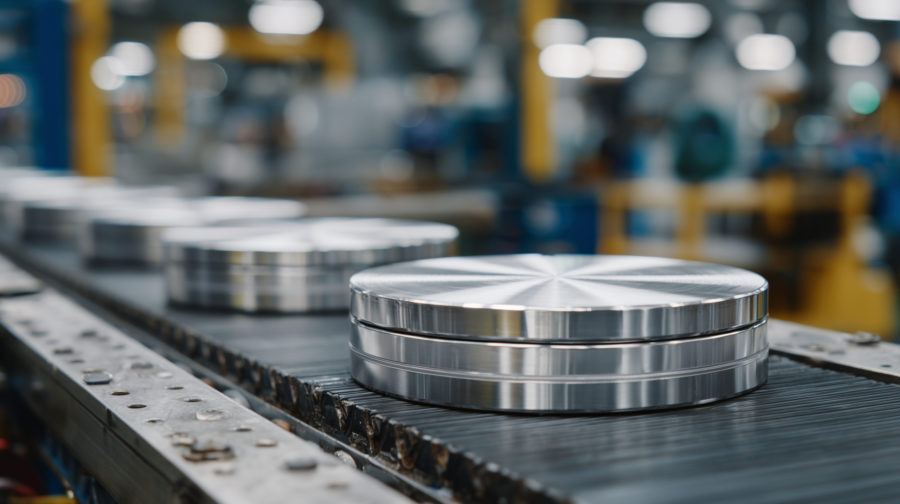
Samarium-cobalt magnets. Stock image.

Advanced Magnet Lab (AML) has been awarded a $2 million Defense Logistics Agency (DLA) contract for the qualification of domestically made high-grade sintered NdFeB (neodymium-iron-boron) magnets.

The Florida-based, privately held company said it will use the funds to develop manufacturing solutions for domestic production and qualification of sintered permanent magnets for defense and commercial industries — with plans underway to rapidly scale manufacturing across end-use applications.

AML said it has longstanding work with US government agencies, including the Department of War and Department of Energy, for permanent magnet-based solutions and manufacturing.

The award is facilitated by a two-year contract with the DLA for supply chain management, alloying, and permanent magnet manufacturing, including alloy composition optimization for NdFeB magnet grades such as N48SH and N35EH by implementing advanced manufacturing techniques.

AML said its novel manufacturing process, PM-Wire, simplifies the production of permanent magnets, while expanding the possibilities for magnet design, materials, and performance characteristics, the company said, adding that the process is built for rapid industrialization within an existing magnet making framework.

In addition to sintered NdFeB permanent magnets, the company is developing permanent magnets with other magnet materials and alloys, including samarium iron nitride (SmFeN), manganese bismuth (MnBi), anisotropic NdFeB and (Mischmetal-Nd) FeB.

AML said its approach with (Mischmetal-Nd) FeB allows for permanent magnets with less critical rare earth elements and clear traceability of inputs for end-use customers.

The company is currently collaborating with a group of US and European rare earth suppliers and innovators, including Phoenix Tailings, a Massachusetts-based rare earth metals producer, Ionic Rare Earths, a miner, refiner and recycler of traceable magnet and heavy rare earths, and Momentum, a Dallas, Texas-based critical minerals processing company.

“We are at a true turning point for the US rare earth magnet industry, and AML is immensely proud to be partnering with the US government, the defense industry and supply chain partners to meet the problem head-on,” AML president Wade Senti said in a news release.


BHP urged to assess rare earths at Olympic Dam
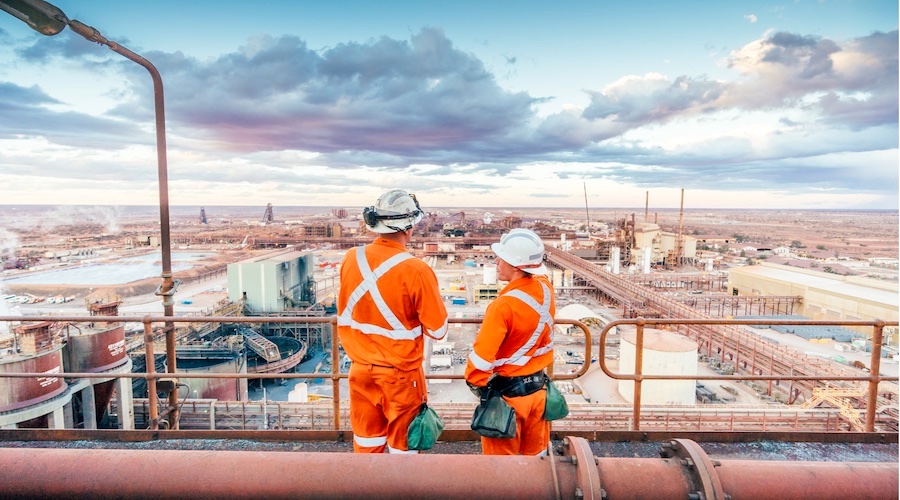

South Australia’s Olympic Dam copper, gold, uranium mine. (Image courtesy of BHP.)

BHP (ASX: BHP) must assess whether rare earths and other critical minerals at its Olympic Dam mine complex can be commercially produced under a new agreement with South Australia signed this week.

The pact is part of a broader plan aimed at unlocking as much as $16.7 billion in investment in the state’s copper sector.

South Australia Premier Peter Malinauskas on Tuesday tabled a revised 78-page “indenture agreement” in parliament, marking the first overhaul in nine years of the legislative regime governing the Olympic Dam copper, gold and uranium operation.

The revised framework adds new obligations requiring BHP to study the recovery of minerals deemed critical or strategic by Canberra, including rare earth elements such as neodymium and praseodymium used in magnets for electric vehicles and wind turbines.

The world’s largest miner must submit a report within two years outlining whether those minerals can be commercially extracted. If they are judged technically or economically unviable, BHP must allow third parties an opportunity to commercialize them.

The updated arrangement also clears the way for BHP to consider a $4 billion expansion of the Olympic Dam copper refinery near Roxby Downs, with additional investment decisions worth as much as $12.7 billion by 2032 for mine and concentrator expansions across the state.

“This milestone agreement enables South Australia to deliver on the promise of a world-class copper province,” South Australian Infrastructure and Energy Minister Tom Koutsantonis said. “The pathway to a net zero future requires copper, and South Australia can play a transformative role as a major supplier to a world that is desperate for strategic and critical minerals.”

Olympic Dam, primarily a copper operation, also produces gold, silver and uranium as byproducts. The orebody contains another 131 minerals, including rare earth elements, that are currently discarded in waste streams because of their low concentrations. 

Interest in those materials has surged as governments in Australia and the US intervene to support critical minerals supply chains and reduce reliance on China.

Doubling down on copper

BHP is considering doubling copper output in South Australia to 650,000 tonnes annually by the mid-2030s. Olympic Dam has consistently produced more than 300,000 tonnes of copper a year over the past three years and it’s considered central to BHP’s long-term growth strategy and Australia’s ambitions to remain a leading copper supplier for the low-carbon transition.

“We commend the South Australian Government for its leadership in making this indenture update happen, as well as for its strong long-term support for the mining industry,” BHP CEO Mike Henry said. “More efficient approval pathways and stable regulatory settings give us the confidence to invest and continue building South Australia’s world class copper province.”

Copper SA, BHP’s South Australian division, operates Olympic Dam alongside the Prominent Hill and Carrapateena mines, acquired through its A$9.6 billion takeover of OZ Minerals in 2023

Exploration at Oak Dam could eventually support a fourth operation in the province. Combined with Escondida in Chile, BHP controls the world’s largest known copper resources.

The company produced more than two million tonnes of the metal in fiscal 2025, up 28% over three years, and expects output of 1.9 million to 2 million tonnes in fiscal 2026. 

BHP has repeatedly floated and shelved Olympic Dam expansion plans over the past 15 years as costs, market conditions and technical challenges shifted.

The revised pact also addresses long-running concerns over water use. BHP must submit a plan by May 2031 detailing how it will end groundwater extraction from the Great Artesian Basin by May 2036. 

The miner and the South Australian government are jointly advancing a seawater desalination project near Port Augusta to support plans to expand copper production over the next decade.

Arafura Rare Earths plans $250M share sale backed by Gina Rinehart
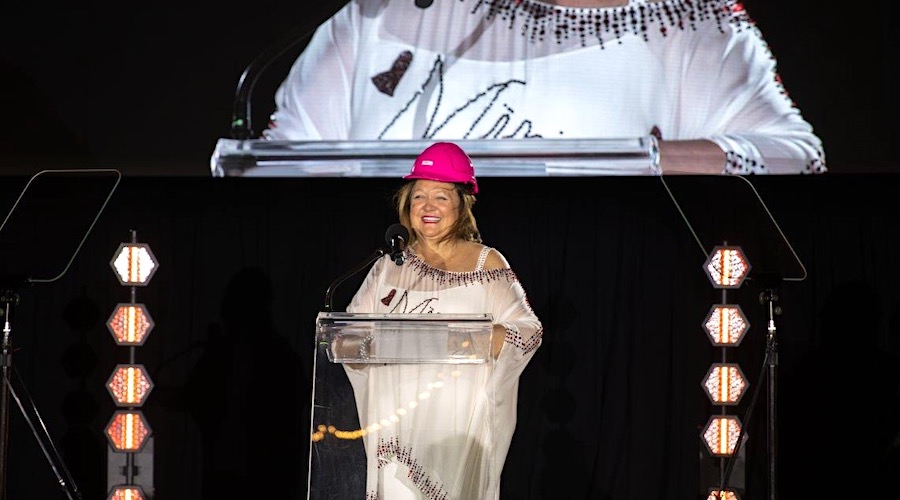
Gina Rinehart, executive chairman of Hancock Prospecting. (Image courtesy of Gina Rinehart.)

Australia’s Arafura Rare Earths said on Friday it plans to raise about A$350 million ($249.83 million) in a share placement backed by Gina Rinehart’s Hancock Prospecting to help fund its Nolans project.

The share placement plan comes a day after the miner approved the development of its $1.6 billion project in the Northern Territory, set to be Australia’s third-biggest rare earths operation by decade-end.

Arafura will issue shares worth about A$175.5 million at A$0.260 apiece in the initial tranche, representing a 16.1% discount to the stock’s last close on Thursday. A second tranche worth A$174.5 million is subject to shareholder approval.

“It’s a real positive and shows how serious investors and governments are about derisking global supply chains from Chinese control of rare earths,” said David Tuckwell, CIO at ETF Shares.

“The discount is effectively the cost of securing significant capital quickly with execution certainty.”

Hancock Prospecting, owned by Australia’s richest person Gina Rinehart and also Arafura’s largest shareholder, has committed to investing about A$85 million in the raising.

Upon completion of the fundraising, Hancock’s stake in Arafura will rise to roughly 17.5% from 15.5% at present.

Arafura said proceeds from the placement will fully fund the equity component required to develop the Nolans project.

The miner has secured financing commitments from export credit agencies in the United States, Canada, Germany and South Korea, among others, amid efforts by Western countries to diversify away from China.

The swift and seamless capital raise signals broad market confidence and marks a rare instance of the stock exchange minting a new mid‑tier miner, Tuckwell said, expecting the project to become one of the few large-scale rare earths operations outside China.

Arafura has now secured about 93% of its binding offtake target for neodymium-praseodymium (NdPr) oxide from the project, following recent supply agreements and support from export credit agencies.

Shares of the firm were on a trading halt.

($1 = 1.4010 Australian dollars)

(By Rajasik Mukherjee, Kumar Tanishk and Jasmeen Ara Islam Shaikh; Editing by Subhranshu Sahu)


Arafura approves $1.6 billion rare earth project
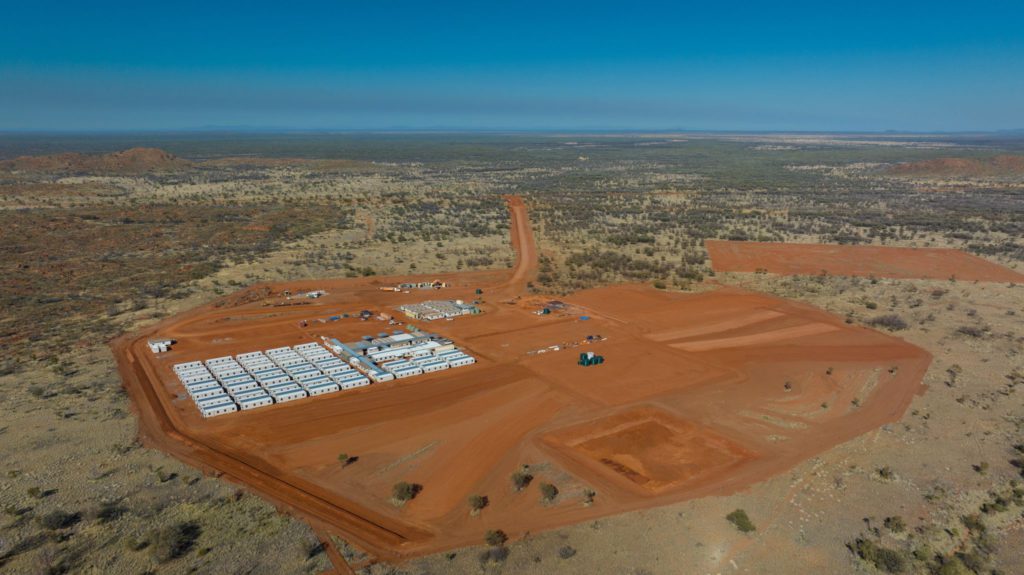
Aerial view of Nolans project in Australia. Credit: Arafura Rare Earths Limited | LinkedIn

Arafura Rare Earths said on Thursday it had approved the development of its $1.6 billion Nolans project in Australia’s Northern Territory, which is set to be the country’s third-biggest rare earths operation by the end of the decade.

The project is designed to deliver 4,440 metric tons of neodymium-praseodymium (NdPr) oxide annually, targeting markets outside China amid growing demand for rare earths used in electric vehicles and wind turbines.

Arafura secured financing commitments from the export credit agencies of the United States, Canada, Germany and South Korea, alongside global trading houses and manufacturers as Western countries step up efforts to diversify away from dominant rare earths producer China.

Arafura will supply South Korean automakers Hyundai and Kia, Germany’s Siemens Gamesa RE, and commodity trader Traxys’ Luxembourg and US units.

Shares of Arafura rose as much as 13.6% to A$0.335 in their biggest intraday gain since March 11. The benchmark stock index was up 1.5%, as of 04:40 GMT.

Construction on the project, which has been in the making since the deposit was discovered three decades ago, will begin in September, with first production expected from mid-2029.

Arafura secured a $1.6 billion funding package including a significant buffer and is backed by Australia’s richest person, Gina Rinehart, whose Hancock Prospecting owns a 15.5% stake.

Raising global supply

Arafura will become Australia’s third-biggest rare earths producer after Lynas Rare Earths, the world’s largest producer outside China, which produced 6,600 metric tons of NdPr in the last financial year, and Iluka, which has 5,500 tons of NdPr capacity and is expected to start production next year.

Australia is pushing to be the top supplier of rare earths to its allies, and Arafura is slated to supply 500 tons of NdPr to the country’s strategic minerals reserve, which is set to be up and running by year-end.

The project itself is set to meet as much as 5% of world demand, according to Australian government projections.

“This announcement today is a really important step forward for the Australian rare earths industry,” Treasurer Jim Chalmers said.

“Rare earths are an absolutely golden opportunity for our country. This is essential to our economic security and to our national security.”

Arafura said engineering contractor Hatch has been engaged to support development.

The final investment decision came after a multi-year financing and offtake strategy.

($1 = 1.3988 Australian dollars)

(By Rajasik Mukherjee, Melanie Burton and Christine Chen; Editing by Subhranshu Sahu, Jamie Freed and Lincoln Feast)


Europe must break China’s grip on rare earths pricing to spur investment, sector body says
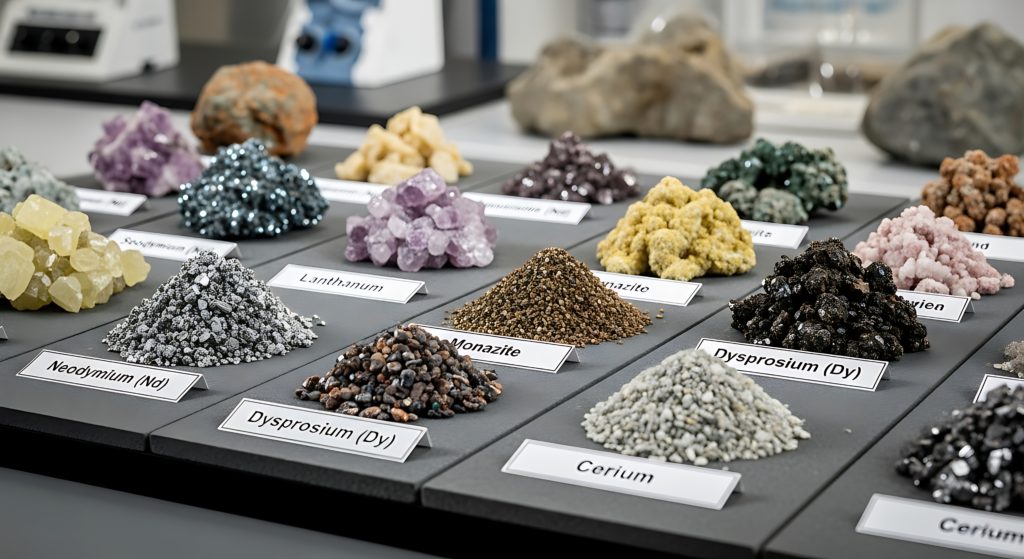

Stock image.

Europe must build its own pricing system for specialty metals and rare earths to reduce reliance on China and unlock investment in mining and processing, industry expert Bernd Schaefer of the EIT told Reuters on Wednesday.

China dominates critical mineral supply chains and sets prices through opaque domestic markets, leaving Western developers without clear benchmarks, complicating investment decisions and delaying already higher-cost projects in Europe.

The EU has a target to mine at least 10% of its annual requirements of strategic raw materials by 2030 and rely on a single third country for no more than 65% of its annual needs.

EIT Raw Materials, an agency partly funded by the EU, is collaborating with digital platform Metalshub, it said last month, to create a European index to foster innovation in new minerals mining, refining and recycling projects in the bloc.

Schaefer said it would, however, take time to create an index with representative prices. The index would aim to provide transparent, market-based price benchmarks for critical minerals traded outside China, giving investors clearer signals on profitability and helping underpin financing for new projects.

“My understanding is that this would require trading a volume of a minimum 10% of the traded volume (non-China)…depending on the raw materials,” Schaefer said. “What we are getting from China is neither representative nor, in strict microeconomic terms, a price,” Schaefer said.

Schaefer said an index could be broader than just Europe, with collaboration from other traders, such as in the United States, Australia, Canada or Britain.

It was difficult to say whether the EU would meet its critical mineral diversification goals due to a lack of transparent data on volumes and growth expectations, he said.

The EU announced its 3 billion euro RESourceEU action plan in December to speed up diversification of the bloc’s supply chains and reduce its overreliance on China.

Concrete action has been slow with the exception of a pilot joint EU stockpile led by Italy, France and Germany. The countries have shortlisted metals including tungsten and gallium as the first to go into storage.

Without building domestic processing and transparent pricing, Europe risks remaining dependent on Chinese benchmarks — and seeing any new raw material output flow straight back into China’s supply chain, Schaefer said.

(By Julia Payne; Editing by Elaine Hardcastle)


MAX Power secures $18M from Sprott in boost to plans for Canadian hydrogen


Drilling at Lawson. Credit: MAX Power

MAX Power Mining (CSE: MAXX) says it is accelerating the commercial validation of what would be Canada’s first natural hydrogen system after securing a C$25 million ($18 million) investment from mining billionaire Eric Sprott.

In a press release on Friday, the energy exploration junior said it has defined the first series of high-priority targets for follow-up drilling at the Lawson natural hydrogen system in Saskatchewan. The drilling, part of an expanded multi-well program, aims to confirm what the company considers to be the world’s first large-scale commercial discovery of this emerging new primary energy source.

In addition to hydrogen, the Lawson complex — located in the heart of the Genesis Trend adjoining the Regina-Moose Jaw Industrial Corridor — is also showing strong potential for helium deposits, the company said.

A survey was conducted this week at six proposed initial well locations at Lawson, after which the MAX Power team finalized its first three drill targets through analyzing 3D seismic data to define structurally optimal locations where the potential for gas flow, volume and concentrations of natural hydrogen and helium could support commercial validation.

Using information collected through the drilling campaign, the exploration and production models will be optimized and refined in real time, with the help of geoscientists, geophysicists, engineers and technicians, to fast-track the timeline for potential commercial discoveries, MAX Power said.

In addition, the MAX Power team has also planned a 2D seismic data acquisition program across the 475-km-long Genesis Trend to further assess dozens of preliminary and more advanced natural hydrogen prospects while also identifying potential new target areas.

Sprott backing

These plans will be funded by the C$25 million announced a day before. Under a private placement, a Sprott-owned entity would acquire 12.5 million units of the company at C$2 per unit. Each unit carries one common share and one warrant to buy shares at C$2.75 each.

Sprott currently holds more than 10% of MAX Power’s outstanding stock, and has agreed to not exceed its shareholder above 19.9%.

“MAX Power is entering the most important execution phase in its history, and Eric Sprott’s fresh investment of $25 million expands and accelerates this execution phase. Lawson confirmed Canada’s first subsurface natural hydrogen system,” MAX Power CEO Ran Narayanasamy said in a press release on Friday.

Shares of MAX Power initially surged on the Sprott investment, but fell during Friday’s trading, down about 5% to C$2.36 by 1 p.m. ET. The Vancouver-headquartered company has a market capitalization of about C$357 million ($259 million).

Canada Nickel, GeoRedox launch first-of-its-kind hydrogen initiative at Crawford

Examining core at the Crawford project in Ontario. (Image courtesy of Canada Nickel)

Canada Nickel Company (TSXV: CNC) has partnered with GeoRedox Corporation to develop the world’s first stimulated geologic hydrogen well on the site of the company’s Crawford nickel project near Timmins, Ontario.

In January, the Ontario government named the polymetallic project as the second to be advanced under its One Project, One Process framework for fast-tracked permitting.

The project will test GeoRedox’s proprietary technology for producing zero-carbon hydrogen from ultramafic rock formations — the same geology that underlies Canada Nickel’s projects in the Timmins district — and represents a foundational step toward a zero-carbon industrial cluster in Northeast Ontario, the companies said.

“The ultramafic rock that hosts our Crawford deposit and 20-plus projects across the Timmins nickel district is precisely the geology GeoRedox’s technology is designed for,” Canada Nickel CEO Mark Selby said in a news release.

“This partnership brings us a significant step closer to a zero-carbon industrial cluster in Northeast Ontario — one that converts our concentrates into finished critical mineral products including nickel, chromium and cobalt, while leveraging the region’s significant carbon storage capacity,” Selbey added.

GeoRedox will fund the demonstration program in full, while Canada Nickel will contribute site access, rock samples, technical expertise, data and other resources necessary for project planning and implementation.

The demonstration is the first phase of a program that, if successful, has the potential to provide a large-scale, carbon-free hydrogen supply for a zero-carbon industrial cluster in the Timmins nickel district.

Once constructed and in operation, Crawford is expected to rank among the Western world’s largest nickel sulphide projects and among the world’s lowest-carbon nickel operations, Canada Nickel said.


Alberta Pushes Ahead With Separation Referendum Despite Court Challenge


Alberta’s Premier Danielle Smith has said Canada’s oil province will go ahead with a referendum on whether to remain in the federation or secede, stating that “Alberta’s future will be decided by Albertans, not the courts.”

“The fact is that between the “Forever Canada” petition requesting a referendum on Alberta remaining in Canada, and the “Stay Free Alberta” petition requesting a referendum on leaving Canada, approximately 700,000 Albertans have signed petitions requesting a vote on this issue,” Smith said, as quoted by Canadian media.

“And I, as Premier, will not have a legal mistake by a single judge silence the voices of hundreds of thousands of Albertans. That’s not the Alberta way. Alberta’s future will be decided by Albertans, not the courts.”

CBC reported earlier in the week that the outcome of the referendum, to be held in October, would not automatically lead to a change in the province’s status, should the vote go the secession way. What it would do is clear the way for another referendum, whose results would be binding.

Talk about a separation between Alberta and Ottawa has been growing louder over the past couple of years as the oil province grows increasingly frustrated with federal policies seen to put Albertans and their businesses at a disadvantage. Earlier this month, a judge even stopped a petition by a pro-cession group called Stay Free Alberta that called for a referendum on whether the province should become independent. The ruling prompted Premier Smith’s remark about “a legal mistake by a single judge”.

Alberta is a major contributor to federal budget revenues thanks to its oil and gas industry, which recently returned to the spotlight as a hero rather than villain, as Ottawa’s new cabinet changed the previous administration’s tune on emission reduction above all else, now prioritizing the profitable development of the country’s oil and gas wealth.

By Irina Slav for Oilprice.com


Carney fast-tracks $1.5B Nouveau Monde Graphite mine — Canada’s answer to China’s 80% supply control


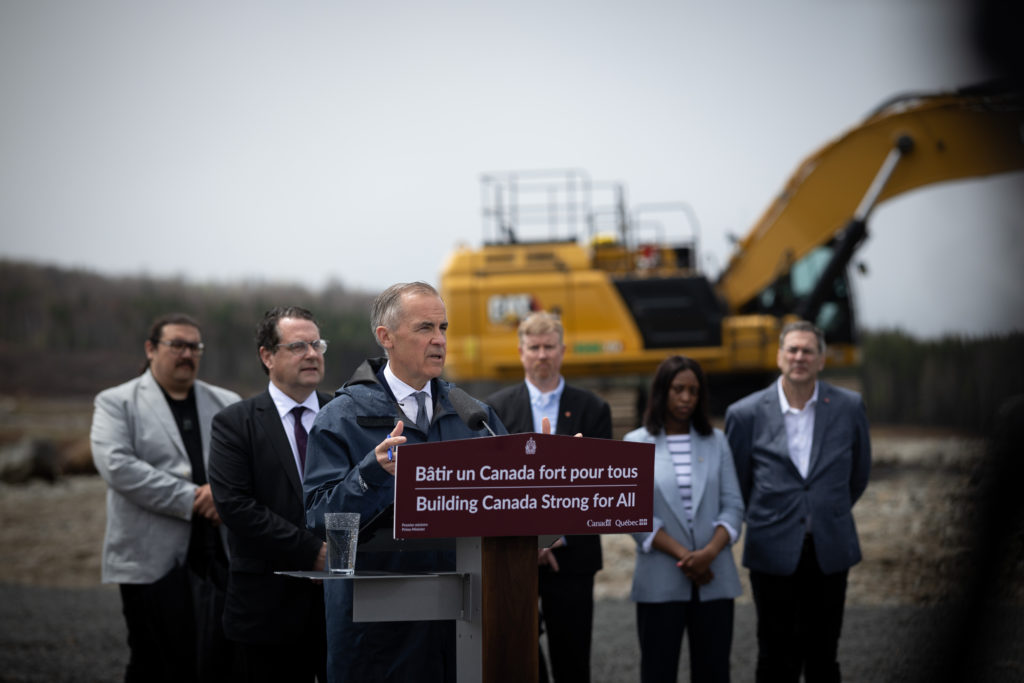
Prime Minister Mark Carney marked the start of construction of Noveau Monde Graphite’s Matawinie mine in Quebec. Photo by Daniel Pereira / Office of the Prime Minister of Canada.

Canada’s Prime Minister Mark Carney announced on Tuesday that construction is starting on Nouveau Monde Graphite’s (TSX-V: NMG)(NYSE: NMG) Matawinie mine in Québec just six months after its referral to the Major Projects Office.

The company is now advancing Phase 2 of the development, which Carney said will become the largest graphite mine in the G7 and bolster Canada’s critical minerals supply chain. China is the world’s leading producer, accounting for nearly 80% of global supply.

Located about 120 km north of Montreal, Matawinie is expected to produce as much as 106,000 tonnes of graphite annually once completed. Ottawa said the mine will create more than 1,000 jobs and attract nearly C$2 billion ($1.5 billion) in investment as Canada pushes to expand domestic battery materials production amid rising geopolitical and trade tensions. 

The announcement NMG’s recent release of $96.5 million from escrow.

“Canada has what the world wants — and we’re moving at speed to get it to market,” Carney said in a statement. “It will create more than a thousand good career opportunities, strengthen our supply chains and build a stronger, more competitive, more independent Canadian economy for all.”

Major milestone

NMG chief executive Eric Desaulniers said the groundbreaking marks a major milestone for the company’s integrated graphite strategy, which includes a planned battery materials plant in Bécancour, Que. He said the project reflects collaboration with governments, local communities and Indigenous partners while advancing Canada’s role in the critical minerals sector.

Federal ministers including Environment Minister Julie Aviva Dabrusin also praised the development, calling it an important step in supporting low-carbon manufacturing and resilient supply chains.

Ottawa has committed financing support through Export Development Canada, the Canada Infrastructure Bank and the Canada Growth Fund, alongside a seven-year offtake agreement for 30,000 tonnes annually of graphite concentrate.

Battery ambitions grow

According to Natural Resources Canada, Canada produced 12,000 tonnes of graphite in 2024, or 0.7% of global supply, ranking eighth worldwide. China dominated production with 79.4% of global output, while Madagascar ranked second at 5.6%, underscoring the concentration of supply the West is trying to diversify.

The project moves ahead as demand for battery-grade graphite accelerates alongside electric-vehicle growth and new US trade measures reshape global supply chains. 

Canada and its allies are increasingly seeking secure, lower-emission sources of critical minerals as they work to reduce reliance on Chinese supply. 

Matawinie is expected to anchor a broader North American graphite ecosystem tied to battery, defence and advanced manufacturing industries.

Canadian steel sector faces deeper pain than aluminum as tariff uncertainty clouds outlook


“The US actually cannot produce enough to satisfy its own needs,” she said. “It’s the US manufacturers that are going to be paying more for that.”  


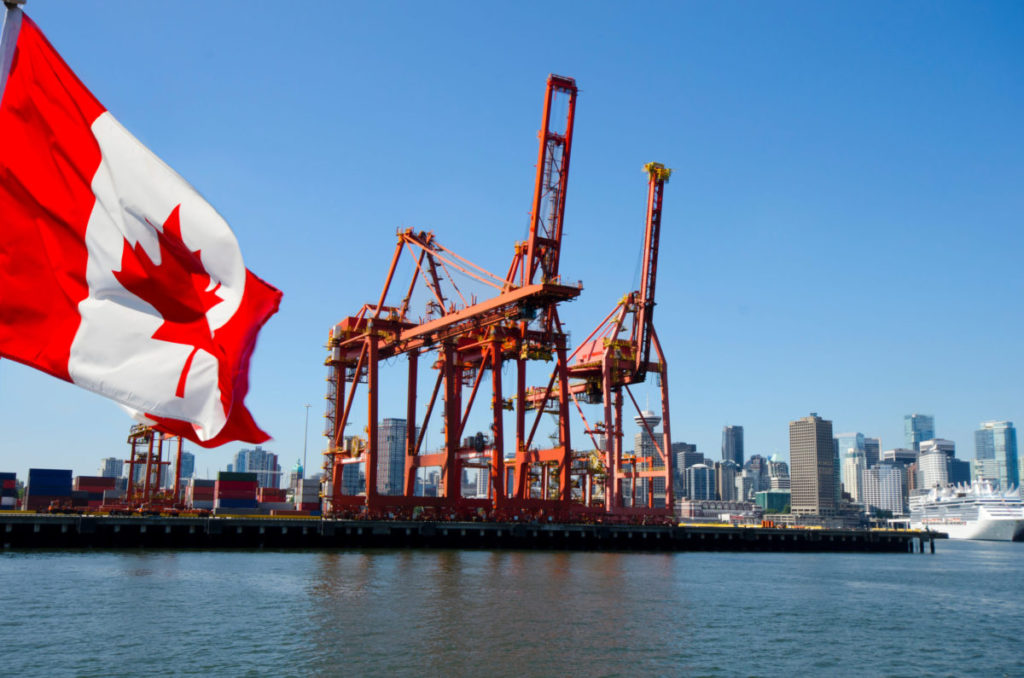
Port of Vancouver. Stock image by Sinidex.

Canada’s steel industry is facing a more severe and potentially longer-lasting disruption from U.S. tariffs than the aluminum sector, according to a senior PwC economist who says Ottawa’s recently announced support measures are primarily designed to buy companies time rather than solve the underlying problem. 

In an interview with MINING.COM this week, Gemma Stanton-Hagan, director of economics and policy at PwC Canada said the federal government’s support package — including $1 billion in loans and $500 million for business diversification initiatives — is significant politically but modest compared with the scale of losses facing producers.  

Canadian steel export values to the US have collapsed to roughly a third of pre-tariff levels. 

“So far this year on a monthly basis, steel exports are about $500 million lower than they were pre-tariffs,” Stanton-Hagan said. “That’s every month revenue is $500 million lower than it would have been.”  

Stanton-Hagan described the funding as a “relatively short-term solution,” noting that many of the affected companies are large multinational firms with deeper capital reserves and longer-term operational strategies.  

The comments come as Canadian producers continue grappling with trade volatility tied to U.S. tariff policies and uncertainty surrounding the upcoming review of the Canada-United States-Mexico Agreement (CUSMA). 

Steel sector particularly vulnerable 

While aluminum producers have been able to redirect some shipments to Europe, the steel industry faces more structural challenges because of global oversupply and its heavy dependence on the US market, Stanton-Hagan said. 

Historically, between 85% and 90% of Canadian steel exports went to the United States before tariffs were imposed, according to the interview. Aluminum exports were even more concentrated, with roughly 94% destined for the U.S. market.  

For aluminum, however, producers have managed to recover some export volumes by increasing shipments to Europe. 

“We’ve seen actually a really good bounce back in aluminum exports, mostly because of growing exports to Europe,” she said, while cautioning that Europe is unlikely to become a major long-term growth market.  

Steel producers have had far fewer alternatives. 

“There’s global oversupply of steel,” Stanton-Hagan said. “Canada produces steel for domestic usage and then also mostly for the U.S., so we really don’t have those other trade relationships.”  

The result has been mounting financial pressure across the sector, with companies reporting significant quarterly losses and reassessing investment plans. 

Liquidity support versus long-term adaptation 

Stanton-Hagan said Ottawa’s support package is effectively divided into two policy objectives. 

The $1-billion loan program is aimed at easing immediate liquidity pressures caused by lower revenues and weaker export demand. 

“That’s really about stopping the bleeding,” she said.  

Meanwhile, the $500-million regional tariff response initiative is intended to help smaller and medium-sized businesses diversify into new export markets and build greater resilience against future trade shocks.  

Stanton-Hagan suggested the federal government is still trying to determine whether the tariffs represent a temporary disruption or a more permanent restructuring of North American trade flows. 

“Is this a blip we’re waiting out … or is this everyone needs to pivot to not sell anything to the US?” she said. “Those are very different policy questions.”  

Strategic importance beyond jobs 

Beyond employment concerns, Stanton-Hagan said the steel and aluminum industries are increasingly being viewed as strategically important sectors for Canada’s broader industrial and national security objectives. 

The federal government’s push for housing, transportation, energy infrastructure and mine development depends heavily on domestic supplies of steel and aluminum, she pointed out.  

“These are also strategic inputs for defense,” Stanton-Hagan added, noting policymakers must weigh the consequences of allowing domestic capacity to erode.  

Stanton-Hagan also suggested US manufacturers may eventually push back more forcefully against tariffs if elevated metal prices continue feeding into inflation and production costs. 

“The US actually cannot produce enough to satisfy its own needs,” she said. “It’s the US manufacturers that are going to be paying more for that.”  

With U.S. midterm elections approaching and concerns about high living costs already weighing on voters, the political sustainability of the tariff regime may increasingly come into question, Stanton-Hagan said. 


How Trump’s Cuba grudge threw a 99-year-old Canadian mining company into turmoil

Old Havana. (Stock image by kmiragaya.)

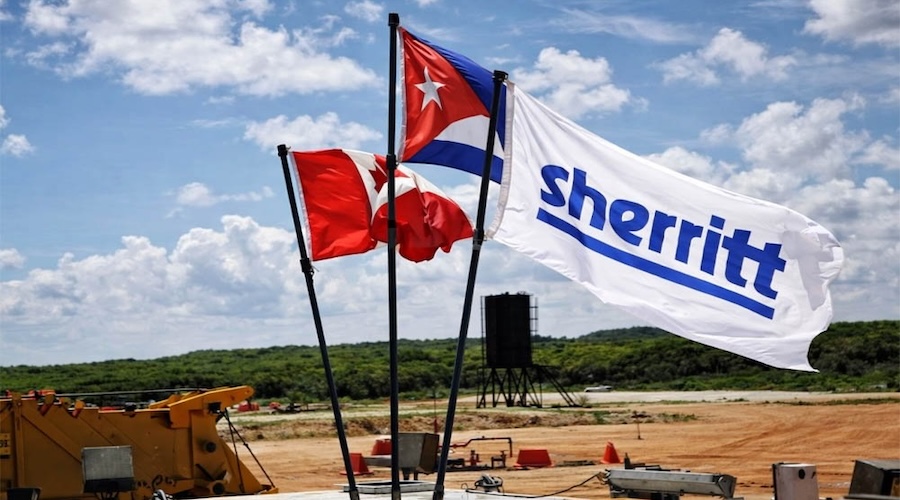
The Trump administration’s hard line against Cuba pushed Sherritt International Corp. to the brink. Now, an ex-adviser to the US president may be the Canadian mining company’s salvation.

The nearly 99-year-old company, whose former chief executive was once known as Fidel Castro’s favorite capitalist, has staked its business on a bet few Western companies would touch. After entering Cuba in the 1990s, Sherritt developed a nickel-and-cobalt mine through a joint venture with the state before expanding into energy. The result was a sprawling business that’s survived commodity busts, US political pressure and economic instability on the island.

That wager abruptly unraveled this month, plunging Sherritt into turmoil. After President Donald Trump expanded sanctions on the communist country, Sherritt initially announced plans to dissolve its mining venture in Cuba. On Wednesday the US charged former Cuban President Raúl Castro with murder, sharply escalating a standoff with Havana as the Trump administration attempts to reshape the island’s political order.

But just days after Sherritt announced its retreat from Cuba, a potential rescuer emerged in the form of a Dallas family office linked to Ray Washburne, a real estate executive appointed by Trump in 2017 to lead the Overseas Private Investment Corp. Washburne’s Gillon Capital LLC signed a non-binding preliminary agreement on Wednesday that would hand the family office a controlling stake in Sherritt.

“It came out of nowhere,” Peter Hancock, Sherritt’s interim chief executive officer, said in an interview. “I would like to tell you that I’m a business genius and that I knew an American entity would see that it could create value in the situation that Sherritt was in. But no, I didn’t foresee that.”

As Trump’s foreign policy during his second term turns markedly more aggressive, Sherritt is still at risk of losing its Havana gamble. The saga underscores the dangers facing companies and investors from shifting geopolitics amid a rapidly changing world order. While major multinational firms have not been immune to conflict-driven losses, the threat is particularly acute for companies with assets concentrated in a single country outside of the US.

It’s not clear whether Sherritt’s preliminary pact with Gillon signals a potential shift in Trump’s Cuba strategy. On Wednesday, he played down the need to further ratchet up pressure on the Cuban government after the charges against Raúl Castro. Representatives for Gillon and the State Department didn’t immediately respond to requests for comment.

But for Hancock, the sudden backing from Gillon helped “bridge the huge gap” between Sherritt and the administration.

“This deal happened because an actor in the United States was able to make a case to the US State Department,” he said. “We were collateral damage in a larger policy objective for the United States.”

Sherritt was founded in 1927 and named after Carl Sherritt, a trapper who staked copper prospects in Manitoba. The company’s first foray into Cuba was steered by Ian Delaney, who became CEO after a proxy fight in 1990 and secured a deal with the Castro government one year later. The state agreed to sell Sherritt unprocessed nickel from Moa, a mine in eastern Cuba that was nationalized after the country’s 1959 revolution.

It was a milestone deal for the Canadian firm, which needed raw material to feed its key asset: a refinery in Alberta. The company entered into a joint venture agreement in 1994 with the state to operate Moa, which produces cobalt and nickel, both key metals for the energy transition and providing power to data centers.

For years, Sherritt was enormously successful in Cuba. Its market capitalization jumped to almost C$5 billion ($3.6 billion) in 2008, while the stock traded as high as C$18. Sherritt, by that time, had poured significant investment into the country, including stakes in electricity, oil and natural gas ventures alongside state companies.

Sherritt executives became the first people barred from entering the US under the Helms-Burton Act, a law passed in 1996 to target firms doing business in Cuba. But Canada and several European nations opposed the law and maintained diplomatic ties with Havana, allowing Sherritt to keep selling most of its nickel and cobalt into those markets as well as Asia.

Yet at the height of Sherritt’s rise following its success in Cuba, the company made costly bet on a nickel project in Madagascar. The decision would ultimately shred its balance sheet, driving debt to almost C$2.5 billion at its peak in 2013. Then came a prolonged slump in nickel prices, leaving the company periodically teetering on the brink of insolvency.

Saddled with a heavy debt load and years of weak cash flow, the company became even more reliant on Cuba, exiting other assets including its Canadian coal business to fund loan repayments and eventually writing off its Madagascar venture. Today, Cuba accounts more than 70% of the company’s asset base on a book value basis.

“They had an ample opportunity to eliminate their indebtedness entirely,” Jeffrey Gavarkovs, a managing partner at Northstream Capital Inc., said in an interview. But “the combination of Cuba and a debt load that was a little bit too heavy was their poison pill.”

While Sherritt continued receiving distributions from its power and nickel operations, the company spent more than C$100 million on an offshore well, a higher-risk category of oil exploration, Gavarkovs said. The effort yielded a well that was ultimately written off as uneconomic.

But according to Gavarkovs, who owns Sherritt bonds, the company’s biggest flaw was its bloated corporate overhead for what had effectively become a single-asset mining company. Directors on the board, rather than ensuring that unsecured note-holders received cash interest payments as required by the debt covenants, prioritized vesting cash-settled stock options, he said.

The company also spent millions trying to fend off several activist campaigns against it, he added. Last year investment firm Pala Assets Holdings won its battle against Sherritt, resulting in the resignation of CEO Leon Binedell and a shakeup of the board.

When US forces captured Venezuelan leader Nicolás Maduro in January, investors began speculating that Cuba could be the Trump administration’s next target. In Venezuela’s case, US oil majors and Western mining companies swarmed into the country after Maduro’s arrest, with Chevron Corp. emerging as one of the clearest winners.

But unlike Chevron, which has a diversified asset base, Sherritt was facing a worsening a fuel shortage as the US blocked Venezuelan exports to Cuba. The company announced plans to pause mining at Moa in February after receiving notice that planned fuel deliveries could not be fulfilled.


As Cuba’s economy continued to crumble, with mass blackouts sweeping the island as Trump tightened his squeeze on the nation of 10 million people, Sherritt faced a choice: keep operations going at a loss and at reduced capacity, or mothball the company’s most valuable asset. In late March, the company announced it was seeking an emergency cash injection of as much as C$50 million to support Moa.

After Trump’s expansion of Cuba sanctions on May 1, Sherritt abruptly decided to relinquish its joint venture stakes on the island. But soon after, the company reversed course.

Hancock was at home in Halifax on Monday, a public holiday in Canada, watching the Giro d’Italia cycling race on TV when the phone rang. On the other end was Washburne, calling with his offer for Sherritt.

Two days later, the Canadian company announced that it had signed a non-binding term sheet with Gillon. Sherritt said the US State Department had no objections to the discussions.

It’s far from certain that Ottawa will support a US investor taking majority ownership of Sherritt, however. Canada instituted a new policy in 2024 to make it more difficult for foreign companies to take control of Canadian critical minerals assets.

To Ben Rowswell, a former Canadian ambassador to Venezuela, the move by a Trump-friendly investor to take control of Sherritt in Cuba exemplifies what’s become known as the Donroe Doctrine, the US president’s take on Washington’s 19th-century push for hemispheric domination.

The latest move provides “further insight into the changing character of the US relationship with the region as it’s turning into an extractive predator” that uses its power over all countries, said Rowswell, now a consultant with strategic advisory firm Catalyze4.

The government of Prime Minister Mark Carney might be reluctant to attempt to block the takeover of Sherritt by a US investor to avoid complicating efforts to renew a free trade agreement with the US, Rowswell said, adding that he believes Carney’s administration should defend the company against US sanctions.

A spokesperson for Canada’s industry department said the government welcomes foreign investment that benefits Canada’s economy, but declined to comment on specific transactions.

Sherritt isn’t the only foreign company with mining operations in Cuba: Singapore-based commodities trading giant Trafigura has a lead-and-zinc mine there in a joint venture with the state. The company has said that it complies with all applicable sanctions and maintains a regular dialogue with relevant authorities.

Despite the potential deal with Gillon, Sherritt’s situation remains tenuous. Three board members have resigned from Sherritt, leaving just Hancock and one other director. Its chief financial officer and its auditor also departed earlier this month. The company now trades as a penny stock, with a market capitalization near C$80 million. Without essential nickel and cobalt supplies from Cuba, the available inventory at the company’s Alberta refinery will run out in mid-June, it said earlier this month.

“A lot of things will need to happen to get to the state where the full value is realized,” said Hancock, adding that sourcing key inputs such as fuel and sulfur would also be critical to unlocking Sherritt’s full potential. But, he added, “the posture of the US government with respect to this deal opens up a much wider world of financing.”

The Fort Saskatchewan refinery is one of just a few nickel processing facilities in North America. As governments and manufacturers race to build critical minerals supply chains outside of China, the facility carries growing strategic importance, according to Northstream’s Gavarkovs.

For Hancock, a former engineer with commodities trader Glencore Plc, there have been “a lot of very unexpected twists and turns” since he stepped in as interim CEO of Sherritt in December. If the Gillon proposal goes ahead, any easing of tensions between the Trump administration and Cuba would likely improve the payoff for the Washburne family office, he added.

Gillon is “very, very familiar with the business and the value that they see down the track,” he said. “This deal signals that they believe Sherritt has got a real bright future when things normalize in Cuba.”

(By Sybilla Gross, Paula Sambo and Stephen Wicary)

Sherritt in talks to hand control of Cuba mining business to ex-Trump adviser

US new sanctions revive a decades-old clash with Sherritt, rooted in the 1990s. (Image courtesy of Sherritt International.)

Sherritt International Corp. is in talks to hand a controlling stake to a family office linked to a former adviser of President Donald Trump, as the mining company seeks to navigate US sanctions tied to its Cuba operations.

The Toronto-based company said it signed a non-binding term sheet for a private placement involving a warrant, which would allow Gillon Capital LLC to acquire enough common shares to own 55% of the company on a fully exercised basis, according to a statement Wednesday.

Sherritt expects that the exercise price will be at a discount to the company’s closing price May 15. The company, which operates nickel and cobalt mining and refining businesses tied closely to Cuban state partners, on Tuesday reversed course on plans to unwind its operations in the Caribbean country.

Shares of Sherritt, which trades as a penny stock, rose 9% in early trading in New York.

Gillon Capital is the family office of Ray Washburne, a real estate executive whom Trump appointed in 2017 to head the Overseas Private Investment Corporation before later naming him to the Presidential Intelligence Advisory Board.

Sherritt said it has “engaged constructively” with the US Department of State, which confirmed no objections to Gillon Capital’s engagement with the company, according to Wednesday’s statement. The Department of State and Department of Treasury don’t view the negotiations as contrary to US law, the statement said.

Last week, Sherritt said it was considering steps to relinquish its 50% stake in a Cuban nickel-and-cobalt mine, as well as surrender its interest in an energy joint venture with the state. On Tuesday, it backtracked on that decision and flagged it was evaluating a “potential value preserving opportunity.”

Sherritt operates nickel and cobalt mining and refining businesses tied closely to Cuban state partners and has long depended on the country for a significant portion of its production.

The company has been in turmoil since Trump signed an executive order earlier this month targeting non-US individuals and entities doing business in Cuba, which has faced sweeping US sanctions since the 1960s. The upheaval triggered a wave of departures, including three board members and the chief financial officer, and triggered a plunge in its share price.

(By Sybilla Gross)

Sherritt drops plan to dissolve Cuban assets


Credit: Sherritt International

Sherritt International (TSX: S) has dropped plans to dissolve its mining assets in Cuba, though operations will remain suspended amid ongoing US sanctions.

In a statement on Tuesday, the Canadian miner said it will now keep its Cuban interests, namely the Moa nickel mining venture, and will not proceed with its application to the Court of King’s Bench of Alberta to disclaim the asset.

The decision was made following further “consultation with advisors, stakeholders and relevant governmental authorities,” and “in light of additional information” currently available to the company, it said.

The announcement comes just days after Sherritt said it would be dissolving the 50/50 Moa joint venture with the state-owned General Nickel Company, citing a “material change” from the JV shareholders’ agreement. It followed a recent executive order by US President Donald Trump that expanded sanctions on Cuba to include non-American entities, including Sherritt.

The extended US sanctions triggered a wave of departures within the company, including three board members, the chief financial officer, and led to a more than 50% drop in its share price.

Before that, the Toronto-based miner had already been struggling due to its heavy exposure to the Cuban market. Sherritt has been mining cobalt and nickel in the island nation since 1990. It also produces electricity, oil and gas through a stake in Energas SA, another joint venture with Cuba’s state electric and petroleum companies.


Sherritt International shares rebounded slightly off an all-time low of C$0.11 on the news. Its market capitalization is approximately C$81 million ($59 million), following a decline that extends to nearly two decades.

While the company is not longer seeking a dissolution of the Cuban assets, its participation in the Moa venture will remain suspended, Sherritt said on Tuesday, adding that it will “continue to work with stakeholders and advisors on steps to address the executive order as soon as practicable.”

The company also said it has been presented, on a preliminary basis, with “a potential value preserving opportunity”, which it will evaluate.

US Supreme Court Rules Cruise Lines Can Be Sued Under Cuban Libertad Act

There are other cases under the Libertade Act also pending in the U.S. courts based on Trump’s 2019 decision not to extend the suspension of the act. Presidents before Trump had suspended the enforcement of the act.Havana docks with cruise ships
Cruises docked at the piers in Havana between 2016 and 2019 working under U.S. licenses (GPH photo)

Published May 21, 2026 6:09 PM by The Maritime Executive


The United States Supreme Court handed down its ruling saying four cruise lines could be sued for their use of the pier in Havana, Cuba, under the Libertad Act passed by the U.S. Congress in 1996. The case has been seen as a potential watershed in the long-running fight for compensation for assets seized during the 1959 Cuban revolution and other events around the globe.

At issue was the cruise lines' use of the docks in Havana between 2016, when the United States lifted many of its restrictions on Cuba under President Barack Obama, and June 2019, when Donald Trump reinstated the restrictions and let a presidential waiver over enforcement of the Libertad Act lapse. The Havana Dock Company, which built and operated the docks under a 99-year concession before the Cuban revolution, sued Carnival Corporation, Norwegian Cruise Line Holdings, MSC Cruises, and Royal Caribbean Group, contending they profited from the use of confiscated property.

The case alleges the cruise lines carried nearly one million passengers to Cuba between 2016 and 2019 using the piers that were tainted property, seized by the Cuban government in 1960 from Havana Docks. Under the Cuban Liberty and Democratic Solidarity Act (known as the Libertad Act or the Helms-Burton Act for its sponsors), companies were given the right to sue for compensation from their seized properties.

A federal district court in Miami found for Havana Docks and awarded damages of $440 million. However, a U.S. Court of Appeals reversed the decision. The cruise line case was argued before the U.S. Supreme Court in February over the interpretation of the act. Among the defenses presented by the cruise lines is the argument that the concession for the piers was to have expired in 2004. Further, it is argued that the cruise lines were operating under permits issued by the U.S. government.

The Supreme Court, in an 8 to 1 decision, ruled that the property was, in fact, “tainted” by the 1960 seizure and that Havana Docks only had to show that the cruise lines had used the confiscated property. The majority opinion written by Justice Clarence Thomas disagrees with the appellate court’s ruling, finding that the act generally makes those who use property tainted by a past confiscation liable to any U.S. national who owns a claim on that property. Havana Docks' claim for the lost docks was certified at $9 million in 1960.

In a concurring opinion, Justice Sonia Sotomayor, joined by Justice Brett Kavanaugh, raises concerns that the majority opinion, however, is too broad. She believes it was unlikely that Congress intended in the act that “someone who suffered a finite loss to reap infinite recoveries.” She believes the claim should be finite and not go on so long as anyone continues to make any commercial use of the docks. Justice Sotomayor, in her opinion, raises another point, highlighting that the cruises were operated at a time when U.S. policy was that they were lawful and beneficial to both Cuba and the United States.

The solo dissent came from Justice Elena Kagan, who focused on the assertion that the Cuban government always owned the docks. She points to the 2004 expiration of Havana Docks’ contract. She warns the Supreme Court’s interpretation of the act “treats all property interests as if they were perpetual ones." She sides with the Appellate Court, saying that Havana Docks’ claim should fail because the cruise lines did not use the docks during the time-limited concession.

The ruling sends the suit against the cruise lines back to the lower courts for further arguments. 

There are other cases under the Libertade Act also pending in the U.S. courts based on Trump’s 2019 decision not to extend the suspension of the act. Presidents before Trump had suspended the enforcement of the act.

The Supreme Court in February also heard a case under the act brought by Exxon Mobil seeking compensation from the Cuban state-owned oil company CIMEX. The U.S. energy company lost its oil and gas assets in Cuba, which were seized by the Castro regime after the revolution and handed over to the state oil company. 

In 2022, it was noted that more than 40 Libertad Act suits had been filed, including cases against commercial shipping companies Maersk, MSC, Crowley Maritime, and Seaboard Marine. Some of the cases brought under the act, such as Crowley Maritime and American Airlines, have reportedly reached settlements, while others will be impacted by the decisions in the cruise line case and the yet-to-be-announced decision by the Supreme Court in the ExxonMobil case.


China probes causes of deadliest coal mine blast since 2009

Stock image.

The causes of a gas explosion at a coal mine in China’s Shanxi province are under investigation and officials with the company were detained following the nation’s deadliest such incident since 2009, state media said.

Authorities at a briefing late Saturday lowered the death toll to 82 from an earlier estimate of 90. They said two people remain missing and 128 are hospitalized after Friday’s blast, according to Xinhua. Rescue efforts continue.

Chinese President Xi Jinping urged stronger risk inspections and hazard controls, and called for heightened vigilance during the current season, when heavy rain and floods are more common. Premier Li Qiang echoed the directives, seeking transparent information disclosure and tighter enforcement of safety responsibilities across key sectors, Xinhua News Agency reported.

China’s State Council investigation team will conduct “a rigorous and thorough investigation to fully ascertain the causes of the accident, clarify the responsibilities of local authorities, industry regulators and the company, and impose severe penalties in accordance with laws and regulations,” Xinhua reported.

The investigation team also called for a nationwide review of mining safety measures and a crackdown on illegal practices, including hidden work sites, falsified monitoring data, unclear worker counts, and improper subcontracting.

Vice Premier Zhang Guoqing was sent to Shanxi to oversee the emergency response efforts, including search and rescue, medical treatment and handling of the aftermath, Xinhua reported. He urged authorities to verify the number of missing workers and prevent secondary casualties.

China has dramatically reduced coal mining fatalities in recent years, but the vast industry continues to juggle competing priorities. The government has pushed output to a record to meet energy security demands, even as safety officials crack down on over-stressed facilities and blame mine owners and operators for accidents.

The mid-sized Liushenyu mine, owned by Shanxi Tongzhou Coal & Coke Group, has an annual production capacity of 1.2 million tons of mostly coking coal — a modest sliver of the province’s overall output of 1.3 billion tons a year.

Even so, the explosion is classed as a very serious accident under Chinese regulations. Both the accident and the widespread security checks that will follow come at a challenging time for the domestic coal market, with supply already tight due to summer demand and upheaval in exports from Indonesia, a major supplier.

Even after years of dramatic renewable energy growth, coal remains a key pillar of China’s energy mix, underpinning power generation and industrial activity. It’s also one of few options to make up for current shortfalls in liquefied natural gas supply from the Persian Gulf.

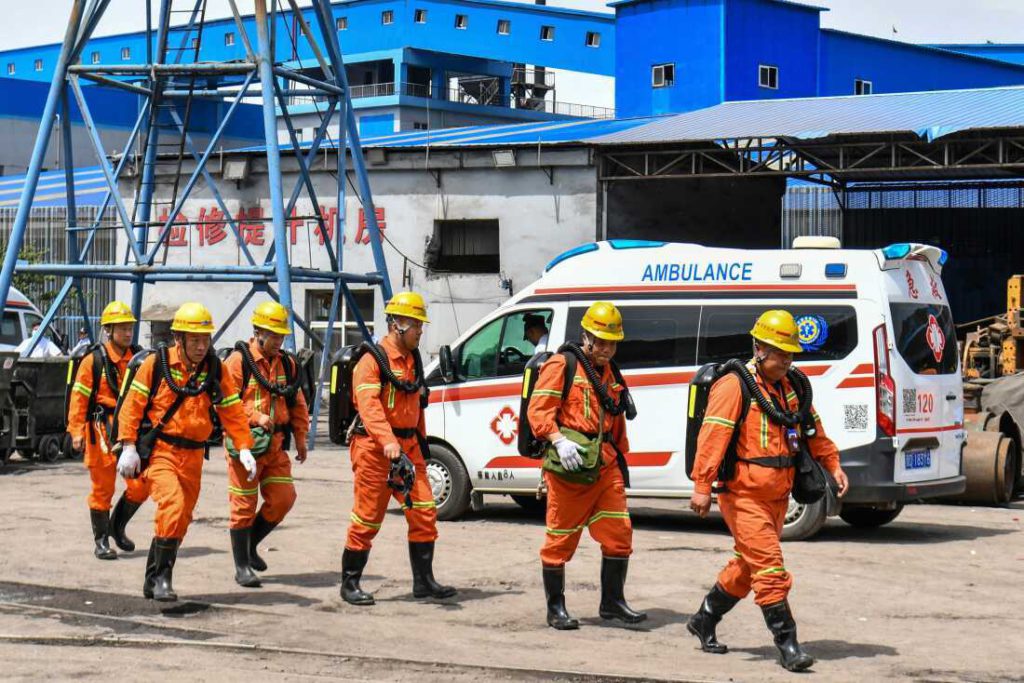
Six teams totaling 345 people have been dispatched by the Ministry of Emergency Management to assist with the rescue, according to local reports, while victims are being treated for injuries including exposure to toxic gases. One miner interviewed by the Beijing News described being knocked out by the blast, only to awaken in darkness before crawling to safety through air thick with dust.

An executive at the company involved in the explosion has been detained, Xinhua reported, citing the rescue command headquarters.

The last coal mine accident that had a higher death toll was a 2009 explosion at the Xinxing mine in Heilongjiang province, near the Russian border, that killed 108 people.


At least 90 dead in China’s worst coal mine disaster in over 16 years


Rescue efforts after mine explosion. Credit: Xinhua | Weibo

At least 90 ​people were killed in a gas explosion at a coal ‌mine in China’s northern province of Shanxi, the country’s deadliest mining accident since at least 2009.

The gas explosion occurred late on Friday at the Liushenyu ​coal mine in Qinyuan county, with 247 workers on duty ​underground, state media Xinhua reported.


The mine is operated by ⁠Shanxi Tongzhou Group Liushenyu Coal Industry, which was established in 2010 ​and is controlled by Shanxi Tongzhou Coal Coking Group, according to ​corporate database Qichacha.

Rescue operations were ongoing and the cause of the accident was under investigation, according to the local emergency management authority in Qinyuan. Shanxi is ​China’s coal-mining heartland.

President Xi Jinping called for authorities to “spare no ​effort” in treating the injured and conducting search and rescue operations, while ordering a ‌thorough ⁠investigation into the cause of the accident and strict accountability in accordance with the law, according to Xinhua.

Premier Li Qiang called for timely and accurate release of information and rigorous accountability.

China has significantly ​reduced coal mine ​fatalities – often ⁠caused by gas explosions or flooding – since the early 2000s through more stringent regulations and safer practices.

In ​2009, a coal and gas outburst in Heilongjiang Province ​killed ⁠108 people and injured 133.

Executives of the company responsible for the mine have been detained, Xinhua reported.

Shanxi provincial authorities have dispatched seven rescue ⁠and medical ​teams totalling 755 personnel to the ​site, the emergency management bureau at Qinyuan said.

(Reporting by Shanghai Newsroom and Fabiola Arámburo ​in Mexico City; Editing by Tom Hogue, Kim Coghill and William Mallard)