Monday, May 25, 2026

China's Solar Exports Soar as World Grapples with Energy Crisis


U.S. Energy Storage Installations Post Record First Quarter

Despite unfavorable federal policies, the U.S. energy storage additions jumped by 31% from a year earlier to 9.7 gigawatt-hours (GWh) in the first quarter of 2026, the strongest first quarter in history, a new report showed on Thursday.   

With energy storage gaining momentum, U.S. developers are set to install more than 610 GWh of energy storage by 2030, according to the report by the Solar Energy Industries Association (SEIA) and Benchmark Mineral Intelligence.

The estimates through 2030 were revised up from earlier forecasts as investors, developers, and grid operators respond to the current energy price volatility tied to disrupted global gas and gas turbine supplies.

Solar and storage are becoming increasingly attractive because they are insulated from fuel price swings and increasingly made in America, SEIA and Benchmark Mineral Intelligence said in the report.

Texas, Arizona, and California led utility-scale battery storage capacity additions in the first quarter, maintaining their positions as the three largest energy storage markets in America. Notably, 71% of all utility-scale energy storage capacity installed in Q1 was built in states won by President Donald Trump, the report said.

A total of 13 states now have explicit energy storage targets, helping drive continued investment and deployment. States like Georgia, Iowa, and Mississippi also posted notable gains in installed storage capacity during the quarter.

Despite the surge in energy storage installations, federal permitting bottlenecks could slow the industry, SEIA warned.

An SEIA analysis has shown that 467 solar and storage projects have permits pending and are vulnerable to politically motivated delays or cancellations.

“Energy storage is no longer just for backup, it’s critical energy security infrastructure,” said Shan Tomouk, BESS and Energy Lead at Benchmark Minerals.

“A supportive policy landscape for BESS will be crucial to enabling the rollout of AI and data centers, while mitigating adverse cost impacts to regular consumers.”  

By Tsvetana Paraskova for Oilprice.com

Sunday, May 24, 2026


Shell Returns to Dutch Supreme Court in Landmark Climate Case

Supermajor Shell is facing the Netherlands’ Supreme Court in an emissions lawsuit that a few years ago led to a ruling forcing the company to slash emissions from operations by 45% by 2030, which was later overturned at a higher court.

Back in 2021, the District Court in The Hague ordered Shell to reduce its carbon dioxide emissions by 45% by 2030 in a landmark ruling on a suit brought in front of the court by environmentalist group Milieudefensie, other NGOs, and a group of private individuals.

At the time, commentators said that the ruling had the potential to set precedents for other oil companies. These emission reductions were to include the so-called Scope 3 emissions, those generated by the use of Shell’s products, per the order of the district court in 2021. Shell appealed the ruling, and in 2024, the appeals court overturned the district court’s ruling.

Shell welcomed the appeals court judgment, with CEO Wael Sawan saying, “We are pleased with the court’s decision, which we believe is the right one for the global energy transition, the Netherlands, and our company.” Shell had argued that a court ruling would do little to reduce overall customer demand for petroleum products or for natural gas to heat and power homes and businesses. The company has also argued it was not up to courts to impose limits on companies’ operations—a prerogative of the legislative system.

Milieudefensie then took matters to the Supreme Court. “Judges have already confirmed that Shell is responsible for reducing emissions and to make its own contribution to the Paris Climate Agreement,” the lawyer representing Milieudefensie (Friends of the Earth), said last year. “There is enough of a legal basis to make the ruling more specific and stronger,” he added at the time.

Shell will maintain its position, too, although earlier reports said the Supreme Court will not look into the arguments and will not be reviewing the facts and evidence that the lower courts considered, but would rather focus on whether procedure was followed accurately and whether the lower courts had the right motivation for their rulings.

By Irina Slav for Oilprice.com

AI Could Unlock $500 Billion for Oil and Gas Producers by 2030

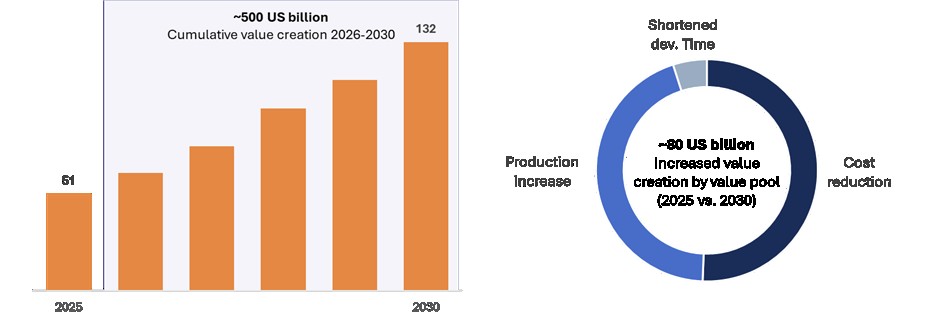
  • Rystad Energy estimates AI and digitalization could generate nearly $500 billion in cumulative value for upstream oil and gas companies between 2026 and 2030 through lower costs, higher production, and faster project development.

  • Operators such as ADNOC and Equinor are already reporting hundreds of millions of dollars in AI-related savings and operational gains.

  • The biggest obstacle is no longer technology availability but scaling deployment across organizations, infrastructure, and workflows.

Digitalization and artificial intelligence (AI) will create close to $500 billion in cumulative value for E&P companies between 2026 and 2030, according to Rystad Energy estimates. This value is captured through cost reductions from more efficient operations, production increases from higher uptime and increased recovery, and compressed development timelines. Cost reductions and production increases are the largest value pools and contribute roughly equally through 2030. Exploration and production (E&P) players currently investing in digital and AI are expected to capture an additional value of $80 billion per annum in 2030 compared to 2025.  

Vale

The returns are already visible in the industry. ADNOC reported $500 million in AI-driven value already in 2023, and the UAE state giant has committed $1.5 billion in digital capital expenditure targeting $1 billion in annual value creation. Norway’s Equinor generated around $200 million in AI-related savings between 2021 and 2024, before reporting $130 million in 2025 alone. The trajectory is not linear. Digital value creation follows a compounding curve as adoption increases and organizational capabilities mature.

The $500 billion value creation opportunity in upstream oil and gas sits across four main workflow categories. The first, asset development, and second, operations and maintenance, relate to mostly surface workflows. The third, exploration and reservoir development, and fourth, drilling, wells and production, represent subsurface-focused workflows. Each is at a different stage of digital maturity. Historically, operators have deployed a wide range of digital tools into various workflows, especially within exploration and reservoir development. When it comes to newer deployments, operations and maintenance is seeing more rapid adoption, primarily through predictive maintenance and remote operations delivering double-digit cost reductions at leading operators. Subsurface workflows hold the largest untapped value potential, especially from getting more volumes out of the ground and reducing drilling costs. Several operators have, for instance, compressed seismic interpretation timelines from months to around 10 days and the next step is to transfer this increased reservoir knowledge into real value.

A key structural finding across all four workflow categories is that AI, in general, does not necessarily raise the ceiling for the best operators, it lifts the rest of the industry towards the performance level that the best operator already achieves. In drilling, the dynamic is already visible as leading US shale operators are close to physical drilling limits, where the best wells can still improve but the biggest effect would come from lifting the average well. We estimate for US land the average improvement potential is close to 10%, while for more complex deepwater wells the potential savings can be far greater – more than 50% in more extreme cases, although between 15% and 20% is more representative of the average.  

Capturing the value at stake requires investment in digital tools, infrastructure and integration, and E&Ps are estimated to have spent around $25 billion on digital and AI purchases last year. The market for providing these tools and services is expected to grow by more than $10 billion by 2030, surpassing $35 billion in total annual market size, before growing closer to $50 billion by 2035.

The early adopters of these technologies typically have digitalization and AI as an integral part of their strategy. Conversations with various industry stakeholders highlight that organizational readiness determines the realistic pace. Traditional cloud migration can take multiple years, cybersecurity gates add months, while cross-silo collaboration requires cultural shifts that no software can automate. Beyond adopting off-the-shelf solutions, some of these players seek to develop their own solutions in-house to gain a competitive advantage over the rest of the industry.

However, the central barrier to capturing this value is not technology availability but deployment at scale. Advanced E&Ps, and those with less capabilities to start, opt for partnerships with suppliers and technology experts to reduce complexity, and simplify integration across equipment, assets, and different parts of their organization, typically through platform solutions. Traditional oilfield service (OFS) providers with domain expertise, and technology experts such as integrators or hyperscalers are among the most important partners for E&Ps seeking to translate digital investment into operational returns. These projects see the commercial model shift from transactional service delivery towards integrated technology partnerships that can then leverage an ecosystem of players, platforms and scalable tools.

AI is accelerating the value potential of digital solutions in oil and gas. Despite many breakthroughs, most current AI applications in upstream rely on traditional machine learning models trained on equipment and workflow-specific data. That training data takes years to accumulate, and models rarely transfer across assets without significant rework. Newer AI approaches may change this dynamic, for instance through agentic AI automating tasks and augmenting humans in a way that breaks down organizational silos and acting as a contextualizing layer that functions across varied data types without full retraining, although this remains an emerging capability rather than a proven solution.

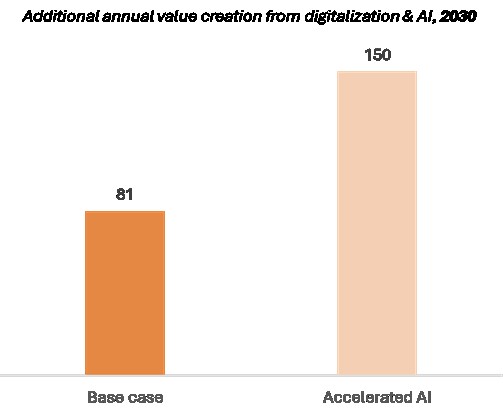
As such, we see a scenario where AI accelerates the value creation further than the base case, where breakthroughs simplify integration and compress adoption timelines industry-wide. In this higher scenario, annual value creation from digital initiatives reaches $150 billion already in 2030, with potential to further grow past $300 billion by 2035, compared to the base case of $178 billion in 2035.

Base scenario and accelerated

This accelerated AI scenario would also require additional spending on digital solutions, up to $50 billion annually in 2030 and close to $80 billion by 2035. This scenario would then follow the wider global trend of more money being injected into AI. The value creation gap between early adopters and followers could widen further in a scenario with faster adoption as data and organizational intelligence accumulate. AI accelerates what happens inside a digitally mature organization; it does not necessarily accelerate the process of becoming one.

By Rystad Energy

Japan to Welcome First Crude Cargo via Hormuz Since War Began

A supertanker carrying 2 million barrels of Saudi crude is set to arrive in Japan early next week after clearing the Strait of Hormuz in late April, in the first shipment of Middle East crude to Japan via the chokepoint since the Iran war began on February 28.

The very large crude carrier (VLCC) Idemitsu Maru, which had departed from Saudi Arabia’s Ras Tanura port in the Persian Gulf in mid-March, is expected to arrive in Nagoya on May 25, data on MarineTraffic showed. As of early Friday, the supertanker was close to the coasts of Japan.

The cargo is destined for the Aichi refinery of local refiner Idemitsu Kosan, according to a briefing document of Japan’s Ministry of Economy, Trade and Industry cited by Bloomberg.

The imminent shipment will mark the first cargo from the Middle East and the Strait of Hormuz to have made it to Japan since the conflict erupted at the end of February and halted most energy supplies via the strait, which is blocked by Iran and separately blockaded by the U.S. in the Gulf of Oman to prevent Iranian oil exports.

Another Japan-bound tanker, Eneos Endeavor, cleared the Strait of Hormuz last week. The Eneos Endeavor, currently in the Malacca Strait, is expected to arrive in Kiire, Japan, on May 30, per data on MarineTraffic. It departed from Mina Al Ahmadi in Kuwait on February 28, the day on which hostilities began.

Meanwhile, Japan in April imported the lowest volume of crude oil from the Middle East on record dating back to 1979 as the Iran war and the de facto closure of the Strait of Hormuz choked supply from the region.

Japan’s crude imports from the Middle East plummeted by 67.2% in April compared to the same month of 2025, provisional trade data from Japan’s Finance Ministry showed on Thursday.

Since the war in the Middle East began, Japan has scrambled to secure crude oil supply from alternative sources and released stocks from reserves as its dependence on crude from the Middle East passing through Hormuz was more than 90% of all crude imports.

By Tsvetana Paraskova for Oilprice.com


Kazakhstan Court Upholds $1.4 Billion Award Against Gazprom

  • Kazakhstan’s AIFC court recognized and enforced a $1.4 billion ICC arbitration award ordering Gazprom to compensate Naftogaz over unpaid gas transit fees.

  • The ruling marks the first court decision worldwide to uphold the arbitration award that Gazprom has so far refused to honor.

  • The case could strengthen Kazakhstan’s reputation among foreign investors while testing Astana’s balancing act between Russia and the West.

A court in Kazakhstan has inserted itself into the Russia-Ukraine conflict, ruling in favor of the Ukrainian state gas entity Naftogaz in a $1.4-billion dispute with the Russian energy behemoth Gazprom.

The judgment and order issued by the court of Astana International Finance Center (AIFC) endorses last year’s ICC International Court of Arbitration award in favor of Naftogaz. “The ICC Award dated 16 June 2025 … in the arbitration Case No. 27245/GL/DTI between the Claimant and the Defendant shall be recognized and enforced,” the AIFC ruling states, adding that the ICC tribunal “had jurisdiction to decide on the matters to be decided.”

The AIFC judgment goes on to order Gazprom to pay Naftogaz over $1.13 billion, along with almost $300 million in accrued interest. In addition, Gazprom is responsible for paying over 5 million euros in court costs.

“All other requests, claims, counterclaims and/or relief sought by the Parties are dismissed,” the ruling adds. Gazprom was given 14 days from the date of the May 15 ruling to appeal and have the judgment set aside.

The AIFC ruling contains a lengthy explanation of its jurisdiction and right to issue a decision relating to the ICC arbitration award. The court cites several provisions in its regulations, including one stating; “The Court may issue rules or practice directions for the further enforcement of other judgments and arbitration awards.”

The Naftogaz-Gazprom arbitration case dates to 2019 over a claim made by the Ukrainian entity that the Russian company failed to make full payments for gas transit fees. The transit agreement expired on January 1, 2025. Russia launched an unprovoked invasion of Ukraine in early 2022.

The AIFC decision is the first court ruling worldwide to uphold the arbitration award. Naftogaz had filed suit in various jurisdictions seeking to recover the ICC arbitration award, which Gazprom has, to date, ignored. So far, neither Gazprom representatives nor the Kremlin have commented on the AIFC ruling.

The AIFC is a special economic zone in Kazakhstan and its court is “separate and independent from the judicial system of the Republic of Kazakhstan.” The AIFC court “has its own procedural rules modelled on the principles and procedures of English common law and standards applied by the world’s leading financial centers.”

Though operating outside of the Kazakh state judicial system, the AIFC decision represents an important test case for the Kazakh government, which maintains strong bilateral ties with Russia, while seeking to attract increased levels of Western investment. Since the start of the Russia-Ukraine war, Kazakh leaders have tried to stake out a generally neutral stance.

Depending on how the AIFC ruling plays out, it can bolster confidence among potential foreign investors that they can receive a fair hearing in Kazakhstan in the event of a financial dispute, while also demonstrating that Astana is not a Russian pawn. 

The AIFC officially launched in 2018. The special economic zone describes itself as designed to “attract capital in an enabling environment with regulation based on the best international standards, robust financial framework and an independent judicial system.”

By Eurasianet

Ukraine Hits 300,000-Bpd Gazprom Neft Refinery in Overnight Drone Strike

Ukraine targeted overnight the Yaroslavl oil refinery in Russia, escalating the drone attacks on Russian refining and oil exporting assets, Ukrainian President Volodymyr Zelenskyy said on Friday.

“Today, there was a report by Commander-in-Chief of the Armed Forces of Ukraine Oleksandr Syrskyi on the use of long-range drones against Russian oil refining and export assets,” Zelenskyy wrote on social media.

“In particular, overnight, the Defense Forces of Ukraine operated against targets associated with the Yaroslavl oil refinery – about 700 kilometers from our territory,” the Ukrainian President said without specifying whether the refinery has been damaged.

“We are bringing the war back home – to Russia – and that’s only fair,” Zelenskyy added.

The attack on the Yaroslavl oil refinery, co-owned by Gazprom Neft, was the fourth on the facility in one month, as Ukraine looks to diminish Russia’s refining and export capabilities amid soaring international oil and fuel prices.

A satellite image taken by a NASA’s Fire Information for Resource Management System satellite shows a heating anomaly at the refinery, which suggests that there may be a blaze at the site, Bloomberg reports.

The attack on the 300,000-barrels-per-day Yaroslavl refinery was carried out hours after Ukrainian drones hit the Syzran oil refinery in Russia’s southwestern Samara region operated by Rosneft.

Zelenskyy on Thursday posted footage of fire and smoke at a facility and captioned the post with “Another Ukrainian long-range sanction against Russian oil refining – and we are continuing this line of action.”

Since international crude oil prices surged following the war in the Middle East, Russia has boosted its oil revenues as not only prices have jumped, but Russian oil was made desirable in India again, thanks to U.S. waivers for sales of Russia’s crude already loaded on tankers.

Ukraine is intensifying attacks at Russian refineries and oil export ports as Kyiv looks to limit Russia’s oil exports and revenues.

By Charles Kennedy for Oilprice.com
Devon Spends $2.6 Billion to Expand Delaware Basin Footprint

Devon Energy said it acquired 16,300 net undeveloped acres in the core of the Delaware Basin in New Mexico for roughly $2.6 billion in a Bureau of Land Management lease sale, marking one of the company’s largest recent acreage additions in the Permian Basin.

The acreage, located in Lea and Eddy Counties, was purchased for about $161,500 per net acre and is expected to add around 400 net drilling locations normalized to two-mile laterals, according to the company. Devon said the deal enhances its premier position in the Delaware Basin and extends the life of its drilling inventory.

The company highlighted several advantages tied to the federal leases, including lower royalty burdens and a high net revenue interest of 87.5%, which it said compares favorably with many state and private leases in the region. Devon also emphasized that the contiguous acreage position would support longer laterals, multi-well pad development, and lower development costs.

CEO Clay Gaspar described the lease sale as a “rare and compelling opportunity” to secure large-scale, high-quality acreage in one of the most productive oil regions in North America. He said the acquisition was evaluated based on rock quality, infrastructure access, and shareholder value creation.

The announcement comes just weeks after Devon completed its merger with Coterra, a transaction the company said strengthened its understanding of the basin and reinforced confidence in the acquired inventory. The combined company is seeking to consolidate its position in the Delaware, where producers continue competing for top-tier drilling locations amid expectations of sustained U.S. shale output growth.

The Delaware Basin, the most prolific oil-producing sub-basin of the Permian, has remained a focal point for consolidation and acreage acquisitions as operators pursue scale, longer laterals, and lower breakeven costs. Federal lease sales in New Mexico have become increasingly competitive due to the limited availability of premium undeveloped acreage.

Devon said the acquisition would be funded with cash on hand while maintaining its balance sheet strength and commitment to shareholder returns, including its recently announced $8 billion share repurchase program.

By Charles Kennedy for Oilprice.com


Matador Expands Delaware Basin Footprint in $1.1 Billion Lease Deal

Matador Resources said Thursday it had secured 5,154 net undeveloped acres in the “core-of-the-core” of the Delaware Basin through a U.S. Bureau of Land Management lease sale, marking a major expansion of its New Mexico shale position.

The Dallas-based producer said the acquisition, valued at approximately $1.143 billion, would add more than 141 net operated drilling locations when normalized to two-mile laterals and provide access to at least nine prospective formations across the acreage package.

CEO Joseph Foran described the transaction as a strategic bolt-on acquisition designed to extend the company’s high-quality inventory while improving operational efficiency through adjacency to existing operated units. The acreage is expected to support longer laterals of three miles or more and integrate with Matador’s current infrastructure and field operations in the region.

The newly acquired leases carry a 10-year term and an 87.5% net revenue interest, terms that Matador said improve project economics relative to many legacy federal leases.

The deal also has implications for the company’s midstream business through San Mateo Midstream, Matador’s joint venture infrastructure platform. The company said several tracts are located near existing gathering and processing systems and could increase throughput volumes and future midstream revenues.

Matador intends to fund the acquisition using cash on hand and borrowings under its credit facility. The company said it has already repaid its reserve-based lending facility and expects adjusted free cash flow to approach $1.2 billion in 2026 under prevailing commodity price assumptions, giving it a path to materially reduce acquisition-related debt by year-end and fully repay the facility in the first half of 2027.

The acquisition underscores the continued competition for premium acreage in the Delaware Basin, the most productive sub-region of the Permian Basin, and the centerpiece of U.S. shale growth. While industry-wide consolidation has accelerated in recent years through multibillion-dollar corporate mergers, Matador’s transaction reflects a parallel trend of operators pursuing targeted bolt-on acreage to extend inventory life and improve capital efficiency.

Matador pointed to its prior federal acreage acquisitions in the Delaware Basin, including the State Line and Rodney Robinson tracts acquired in 2018, as evidence of its ability to generate returns from similar transactions. The company said those assets have already repaid associated acquisition and development costs while generating an additional $1.9 billion in returns.

Matador primarily operates in the Delaware Basin of West Texas and southeastern New Mexico, with additional operations in Louisiana’s Haynesville shale.

By Charles Kennedy for Oilprice.com


Norway Doubles Down on Oil and Gas as Europe Scrambles for Supply

  • Norway is boosting fossil fuel production to offset energy supply disruptions caused by Middle East instability and sanctions on Russian energy.

  • The Norwegian government plans to reopen three North Sea gas fields and maintain high production levels beyond 2030.

  • Environmental groups argue the policy undermines climate goals and delays Europe’s transition away from fossil fuels.

Norway, well known for its oil and gas production, has ramped up its fossil fuel output in recent weeks to fill the gap following the closure of the Strait of Hormuz and the ongoing energy trade disruptions. While some countries are grateful to Norway for helping alleviate oil and gas shortages, environmentalists have critiqued the move, suggesting that more of a focus must be placed on increasing the region’s renewable energy capacity.

Norway appears to have taken on the role of “Europe’s saviour” as it stepped in to replace Middle Eastern oil and gas imports following the closure of a key trade corridor connecting Asia and Europe. The Prime Minister of Norway’s Labour-run government, Jonas Gahr Støre, explained, “It’s [Iran] a war that appears to have no plan… In such unpredictable times, Norway needs to be reliable.”

Norway previously increased its fossil fuel output following the Russian invasion of Ukraine in 2022, as several European governments stopped purchasing oil and gas from Russia and, instead, looked to Norway to fill the gap. Norway has since become Europe’s largest pipeline gas supplier following the imposition of strict sanctions on Russian energy. Now, an estimated 90 to 95 percent of Norway’s oil goes to Europe, while the EU attains around one-third of its gas imports from Oslo.

However, Norway is close to reaching its maximum output, meaning that it cannot increase production from existing projects much further. Norway’s oil output is expected to decrease after 2030 unless it develops new projects. Therefore, if it hopes to boost output, Norway must invest in new exploration activities, a move that environmentalists are staunchly against.

Norway’s Energy Minister Terje Aasland stated in March, “Our focus is to be a stable, long and predictable supplier of energy to the European market.” The stance appears to be the same across most of the political spectrum, with most politicians seeing Norway’s oil and gas production as key to ensuring Europe’s energy security, particularly during a time of geopolitical turmoil, which has driven up energy prices significantly.

Following over two months of severe energy trade restrictions due to the ongoing Iran War, Aasland has doubled down on his comments about Norway as a major energy provider. “We will develop, not dismantle, activity on our continental shelf,” Aasland recently stated. In May, Aasland announced plans to reopen three gas fields – Albuskjell, Vest Ekofisk and Tommeliten Gamma – in the North Sea, off Norway’s southern coast, by the end of 2028, almost three decades after their closure.

The government hopes that reopening the fields will help fill the gap left by ongoing sanctions on Russian energy and the Middle East trade disruption. The reopening of the fields is expected to maintain Norway’s gas and oil production at around the output recorded in 2025.

“Norwegian offshore production plays an important role in ensuring energy security in Europe… The world, and Europe, will have a need for oil and gas for decades to come, and it is crucial that Norway continues to develop its continental shelf to remain a reliable and long-term supplier … and (with) a high level of exploration activity,” stated Aasland. “We have a responsibility. Our focus is very clear,” Aasland said about Norway’s role in providing energy to Europe.

Meanwhile, Ola Morten Aanestad, the Press Spokesperson of Norway’s state-owned oil firm Equinor, said the company plans to invest $6 billion a year up to 2035 to help it avoid a decline in output. Aanestad highlighted plans for “more drilling … a lot of new development, more pipelines … maybe smaller fields developing, but still important.”

Norway pumped 2.31 million barrels of oil equivalent per day in the first quarter of the year, according to its latest financial results, nearly 9 percent more than in the same period last year. In mid-May, Norway's government revised its earnings forecast upwards for oil and gas production this year, from $60 billion to $79 billion, citing higher global energy prices.

However, Norway’s Socialist Left party does not agree with the government’s commitment to maintaining oil and gas output. The deputy leader and environment spokesperson for the party, Lars Haltbrekken, said, “It shows that the government is once again blatantly ignoring environmental advice from its own experts. All the talk about responsible oil extraction is nothing but nonsense. It’s greenwashing through and through, with vulnerable and important natural areas being put at risk with full awareness.

While some view Norway’s plans for maintaining or increasing oil and gas output as key to ensuring Europe’s energy security, others see the government’s ongoing support for fossil fuels in a time of global crisis as “greenwashing’. While Norway is clearly filling a gap and providing European powers with a more stable and geopolitically certain oil and gas supply, environmentalists worry that plans to maintain high output beyond 2030 could reduce the urgency to achieve a green transition. 

By Felicity Bradstock for Oilprice.com


Equinor and Aker BP Realign Stakes to Boost Norway Output

Equinor and Aker BP have struck a strategic collaboration covering selected assets on the Norwegian Continental Shelf, with a series of transactions designed to simplify ownership, align development interests, and unlock more value from undeveloped resources.

Under the deal, Equinor will sell Aker BP a 19% interest in several discoveries in the Ringvei Vest area, including Grosbeak, Røver Nord, Sør, Toppand, and Swisher. The companies also aim to include the Kveikje discovery in the Ringvei Vest development.

Ringvei Vest, operated by Equinor, is expected to be developed as a cluster of oil and gas discoveries in the Troll-Fram area of the North Sea.

Equinor will also sell Aker BP a 38.16% stake in the Frigg UK licence, leaving Equinor with 61.84%. That transaction is intended to support a coordinated appraisal and development of the Omega Alfa discovery and remaining Frigg-area oil potential.

In return, Equinor will increase its stake in the Wisting discovery from 35% to 42.5%, strengthening its position in what the company describes as the largest undeveloped discovery on the Norwegian Continental Shelf.

Aker BP will pay Equinor $23 million in cash. The agreements are effective from Jan. 1, 2026, and remain subject to regulatory approvals.

The transactions come as Norway’s offshore sector works to sustain production from a mature basin where new output increasingly depends on tiebacks, cluster developments, and more efficient use of existing infrastructure. By aligning ownership across key discoveries, Equinor and Aker BP are aiming to reduce project complexity and make faster investment decisions.

For Equinor, the deal fits its strategy of optimizing its oil and gas portfolio toward 2035 while concentrating exposure around higher-value developments. For Aker BP, the agreement expands its position in several North Sea discoveries and supports a more coordinated role in future development planning.

By Charles Kennedy for Oilprice.com