Monday, May 25, 2026

 Macron, EU’s Kallas condemn Russian attack on Ukraine with Oreshnik ballistic missile


French President Emmanuel Macron and the European Union’s foreign policy chief Kaja Kallas on Sunday condemned Russia’s use of a nuclear-capable Oreshnik hypersonic ballistic missile in its massive overnight attack on Ukraine. While Macron said the strikes targeting civilians signalled “the dead end of Russia’s war of aggression”, Kallas accused Moscow of engaging in “reckless nuclear brinkmanship”.


Issued on: 24/05/2026 

By: FRANCE 24
Video by: Gulliver CRAGG

A residential building burns after a Russian missile strike on Kyiv, Ukraine, on Sunday, May 24, 2026. © Evgeniy Maloletka, AP
01:51


Russia pounded Kyiv with a massive missile and drone attack that killed four people, authorities said Sunday, after President Vladimir Putin threatened retaliation for strikes in Russian-occupied eastern Ukraine.

Multiple rounds of loud explosions were heard in the Ukrainian capital throughout the early hours of the morning, in a barrage the air force said involved 600 drones and 90 missiles.

Kyiv Mayor Vitali Klitschko said two people had been killed in the capital and dozens wounded, while the head of the surrounding Kyiv region said two people had also been killed there.

Russia launches massive missile strike on Kyiv
© France 24
01:40

Air defences intercepted 549 of the drones and 55 missiles, the air force said. Ukraine’s President Volodymyr Zelensky said Russia had fired its nuclear-capable hypersonic Oreshnik missile and wounded 69 people in the capital in the barrage.

“Three Russian missiles against a water supply facility, a market burnt down, dozens of residential buildings damaged, several ordinary schools, and he (Putin) launched his ‘Oreshnik’ against Bila Tserkva (in central Ukraine),” Zelensky said on Telegram.

“They are genuinely deranged.”

© France 24
01:39

Russia’s army confirmed it had launched the Oreshnik at Ukraine, saying it was “in response to Ukraine’s terrorist attacks on civilian infrastructure on Russian territory”.

The blasts in the capital caused a residential building near the government district to shake, while dozens of people took shelter in an underground metro station in the city centre.

“Russia hit a dead-end on the battlefield, so it terrorises Ukraine with deliberate strikes on city centres,” the European Union’s top diplomat, Kaja Kallas, wrote on X.

“Moscow reportedly using Oreshnik intermediate-range ballistic missiles—systems designed to carry nuclear warheads—is a political scare-tactic and reckless nuclear-brinkmanship.”

French President Emmanuel Macron joined the criticism, saying the strikes signalled “the dead end of Russia’s war of aggression”.

'We don't know what the death toll among military personnel is': Kyiv reels from Russian strikes

© France 24
02:37

Klitschko said damage had been recorded in every district of Kyiv, adding that a strike on a school had sparked a fire and another on a business centre led to people being trapped in a shelter.

The building housing the studio of German broadcaster ARD was also damaged, the outlet said in a statement.

Ukrainian authorities said Russian strikes had also wounded 12 people in the Kharkiv region, 11 in the Cherkasy region and seven in the Dnipropetrovsk region.
Retaliation

Ukraine had been expecting a major attack after its own forces launched a drone barrage on Starobilsk, in the Russian-occupied east of the country, which Moscow said hit a college dormitory and killed at least 18 people.

Varios residentes retiran cristales rotos en un edificio de apartamentos dañado tras un ataque ucraniano con drones en el transcurso del conflicto entre Rusia y Ucrania, en Krasnogorsk, en la región de Moscú, Rusia, el 17 de mayo de 2026. REUTERS - Stringer
01:48

Launched overnight on Thursday to Friday, the drone salvo—one of Ukraine’s deadliest such strikes in months—also wounded 42 in the city, located in the occupied Lugansk region.

Ukraine denied targeting civilians, saying it had hit a Russian drone unit stationed in the area.

Russia’s foreign ministry said on Friday those responsible would face “inevitable and severe punishment”.

Ukraine regularly targets Russian-controlled areas of the country with drones, arguing that the strikes are retaliation for Russian attacks.
Occupied territory

Russia’s emergency ministry said on Saturday it had pulled two more bodies from the rubble of the dormitory in Starobilsk, taking the death toll to 18.

Video shared by the ministry showed dozens of rescuers sifting through what remained of a section of the five-storey building.

Most of those killed and missing were young women born between 2003 and 2008, according to a list of casualties published by the Moscow-backed governor of occupied Lugansk, Leonid Pasechnik.

Starobilsk lies about 65 kilometres from the front line in eastern Ukraine. It was captured by Russian forces in the early months of the offensive in 2022.

Kyiv has recently expanded its drone capabilities and stepped up strikes on undisputed Russian territory, including residential areas and oil export infrastructure.

Moscow has hit Ukraine almost daily with barrages of missiles and drones since launching its full-scale invasion of the country in 2022, also hitting infrastructure and causing civilian deaths. It denies targeting civilians.

US-led efforts to negotiate an end to more than four years of war have slowed in recent months, with Washington’s attention diverted towards its conflict in the Middle East.

(FRANCE 24 with AFP)


'Reckless escalation': Europe condemns Russia’s use of 'Oreshnik' missile
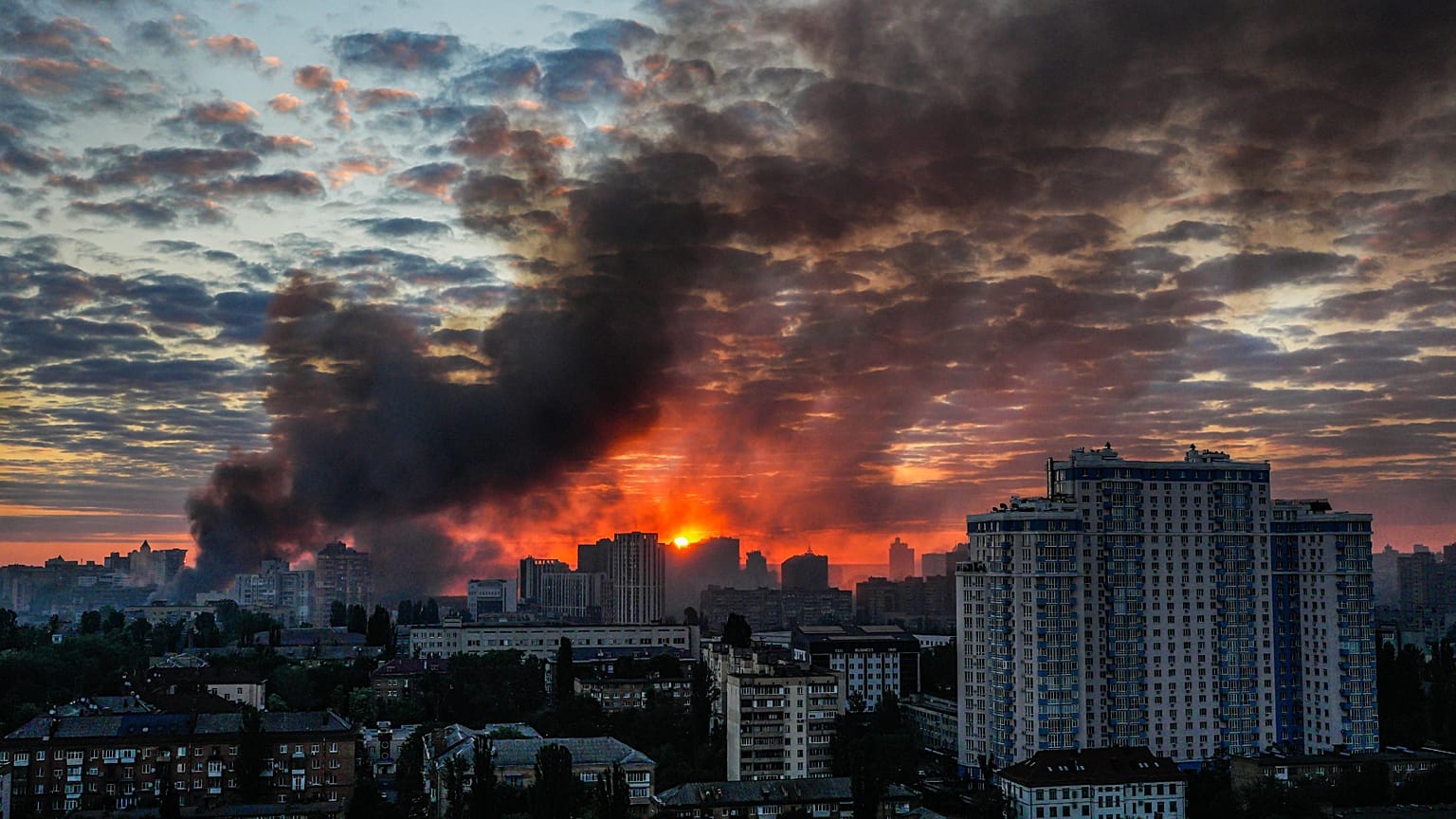
Following a heavy Russian air strike on Kyiv in Ukraine, smoke rises above the city at sunrise on Sunday, 24 May 2026.
Copyright AP Photo

By Sonja Issel
Published on


Russia’s use of the “Oreshnik” missile has drawn international attention. According to Moscow, the intermediate-range missile is capable of striking targets across large parts of Europe.

On Sunday, Ukrainian President Volodymyr Zelenskyy said Russia had again deployed its "Oreshnik" intermediate-range ballistic missile, this time in the Kyiv region.

The Russian Defence Ministry later confirmed the launch, saying it came as part of a retaliatory attack following Ukrainian strikes against "civilian targets," which Kyiv has denied.

Moscow's use of the "Oreshnik" missile has sparked strong reactions abroad.

German Chancellor Friedrich Merz condemned the attack as a "reckless escalation" in a post on X and reaffirmed Germany’s support for Ukraine.

French President Emmanuel Macron also condemned the latest Russian strikes, saying civilian targets in Ukraine had once again come under attack. He described the reported use of the nuclear-capable "Oreshnik" missile as a sign of both the deadlock in Russia’s war effort and a dangerous escalation of the conflict. Macron added that France would continue supporting Ukraine and efforts towards a just and lasting peace.

European Commission President Ursula von der Leyen said the massive Russian assault demonstrated "the Kremlin’s brutality and disregard for both human life and peace negotiations."

Terror against civilians, she said, was "not strength" but "desperation." She added that the European Union would continue supporting Ukraine, particularly by strengthening its air defence systems.

EU foreign policy chief Kaja Kallas described the attacks as "abhorrent acts of terror" against the Ukrainian civilian population. She said Russia had reached a military dead end and was therefore deliberately targeting city centres.

Kallas called the reported use of the "Oreshnik" missile particularly alarming, describing it as "reckless nuclear brinkmanship." EU foreign ministers are expected to discuss further pressure on Russia next week.

The "Oreshnik" missile's first known use came in 2024 during an attack on the Ukrainian city of Dnipro. Since then, the weapon system has become one of the Kremlin’s most closely watched military projects.

Russian President Vladimir Putin has described the ballistic missile as a "state-of-the-art".

Moscow says it is an intermediate-range ballistic missile. It is reportedly capable of hitting targets between 3,000 and 5,500 kilometres away. Russian military officials have claimed this would put large parts of Europe within range.

Belarus is also believed to possess the missile system.

The deployment of the “Oreshnik” missile came as part of a large-scale Russian offensive overnight into Sunday. According to the Ukrainian Air Force, Moscow launched 90 missiles and cruise missiles as well as around 600 drones. Although many of the targets were intercepted, dozens of hits were still reported.

Among the sites damaged was the centrally located studio of German public broadcaster ARD, which was heavily damaged and partially destroyed. According to the broadcaster, a massive blast wave likely caused the destruction, shattering windows and devastating parts of the studio.

No one was injured in the attack. At the time of the strike, no employees were inside the building.


European leaders condemn Russia's deadly

ballistic missile attack on Ukraine


European Union leaders are considering putting further pressure on Russia in response to intense bombing of the Ukrainian capital in the early hours of Sunday. Russian forces fired a nuclear-capable missile in one of their heaviest barrages of the war so far.


Issued on: 24/05/2026 - RFI


Debris lines the streets of Kyiv in the aftermath of an overnight Russian missile and drone strike on Ukraine, 24 May 2026. © REUTERS - Thomas Peter

At least four people died when Russia pounded Kyiv overnight, Ukrainian authorities said, two in the capital and two in the surrounding region.

More than 80 people were reported wounded after the assault left damage in some 50 locations across Kyiv, including residential buildings, schools and shopping centres.

Russia confirmed it fired its powerful hypersonic Oreshnik ballistic missile, capable of carrying nuclear or conventional warheads. It is the third time Russia has used the missile during four years of war in Ukraine.

Kaja Kallas, the EU's foreign policy chief, called its use "a political scare tactic and reckless nuclear brinkmanship". She said the bloc's top diplomats would meet within days to "discuss how to dial up the international pressure on Russia".

'Dead end'

The attack also included 600 strike drones and 90 missiles, according to Ukraine's air force.

Saying the Oreshnik struck the city of Bila Tserkva in the Kyiv region, Ukrainian President Volodymyr Zelensky called Russia "genuinely deranged".

German Chancellor Friedrich Merz described Russia's decision to use the ballistic missile as a "reckless escalation", while French President Emmanuel Macron said the strikes signalled "the dead end of Russia's war of aggression".

"Terror against civilians is not strength. It's despair," European Commission president Ursula von der Leyen wrote on X.

The attacks came after Russian President Vladimir Putin threatened retaliation for Ukrainian strikes in Russian-occupied territory in the east of the country.

Ukraine had been expecting a major attack after its own forces launched a drone barrage on the city of Starobilsk last week that Moscow said hit a college dormitory and killed at least 21 people, mostly students.

The Ukrainian air force said it intercepted 549 drones and 55 of the missiles fired in Sunday's strikes, highlighting its shortage of air defence missiles.

The country relies on US-made air defence systems to down such weapons, but interceptors remain in short supply, especially since the United States and Israel launched their air campaign against Iran.

(with newswires)


What is Russia’s Oreshnik missile?


Published on


Russia’s Oreshnik missile is a nuclear-capable intermediate-range ballistic missile that Moscow says can evade air defences and strike targets across Europe at hypersonic speeds.

Russia’s Oreshnik missile has returned to the spotlight after Moscow confirmed using the nuclear-capable weapon in overnight strikes on Ukraine, sparking fierce criticism from French President Emmanuel Macron and EU officials.

The Oreshnik missile is an intermediate-range ballistic missile that Moscow says can strike targets across Europe and evade modern air defence systems.

Its first known use came in a strike on the Ukrainian city of Dnipro in 2024. The weapon has since become one of the Kremlin’s most closely watched weapons systems.

Russian President Vladimir Putin has described Oreshnik as a “state-of-the-art” weapon capable of carrying multiple warheads and travelling at hypersonic speeds.

How far can the Oreshnik travel?

Russia classifies the Oreshnik, whose name comes from the Russian word for “hazel tree,” as an intermediate-range ballistic missile, meaning it can hit targets between 3,000 and 5,500 kilometres away. Russian military officials say it would be capable of striking targets across much of Europe.

Belarusian leader Alexander Lukashenko has said the missile has also been deployed in Russian ally Belarus.
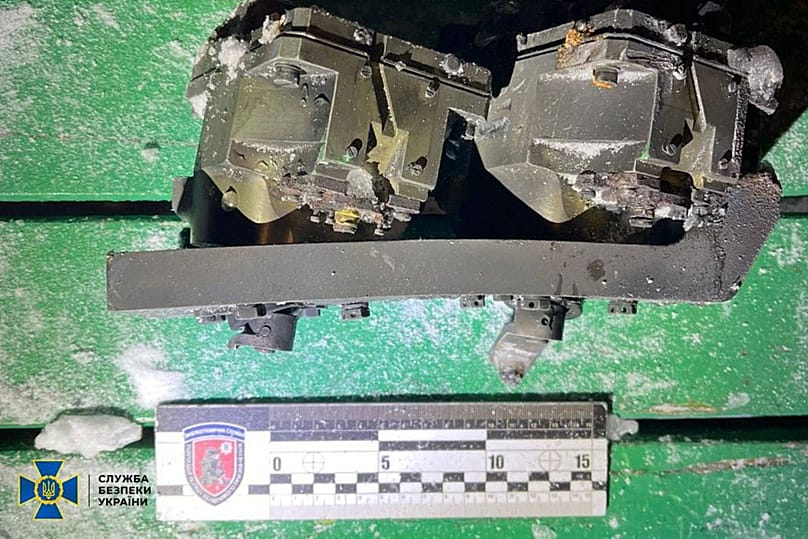
This photo provided by the Ukrainian Security Service on Friday, Jan. 9, 2026, shows a fragment believed to be a part of a Russian Oreshnik intermediate range hypersonic balli AP/Ukrainian Security Service

Can it carry nuclear warheads?

Russian officials say the missile is nuclear-capable, although the first known strike in Ukraine appeared to use non-nuclear or dummy warheads. Military analysts believe Oreshnik could eventually be equipped with nuclear payloads.

Putin has claimed the missile’s impact generates extreme heat and can destroy deeply protected targets, though the first strike in Dnipro caused relatively limited visible damage, Ukrainian authorities said.

Why is the missile difficult to intercept?

According to the Kremlin, Oreshnik travels at around Mach 10, or roughly 10 times the speed of sound. Russian officials claim this makes it almost impossible for current air defence systems to intercept.

The Center for Strategic and International Studies' Missile Threat project says it is "not uncommon" for ballistic missiles or their reentry vehicles to reach hypersonic speeds.

Where did the missile come from?

The US Department of Defense has described Oreshnik as an experimental system based on Russia’s RS-26 Rubezh, a road-mobile intercontinental ballistic missile. Putin has insisted it is not simply a Soviet-era upgrade, but an entirely modern weapon developed after an order issued in 2023.

‘Aid workers are targeted’: Russian drones strike UN convoy in Ukraine

Russian drones twice targeted a UN humanitarian mission tasked with delivering aid to civilians in the southern Ukrainian region of Kherson on May 14. In the hours following the strike, Russian military bloggers published footage of the attack, only to delete it shortly after.


Issued on: 19/05/2026 
By: The FRANCE 24 Observers/Guillaume MAURICE

This screenshot from a video published by a Russian military blogger on Telegram on May 15, 2026, shows the moment just before a Russian kamikaze drone strikes a UN vehicle in Ukraine’s Kherson region. Location: 46°37'16.18"N 32°34'35.76"E © Telegram / osvedomitell_alex

It was 9am on May 14 when an FPV drone slammed into a convoy of white, UN-marked vehicles in southern Ukraine. The targeted humanitarian mission was being carried out by teams from the UN Office for the Coordination of Humanitarian Affairs (OCHA).

The convoy was moving between the cities of Kherson and Ostriv when the Russian kamikaze drone suddenly struck one of the vehicles.


This video was posted to X on May 14, 2026, by OCHA. It captures the moment a Russian drone attacked the convoy. Source: X / OCHA_Ukraine


‘We didn't see the drone coming’


The attack occurred as the humanitarian convoy was crossing the bridge connecting Kherson's port district to the Ostriv neighbourhood. The area sits nearly six kilometres from the nearest Russian positions across the Dnieper River, which separates the two armies.

This image shows the areas under Russian control (in red) and those under Ukrainian control (in green). The red circle indicates the location of the UN convoy at the time of the attack. © Deep State Map

Andrea De Domenico, OCHA’s head of office in Ukraine, was in the vehicle directly behind the car targeted by the drone. He told our team:

"The first strike hit near a bridge between Kherson and Ostriv around 9am. We knew it was a dangerous crossing – completely open and highly exposed – so we were moving fast. I was filming on my phone to get footage for an update on our mission.

Just as we cleared the bridge, the drone struck the back of the convoy’s lead vehicle. We didn’t see it coming, especially since we didn't have drone detectors. Fortunately, no one was injured, and we were able to keep driving."

On May 15, the Telegram channel of Russian military blogger osvedomitell_alex, who shares updates on Russian units in the Kherson region, published the drone footage of the attack. Although the video was later deleted, the post was archived on the TGstat platform, and the footage has since been reposted by another Russian blogger.


Pro-Russian blogger zlobnyi_surok posted on May 15, 2026, the video of the attack, which had been initially shared by osvedomitell_alex. The impacts of two Russian FPV drones are visible at 0:34 and 0:56. Source: Telegram / zlobnyi_surok

The drone footage is unequivocal: it shows the drone hovering over the canals of Kherson’s port before diving toward a vehicle in the convoy crossing the bridge. The UN logo is clearly visible on the door of the white vehicle. The footage has been geolocated by volunteer teams from the GeoConfirmed group.

The drone footage has been geolocated by volunteer teams with the Geoconfirmed organisation. Location: 46.623280, 32.5950 © X / 99Dominik_ / Zeldamices


In the video he posted on May 15, blogger osvedomitell_alex reused the footage captured by Andrea De Domenico, which OCHA had shared on its social media the previous day.

‘The drones were hunting for us’


A second drone strike hit the Ostriv area, located in close proximity to Russian positions. This time, UN vehicles were parked outside a building. As with the first attack, footage captured by Russian drones was shared by osvedomitell_alex and then geolocated by the GeoConfirmed team.

The building where the UN vehicles were parked is a former school that had been repurposed into a humanitarian aid centre.

A Google Earth image (above) and a screenshot from the Russian drone footage (below) show the same two buildings located in Ostriv. © X / 99Dominik_ / Zeldamices


For De Domenico, this second attack is proof that the UN convoy was deliberately targeted:


"The second strike occurred twenty minutes after the first. They targeted us a second time while we were parked in front of a building where we had just delivered humanitarian aid. We were bringing food to this centre, which locals use to recharge their phones since there is no longer any electricity in Ostriv.

While I was speaking with residents inside the building, there was a loud explosion. My team came to tell me the car had been hit again. At that moment, I realised we had to leave the area, because it was clear that the drones were hunting for us. We finally managed to get away half an hour later."
‘We gave notice of our mission six days before it began’

In its Telegram post, osvedomitell_alex attempted to justify the strike on the OCHA mission. He claimed that "no official authorisation, notification, or security corridor was received for this 'humanitarian mission’. In an active combat zone, such vehicles automatically become targets".

The blogger further argued that the UN vehicles should not have been operating in the area: "Objective control footage clearly shows the vehicle driving through the red zone. Our teams immediately identified it as a priority target and a potentially dangerous object."

De Domenico said notifying both parties to the conflict is a prerequisite for every mission his teams undertake:


"As always, we notified both parties to the conflict ahead of our intervention. This time, we gave notice of our mission six days before it began. Therefore, everyone had plenty of time to adapt to our presence. Following the attack, we asked the parties what had happened. OCHA is not in a position to attribute the attack to either side, as that is not our role.

But humanitarians are not the only ones being targeted. In Kherson, drone attacks against civilians have become systematic. It is crucial for us to continue supporting the people in this region. In Ostriv, more than two hundred people are living in isolation. Often elderly and destitute, they risk their lives every day because of the drones. They are living without water or electricity. It is therefore vital to speak with these residents to understand why they refuse to leave Ostriv, which is an extremely dangerous locality.

In Kherson, as elsewhere, it is clear that the floodgates of lawlessness have been opened: aid workers are targeted in flagrant violation of international law. Drones are reshaping not only the conduct of war, but also the way crimes against civilians are committed."

This article has been translated from the original in French.


Ukraine Claims Attack on Russian Frigate Admiral Essen

Bora-class
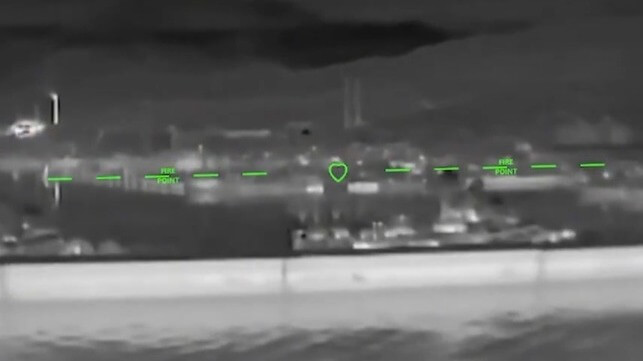
A Fire Point attack drone closes in on a Bora-class missile corvette at Novorossiysk (AFU / Magyar)

Published May 24, 2026 6:01 PM by The Maritime Executive


Ukraine's drone forces claim to have hit a Russian frigate at a pier in Novorossiysk, along with one of Russia's rare hovercraft-like fast missile corvettes. The strikes occurred as part of a broader campaign against targets at the Sheskharis oil terminal and associated infrastructure. 

Ukrainian drone forces commander Robert "Magyar" Brovdi reports that the strike hit the frigate Admiral Essen, previously damaged by a Ukrainian cruise missile in the opening months of the war. Accompanying video footage from Ukraine's general staff appears inconclusive, and the extent of any damage was not reported. 

Also targeted was a Project 1239 Bora-class missile corvette, one of two in existence. The Bora-class is a late Soviet design with a catamaran hull and rubber curtains fore and aft. Fitted out as a "surface-effect ship," it can function in the manner of a hovercraft to achieve high speeds, up to a maximum of 55 knots in calm conditions. Samum, one of the two sister ships, was reportedly damaged by a Ukrainian strike in 2023. 

In the same operation, Ukrainian drones struck and ignited an oil storage tank farm at Grushova, starting a fire. The Sheskharis marine terminal in Novorossiysk's inner harbor - a perennial target - was also hit and damaged. Russian authorities asserted that the sites had been hit by falling drone debris. 

In addition, Ukraine claims to have damaged the sanctioned "shadow fleet" tanker Chrysalis. As of Sunday, Chrysalis' AIS signal suggested that the vessel was at anchor just off the coast of Turkey, near the northern entrance to the Bosporus. The claim could not immediately be confirmed. 

Chrysalis has previously been targeted by a much different opponent - Yemen's Houthi rebels. The tanker was attacked twice by Houthi missiles in 2024, but escaped without harm. 

INTERVIEW

Moldovans 'want to be EU citizens, not Russian citizens', says president Sandu

Strasbourg – Moldovan President Maia Sandu says joining the European Union is a matter of democratic survival for her country, which is under growing pressure from Russia and the unresolved conflict in Transnistria. In a joint interview, Sandu spoke to RFI and German broadcaster Deutsche Welle at the European Parliament in Strasbourg, where she received the European Order of Merit on Tuesday.


Issued on: 20/05/2026 - RFI

Moldova’s President Maia Sandu took part in a joint interview with RFI and Deutsche Welle at the DW studios in Strasbourg. © RFI

Moldova, one of Europe’s poorest countries, has stepped up its push towards joining the EU since Russia launched its full-scale invasion of Ukraine in 2022. The former Soviet republic was granted EU candidate status the same year.

Moldova has strongly backed Ukraine, while trying to maintain its constitutional neutrality.

The country is under pressure from Moscow and dealing with instability linked to Transnistria, a pro-Russian region which split from Moldova after a short war in the early 1990s following the collapse of the Soviet Union – and where Russian troops remain stationed.

It is internationally recognised as part of Moldova but has long relied on Russian political, military and economic support.

Many Moldovans, including Sandu herself, also hold Romanian passports. In January, the Moldovan president said she would support unification with Romania if there were a referendum on the issue.

Last week, more than 30 countries pledged in Chisinau, Moldova’s capital, to create a special tribunal to prosecute Russian crimes linked to the war against Ukraine.

Sandu accuses Moscow of trying to intimidate Moldova and recruit fighters for the war in Ukraine, and insists that Moldovans increasingly see their future with Europe rather than Russia.

Moldova’s vote sets it on EU course but deep political rifts remain

RFI/DW: You've just received the European Order of Merit for "steering Moldova decisively along its European path”. Are you still confident that Moldova will join the EU before 2030?

MS: I am very determined and confident that Moldova will become part of the European Union. It is our commitment to the people of Moldova to be ready by 2030. And we do believe and hope that the EU institutions and the EU member states will support our agenda.

RFI/DW: Are you not concerned that this process is taking too long?

MS: There is always a risk that some things will be delayed, but we are not losing time. We are implementing the reforms and not waiting for formal decisions. But of course, we also want those formal decisions to be taken.

RFI/DW: Would a two-step approach work for you – becoming a partial member before full membership?

MS: We are now working on full membership. This is a merit-based process. We are implementing the reforms for full membership. So this is the discussion we are having with the EU institutions and EU member states, and this is the process we are following at home.

RFI/DW: A major hurdle for Moldova on its path to the EU is Transnistria, the separatist region where Russian troops are stationed illegally. What will you do about that, and how can Moldova become an EU member despite this major problem?

MS: Of course we would like to solve the problem and we have been taking measures, including economic and financial measures. We see more people from the Transnistrian region coming for jobs on the right bank of the Nistru [the government-controlled side of Moldova] because they realised they cannot rely on Russia after experiencing an energy crisis in the middle of winter, when Russia stopped gas supplies.

There's still a security issue because Russia keeps troops illegally on our territory. But we do hope to solve this issue peacefully. This is our commitment – to solve the conflict peacefully. So we are working on this issue while also working on the reforms linked to our EU integration path.

Moldova’s pro-EU ruling party wins majority in parliamentary elections

RFI/DW: Vladimir Putin has signed a decree making it easier for residents of Transnistria to obtain Russian citizenship. You said this could be Russia trying to recruit soldiers to fight in Ukraine. What is your country’s response to this decree, and what can be done to prevent people from Transnistria fighting for Putin?

MS: We know that Russia is trying to threaten us, and this may also be part of the plan – to scare us. Russia has been doing this for a long time. We want to solve the conflict peacefully and we have made this clear again and again. We will not allow Russia to influence our internal and external policies through these threats.

We believe in freedom and sovereignty, and that is why we will make decisions that suit Moldovans, not decisions that suit Russia. The Kremlin does not value human life and we have seen this in Russia itself. We also know that Russia has been trying to recruit people from other countries to fight in Ukraine.

But we also know that people in the Transnistrian region do not want this. The proof is that when the war started, many young people from the region moved to the right bank of the Nistru because they were afraid Russia would send them to war. They do not want to be part of this crazy, brutal war. They want to live in peace.

RFI/DW: Does this mean you don't expect many residents of Transnistria to apply for Russian citizenship?

MS: I believe those who wanted Russian citizenship probably got it in the past. But I also don't see why people would want Russian citizenship these days. On the contrary, many people who did not have Moldovan passports have now obtained them. People want to be EU citizens, not Russian citizens.

RFI/DW: Many Moldovans have Romanian passports, including you. In January, you said that if there were a referendum, you would support unification between Moldova and Romania. What would be the advantages of such a scenario, and could it become an alternative if EU accession does not work?

MS: I want my country to be safe and I want Moldova to be part of the free world. It is becoming more and more difficult for small countries, especially in our region, to preserve and pursue their goals because of Russian aggression.

For us, being part of the European Union is the strategy for surviving as a democracy. And we hope we can achieve this sooner than later.

RFI/DW: Without becoming part of Romania?

MS: Well, we can join Romania in the European Union. And this is not only what we believe – most people in Moldova support EU integration. There are also people who support unification with Romania. Right now we are working hard to make Moldova part of the European Union and we hope this scenario will work.

If it does not work for one reason or another, of course we will consider other options. The main objective is to preserve peace in Moldova and keep Moldova part of the free world.

How Russian disinformation flooded Moldova's media landscape ahead of election

RFI/DW: Moldova recently said it would join the “coalition of the willing” in the event of a ceasefire between Russia and Ukraine. What would Moldova contribute? Could it provide bases for European soldiers, for example?

MS: Moldova is a neutral country and we have to respect the neutrality set out in our constitution. But we have been helping with de-mining and we could do more in that area if needed. We have also supported the solidarity lanes [a network of alternative trade routes established in May 2022 by the EU, Ukraine and Moldova] and we could do more there as well.

We are still discussing this, but we want to help while also respecting constitutional neutrality. That means there are some things we cannot do, including sending soldiers.

RFI/DW: Moldova’s experience dealing with Russian troops could also be an asset to the coalition of the willing, since Russian troops are stationed in Transnistria.

MS: We have managed to keep the situation peaceful. We have avoided destabilisation that could have dragged the region and the country into war. But it is in Moldova’s interest, Ukraine’s interest and the interest of the EU as a whole to see Russian troops withdrawn from Moldova.

We have to work together on these issues.

RFI/DW: Do you think Vladimir Putin will one day stand before this court?

MS: Yes. Accountability is very important. Without accountability, these crimes against humanity risk being repeated.

It is our duty to make sure there is accountability and to make sure those responsible for what has been happening in Ukraine for more than four years answer for their crimes.

This interview was conducted by Daniel Vallot for RFI and Dana Alexandra Sherle for Deutsche Welle.
Lukashenko Has Repressed At Least 500,000 Belarusians Since 2020 – OpEd


May 25, 2026 
By Paul Goble


“The number of politically motivated criminal cases [in Belarus] exceeds the number of those freed or serving time behind bars,” Vladimir Zhigar says in a new report which shows that since 2020, the Belarusian dictator Alyaksandr Lukashenko has actively repressed 500,000 of his country’s citizens, not the few thousand many speak of.

Zhigar, who represents the organization of former force structure employees who now cooperate with the BelPol opposition, made these remarks at a congress concerning such people at a conference in Vilnius (rfi.fr/ru/европа/20260522-belpol-с-мая-2020-года-в-беларуси-репрессировано-полмиллиона-человек).

There, he presented a report BelPol has compiled about repression in Belarus since 2020. According to him, at least a half million Belarusians have been subject to repressive actions by the state, a figure that his group has compiled because Lukashenko stopped publishing data on this issue two years ago.

This figure includes both those who Belsians who have been harassed without being arrested, others against whom charges have been brought and who have been imprisoned for various lengths of time, and a third group consisting of those who have subjected to harassment and various restrictions after they are released, according to the report.


As large as the figure of 500,000 is, BelPol continues, the true dimensions of repression in Belarus are much larger if one includes the families and friends of those subject to repression in the narrow sense and all Belarusians who suffer from Lukashenko’s authoritarian policies.

Other speakers at the Vilnius conference, including Belarusian Nobelist Ales Ales Bialiatski, agreed and said that Lukashenko’s continuing campaign against the population is designed to intimidate all Belarusians to keep quiet and to force those who can’t to leave the country and not return.
How Russia’s shadow fleet keeps slipping through Europe’s net

Russia’s vast “shadow fleet” of vessels has been seen primarily as a means of keeping the Kremlin’s oil revenues flowing despite Western sanctions. But a new report from the monitoring group ACLED argues the fleet has evolved into something bigger – a flexible platform for hybrid warfare across northern Europe.


Issued on: 22/05/2026 - RFI

Swedish police and coast guard officers board the tanker Sea Owl I off Trelleborg on 13 March 2026, amid suspicions that Russian commanders were sailing under false documents. AFP - JOHAN NILSSON

In a report published on Friday, the conflict-monitoring organisation ACLED describes an increasingly emboldened maritime system that allows Moscow not only to circumvent sanctions, but to operate in the grey area between commerce, espionage, intimidation and sabotage.

Despite hundreds of sanctions, Russia is still successfully using the fleet to sustain its war economy, exposing vulnerabilities in Europe’s critical infrastructure.

According to ACLED, the fleet comprises anywhere between 1,000 and 3,200 vessels. Ukrainian authorities have identified nearly 1,400 ships, while estimates suggest the network now transports up to 80 percent of Russia’s seaborne crude exports.

Many of the vessels are ageing tankers hidden behind layers of shell companies, false registrations and frequent name changes.

Crews are reportedly recruited through WhatsApp, communications rely on Starlink, payments can be made in cryptocurrency, and ships often manipulate or disable their Automatic Identification Systems to avoid tracking.

This has allowed Moscow to keep oil moving around the globe even as the European Union, the United Kingdom and the United States have imposed broad sanctions. As of May 2026, the EU alone had sanctioned 632 vessels linked to the shadow fleet.

However, under the UN Convention on the Law of the Sea, European states cannot board or seize suspicious vessels unless they can prove criminal activity or demonstrate that a ship is effectively “stateless” – which has created an ideal operating environment for Russia.


The Baltic Sea's critical European infrastructure © ACLED

Military implications

The Baltic Sea has become the focal point of shadow fleet activity, being home to Russia’s major oil terminals at Primorsk and Ust-Luga. The region is also dense with undersea telecoms cables, electricity links and gas pipelines connecting Nordic and Baltic states.

On New Year’s Eve 2025, Finnish special forces boarded the cargo ship Fitburg after an undersea cable between Helsinki and Tallinn was damaged. Investigators said the vessel had dragged its anchor along the seabed while travelling from St Petersburg towards Israel. Finnish authorities later discovered sanctioned Russian steel on board.

Although investigators stopped short of claiming deliberate sabotage, the episode highlighted the increasingly blurred line between sanctions evasion and hybrid warfare.

Maritime intelligence company Windward recorded more than 2,300 Russian-affiliated vessels entering the Baltic between February 2024 and February 2025. During the same period, “drifting activity” – when a vessel is stationary or moving slowly without any obvious navigational purpose – near subsea infrastructure increased dramatically, while more than 16,000 gaps in vessel tracking signals were recorded.

The result is a persistent atmosphere of uncertainty that benefits Moscow, according to Windward.

French enforcement

France has become one of the more visible European players in terms of testing how far coastal states can go in response to Russia’s shadow fleet.

One key case involved the tanker Pushpa – also known as the Kiwala or the Boracay – a sanctioned vessel operating on the Russia to India route.

French naval forces seized the ship after it was tracked off the Danish coast, during a wave of drone incidents which temporarily closed several Danish airports in September 2025.

There is no claim that the tanker directly launched the drones. But the incident demonstrated that European governments are increasingly willing to act on the risks created by the shadow fleet’s presence, even if individual incidents remain difficult to prove.

In February 2026, Swedish forces reportedly observed and jammed a reconnaissance drone launched near Malmö against the French aircraft carrier Charles de Gaulle.

That drone was traced not to a shadow fleet tanker, but to the Russian intelligence vessel Zhigulevsk, but the episode underlined that the boundary between commercial shipping, intelligence activity and military pressure is becoming harder to draw.


Russia's hybrid maritime campaign in European waters © ACLED

The cost to Moscow

In terms of a wider European response, NATO has launched the Baltic Sentry operation, while the UK has introduced its Nordic Warden surveillance measures. Since late 2024, eight European enforcement actions against shadow fleet vessels have been recorded, mainly through boardings and seizures where legal grounds can be established.

Moscow, however, has adapted quickly. Some tankers have been escorted by Russian warships, while dozens of vessels have been reflagged under the Russian registry to make boarding more difficult in legal terms. There has also been increasing use of military-linked personnel aboard commercial tankers.

European action thus raises the cost to Russia of using a shadow fleet, but the fleet remains central to keeping its oil revenues flowing despite sanctions.
'Wiped out': Ukraine's bird lovers long for peaceful skies

Kryvyi Rig (Ukraine) (AFP) – When Viktor Sevidov looked up to the sky above Ukraine's war-scarred landscape, he was not watching out for incoming missiles or drones. Instead, he was looking for birds.


Issued on: 24/05/2026 - RFI

Russia's 2022 invasion has wrought yet more suffering on Ukraine's birdlife. © Genya SAVILOV / AFP

"There's a jay... That's a bluethroat... Do you see the hen harrier? We're lucky," the 37-year-old photographer told AFP.

Threatened in peacetime by deforestation, intensive agriculture, urbanisation, pollution, hunting and climate change, Russia's 2022 invasion has wrought yet more suffering on Ukraine's birdlife.

The constant aerial bombardments have devastated wildlife and wrecked a delicate ecosystem across a 1,200-kilometre (750-mile) frontline – including birds' nesting grounds and migratory routes.

Every dawn or dusk, Sevidov leaves his grey apartment block on the outskirts of Kryvyi Rig, an industrial city in central Ukraine, to see what birds he can spot

"I see shaheds every day... I want to see a clear sky," he said, referring to the Iranian-style attack drones that Russia fires hundreds of every day at Ukraine.

Constant aerial bombardments have devastated wildlife © Genya SAVILOV / AFP


Amid a global biodiversity crisis, birds – which play a vital role in pollination, seed dispersal and controlling insect populations – are one of the fastest declining groups.

Before Russia invaded, Sevidov photographed wildlife in the southern Zaporizhzhia and Kherson regions.

Partly occupied by Russia and under constant bombardment, his previous spots are either "destroyed" or "unreachable".

One day in 2024, he saw a Russian missile shot down above him while he was taking photos near Odesa.

"For me, it's disgusting... I don't want to see that. I love nature. I love life. Not things that bring death."

'Fatal'

Contrary to what some may think, birds cannot always easily flee the dangers of war, zoologist Ewa Wegrzyn, from the Polish University of Rzeszow, said.

Many species of birds are philopatric, meaning they either stay in the area they were born or regularly return to the same place to mate.

"Unfortunately, during war, philopatry can be fatal, as it leads birds along migration routes over areas affected by fighting," Wegrzyn said.

Birds cannot always easily flee the dangers of war © Tetiana DZHAFAROVA / AFP


At a refuge centre in Voropaiv, near the capital Kyiv, more than 200 birds have been housed, including dozens wounded in the war.

"Birds very often get caught in anti-drone nets or become entangled in fibre-optic cables, injuring their wings, and they suffer terribly," Iryna Snopko, the shelter's 63-year-old director told AFP.

Alongside covering roads in huge nets to stop drone attacks, both Russia and Ukraine have fired thousands of tethered fibre-optic attack drones – with the webs of discarded cables stretching for dozens of kilometres.

Wildlife in Chernobyl exclusion zone

Since 2022, the Sadyba Nyushanik centre has built a new aviary to house the influx of injured birds.

Among those taken in are a blind swan, an eagle with an amputated wing and a stork that suffered a concussion during an air attack.

They recently paid to treat an owl that had been severely burned when a drone crashed into its tree. It later succumbed to the injuries.

Birds play a vital role in pollination, seed dispersal and controlling insect populations © Genya SAVILOV / AFP


Walking around, Snopko spoke affectionately about the "love stories" that have formed among the storks.

She showed off a female crow, Varia, who can say her own name.

"Vooaaria!" the bird croaked, a concoction of sounds that resembled a drunken old man.
'Wiped out'

When Russia invaded in 2022, Sevidov stopped taking photographs for two years – not wanting to pursue his "hobby" while many of his friends were going off to war.

He had wanted to join the army, but was declared unfit for service as one of his arms has been disabled since birth.

Those same friends eventually convinced him to restart, to try to show something "positive".

Soldiers recalled seeing "traumatised" animals near the front © Genya SAVILOV / AFP


His vivid colour photographs now frequently appear in local media outlets – alongside pictures of fires, explosions and obituaries.

Bird enthusiast and Sevidov's best friend, Vyacheslav Kaistro, did enlist.

"There's simply no living space left where the fighting is taking place," the 58-year-old told AFP, speaking in a park in the central city of Dnipro.

Nearly half of migratory species in decline as UN summit opens

"Habitats are being destroyed. The birds that live in those habitats are simply being wiped out."

He recalled seeing a lot of "traumatised" animals near the front.

"Their behaviour is completely different... as if they're under the influence of some kind of drug."

One night in 2023 while on an offensive he saw a Eurasian eagle-owl for the first time in his life.

"It was a bad omen. I had a feeling that something was going to happen," he said, falling silent and staring ahead with eyes frozen.

Hours later he stepped on a mine, losing his right leg in the blast.