Monday, June 01, 2026

DROUGHT, WAR AND NOW ...

Locust army swarms Iran as farmers battle to save their crops

Locust army swarms Iran as farmers battle to save their crops
Stock image: Locusts destroy crops in biblical swarm across southern Iran. / bne IntelliNewsFacebook
By bnm Tehran bureau May 31, 2026

Billions of hungry Moroccan Locust (Dociostaurus maroccanus, or DMA) have descended on southeastern Iran, and thousands of families are fighting to stop the ravenous swarm from devouring everything they own.

The pests have exploded across the plains of southern Sistan-Baluchestan near Pakistan, where farming and herding keep thousands of households alive, state media reported on May 31.

This latest infestation is part of a growing trend of pest-related agricultural challenges linked to climate change. As global temperatures rise and weather patterns become more erratic, experts warn that such infestations may become more frequent and intense, threatening food security and farmers' livelihoods worldwide. That, coupled with increasing droughts, is putting a series of strain on food production in the region, which is struggling to deal with the changing weather patterns.

Numbers have rocketed to between 10 and 12 locusts per square metre in parts of Konarak, four to five times higher than last year in the latest sign of changing climatic conditions in the already arid region of the Islamic Republic.

"This year the locusts have been far more noticeable than in past years, and it has worried farmers," local grower Mohammad Amiri said. He warned that without early action, young crops would have been hit hard.

Sedigh Pourian, head of the technical and infrastructure office at Konarak's agriculture authority, said egg-laying hotspots had been tracked down in the foothill rangelands using specialist pest-monitoring systems, triggering a mass eradication drive but farmers are still worried despite official comments of it all being under control.

The bugs do not stop at crops. In large enough numbers, they strip rangeland vegetation bare, slashing animal feed, driving up the cost of keeping livestock, and threatening food security across the region already under pressure from supply-side issues stemming from the ongoing war with the US and the blockade of southern ports.

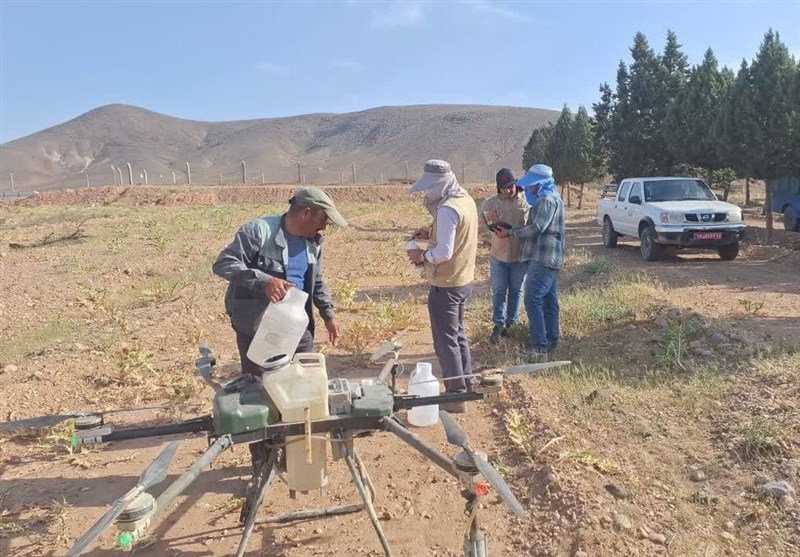
Local teams have ploughed up egg sites, cleared weeds and launched targeted spraying across around 1,000 hectares so far, racing to crush the population before the insects mature and breed again.

Chemical operations cost between IRR15mn and IRR50mn ($8.69 to $28.97) per hectare depending on the pesticide and kit used, piling pressure on the cash-strapped plant-protection budget.

Experts have ordered a freeze on harvesting and grazing in sprayed zones for 72 to 96 hours, with farmers kept updated to avoid any risk to people and animals.

Pourian said protecting the environment, keeping pesticide residues out of produce and sparing beneficial insects were all priorities alongside the cull.

"If the agriculture authority's measures had not been taken in the early stages, the chance of damage to young crops would have been very high," Amiri said.

In 2024, it was reported that locust infestations had accelerated across Asia as temperatures continued to rise. 

Tajikistan and Afghanistan are facing a dangerous infestation situation, according to the latest Food and Agriculture Organisation (FAO) forecast on invasive swarms of the crop-devouring pest.


Was Trump Ever a ‘Realist’?

by | Jun 2, 2026

Reprinted from The Realist Review.

Over the course of his three presidential campaigns (2016, 2020, 2024), President Donald J. Trump promised an America First foreign policy – one that would see America pull back from postwar European security commitments, end the war in Ukraine, and keep the country out of the Middle East “forever wars” that so beguiled (and then bedeviled) every US president for the past quarter of a century. Instead, as we head into the 2026 midterms, his record is, to a surprising degree, primarily one of continuity with the national security policies of his predecessors. In the context of foreign policy, Trump II might properly be seen as Bush-Cheney’s third term, such has been the influence of neoconservative personnel and ideas within his two non-contiguous administrations.

Trump is often seen, and for good reason, as a man set on overturning long-established “norms” of governing. And yet, for someone with such an outsized reputation for disruption and chaos, during both of his terms in office, Mr. Trump placed foreign policy under the purview of the Establishment figures like former ExxonMobil CEO Rex Tillerson, former Congressman Mike Pompeo, Lt. General HR McMaster, former UN Ambassador under George W. Bush, John Bolton, the real estate magnates Steve Witkoff and Jared Kushner, the neoconservative US Senator Marco Rubio, South Carolina Governor Nikki Haley, and Raytheon vice president Mark Esper. Far from being kept out of the fold, neoconservative ideologues whom Mr. Trump attacked with ferocity during his first run for the presidency in 2016 were welcomed in at the highest levels. No one had any right to be surprised, after all, those who have had the disagreeable experience of dealing with Mr. Trump in his former life as a New York real estate magnate understand that with him, a promise made is as good as a promise broken – it is a pattern of mendacity that defines his career in business and politics.

Trump announced his candidacy at Trump Tower on June 16, 2015. Within the span of a single month, he was leading in the Republican primary polls. As summer turned to fall, panic began to set in among his Republican opponents, who–with the exception of Senator Rand Paul (R-KY) – dared not deviate from the strictures of Washington‘s foreign policy establishment. Each was as unremarkable and as in thrall to the Bush-Cheney era neoconservative orthodoxy as the next. In September 2015, only weeks before an urgently needed back surgery, I flew from Washington, D.C., to the Ronald Reagan Presidential Library in Simi Valley, California, to report on the GOP primary debate for The Nation. After viewing the sorry spectacle, one thing above all others was clear: that despite recent setbacks, such as the failure of the Bush-Cheney Global War on Terror and the recently agreed-upon Joint Comprehensive Plan of Action for Iran’s nuclear program, the idea that neoconservatives were a spent force within the GOP was premature, at best. It was clear to me, anyway, that the neocon outlook continued to have a stranglehold on the Grand Old Party.[1] The joint attempt by Trump’s 14 opponents (10 faced off against Trump directly, 4 were relegated to a sort of undercard bout, including the noted chicken-hawk Lindsey Graham) to derail his candidacy came to naught. Yet few remember that at that early stage of the primary contest, Trump had yet to give full vent to his anti-interventionist, America First, message. At the Reagan Library debate, Trump’s message was a marriage of jingoism and militarism, reminding the assembled audience of GOP dignitaries, operatives, and hangers-on that he “is a very militaristic person.”[2]

Only gradually did Trump take on the role of neocon-slayer that many had assumed Paul would play that year, including TIME Magazine, which placed Paul on its October 2014 cover and declared him “the most interesting man in politics.”[3] Trump, at the urging of his close adviser, the publicist and former Goldman Sachs banker and Epstein associate Steven K. Bannon (now, somehow, a tribune of the common man), continued to play up his entirely fabricated record as an early opponent of the Iraq War. During a heated exchange between Trump and George W. Bush’s young brother, the hapless former governor of Florida, Jeb Bush, at the Republican primary debate in Greenville, South Carolina, on February 13, 2016, Trump condemned the Iraq war as “a big fat mistake.” Later on, when the neoconservative Cuban-American Senator from Florida, Marco Rubio, said “on behalf of me and my family [sic], I thank God, all the time, that it was George W. Bush in the White House on 9/11 and not Al Gore,” Trump shot back: “How did he keep us safe when the World Trade Center… the World-excuse me, I lost hundreds of friends. The World Trade Center came down during the reign of George W. Bush. He kept us safe? That is not safe, Marco.”

Trump’s seeming turn against Bush-era neoconservatism caught the attention of a small group of foreign policy realists centered around the Washington-based think tank, the Center for the National Interest (CTNI), many of whom had been critics of the 2003 war in Iraq and generally drew their inspiration from what was thought to be the “realist” line of thinking embodied by President Richard Nixon, Secretary of State Kissinger, and to a somewhat lesser extent, George HW Bush, and his national security adviser Brent Scowcroft, began to warm to Trump’s candidacy and offered to assist with shaping and sharpening the novice candidate’s foreign policy positions.[4]

Russia Hoax

On April 27, 2016 Trump, with the assistance of CTNI’s Richard Burt, a respected arms control expert who had served as Ronald Reagan’s ambassador to West Germany, delivered what was billed as a major foreign policy address the Mayflower Hotel in Washington. Given CTNI’s involvement, it was expected that Trump would unveil a new, perhaps even coherent, foreign policy strategy that would seek to move the GOP away from the neoconservatism that had dominated since 9/11. Yet mixed messages prevailed. The candidate who had so stridently condemned the Bush-Cheney record in South Carolina was introduced by Bush’s ambassador to the United Nations, Zalmay Khalilzad, a neocon intellectual of longstanding. While Trump made some nods in the direction of the realist camp, including criticism of President Obama’s disastrous intervention in Libya, Trump’s critique was much in line with the Republican foreign policy establishment, including accusations of abandoning our European allies, such as Poland and our “friend” Benjamin Netanyahu. Where he did depart from the foreign policy establishment was with his view that the US was “not bound to be adversaries” with Russia and China. Indeed, Trump, to the certain consternation of both the Obama administration and the Republican leadership alike, said that regarding the recent downturn in relations between Washington and Moscow, “common sense says this cycle of hostility must end.”[5]

The speech was a flop. Realists found it to be, as the CATO Institute’s Doug Bandow put it, “a very odd mishmash.” Establishment figures such as the Brookings Institution’s Thomas Wright (a future member of the Biden administration’s National Security Council (NSC)) called it “completely contradictory.” Yet despite Trump’s concessions to the status quo, the Mayflower speech won Trump the enduring ire of the establishment. After the speech, Senator Lindsey Graham (R-SC), who is today one of Trump’s most obsequious cheerleaders, said: “Ronald Reagan must be rolling over in his grave.”[6] Trump’s promise, soon to be cast aside along with so many others, that he would staff his administration “with those who have perfect resumes but very little to brag about except responsibility for a long history of failed policies and continued losses at war,” ensured, as two CFTNI executives wryly noted, that the “foreign policy community would race to the barricades.”[7] The decision by the CTNI to invite (and provide a front row seat to) the Russian Ambassador to the United States, Sergei Kislyak. Kislyak’s appearance (who was something of a mainstay at CTNI events in those years) set off a series of hysterical and ultimately unfounded attacks against the Trump campaign.[8] These were the opening salvos of the national embarrassment that became known as Russiagate, which were fired shortly thereafter. Among its first targets was Burt, whom the media invariably portrayed as a Russian agent of influence.[9]

After Trump secured the Republican nomination, his Democratic opponent, former Secretary of State Hillary Clinton, lost little time in tying Trump to Russia. Indeed, Clinton’s campaign manager, Robby Mook, then all of 36 years old and armed with an entirely unearned sense of entitlement, took on a role as a kind of millennial reincarnation of Roy Cohn. But the Russia ruse didn’t take. And as time went on, it became clear to the Trump campaign that Clinton’s record in the Senate (she had voted, among other things, to authorize the use of military force in Iraq) and as the nation’s top diplomat, handed Trump a potent message to an electorate that was increasingly fed up with the series of post 9/11 ‘forever wars.’

A poll published by the Pew Center in July 2016 found that 43 percent of Americans believed that the US should “mind its own business internationally.” A further 69 percent said that the US should focus more on domestic problems, while 70 percent said the next president should focus on domestic policy, compared to only 17 percent who said the focus should be on foreign policy.[10] Trump, as he had done throughout his career in business and entertainment, had read the mood of the public and acted accordingly, and adopted the rhetoric of foreign policy realists to achieve his own ends. A month after the election, Trump promised a crowd at Fort Bragg in North Carolina, that his administration “will stop racing to topple foreign regimes that we know nothing about, that we shouldn’t be involved with.”[11]

The extent and depth of the foreign policy establishment’s anger in the wake of Trump’s surprise victory can be seen in the maneuvers it, via its proxies in the outgoing Obama administration and legacy media outlets like the New York Times and Washington Post, deployed to keep Trump from completing (or, perhaps even from starting) his first term. There was what now appears to have been a deeply misplaced fear on the part of Official Washington that Trump would be as good as his word, at least as far as foreign policy was concerned.

Continuity Not Change

The only US president with no prior military or political experience, Trump was forced to rely on “experts” with long ties to the foreign policy establishment. And the ceaseless and baseless campaign to paint him as a Manchurian candidate hobbled any serious effort to revive US-Russia relations. In this, it undoubtedly succeeded. In the opinion of Ambassador jack Matlock, “The effect of the “Russiagate,” hoax… meant that any attempt to make a deal with Russia would have been condemned in the US by those claiming falsely that Russia had embarrassing evidence about him and thus he was subject to blackmail.” In fact, far from being a “dupe” of the Kremlin Trump’s first term record rivaled the hawkishness of the preceding Obama administration.

As is by now clear, from 2017-2021, Trump’s foreign policy was largely circumscribed by Russiagate – but not only. As I have touched on in other contexts, U.S. presidents, despite the power for which their office is renowned, often become, willfully or not, captive to the national security bureaucracy, which often has an agenda that is at odds with the agenda an incoming president campaigned (and won) on. This is hardly a new phenomenon. Decades ago, the philosopher Hannah Arendt observed that the President is “the only person in this country whose range of choices can be predetermined.”

To take one example: Former CIA Director John Brennan, in a newly released Oral History of the Obama Administration taken by the University of Virginia’s Miller Center, registers his amazement at the unexpected continuity between the policies he enacted under Obama and those pursued by his successor, the neocon ideologue Mike Pompeo in the first Trump administration:

I thought that Obama was going to be succeeded by Hillary Clinton, [laughs] and I was comfortable with whoever Clinton was going to appoint as CIA director, who would continue along that path. I was concerned, then, when [Michael] Mike Pompeo was tapped by [Donald] Trump. Pompeo came in and was telling people that he was going to reverse everything I had done. But then some of the key seniors he brought in with him, once they understood what I did, saw the benefit of it, and it wasn’t then reversed at all. [Emphasis added].

Trump may have won the presidency twice, but the foreign policy establishment remains undefeated.


  1. James Carden, The Republicans Just Can’t Quit Neoconservatism, The Nation, September 17, 2015.
  2. Ibid.
  3. In retrospect, it seems clear that Paul was badly staffed. His aides included the dubious Sergio Gor, who jumped ship and became among Trump’s most obsequious lieutenants, and Doug Stafford, who came under fire for plagiarizing passages from Wikipedia and including them in Paul’s speeches. Other aides included the MS Now talking head, Elise Jordan.
  4. I had served as a contributing editor and online columnist at the Center’s flagship publication, The National Interest, until March 2015.
  5. Text of the Mayflower speech can be found at https://fpa.org/wp-content/uploads/2025/12/DonaldTrumpAmericaFirstSpeech-2016-MayflowerHotel.pdf
  6. See, Graham, Bandow and Wright in https://www.politico.com/story/2016/04/donald-trump-foreign-policy-speech-reaction-222544.
  7. Paul Saunders and Dmitri Simes, Hosting Trump, The National Interest, May 2, 2016.
  8. Few critics bothered to note that the Ambassadors from Italy, Singapore, and the Philippines were also in attendance.
  9. Among the sillier examples of these accusations, see James Kirchick, https://www.politico.eu/article/donald-trumps-russia-connections-foreign-policy-presidential-campaign/
  10. See, https://www.pewresearch.org/politics/2016/07/07/2016-campaign-strong-interest-widespread-dissatisfaction/
  11. See, https://www.theguardian.com/us-news/2016/dec/07/donald-trump-we-will-stop-racing-to-topple-foreign-regimes 
James W. Carden is the editor of The Realist Review.  He is a columnist and former adviser to the US-Russia Bilateral Presidential Commission at the U.S. Department of State. His articles and essays have appeared in a wide variety of publications including The Nation, The American Conservative, Responsible Statecraft, The Spectator, UnHerd, The National Interest, Quartz, The Los Angeles Times, and American Affairs.


Israeli Claims About an Iran ‘Threat’ Were Always a Lie. Now We Have Proof


It is not Tehran led by unhinged, genocidal megalomaniacs threatening the security of the region and the world. It is Tel Aviv and Washington

by | Jun 1, 2026 

Could it be that Israel’s 30-year narrative about Iran – one that persuaded US President Donald Trump to wage a criminal and disastrous war of aggression – was always a fiction, an invention cooked up in Tel Aviv?

Far from Tehran posing an existential danger to Israel, as Prime Minister Benjamin Netanyahu has claimed for decades, might Israel’s real fear be that a stronger Iran would undermine its unique leverage over Washington, threatening its status as the region’s sole – and unmonitored – nuclear power?

Might large parts of the globe be facing economic meltdown simply so that Israel can remain the Middle East’s top dog – an unaccountable apartheid state committing genocide against the Palestinian people and ethnically cleansing southern Lebanon?

We got a definitive answer last week, care of the New York Times. It is an uncompromising yes to all of these questions.

The newspaper reported that Netanyahu not only mis-sold Trump on the idea of quick regime change in Iran following a short “shock and awe” bombing campaign. He also identified to the White House who was going to replace Ayatollah Ali Khamenei, Iran’s supreme religious leader.

Extraordinarily, according to the Times, Netanyahu named the man for the job as former Iranian President Mahmoud Ahmadinejad. The aim at the start of the air campaign was for Israel to kill Khamenei, then liberate Ahmadinejad from house arrest by striking the guards who were confining him.

Presumably, Ahmadinejad was then supposed to storm the citadel and seize the keys to the palace. But only Khamenei’s assassination went according to plan.

Ahmadinejad, who had reportedly been consulted on the scheme beforehand, is believed to have been injured in the Israeli strike near his home. He got cold feet, possibly suspecting he was being set up for assassination too, and went into hiding. His current whereabouts and medical condition are unknown.

Ultimate bogeyman

Neither US nor Israeli officials would comment to the Times on the alleged regime-change plot, a scheme that the newspaper called “audacious”. That is the understatement of all understatements.

The idea that Ahmadinejad had the popular support, let alone the religious authority and military muscle behind him, to take on the Islamic Revolutionary Guard Corps, Iran’s crack military force responsible for protecting the clerical regime, is for the birds.

That anyone in the White House took this plan seriously, let alone acted on it, is a genuinely staggering notion. But the proposition that Ahmadinejad could retake the reins of power in Iran is possibly the least preposterous part of the scheme.

While younger readers may not recognize Ahmadinejad’s name, everyone else should. He made headlines on an almost weekly basis during much of his eight-year presidency, starting in 2005. Why? Because Israel turned him into the ultimate bogeyman.

After neighboring Iraq’s Saddam Hussein was toppled and executed in 2006, following an illegal invasion by the US and Britain, Ahmadinejad was hyped as the new implacable threat to regional peace.

Claims about Ahmadinejad first breathed an illusory substance into Israel’s now-unchallenged script that a supposedly fanatical, deranged Iran would leave no stone unturned in seeking to destroy Israel. Ahmadinejad, we were told time and again, was seeking to pursue a nuclear bomb – even after Khamenei had issued a religious edict in 2003 strictly banning its development.

In 2006, Ehud Olmert, then the Israeli prime minister, warned the world that Ahmadinejad was a “psychopath of the worst kind”, adding: “He speaks as Hitler did in his time of the extermination of the entire Jewish nation.”

Olmert was echoing a panic-inducing campaign led by Netanyahu, then Israel’s opposition leader, that Iran needed to be attacked immediately to save Israel and the world.

“It’s 1938 and Iran is Germany,” Netanyahu told a meeting of American Jewish leaders that same year. “And Iran is racing to arm itself with atomic bombs.” Of Ahmadinejad, he said: “Believe him and stop him… He is preparing another Holocaust for the Jewish state.”

Under Ahmadinejad, Iran was supposedly hellbent on destroying Israel, turning it into a giant Auschwitz. Also in 2006, Netanyahu told Israeli Army Radio: “Israel would certainly be the first stop on Iran’s tour of destruction.”

Ahmadinejad was so unhinged, Netanyahu said, that he would not stop at Israel’s eradication: “Iran is developing ballistic missiles that would reach America, and now they prepare missiles with an adequate range to cover the whole of Europe.”

‘Genocidal intent’

A short time later, Israel’s fear-mongering operation reached a crescendo in London.

Netanyahu told members of the British parliament that Ahmadinejad had to be urgently brought before the International Criminal Court – the war crimes court in the Hague – for his “messianic apocalyptic view of the world”.

Irony of ironies, Netanyahu – who 20 years later is a fugitive from that same court, accused of crimes against humanity for starving the people of Gaza – emphasized Ahmadinejad’s supposed genocidal intent towards Israel.

“In the 1930s, too, no one believed that Hitler was capable of taking action because he didn’t explicitly talk about wiping out the Jewish people,” Netanyahu told British MPs. “In contrast, the Iranian president publicly announces his intentions and no one is trying to stop him.”

Michael Gove, a former Conservative cabinet minister who chaired the meeting, enthusiastically agreed, ignoring a confounding fact: that thousands of Jews have lived in Iran for centuries.

Gove told the meeting that Ahmadinejad’s “rhetoric is more than worrying, but tantamount to an incitement of genocide”.

Gove’s concern about genocide has not subsequently extended to Gaza. He has repeatedly denounced anyone, including legal experts and Holocaust scholars, who has noted Israel’s genocide there.

In the midst of the mass slaughter in Gaza, Gove even called for the Israeli military to receive the Nobel Peace Prize.

Smoke and mirrors

Two decades ago, the message from Netanyahu was clear: Ahmadinejad was so rabidly antisemitic that he deserved to be compared to Hitler.

Ahmadinejad was so eager to pursue a nuclear weapons program that he was prepared to defy the country’s supreme religious leader. He was so mentally unstable that he was ready to use those weapons to exterminate Israel, even though such a move would ensure a retaliatory nuclear counter-strike on his own country.

Lest we forget, Ahmadinejad had a reputation for such ruthless crackdowns on political opponents that Amnesty International noted in 2014 that his rule had “sounded the death knell for academic freedom in Iran”.

Yet, fast forward two decades, and Netanyahu reportedly now thinks Ahmadinejad is the best person to lead Iran; the person for whom it was worth killing Khamenei, Iran’s most influential opponent of nuclear weapons.

The New York Times reports that in recent years, there were strong suspicions inside Iran that Israel, Britain and the US were cultivating ties with Ahmadinejad and those around him – suspicions that now seem to be confirmed by Israel’s regime-change plan.

The newspaper further reports that Ahmadinejad had recently travelled to both Guatemala and Hungary, countries with very close ties to Israel.

Does any of this make sense? And yet for western media, the fact that Netanyahu was championing Ahmadinejad as Iran’s savior, and that the US administration wholeheartedly bought into this idea, is little more than “surprising”.

In truth, it wrecks Israel’s entire narrative about Iran. It is a telling reminder of the yawning gap between what we have been told about Iran for decades, and what has actually been going on.

Image and reality bear almost no resemblance to each other. This has all been smoke and mirrors.

‘Wiped off the map’

In my 2008 book Israel and the Clash of Civilisations, I pointed out that nothing Israel was telling us about its Middle Eastern rival could be accepted at face value – least of all Israel’s assertion that Ahmadinejad was a Jew-hating “new Hitler”.

Many of the claims promoted 20 years ago by Israel about Ahmadinejad’s genocidal intent stemmed from a mistranslation of a speech in which the Iranian leader had quoted the late Ayatollah Ruhollah Khomeini, who led the 1979 Islamic Revolution.

According to western politicians and media, Ahmadinejad had called for Israel to be “wiped off the map” – widely portrayed as an ambition to launch a nuclear strike on Israel.

In fact, Ahmadinejad had been repeating Khomeini’s observation that Israel could not survive indefinitely in the form of an illegitimate Jewish supremacist state oppressing another people. He was pointing out that Israel’s days as a racist state were numbered, just as apartheid South Africa’s had been.

The sentiment behind Khomeini’s statement should be much clearer in the present circumstances, when it is Israel, not Iran, that has been busy wiping people off the map – in Gaza and southern Lebanon.

Similarly, Israel and its western allies made a great deal of noise in 2006 when Ahmadinejad called what was widely misrepresented as a “Holocaust denial” conference in Tehran. In fact, Ahmadinejad had organized what was intended to be a provocative – and to some, offensive – stunt to challenge western taboos about Israel and underscore the West’s hypocrisy towards Muslims.

Ahmadinejad’s point was twofold: firstly, if Muslims are not entitled to have their beliefs and sensitivities respected by westerners – as evidenced by the 2005 “Danish cartoon affair” and the “free speech” defense for presenting caricatures of the Prophet Muhammad – why should westerners expect their own sensitivities about Israel and the Holocaust to be exempt from challenge?

He also wanted to dissect the western belief that someone else, the Palestinian people, should pay a heavy price, including decades of dispossession and abuse, for the West’s crimes against Europe’s Jews.

Horror show

The disinformation about Iran should have been all too glaring back in 2006, had any of it been reported properly – just as it should be now, two decades later, were western journalists doing their job rather than acting as stenographers for Israel and the White House.

The lies, now as then, serve the same end: to justify crushing Iran – then through sanctions, later through the addition of illegal bombing – so that Israel’s right to trample over the lives of people across the region without consequence can be protected.

Iran, now refusing to release its choke-hold over the Strait of Hormuz and the global supply of oil, is demanding that the price include an end to US backing for the Israeli-directed horror show in the Middle East.

Like a spoiled toddler, Trump is thrashing around – while cashing in on the volatility of the oil markets – trying to impose the old rules, when the terms of the confrontation are no longer under his exclusive control.

His latest tantrum – one cooked up in Tel Aviv as much as Washington – is that most Arab states, including Iran’s neighbors in the Gulf, be forced to sign the so-called Abraham Accords with Israel. This is being presented as the framework for a regional “peace deal” involving Iran. In truth, it is the very opposite.

The accords are designed to cement Israel’s status as the Middle East’s top dog, subordinating Arab states’ interests to Israel’s, and thereby isolating Iran in the region and leaving the Palestinian people and Lebanon to a genocidal Israel’s mercy.

This is another swindle, like Trump’s “Board of Peace”, which dresses up US and Israeli criminal aggression and genocide as peacemaking.

What the past 20 years of lies and misdirections have sought to hide is a simple fact: it is not Tehran that is led by unhinged, genocidal megalomaniacs threatening the security of the region and the world. It is Tel Aviv and Washington.

Since the pair launched their criminal war of aggression against Iran three months ago, Tehran has shown restraint, acted with caution, and displayed a willingness to negotiate in good faith. Too bad there are no responsible adults on the other side with whom it can make a deal.

[First published by Middle East Eye]

Jonathan Cook is the author of three books on the Israeli-Palestinian conflict, and a winner of the Martha Gellhorn Special Prize for Journalism. His website and blog can be found at www.jonathan-cook.net.

Panama-flagged tanker hit by explosion in Iraqi waters in Persian Gulf

Panama-flagged tanker hit by explosion in Iraqi waters in Persian Gulf
Panama-flagged tanker hit by explosion in Iraqi waters in Persian Gulf / bne IntelliNewsFacebook
By bnm Gulf bureau June 1, 2026

A container ship operated by Mediterranean Shipping Company (MSC) was struck by a large explosion on its starboard side in the Khor Abdullah waterway south of Umm Qasr port, UKMTO confirmed on June 1, as conflicting accounts emerged over the cause of the incident.

The vessel, identified as the MSC Sariska V, is Panama-flagged and Swiss-owned, and had arrived at Umm Qasr from Qatar, loading 96 containers at the port before departing.

UKMTO said an unknown projectile had struck the starboard side of the vessel approximately 40 nautical miles southeast of Umm Qasr and advised all shipping to transit the area with caution.

A security source cited by Iraqi said the vessel had been targeted by a suicide boat, with footage circulating among Basra mariners appearing to show a large hole in the hull and water ingress. Iraqi authorities have not confirmed this account.

An official Iraqi source gave a different account, telling that the vessel had suffered a mechanical imbalance and lost stability due to high winds after leaving port, and that no attack had taken place.

Iraqi authorities are investigating. No group has claimed responsibility but comes hours after Iranian missiles struck a US base in neighbouring Kuwait.

The incident is the second such attack in Iraqi territorial waters this year. A foreign vessel was struck in Basra's waters on March 12 in an incident whose origin also remained unidentified, with the Iraqi navy evacuating the foreign crew.

A separate vessel, MV KSL Xinyang, arrived at Umm Qasr from China via the Strait of Hormuz on the same day, the Iraqi Ports Authority announced.

UKMTO said the vessel was transiting the Persian Gulf when it was hit and that authorities were investigating the incident.


Vessels in the area were advised to transit with caution and report any suspicious activity to UKMTO. According to images seen by Newsbase, the container ship was headed from from Kuwaiti waters and had entered Iraqi waters when struck.