Sunday, June 14, 2026

Kenya’s Protests Against the Ebola Quarantine Facility Are as Much About the Economy as They Are About Sovereignty


 June 12, 2026

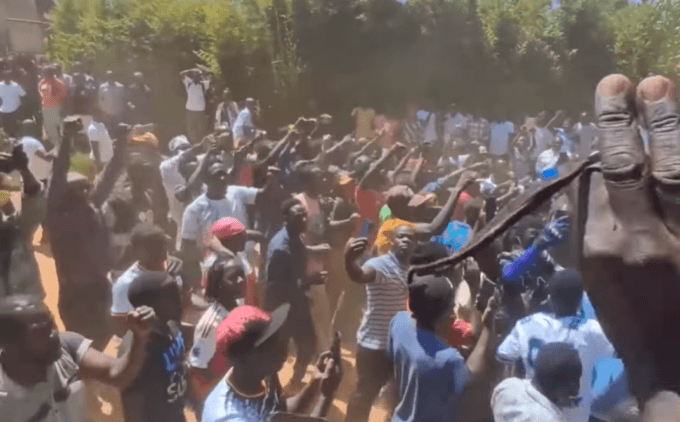
Photograph Source: Capital FM Kenya – CC BY 3.0

The main news item in African media this past week has been the controversy surrounding a proposed U.S.-funded Ebola quarantine facility in Kenya. What began as a public health initiative has rapidly evolved into a politically charged national dispute. The project has triggered protests and legal action. Two people have reportedly died during demonstrations. The High Court, according to media reports, has ordered the government to disclose details of the agreement underpinning the facility, while public debate has expanded beyond epidemiology to questions of sovereignty, transparency and public trust.

These public protests suggest that many Kenyans are not merely contesting the health facility and the U.S. imperialist conspiracy surrounding it. They are contesting the way consequential public decisions are made, communicated and justified. In this respect, the proposed facility has become a vehicle for expressing deeper anxieties about governance, accountability and state responsiveness.

While sovereignty concerns have featured prominently in public debate, the controversy also reveals an important economic dimension. Kenya has already signed the Health Cooperation Framework, parts of which provide for health-data sharing arrangements that have become the subject of legal and political controversy. Narrative economics offers a useful lens for understanding Kenya’s political economy of public discontent. It argues that economic and political outcomes are shaped not only by institutions and material conditions, but also by the stories citizens construct about power, opportunity and the responsiveness of the state.

This angle helps explain why episodes of public protest have become a recurring feature of Kenya’s political economy. Successive administrations have confronted major demonstrations linked to contentious political or economic decisions, and in each instance, the state’s management of dissent has itself become a source of grievance. The pattern has remained remarkably consistent: public grievances intensify, citizens mobilise, confrontations occur with security forces and people die. Allegations of excessive force, disappearances and institutional indifference dominate Kenya’s politics. These disputes eventually subside, but the broader narrative of non-responsiveness survives.

The May 2026 fuel price protests illustrate this pattern with starkness. Following consecutive fuel price increases of 24 and 23 percent in successive months, transport unions called a nationwide strike that brought Nairobi and Mombasa to a near standstill. According to media reports, at least 4 people were killed, and 30 were injured, with 348 arrested. The Interior Ministry’s response was dismissive, attributing the unrest to criminal elements and political manipulation rather than to the material conditions driving ordinary Kenyans into the streets. Rights groups were swift to condemn the use of lethal force against citizens protesting fuel costs that were cascading into food prices and deepening household hardship. This was not an isolated incident. In June 2024, security forces are said to have killed at least 60 people during tax protests, and further deaths occurred in 2025 over corruption, brutality and the rising cost of living. What connects these episodes is the consistency of the state’s response, and the lesson we draw from it.

The significance of this pattern lies in its cumulative effect. Citizens interpret new events through the lens of previous experiences. Over time, repeated interactions between citizens and the state create enduring narratives about how power is exercised, whether institutions listen and whether public concerns receive meaningful consideration.

In Kenya, one such narrative increasingly centres on the perception of political distance between the state and society and nowhere is that distance more legible than in the trajectory of the Hustler Nation narrative. President Ruto’s ascent to the presidency was built on an explicit compact with ordinary Kenyans including the small traders, boda operators and the urban informal workers. It was premised on the promise that the state would finally be responsive to those at the margins. Yet the consecutive fuel price increases of recent months, the deaths of protesters at the hands of security forces, and the government’s dismissal of dissent as the work of criminal elements and political actors represent not merely policy failure but the visible collapse of that compact. For many citizens, particularly younger people, the question is no longer confined to a particular tax proposal, public health project or infrastructure initiative. The deeper concern is whether economic opportunity, social inclusion and upward mobility remain genuinely attainable under an administration that came to power speaking their language but has since deployed the same instruments of exclusion and force that defined its predecessors.

This is why the economic implications of recurring protests extend beyond the immediate political moment. Economic sentiment is shaped not only by macroeconomic indicators but also by perceptions of institutional quality and political stability. Investors, businesses and households respond to signals about predictability, responsiveness and risk. Repeated cycles of protest and confrontation reinforce perceptions of uncertainty and weaken confidence in the state’s ability to manage disagreement through consultation and consensus.

Kenya is not alone in confronting this challenge. Across Africa, governments increasingly find themselves governing within narratives that they do not fully control.

In Ghana, the Beyond Aid narrative emerged as a powerful story of economic sovereignty, self-reliance and national dignity. It resonated because it promised a future less dependent on external assistance and more grounded in domestic capability. Yet the narrative’s durability depended on visible progress and tangible results. Aspirational stories can inspire confidence, but they can also generate disappointment when delivery falls short of expectations.

South Africa offers a similar lesson. The New Dawn narrative emerged after a period of institutional decline and state capture. It promised renewal, reform and the restoration of public trust. Initially, it generated optimism among citizens and investors alike. Yet over time, the pace of visible reform struggled to keep pace with the expectations created by the narrative. The result was not merely disappointment but growing scepticism about institutions’ capacity to deliver meaningful change.

The comparative lesson is straightforward. Narratives are not peripheral to governance. Citizens experience the state through both policy outcomes and the stories they construct about those outcomes. A strong narrative without delivery eventually loses credibility. Equally, technically sound policies can struggle to gain acceptance when they are introduced into an environment where trust has been weakened by previous cycles of contestation and confrontation.

This brings us back to the controversy surrounding the proposed Ebola quarantine facility. The issue is larger than the facility itself. The protests are best understood as part of a broader conversation about governance, participation and trust. The facility has become the latest focal point through which citizens are expressing accumulated frustrations about how decisions are taken and whose voices matter in the process.

Understanding Kenya’s current moment, therefore, requires more than an assessment of a single public health project. It requires an appreciation of the stories that citizens have come to tell about the state and their place within it.

The challenge for governments across Africa is not simply to communicate better. It is to ensure that policy, institutional behaviour and public communication reinforce one another. Trust is not built through slogans, stunts, newsletters, commissions of enquiry or public relations. It is built through repeated demonstrations that institutions are responsive, accountable and attentive to citizens’ concerns. Where such trust exists, difficult policy decisions become easier to sustain. Where it is absent, even technically sound decisions can become catalysts for resistance.

The events unfolding in Kenya are therefore not only a public health story. They are also a story about governance, trust and economic confidence. They remind us that economic outcomes are shaped not only by policies and institutions but also by the narratives through which citizens interpret them.

This article was produced by Globetrotter.

Busani Ngcaweni is Director of the Centre for Public Policy and African Studies at the University of Johannesburg and Professor at China Foreign Affairs University.


CITU Blames ‘Serious Lapse’ by RINL Management in Following SOPs That Led to Blast Killing 9 Workers


Newsclick Report |


The TU demanded a “serious” probe into the Vizag steel plant accident, and adequate compensation for the deceased and injured.


Representational Image. (File Image)

New Delhi: The Centre of Indian Trade Unions (CITU) has demanded a “serious probe” into the accident in Vizag Steel Plant, killing 9 people and severely injuring many workers on the shopfloor. It has demanded adequate compensation for both the deceased and injured workers.

 One June 8, an explosion in the public sector Rashtriya Ispat Nigam Limited plant in Visakhapatnam, Andhra Pradesh, claimed the lives of nine workers. The fire following the accident spilled hundreds of tonnes of molten steel in the plant, causing severe burn injuries to many workers on the shopfloor, reports said.

In a statement, CITU flayed the Central government for “hurriedly” issuing an official release terming the accident as a “fire accident”. This “is not wholly factual and smacks of evasion of responsibility and accountability.  Such horrible accident took place basically owing to gross violation of and compromise in the “STANDARD OPERATING PROCEDURE(SOP)” which is integrally linked with the basic preventive safety norms in such an extremely hazard-prone steel production process,” CITU said in its statement.

Blaming the RINL management for “professional failure in ensuing proper equipment, proper quality of basic raw materials and stringent pursuit of SOPs, the CITU demanded a thorough probe on the accident by an impartial “to find the truth and stringently fixing accountability.”

Read the full press release below:

CITU EXPREESES SERIOUS CONCERN OVER THE GRIEVOUS FATAL ACCIDENT IN VIZAG SREEL KILLING EIGHT WORKERS AND SEVERELY INJURING MANY ON THE SHOP FLOOR ON 8TH JUNE 2026

CITU DEMANDS SERIOUS PROBE ON THE ACCIDENT INCLUDING ON PREVENTIVE SAFETY AND OBSERVANCE OF STANDARD OPERATING PROCEDURE BY AN IMPARTIAL AGENCY AND FIX THE ACCOUNTABILITY

CITU DEMANDS LEGITIMATE COMPENSATION TO AFFECTED WORKERS AND THEIR FAMILY AND PERMANENT EMPLOYMENT FROM VICTIM’S FAMILY

The Centre of Indian Trade Unions is extremely shocked and grieved over the horrible fatal accident that took place in Visakhapatnam Steel Plant on 8th June 2026 while moving hot molten liquid steel from furnace (SMS) to continuous casting system. 8 employees on duty comprising 3 regular workers, 4 contract workers and one officer were killed on the spot and six more were severely injured besides a few others. Death toll may further increase.

A hurriedly issued Official Press Information Bureau Release after about three hours termed the accident as “Fire Accident”, which is not wholly factual and smacks of evasion of responsibility and accountability.  Such horrible accident took place basically owing to gross violation of and compromise in the “STANDARD OPERATING PROCEDURE(SOP)” which is integrally linked with the basic preventive safety norms in such a extremely hazard-prone steel production process. While moving hot liquid molten steel from SMS-1 in the ladle through Crane to its destination of continuous caster, said molten steel has to be mixed with elements like ferro-alloy, manganese, silicon etc and compulsorily allow the MIX to be homogenized and degasified through Ladle Furnace (LF) and RH before the same is put in continuous caster. Any fault, evasion of this homogenization and degasification of the hot steel mix provokes the possibility of explosion of hot metal-mix on the Ladle and accident takes place through huge spillage of the hot metal from the Ladle causing such horribly tragic fatal accident as has happened in Vizag Steel Plant. And possibility of such default and violation of SOP cannot be wished away as the Vizag Steel Plant with such a huge capacity is operating with only one Ladel Furnace (LF), where as all other integrated steel plants under SAIL are having not less than three LF. Despite repeated and consistent persuasion by all the unions in the Plant to increase the number of Ladel Furnace, the management has been arrogantly ignoring such crucial necessity and made themselves busy in cutting down manpower and pushing for outsourcing to private. It is also reported that the quality of the ferro-alloy mixed with hot metal was below the standard quality and the standard time to be made available for Ladle Furnace process or Argon Rinsing Station (ARS) has been skipped   on that fateful day of accident.

Situation has become much more critical in the production operation owing to thoughtless drive of cutting down operational manpower by the management, may be under the direction of concerned Ministry. In the face of depletion of regular trained workforce due to superannuation, any fresh recruitment has been not only stopped, the management has been pursuing virtually forced VRS further creating shortage. Not only that, more than 5000 skilled contract workers have been illegally terminated and a crisis of trained and skilled manpower availability has become a big hazard in ensuring safe and productive operation.

It is thus clear that the grievous accident killing eight employees and seriously injuring many could have been avoidable, had the standard operating procedure and ensuring proper quality of the mixing material and also operational discipline been religiously followed. Professional failure of the managerial authority in ensuing proper equipments, proper quality of basic raw materials and stringent pursuit of the standard operating procedure has caused such a grim tragedy and so many loss of lives. CITU demands a thorough probe on the accident by an impartial agency taking all above aspects with required focus to find the truth and stringently fixing accountability.

CITU also demands legitimate compensation for all the workers and their families affected by this tragic accident and also permanent employment to the family members of those died due to the accident at the earliest.


Bengal: Red Flags Stand up Against BJP Bulldozers to Defend Hawkers


The PM sold tea at the railway station, had jhalmuri from a hawker. Was that just a show? ask evicted railway station hawkers.


Bulldozer action at Dum Dum station area.

In a significant interim relief for thousands of small traders and railway hawkers, the Calcutta High Court has stepped in to halt the Railway authorities’ ongoing eviction drive, which has involved the use of bulldozers in several railway market areas.

Acting on petitions filed by the Centre of Indian Trade Union (CITU)– affiliated Railway Hawkers’ Union and associations representing small businesses, the Calcutta High Court on Wednesday (June 10) ordered temporary suspension of the eviction process in the railway markets of Naihati, Dankuni and Konnagar until June 17.

Justice Hiranmay Bhattacharya, while issuing the order, directed that neither the Railway authorities nor the state government would be permitted to carry out any forcible eviction at these three locations until June 17.

An intense and deeply controversial eviction drive against hawkers and small traders is currently unfolding across railway stations and adjoining areas throughout West Bengal. The operation has drawn sharp criticism from those who see it as a humanitarian crisis rather than an administrative exercise.

Only a few months ago, the state's current Chief Minister, Bharatiya Janata Party (BJP) leader Suvendu Adhikari, served as the leader of the Opposition in the Assembly. During that period, he repeatedly declared that he would stand in front of bulldozers and resist any attempt to evict hawkers through force. Today, critics allege that under his administration, the state police, Railway Protection Force and Central security personnel are carrying out widespread evictions with bulldozers across the state. According to those opposing the drive, shops are being demolished without due process or adequate rehabilitation measures, leaving countless families facing an uncertain future overnight.

Just five days ago, a dramatic late-night eviction operation was carried out in Jadavpur, where hawkers were forcibly removed from their places of business. There was heavy security deployment.

During protests against the eviction, Left activists reportedly stood in front of the bulldozers in an attempt to prevent the demolition. Several protesters were allegedly assaulted and left bleeding during the confrontation. Among those detained were CPI(M) leaders Srijon Bhattacharya and Sujan Chakraborty, and numerous Left activists.

For the authorities, the operation is being presented as an exercise in clearing railway land. For thousands of affected families, however, it has meant the loss of livelihoods built over decades. As bulldozers move through market areas, scenes of anguish and uncertainty have emerged, with many small traders and hawkers left without any visible means of survival.

While the machinery of eviction rolls on, devastated families are left counting their losses. The cries of those suddenly deprived of their livelihoods stand in stark contrast to the official narrative of development and enforcement. Across affected communities, a common refrain can be heard: “What kind of Bengal is this?” For many, each new morning now seems darker than the night before.

Against the backdrop, hawkers and small traders view the recent directions of the Calcutta High Court as a significant and hopeful development. However, CITU leaders say they have little faith in either the state government or the Railway authorities. Instead, they are preparing to intensify both the legal battle and the struggle on the streets, Ujjal Sarkar, a CITU leader, told this reporter.

As the confrontation deepens, red flag marches, protest rallies and public meetings have become an almost daily occurrence across Bengal. The key demand remains unchanged: “No eviction of hawkers and small traders without proper rehabilitation”.

“We are now placing our trust in the movement led by the red flag alone. Left activists have stood beside us, risking their own safety and spending sleepless nights in this struggle. Today, they are the ones who feel like our own family”, said Jaydeb Maji, a tea stall owner near Konnagar railway station, and Nizamuddin Bayen, a pavement vendor who sells plastic toys.

For Jaydeb Maji, the crisis carries a painful irony. He recalls voting for BJP in the hope of defeating the Trinamool Congress (TMC), and even joined the victory celebrations, his face covered in saffron-coloured powder (gerua abir). Today, however, a dark shadow hangs over his family’s future.

“If my stall is demolished, how will my family survive?” he asked, his voice heavy with anxiety. “It was the Left activists who stood in the way and tried to stop the eviction. The TMC has simply disappeared,” he added.

BJP’s Slogan and Reality

After coming to power, BJP has proclaimed “Trust in, Fear Out”, but in practice it is the poor and marginalised who are being made to live in fear, alleged Gargi Chatterjee, a CITU leader. “Now, bulldozers have been deployed at several railway stations, with the Railway authorities and police jointly carrying out eviction drives against hawkers” she said.

According to Chatterjee, sustained protests led by Left- affiliated trade unions have so far succeeded stalling such eviction drives at a few railway stations. “But for how long can they be stopped?” she said.

Accusing the BJP of pursuing an aggressive and all-encompassing agenda, Chattetjee said, “The moment BJP came to power in the state, it adopted a sweeping approach that has consistently targeted the livelihoods of ordinary people. Under the banner of the “Amrit Bharat Station” project, railway stations are being transformed into glittering modern facilities. The bulldozer-driven eviction of hawkers is part of an attempt to clear the way for corporate interests, like Adani and Ambani, while snatching away the daily bread of thousands of poor families.”

The CITU leader alleged that the “modernisation” drive has come at the cost of some of the most vulnerable sections of society, many of whom depend entirely on hawking for their survival. In the face of such a grave crisis, can we remain silent spectators? This struggle is far from over, it will grow stronger and more determined in the days ahead, added Chatterjee.

Several hawkers of Howrah, Sealdah, and Dumdum station told this reporter that their association with the Railways goes back many years. “Our connection with the Railways is not just about earning a livelihood. Over time, we have developed a deep bond with passengers as well.  We are often the first to assist them in times of need and regularly contribute to their safety and well-being. Did the Railway and State administration consider this once before carrying these eviction drives”. said Santanu Ghorui, a banana-selling hawker at Howrah Station.

Breaking down, Dipak Haldar, a hawker who sells chhola- bhatora at Sealdah station, said, “Please note this down. My entire family members voted for BJP. The day after the election victory, I joined the celebratory procession, covered in saffron colours. BJP leaders had assured us that no hawker would have to pay extortion money to continue earning a living at the station. They promised an atmosphere of trust, where fear would no longer exist. But today, it feels as though we have been uprooted completely. We had heard of “Bulldozer Raj” elsewhere. Now we have seen it for ourselves.”

Holding back tears, he added, “Today, we are forced to say the opposite of what we were promised: “Fear In, Trust Out.”

Evicted Without Rehabilitation

Barely a month since BJP assumed power in West Bengal, the new administration has launched a series of eviction drives in the name of administrative action. From the removal of pavement hawkers to the demolition of what authorities describe as ‘illegal structures’ using bulldozers. These operations have emerged as one of the defining features of the new government’s approach to governance.

Across Kolkata and several districts, many residents are openly voicing their concerns. “It has not even been one month, and people are already witnessing the true face of this government,”, said several protesters and affected vendors.

The eviction drives carried out in and around the railway station areas of Howrah, Sealdah, Dum Dum, Sonarpur, Memari and Uttarpara have not merely resulted in the destruction of hawkers’ stalls. Behind every demolished structure lies a larger story-- the daily struggle for survival, the source of food and income for lakhs of people.

Several passengers, too, voiced strong objections to the railway authorities’ concerns over the quality of food sold by hawkers on station platforms. Regular commuters like Angshuman Haldar, Yadav Mishra, Mansur Choudhury who travel daily between Naihati and Sealdah for work at Moulali area at a private company, told this reporter, “The inexpensive puffed rice, luchi and vegetable curry sold by hawkers at various stations are what many of us eat every-day. We have never faced any health problems because of it. Now these hawkers have been removed, where are we supposed to buy food at affordable prices?’’

When questioned whether the removal of hawkers would lead to the closure of food stalls and other shops at railway stations. “Of course not”, they said in chorus. “Instead, large companies will be allowed to set up business on the platforms. In fact, that process has already begun. But how will poor and lower-income passengers afford the higher prices charged at such outlets?’’

To attack such people and drive them out in this manner is extremely inhumane, said Sajol Modak at Dum Dum Station.

Many displaced vendors also pointed out what they described as a stark contradiction in the present double engine government approach. “The Prime Minister’s life story has often been published with the claim that he once sold tea at a railway station. Yet. it is under this government that one of the most organised drives against railway hawkers has been carried out.’’

The hawkers further noted that during election campaigns of Bengal, photographs of the Prime Minister buying and eating jhalmuri from street vendors were widely circulated in the media. “But after BJP’s electoral victories, the very vendors whose livelihoods symbolised the struggles of ordinary working people are being evicted. Is this not the height of hypocrisy?’’ they asked.

Binoy Mondal, a puffed rice trader at Sealdah Koley Market, told this reporter that a large section of his customers were hawkers who sold jhalmuri while moving through train compartments or from platforms across the station. Since their eviction, they have virtually stopped coming to purchase puffed rice from him, causing his own sales to collapse.

He pointed out that the crisis extends far beyond the hawkers. “It is not only hawkers who have suffered” he said, “Countless others whose livelihoods depend on them have also been pushed into uncertainty”.

The relationship between railway hawkers and the Indian Railways stretches back decades. Hawkers have long been an integral part of the culture of rail travel, serving passengers across stations and train compartments while earning an honest livelihood. Over the years, they have repeatedly demanded official recognition of their work and their role in the railway ecosystem.

Late-Night Bulldozers at Dum Dum Station

While eviction drives were resisted at stations including Ballygunge, Ranaghat, Belgharia, Halisahar, Jagaddal, Dum Dum Cantonment, Barasat, Baruipur and Palashi through sustained protests by CITU, the authorities finally struck at Dum Dum station on May 30 (Saturday), shortly after midnight. Bulldozers rolled into the station premises and nearly 500 hawker stalls were demolished. Watching their livelihoods being reduced to rubble, many hawkers and their family members broke down. “We were not given even a moment’s notice” said Sujoy Karmakar, Bibhas Nandi, Bidisa Haldar and several hawkers.

As news of the operation spread, CITU leaders rushed to the spot and held discussions with railway officials. On Saturday morning, the Station Manager had reportedly assured hawkers that no immediate eviction would take place. Reassured by that promise, many of them had opened their stalls as usual and later returned home, unaware of what was to come.

By midnight, the area had been sealed off by bulldozers, central security forces and police personnel. Trade union leaders appealed to the railway authorities not to destroy the livelihoods of poor working people. Veteran former MP Tarit Baran Topdar reached the site and urged railway officials to halt the demolition, saying he would raise the matter with both the Railway Minister and Prime Minister, but his appeals went unheeded.

Far from being silenced, the evictions have fuelled a growing wave of protests. Demonstrations, rallies and resistance campaigns against the displacement of hawkers are continuing across railway stations and localities throughout Bengal, as affected families and their supporters vow to carry forward the struggle for rehabilitation and right to livelihood.

The writer covers the Jangalmahal region for ‘Ganashakti’ newspaper in West Bengal.

What Helped Modi Consolidate His Power?


Ram Puniyani | 


Ramchandra Guha’s analysis blaming the Gandhi family for Modi’s power consolidation is superficial, as it ignores RSS propaganda, and corporate-media-judiciary backing.

Historian Ramchandra Guha, in his article in digital news website Scroll, wrote: “Gandhi Family has helped Modi to consolidate his power”. This is a totally superficial analysis of the consolidation of the power of Narendra Modi-Bharatiya Janata Party (BJP) in the past over a decade. The points made by Guha of dynastic succession in Congress do no hold much water, as dynasts within the BJP and other parties are proliferating at equal pace.

Guha may have some point in criticising Rahul Gandhi for not pursuing issues more consistently, but that is also doubtful, Rahul Gandhi has consistently talked against the danger of BJP’s parent organisation and its Hindu nationalist politics that is damaging our democracy.

Rahul Gandhi may have taken to politics due to his mother, Congress leader Sonia Gandhi’s prodding, but what is definite is that he no longer is being instructed by his mother. He has interacted with all and sundry in national politics, and has met and seen the country through his magnificent Bharat Jodo Yatras. His sister, Priyanka, may be a better orator in Hindi but that does not matter in entirety as far as leading a movement or a party is concerned.

Rahul may be surrounded by some sycophants, but surely he has a mind of his own and he may be building a younger team to strengthen the party organisation on the basis of an ideology rooted in the principles of Gandhi, Nehru and Ambedkar.

Is it true that the Gandhi family has helped Modi consolidate his vice-like grip on the nation? Guha needs to see the mechanisms aiding Modi in coming to power and holding on to it, despite failures on economic front, on foreign policy etc. Modi is a fully trained Rashtriya Swayamsevak Sangh (RSS) pracharak and was hand-picked by then Prime Minister Atal Bihari Vajpayee to be the Chief Minister of Gujarat on this count alone, since he didn’t have any administrative experience.

The RSS ideology of Hindu nationalism runs in Modi’s blood. After the Gujarat communal carnage of 2002, perpetrated in the aftermath of the Godhra train burning, Modi, then the Gujarat Chief Minister, managed to consolidate his power in the state through communal polarisation. The entire RSS combine reportedly stood solidly behind him.

After visiting the refugee camp in Juhapura after the violence Vajpayee reminded Modi ablout following ‘Raj dharma’, to which Modi bluntly answered that that’s what he was doing. Reportedly, when Vajpayee wanted to remove him from Chief Ministership of Gujarat, top BJP members stood with Modi, forcing Vajpayee to whitewash the carnage.

Modi’s dog whistles against Muslims were too clever all through, pumping life into the Hindu nationalist politics of RSS, which is said to have been the “real force” behind Modi coming to power at the Centre. This was facilitated, as the other contender for Prime Ministership, Lal Krishna Advani, became persona non grata for RSS after his comments on Mohd. Ali Jinnah. While visiting Pakistan to inaugurate the Katas Raj Temple, Advani also visited Jinnah’s mausoleum and said that Jinnah’s 11th August 1947 speech in the Pakistan Constituent Assembly was the best definition of secularism. Jinnah had said in that speech that now that Pakistan had been formed, all religious communities were free to pursue their own religion.

The 2014 Lok Sabha elections saw Modi hiring global image-building agency APCO at State expense to prop him up as a “charismatic” figure. His promises of reducing the prices of commodities, Rs 15 lakh in everyone’s bank account and creation of two crore jobs every year, were magic for the people, especially in the backdrop of Anna-Kejriwal movement for Jan Lokpal. This movement was allegedly aimed to defame Congress and pave the way for Modi.

Having come to power in 2014, Modi converted all the Central agencies -- Enforcement Directorate, Income Tax Department, Cenyral Bureau of Investigation -- into parrots and the Opposition was mauled in various ways. In the use of these agencies and later a “helpful judiciary”, the role played by RSS-trained pracharaks, an intense and successful propaganda of Hindu nationalism was launched.

From 1978, the Janata Party days, when Advani was the Information and Broadcasting Minister, a large section of the media had started bending toward RSS ideology. This process became more or less complete when Modi started wooing the corporate world as Chief Minister of Gujarat. The corporate world not only projected Modi as the next Prime Minister but also went on a buying spree of major TV channels and other sections of the media. Modi put his eggs in the basket of social media and the IT cell as well.

Through mechanisms of repression and propaganda a la Goebbels (Hitler's propagandist), Modi soon had a vice-like grip on social common sense. His mantra was to repeat his success through ‘saam daam danda bhed’ (by hook or by crook). The Election Commission of India (ECI) was also brought under the total grip of the Prime Minister, as the process of selection of Election Commissioners was changed by replacing the Chief Justice of India (or his nominee) from the selection committee by one more cabinet minister.

With a helpful ECI and the judiciary, the circle was complete. Complaints about the abuse of EVMs (electronic voting machines) were already in the air. In the 2024 Lok Sabha election results, social activists Teesta Setalvad and Parkala Prabhakar proved by analysing the election data that 78 parliamentary seats were “stolen”.

With the ECI bringing in SIR (special intensive revision of electoral rolls), non-BJP voters were reportedly being deleted from electoral rolls. In the case of the recent West Bengal Assembly elections, 91 lakh voters were deleted during SIR. Of these, the case of 27 lakh voters’ who had appealed, was not taken up for proper review till the elections. The result is there for all to see.

Guha ignores the core reasons behind the consolidation of Modi’s power, and by giving superficial examples of Rahul’s foreign trips or Priyanka being a better orator in Hindi or Sonia Gandhi still controlling the ropes and Rahul meekly following her instructions, lower the level of analysis. The core reasons for Modi coming to power and retaining power are markedly different than the “weaknesses” of the Gandhi family or the other Opposition parties.

Yes, it is true that the politics and propaganda of RSS have not been countered and dealt with by the Opposition properly. The response to emotive issues like temple destructions, forcible conversions, beef eating or ‘love jihad’ has not been countered adequately, which is the reason for consolidation of power of Hindu nationalist Modi. The Opposition in general and the Gandhi family in particular need to mend their ways for sure, but the core infiltration of society by RSS ideology is the real elephant in the room! 

The writer is a human rights activist, who taught at IIT Bombay. The views are personal.


Memes to Mobilisation: Political Awakening of India’s Youth


Shirin Akhter |


The Delhi protest at the call of Cockroach Janata Party reflected the collective expression of youth on anxieties over unemployment, exam irregularities, shrinking opportunities and State indifference.


Image Courtesy: Wikimedia Commons

The Constitution of India grants its citizens the right to freedom of speech and expression, the right to assemble peacefully and the right to participate in public life. But these rights are not self-executing guarantees, they remain meaningful only when citizens care to exercise them. Rights survive only when citizens are able to defend them. Institutional accountability exists only when people demand it. Briefly, Institutions function only as well as the society makes them function.

The rapid spread of the metaphor ‘cockroach’ reflected widespread anxieties about unemployment, examination irregularities, shrinking opportunities and a growing sense that public institutions were becoming increasingly indifferent to the concerns of ordinary citizens. The protest at Jantar Mantar suggests that those anxieties have now found collective expression.

Many observers are asking whether the movement will survive? Will there be a second protest? Will the crowds return a second time? Can the organisation sustain itself? Will it evolve into a political force or disappear as quickly as it emerged? These are reasonable questions. Yet they may not be the most important ones.

Movements rise and fall. The true significance of this gathering lies in the fact that it is for the first time in many years that a large number of young Indians assembled. They assembled not because they were mobilised by a political party or by a charismatic leader, nor because they were instructed by the opposition leaders. They gathered because they recognised that the challenges they face are not individual failures but collective experiences.

For years, youth have been trained to interpret their struggles as personal shortcomings. If jobs are scarce, they must acquire more skills. If examinations are cancelled, delayed or compromised, they must simply prepare harder and wait longer. If recruitment processes become uncertain, they must remain patient, persevere or find alternatives to dignified employment. Structural failures are routinely transformed into individual responsibilities. As a result, this generation has been a compelled to internalise collective failures as personal inadequacies.

What happened at Jantar Mantar on June 6, challenged this narrative.

Young people from different regions, communities and backgrounds came together around a shared understanding that their difficulties are not isolated incidents. They recognised that unemployment, uncertainty and institutional neglect are social realities affecting millions.

What began as an internet phenomenon, ultimately found expression in a physical gathering of citizens asserting their demands. The language of the movement may have emerged from meme culture. The symbol of the cockroach may have travelled through social media. Yet the concerns being expressed were rooted firmly in the material world of denied aspirations, failed examinations, lack of employment, denial of public accountability. It is a conscious attempt by our youth to secure their future.

Most importantly, the movement succeeded in translating symbolic politics into a tangible democratic demand. The meme became a vehicle through which thousands of young citizens articulated a clear political objective and demanded accountability from those exercising public authority.

The protest built a bridge between the digital and the real. We may be witnessing a transformation in the location of democratic politics itself. Where collective consciousness is increasingly forged online, but it continues to seek validation through public assembly and collective action. The medium may have changed from pamphlets and student unions to hashtags and memes, yet the democratic impulse remains remarkably familiar, ordinary citizens coming together to insist that power answer to the people.

This is why the gathering deserves recognition irrespective of what happens next.

For too long, many Indians have assumed that the defence of democracy is primarily the responsibility of opposition parties, courts, journalists or civil society organisations. All of these institutions matter. Yet democracy cannot ultimately be outsourced.

No Opposition party can substitute for an engaged citizenry. No court can preserve democratic freedoms if citizens cease to value them. No institution can remain accountable if society stops demanding accountability.

The young people who gathered at Jantar Mantar reminded the country of this fundamental truth.

Whether the movement gathers momentum remains uncertain. Perhaps the crowds will return in greater numbers. Perhaps they will not. Perhaps the organisation that convened the protest will grow. Perhaps it will fade. No one can know.

But something important has already happened.

A generation frequently caricatured as distracted, self-centred and politically disengaged, demonstrated an ability to organise, mobilise and act collectively. Young people stood beside one another and asserted that their concerns matter. They demonstrated that they are not willing to wait indefinitely for others to defend their interests or speak on their behalf.

That achievement should not be underestimated.

At a moment when cynicism often appears easier than hope, they chose participation over passivity. They chose solidarity over isolation. They chose citizenship over resignation. For now, that is enough. Not because the struggle has been won. Not because the future is certain. But because India's youth have shown that they remain conscious of their rights, aware of their responsibilities and willing to stand up for one another.

Democracy is ultimately sustained not by constitutions alone, but by citizens who choose to act as citizens. The young people at Delhi’s Jantar Mantar did precisely that. And for that, they deserve to be congratulated.

The writer is Associate Professor at Zakir Husain Delhi College, University of Delhi. The views are personal.