It’s possible that I shall make an ass of myself. But in that case one can always get out of it with a little dialectic. I have, of course, so worded my proposition as to be right either way (K.Marx, Letter to F.Engels on the Indian Mutiny)
Sunday, June 14, 2026
Welcome to Mexico, World Cup Fans, a Paradise for Soccer and Inequality
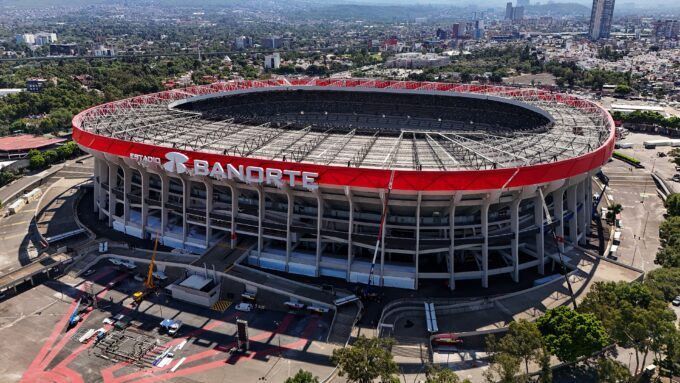
Azteca Stadium (now Banorte), Mexico City. Photo: ProtoplasmaKid, Wikimedia. CC BY 4.0.
This year’s World Cup is historic because for the first time ever it will be co-hosted simultaneously by three countries: Mexico, the United States, and Canada. However, in Mexico it will leave behind a trail of socioeconomic blows, including huge debts the government has incurred to host it.
While the competition enjoys global passion, the tournament is structurally designed to disadvantage developing country hosts. This is not by accident. It is a deliberate design so that the world soccer tournament economically benefits the ultrarich and the Global North.
For Mexico, the soccer summer festival has already pushed the country into debt and turbocharged inequalities at a time when citizens are grappling with the high cost of living worsened by the war in Iran. Mexicans are being forced to trade their rights, livelihoods, and development for investments and refurbishment of amenities for soccer tourists.
Oops! They did it again…
From the outside, it might seem like Mexico, the United States, and Canada are equals and good friends — close enough to cooperate and organize a global event together. But that’s just cosmetic.
Here is the stark reality: the World Cup will be in Mexico, but Mexicans aren’t invited. The entry fees are out of control, plagued by dynamic pricing, speculation, and restricted access to those who can pay around 50,000 Mexican pesos ($2,870) for a ticket to the opening ceremony. This is five times the country’s minimum wage.
Not only are Mexicans being shut out of the stadiums, they are also being expelled from the World Cup landscape. There is documentation of the forced evictions of street vendors and sex workers, as well as gentrification and touristification of neighborhoods and public spaces — all to meet foreign expectations of visiting Mexico as a soccer paradise, not as the unequal and violent place it truly is.
Billions of dollars that could have been spent on education, healthcare, and local infrastructure are being diverted and pumped into beautification projects that will cosmetically facelift host cities while public hospitals persistently face significant drug shortages and schools lack basic necessities to deliver quality education.
Prepare your profits pool
The promise of the economic windfall this event will bring is another lie. Following negotiations with the government, the soccer governing body, FIFA, has beenexempted from paying taxes in Mexico. By contrast, in the United States and Canada, FIFA will pay taxes on the profits and revenue it generates. So, Mexicans end up once again paying to keep the public debt afloat while struggling to afford necessities like food and fuel.
Added to this are fiscal benefits for FIFA and multinationals like Coca-Cola, Adidas, Aramco, Visa and others. In other words, part of the event’s costs are being shifted to public resources paid for by the working class, while private interests are allowed to influence public decisions.
President Claudia Sheinbaum announced that 2 billion Pesos ($115 million) in public investment would be spent on transportation alone in preparation for the tournament. Meanwhile, FIFA expects to generate a record-breaking $1.8 billion to over $2.8 billion in total sponsorship and marketing revenue, marking the highest sponsorship income for a standalone sporting event in history.
If Mexicans are paying for the World Cup with public money, it would be fair that they should access the profits to contribute to improving Mexicans’ wellbeing through equitable distribution. But what we see is the pursuit of excessive profit taking precedence over the collective and public interest.
The penalty shootout
The World Cup is taking place at the same time as the renegotiation of the United States-Mexico-Canada Agreement. This trade treaty reinforces the perception of Mexico as a territory of cheap labor, resource exploitation — and it comes with strict enforcement mechanisms that allow the United States to dictate domestic industrial policies. This is not just a coincidence but a blunt reminder of how systems are rigged to serve the interests of billionaires and the Global North.
But there is another, far more ambitious and levelled playing field: the streets. Starting with a major protest on March 28 outside Azteca Stadium in Mexico City, social movements have demanded water, housing, and dignity for the people — not for World Cup tourists. Under the slogan “soccer yes, capitalism no,” we, Mexicans, join the struggle for truth and economic justice. It is our lives that are at stake, so we demand a change in the rules — for life, for the commons, and for soccer for all.
Soccer is played, paid for, and celebrated by the Global Majority, we the 99%. We who are struggling daily with the cost of living. It is only right therefore that the revenue it generates prioritizes ordinary people and defends their rights rather than feeding the endless greed of the 1%, FIFA fat cats, and the superrich.
Toxic Metals, Sulphur & Coal Dust: The Battle To Clean Up The Worst Air in South Africa
From wealthy suburbs to impoverished townships, people living in South Africa’s industrial heartland are uniting to stop an environmental disaster on their doorstep.
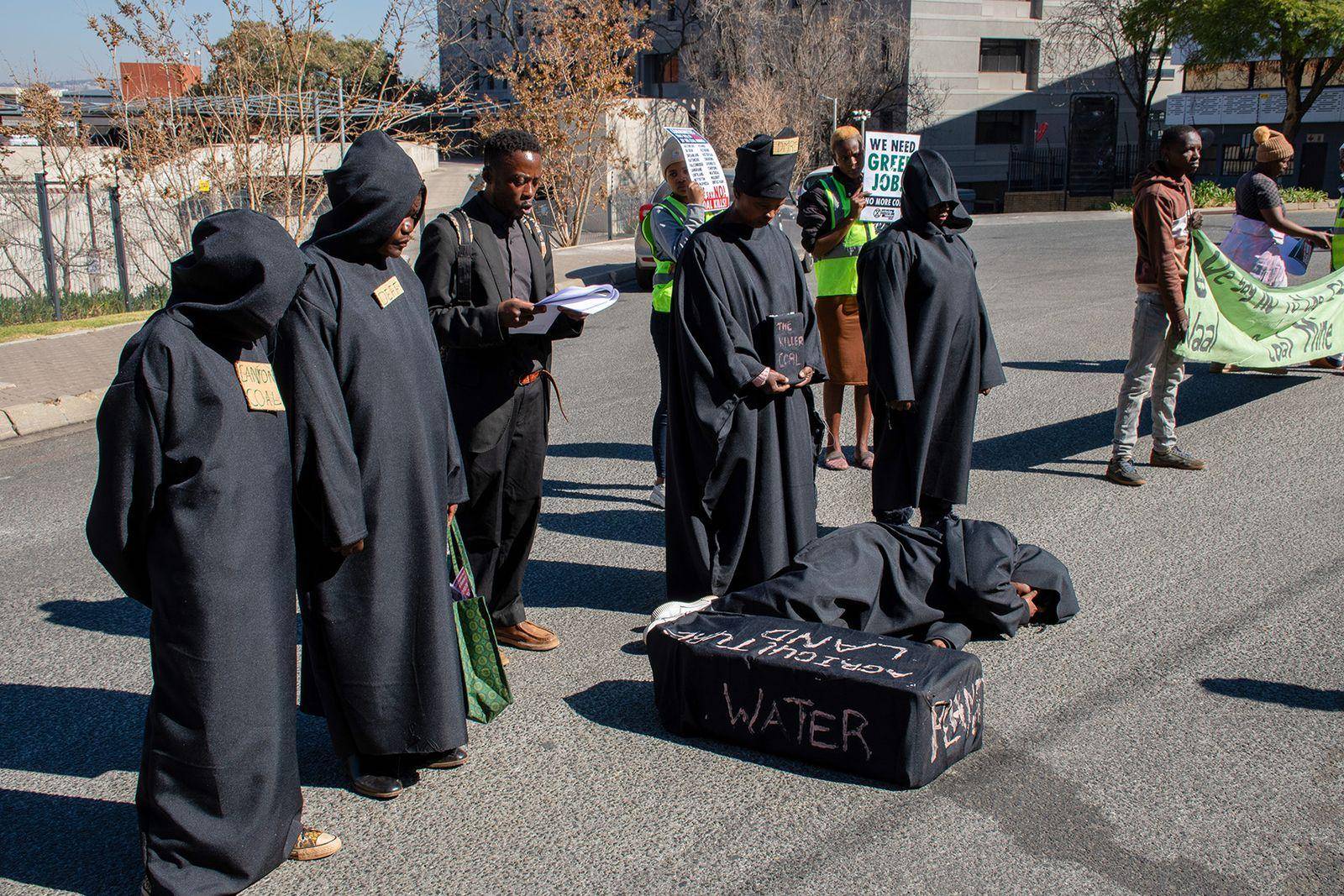
Mdu Tshabalala (3rd from left) and other Vaal residents protest outside Glubay Coal’s offices in Johannesburg, July 2024. (Julia Evans/Daily Maverick)
When Mel Mandy gave birth to her first child twenty-five years ago, the doctor told her off for smoking while pregnant. Her boy had been born with underdeveloped lungs, a common condition in the newborns of smokers. But Mandy had never smoked a cigarette in her life. The problem was where she lived.
Mandy is one of the nearly two million people who live in South Africa’s Vaal Triangle. The coal-rich region, 60km south of Johannesburg, encompasses three cities, wealthy suburbs, impoverished townships, and some of the most polluting industries in existence, including the largest steel plant in Africa, a petrochemical plant, and a coal-fired power station.
One of Vaal’s cities, Vereeniging, is by some measures the most polluted city in the world. Its air regularly registers the highest recorded concentrations of toxic emissions known as PM2.5, microscopic particles which can penetrate lung tissue and cause cancers, cardiac problems, and other diseases.
Mandy lives in a town called Meyerton, just east of Vereeniging. Her house stands 6km from a manganese smelter, once the largest in the world, where giant coal-fed furnaces produced an alloy used to strengthen steel. Officially, the smelter was allowed to pump out emissions for one hour a day. According to Mandy, it belched out black smoke all night under the cover of darkness. “Some nights, the sulphur smell was so strong it would burn your nose,” she recalled.
Her son suffered repeated lung infections, and her younger daughter developed severe asthma. Mandy emailed the government repeatedly for years about the emissions. Eventually the national environmental enforcement agency, known as the Green Scorpions, got in touch. The Green Scorpion was apologetic – the agency was too short-staffed to investigate. But if Mandy could source any data to back up her claims, they might be able to prosecute.
So Mandy met with an epidemiologist at Wits University in Johannesburg, who got in contact with a neurologist studying the health effects of manganese at Washington University, USA. It turned out that this manganese smelter was the only one in the world to operate right beside residential areas, and in 2013 the neurologist and the epidemiologist co-launched a study into the plant’s manganese-laced pollution and its health impacts on nearby communities.
The study involved establishing air monitoring stations, and collecting toenail or hair clippings from locals. The focus was on Sicelo, an impoverished township that reached up to the very edge of the smelter. Mandy became a fieldworker, recruiting a growing pool of participants and ensuring tests went smoothly. The Green Scorpions were invited to look at the dataset, which was showing how proximity to the smelter increased rates of parkinsonsim, cognitive decline and depression – all symptoms of manganese poisoning. Two years later the agency prosecuted the smelter’s owners, Samancor, for failing to monitor and manage its pollution.
The owners pled guilty, paid fines of around $300,000, and promised to undertake costly upgrades to become compliant with environmental regulations. Within four years, the plant was mothballed due to unsustainable operational costs. Meanwhile, the health study expanded and still continues to this day, and Mandy’s now adult children are thriving, albeit away from Meyerton. If this was a Hollywood film, the credits would start running now.
But the real story doesn’t end there. Today, the manganese smelter has a new owner, who not only wants to restart operations by next year, but also turn 2,500 hectares of farmland directly behind it into two open-pit coal mines. And despite national air pollution laws clearly outlawing such a project, the government has just awarded the mines environmental authorisation.
Mandy is now part of a coalition of residents, spread across dozens of affected communities, preparing to fight that authorisation in court and on the streets. At risk is not just the air they breathe, but the structural integrity of their buildings, the toxicity of their drinking water, the value of their properties and businesses, and the very existence of their neighbourhoods.
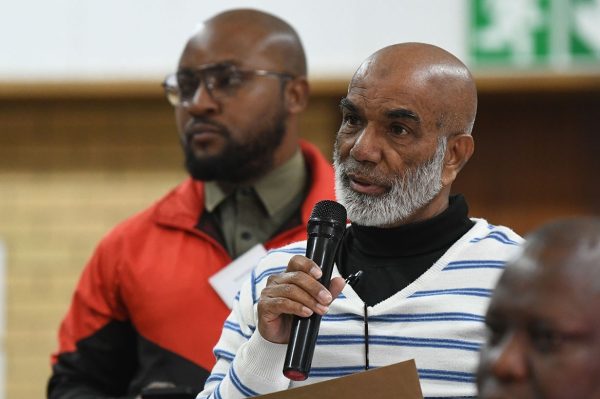
Yusuf Sather speaks at a public consultation open day for the mine in June 2023. (Christiaan Cloete)
The shit hit the fan
Initially, the proposal was for just one open-pit coal mine covering farmland between Vereeniging and Meyerton – farmland almost entirely surrounded by residential areas. The company managing the project, Glubay Coal, was legally required to engage in a public participation process, so in late 2019 it hired a consultancy firm to hold open meetings in four of the communities close to the proposed mine site.
One of those four chosen communities was Roshnee, a wealthy and predominantly Indian suburb north of Vereeniging. A consultant had turned up a ratepayers’ association meeting there to see if a public gathering could be accommodated, and the five attendees listened as he made a short presentation about the mine, which would operate as close as 2km from their homes. One of those listening was Yusuf Sather, who had spent 25 years working in the mining industry.
Sather knew better than most what it actually meant to have an open-pit coal mine on your doorstep. Open-cast extraction involves large-scale surface blasting, which would either send huge plumes of black coal dust into the air, or use up billions of litres of water each month to smother it. The blasting would also threaten the structural integrity of buildings within a 4km radius. Two schools sat within 1km of the proposed mine site. Some homes were just 100m away.
Throughout its 30-year lifetime, the mine would pump out acidic wastewater to stop it flooding, and this would poison the groundwater in a region where many still drink from boreholes. The air and noise pollution would make houses impossible to sell, and drive away local business. And a huge area of fertile farmland, supporting hundreds of workers and vegetable street-sellers, would be totally erased.
Sather and the other worried residents decided to hold their own community meeting about the mine, weeks before the official consultancy one. Eight days later, around 400 residents filled Roshnee’s civic centre to hear about the mine’s adverse impacts from medical and legal experts, as well as the local farmers facing ruin. A steering committee was established, and an online petition was started.
Supporters were encouraged to join a WhatsApp chat for further campaigning, and sign up as Interested and Affected Persons (IAPs) so they could receive official updates about the mine from the consultancy firm. Hundreds did so. The Coal-ition Committee was born, and the resistance had begun.
The four public meetings were poorly advertised. Notices appeared in unread local newspapers, or on roadside fences too small to read from a passing car. When the consultant eventually entered Roshnee’s civic centre to do his own presentation, he wasn’t ready for the levels of knowledge and opposition in the room. “It was a disaster,” remembered Sather. “The guy couldn’t answer any of the questions we put forward. He just kept saying he needed to go back and confer with Glubay Coal.” The residents became increasingly exasperated, and the consultant left early.
As the Covid pandemic swept across the globe, Glubay Coal’s venture went into hibernation. But when it reawakened in 2023, it had grown even larger. Now it encompassed two open-pit mines, with a smaller mine nestled beside the first, and a railway siding to link the coal to the wider rail network once used by the smelter. Despite also requiring surface blasting, the second mine was just 1km away from a hazardous landfill site full of toxic medical waste and chemicals.
This is when, as Sather puts it, “the shit hit the fan.” Coal-ition members reached out to the local media, and set up stalls in regional malls, schools and community centres, encouraging people to sign up as IAPs, register their objections to the mines, and join the Coal-ition. By now membership of the group had spread well beyond Roshnee, and was close to one thousand strong.
Because the mine project had been expanded, the public participation process had to be restarted. Glubay Coal hired a new consultancy firm, which decided to replace large, potentially volatile meetings with open days, where residents would arrive in small scheduled groups to read brochures and ask questions. There would be just two of these days – in a small suburb dominated by a shopping centre, and Sicelo, the impoverished township of corrugated iron shacks right next to the smelter. Roshnee’s civic centre would no longer be part of the process.
The presentation now focused on how the mines would create five hundred and fifty jobs for the region – and for the poorest communities in the Vaal, the promise of jobs trumped all other concerns. One third of South Africans are unemployed – the second-highest rate in the world. But in the Vaal Triangle the rate is well over half. The region has endured two decades of economic decline, with once thriving steel plants and collieries slowing production or closing outright, and many thousands of jobs being shed.
This industrial retreat has been partly down to competition from China, and partly because of a domestic energy crisis that has seen electricity costs soar as supply has faltered. Mismanagement and corruption in the state-owned power company Eskom, whose coal-fired power plants generate 90% of the nation’s electricity, has meant power cuts and managed blackouts have become part of South African life.
An outgoing Eskom chief executive, brought in to clean up the company, publicly agreed that it was “a feeding trough” for the country’s governing party, the ANC, and claimed Eskom sustained at least four organised crime networks. The next morning, his coffee was spiked with cyanide. He was lucky to survive.
For Sather and the members of the Coal-ition, the economic benefits of the mines were a mirage. “Coal mining is increasingly mechanised. You need to employ specialised people from outside to come in. Locals could do the more menial jobs, but that would only be two or three hundred. More jobs would be lost destroying all the farmland, which supports small entrepreneurs selling maize and vegetables,” he stressed. Another problem for the poorest job-seekers in the Vaal, is that they often live closest to the industrial sites and so suffer most from the pollution. They become too sick to work for the companies that were poisoning them.
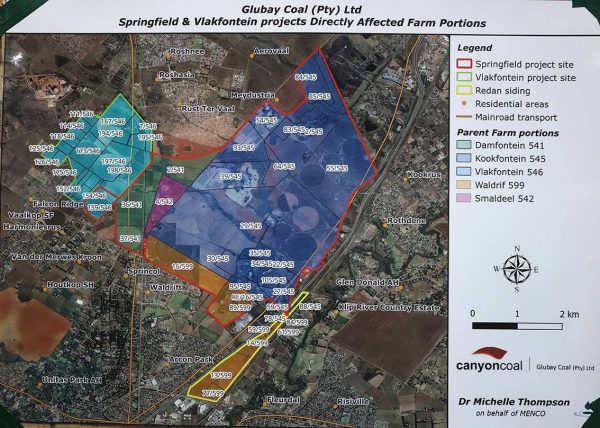
A map showing the two proposed mine sites and the many residential areas surrounding it. Meyerton is in the northeast corner. (Christiaan Cloete)
Respiratory illness was everywhere
In 2007, Mdu Tshabalala applied for a factory worker job at the massive ArcelorMittal steel plant in Vereeniging. Tshabalala had studied business administration at college but, like so many young people in the Vaal, was struggling to find steady work. So he turned to the factory that loomed over Sebokeng, the township where he lived. He was sent to a doctor stationed by the steel plant and diagnosed with sinusitis. The doctor gave him a piece of paper telling him he was not fit to enter the factory.
Tshabalala has suffered from sinusitis for his whole life. As a child growing up in Sasolburg, the Vaal Triangle’s southernmost city, his nose became so blocked he couldn’t sleep, and he would use an asthma inhaler in the evenings. He also suffered regular nose bleeds, headaches and eye infections. The air would smell like rotten eggs thanks to the hydrogen sulphide emissions from a Sasol petrochemicals plant, and buildings were coated in black dust from a nearby open-pit colliery owned by the same company. “In Sasolburg, everyone was sick,” Tshabalala said. “My cousin was repeatedly hospitalised with breathing issues. Respiratory illness was everywhere.”
Despite his health problems, the teenage Tshabalala developed a love for breakdancing. When his family moved to Sebokeng, he befriended other performers and artists, and they formed an environmental group after clearing a rubbish-strewn local space for them all to use. This led to Tshabalala joining a youth climate forum in the run-up to COP17, which was hosted by South Africa. At the convention, he discovered the existence of a local organisation called the Vaal Environmental Justice Alliance (VEJA).
VEJA grew out of the efforts of black farmers, post-apartheid, to get compensation from a local steel plant for poisoning their farmland, as well as former steelworkers seeking fair dismissal. Today, VEJA advocates for townships across the Vaal Triangle, holding community workshops about the impacts of industrial pollution, tracking those impacts, and taking the companies responsible to court. Tshabalala is now a manager of the group, and his sinusitis is kept in check with herbs grown by his wife, who is also an environmental activist.
South Africa actually has robust air quality laws that should render most of VEJA’s work unnecessary. In 2006, the government designated the Vaal Triangle as the country’s first air quality priority area, meaning legal limits on emissions from heavy industry, mines, and waste burning (common in poorer communities where local services are absent). But the corporate polluters were granted exemptions by the government after complaining that compliance would be too costly and threaten yet more jobs. Recent legal amendments have set even tougher pollution limits, yet the air quality of the Vaal remains some of the world’s worst.
Tshabalala and his wife ran a small but active Extinction Rebellion chapter in Sebokeng, and in July 2024, Tshabalala approached the Coal-ition Committee to propose a joint protest outside Glubay Coal’s headquarters in Johannesburg. Time was short to prepare – Tshabalala had already applied for a police permit, which meant the protest would need to happen within two weeks. And Coal-ition members would need to organise their own transport.
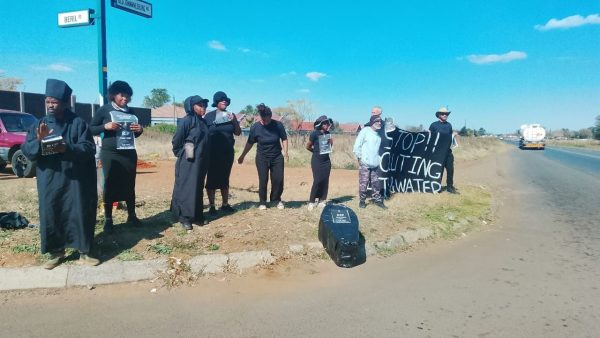
On the day, Extinction Rebellion Vaal activists staged a funeral for their land, air, and water outside the glistening corporate headquarters, and Tshabalala handed a memorandum of demands to a sheepish looking Glubay executive. From a media perspective, the action was a great success. Both Tshabalala and Sather had scoured their journalist contacts, and the protest was covered by the national press.
But from a community cohesion perspective, it was a disappointment. Only three members of the Coal-ition Committee attended. When Tshabalala organised another protest against the mine three months later, this time outside the Department of Mineral Resources and Energy in Pretoria, not one of the approximately one hundred Vaal residents who attended were from the Coal-ition. “They are scared,” said Tshabalala when asked to explain the disparity. “Middle class people don’t like protests. That is my observation.”
Mandy, who is half-British, half-Afrikaner, had a different explanation: “I think a lot of white South Africans view that kind of protest as ‘toyi-toying’ and so not for them.” Toyi-toyi is a fusion of dance, marching and chanting that became a regular feature of anti-apartheid street protests in the 1980s, and synonymous with black activism. When I ask Tshabalala if there were racial tensions at the initial meetings between township activists and Coal-lition members, he chuckles. “At the beginning, yes, there were tensions. But now we have got over each other, and I’ve made a lot of friends. We are united against a coal mine that will devastate our communities.”
Despite the widespread resistance to the mine, Glubay submitted an environmental impacts assessment to the government last July, and in February of this year the government granted the mines environmental approval. Residents had just twenty days to submit appeals, and Mandy, Sather, and Tshabalala were in regular communication as they hastily coordinated their efforts. Sather hired a lawyer to file an appeal on behalf of the now 9,000 registered IAPs, with legal funding coming from a group of Roshnee business owners.
For his appeal, Tshabalala approached lawyers at the Centre For Environmental Rights (CER), an organisation that has worked with VEJA on previous legal cases. He then visited townships and informal settlements to garner community support. Mandy has written her own appeal, focusing on the ties between the coal mines and the manganese smelter.
The activists found out by accident that Glubay Coal, the company behind the mine proposal, and Khwelamet, the company that bought the manganese smelter last June, are ultimately owned by the same private investment company, Menar. The two entities are symbiotic – the smelter will have a ready supply of coal, and the mines will have access to the smelter’s railway network. “The site’s one long mining belt with a smelter at the end. The three businesses should be treated as one,” said Mandy.
XR Vaal and the Coal-ition Committee hold a small roadside rally to raise awareness about the coal mines, May 2026. (XR Vaal)
The full nine yards
Menar’s founder and managing director is Vuslat Bayoğlu. He moved from Turkey to South Africa in 2002, and quickly started buying up mining interests across the country. He has become a prominent voice in the sector, courting the South African media, writing op-eds, and making speeches that champion coal and competitively priced electricity to resurrect the nation’s mining sector. Asked to predict what 2026 would bring at a recent mining expo, Bayoğlu bullishly replied: “I think we’re going to bring all these smelters back, and we’re going to re-industrialise South Africa, which we need to do because that’s how we create jobs in this country.”
But Bayoğlu has also courted controversy. He was linked to South African arms companies bought by his brother, and accused by a former Turkish ambassador and a Turkish government official of being a member of FETO, a terrorist group implicated in a failed coup in Turkey in 2016. Since the coup attempt, thousands of suspected FETO members and hundreds of millions of dollars have moved from Turkey to South Africa.
Even if the Vaal resident’s appeals are dismissed, Bayoğlu will still have a number of hurdles to jump before his open-pit mines can begin operations. Environmental management licences for water, air quality, and waste will all need to be applied for. And should the government grant them, each licence will be appealed by Vaal’s residents. “We will oppose at each and every stage, go the full nine yards” said Sather, who expects the litigation process to last at least two years. The Roshnee residents currently paying the legal costs will not last that long though. “If we have to go to court, we’ll launch a fundraising campaign,” he added.
At a recent Coal-ition Committee group meeting, the first to be held since the mines received Environmental Authorisation, some hard truths were delivered by Sather and Tshabalala about the campaign. The two men stressed the need to increase media exposure now the appeal process has begun, and for Vaal’s activist residents to come together and embrace nonviolent protest to get their voices heard. A large march targeting the government institutions that are failing them received broad support from the attendees, and is being planned for the coming weeks.
To mark this new unified approach, the day after the meeting, Sather and a few other Coal-ition members joined Extinction Rebellion Vaal for a small but noisy rally along a busy main road that passes between the two proposed mines. Mandy, meanwhile, has promised to attend the coming march. After twenty-five years of environmental activism, it will be her first ever street protest.
Adem Ay is a writer and activist based in London. He spent five years working for Extinction Rebellion, where he helped coordinate the global media team and edit a global newsletter that connected him to activists all over the world. He wants to spread their inspiring stories as far and wide as possible.Email
For a colonized people the most essential value, because the most concrete, is first and foremost the land: the land which will bring them bread and, above all, dignity. – Frantz Fanon
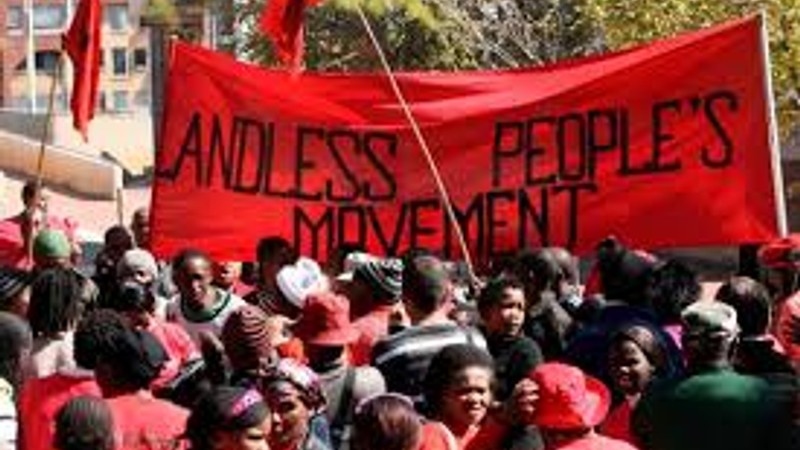
On Friday 12 June we will march against the Bill in Durban, Johannesburg and the Pixley ISaka Ka Seme municipality in Mpumalanga. We will be joined by our comrades in progressive trade unions and other organisations of the authentic left.
We will march against the hard turn to the right by the Government of National Unity and against the attempt to criminalise our lives and struggles. We will march for land, freedom and dignity.
If passed into law the PIE Amendment Bill would criminalise poverty and the struggles of impoverished people. It would make it easier to evict people into homelessness while criminalising the collective efforts of poor communities to secure land, organise themselves and defend their rights. Activists, community leaders and social movements would face imprisonment and massive fines of up to a million rand for supporting land reform from below.
Since the intention to amend the PIE Act was first announced we have held meetings in shack settlements and villages across the provinces where we organise, as well as a General Assembly in Durban, to discuss this attack on the poor. We have organised local pickets and protests, and confronted the government when they have allowed public hearings to go ahead.
African people were impoverished and made pariahs in their own country by colonial land dispossession. The ANC has failed to heal this wound, and has left most of us impoverished and, when we come to the cities in search of education and work, treated like pariahs. The PIE Bill did not give us land but it did place some limits on how the state and private landowners could treat us, and did give us some space to organise ourselves as we struggle for land reform from below. The attempt to amend the Bill is an attempt to remove the limited protections that were won by the mass struggles against apartheid and is part of a wider turn to the right by the ANC and the GNU.
The PIE Amendment Bill tells every shack dweller, every rural person planning to make their way to a city in search of a better life, every worker who sleeps four to a room, every young person who does not have a job but needs to form their own household and every woman without much money who needs to escape an abusive relationship that their life is worth nothing in the eyes of this government.
The PIE Amendment Bill is a new chapter in the history of repression that runs through the Native Land Act of 1913, the Slums Act of 1934, the Group Areas Act of 1954, and the Slums Act of 2009. Each of these Acts aimed to exclude the majority from access to land and the cities and to criminalise access to land outside of the state and the market. Each of these Acts was an act of war against the African people, an Act designed to make us poor, keep us poor and rob of us our dignity. Each of these Acts was an attempt to make sure that we were permanent pariahs.
Just as we defeated the Slums Act of 2009 we will defeat the PIE Amendment Bill. And just as we continued the struggle for land after we defeated the Slums Act of 2009 we will continue the struggle for land after we have defeated the PIE Amendment Bill. Our humanity is not negotiable and we will struggle to defend it, and create the material conditions for our lives to flourish, whatever the risks and costs.
Over the last twenty years our movement has won more gains and victories than we can count. Many thousands of people have won land and we have won gains that benefit all poor people. Our movement has also become a home for the oppressed, a space where our dignity is recognised and solidarity is built. If passed into law the PIE Amendment Bill would criminalise our movement overnight. It is a direct attack on our movement and on democracy and we will resist it with all out strength, and with the support of all genuine democrats.
It is important that the people of South Africa are very clear that the ANC, which is now in a coalition with the DA and FF+, is launching an outright attack on poor people in general and the organised poor in particular that is attempting to roll back the limited but important gains in rights won after 1994.
This Bill is unconstitutional, and if necessary we will confront it in the Constitutional Court. It is an attack on the Constitution from the right that aims to give property owners even more power than they currently have. When she announced the Bill, Thembi Simelane, the minister of human settlements was very clear about its purpose. She said that it will ‘create a more stable and predictable environment for investment and growth’.
In Durban we will march from Curries Fountain to the City Hall. In Johannesburg we will march from Jeppe Park to the Gauteng Legislature, where we will make a submission on the Bill. In the Pixley ISaka Ka Seme we will hold a picket.
We are living through a terrible social crisis. Unemployment is at catastrophic levels, especially among young people, where it is over 60%. Hunger is widespread, with more than a quarter of families going hungry. Last year, more than 10,000 children died of starvation.
Public institutions have been hollowed out by organised corruption, often tied to criminal networks, as well as decades of austerity. Many municipalities are collapsing under debt, mismanagement and infrastructural decay. The rates of murder and rape are among the highest in the world, and more and more people have to live in shacks every year.
For many people, daily life has become increasingly precarious. Entire communities experience state abandonment while a small political and economic elite continue to accumulate wealth. The promise that democracy would bring dignity and meaningful social transformation was first broken and has now been abandoned.
Things cannot go on as they are. While our movement and the wider left struggle for a society in which land and wealth are fairly shared, a society in which the humanity and dignity of all people is respected, the forces of the right are moving fast to contain the crisis with repression. The PIE Amendment Bill is part of that turn to the right, that turn to repression. Those who tell us that the poor migrant is the cause of our problems and is our enemy are another part of that turn to the right. We will not be fooled into calling a poor migrant our enemy.
The migrant who comes to the city looking for work is not the one who stole our land, who sends out men with guns to evict us, who steals from the people via corruption and cuts budgets for social spending.
We know who our real enemies are, and they include the people who are trying to push this amendment to roll back the limited gains of 1994 and criminalise poverty and the self-organisation of the poor. The real enemies are the ones who wants to amend our Constitution so that apartheid can walk through the front door again.
We will not be cowards hiding under the bed while the amabutho of capital and corrupt nationalism march past. We will fight. We will occupy. We will shut down streets. If the Minister of Human Settlements does not have ears to hear us and eyes to see us we will meet her in the Constitutional Court.
They want to make sure that we are permanent pariahs in our own country. We refuse to have our aspirations for land and dignity criminalised and we will not allow our movement to be criminalised. We refuse to be pariahs. We are the people of this land and we will continue the struggle of our ancestors, the struggle to make this a free and rich land, a welcoming land, a land where we can all flourish and live in peace.
We call on all progressive trade unions and organisations, and all shack dwellers and rural landless people, to stand with us in Durban, Johannesburg, and Pixley ISaka Ka Seme Municipality, in Durban, and in every corner where the poor are told to be quiet and to accept that our lives should not count the same as all other lives.Email
Abahlali baseMjondolo (The Residents of the Shacks) is a movement of the poor in South Africa. Abahlali is an autonomous, democratic, membership-based social movement comprising more than 150,000 members, operating in 93 branches in 4 provinces. Their politics are rooted in a universal commitment to affirming and defending human dignity as they struggle for land and housing, to foster communities of care, self-nourishment, and solidarity.