Sunday, June 14, 2026

Opinion

Riz Ahmed’s 'Bait' gives James Bond treatment to South Asian and Muslim experiences

(RNS) — The dramedy examines a young Pakistani-British Muslim chasing a sense of belonging and what it means to be fully oneself and fully Muslim.


Actor Riz Ahmed in "Bait." (Photo courtesy of Prime)

Dilshad Ali
June 12, 2026
RNS


(RNS) — In a scene about midway through Riz Ahmed’s new Amazon Prime six-part dramedy, “Bait,” struggling actor Shahjahan Latif (played by Ahmed) runs into a security agent in a London underground station whom he had been looking to hire for his family.

Latif is carrying a pig’s head in a canvas bag (more on that later) while having an existential breakdown, having run away from the police station where he went to report his house being broken into, the pig’s head thrown through the window and his family missing. But his paranoia gets the best of him, as he begins to worry that the police are racially profiling him and will consider him a prime suspect instead of seeing the crime itself as racially motivated. 

And so, on the run, he panics as he irrationally thinks police on duty at the underground station are closing in on him. Seeing the security agent he was considering hiring becomes an unexpected solace and sense of relief. In pairing up with the white agent, he perceives the suspicious eyes are no longer on him.

“Must be nice to be tall and white,” he says to the security agent.

“Membership has its privileges,” the man replies back to him.

It is this kind of membership, this kind of unattainable belonging that could possibly erase childhood memories of being violently bullied, that Latif is chasing. Something familiar to more of us who are Muslim and/or South Asian (or any non-white combination of the sort) than we may care to admit.
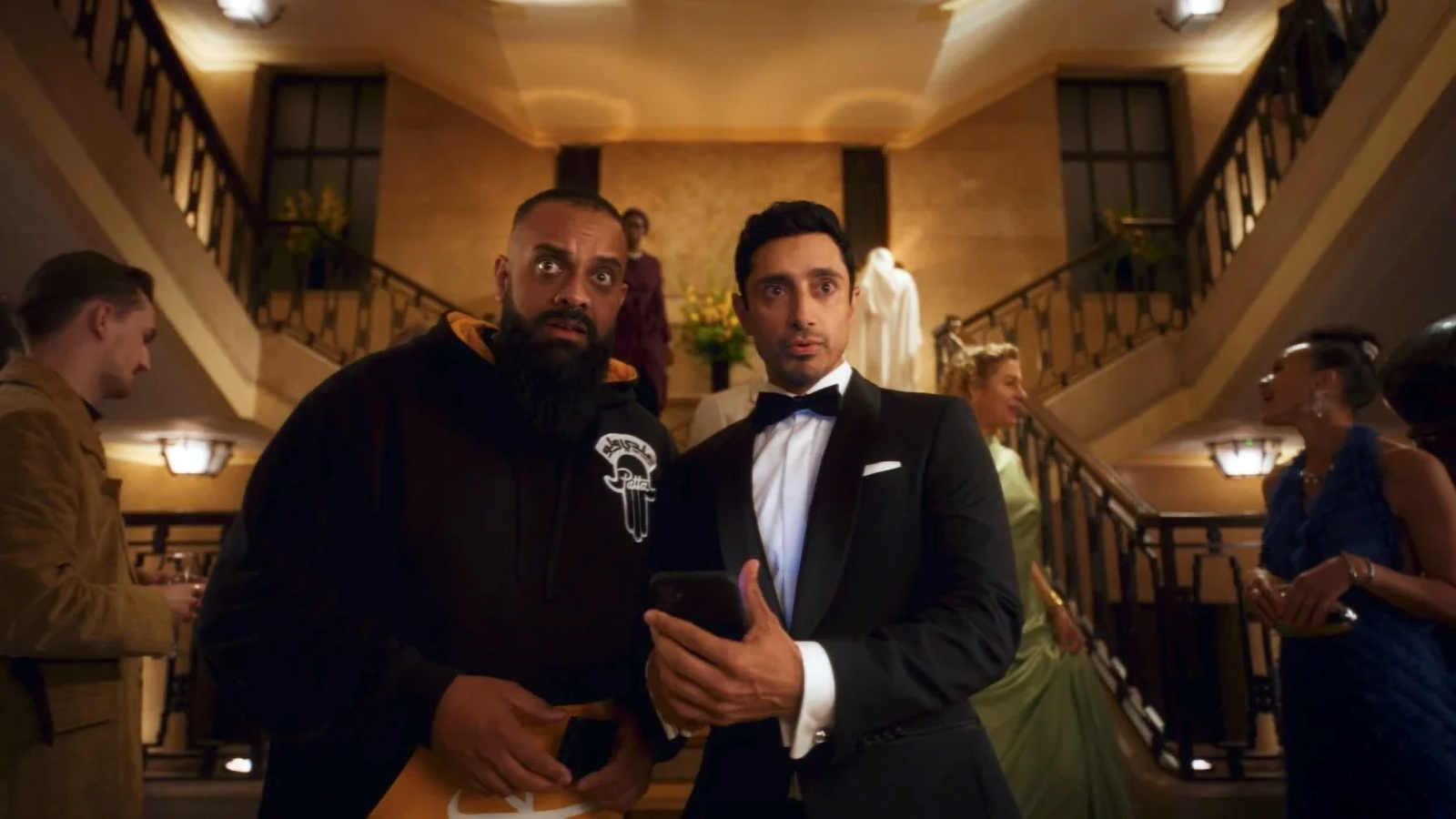
Guz Khan and Riz Ahmed in “Bait.” (Photo courtesy of Prime)

“Bait” is the story of Pakistani-British-Muslim actor Latif on the verge of breaking boundaries by auditioning for one of the biggest and most coveted roles in cinema — James Bond — and the lengths he goes to in order to remain relevant (in the acting community and within his family). But what it examines is chasing that sense of belonging and what it means to be fully oneself and fully Muslim — even with storylines of ending up in a club on Eid al Fitr and running around with a pig’s head in a canvas bag. (I promise, more on that later.)

For Muslims and particularly South Asians, Ahmed has become a trailblazer, helping make these communities a recognizable force in film and television. From early roles in HBO’s “The Night Of” (for which he won an Emmy) and “The Sound of Metal,” Ahmed has done much to hold Hollywood and British television and cinema to better standards in the portrayal of Muslim characters. Ever heard of “The Riz Test”? That comes from his 2017 speech to the House of Commons about authentic diversity representation on screen.


“Bait,” Ahmed said, was inspired by his personal experiences, which aren’t the experiences of all South Asian Muslims. But that’s kind of the point. 
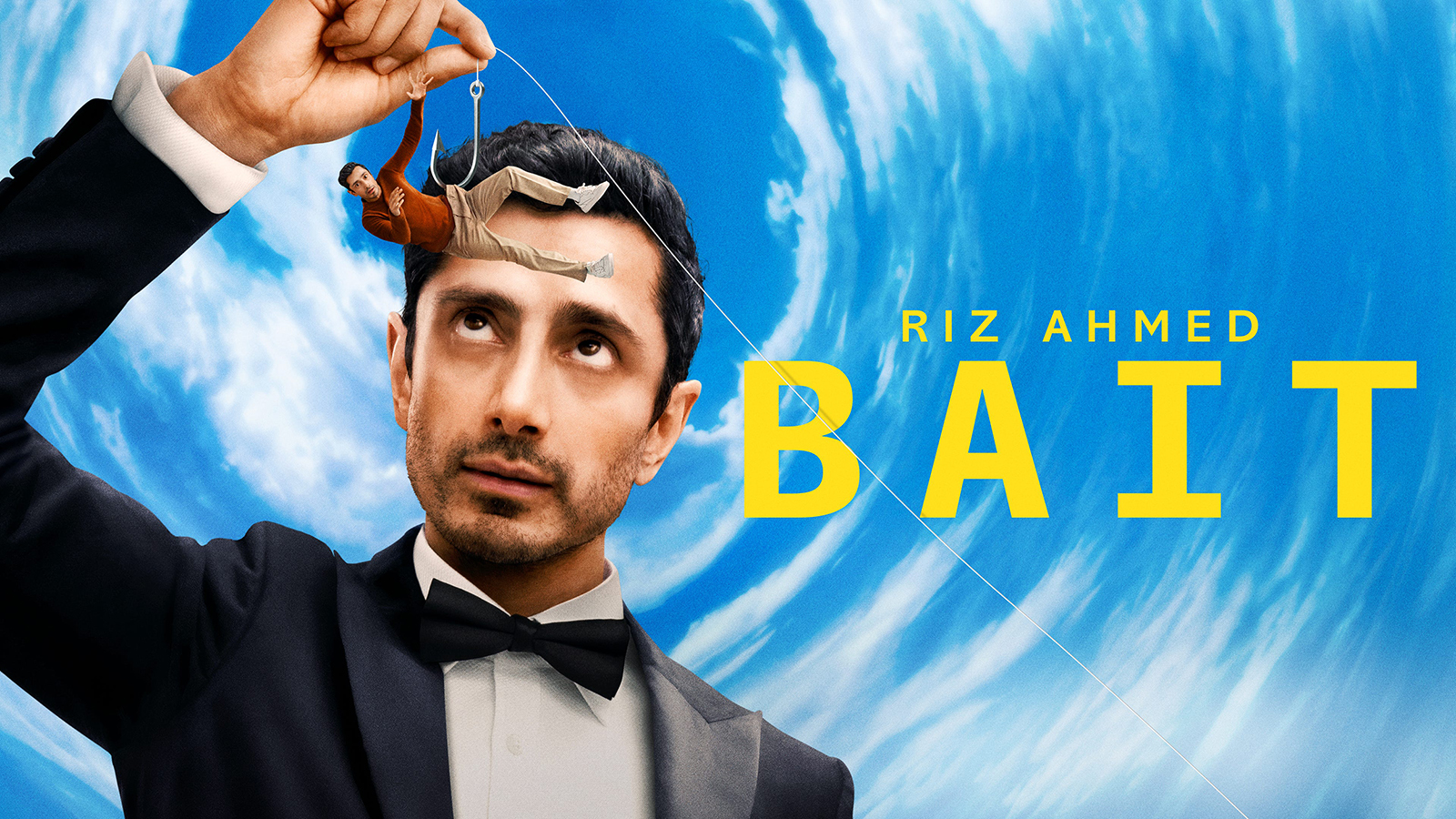
“Bait” promotional poster. (Image courtesy of Prime)

As he said in this Los Angeles Times interview, “Shah Latif … is having an identity crisis. He’s trying to work out who he is. So it stands to reason the show should also be trying to work out what it is. The show needs to be having an identity crisis.”   

Founder and editor-in-chief of the British Muslim media site Amaliah, Nafisa Bakkar, wrote in her Substack reflection on “Bait”: “Can you include something that would normally be considered haram, offensive or culturally off-limits, and still have it feel truthful rather than superficially subversive to a white gaze?” The line between offense and authenticity, Bakkar wrote, is dictated by who is telling it.

Even though my Muslim experience is certainly not Latif’s (or Ahmed’s, for that matter), they are all lived Muslim experiences, no matter the halal-to-haram ratio. 

“Bait” benefits from the wide reach of streaming platforms, which affords a show the ability to be more hyper-specific in its story telling and target audience. This has opened up a growing bank of opportunities for Muslim-oriented shows, said Zaki Hasan, an arts critic with the San Francisco Chronicle and a professor of communication and media at San Jose State University.

“Streaming plays to narrow casting and sort of slicing the demographics very thin,” he said. But can shows like “Bait” that play to a seemingly narrow South Asian and Muslim audience reach beyond those demographics?
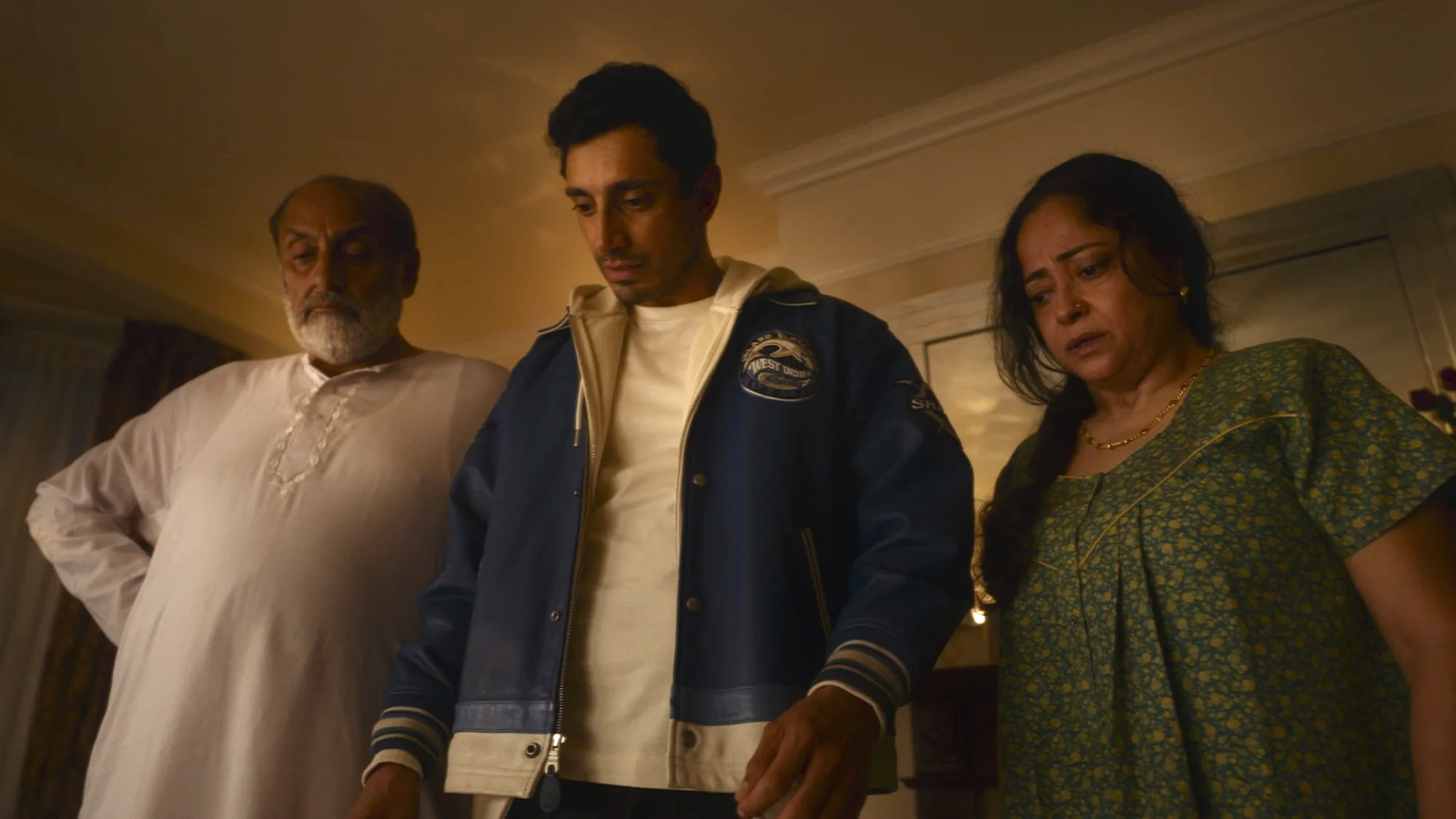
Actors Sajid Hasan, from left, Riz Ahmed and Sheeba Chaddha in “Bait.” (Photo courtesy of Prime)

“I think that when it comes to the Muslim community, this is uncharted waters,” Hasan said. “I’m reminded of a favorite quote by writer/director Nicholas Meyer, who once said, ‘I find that in specificity you will find universality.’”

“Bait” isn’t the first show to center Muslim stories as it intersects with South Asian and Middle Eastern-North African (MENA) cultures. “Ramy” featured Egyptian-American comedian and actor Ramy Youssef, “Mo” is based on the life of Palestinian-American comedian Mo Amer, and “We Are Lady Parts” was created, written and directed by Nida Manzoor and followed an all-female Muslim punk band. All the shows were inspired in part by their creators’ lives straddling faith and culture.

“Bait” draws viewers into extreme specificities in the familial relationships, inside jokes, cultural and faith rituals and even geography of South Asian Muslim life in and around London and surrounding neighborhoods. As Bakkar noted, it’s not “sort of” brown or Muslim in its storytelling, but rather it goes all in. Latif starts off wanting to become the next James Bond and prove to Britishers (and his extended Pakistani family) that brown Pakistani Muslims can be fully British (something that is fueled by childhood experiences of being bullied).

But who has placed that mantle upon him? His family? His agent? Himself? Is it even something that needs proving, and will becoming the next Bond really make the sort of impact he is hoping for? “Bait” finds its heart in exploring these questions, even as it gets kind of bizarre by Muslim South Asian standards in the latter half of the series.

In discussing the show with a family member who enjoys Ahmed’s work as much as I do, she admitted to dropping the show after episode three when the plot had Latif leaving a family Eid celebration (rife with aunty gossip and cousin oneupmanship) to help an ex-girlfriend find her missing purse in a club. While scenes like these may alienate some Muslims who take issue with going from Eid prayers and family celebrations to dancing in a club (I mean, that’s not how many Muslims I know spend their Eid), others will relate to how Latif juggles all parts of his life.

Actors Riz Ahmed and Ritu Arya in “Bait.” (Photo courtesy of Prime)

And then there’s the pig head that Latif totes around. He begins conversing with the pig head about the weight he is carrying in trying to shed his bullied past and become a strong actor who will force white Britishers to reckon with his faith, culture and skin color. It’s a sort of twisted homage to Shakespeare’s Hamlet talking to the skull of Yorick. 

It becomes a clever clapback on anti-Muslim types who think waving a piece of bacon is Muslim kryptonite. (Yes we don’t eat pork or pork products, but we won’t wither and die in the presence of pigs or bacon.)

Yes. It’s weird, but stick with it. In reporting on Muslims for more than two decades, one of the oldest adages I’ve repeatedly fallen back on is that Muslims are not a monolith. We don’t all worship the same way or follow the teachings of our faith the same way. Whether I like it or not, “Bait” isn’t ‘My South Asian Muslim Life.’ It’s not meant to be, and that’s why it is fun to watch. It’s the kind of narrow casting that can draw in South Asian Muslims but also appeal to wider audiences because of its specificities and attention to detail.

(Dilshad D. Ali is a freelance journalist. The views expressed in this commentary do not necessarily reflect those of RNS.)


US Supreme Court stops execution of inmate who became a ministry leader on death row

(RNS) — At the heart of Alabama’s latest death penalty controversy is Jeffery Lee, who became a Christian mentor to other incarcerated men on death row. Opponents to Lee’s execution ask courts to 'choose life.'


Abraham Bonowitz, of the group Death Penalty Action, leads a demonstration outside the Capitol in Montgomery, Ala., on Monday, June 8, 2026, to oppose an upcoming execution in Alabama. (AP Photo/Kim Chandler)


Chloe Landen
June 12, 2026
RNS

(RNS) — The Supreme Court on Thursday (June 11) prevented Alabama from executing a man who became a Christian ministry leader during his 26 years on death row, deciding that killing him using nitrogen gas was unconstitutional.

Jeffery Lee, who is imprisoned for the murder of two people, elected in 2018 to be executed by nitrogen hypoxia over lethal injection. But following the method’s first use in 2024, he was among several Alabama inmates to file lawsuits challenging the constitutionality of nitrogen suffocation. After two lower court rulings blocked the method this week, deeming it cruel and unusual punishment, NBC News reported that the Supreme Court denied the state’s request to execute Lee yesterday evening. 

Lee was convicted of fatally shooting Jimmy Ellis and Elaine Thompson during a pawn shop robbery outside Selma, Alabama, in 1998. Lee’s trial lasted two days, and in a 7-5 vote, the jury chose a sentence of life imprisonment without parole. Yet, in a move that has defined Alabama criminal court proceedings, the presiding judge sentenced Lee to death. Alabama is one of three U.S. states that have historically permitted judicial override, a process that grants judges the power to overrule a jury’s decision.

In Alabama, judicial override has disproportionately sentenced defendants to death. A 2011 Equal Justice Initiative report revealed 21% of the state’s death row inmates were sentenced to death through judicial override, contributing to the state’s highest per capita death sentencing and execution rate in the country.

Jeffery Lee, in an undated photo. (Photo courtesy of the Alabama Department of Corrections)

In 2017, Alabama became the last state to abolish judicial override, but the decision did not retroactively apply to previous sentences.

Since being sentenced in 2000, Lee has been held in William C. Holman Correctional Facility in Atmore, Alabama. In that time, he became a ministry leader through Kairos Prison Ministry International, a Christian nonprofit headquartered in Florida that aims to serve the spiritual needs of inmates and is supported by volunteers.

According to The Campaign for Clemency for Jeffery Lee’s website, he was selected for the leadership role by Kairos ministry — a decision the campaign said reflected his “tremendous transformation” and potential to serve as a “positive influence” on others. He has since mentored other incarcerated men on death row, the group said. 

“Jeffery is not the same person he was decades ago,” the campaign states. He “did not walk into the Holman Correctional Facility a man of faith. That came later and it came slowly — from the inside out.” The campaign’s website also links several Holy Week sermons delivered by Lee.

The campaign argues Lee’s execution should be prevented on the grounds of his moral and spiritual transformation, in addition to his turbulent upbringing and a traumatic brain injury that they claim impacted his early life and subsequent crime.

Kairos declined an RNS request to comment on the case. 


In Alabama, lethal injection is the default execution method for those incarcerated on death row, but in recent years, the state has come under criticism for several botched attempts. In response, Alabama pioneered death by nitrogen suffocation in 2024. The method requires strapping an inmate to a gurney, placing a mask on their face, and releasing nitrogen to restrict oxygen. Prior to its first application in 2024, the method had never been tested.

The decision to experiment with nitrogen suffocation drew international alarm. Before Alabama executed its first inmate via nitrogen suffocation, Kenneth Smith, United Nations experts expressed concern that the new method could cause immense suffering and amount to torture. Smith reportedly convulsed and writhed for 20 minutes before he died. Afterward, U.N. Human Rights experts called for an urgent ban on the practice.

The U.S. Supreme Court is seen Friday, April 17, 2026, in Washington. (AP Photo/Mariam Zuhaib)

Since then, Alabama has executed seven inmates via nitrogen suffocation. The majority vigorously struggled for several minutes, and many took between 16 and 32 minutes to die. Last year, the execution of Anthony Boyd became the longest recorded death by nitrogen suffocation, totaling 38 minutes.

Lee’s lawsuit noted that the method causes extreme suffering and claimed he would rather die by firing squad.

Following a lower court ruling earlier this week, Lee told NBC News, “Fear not, I am not finished, and just, you know, to me, my faith is everything.” The state then appealed the decision to the Supreme Court.


As Lee’s case has entered the national spotlight, several religious leaders have argued against Lee’s execution and advocated for clemency. Retired Brigadier Gen. Carlton Fisher, who served as a chaplain in the U.S. Army Reserve and the Federal Bureau of Prisons and holds a doctorate in ministry, published an op-ed last week criticizing Alabama’s history of judicial override. In Lee’s case, Fisher argued, Alabama should “honor the decision of the jury” that “chose life.”

Similarly, Drayton Nabers, Jr., former chief justice of the Alabama Supreme Court, published an op-ed urging Alabama to honor the jury’s vote.

Though not explicitly mentioned, Fisher and Nabers’ writing both invoke a scriptural mandate in Deuteronomy 30:19 to “choose life.” The biblical mandate has been made well-known by Christian anti-abortion activists in the United States.

In a statement more clearly grounded in theology, the Catholic Mobilizing Network urged Gov. Kay Ivey and the Alabama Bureau of Pardons and Paroles to grant Lee clemency, calling capital punishment “an act of state sanctioned violence that violates the sacred dignity of every human life.” CMN has long taken a theological stance against legal execution.

A social media account supporting Lee’s clemency released an emotional video Thursday evening in which Lee can be heard telling his mother, “I won,” to which his mother replied: “Thank you, Jesus.” “Let them know what God did,” Lee can later be heard saying.

But for supporters of Lee’s clemency, the battle continues. In a statement given to NBC, Ivey said the state still plans to reschedule Lee’s execution. “I remain committed to ensuring that justice is ultimately served for his victims,” she stated. 

Astronaut Victor Glover is still trying to find the spiritual words to describe his Moon mission

(RNS) — 'At the end of it, when we were just responding totally instinctually, we talked a lot about God,' Glover told RNS in a recent interview, referring to the Artemis II crew.


Jack Jenkins
June 12, 2026 
RNS


(RNS) — On a humid evening in late March, Victor Glover huddled with his fellow Artemis II astronauts to have what the spacefarers called their “ultimate dinner.” It was their last full meal before embarking on their historic journey around the Moon — the first human-crewed visit to Earth’s silver satellite since 1972.

After Glover finished his spread of lamb chops, spinach and sweet potatoes, the cook returned with something else: Communion elements. The cook, a Christian himself, then sat next to Glover and Canadian astronaut Jeremy Hansen as the men paused to pray before observing the Christian sacrament together.

“I prayed and I pleaded that God accepts that I do this for the mission,” Glover, who worships with Churches of Christ congregations in Texas, told Religion News Service in a recent video interview.

It was a quiet moment of religious ritual shortly before a rocket launch so explosively loud that, even a mile away, the boom rivaled the sound of standing near a screaming jet engine. The Space Launch System that carried the Orion spacecraft then catapulted Glover, the pilot for the mission, and his fellow Artemis II crew members into space, where they soared around the Moon and back in a gaping 252,756 mile arc that took them farther away from the Earth than any human beings in history.

But as millions back home marveled at the nine-day mission’s breathtaking photographs and technical accomplishments, Glover said the journey was also steeped in spiritual significance, from blastoff to splashdown.


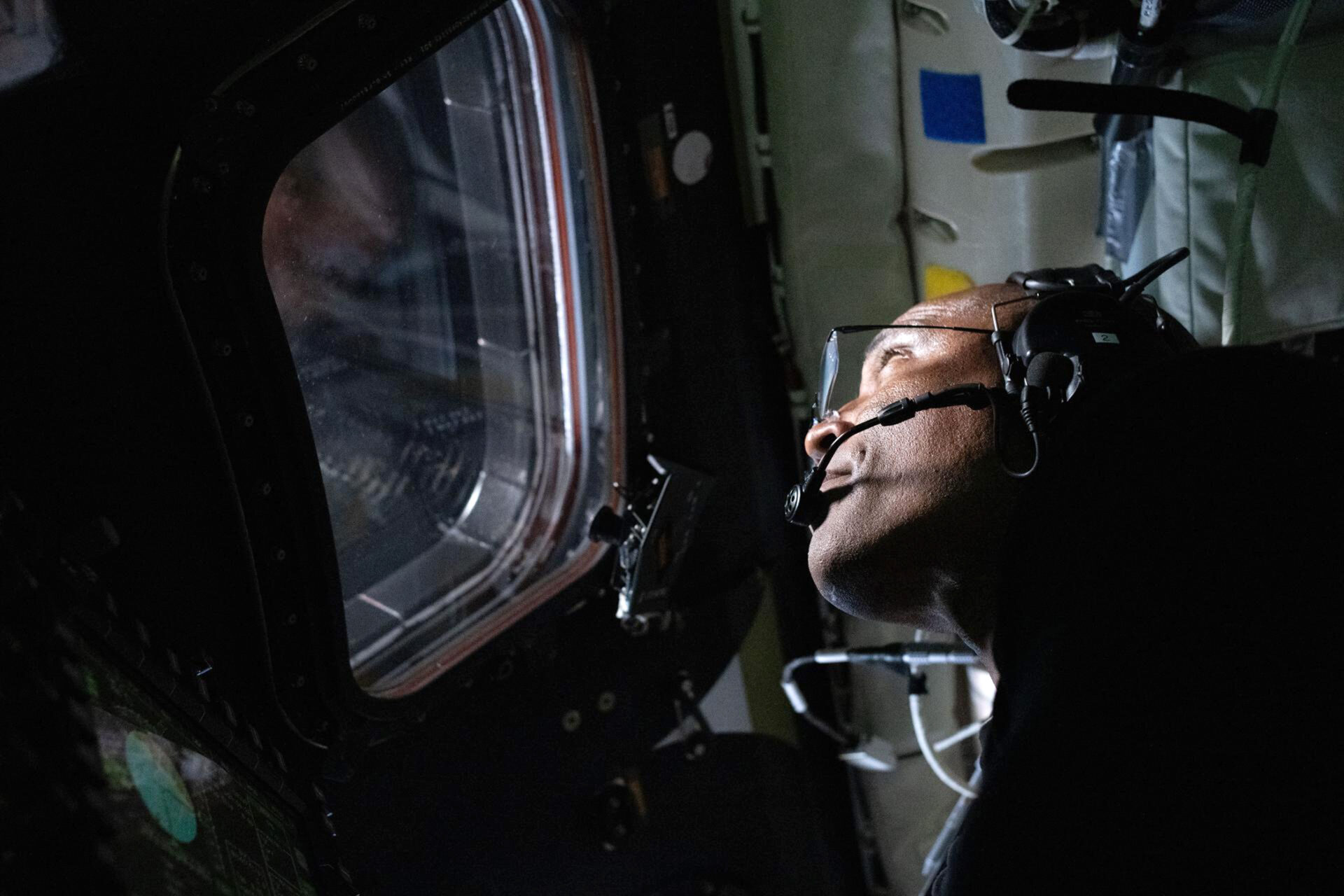
The Artemis II crew captured this view of an Earthset on April 6, 2026, as they flew around the Moon. (Photo courtesy of NASA) TOP PHOTO: NASA astronaut and Artemis II Pilot Victor Glover peers out the window of the Orion spacecraft during the Artemis II lunar flyby on April 6, 2026. (Photo courtesy of NASA)

“At the end of it, when we were just responding totally instinctually, we talked a lot about God,” he said, referring to the crew. “We talked a lot about creation and the beauty of the universe and the cosmos.”

Glover, 50, said just talking about the mission — even among the Artemis II crew members in their brief reunions between press junkets — has been a challenge. Multiple times in his interview with RNS, Glover admitted to struggling to articulate his thoughts on aspects of the flight, which included witnessing a spectacular solar eclipse rarely seen from space that spurred mission commander Reid Wiseman to quip to Glover, “I don’t think humanity has evolved to the point of being able to comprehend what we are looking at right now.”

“At the end of it, when we were just responding totally instinctually, we talked a lot about God ... We talked a lot about creation and the beauty of the universe and the cosmos.”Victor Glover

While he feels his faith has “definitely grown” through the journey, Glover said the inability to find the right words is something he has come to embrace as a kind of spiritual posture.

“I don’t have to be quick to put words on it and label the moments in the mission,” he said, later adding: “I’m actually getting comfortable not having to answer things. You have questions? Let’s talk about the question.”

Video Player


03:08


A faith that dwells among the stars

The clear impact of the mission on Glover is striking given his already ample experience as an astronaut. In 2020, he was among the first astronauts to fly aboard the Dragon Capsule, a commercial spacecraft created by Space X, to the International Space Station, where he and three other astronauts lived, suspended above the Earth, for 167 days. In an interview with the Christian Chronicle before the mission, he said he planned to bring Communion cups aboard the ISS, hoping to continue worshipping virtually with his faith community.

It’s hardly the first time an astronaut has engaged in religious ritual while in space (Buzz Aldrin, a Presbyterian, took Communion shortly before stepping out on the lunar surface during Apollo 11), and Glover said he counts himself among those who do not see science and religion as incompatible.

“If God could create the universe, God could create a thing to evolve,” Glover said, noting he once challenged a preacher’s claim that the Earth was 3,000 to 7,000 years old.

“I’m actually getting comfortable not having to answer things. You have questions? Let's talk about the question.”Victor Glover

And when the remake of the television series Cosmos aired in 2014, Glover said he had his four daughters lie down on their living room floor, close their eyes and listen as each read from the show’s description of the beginning of the universe. He asked them to build a picture in their mind of what they heard, which included descriptions of the Big Bang.

Glover encouraged his daughters to think about how someone who lived “2,000 years ago, 3,000 years ago” would describe the birth of the universe, and they noted how it echoed the Bible’s description of creation in Genesis.

“I saw my kids’ eyes light up,” Glover said. He added: “I work in science. I work in church. I don’t see them as conflicting.”


A close-up view from the Orion spacecraft during the Artemis II crew’s lunar flyby on April 6, 2026, captures a total solar eclipse, with only part of the Moon visible in the frame as it fully obscures the Sun. Venus is a bright spot on the left of the frame. (Photo courtesy of NASA)
Articulating a ‘gentle faith’

NASA also sought religious perspectives while prepping for the Artemis II mission. In a recent interview Wiseman conducted with The New Yorker, the mission commander said the agency hired “spiritual and cultural leaders” to come speak to the team “about the significance of the Moon around the world.”


NASA astronaut Victor Glover conducts leak checks on his spacesuit in the Neil A. Armstrong Operations and Checkout Building at the agency’s Kennedy Space Center on Wednesday, April 1, 2026, in Florida. (Photo courtesy of NASA/Kim Shiflett)

“We wanted to know how everyone sees the Moon,” Wiseman said.

During the mission itself, which coincided with the Christian Easter holiday and the Jewish celebration of Passover, Glover made reference to the Bible and his faith in his public statements at least twice: once during a televised interview with CBS as they hurtled away from Earth, and a second time during a broadcast just before the crew vanished behind the Moon and entered a 40-minute period of radio silence.

“As we continue to unlock the mysteries of the cosmos, I would like to remind you of one of the most important mysteries there on Earth — and that’s love,” Glover said, referencing the Gospel of Matthew during the broadcast. “Christ said, in response to what was the greatest command, that it was to love God with all that you are. And he also, being a great teacher, said this: ‘I give you equal to it, and that is to love your neighbor as yourself.’”

He added: “And so, as we prepare to go out of radio communication, we’re still able to feel your love from Earth and to all of you down there on Earth, and around the Earth, we love you from the Moon.”

It’s a kind of public-facing religious rhetoric that has proven controversial in the past. After Apollo 8 astronauts read from the book of Genesis while circling the Moon in 1968, an atheist activist filed a lawsuit. The legal challenge was thrown out, but it left NASA skittish about religious rhetoric taking center stage during missions.

But public reception of Glover’s remarks seemed generally positive, with many lauding what one commentator called the astronaut’s “gentle faith.”

“I work in science. I work in church. I don't see them as conflicting.”Victor Glover

“I tried to speak something that was true for me personally, but also true universally, no matter what you follow, whatever faith — or lack of faith — you have,” Glover said, musing that the warm reception may have been because “people’s hearts needed something,” at a time when “there’s a lot of negativity flying around.”

“You can understand how important it is to love something bigger than yourself, and how you should love your neighbor. If we could figure that out, all of us would be better today,” he said.
A religious return

According to Glover, his crewmates were frequently at a loss for words as they gazed back at an Earth that grew ever smaller throughout their journey. He often heard them exclaiming reverently to each other, “Oh my God.

NEW: Bring more puzzles and play to your week with RNS Games

“We Christians are often, too often, quick to say, ‘do not use the Lord’s name in vain,’” he said. “I will tell you, I never felt it was in vain: I thought that is the appropriate utterance for this moment. It’s truly a God moment.”


NASA Artemis II astronauts Victor Glover, center left, and NASA astronaut Christina Koch, center right, are sit on a Navy MH-60 Seahawk on the flight deck of USS John P. Murtha after they were extracted from their Orion spacecraft after splashdown, Friday, April 10, 2026, in the Pacific Ocean off the coast of California. (Photo courtesy of NASA/Bill Ingalls)

Glover stopped short of suggesting his fellow astronauts were using the same spiritual lens he does. Neither Hansen nor Christina Koch, both mission specialists, appear to have publicly discussed their faith — if they claim one — before or after the mission, and Captain Wiseman has described himself as “not really a religious person.”

Even so, one of the first calls Wiseman made after splashing down in the Pacific Ocean on April 11 was to a chaplain. In a recent public appearance, Wiseman said that as the crew waited together in a medical bay, he felt the astronauts had “no other avenue” to “explain” what they saw during their time in space.

The Navy chaplain on duty that day was Lt. Eliseo Morales Jr., who is affiliated with the Presbyterian Church (USA). In an email to RNS, Morales said that around the same time, an officer called him and said, “Chaps, your presence is requested at medical.”

When Morales entered the room, Wiseman embraced him. The mission commander, who has discussed the encounter publicly and gave Glover permission to mention it, then broke down into tears.


“I’ve told (Wiseman) this since: That was one of the most spiritual moments of my life,” Glover said.

Morales said that he, too, left the experience moved, saying it felt “like a dream.”

“Praying for and meeting actual astronauts who we just recovered from a capsule in the middle of the ocean is a sentence I never thought I would write in my entire life,” he said in the email. “Yet God placed me on this ship for that reason.”

The impulse to call a chaplain speaks to the power religion can have in tense moments, said Glover, including when it comes to articulating the seemingly intangible.

“(Wiseman’s) brain and emotion and development and maturity thought to bring a person in who could understand,” Glover said. “When you think about it, that’s what church is supposed to be anyway: When people have need, you want them to reach for that.”

Morales felt similarly. He noted that, while his meeting with Wiseman and the other astronauts was a “once-in-a-lifetime moment,” it was “no more sacred than the time I was speaking to a young Sailor in my office … who was going through overwhelming challenges in his life.”


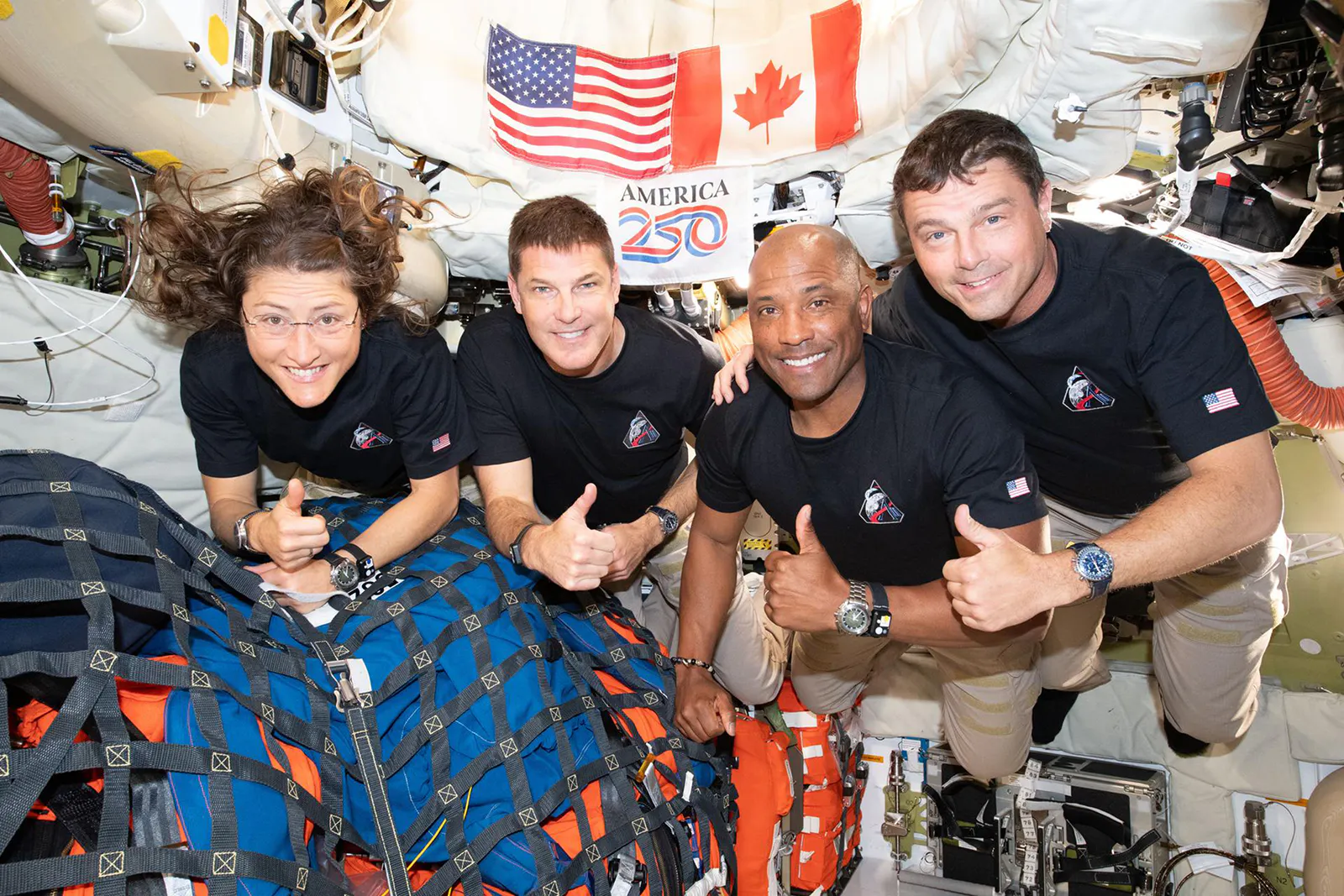
The Artemis II crew, from left, Mission Specialist Christina Koch, Mission Specialist Jeremy Hansen, Pilot Victor Glover, and Commander Reid Wiseman pause for a group photo inside the Orion spacecraft on their return to Earth, on April 7, 2026. (Photo courtesy of NASA)

Wiseman, in his New Yorker interview, said he and Glover discussed the divine while carving out a few hours together in the Montreal airport during a media tour in April.

“I told him, ‘I think we slipped through the hands of God during that mission,’” Wiseman said, referring to Glover. “That just stopped him in his tracks. He completely agreed. There’s just ways that we see the world right now that are totally different.”

And while a trip to the Moon and back may have left him spiritually reeling, Glover gave no indication that it fractured his faith itself. He said he initially wanted to return to church a day after coming home, and although his family shot down appearing in person, they worshipped virtually together that Sunday.

And while the Communion he shared at his “ultimate meal” was certainly uniquely timed, it was hardly his last.

“I got right back to it when I got back to Earth,” he said.


Earth is illuminated against the blackness of space in this photo taken by an Artemis II crew member through an Orion spacecraft window. (Photo courtesy of NASA)