It’s possible that I shall make an ass of myself. But in that case one can always get out of it with a little dialectic. I have, of course, so worded my proposition as to be right either way (K.Marx, Letter to F.Engels on the Indian Mutiny)
Tuesday, June 23, 2026
NorthStandard & Sailors’ Society Put Seafarer Wellbeing at Heart of Safety
Colin Gilespie, Global Head of Loss Prevention, NorthStandard
NorthStandard will partner maritime welfare charity Sailors’ Society to support seafarers’ emotional wellbeing in delivering Sea Mate - an industry?leading online mental health awareness training programme.
Launched during the week of Day of the Seafarer 2026 (25 June), the partnership reinforces shared commitments to recognise and support the vital contribution seafarers make to global trade, delivering Sea Mate as part of NorthStandard’s My Mind Matters initiative.
Sea Mate offers seafarers a range of onboard emotional support, training seafarers to become Wellbeing Officers who can recognise distress, provide peer support and respond to challenges arising at sea.
Life at sea presents unique challenges, including isolation, fatigue, and prolonged periods away from home. Its pressures can intensify due to unpredictable events, such as geopolitical conflicts, piracy incidents, or disruptions like the COVID?19 pandemic. Recent events in the Persian Gulf underline how crews going about their daily duties can suddenly become exposed to high stress situations that last for weeks or months.
Sea Mate offers a two?day remote training programme, available in multiple languages, which shares the real?world skills seafarers need to face onboard realities. It helps crews recognise early warning signs of emotional distress and to support one another when challenges arise. Sea Mate also extends beyond the course itself to offer access available to ongoing professional guidance, peer networks, and Sailors’ Society’s 24/7 crisis response services.
For NorthStandard, the partnership reinforces its commitment to seafarer wellbeing, in line with findings from the Safety4Sea SEAFiT Survey and cases seen by the club which highlight gaps in crew awareness, coping strategies, and confidence to act.
By focusing on early intervention, open communication, and resilience, Sea Mate helps create psychologically safer working environments on board. Stronger crew wellbeing is strongly linked with improved retention, a reduced risk of incidents, and more stable ship operations, supporting safe and sustainable shipping.
Colin Gilespie, Global Head of Loss Prevention, said: “We are pleased to be partnering with Sailors’ Society to deliver Sea Mate and further strengthen the support available to seafarers. Providing practical, accessible training that helps crews recognise and respond to wellbeing challenges is vital in today’s operating environment. We are committed to helping our Members support their crew, recognising that strong wellbeing is fundamental to safe and efficient operations. Through this programme, we are giving Members further tools to build more resilient crews and safer vessels.”
Through the partnership, NorthStandard Members are eligible to one free remote Sea Mate course each year for up to 16 seafarers, as well as discounted rates for additional courses. This enables Members to scale wellbeing support across fleets and embed a proactive safety culture without adding operational burden.
Sailors' Society CEO Sara Baade said: "This generous partnership with NorthStandard could see thousands of new Wellbeing Officers on board ships across the world, trained to give frontline help and support to fellow crewmates. Our Sea Mate training has been hugely popular with shipping companies who know that seafarers' wellbeing directly affects the safety of their colleagues, the cargo and the ship. We are looking forward to NorthStandard members benefitting from this programme and applaud NorthStandard for its commitment to crew wellbeing."
The products and services herein described in this press release are not endorsed by The Maritime Executive.
Ship Recycling Governance: Moving Beyond the False Basel-HKC Dichotomy
The recent response by BIMCO to my article, "HKC Certification Can't Substitute for the Basel Convention," reflects a broader debate that has occupied the ship recycling community for years. Such exchanges are healthy and should be encouraged. Yet, perhaps unintentionally, the discussion continues to revolve around the wrong question. The issue is not whether the Basel Convention and the Hong Kong International Convention for the Safe and Environmentally Sound Recycling of Ships (HKC) are competing regimes. Nor is the issue whether one convention should replace the other. Legally speaking, there is little room for serious controversy. Both conventions apply. They regulate different aspects of the same activity and perform different functions.
The difficulty lies not in the law itself, but in the facts. More precisely, the problem lies in how the international community has struggled to operationalize the Basel Convention's open-ended standards in the ship recycling context within the realities of developing countries. Consequently, the central question should not be whether Basel applies. The real question is how Basel is to be implemented.
Unfortunately, the international debate has increasingly moved in the opposite direction. Much of the contemporary discourse implicitly assumes that one convention must prevail over the other. The IMO recently adopted the Provisional Guidance on the Implementation of the Hong Kong Convention and the Basel Convention with Respect to the Transboundary Movement of Ships Intended for Recycling (IMO Circular HKSRC.2/Circ.1). Yet, the premise underpinning the Provisional Guidance appears to rest on an assumption whose legal basis merits further examination.
The Basel Convention governs the transboundary movement and environmentally sound management of hazardous waste. The HKC establishes a framework for the safe and environmentally sound recycling of ships and regulates operational standards at recycling facilities. These are different subject matters. Nothing in the HKC repeals the Basel Convention. Nothing in the Basel Convention can reasonably be interpreted as excluding the application of the HKC. Nor does Article 30 of the Vienna Convention on the Law of Treaties authorize states to disregard obligations under one treaty merely because another treaty addresses related issues. The answer has never been "Basel or HKC." The answer has always been "Basel and HKC." Indeed, even the BIMCO article acknowledges that both conventions exist within a broader regulatory system.
BIMCO’s discussion subsequently shifts to the historical shortcomings of the Basel regime in the ship recycling context and portrays the Hong Kong Convention as a practical response thereto. However, even if those shortcomings are accepted, considerations of expediency or regulatory convenience do not, as a matter of international law, generate exceptions to treaty obligations or alter the legal relationship between the two conventions. BIMCO argues that the Basel Convention's prior informed consent procedure has never worked effectively in the context of end-of-life ships and that the HKC emerged because no functioning global regime existed. There is considerable truth in the proposition that Basel's mechanisms were not designed with ships in mind. But this does not lead to the conclusion that Basel somehow ceases to apply. International law contains many obligations that are difficult to implement. Climate agreements are difficult. Biodiversity protection is difficult. Human rights treaties are difficult. Yet no one argues that practical obstacles extinguish legal obligations. Difficulty is not a recognized principle of treaty interpretation.
The fact that the Basel regime has not operated optimally for ship recycling does not mean that the Convention is inapplicable. It merely demonstrates that the international community has not yet developed adequate methodologies for implementing Basel in a manner compatible with the realities of global shipping and developing countries. Failure of implementation should not be confused with failure of law.
Perhaps the greatest misunderstanding in this debate is the assumption that the controversy concerns competing legal norms. It does not. The problem is methodological. The Basel Convention relies on concepts such as "environmentally sound management." Like sustainable development, due diligence, best available techniques and equivalent protection, these are indeterminate standards. They deliberately provide flexibility because environmental regulation must accommodate different economic and technological realities. The difficulty is that international law has supplied no clear methodology for determining when such standards have been satisfied. How much downstream waste infrastructure is sufficient? At what point should environmental protection be considered environmentally sound? Must developing countries replicate OECD waste management systems? Or does international law permit context-sensitive solutions? These are the questions that remain unanswered.
Consequently, the debate has shifted from determining how Basel should be complied with to questioning whether Basel should be complied with at all. That is a dangerous shift. BIMCO correctly observes that nobody intends to replace the Basel Convention's prior informed consent system. Yet the increasing reliance on the HKC's International Ready for Recycling Certificate has generated a tendency to attribute to the flag state functions that Basel reserves for exporting states.
The issue here is not whether the flag state plays an important role. Undoubtedly, it does. The issue is jurisdiction. The HKC certificate is issued pursuant to maritime jurisdiction exercised by the flag state. The Basel Convention, by contrast, is built upon territorial export control. These are fundamentally different legal obligations and concepts.
Jurisdiction under international law does not arise from convenience, familiarity or practical efficiency. It arises from legal authority. The fact that flag states may possess greater familiarity with ships than environmental authorities in exporting states does not alter the legal architecture established by the Basel Convention. Otherwise, expertise itself would become a source of jurisdiction. That proposition has no basis in international law.
Ironically, the Basel-HKC debate exposes a much broader problem affecting international environmental law generally. Many treaty obligations are expressed through flexible standards. Environmentally sound management, sustainable development, due diligence and equivalent protection all belong to this category. The purpose of these standards is to accommodate diversity among states. Principle 11 of the Rio Declaration expressly recognizes that environmental standards applied by some countries may be inappropriate and impose unwarranted economic and social costs on others, particularly developing countries. Similarly, the principle of common but differentiated responsibilities acknowledges that states differ in their capabilities and developmental circumstances.
Yet despite these principles, the international community has provided very little guidance concerning what compliance actually looks like in developing countries. As a result, developing states are often measured against unstated OECD benchmarks. Compliance thereby ceases to be anchored to fixed legal standards and instead becomes a fluid target, with legal obligations varying according to the regulatory capacities of individual States. More improvements are always demanded, but no objective endpoint is ever defined.
Bangladesh, India and Pakistan have invested heavily in upgrading their ship recycling sectors. The progress is undeniable. The entry into force of the HKC has undoubtedly accelerated this transformation. These achievements deserve recognition. But acknowledging progress should not lead us to abandon the question of Basel compliance. Quite the opposite. Progress should compel us to ask a more sophisticated question: What constitutes environmentally sound management in the context of developing countries?
For years, the debate has focused on whether Basel applies to ships. That question has largely been answered. The Basel Convention applies. The HKC applies. The real challenge is operational rather than doctrinal. How should environmentally sound management be measured? How should equivalence be assessed? What level of downstream infrastructure is sufficient? How should sustainable development and common but differentiated responsibilities influence compliance assessments? These are the questions that deserve the attention of governments, international organizations and industry.
The problem is not one of legal incompatibility. It is one of scientific and methodological uncertainty. The answer therefore lies not in choosing between two conventions, nor in constructing artificial hierarchies between them. Rather, the international community should devote its energies to developing transparent and context-sensitive methodologies capable of identifying when environmentally sound management has been achieved.
Only then will the debate move from endless arguments over treaty interpretation to meaningful discussions about measurable compliance. The success of the Hong Kong Convention should be welcomed. The improvements witnessed in South Asia are real and substantial. Workers and the environment are undoubtedly better off today than they were twenty years ago.
But the existence of progress should not tempt us to convert practical difficulties into principles of treaty interpretation. The future of ship recycling does not lie in choosing between Basel and Hong Kong. Both conventions are here to stay. The real question facing the international community is not whether Basel applies. It is whether we are finally prepared to develop the tools necessary to make Basel work in the context of developing countries. Until that question is addressed, the debate will continue to ask the wrong question. And when we ask the wrong question, we should not be surprised when we fail to find the right answer.
Dr. Ishtiaque Ahmed is Professor and Chair of the Department of Law at North South University, Bangladesh. A former Merchant Marine Engineering Officer, he earned his Doctor of the Science of Law (J.S.D.) degree from the University of Maine School of Law, USA, with specialization in international ship recycling law and policy. He served as the sole legal consultant in the drafting of the proposed Bangladesh Ship Recycling Rules 2025 and the revision of the Bangladesh Ship Recycling Act 2018. Dr. Ahmed is a Barrister of England and Wales, a Member of the Chartered Institute of Arbitrators (MCIArb), London, an Advocate of the Supreme Court of Bangladesh, and is listed as a panel arbitrator of the Changsha Arbitration Commission (CSAC), People’s Republic of China. His research and professional interests lie at the intersection of maritime law, environmental regulation, and sustainable ship recycling governance. He may be reached at ishtiaque.ahmed@northsouth.edu.
The opinions expressed herein are the author's and not necessarily those of The Maritime Executive.
DHL Partners with Under-Development Vela Wind-Powered Cargo Ship
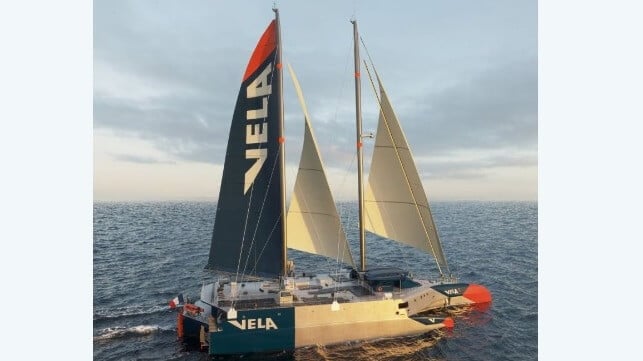
Vela will be 100 percent wind power and it enters service in 2027 (Vela)
The freight forwarding arm of global shipping giant DHL is partnering to offer customers the option of transporting goods transatlantic on a wind-powered cargo ship. Vela announced its partnership today, June 22, saying it will combine environmental performance and logistical excellence.
DHL Global Forwarding France, the freight forwarding business for DHL, will become a partner committing to space on the new ship. It joins the group of what the company calls pioneer cohorts, which will be among the founding members for the service.
Vela is the latest in a series of wind-powered cargo concepts that are beginning to take shape. The company has ordered the first of what it says will be five ships by 2028, which will make it possible to maintain weekly transatlantic service between France and the United States. The vessel is under construction at Austal Philippines’ Balamban, Cebu shipyard. A year ago, it marked a key milestone as the aluminum hull completed assembly and was turned over.
They expect to launch the service in early 2027, with a counter on the website saying the service is 161 days away (as of June 22, 2026). They plan to sail from Normandy and Bordeaux, and the westbound leg will require 10 to 13 days to reach New Jersey. The return trip to France is expected to last 8 to 10 days. They highlight that the ship will be fast, with an expected average speed of 14 knots, and they will optimize navigation in real time through advanced weather routing to follow the winds.
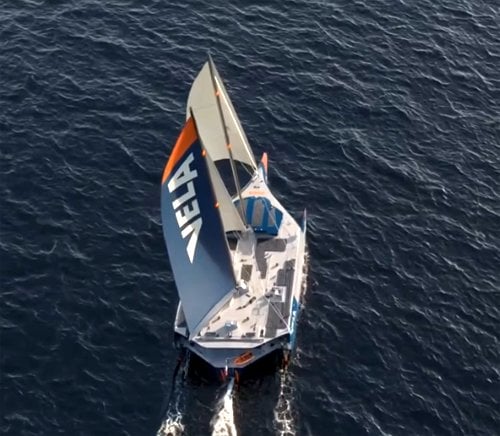
The company says its trimaran will be the first of its kind, crafted by world-leading experts VPLP and MerConcept. They highlight that the trimaran will be more stable and faster, providing a secure platform for cargo.
The ships will be 220 feet (67 meters) with a capacity of 415 metric tons carried on European pallets. The plan calls for a capacity of 500 pallets per week and a total of 30,000 pallets per year, each way on the Atlantic. The cargo areas will include temperature control, which the company says makes it well-suited for pharmaceuticals and cosmetics, luxury goods, wines and spirits, aerospace, and more broadly, high-value goods, where quality, traceability, and security are essential.
The ships will be 100 percent wind-powered, meaning they will achieve a 99 percent reduction in greenhouse gas emissions. The ship will have 6,705 square feet of sail area as well as solar panels and hydrogenators. The air draft will be 200 feet (61 meters).
Vela follows the Neoliner Origin, which launched last October, also offering wind-propulsion. It highlights original customers, including Jas. Hennessy, Remy Cointreau, Longchamp, Manitou, and Renault Group. These concepts look to expand their operations to maintain a regular, sustainable alternative crossing the Atlantic.
Master and Pilot at Fault as Bulker Contacted Wharf During Departure
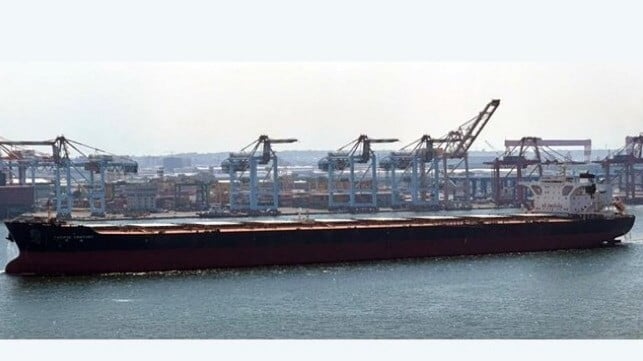
Master and pilot failed to properly plan the departure maneuver for the bulker in Taiwan's busy port (TTSB)
Failure by the master and pilot of the bulk carrier Pacific Century to clearly discuss and agree on the departure procedures caused the vessel to make contact with a wharf and the sinking of a boat at Taiwan’s largest commercial port last year. That was the finding in a report issued by the Taiwan Transportation Safety Board (TTSB).
Investigators found that the 295-meter Hong Kong-flagged bulk carrier made contact with Wharf No. 89 during departure operations at the Port of Kaohsiung on June 9 last year due to a lack of proper communications. Apart from causing damage to the vessel’s rudder and the wharf facility, the incident caused the capsizing and sinking of a working boat that was moored alongside the wharf. The boat was impacted by the propeller wash generated by the Pacific Century.
As Taiwan's largest harbor, Kaohsiung is a crucial transshipment hub in East Asia. Last year, the port handled roughly 8.8 million TEUs of container traffic with total cargo volume reaching over 220 million metric tonnes. During the year, the port recorded a total of 28,899 vessel calls.
In its investigations, TTSB was able to establish that during the departure operation, the pilot and master of the 94,955 gross tonnage carrier operated by the Hong Kong Ming Wah Ship Management Co. completed a basic Master–Pilot Information Exchange (MPX). However, the lateral clearance required for pulling the vessel away from the berth, as well as the timing and procedure for initiating astern propulsion and sternway movement, were not clearly discussed and agreed upon during the information exchange process.
Failure to clearly discuss and agree on the departure procedure resulted in Pacific Century entering continuous sternway before establishing sufficient lateral clearance under restricted water space conditions while departing the port. The result was reduced time and space available for safe maneuvering corrections during departure.
According to the investigation, as the actual maneuver gradually deviated from the pilot’s original expectations, the master and pilot did not identify the deviation at an early stage or adjust the maneuvering approach accordingly.
Investigators were able to establish that during astern propulsion, the vessel developed a starboard-turning tendency due to the transverse thrust generated by the propeller and the pushing force applied to the port bow by the tug, causing the stern to gradually drift toward Wharf No. 89.
When the distance between the stern and the corner of the wharf had reduced to approximately 0.1 nautical miles, and the sternway speed had reached approximately 2.5 knots, the pilot became aware of the drift and initiated emergency corrective actions. However, the available maneuvering space was limited due to the vessel’s distance from the wharf and sternway speed, resulting in contact between the vessel’s stern and the wharf and causing the working boat to capsize and sink.
“After Pacific Century entered the sternway phase, the bridge team primarily provided vessel speed information as part of the vessel’s situational updates, but did not simultaneously incorporate critical information such as Course over Ground (COG), sternway track, and the vessel’s relative position to the wharf as references for continuously monitoring the vessel’s sternway direction, heading, and relative position,” states TTSB.
Following the investigation, the Kaohsiung harbor pilot office has taken actions to strengthen pilots’ maneuvering judgment and risk identification, as well as strengthen the mechanism for continuous information exchange between pilots and masters during pilotage operations.
The Hong Kong Ming Wah Ship Management Co. reviewed its existing safety management and berthing/unberthing operational procedures to ensure that masters maintain awareness of the vessel’s movement status during pilotage operations.
U.S. Completes 66th Lethal Strike on a Suspected SmugglingFISHING Boat
A fraction of a second before impact in the June 21 strike (U.S. Southern Command)
On Saturday, U.S. Southern Command conducted a lethal strike on a suspected drug smuggling boat in the Caribbean, killing two and leaving multiple survivors.
According to the command, a drug-smuggling boat was spotted in the Caribbean on a known narco-trafficking route on Sunday. An airstrike destroyed the boat and killed two occupants. Six men survived the initial attack; the U.S. Coast Guard has been notified.
It was the command's 66th strike overall and its third strike in the span of a week. On Thursday, the military intercepted a go-fast vessel in the Eastern Pacific and determined that it was likely engaged in narco-trafficking. The vessel had four outboard motors, was traveling at high speed, and was heavily laden with packages towards the bow.
Southcom aviation assets struck the vessel with an explosive munition and destroyed it, scattering the cargo into the water and killing three suspects. No survivors were reported.
An additional drug-boat strike occurred Tuesday in the Eastern Pacific, and it killed one suspect and left two survivors. The U.S. Coast Guard was notified.
Mixed results
The stated objective of the $5 billion strike program is to stop the flow of cocaine from South America into the United States. It has meaningfully reduced the use of go-fast smuggling vessels off Venezuela, where the campaign initially concentrated its efforts, according to InSight Crime - but the net outflow of cocaine to Western consumer markets is likely unaffected.
"Concealment within legitimate cargo remains the main method for reaching consumer markets in the United States, Europe, and beyond, with traffickers routing loads through ports in countries like the Dominican Republic," assesses Alex Papadovassilakis for Insight Crime. "Spreading military presence over multiple trafficking regions — the Pacific, the Caribbean, and Central America — promises to create weak links, as intense pressure in one smuggling corridor simply pushes traffickers to redirect drug flows into another."
On the street, the circumstances appear unchanged. "Cocaine remains highly available, highly prevalent and relatively inexpensive [in the U.S.]," substance use researcher Dr. Carl Latkin told the New York Times. Nabarun Dasgupta, an addiction scientist at University of North Carolina, confirmed that per-gram street dose pricing remains at about $60-100 in the U.S., unchanged from price levels before the campaign.
Tanker Owners Are Having the Best Week of the Hormuz Crisis
The Strait of Hormuz may be reopening, but don't tell tanker owners the crisis is over.
They're making too much money.
As Middle Eastern producers scramble to move crude that has spent months stranded in the Persian Gulf, tanker rates have exploded higher, turning a slow return to normal into a windfall for shipping companies.
According to Reuters, the cost of hiring a tanker in the Gulf has nearly doubled in just a week, jumping from around $106,000 per day to more than $190,000 per day. For some very large crude carriers (VLCCs) hauling cargoes through Hormuz, daily earnings have surged to nearly $470,000—a level that would have seemed absurd before the war began.
Oil prices have spent much of the past week falling as traders price in the return of Middle Eastern supply, with Brent futures trading at $77 on Tuesday afternoon. Meanwhile, the people actually moving that oil are charging some of the highest rates seen during the entire crisis.
There still aren't enough ships.
Even after Iran lifted its effective blockade last week as part of the 60-day ceasefire agreement with the United States, traffic through Hormuz remains well below normal levels. Before the war began in late February, roughly 125 ships passed through the chokepoint each day. Current traffic remains a fraction of that.
At the same time, roughly 100 tankers are still trapped inside the Gulf carrying cargoes loaded during the conflict.
Now producers want their barrels moving again.
Abu Dhabi's ADNOC has been aggressively marketing crude cargoes, while refiners in major importing nations such as India are seeking additional Middle Eastern supplies after months of disruption. The result is a sudden surge in demand for ships just as vessel availability remains unusually tight.
The futures market has largely moved on from the crisis, but the shipping market clearly hasn't.
Until more vessels begin moving through the world's most important oil chokepoint, tanker owners may remain among the biggest winners of a conflict that cost almost everyone else dearly.
By Julianne Geiger for Oilprice.com
Tankers Emerge from Dark Mode amid Tentative Hormuz Reopening
A growing number of oil tankers have been broadcasting their position and intention to pass through the Strait of Hormuz in recent hours, in a sign that a tentative recovery of traffic through the chokepoint is underway.
Before the U.S. and Iran signed the memorandum of understanding to negotiate a peace deal, most tankers were moving through and around the Strait of Hormuz in the so-called dark mode, with transponders and AIS positioning switched off.
Once the hallmark of Iran’s sanction-evading tactics, dark mode has become mainstream in the Persian Gulf, the Gulf of Oman, and most of all – in the Strait of Hormuz, as tanker owners and shippers sought to protect their cargoes from attacks.
The dark crossings of vessels compounded the already difficult task of market analysts and observers to estimate how much supply was lost in the Middle East and how much could still reach some buyers with stealthy moves out of the region.
Since the U.S.-Iran memorandum of understanding was signed, more vessels have started to openly broadcast their position, according to conventional visible tracking signals monitored by Bloomberg.
As many as seven tankers were broadcasting they were in the Strait of Hormuz on Tuesday morning local time—two outbound non-Iranian supertankers, three outbound tankers carrying fuels, and two Iran-flagged medium-sized Suezmax tankers inbound moving into the Gulf, according to the data.
While the increase in visibility in tanker positioning suggests a tentative recovery of confidence, shipowners remain wary of abrupt changes to navigability conditions, including conflicting signals from the U.S. and Iran on whether the Strait is open or not, and where mines need to be cleared.
A total of 25 AIS-visible transits through Hormuz were recorded on June 22, including French- and Qatari-linked LNG carriers, maritime intelligence firm Windward said.
But in a sign that shippers are still waiting for full go-ahead, Indian Oil Corporation (IOC) has reportedly failed to charter three tankers to pick up crude and gas from the Persian Gulf and ship the volumes through the Strait of Hormuz, as many shipowners and operators remain very cautious about sending vessels to the area.
By Charles Kennedy for Oilprice.com
Op-Ed: In the Strait of Hormuz, Free Transit Is No More
While Tehran has pledged to allow free passage for the next 60 days, the long-term future of the strait is under Iranian control
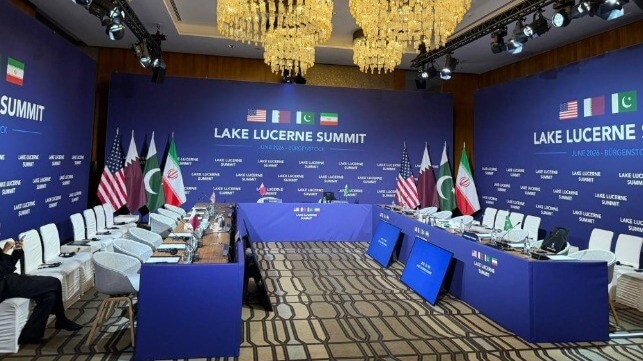
An empty conference room awaits American and Iranian negotiators, June 21 (Courtesy IRNA)
The Memorandum of Understanding (MoU) signed by the leaders of Iran and the United States last week sets the agenda for further negotiations, which, after some delays, have now commenced between the two parties, with Pakistan and Qatar present as intermediaries. The talks are taking place in the Qatari-owned mountainside resort of Bürgenstock in Switzerland.
Political commentators have gone into overdrive, seeking to paint the MoU as a victory or defeat for one side or another. Much remains to be resolved, with plenty of evidence that there is very little meeting of minds on a number of extremely contentious issues. The Iranian delegation is absolutely in no mood for compromise, and is buoyed up by what it sees as its political success so far.
There is a strong likelihood that the talks will break down, and that the negotiations are in effect only an elongation of the pre-existing ceasefire. President Trump clearly wants to walk away from the issue and leave his Vice President to clear up the mess, an impression strengthened by his description of the MoU negotiations in terms of their effect on domestic gasoline prices and inflation rather than on the future of the Middle East. But if President Trump is not engaged in the follow-through, both Israel and the Gulf States most certainly are. Neither is likely to want to allow Iranian hardline positions to prevail, and both have plenty of capacity to sabotage the negotiations in Switzerland if the talks look like threatening their future national security.
While there is a risk of a resumption of fighting, there are already conclusions to be drawn about the outcome of the war — practical realities that leaders and CEOs within the maritime community need to absorb as they shape their business plans.
Free transit through the Strait of Hormuz is no more. Just possibly, a deal will be done in the negotiations whereby fees described as navigation dues will be charged at acceptable levels. Shipowners may not mind, because these are costs that can be passed on; but ministers of business, economy and finance are likely to be very wary of any charges that have the overall effect of increasing prices and reducing the Gulf's competitive advantages.
Much more concerning, though, is the reality that, if current circumstances prevail, Iran will in the future be able to close the Strait again whenever it wants to, on a political whim, as it has demonstrated it can do. It is already trying to ensure that traffic through the Strait uses its own "Persian Gulf Strait Authority" route rather than the internationally recognized Traffic Separation Scheme, so that it may hereafter be able to exert political control over shipping transits. This will force all the GCC states to radically redesign their logistics and communications infrastructure, although some of the alternative routes out of the Gulf carry risks of their own. Also badly affected will be the confidence of foreign direct investors, particularly in Bahrain, Kuwait and Qatar, which have no alternative routes out of the Gulf.
The Houthis have not succumbed to pressure from the IRGC to disrupt traffic in the Red Sea, having their eye at present on the hope of a life-saving financial deal with the Saudis to help rescue the economy of northern Yemen. But the recent war has demonstrated that it would be easy to close the Bab el-Mandeb, and the Houthis have shown themselves to be a resilient enemy; hence the risk of closure, not so far realized, is very real, and would probably have consequences on a similar scale to the disruption caused in the Strait of Hormuz.
The question of the IRGC curbing its regional expansionist program is not even on the agenda at Bürgenstock. Moreover, in the discussions surrounding the negotiation of the MoU, the IRGC made it clear that it would press on with this program. This is immediately evident in Lebanon, where the IRGC has not given up on Hezbollah. But it is also evident in Iraq, where the IRGC appears to be reorganizing to avoid coming under pressure from the new Iraqi government – which is itself under regional and American pressure to curb the obviously Iranian-controlled PMF militias. The IRGC's subversive model, bringing disruption to political stability across the Middle East, has been battered by Israel in particular over the last 12 months. But although damaged, it is still intact; the IRGC's intent remains, and with an influx of money released by the lifting of sanctions, it will flourish again and take on new targets.
Another permanent threat to peace and stability is the survival of a critical mass of the IRGC Aerospace Force's drone and missile capability. A comparison of known drone and missile storage and launch sites against the facilities known to have been attacked in 2025-26 suggests that very few of these sites were left untouched; it is not as if the Iranians had successfully kept their sites hidden. But they were built in expectation of attack, well dispersed, with multiple exits. The speed with which some sites have been repaired suggests that recovery plans and resources had been pre-positioned for just such an eventuality. Moreover, if any funds are released to the Iranians by way of sanctions relief, further repair and enhancement of the more than 40 sites spread across the country will be accorded high priority.
To a degree, the survival of the IRGC Aerospace Force's operational capability can be countered by increased spending by GCC states on air defenses; but the brutal fact is that the capability remains intact and is a continuing threat that the IRGC has demonstrated it will have no compunction about using, either directly or through its proxies. It is now understood, moreover, that the Iranians have access to timely and accurate information for targeting both US military and GCC infrastructure, supplied courtesy of the joint Russian/Iranian Khayyam/Kanopus-V satellite constellation. This makes the residual drone and missile threat even more potent.
Finally, the mood of the GCC states must be considered. All, to a greater or lesser degree, attempted to conciliate with Iran before the war. All, even Oman, have been attacked by Iran nonetheless. There is now a stark recognition that Iran is determined to achieve regional dominance, which threatens the future of all the Gulf monarchies. The GCC countries may still smile at the Iranians, but they all know they have an implacable enemy, and will be looking for ways to get the better of Tehran.
In summary, if war does not resume and the negotiations in Bürgenstock continue in the same vein as they have so far, then the Middle East can look forward to greater Iranian dominance, driven by the prevailing IRGC-Paydari hardliners. Logistics in the Gulf will remain difficult and threatened, alleviated only when major capital investment projects to broaden contingency options come to fruition.
Even if these problems can be overcome, the Gulf region will for many years be far less stable than it was when it enjoyed the benefits of Pax Americana — a product seemingly now being withdrawn.
The opinions expressed herein are the author's and not necessarily those of The Maritime Executive.
Strait of Hormuz Traffic is Beginning to Return, But it is Hard to Spot
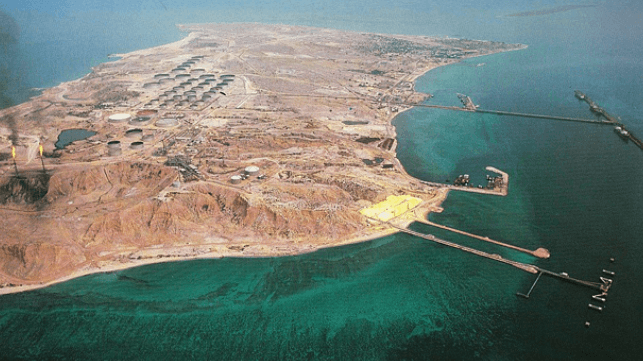
Iran's Kharg Island loading terminals (public domain file image)
Despite some new conflicting guidance from U.S. and Iranian forces on the safest route through the Strait of Hormuz, commercial shipping is resuming slowly - though it is tough to spot.
"50-60 percent of the traffic is completely dark," said Windward co-founder Ami Daniel, speaking to CNBC. The blackout is more than just transiting with AIS off - these ships are moving without radar, satellite or VHF comms for fear of being targeted. "This is like full-on navy operational mode for ordinary tankers," he added, and it makes it tough to count the number of transits accurately. As might be expected from these extreme precautions, "[shipowner confidence] is absolutely, without a doubt not there yet," he said.
Iran's shadow fleet tonnage continues to operate with a diversity of deceptive practices, including fraudulent flagging; hidden ownership; and coastwise shipments of oil from Iran towards Iraq, where covert STS transfers to disguise the origin of oil have historically been common. Outbound, sanctioned, Iran-linked tankers made up a large share of the day's traffic, Windward said.
Iran has a motive to export quickly: the U.S. Treasury has given Iran a 60-day waiver to sell crude at any price it can, to any willing buyer. China has historically been Iran's top customer for petroleum, but cut its imports by half during the peak of the Hormuz crisis; its return to the market is expected to come soon, and to absorb much of the pent-up surge of Iranian exports.
Iran's tankers tend to use Iranian-controlled northern half of the strait, but foreign-flag vessels have a choice of routing. The FT reports that shipowners are receiving competing instructions from Iran's Persian Gulf Strait Authority (which manages the northern, Iranian route) and U.S. Central Command (which has its own corridor on the south side, in Omani waters). The so-called PGSA advises using its lane for safety, while CENTCOM and certain Western insurers advise that the Omani lane is better. If followed, that choice could put them in Iran's crosshairs.
"If they follow the guidance of underwriters and U.S. authorities by navigating closer to Oman, they risk interference, detention or potential hostile action from Iranian authorities," said Dr SV Anchan, chair of Safesea Shipping, speaking to the FT.
Alternatively, if owners choose to follow Iranian guidance, they can submit all transit details to the "PGSA" at least 48 hours ahead of the planned crossing, wait for a transit permit valid for a one-way voyage, and have the crew stand by for further instructions on VHF.
U.S. Treasury Suspends Restrictions on Iranian Oil and Tankers for 60 Days
U.S. has suspended the restrictions on Iranian oil exports and tankers (Tasnim - CC BY 4.0)
Indicating that there was positive movement in the negotiations between the United States and Iran, Treasury Secretary Scott Bessent announced on Monday a sweeping 60-day suspension of nearly all restrictions on Iran’s oil industry. It followed Iran’s quick resumption of oil exports after the U.S. last week ended its blockade for ships heading to Iranian ports and on tankers carrying Iranian oil.
Bessent said as part of the framework signed between Iran and the United States, “Treasury has issued a temporary 60-day general license authorizing the production, delivery, and sale of Iranian oil.” It is in effect until 12:01 a.m. Eastern Daylight Time on August 21.
The General License is extremely broad and represents a total reversal of the Trump administration’s campaign of maximum pressure that has been in effect. It covers the production, sale, delivery, and offloading of crude oil and petrochemical products. It also covers vessels currently listed as blocked by the United States and permits servicing of the vessels.
Included in the terms is authorization of transactions that import Iranian oil and products into the United States. Further, it states that payments can be made in U.S. dollar-denominated funds to Iran, its government, or individuals previously blocked.
Bessent said the moves were “in line with” productive talks in Switzerland. He said Iran has committed to free and open transit in the Strait of Hormuz. It is also reportedly agreeing to again permit International Atomic Energy Agency inspectors into Iran.
The official permission follows a rush by Iran to export oil after the end of the blockade. Analysts at the well-known tracking service TankerTrackers.com reported in the first five days, “Iran has exported nearly 18 million barrels (or $1.44 billion) of crude oil.” Today, it wrote in a social media posting that the exports have risen to 36 million barrels of crude oil. TankerTrackers.com estimates that “roughly an equal amount is still afloat in Iran.”
Critics point out the large amounts of money the United States is quickly releasing for Iran by permitting these transactions. It comes as Donald Trump is writing online that the Iranian economy was “broken” while inflation was at 250 percent.
Despite Iran’s assertion over the weekend that it had again suspended transits of the Strait of Hormuz, U.S. Central Command asserted the southern lane near the coast of Oman is moving. On Saturday, it wrote, “Safe passage through the international waterway remained intact today as 55 merchant ships transited, moving large amounts of cargo and more than 17 million barrels of oil to global markets.” Volume, however, was reported to have slowed on Sunday.
As of June 14, CENTCOM said U.S. forces had redirected 142 commercial ships that complied with its orders and disabled nine vessels that did not comply. U.S. forces are reported to be closely monitoring vessel movements since the end of the blockade.
With U.S.-Iran Deal Signed, Jones Act's Defenders Call for an End to Waiver
Now that the U.S. has signed a ceasefire deal with Iran and tanker flows in the Strait of Hormuz appear to be back on the rise, American domestic shipping interests are renewing their call for the Trump administration to end its broad Jones Act waiver policy for energy cargoes. The 30-plus-90-day waiver is one of the most significant executive orders of its kind since the WWII era.
"With President Trump's signing of the Iran ceasefire agreement, the statutory basis for the Jones Act waiver is concluded. It's time to end the waiver, put Americans back to work, and resume the task of Restoring America's Maritime Dominance. Let's do this, Mr. President!" said the American Waterways Operators' President and CEO, Jennifer Carpenter, in a statement last week.
Since its entry into force on March 18, the administration's Jones Act waiver has been used for about 110 voyages to move about 25 million barrels, equivalent to 1.4 percent of American consumption, according to the American Maritime Partnership. The biggest beneficiaries so far have been motorists and commercial aircraft operators in the state of California, where refinery closures and a dearth of pipeline interconnections make the energy market unusually dependent upon seaborne supplies. Shipments from the Gulf Coast to the Golden State since March total about eight million barrels of gasoline, jet fuel and other products; in May, Reuters estimated that Texas was supplying about six percent of California's fuel and blendstock needs using waivered tankers.
In normal times, California fuel markets are usually topped up with imported products from Asia; the long Texas-to-California route through the Panama Canal rarely happens at scale on Jones Act tonnage, according to the American Petroleum Institute. Shipment volumes from the Gulf to the mid-Atlantic states have also been notable, API says. The waiver activity did not appear to have an appreciable impact on U.S. fuel prices, which rose throughout most of the period in all regions.
While fuel prices may not have come down, there are other foreseeable outcomes. Act's defenders have long warned that without its legal protections, foreign operators would enter U.S. coastwise commerce - with potential implications for U.S. national security. AMP tallied up the waivered voyages and determined that about one quarter were performed by Chinese-owned or Chinese-subsidized ships, including one tanker operated by state-owned giant China COSCO.
"AMP members continue to report canceled contracts and lost business opportunities as foreign vessels take domestic cargoes from Americans," the group said in a statement. In addition, the Federal Reserve has warned that investments in America's maritime industry are being put on hold because of the waiver and the uncertainty it injects into business decisions.
If the waiver were made permanent by an act of Congress, U.S.-built ships would lose the protected legal status that underpins their valuation. Domestic shipowners would be exposed to competition from lower-cost ships manned with lower-cost labor, Jones Act advocates warn, with effects on asset value, revenue, employment, newbuild ordering and fleet size.