Low on Fuel, Russian Frigate Drifts in the English Channel
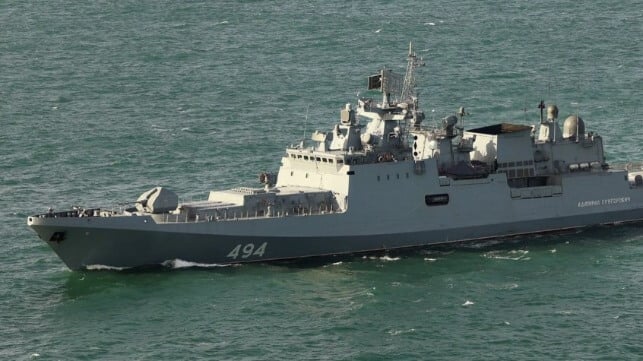
A Russian frigate stationed in the English Channel, which was not on hand to impede the Royal Navy’s seizure on June 14 of the sanctioned Cameroon-flagged Aframax Smyrtos (IMO 9389100), appears to be running very low on fuel.
The frigate RFS Admiral Grigorovich (F494), the lead ship of its namesake class and launched in 2014, has frequently been seen recently in the English Channel and Western Approaches, the more so since Russia has perceived that tankers carrying Russian oil are at risk of seizure. On several occasions she has been refueled, not by one of the numerous oilers equipped for the task and which support far-distant Russian Navy deployments, but by a Project 304 Amur-class floating repair ship, normally used to provide dockside workshop facilities when supporting long-range deployments. Although equipped with five-tonne cranes, the Amur-class vessels are not equipped for conducting replenishments at sea, and have been spotted instead coming alongside the frigate Admiral Grigorovich and conducting makeshift fuel transfer operations at sea. The Admiral Grigorovich does not appear to be equipped with a Ka-27 helicopter, which other ships of the same class often are, and which might help with replenishment tasks.
In an incident in foggy conditions in the English Channel on June 16, the Admiral Grigorovich fired warning shots at a British-flagged yacht, the Bright Future (MMSI 235086766). Although the skipper of the Bright Future claimed he was not on a collision course, the British Ministry of Defence described the firing of warning shots as a normal procedure if closing on a warship. The Admiral Grigorovich was drifting at the time of the incident, presumably to save fuel.
The Admiral Grigorovich was back shadowing Russian tankers through the Channel on June 18, escorting the OFAC and UK sanctioned Russian-flagged Aframax Forwarder (IMO 9419448), which had loaded 730,000 barrels of Urals crude at Ust Luga on June 2 and is bound for Dongying in China. The two Russian ships were shadowed on their way through the Channel by HMS Tyne (P281), without any attempt to repeat the seizure operation carried out earlier in the week against the Aframax Smyrtos (IMO 9389100). The seized Smyrtos is being kept at anchor off Weymouth, in part to ensure that its crew cannot claim asylum in the UK. Three other Aframax tankers which had loaded at Ust-Luga and Primorsk also passed through the Channel on June 18, but were not on any sanctions list, namely the Palau-flagged Visund (IMO 9378864), the Barbados-flagged Aequora Fortune (IMO 9297503) and the Maltese-flagged Hellas Calafia (IMO 9798088).
The Russian Navy is clearly under pressure, and having to prioritize its tasks carefully. Russian tankers are now at risk from the Ukrainian long-range sanctions program not only in the Black Sea, but now also in the Mediterranean. Increasing numbers of European countries are intercepting Russian dark fleet tankers in the Mediterranean, the Baltic and the English Channel. Seizures are not yet taking place when dark fleet tankers are being escorted by Russian warships, which is putting greater pressure on the Russian Navy to find escorts in sufficient numbers, but at a time when Russian warships are themselves also being attacked by Ukrainian drones.
Russian Navy Struggling to Maintain a Mediterranean Presence
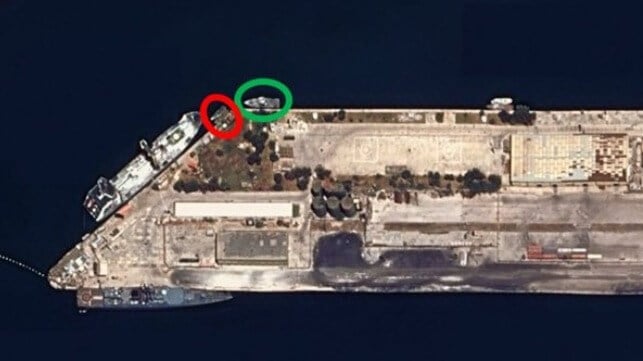
The Russian Navy seems once again to be heading for a Mediterranean exit, after a presence in May suggested it might be attempting to re-establish its permanent base in the Syrian port of Tartus, once the headquarters of the Mediterranean Flotilla.
On April 29, a convoy passed into the Mediterranean through the Strait of Gibraltar, escorted by the Gorshkov Class frigate RFS Admiral Kasatonov (F461). The convoy consisted of three sanctioned vessels, often involved in arms shipments and resupply activities, the oil products tanker General Skobelev (IMO 9503304), the Ro-Ro cargo vessel Sparta (IMO 9268710), and the Project 23130 oiler Akademik Pashin (IMO 9778193). The convoy had passed through the English Channel on April 18, then through the Strait of Gibraltar, and despite advertising its destination as Port Said, it headed for Tartus. The Admiral Kasatonov then escorted the Sparta and the General Skobelev back towards Gibraltar, handed them over to the frigate RFS Boiky (F532), and then turned backed to Tartus and was imaged with the Akademik Pashin dockside on the old Mediterranean Flotilla wharf on June 4.
In the imagery of June 4, the Admiral Kasatonov and Akademik Pashin are protected by an anti-sea drone barrier – not a precaution which was necessary even a year ago. The maritime open source analyst community have also identified two Raptor and a Project 21980 Grachonok Class Anti-Saboteur Vessel docked close by the Akademik Pashin. It is unclear whether these anti-saboteur craft have arrived recently (perhaps carried by the Sparta on its recent visit), to enhance port security in the face of the Ukrainian long-range sanctions program, or have been kept hidden somewhere in the Tartus area since they were last seen there during the heyday of the Mediterranean Flotilla. Their appearance certainly indicates that the Ukrainian threat is being taken seriously, but also lends weight to reports that the Russian Navy is re-establishing a permanent presence in Tartus. These small port security craft cannot make their way home on their own, so look set to remain in Tartus, presumably to provide security for the Russian presence.
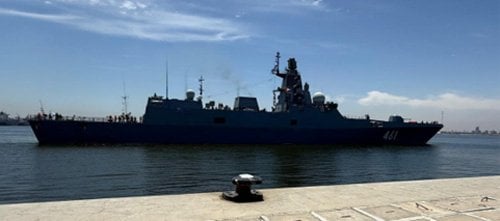
The Admiral Kasatonov alongside in Alexandria (Russian Navy)
The Admiral Kasatonov and the Akademik Pashin subsequently made a port visit to Alexandria on June 12, to celebrate Russia Day. The pair were then spotted south of Sardinia on June 18.
The Admiral Kasatonov was also supported by the oiler Akademik Pashin on a foray into the Mediterranean in March 2021, during which the ships visited Algiers, Piraeus, Alexandria, Tartus, and the Turkish naval base at Aksaz. The Admiral Kasatonov also visited the Mediterranean in 2022 and 2023, suggesting a permanent allocation to the area despite being assigned to the Northern Fleet. But the frigate is probably a less welcome Mediterranean port-caller now than it has been in previous years.
If as expected the two warships head for the Strait of Gibraltar and then for the Admiral Kasatonov’s home port of Severomorsk, the oiler Akademik Pashin will be welcomed in particular by the RFS Admiral Grigorovich (F494). The Admiral Grigorovich is still loitering in the English Channel, harassing the yachting community, seemingly low on fuel and probably looking for a fill-up replenishment at sea.

No comments:
Post a Comment