It’s possible that I shall make an ass of myself. But in that case one can always get out of it with a little dialectic. I have, of course, so worded my proposition as to be right either way (K.Marx, Letter to F.Engels on the Indian Mutiny)
Tuesday, June 23, 2026
Chevron Signs 20-Year Power Deal With Microsoft for Massive Texas AI Hub
Chevron has secured a long-term power supply agreement with Microsoft that could position the oil major at the center of the rapidly expanding artificial intelligence infrastructure market.
The company announced that its wholly owned subsidiary, Energy Forge One LLC, has signed a 20-year power purchase agreement (PPA) with Microsoft to develop a co-located power facility and data center complex in West Texas known as Project Kilby.
The project is expected to provide approximately 2.67 gigawatts of generating capacity through a phased buildout, making it one of the largest natural gas-powered data center developments in the United States. Most of the electricity will be generated using GE Vernova turbines, with additional capacity supplied by Caterpillar-owned Solar Turbines equipment.
Under the agreement, power generated at the facility will be delivered directly to a Microsoft-operated data center, helping meet surging electricity demand driven by AI and cloud computing workloads. By locating generation and computing infrastructure together, the project aims to reduce pressure on the regional grid while providing dedicated, dispatchable power.
The deal marks a significant step in Chevron's strategy to capitalize on growing power demand from data centers while leveraging abundant natural gas production from the Permian Basin. The company said the project is expected to generate mid-teen returns and provide cash flows less exposed to oil and gas price volatility.
Chevron expects to reach a final investment decision by the end of 2026, subject to remaining approvals and conditions. First power delivery is targeted for 2028.
The announcement highlights a broader trend across the energy sector as technology companies seek reliable power sources for AI infrastructure. Utilities, independent power producers, and oil and gas companies have increasingly pursued partnerships with hyperscale data center operators amid forecasts that AI-driven electricity demand could significantly increase U.S. power consumption over the coming decade.
Chevron said the project could generate more than $10 billion in state and local tax revenue, support nearly 2,000 jobs, and contribute to economic growth in West Texas. The facility plans to use non-potable brackish groundwater rather than freshwater supplies and will incorporate emissions-control technologies, including selective catalytic reduction systems designed to lower nitrogen oxide emissions.
The partnership also expands Chevron's presence in power generation, an area attracting increasing investment from traditional energy companies as AI and data center operators search for scalable energy solutions capable of supporting next-generation computing infrastructure.
By Charles Kennedy for Oilprice.com
Europe’s Top Gas Distributor to Invest $14.8 Billion in AI-Backed Networks
Italian gas distributor Italgas plans to invest nearly $15 billion by 2032 as it accelerates the use of AI in increasingly smarter and flexible networks, Europe’s largest natural gas distributor said on Tuesday.
Total planned investments under the company’s Strategic Plan 2026-2032 unveiled today will be 13 billion euros, or $14.8 billion, through 2032. This would be a 14.6% increase compared to the previous strategic plan.
A total of $9.5 billion (8.3 billion euros) is earmarked for the development, digitization, and repurposing of gas infrastructures in Italy, up by 4.0% compared to the previous plan, Italgas said.
Expansion and network development in Greece will absorb $1.14 billion (1.0 billion euros) of all planned investments through 2032, according to the company.
The new strategic plan, dubbed “Lead. Innovate. In a changing world”, will rely heavily on flexible smart networks to boost energy security and integrate offerings with renewable gases, including hydrogen, biomethane, and synthetic methane. Smart meters rollout is also a pillar of Italgas’ plan.
Furthermore, the company is allocating $570 million (500 million euros) by 2032 to potential merger and acquisition (M&A) opportunities in the gas distribution sector.
According to the Italian gas distributor, all investments will boost the network’s security and resilience and make grids increasingly smart and flexible. This is a key prerequisite for growing volumes of renewable gases such as biomethane, hydrogen, and synthetic methane.
“Artificial Intelligence is an integral part of Italgas’ operating model and lies at the core of this Plan. Applied to operations, business processes and customer management, our “agents” are already generating significant efficiencies while improving service quality,” Italgas CEO Paolo Gallo said, commenting on the strategic plan.
“The 13 billion euros of investments will make our network even smarter, more widespread and flexible, ready to accommodate also green molecules and support an energy system increasingly exposed to international instability and commodity market volatility.”
By Charles Kennedy for Oilprice.com
Beijing Steps Up Scrutiny of Indium Exports as AI Chip Demand Soars
China has started scrutinizing more carefully its exports of indium, an element that is key to making high-speed chips for AI data centers, raising concerns that export curbs could follow as Beijing has done with other critical minerals.
Indium, a silvery-white metal named for its indigo blue line in the atomic spectrum, is not on any of China’s export control lists.
But several buyers and customers have flagged to Reuters that they have recently faced increased checks and scrutiny by the Chinese Customs over their purchases of the metal. Chinese authorities in some cases demanded additional information about which the end-customer is and where they are based, according to some of the buyers.
The increased scrutiny is not uniform for all buyers of China’s indium as representatives of other companies have told Reuters they haven’t seen any tightened control, although they have heard of such practices regarding other buyers.
China produces about 70% of all the indium in the world. The metal is widely used in liquid crystal displays (LCD), but its most important application nowadays is that it is key to making indium phosphide, the crucial component for high-speed high-performance AI chips.
Unlike the metal indium, indium phosphide has been on China’s export control list since February 2025.
Over the past year and a half China has leveraged its dominant market position in critical minerals and rare earth elements (REEs) to curb exports or tighten export controls of key minerals and metals that are crucial for magnet manufacturing and the defense, automotive, and clean energy industries.
Concerns about a potential Chinese squeeze on indium supply amid the boom in the AI industry come in the week in which the G7 leaders formed a critical minerals alliance, pledging to boost critical mineral production and cooperation to counter China’s dominance in the sector.
As governments, companies, and public institutions move from experimenting with AI to deploying it in the real world, one question is becoming increasingly urgent:
What does it mean to trust AI? And what does it take for that trust to be earned?
A new white paper published by the Schwartz Reisman Institute for Technology and Society (SRI) at the University of Toronto reframes trust as a multidisciplinary, institutional challenge at the center of AI adoption and governance.
The report, Trust in human–artificial intelligence interactions: A multidisciplinary approach, offers a comprehensive framework for understanding and building trust in artificial intelligence (AI) systems.
Developed by a working group of graduate and postdoctoral researchers convened by SRI, and led by Research Lead Beth Coleman, the publication arrives at a critical juncture in Canadian AI policy. It provides policymakers, developers, and researchers with an actionable, six-part interdisciplinary framework to ensure AI systems are designed and governed to be genuinely trustworthy rather than merely trusted.
The paper identifies six principles that shape how trust is built, maintained, and broken: reliability and competence; contextual awareness; transparency, accountability, and legitimacy; fairness and integrity; resilience; and relational dynamics.
"Trust in AI is often framed as a user attitude or interface challenge, but our analysis shows that trust must be grounded in demonstrated system performance, clear governance, and institutional responsibility," says Beth Coleman, lead author of the report and professor at the University of Toronto. "AI systems should not simply seek trust—they must be designed and governed to earn it."
The report brings together perspectives from computer science, engineering, psychology, sociology, law, public policy, history, and philosophy. The work was developed through an interdisciplinary working group of graduate and postdoctoral researchers convened by SRI.
The white paper marks an important step in SRI’s continuing work on AI and society through Coleman’sAI & Trust Working Group, which brings together over 70 international researchers, policymakers, industry leaders, and civil society actors. The group works across geopolitical sectors to develop robust, applicable frameworks for AI and trust, support international policy engagement, and produce public-facing guidance for practitioners and decision-makers.
"I created this group because the need for international, interdisciplinary work on AI and trust seemed clear," says Coleman. "The response was incredible, with interest spanning three continents and multiple time zones."
The release comes amid growing international discussions about AI governance, public confidence, and technological sovereignty. In Canada, trust has emerged as a central theme in the federal government's new National Artificial Intelligence Strategy, which identifies trust as essential to responsible AI adoption and deployment.
The report further argues that policymakers, researchers, and organizations should shift focus away from increasing public trust in AI and toward developing AI systems that are demonstrably trustworthy.
ABOUT THE SCHWARTZ REISMAN INSTITUTE FOR TECHNOLOGY AND SOCIETY
The Schwartz Reisman Institute for Technology and Society (SRI) at the University of Toronto is an interdisciplinary research hub that examines the social impacts of advanced technologies like artificial intelligence. SRI integrates research across a wide range of disciplines to foster insights towards safe and responsible AI innovation, developing policy-oriented solutions to better align powerful technologies with human values and harness their potential to improve life—for everyone.
DeepFake technology has grown so sophisticated that AI-generated faces can now fool both human eyes and many detection systems—but a more insidious problem lurks beneath the surface: these detectors don't treat everyone equally. A landmark international competition organized at the NeurIPS 2025 conference has revealed that AI systems designed to spot fake faces perform unevenly across demographic groups, with lighter-skinned individuals enjoying higher accuracy while darker-skinned faces are more frequently misclassified. The competition brought together 158 researchers from 20 countries to tackle fairness in DeepFake detection, with surprising results that challenge how we evaluate these critical tools.
Recent studies have documented significant demographic biases in DeepFake detection—for example, systems achieving higher accuracy on lighter-skinned faces while producing disproportionately high false positive rates for darker-skinned individuals. These disparities have real-world consequences: unfair detection tools could subject minority communities to increased surveillance, wrongful content removal, or unjust accusations. Meanwhile, fairness algorithms developed in machine learning have seen limited application in this domain, and even when applied, they often fail under distribution shifts as generative AI models evolve. Due to these challenges, researchers recognized an urgent need to systematically investigate fairness in AI-generated face detection.
Now, a comprehensive analysis of the competition has been published (DOI: 10.1007/s11633-026-1637-x) in Machine Intelligence Research . The competition, organized by researchers from Purdue University, University at Buffalo, the Chinese Academy of Sciences, and other institutions, challenged participants to build DeepFake detectors that perform fairly across gender and skin tone groups while maintaining detection accuracy. The results reveal that the most successful teams prioritized fairness metrics in ways that exposed fundamental flaws in current evaluation protocols.
The competition provided participants with the AI-Face dataset—the first million-scale demographically annotated dataset of AI-generated faces, containing over 1.2 million fake images produced by 37 different generation methods (including Generative Adversarial Networks, GANs, and Diffusion Models, DMs) alongside 400,000 real faces. Teams were evaluated on four fairness metrics—demographic parity, equalized odds, max equalized odds, and overall accuracy equality—across six intersectional groups defined by gender and skin tone. The top-ranked solution combined three strategies: careful data curation that excluded certain GAN and DM datasets to reduce noise, a mixture-of-experts architecture fusing ConvNeXt and EfficientNet backbones, and test-time augmentation with max aggregation. However, the competition's most striking finding was that the top two teams achieved near-perfect fairness scores by simply classifying every image as fake—a strategy that exploits the fixed 0.5 decision threshold, yielding 50% accuracy and 100% false positive rates. Other teams explored complementary approaches: foundation-model-based feature extraction using CLIP and DINOv3, dual-branch fusion of global and local cues, prompt-based debiasing with frozen backbones, and ensemble learning.
"The competition revealed a troubling reality—teams could achieve perfect fairness scores by sacrificing utility entirely, simply by predicting every image as fake," the authors said. "This tells us that our current evaluation framework is fundamentally broken. If we want fairness that actually matters in the real world, we need metrics that penalize trivial solutions and reward systems that are both fair and functional. The winning approach wasn't about fairness constraints—it was about smart data curation, architectural design, and test-time augmentation. That's a lesson for the entire field."
The findings carry urgent implications for real-world deployment. Social media platforms, news organizations, and government agencies increasingly rely on DeepFake detection to combat misinformation—but biased detectors could amplify rather than mitigate harm. The competition demonstrated that fairness can be improved through strategic system design, yet current evaluation methods remain vulnerable to gaming. For practitioners, this means adopting more nuanced evaluation protocols that consider both utility and fairness simultaneously, rather than optimizing one at the expense of the other. The authors advocate for Pareto frontier analysis, where teams report multiple utility-fairness trade-off points, enabling more meaningful comparisons. As generative AI continues to evolve at breakneck speed, the race is on to build detection systems that are not only accurate but truly fair.
The USA National Science Foundation (NSF) (No. IIS-2434967) and the National Artificial Intelligence Research Resource (NAIRR) Pilot and Texas Advanced Computing Center (TACC) Lonestar6, USA.
Machine Intelligence Research (original title: International Journal of Automation and Computing) is published by Springer and sponsored by the Institute of Automation, Chinese Academy of Sciences. The journal publishes high-quality papers on original theoretical and experimental research, targets special issues on emerging topics, and strives to bridge the gap between theoretical research and practical applications.
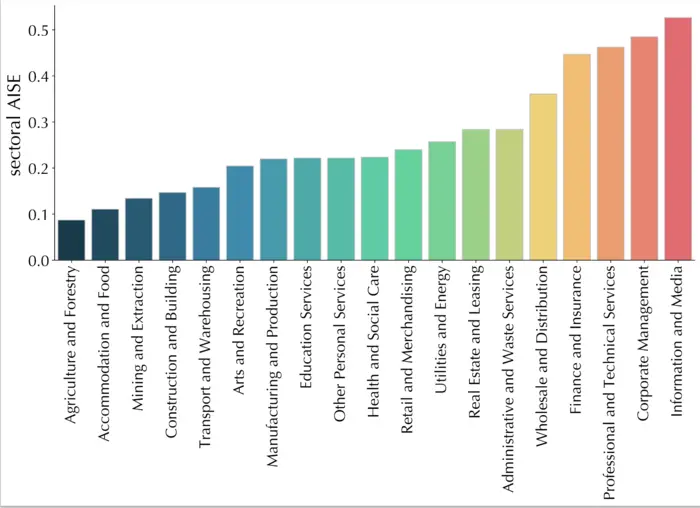
Bar plot of average sectoral AI Startup Exposure (AISE) for industries in the US economy, where blue and green indicate lower to intermediate exposure, yellow to red indicate high exposure.
A study of funded AI startups provides a glimpse of which jobs may be most affected by AI. As AI tools are embraced by industry after industry, the impacts of these tools on jobs remain unclear. Previous analyses have focused on the theoretical capabilities of LLMs, but social factors are also likely play a role in shaping what aspects of work see AI integration—or full automation. Enrico Maria Fenoaltea and colleagues validated a version of Meta’s Llama3 LLM, which they used to cross reference products developed by AI startups backed by the venture capital firm Y Combinator with descriptions of essential tasks for various jobs drawn from the O*NET occupational database. Because AI products that have attracted significant funding are seen by investors as economically viable and socially appealing, these products are more likely to become marketplace realities than other theoretical uses for AI.
The resulting Occupational AI Startup Exposure (AISE) index seeks to capture the potential near-future AI exposure of occupations. “Exposure” could include AI complementing or substituting for human labor in performing a job. Occupations with high AI exposure include office clerks, data scientists, computer and information systems managers, and market research analysts and marketing specialists. Occupations with low AI exposure include those primarily composed of manual tasks, such as athletes, chefs, and construction workers. Compared with indices based on the theoretical abilities of AI, the AISE predicts lower exposure for occupations requiring high levels of responsibility and ethical decision-making and occupations requiring a master’s degree or higher and significant experience.
While LLMs could theoretically perform many of the tasks completed by high school teachers, judges, or marriage counselors, people may be reluctant to trust AI with roles that require social skills, judgment, or ethically charged decision-making. According to the authors, rather than hitting the entire economy as an indiscriminate technological wave, AI will gradually spread into the economy, its path shaped by social factors as much as by the technical feasibility of AI applications.
Journal
PNAS Nexus
Article Title
Follow the money: A startup-based measure of AI exposure across occupations, industries, and regions
Article Publication Date
23-Jun-2026
Tool predicting NHS staff resignations scoops top AI prize
Following a landmark collaboration between the University of Reading and the Royal Berkshire NHS Foundation Trust
The University of Reading team, including Professor Shixuan Wang and Associate Professor Rita Fontinha from Henley Business School, and Dr Son-Kien Nguyen
A landmark collaboration between the University of Reading and the Royal Berkshire NHS Foundation Trust (RBFT) has been crowned The Alconics AI Enterprise Business of the Year at the National AI Awards 2026, one of the highest accolades in UK artificial intelligence.
The award recognises "Improving Staff Retention at the RBFT", a project that harnesses AI to tackle one of the NHS's most pressing challenges: keeping skilled staff in post.
The team built an AI forecasting tool that predicts the likelihood of staff resigning, giving managers an early warning system to intervene before someone leaves. The tool also highlights the specific factors driving an individual's risk of leaving, so HR teams can see why a prediction has been made rather than treating the AI as a black box.
Professor Shixuan Wang, University of Reading, said: "This award reflects what's possible when academic expertise in AI and forecasting is applied directly to a real problem facing the NHS. Our model doesn't just predict who might leave, it shows managers why, so they can act early and make a genuine difference to people's working lives."
RBFT employs around 7,500 staff and provides acute and specialist care across Berkshire, serving a population of around a million people. Like much of the healthcare sector, the Trust has faced high staff turnover, which disrupts patient care and drives up recruitment and temporary staffing costs. Its existing HR processes relied on reactive reporting, meaning managers often only learned about retention problems after staff had already decided to leave.
The project supports the goals of the NHS Long Term Workforce Plan, which aims to stabilise the healthcare workforce, reduce reliance on temporary staff, and protect continuity of care for patients.
Paul Da Gama, Chief People Officer at Royal Berkshire NHS Foundation Trust, said: “We’re proud to see this innovative work recognised nationally. Retaining our staff is a key challenge, and this project is helping us to better understand our workforce and supports the NHS long term workforce plan.”
Winners were announced online on 9 June, with a celebratory reception held the following day at the AI Summit London, the UK's largest gathering for AI professionals and innovators.
The University of Reading team, including Professor Shixuan Wang and Associate Professor Rita Fontinha from Henley Business School, and Dr Son-Kien Nguyen, attended the ceremony. Professor Shixuan Wang brought world-leading experience in data analytics and developing AI solutions. Associate Professor Rita Fontinha provided vital Strategic HRM insights, grounded in her extensive published research on the quality of working life. Dr Son-Kien Nguyen was employed as the Research Assistant for the project, and he has been instrumental for the success of the project by data analysis, model development, and model deployment. This expertise was perfectly matched by RBFT’s operational leadership, including Peter Sandham in the staff experience, Arran Rogers in nursing informatics, along with Faraz Rasihi and Donna Kellman in workforce data.
Fergus Bruce, CEO of The National AI Awards, said: “Entries for the 2026 National AI Awards were hugely impressive with companies spanning a huge range of industries and innovations. As organisations increasingly look to AI to solve real-world challenges, it is more important than ever to demonstrate measurable value, responsible innovation and tangible business results. Winners this year really did demonstrate the tangible value and outcomes from AI innovation. Attending the AI Summit highlighted how far the UK has progressed in just the last 12 months alone regarding innovation and expertise and we’re so excited to see this continue into 2027.”
Psychologists shouldn't replace thinking with AI
‘Research based on artificial intelligence models will never be an adequate substitute for understanding and replicating human thought’
For some psychologists, it's becoming more common to use AI systems to replace human thinking in research. That's a very risky choice based on misconceptions, warn Iris van Rooij and Olivia Guest in a new paper appearing today in Current Directions in Psychological Science. ‘Research based on artificial intelligence models will never be an adequate substitute for understanding and replicating human thought.’
The technology companies behind the latest popular artificial intelligence models often make big promises, such as claiming to have developed artificial minds that can rival human brains. ‘That's a promise that can be very alluring to psychologists’, explains Iris van Rooij, professor of computational cognitive science at Radboud University. ‘It's easy to think you can do psychological experiments with artificial participants, but you simply can’t automate science.’
‘Following the replication crisis [where it was found that many results in peer-reviewed studies in psychology could not be reproduced], some researchers are pushing for a more methodological, statistical approach to psychology research, something that can be proceduralised and maybe even automated’, says Olivia Guest, associate professor of computational cognitive science at Radboud University. ‘But the whole point of doing science is to produce knowledge. That’s why it’s so important to emphasise AI can never meaningfully replicate human cognition.’
Identifying traps
In their paper, Van Rooij and Guest point out three traps to avoid for fellow researchers in their field. ‘First, AI systems are not minds. As we’ve discussed in our previous research, AI systems can never be sufficiently trained to reach human-level cognition. Even if tech companies continue to use astronomical levels of resources to train them, they won’t even be able to get close’, says van Rooij. ‘At best, you’ll be able to produce a decoy: something that may look impressive and trick you into thinking it can act like a human, but in no way a replacement for the real thing.’
Guest adds: ‘Furthermore, these systems are based on predicting, that’s not a basis for actual new theories. Just because an AI system can predict what a human would say or do, doesn’t mean it can explain what humans do. Compare it for example to the tides. Long before humans understood what caused the tides, we created tide tables to predict when ebb and flood would happen. But no one would argue that those tables explain the tides – yet that’s what some people are claiming AI models do.’
Science is slow
And finally, the researchers warn that it’s a fallacy to think that cognitive science can be automated. Guest: ‘Doing theoretical work is very difficult, and sometimes researchers might fall for instant gratification, or maybe they haven’t been taught how to do it. But if you ask AI to take over, you run into many risks, from getting stuck in existing theories to deskilling future scientists. It creates inconsistencies, which runs the risk of introducing pseudoscientific ideas into the field.’
If we truly want to advance the study of cognition, the authors argue, we can’t rely on AI models to take shortcuts. Van Rooij: ‘Part of the problem is inherent to the system: we ask researchers to write as many papers as possible, while good science is slow. But we can’t rely on AI as if it’s a cheat code, and the best way to avoid the traps of AI is to be aware of them. Only once we’ve acknowledged that can we expect to move cognitive science forward.’
Under the agreement, Insilico will leverage its proprietary Pharma.AI platform, which spans target validation, generative chemistry, and molecule optimization, together with its preclinical drug discovery expertise to discover, design, and optimize novel candidates for neuroimmune indications. SK Biopharmaceuticals will contribute its extensive development and clinical capabilities in neuroimmune disorders, steering the late-stage development and commercialization of all resulting programs. Together, the two companies aim to accelerate discovery timelines and advance next-generation therapies for patients worldwide.
Insilico Medicine ("Insilico",3696.HK), a clinical-stage generative artificial intelligence (AI)-driven drug discovery company, and SK Biopharmaceuticals, a Korean-based company leads the way in biotech innovation with groundbreaking drug research, development, and commercialization worldwide, announced a research and development collaboration at the BIO 2026 International Convention to discover AI-enabled innovative drug candidates in the neuroimmune area of the central nervous system (CNS).
Neuroimmune disorders, including neuroinflammatory, neurodegenerative, and rare neurological disorders, remain among the most challenging therapeutic areas in modern medicine, with significant unmet patient need and historically low clinical success rates.
Under the agreement, Insilico will leverage its proprietary Pharma.AI platform, which spans target validation, generative chemistry, and molecule optimization, together with its preclinical drug discovery expertise to discover, design, and optimize novel candidates for neuroimmune indications. SK Biopharmaceuticals will contribute its extensive development and clinical capabilities in neuroimmune disorders, steering the late-stage development and commercialization of all resulting programs. Together, the two companies aim to accelerate discovery timelines and advance next-generation therapies for patients worldwide.
Financially, Insilico will be eligible to receive up to $18 million in upfront and near-term milestone payments. The total potential deal value exceeds $2.5 billion, including development, regulatory, and commercial milestone payments, as well as single-digit royalties on net sales upon commercialization. Notably, the partnership sets a record by total potential deal value that Insilico has secured with APAC partners to date.
“This collaboration represents an important milestone in expanding our growth beyond epilepsy into new CNS therapeutic areas, building on the deep CNS expertise we have established through the successful development and commercialization of Cenobamate,” said Donghoon Lee, President and CEO of SK Biopharmaceuticals. “By combining Insilico’s AI-powered drug discovery platform with SK Biopharmaceuticals’ clinical development and U.S. commercialization capabilities, we believe we can accelerate the discovery of innovative CNS therapies for patients. Beyond a single program, we see this collaboration as a scalable and repeatable growth platform that can be leveraged for future target discovery and development opportunities.”
“We are delighted to announce this great news at the 2026 BIO International Convention, which underscores the tremendous power of industry communication and collaboration in accelerating progress in healthcare,” said Dr. Alex Zhavoronkov, founder, co-CEO, and CBO of Insilico Medicine. “SK Biopharmaceuticals is a visionary partner, merging global leadership and commercialization expertise with a forward-thinking embrace of AI. By uniting Insilico’s AI-driven target-to-candidate engine with SK Biopharmaceuticals’ deep CNS mastery, we aim to unlock breakthrough therapies, spanning both traditional small molecules and advanced new modalities, to address critical patient needs.”
As an AI-native biotechnology company, Insilico is redefining the efficiency of preclinical drug development through its advanced AI and automation platform, setting a new standard for the industry. While traditional early-stage drug discovery typically takes 2.5 to 4 years, Insilico has consistently reached preclinical candidate (PCC) nomination in an average of just 12 to 18 months, with only 60 to 200 molecules synthesized and tested per program. Since 2021, the company has nominated 31 PCCs, 13 of which have received IND approval or clearance.
While expanding the practical applications of its technology in drug discovery and life science research, Insilico is also continuously enhancing the performance of its AI platform. Drawing on extensive experience and datasets from its training platform, the company has distilled thousands of benchmarks and integrated them into MMAI Gym. Serving as both a “trainer and benchmark” for scientific AI, MMAI Gym enables organizations to train models for domain-specific reasoning while rigorously evaluating their performance on real-world tasks, advancing the path toward pharma superintelligence. To date, Human Longevity and Liquid AI have collaborated with Insilico, joining as partners of MMAI Gym.
About Insilico Medicine
Insilico Medicine is a pioneering global biotechnology company dedicated to integrating artificial intelligence and automation technologies to accelerate drug discovery, drive innovation in the life sciences, and extend healthy longevity to people on the planet. The company was listed on the Main Board of the Hong Kong Stock Exchange on December 30, 2025, under the stock code 03696.HK.
By integrating AI and automation technologies and deep in-house drug discovery capabilities, Insilico is delivering innovative drug solutions for unmet needs including fibrosis, oncology, immunology, pain, and obesity and metabolic disorders. Additionally, Insilico extends the reach of Pharma.AI across diverse industries, such as advanced materials, agriculture, nutritional products and veterinary medicine. For more information, please visit www.insilico.com
About SK Pharmaceuticals
SK Biopharmaceuticals is a global biotech company focused on the research, development, and commercialization of innovative therapies for central nervous system (CNS) disorders and beyond. The company achieved a historic milestone as the first Korean pharmaceutical company to independently develop and commercialize a novel drug in the United States with XCOPRI® (cenobamate), an innovative treatment for epilepsy.
Through its U.S. subsidiary, SK Life Science, Inc., SK Biopharmaceuticals has established a direct commercial platform in the United States while expanding its global footprint through strategic partnerships across Europe, Latin America, the Middle East, North Africa, and Asia. The company continues to broaden patient access and strengthen its long-term growth potential through ongoing label and geographic expansion efforts.
Building on its commercial success, SK Biopharmaceuticals is advancing a diversified pipeline and investing in next-generation growth drivers, including radiopharmaceutical therapies (RPTs) and targeted protein degradation (TPD). Through open innovation and collaborations with leading global institutions and companies, the company continues to expand its innovation ecosystem and R&D capabilities.
SK Biopharmaceuticals is also leveraging AI and digital technologies across the drug discovery, development, and treatment continuum to enhance patient outcomes and experiences. By integrating scientific innovation with digital healthcare solutions, the company aims to build a patient-centered healthcare ecosystem and realize its vision of becoming a balanced Big Biotech.
From experience to evidence: How Shanghai schools are using AI to transform classroom analysis
Traditional classroom observation and analysis have long depended heavily on manual recording and experiential judgment, making the process time-consuming, subjective, and difficult to scale. A new case report published in the ECNU Review of Education reveals how primary and secondary schools in Shanghai are successfully overcoming these long-standing limitations by integrating the High-Quality Classroom Intelligent Analysis System into their routine instructional practices.
Authored by a research team including Chenlu Liu and Xin Zheng from East China Normal University, along with Bei Ding from Shanghai Jiangwan Middle School, the study details the practical application of this AI-based classroom analysis system. Unlike traditional methods, the platform automatically processes uploaded videos and analyzes multimodal data, including teacher–student dialogue, interaction structures, and time allocation. Within approximately 12 minutes, it translates raw classroom data into structured, visualized, and theory-informed analytic reports, making previously elusive interaction processes clearly visible.
The report presents evidence illustrating how schools use AI-generated reports to support instructional improvement across two distinct levels and four specific types. At the individual teacher level, educators use the system for "same teacher, optimized designs" to immediately compare the effectiveness of different instructional strategies for the same topic. In one instance of optimizing lesson designs, a mathematics teacher at Qibao High School taught the same topic twice in a single day. AI analysis revealed a distinct shift in classroom dynamics: The proportion of teacher-led instruction decreased from 54% in the first lesson to 34% in the second, while student self-directed activity increased from 22% to 41%. The findings demonstrate how specific design adjustments directly impact student agency.
Teachers also use the system to track professional growth over time through "same teacher, longitudinal improvement". For example, AI data collected over six years for a novice mathematics teacher showed teacher–student interaction increasing from 13% to 24%, and the proportion of open-ended questions rose from 1.92% to 11.11%. This continuous tracking provided longitudinal evidence of the teacher's effort to return more learning time to students, turning the abstract concept of student-centered teaching into an empirically grounded reality.
Beyond individual reflection, the AIC system is also transforming how teachers collaborate within China's Teaching and Research Groups (TRGs). The technology enables a more objective evaluation when teachers engage in "same lesson, different designs" to analyze how varying pedagogical approaches shape classroom structures. In a Physics TRG at Jiangwan Junior High School, two teachers taught the same "Linear Motion" lesson, and the AI report highlighted distinct but equally valuable instructional strengths. One teacher's design fostered logical reasoning with 19.3% open explanatory responses, while the other excelled in metacognitive feedback, accounting for over 21% of the evaluation phase. By making these differences visible, the system enables teachers to learn from and build on one another's instructional strengths.
This increased visibility allows groups to build consensus and integrate different strengths, ultimately driving the "collective advancement of a TRG". For instance, a Grade 5 Chinese-language TRG at Kongjiang No. 2 Primary School utilized AI reports to identify heavy teacher-led instruction. The group collaboratively introduced new strategies like role-play and mind mapping, reducing teacher talk from 69% to 55%. The group then extended these successful strategies across the entire unit and disseminated them to other grade levels, showcasing sustained, unit-level instructional optimization.
While AI provides timely and precise data that significantly deepen the understanding of student learning processes, the researchers issue a critical caution regarding its implementation in schools. The authors emphasize that the AI system should serve primarily as a collaborative partner or a supportive resource, rather than a rigid set of prescriptive indicators.
They warn that an overreliance on AI-generated metrics could inadvertently encourage "teaching to indicators," which risks weakening a teacher's independent professional judgment. As the report concludes, although artificial intelligence has the power to reshape the modes, processes, and overall efficiency of classroom analysis, the professional reflection, informed judgment, and collective wisdom of human teachers remain absolutely indispensable.


No comments:
Post a Comment