.jpeg)
U.S Northwest Could Potentially Be In For ‘One Of The Strongest El Niños We’ve Had’
June 24, 2026
Oregon Capital Chronicle
By Alex Baumhardt
(Oregon Capital Chronicle) — Warming temperatures at the equator could paradoxically bring the Northwest a wet fall and high winter snowpack, according to climatologists.
The West could be in for “one of the strongest El Niños we’ve had,” Larry O’Neill, Oregon’s state climatologist, said Monday. The ocean and atmospheric weather pattern that occurs every few years and touches all parts of the West typically brings with it warmer and drier temperatures from August through winter, but during a super El Niño — of which there have been only three since 1980 — it does the opposite, bringing greater rain and mountain snowpack.
“The very strong ones don’t follow the typical rule of thumb,” O’Neill said following an online drought and climate outlook meeting hosted by the National Oceanic and Atmospheric Administration.
That could be great for many drought-stricken parts of Oregon and the region, where heat, record low snowpack, depleted reservoirs and low stream levels have caused Gov. Tina Kotek to declare a drought emergency in nearly half the state’s counties. In April, Washington Gov. Bob Ferguson declared a statewide drought emergency for the fourth year in a row, and that same month Idaho Gov. Brad Little declared a statewide drought emergency for the first time in 25 years.
The National Oceanic and Atmospheric Administration earlier this month said El Niño conditions had formed in the Pacific, with a 63% chance of a “very strong” El Niño peaking by the end of the year.
But, O’Neill also cautioned, recent El Niño events and its counterpart La Niña — typically associated with colder temperatures and snow — have become far more unpredictable under rising global temperatures.
“In the last couple years, the La Niñas haven’t really been acting like they usually did. This past year, for instance, we had a weak La Niña, which is supposed to give us a good snow pack, and yet we ended up with our worst snow pack in our recorded history,” he said. “So where exactly this El Niño goes is pretty uncertain.”
If it’s weaker than expected, drought could continue through the winter and spring, exacerbating already low snowpack and water levels. If it is a “very strong” El Niño, depleted reservoirs and mountain snow banks could be refilled and formed, O’Neill said.
Another byproduct of a strong El Niño worth tracking over what’s predicted to be a tough wildfire year: more lightning. O’Neill and his colleagues have been studying decades of lightning patterns in Oregon during El Niño and La Niña events and found that in eastern Oregon there’s a slightly higher prevalence of lightning during an El Niño period.
Record heat
Taken together, August through November of 2025 was the record warmest on average across the Northwest in more than 130 years of recordkeeping. NASA scientists, using NOAA records of global average temperatures dating back to 1880, found that November was the third-warmest on Earth, behind only 2023 and 2024.
This October to May was the second warmest on record for Oregon and Idaho, and the third warmest for Washington. May temperatures across the region were about 4.5 degrees Fahrenheit above normal, and nearly 5 degrees above normal in Oregon. And in the last 60 days, Washington experienced its third warmest June and July on record, Oregon its fifth and Idaho its 15th warmest start to summer.
There’s a 50% to 70% chance that the region will continue to see above normal temperatures from July to September, scientists at the NOAA meeting said.
Low flow
“So not only did we start with below normal snow pack overall, but that snow pack has melted faster than normal as well,” said Karin Bumbaco, Washington’s deputy state climatologist.
Snow in Idaho, western Montana, the Washington Cascades and Snake River Basin melted two to five weeks earlier than normal, and in parts of the Oregon Cascades, mountain snowpack melted two months earlier than normal, Bumbaco said.
In Oregon, this means water reservoirs in Prineville and the Crooked River Basin and Crescent Lake in the Deschutes River Basin are expected to be low or very low by autumn. Crescent Lake is on track to end the season at its lowest level since the drought of the early ’90s, Bumbaco said.
In southern Oregon, some irrigation districts have curtailed junior water rights. In the Klamath Basin, the Klamath Project Drought Response Agency will pay farmers to stop irrigating and leave fields idle to reduce the risk of water shortages.
Oregon is breaking the most records for low streamflow in the region, and it’s expected to get worse in eastern Oregon and southern Idaho during the next four months, according to Bumbaco.
Low power
That’s a problem for the region’s hydropower system, according to Vince Tidwell and Natalie Voisin of the Pacific Northwest National Laboratory. Between 2003 and 2020, the region lost about 300 million megawatt hours of electricity generation from drought alone, Tidwell said, costing the sector about $28 billion.
And despite peak demand for electricity in the region growing by 4.6% since last summer, energy availability has increased by only 1.5%, Voisin said.
“If there was a perfect storm of extreme events, then there is an elevated risk that there could be an energy shortfall,” she said.
About Oregon Capital Chronicle
The Oregon Capital Chronicle, founded in 2021, is a professional, nonprofit news organization. We focus on deep and useful reporting on Oregon state government, politics and policy. Staffed by experienced journalists, the Capital Chronicle helps readers understand how those in government are using — or abusing — their power, what’s happening to taxpayer dollars, and how citizens can stake a bigger role in big decisions.
View all posts by Oregon Capital Chronicle →
‘El Niño is a distraction’: Why Europe’s deadly heatwave isn’t down to a natural weather phenomenon

Europeans are sweltering under the latest heatwave, which experts say is being “amplified by long-term warming” – not El Niño.
Western Europe continues to swelter under its third heatwave of the year, as blistering temperatures show no sign of falling until the weekend.
On Monday (22 June) France placed more than half of its 96 mainland departments under red alert, urging citizens to exercise “absolute vigilance” and stay out of the direct sun during the hot spell.
It comes as huge swathes of the country grapple with temperatures exceeding 40℃ as well as a string of tropical nights – where the temperature never falls below 20℃ during a 24-hour period.
Two children, aged four and two, were found dead in their family’s car in south-eastern France on Monday, with officials confirming that intense heat is the “leading line of inquiry”. The tragic deaths follow those of three elderly people who died near Bordeaux over the weekend due to health problems caused by extreme temperatures.
Across the channel, the UK Met Office has issued a red extreme heat warning for today and tomorrow across parts of central and southern England, as well as Wales. Temperatures are expected to rise to 39℃ in the coming days, while overnight temperatures will also be “very high”.
“Humidity is also a factor, making this heatwave even more impactful with heat stress a danger to all,” the Met Office says.
In Germany, rising temperatures have increased the chances of forest fires, particularly in the south and east of the country. Regions including Bonn, Stuttgart and Frankfurt are bracing for temperatures nearing 40℃ over the weekend.
Is El Niño behind Europe’s sizzling heatwave?
Earlier this month, the US National Oceanic and Atmospheric Administration (NOAA) declared that El Niño conditions are officially underway in the tropical Pacific, following months of monitoring.
Many forecasters warn that El Niño conditions could be the strongest event in decades, leading to media coverage of a so-called ‘Super El Niño’. However, this isn’t an official scientific category and isn’t used by NOAA.
El Niño (Spanish for ‘the boy) is a naturally occurring phenomenon that happens when sea temperatures in the Eastern Pacific Ocean become unusually warm. This can push up global temperatures, paving the way for more extreme weather.
Previous El Niño events, such as the one during May 2023 through March 2024, contributed towards record-breaking heat which fuelled a series of deadly heatwaves, wildfires and floods across the globe.
Experts at the IHE Delft Institute for Water Education in the Netherlands have warned that El Niño can have a series of knock-on effects beyond hotter temperatures, including drought, food insecurity and even electricity shortages.
Many media outlets are pinning the current heatwave in Europe on El Niño, but Ioanna Vergini, founder of global weather forecasting platform WYF24, tells Euronews Earth that this is “meteorologically off”.
“The Pacific isn't in a strong El Niño state now, and even when it is, its direct influence on European summer heat is weak and poorly constrained,” she explains.
“This is a classic jet-stream blocking event acting on a record-warm background. The dome is the mechanism; long-term warming is the amplifier; El Niño is a distraction.”
When and where does El Niño’s impact hit?
While El Niño’s impact can be severe, disruption is mainly felt in the tropics. Flooding is a common risk in South America, such as in northern Peru, and can reach parts of East Africa, Central Asia and the southern US.
Droughts and wildfire risks rise during El Niño, particularly across much of Australia, northern parts of South America and in Asian countries like Indonesia.
In Europe and the UK, El Niño’s impacts are much more indirect – but can still increase the likelihood of more unsettled conditions later in the year – such as a milder, wetter and windier weather during autumn and early winter.
“El Niño can also be associated with colder and calmer late winter periods in the UK,” says the British Met Office. “However, any potential impacts will be assessed in more detail later in the year as forecasts evolve.”
Climate experts predict that at the end of this year, and into 2027, the world will likely see very high temperatures – but this isn’t contributing to the intense heat already gripping much of Western Europe.
El Niño ‘comes and goes’ – climate change doesn’t
Most El Niño events have temporarily increased global average temperatures by around 0.2℃.
This is not as significant as human-made climate change, which has pushed the global surface temperature up by approximately 1.3 - 1.5℃ compared to pre-industrial levels.
El Niño’s impacts are therefore compounded by an already warming world. It’s why 2025 was the third warmest year on record – hotter than the El Niño year of 2016 – despite the naturally forming cool drag of a La Niña event.
La Niña (Spanish for the girl) typically cools global temperatures by strengthening trade winds and pulling colder water from the ocean depths to the surface across the equatorial Pacific. La Niña occurs irregularly too, but tends to last longer than El Niño.
"El Niño is a natural phenomenon," climate scientist Friederike Otto from Imperial College London said back in May, before El Niño conditions had officially started. "It comes and goes."
Europe is warming more than twice as fast as the global average, with temperatures up by around 2.5°C compared to pre-industrial levels.
Parts of Europe extend into the Arctic, the fastest-warming region on Earth, where temperatures are rising at three-to-four times the global rate. As snow and ice melt, less sunlight is reflected by the Earth's surface, while the darker surfaces that are exposed absorb more heat, amplifying the melting.
Emissions controls have helped Europe to reduce air pollution, which has brought wide-reaching benefits for human health and the environment. But it has also reduced the low-level clouds produced by aerosols, which acted as a cooling barrier.
Villages in northern France have been sweltering this week as temperatures broke through the 40°C in what is already clearly going to be the fourth hottest year in recorded history.
At least 18 people reportedly died in France in the last week, including two children left in a hot car, after temperatures records were smashed.
The annual disaster season of extreme weather is underway and Europe is already suffering from another heatwave that has sent the mercury rising. In its latest climate report, the United Nations’ Intergovernmental Panel on Climate Change (IPCC) warns that heatwaves are going to be a permanent fixture on the calendar from now on and the death toll in Europe is already climbing.
The Climate Crisis is accelerating. The IPCC says that the Paris Agreement goal of keeping temperature increases to less than 1.5°C-2°C above the pre-industrial benchmark has already been missed and temperature increases are on course to reach a catastrophic 2.7C-3.1C by 2050 when large parts of the world will become uninhabitable.
Europe is going to be hit hard, says the IPCC as it is warming faster than the rest of the plant. The most urbanised continent by some distance, some 547mn people — 74% of the European population — live in towns and cities, and the EU's metropolitan regions, home to 39% of the bloc's population, generate nearly half its GDP. The IPCC's Sixth Assessment Report, in its chapter on European cities, shows clearly how fast the process is going.
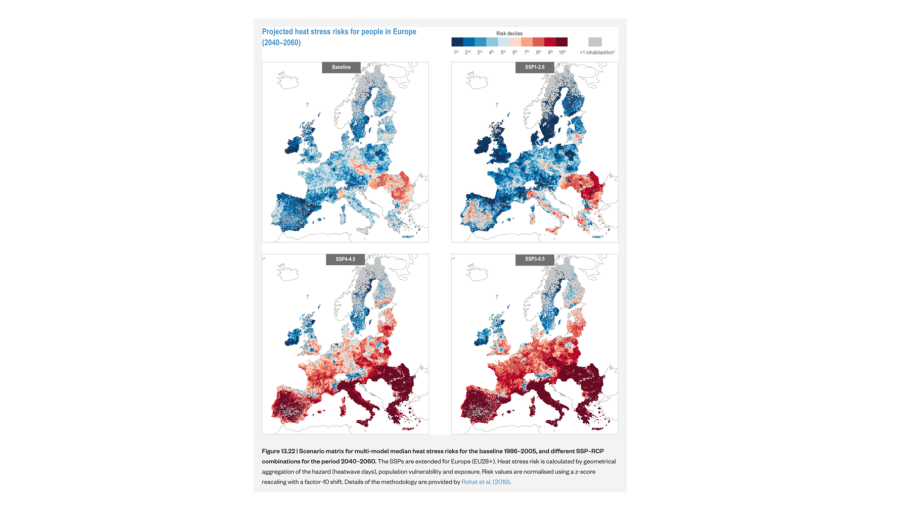
The IPCC plots projected heat stress risk across Europe for the 2040-2060 period under four scenarios, ranked by decile from the lowest-risk dark blue through to the highest-risk dark red in a heat map of the Continent. The baseline panel — reflecting the 1986-2005 reference period — already shows the familiar north-south gradient: Britain, Ireland, France, Germany and Scandinavia sit predominantly in the cooler blue deciles, while a band of amber and light red risk runs through the Balkans, Greece and parts of southeastern Europe.
What changes across the subsequent three panels is the speed and scale of the shift southward and eastward into deep red. Under SSP1-2.6 — the IPCC's low-emissions, high-cooperation pathway model — northern and western Europe largely retains or even improves on its current risk profile, but the Balkans and parts of southeastern Europe darken into the highest decile.
Under SSP4-4.5 — a middle pathway model marked by high inequality — risk darkens across virtually the entire southern half of the continent, with the Iberian Peninsula, southern France, Italy and the Balkans all turning deep red.
By SSP3-8.5 — the high-emissions, low-cooperation model that has historically been used as a worst-case benchmark — the red zone has expanded further still, swallowing almost the entirety of southern and central-eastern Europe in the two highest risk deciles, leaving only Scandinavia, the British Isles and pockets of Western Europe in cooler categories.
The rising heat is going to kill more people each year. At 1.5°C of global warming, the IPCC projects approximately 30,000 annual deaths across Europe attributable to extreme heat — a figure that could nearly triple under 3°C of warming. The 2010 heatwave across eastern Europe, by comparison, killed an estimated 55,000 people in a single event, illustrating the scale of mortality a single extreme summer can already produce at current warming levels.
Southern Europe carries the heaviest burden in every scenario the report models. Heat-related mortality and morbidity are expected to be highest there, and to grow fastest, with the region's vulnerability compounding under the higher-inequality SSP3 and SSP4 pathways relative to the more cooperative SSP1. Heat-related respiratory hospital admissions across Europe are projected to rise from roughly 11,000 annually in the 1981-2010 reference period to 26,000 a year between 2021 and 2050 — a more than doubling driven chiefly by the rising frequency of extremely hot days in the south.
Cities compound the underlying climate signal rather than simply inheriting it. Three-quarters of Europeans live in urban areas, where the urban heat island effect, building density and air pollution interact to intensify the physiological impact of any given heatwave beyond what the raw temperature data alone would suggest.
The report's modelling finds that holding warming to the Paris Agreement's 1.5°C target rather than 2°C would, on its own, reduce summer premature deaths in large European cities by 15 to 22% — a single half-degree of difference translating into tens of thousands of lives across the continent's urban population over time.
The report does flag a genuine source of uncertainty that cuts against the starkest readings of the map: human acclimatisation. Evidence is emerging across most European regions of rising heat tolerance over time, and some projections that assume full physiological and behavioural adaptation suggest mortality rates could remain flat or even fall despite continued warming. The penetration of air conditioners will play an increasingly important role in European demographics as the crisis plays out; ubiquitous in America, air conditioner penetration in Europe is far lower, but that is starting to change as cooling becomes an existential question.
But the uncertainty around humanity's capacity to adapt to genuinely unprecedented heat extremes that fall outside the historical range entirely, remains large. The IPCC explicitly does not treat acclimatisation as a reason to discount the risk captured in the maps.
El Niño, War, and Fertilizer Costs Create a Dangerous Inflation Cocktail
- A super El Niño is expected to increase the risk of droughts, floods, crop losses, and higher food prices, adding to inflationary pressures already amplified by elevated energy and fertilizer costs.
- India appears most vulnerable, with concerns over a weak monsoon, rising food prices, slower growth, and pressure on the Reserve Bank of India.
- Brazil and Mexico could face higher electricity and agricultural costs, while weather-related disruptions may complicate monetary policy and economic planning across emerging markets.
Rory Green, TS Lombard's chief China economist, is the latest Wall Street strategist to warn of the mounting macro and food inflation risks that a super El Niño could release on certain regions of the world.
In a note titled "Super El Niño: Famine Follows War?" Green warns that war-related disruptions to energy and fertilizer markets, compounded by adverse weather conditions, could create a perfect storm for global food prices.
Green said, "In general, El Niño raises temperatures and significantly exacerbates both drought and heavy rainfall. For global macro, it is an inflationary shock via the food price channel – a shock that will likely be compounded by existing war-related high fertilizer costs."
He said within his coverage, "India is the most exposed to both growth and inflation risks, supporting our underweight Indian assets. Brazil and Mexico, too, will receive an inflation impulse."
In recent weeks, the Japanese Meteorological Agency became the first major weather body to formally declare the onset of a super El Niño in the tropical Pacific.
If that forecast is correct, adverse climatic disruption could persist for 2 or more years, raising the risk of drought, flooding, lower crop yields, and higher food prices across key agricultural regions.
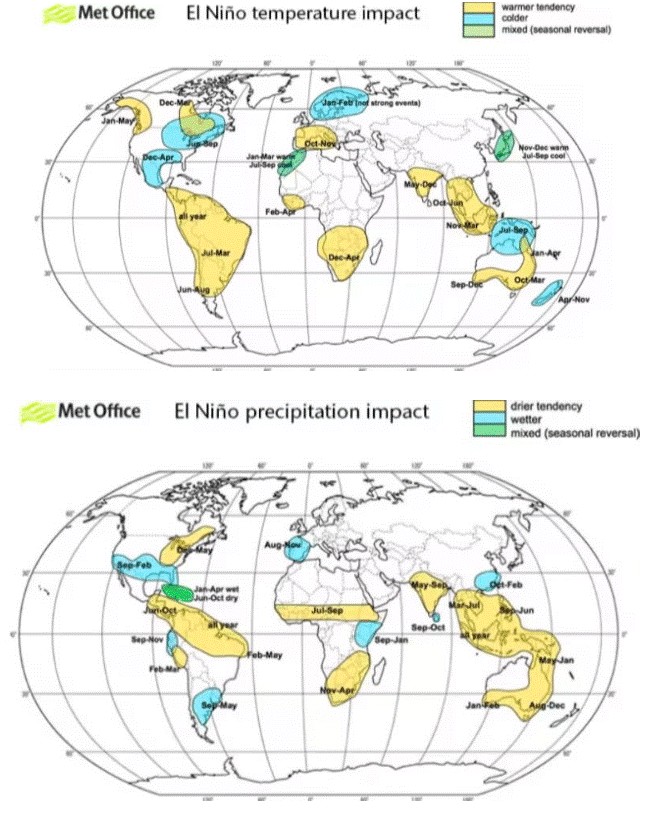
Green noted that El Niño has typically been associated with "hotter and drier conditions in India, parts of South and Southeast Asia, and Central America. But at the same time, it brings higher rainfall to parts of southern South America, the United States and Central Asia."
Chart 1: GDP impact of past El Niño
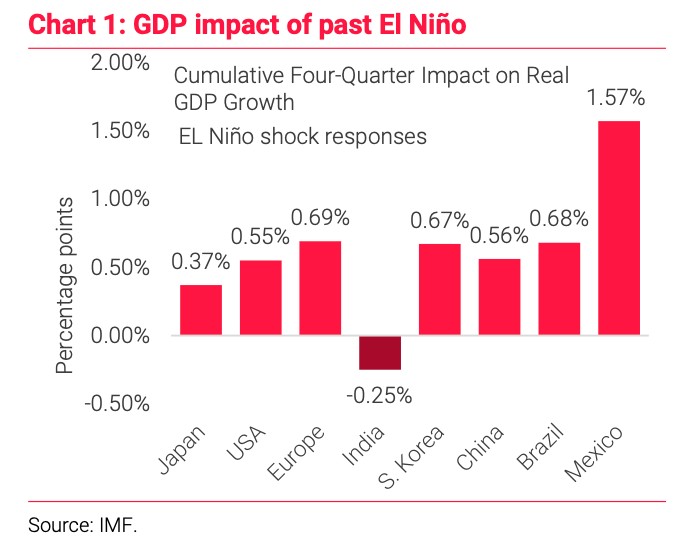
Chart 2: CPI impact of past El Niño
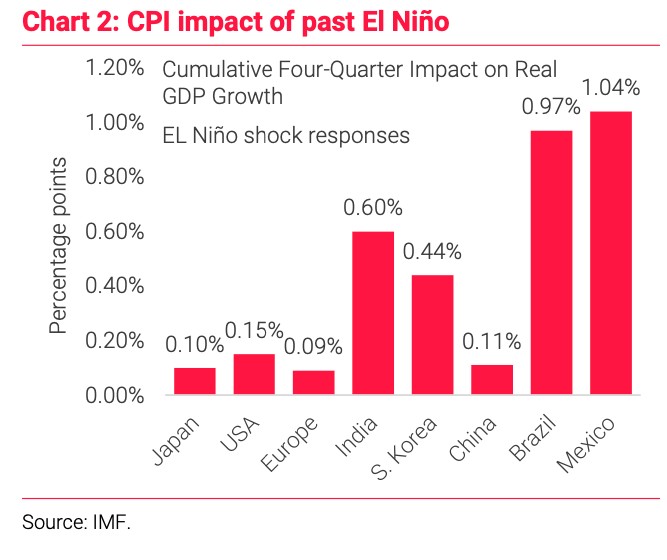
El Niño Impact Watch:
If it proves "strong" or "very strong", the 2026 El Niño is likely to have a historically large impact on global food prices, given already elevated underlying inflation, existing supply-chain disruption and the current high cost of farm inputs. China, Korea and Taiwan are relatively well insulated from the shock. As are most DMs, with the exception of Australia, as the maps below and the charts above show. In our coverage, it is India and LatAm that are most exposed.
India Impact:
El Niño to hit prices, employment and potentially equities
India's Met Department recently warned that El Niño conditions will strengthen during the crucial monsoon season that accounts for ~75% of the annual rainfall the country receives. The Met Department (IMD) has forecast rainfall in the June-September monsoon to be 90% of the long-period average (LPA); if that projection bears out, India will face its worst monsoon since 2015. That year, the IMD had initially predicted below normal rainfall of 93% of the LPA, but the actual rainfall recorded was 86%, leading to drought-like conditions across many parts of India. Even though it is early days yet in this year's season with the rains just about setting in over south peninsular India, indications are that the monsoon is off to a weak start. Rainfall in the first 15 days of June has already been far below normal, as Chart 1 below shows, and the progress of the monsoon across the subcontinent has stalled.
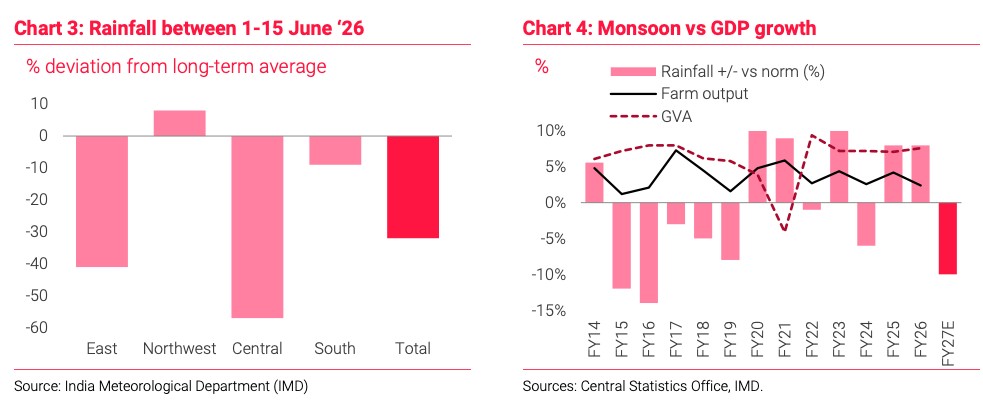
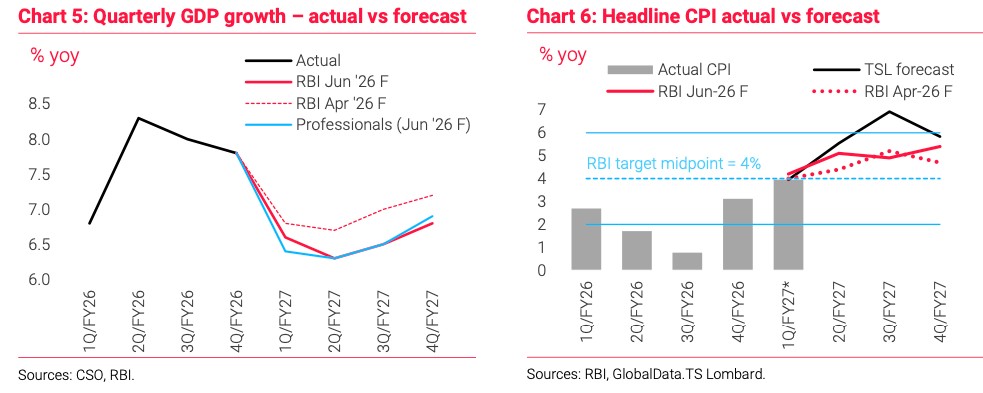
A weak monsoon will exacerbate headwinds to growth that India's heavily energy import- dependent economy has been facing due to the surge in global oil prices. Damage to the summer-sown crop output is a risk to agricultural incomes and rural demand, as well as a potential inflation trigger. Rising food and fuel costs pushed headline CPI higher to 3.9% yoy in May, up from 3.5% yoy in April; May’s food price inflation rose at a faster pace to 4.8% yoy. We expect high commodity prices to spill over into broader inflation, and for headline CPI to breach the upper threshold of the Reserve Bank of India's (RBI) 2-6% flexible target by 3Q/FY27. At its early June policy, the RBI revised up its inflation forecast for FY27 to 5.1% vs 4.6% previously, cautioning against upside risks to its projection. It cited further downside risks to its GDP growth forecast for FY27 that is cut to 6.6% (vs 6.9% previously) owing to supply shocks from both energy and weather-related factors.
The government has been taking proactive measures to combat the El Niño impact, including increasing stocks of rice and wheat in state-run warehouses. How the El Niño impacts the monsoon will be clearer by end-July, when the IMD issues its updated monsoon forecast. July is the key month for crop sowing as the rains typically cover the entire country by the start of the month. Last week, Agriculture Minister Shivraj Singh Chouhan said almost 200 districts (a quarter of India's total) are "most vulnerable" to the impact of El Niño. The monsoon season's impact on crops is determined not just by the quantity of rainfall but also its geographical distribution. The accumulation of water in reservoirs – critical for the winter-sown crop – is also important to track: as of early June, the level was a little lower vs a year ago but higher vs the LPA.
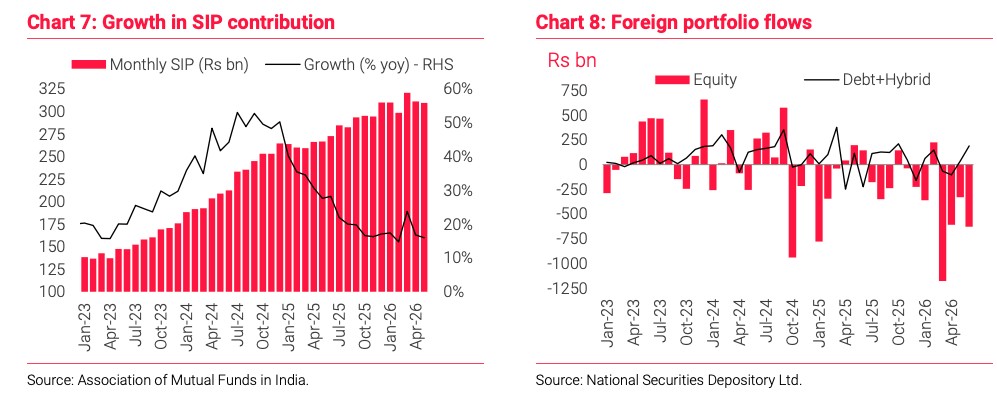
For now, the markets are rebounding after tensions in the Middle East eased, but the Indian economy's resilience will be tested again soon if the monsoon fails: since 1951, 12 of 17 El Niño years have witnessed deficient rains. Foreigners remain net sellers in the equity market, although tax exemptions announced for overseas bond investors are pulling flows into local debt. Equities have been supported by local investors, but returns have been capped as momentum of domestic flows has been flagging recently
Brazil Impact
El Niño could weigh on power, food prices
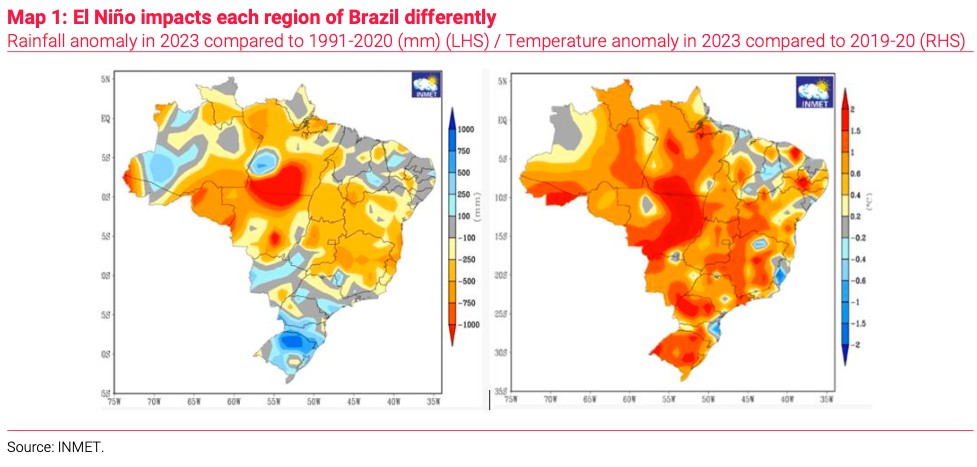
A 'Super El Niño' could push up inflation, but Brazil is more prepared for extreme weather than in the past. As a country that spans across the South American continent, El Niño has an uneven impact on regional weather patterns. In southern Brazil, overall precipitation, the number of heavy downpours and the severity of storms tends to increase, particularly in the spring. Northern Brazil, including parts of the Amazon basin, tend to have drier weather, as does the country's northeast. While parts of the country's populous southeastern region see a limited impact, key states – including Minas Gerais, tend to be drier than normal. Across the countries, average temperatures tend to rise, and the number of heatwaves tends to increase. These factors, coupled with the greater frequency of extreme weather already effecting the country because of climate change, mean that Brazil runs an even greater risk of severe events this year, similar to the record floods in Rio Grande do Sul state in 2024.
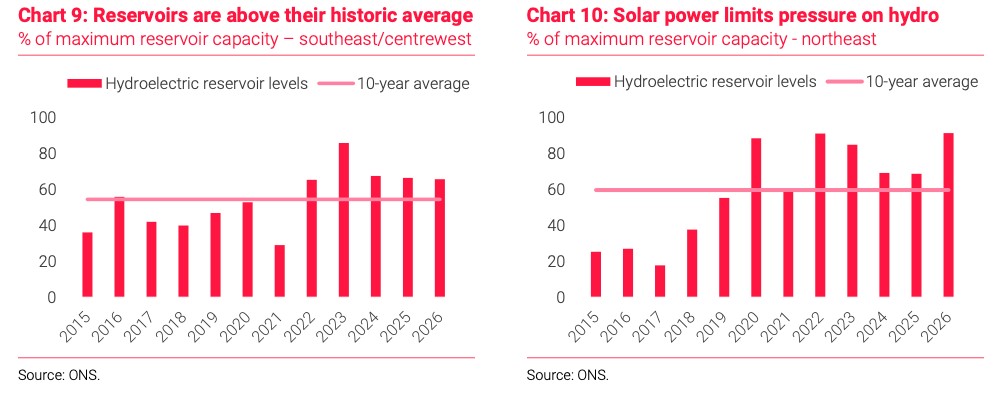
The El Niño adds another layer of uncertainty regarding the economic outlook. Although we do not expect the El Niño to play a decisive role in the direction of the economy in H1/26, it could exacerbate existing issues in the economy, including inflation. Electricity prices, which typically tick up during the dry season (April to October) could rise even more if dry weather has a significant impact on hydroelectric reservoir levels in south-central Brazil, which holds the lion's share of the country's generation capacity. This would force the National Systems Operator (ONS) to continue to maximize the use of high-cost thermoelectric plants to offset the reduction in hydroelectric generation. This would mean that electricity costs would increase in the coming months through the so-called tariff flag systems, which is imposed to cover the costs of thermoelectric generation. Likewise, energy consumption – and spot market prices – tends to increase during heatwaves, as more households use air conditioning. The positive news is that Brazil is entering the dry season, Brazil's hydroelectric reservoirs are in a slightly more comfortable situation than in previous El Niño years, which could limit the impact of the weather phenomenon on power prices.
The El Niño could have an impact on food prices, but not in the short term. When temperatures exceed 40°C for prolonged periods, it generally takes three to four months for the hot, dry conditions to affect fruit and vegetable harvests. The effect on grain and oilseed crops takes even longer. Brazil has already harvested its summer soybean crop and the winter corn crop is in the ground and scheduled for harvest in August and September. At that point, farmers begin planting their summer crops. Even without the El Niño, there are already doubts regarding whether Brazil will manage to expand its soybean and corn crops in the upcoming 2026/27 season. This is because of unfavourable global prices, as well as higher input costs, which could force Brazilian farmers to reduce fertilizer use. While a modest decline in fertilizer application is unlikely to significantly affect yields in a single season, production costs for soybeans and corn will be higher for the 2026/27 season. This increase could influence the cost of meat and biofuels in the following year. In short, pressures from weather and fertilizer prices are present, but their impact on food prices is unlikely to be felt until early next year.
Mexico Impact
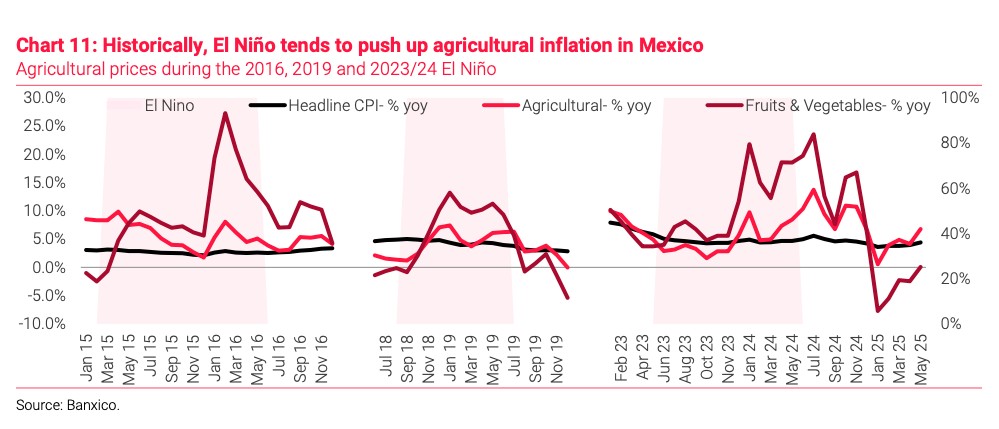
The most immediate impact is likely to come through agricultural prices. Adverse weather conditions have historically reduce agricultural output and, with a lag, feed into livestock prices as poorer pasture conditions and water scarcity raise production costs. Agricultural inflation hit 14.33% y/y during the 2023-24 El Niño, nearly three times the headline rate, with fruits and vegetables peaking at 25.69%. The 2026 starting point is no less uncomfortable. Fruits and vegetables spiked to 21.77% in March and, despite easing to 14.38% in May, remain well above headline, leaving the most weather-sensitive part of the CPI basket exposed to a renewed supply shocks. It's worth highlighting that El Niño affects Mexico in distinct ways, with northern states tend to see higher precipitation in winter, which tends to benefit export crops. But the weather phenomenon also boosts the risk of unseasonal frosts and floods that damage, with potential implications for the tomato, wheat, and maize harvests. In the centre-south, El Niño reduces rainfall and coffee, sugarcane, maize, beans, and avocados are the most exposed crops.
Bad timing for Banxico. The central bank cut rates to 6.5% in May and signalled that the easing cycle had likely come to an end, citing weak activity and a resilient peso. We continue to view growth risks as outweighing inflation concerns and believe additional easing in Q3/26 remains possible. However, a moderate-to-strong El Niño would complicate that assessment by pushing up agricultural inflation through supply-side shocks that monetary policy cannot easily offset. This would make any further easing harder to deliver, even as growth concerns continue to mount.
El Niño also exposes structural vulnerabilities to more extreme weather. Along the Pacific coast, warmer sea surface temperatures fuel a more active hurricane season, raising the risk of storm damage to coastal infrastructure and export agriculture. At the same time, the phenomenon puts urban water supply under pressure. Cutzamala, which provides roughly a quarter of Mexico City's water, fell to just 27% capacity during the El Niño. An exceptionally wet 2025 reversed much of that damage, bringing the system back to 67.7% by early June 202 – the highest level in the seasonal cycle in seven years. That buffer offers some protection, but a strong El Niño would still test it.
Green's note builds on a UBS report published earlier this month, which warned that El Niño risks could send food inflation higher across Asia.
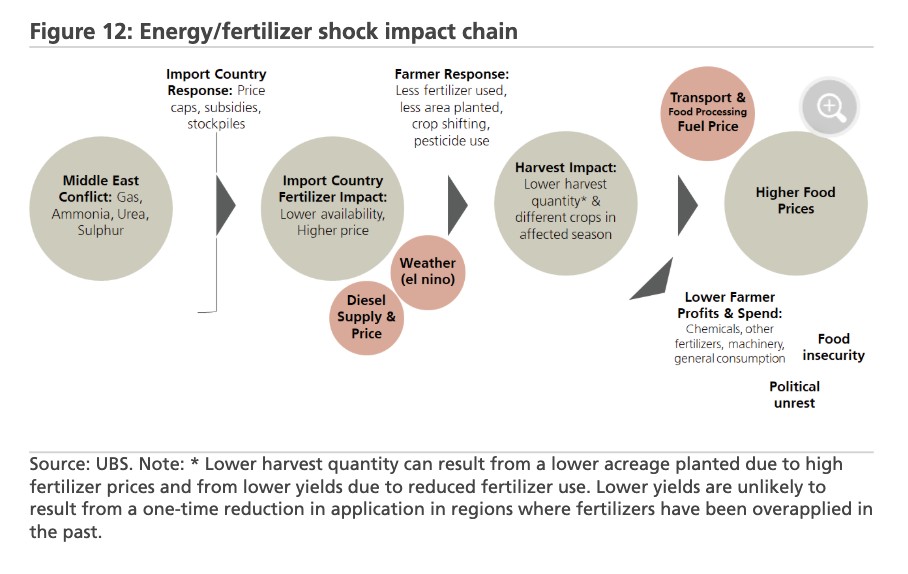
The U.S. is not out of the woods just yet. Bank of America analysts warn that the energy shock of the last several months could ultimately feed into food inflation later this year, with a lag (read the report).
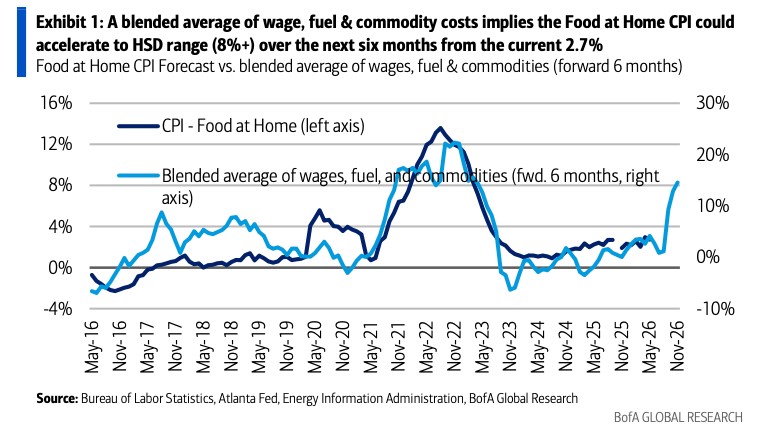
Now there has been what Daryna Kovalska, a commodity strategist at BofA, described as an "aggressive positioning washout" in the agriculture trade. However, she believes that the selloff in soft commodities such as corn is well overdone.
By Zerohedge