It’s possible that I shall make an ass of myself. But in that case one can always get out of it with a little dialectic. I have, of course, so worded my proposition as to be right either way (K.Marx, Letter to F.Engels on the Indian Mutiny)
Wednesday, June 24, 2026
Canada’s illegal cannabis market leads to national organization suspending operations
Displays are pictured at an provincially operated cannabis store in Quebec City, Friday, June 19, 2026. THE CANADIAN PRESS/Jacques Boissinot
A national cannabis lobby group says it’s suspending its operations, citing the financial challenges to the industry from the illicit market.
In a news release Monday, the Cannabis Council of Canada suggested its members don’t have enough money to pay for its lobbying services.
Financial pressure, complex regulations and the “highly active” illicit market have “constrained the resources available to sustain a national association at its current level of activity,” the council said.
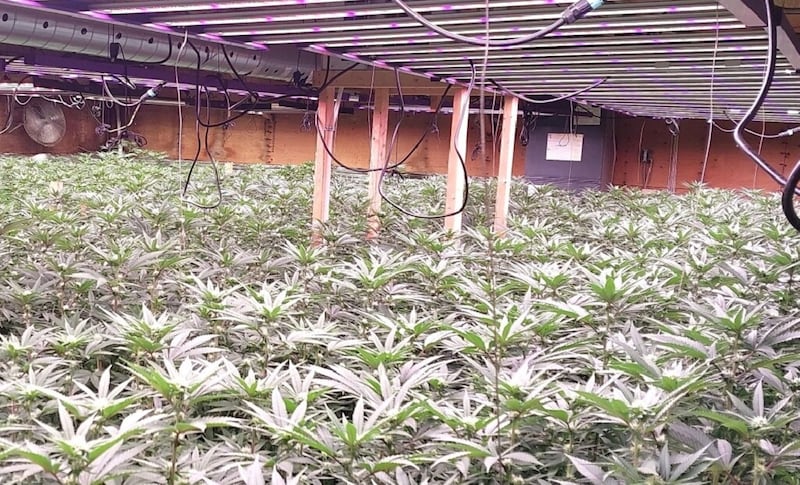
In Canada, growing cannabis is regulated by the federal government, while the retail sale of cannabis and its products falls under provincial jurisdiction. A committee of the Canadian Senate is currently studying a report about cannabis and its impact on the population. The study covers both the health aspects of the legal drug and jurisdictional issues between provincial governments and First Nations. Contributed/OPP
The council’s president, Paul McCarthy, said in an interview last week the organization has been calling on Ottawa to establish a national strategy for eradicating the unregulated cannabis market.
“While this is a provincial and territorial responsibility, I would say accountability rests with the federal government … they legalized it, it wasn’t the provinces and territories,” he said Thursday, adding that Ottawa would be best equipped to deal with the complexities of cannabis enforcement.
The federal departments of health and justice did not immediately respond to a request for comment.
Michael Ravensdale, Vice President, production and quality for the CannTrust Niagara Greenhouse Facility, holds a handful of cannabis bud during the grand opening event in Fenwick, Ont., on Tuesday, June 26, 2018. (THE CANADIAN PRESS / Tijana Martin)
McCarthy said the businesses the council represents, which include cannabis producers and processors, generate billions of dollars in revenue, but the majority of them remain unprofitable.
“One of the biggest reasons is because they’re trying to compete against illicit product. They’re eating up market share and they’re driving down price, and the margins are already razor thin,” he said.
A federal strategy to tackle the unregulated market should involve intelligence gathering to identify illicit operations, disrupt the shipment of product and illegal online sales, and conduct enforcement at brick-and-mortar stores, McCarthy said.
A cannabis plant approaching maturity is photographed at the CannTrust Niagara Greenhouse Facility during the grand opening event in Fenwick, Ont., on Tuesday, June 26, 2018. THE CANADIAN PRESS/ Tijana Martin
“Illegal product is being sold and shipped through Canada Post, Purolator or other delivery services. You need to find a way to cut that off, because if someone buys illegal product and it never shows up to their door, guess what they’re not doing again? They’re not going to keep buying through that channel,” he said.
Instead of each province and territory creating and enacting its own plan to tackle illicit cannabis, the federal government ought to establish a strategy that can be deployed Canada-wide, McCarthy said.
“Let’s pool resources, pool strategies. We don’t need to build this (enforcement plan) 13 times. Let’s build it once and deploy that everywhere,” he said.
A woman smokes cannabis in a Toronto park on Wednesday, October 17, 2018, as they mark the first day legalization of cannabis across Canada. THE CANADIAN PRESS/Chris Young
McCarthy said there are many risks associated with the illicit market, including in the potential health and safety hazard of using an unregulated and potentially inaccurately-labelled product. Another serious concern is the risk of underage Canadians being able to purchase the drug, he said.
The government’s objectives when legalizing cannabis in 2018 were to displace the illicit market, keep the drug out of the hands of youth and ensure the product is safe, McCarthy said.
“The illicit market is the … common denominator that is actually the barrier to achieving all of the public policy objectives of legalization,” he said.
In Monday’s statement, the council said it is proud of the role it played advocating for a responsible, competitive and sustainable legal cannabis industry, and its records will be preserved as the organization becomes dormant.
Lyndsay Armstrong, The Canadian Press
This report by The Canadian Press was first published June 22, 2026.
Bank of Canada security workers start job action after talks fail
Bank of Canada building is pictured in Ottawa on Tuesday, April 28, 2026. THE CANADIAN PRESS/Sean Kilpatrick
OTTAWA — Security officers at the Bank of Canada began a job action today after talks failed to secure a new collective agreement between the central bank and the union.
The Public Service Alliance of Canada says 63 security officers at the Bank of Canada’s Ottawa and Montreal offices are on strike and the Montreal workers are also locked out by the employer.
A statement from the union claims officials at the central bank are pushing for changes that would undermine how seniority affects overtime and vacation for workers, as well as proposing a rollback in maternity leave.
The union also alleges that the Bank of Canada has been contacting workers to work through the legal strike and plans to contract a third-party for security services during the labour disruption.
The Bank of Canada would not comment on the labour action or negotiations but says in a statement that management needs to ensure all critical operations can continue during the dispute while honouring its obligations under the Labour Code.
The union says workers are looking for fair wages, stable schedules and “basic respect” from one of Canada’s most powerful financial institutions.
This report by The Canadian Press was first published June 23, 2026.
Craig Lord, The Canadian Press
Detroit Three, union set to open bargaining against backdrop of tariffs, CUSMA review
TORONTO — Against the backdrop of U.S. tariffs battering local automakers, uncertainty linked to upcoming trade talks and the “incursion” of Chinese electric vehicles into Canada, the union representing nearly 19,000 Canadian auto workers says it’s bracing for the most significant labour negotiations in its history.
Talks between Unifor and the Detroit Three automakers are set to kick off Monday in Toronto as their current collective agreements are set to expire Sept. 20.
Unifor, which typically uses pattern bargaining for its auto sector negotiations, will go toe-to-toe with Ford Motor Co. first, just as it did three years ago. Talks with Stellantis and General Motors are expected to follow.
The decision by Canada’s largest private sector union to target Ford reflects the “difficult” conditions hanging over the sector right now, said Unifor national president Lana Payne.
Autoworkers have been facing “unprecedented uncertainty” from the ongoing trade war, she said, and there’s little indication a resolution is around the corner, despite the looming July 1 deadline to formally extend the Canada-United States-Mexico Agreement.
“This is the most consequential round of auto bargaining that we have done in our history, and I say that knowing that we went through a global financial crisis in 2008-2009 where two of the automakers, it wasn’t a guarantee that they would survive,” Payne said in an interview.
The federal and Ontario governments spent billions on bailouts to Chrysler and General Motors in the wake of the financial crisis, when auto manufacturers seemed on the brink of collapse.
“But this is ... on a much larger scale, I would say, given if we’re unable to resolve the tariff situation and find a path forward here through the CUSMA review, it will have massive long-term implications for the Canadian auto industry.”
She called Ford the “most stable employer” of the trio since U.S. tariffs on the industry began last year, touting Ford’s Windsor, Ont., engine plants that “haven’t missed a beat” in that time, along with the company’s ongoing $5 billion investment in its operations.
A 25 per cent tariff on all cars and trucks not built in the U.S., along with their parts, remains in place. CUSMA-compliant auto and truck parts are not currently subject to that levy.
“As a union, we can’t afford to sit on the sidelines and just wait for those conditions to improve,” said Payne.
“All of this is going to be a massive challenge, but bargaining does one thing for us. There are many things that are outside of our control right now. Bargaining is one thing that is inside our control.”
When it comes to the union’s priorities, job security is paramount.
Both General Motors’ Ingersoll assembly plant and Stellantis’ Brampton assembly plant sit idle. The union says nearly 6,500 total jobs have been lost in the auto manufacturing sector since February 2025, citing Statistics Canada data.
Meanwhile, the Detroit Three face new competition after the federal government opened the door to Chinese-made electric vehicles. In a deal announced earlier this year, Ottawa pledged to reduce its 100 per cent tariff on Chinese EVs to 6.1 per cent, with an annual cap of 49,000 vehicles.
“Obviously, wages and pensions are important to how we can make improvements to the living standards of our members and they are priorities, there’s no doubt about it, but job security and getting investments in our plants is critical right now,” said Payne.
For Ford, both stability and flexibility are key as it contends with an evolving landscape, as it says rising costs, new competitors and shifting product demand are reshaping its considerations around potential investments.
Unifor National President Lana Payne speaks during a rally calling for the protection of Canadian jobs, at the union's Constitution Convention in Vancouver, on Thursday, Aug. 28, 2025. THE CANADIAN PRESS/Darryl Dyck
The company said its $5-billion spend, the majority of which has already been committed, involves the retooling of its Oakville, Ont., assembly plant to support the launch of its Ford Super Duty pick-up trucks. The funding has also gone toward Ford’s first stamping plant in Canada which it said will provide jobs for 100 employees at the site.
Other chunks of funding have been allocated to Ford’s Windsor facilities, including its Essex engine plant which is being expanded to support production of its 7.3-litre engine line.
Ford said it hopes those commitments, along with its long-standing relationship with the union, can serve as a foundation for talks.
But while a win for the union would mean securing firm product allocation commitments from the three companies, it could face a bumpy road getting there, said Ryan Robinson, an automotive research leader at Deloitte.
The CUSMA review will play a central role at the bargaining table, he said, but manufacturers have to be prepared for a wide variety of outcomes given the unlikelihood one will emerge in the short-term. That includes a potential scenario in which manufacturers have to meet more stringent requirements for a vehicle to qualify for CUSMA compliance.
Robinson added that if tariffs survive the CUSMA review, an outcome that seems likely, it’s going to be “a pretty tough sell” for manufacturers to raise their product allocations for Canadian plants.
“Everything boils down to essentially how comfortable the Detroit Three are in where the CUSMA negotiations are going to settle,” Robinson said.
“For the manufacturers, I think it’s all about having that comfort that they can make money building vehicles or allocating vehicles to their Canadian manufacturing footprint. And that’s a big question mark right now.”
In 2023, Unifor’s bargaining with the Detroit Three resulted in a deal that secured base wage gains for production workers of nearly 20 per cent, along with a long list of other improvements including to pensions, job security, a faster path to seniority, bonus pay and more vacation days.
At that time, the union entered talks from a position of relative strength, said Larry Savage, a labour studies professor at Brock University. This go-round, it heads into bargaining “from a position of relative weakness” due to external pressures.
“That makes it very difficult for the union to craft a strategy that is static,” Savage said.
“As a result of that, I think it’s unlikely that Unifor will secure the same gains it managed to win in the last round.”
Savage said workers should prepare for a very “tense” round of talks, which could feature “credible threats” by their employers to shift production out of Canada. With Chinese EVs likely to increase low-cost competition in the Canadian auto market, Savage said it undercuts the union’s ability to use strikes as a potential tool to secure new investment or job guarantees.
“I think it’s going to be an incredibly difficult round of bargaining for Canadian auto workers,” he said.
Payne acknowledged the tough task ahead, but said the union believes it can “create our own leverage” at the bargaining table.
“We are not in a situation where we’re saying that we’re accepting concessions,” the union president said.
“The reality is this tariff crisis can’t be solved with concessions in a workplace. It’s so much greater than that. It has to be solved at a negotiating table between Canada and the United States.”
This report by The Canadian Press was first published June 18, 2026.