Wednesday, June 24, 2026

AU CONTRAIRE

Ukraine, Europe and Global Security - Lavrov

Ukraine, Europe and Global Security - Lavrov
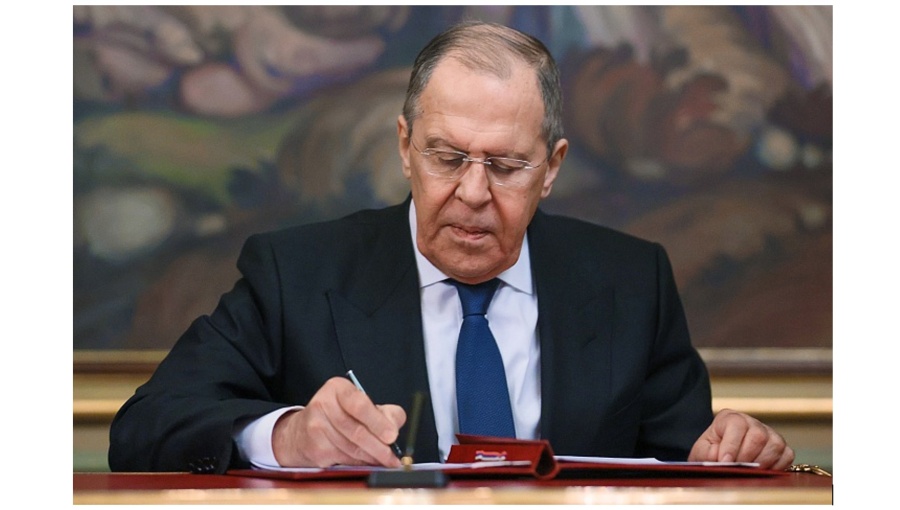
Russia’s veteran Foreign Minister Sergei Lavrov penned an article that was originally planned to be published in the Brussels-based Politico-Europe but got pulled. The ministry subsequently published the piece on its own website. / bne IntelliNewsFacebook
By Ben Aris in Berlin June 23, 2026

Below is the text of an article by Russia’s veteran Foreign Minister Sergei Lavrov that was originally planned to be published in the Brussels-based Politico-Europe outlet, but according to reports was pulled at the last minute by editors.

The Russian Ministry of Foreign Affairs subsequently published the article on its own website. It comes in the context of America’s withdrawal from the ceasefire negotiations led by the Trump administration that came close to doing a deal at the Moscow meeting on December 3 that produced a 27-point peace plan (27PPP) that the Kremlin largely accepted.

But then the Gulf War broke out and US President Donald Trump lost interest in the Ukraine war talks which hit a roadblock over the issue of control over Donbas and the West’s reluctance to offer Ukrainian President Volodymyr Zelenskiy a real security deal.

Since then the burden has fallen entirely on Europe’s shoulders. At the E3 London summit on June 8 the leaders of France, Germany and the UK drew up a five point plan to end the war. But it starts with a call for an unconditional ceasefire before any negotiation can start – a position the Kremlin categorically rejected at the similar “final offer” summit in London a year earlier.

The Kremlin has said repeatedly that it is open to talks and Russian President Vladimir Putin said the “end of the war is close” at a press conference following the Victory Day parade this year. But observers say that the Kremlin’s position remains unchanged: the war will end when either Russia captures, or Bankova concedes, control over the remaining unoccupied parts of the Donbas are in Russia’s hands.

Lavrov discusses these points and more in his article:


Some Reflections on Resolving the Ukrainian Crisis, Europe and Global Security

At a meeting in London on 7 June 2026, the leaders of Britain, France, and Germany, as well as Vladimir Zelenskiy, laid out five preconditions for Russia to secure a "just and lasting peace" in Ukraine. The united Europe now presents this list of demands as the basis for dialogue with Moscow.

Background

More than two decades of negotiation with Europe, as part of the collective West, leads to only one conclusion: engaging Russia in dialogue has served as a diplomatic smokescreen for the geopolitical expansion of Western institutions, above all Nato and the European Union, eastwards, right up to Russia's borders.

Europe's complicity in fuelling the Ukrainian crisis is undeniable. Together with the United States, European countries orchestrated the Orange Revolution in Kyiv in 2004. To create an anti-Russian bridgehead in Ukraine, they spent years buying off politicians and entire parties, rewriting history and educational curricula, cultivating and nurturing Ukrainian nationalism, and went to great lengths to pull Ukraine away from Russia.

In 2013, the European Union rejected outright our proposal for a compromise on the association agreement – a deal Brussels had long been pressing Viktor Yanukovych to sign. It is worth recalling: Ukraine was offered unilateral market opening, without reciprocal commitments – terms that would have proved incompatible with Kyiv's continued membership in the CIS free-trade zone. When Viktor Yanukovich requested a deferral, the Europeans incited street riots which swiftly escalated into a coup d'état in Kyiv in February 2014.

Germany, France and Poland then proved themselves to be equally treacherous. Having guaranteed that the agreement struck between the opposition and Viktor Yanukovych would be honoured, they washed their hands of it the instant that same opposition, their own handiwork, took power. "Democracy," they shrugged, "takes unexpected turns."

Europe thereafter lent its backing to the new authorities. In Odessa on 2 May 2014, the burning alive of dozens of innocent supporters of closer ties with Russia did not draw a single word of condemnation from European capitals.

As co-guarantors of the 2015 Minsk Agreements, France and Germany effectively encouraged the Ukrainian regime to sabotage its own commitments. As Angela Merkel and François Hollande later conceded – after the special military operation had already begun – the implementation by Kyiv of the Minsk Agreements, unanimously approved by the UN Security Council, was never genuinely intended. The objective, they admitted, was merely to buy time: to shore up the Armed Forces of Ukraine and flood them with Western weaponry.

Russia, for its part, explored every diplomatic avenue to defuse Europe's security crisis. However, in January 2022, the United States and Nato rejected Russia's proposal for legally binding mutual security guarantees. European Nato members actively endorsed that rebuff.

Following the launch of the special military operation, the united Europe threw its support behind the British Prime Minister's efforts to sabotage the Istanbul negotiations between Russia and Ukraine. Boris Johnson's appeal to Kyiv – "don't sign anything, just fight" – slammed the door on genuine diplomacy for the foreseeable future.

Current Situation

So what has prompted European leaders to suddenly shift their rhetoric and start talking of negotiations and what are they aiming for with these statements? For instance, the EU diplomacy head Kaja Kallas has stated: the purpose of any dialogue with Russia is to dictate Europe's terms. These include: paying "reparations" to Ukraine; withdrawing troops from Transnistria and the South Caucasus; abolishing the "foreign agents" law; and accepting hard limits on the size of the Russian Federation's Armed Forces. In her framing, "there can be no just and lasting peace without accountability for Russia." During the UN Security Council session on 19 May 2026, an EU representative made the point unequivocally: "supporting Ukraine militarily does not contradict the pursuit of peace, but rather serves as a fundamental prerequisite for any credible, good-faith negotiations."

Europe's plan is to talk with Russia while simultaneously pressing ahead with a campaign of legal warfare orchestrated through the Council of Europe. Within this once-respected organization, an entire infrastructure is being assembled for the express purpose of "holding Russia accountable": a Register of Damage, a Claims Commission, and a Special Tribunal.

The European Union has also given the green light to detaining merchant vessels on the high seas. Several incidents have already taken place in the Baltic and the Atlantic. At the same time, the West studiously averts its gaze from the terrorist acts of sabotage perpetrated by the Armed Forces of Ukraine in the Black and Mediterranean Seas.

The real objective of Europe's leaders, then, is not to negotiate with Russia. It is to shore up the Zelenskiy regime and preserve it as a launchpad for continued confrontation against Russia. With this in mind, European leaders are scrambling to secure a ceasefire as quickly as possible and for one reason only: to prevent the collapse of the Armed Forces of Ukraine on the battlefield. The plan is to "freeze" the conflict without addressing its root causes, and then rapidly deploy military contingents from the Anglo-French "coalition of the willing" onto Ukrainian soil.

It is widely known that European elites have invested their "political capital" in the confrontation with Russia, pouring hundreds ofbns of dollars into propping up the Kyiv regime and ramping up the military budgets of EU member states and Nato. Europe now aims to achieve "defence readiness" against Russia by 2030. Until then, they mean to buy time by whatever means available. In a strikingly candid remark this April, Belgium's chief of staff put it bluntly: "We still have a few years. Thanks to the courage and blood of the Ukrainians, who are buying us that time."

The united Europe continues to dream of expansion. It intends to absorb Ukraine and Moldova, while pulling Armenia into its sphere of influence. Nato has already expanded eastward, swallowing up Finland and Sweden. As for Ukraine, it is increasingly eyed as the "striking fist" of a future European military force, independent of the United States and independent of Nato.

Risks to Global Security

This state of affairs poses serious threats to global security. A direct confrontation between Nato and Russia could rapidly escalate into an exchange of nuclear strikes, with catastrophic consequences.

Under the banner of "strategic autonomy," Europe is witnessing a significant build-up of its military capabilities, including in the nuclear sphere. Paris's intention to extend its "nuclear umbrella" to several EU and Nato member states is a source of deep concern. This will do nothing to strengthen the security of France itself or the recipients of its so-called protection.

For all that, Europe's political and military establishment continues to attribute aggressive plans to Russia – plans that, they claim, reach far beyond Ukraine. The Russian President has stated on numerous occasions that all of this is nonsense, provocation, and disinformation, all aimed solely at extracting budget funds for the fight against Russia. That is scarcely the climate for substantive dialogue.

Russia's Position

As for negotiations, Vladimir Putin reiterated at the St. Petersburg International Economic Forum that Russia is not opposed to contacts with any party. We see Europe, however, as a party bent on Russia's defeat – a stance the Europeans themselves openly avow. Dialogue with Europe, therefore, cannot be conducted as though it were an impartial third-party observer.

Russia would prefer to achieve the goals of the special military operation through diplomacy. That requires reliably guaranteeing security along Russia's western borders and ensuring respect and dignity for our citizens and compatriots, including the right to speak their native Russian language and practice Orthodox Christian faith. Further military, political and economic expansion by the West is unacceptable: it runs counter to the imperatives of a multipolar world.

European leaders should recognize that the model of regional security built in Europe over decades, ever since the adoption of the Helsinki Final Act in 1975, has been destroyed by their own hands. And it will never be restored. We must now move toward creating a continent-wide security architecture open to all Eurasian countries and that reflects today's multipolar reality.

The principle of equal and indivisible security trampled upon by the Euro-Atlantists, can be embodied within a new Eurasian architecture. When the time is ripe, Europe too will be able to join this great effort.

The key point is that meaningful dialogue requires the restoration of trust, shattered by the anti-Russian actions of the West, and Europe as part of it, in the post-Cold War era. Trust can be recovered only through concrete steps that demonstrate a sincere commitment to move away from using diplomacy as a cover for expansionist ambitions. Trust cannot be restored, nor can dialogue be resumed, through ultimatums such as the one issued to Russia in London on 7 June 2026.

P.S.: It is noteworthy that the London ultimatum was unequivocally reaffirmed by the ambassadors of Britain, France and Germany at the meeting at the Russian Foreign Ministry on 11 June 2026, – a meeting they had so insistently requested. That was the sole purpose of their visit to the Ministry.


ECO FEMICIDE

UN expert calls on Ecuador for swift probe into Polish activist's death

UN expert calls on Ecuador for swift probe into Polish activist's death
Koniuszek had spent roughly a decade documenting environmental crimes and corruption on social media and alongside local journalists in Santa Elena.Facebook
By bnl editorial staff June 24, 2026

The United Nations special rapporteur on human rights defenders, Andrea Bolaños, has urged Ecuador to conduct a swift, thorough and independent investigation into the death of Monika Silva Koniuszek, a Polish-born activist found dead at her home in Montañita, a coastal town in Santa Elena province, on June 8.

A postmortem carried out in Guayaquil determined that Koniuszek, 41, died from a blow to the head and strangulation, contradicting an initial statement by interior minister John Reimberg, who said before autopsy results were available that the evidence pointed to suicide. According to The Guardian, attorney Lita Martínez, director of the Ecuadorian Centre for the Promotion and Action of Women (Cepam), said the forensic findings made the suicide hypothesis untenable.

Koniuszek had spent roughly a decade documenting environmental crimes and corruption on social media and alongside local journalists in Santa Elena. Colleagues said she had recently begun investigating Noboa Trading, the fruit conglomerate belonging to the family of President Daniel Noboa, pursuing allegations that cocaine had been seized in the company's banana containers and that senior Ecuadorian judicial officials were obstructing the investigation. Shortly before her death, she reportedly delivered a dossier of allegations to the US embassy in Quito. She had also investigated claims that politically connected figures in Santa Elena were involved in a land-trafficking ring.

Speaking to The Guardian, fellow activist and British author Beth Pitts, who collaborated with her on local campaigns, described Silva Koniuszek as someone who publicly denounced corruption and environmental crimes when others were too afraid to speak out. Friends said she had been receiving explicit death threats and facing judicial harassment, allegedly linked to networks connected to the November 2025 assassination of local journalist Robinson del Pezo. Polish friend Joanna Cuper told broadcaster TVP Info that Silva Koniuszek had told her she was being followed, and that cartels had placed a price on her head. Three years ago her then-husband took their two daughters to Brazil following threats against the family.

Bolaños, who described the case as far from isolated, on June 22 called on Ecuador to "end the persecution and criminalisation of human rights defenders and strengthen institutional protection mechanisms." Poland's prosecutor's office confirmed it had requested mutual legal assistance from Ecuadorian authorities, while the Polish embassy in Peru called for accountability and stressed the importance of protecting human rights defenders and journalists.

The Permanent Committee for the Defence of Human Rights (CDH) and Cepam urged investigators not to rule out femicide or the possibility that her activism was the motive for the killing.

Markets bet big on De la Espriella, Colombia's next president. Economists are not so sure

Markets bet big on De la Espriella, Colombia's next president. Economists are not so sure
Abelardo de la Espriella, a far-right lawyer and businessman whose campaign drew repeated endorsements from US President Donald Trump, won Colombia's presidential runoff on June 21 by a margin of less than one percentage point.Facebook
By Cynthia Michelle Aranguren Hernández in Bogota June 24, 2026

Financial markets cheered Abelardo de la Espriella's victory in Colombia's June 21 presidential runoff. The peso surged, bonds rallied and equities climbed on hopes of business-friendly reform.

But two Colombian economists interviewed by IntelliNews caution that the structural costs of “El Tigre’s” programme — spanning deep state cuts, fossil-fuel expansion, labour deregulation, a sharp geopolitical pivot toward Washington and a hardline security agenda — could far outweigh the initial euphoria, with consequences felt most acutely in the country's poorest regions, communities and ecosystems.

Right-wing populist De la Espriella beat leftist senator Iván Cepeda by a margin of barely 250,000 votes — one of the narrowest in Colombian history — and is set to take office on August 7 presiding over a deeply polarised country that now joins a wave of like-minded governments across the region. That fragile mandate, economists warn, will collide directly with an economic and security programme that assumes far more room for manoeuvre than the numbers suggest he has.

The fiscal paradox of tax cuts that may not stimulate

Laura Andrea Cristancho Giraldo, an economist and tenured professor at the Faculty of Business, Management and Sustainability at Politécnico Grancolombiano in Bogotá, said market optimism rests on conditions that have yet to be met. "Markets typically react favourably to corporate tax cut proposals due to their potential to stimulate foreign direct investment," she said. "However, this effect will depend on the fiscal credibility of the incoming administration."

If lower tax revenues are not offset by structural adjustments to public spending, she warned, concerns over the fiscal deficit, public debt and the country's credit rating could mount. Foreign direct investment, she added, responds primarily to legal, regulatory and macroeconomic stability — not to tax cuts alone.

Felipe Abondano, a Colombian journalist and economic analyst, was more categorical: tax cuts as a stimulus tool have "never worked anywhere else in the world." He pointed out that De la Espriella's own campaign positions shifted repeatedly, leaving genuine uncertainty over which proposals will actually be implemented in office.

The proposed 40% reduction in the state apparatus carries the most concrete risks, Abondano argued. The merger or closure of institutions such as the National Savings Fund would directly curtail Colombians' access to housing finance, while planned ministry unifications would slash investment in culture and sport — sectors with outsized economic multiplier effects in many communities. "In many parts of Colombia the only official employer is the state, and the only people with purchasing power for many things," he said. "It will have a differential and very deep impact, especially in the regions."

Yet the scale of the fiscal challenge awaiting the new government is not in dispute. Outgoing President Gustavo Petro decreed a 24% minimum wage rise in January — more than even unions had demanded — aggravating a budget deficit that already exceeded 6% of GDP last year, according to Barron's. Nicolas Jaquier, an emerging-market fixed income portfolio manager at Ninety One, told the publication that Colombia needs "a 4-5% of GDP fiscal adjustment.” Meanwhile, some 90% of government spending goes to politically untouchable areas such as the military and pensions, Paul Dmitriev of Global X ETFs told Barron's, while interest costs already absorb around a fifth of state revenue.

Locally, the powerful National Association of Financial Institutions (Anif) has urged the incoming government to defuse what it calls a "fiscal bomb" by cutting $7.8bn in public expenditure and advancing a $3.5bn tax reform, Blu Radio reported. Anif's proposals — including reducing state payrolls, raising diesel prices and dismantling existing tax exemptions — sit in direct tension with De la Espriella's promise of corporate tax cuts, suggesting the new administration's fiscal room may be far narrower than markets currently anticipate.

Energy: short-term revenues, long-term ecological and economic costs

On fracking and hydrocarbon expansion, two of De La Espriella’s signature proposals, the experts who spoke to IntelliNews converged on the asymmetry between near-term gains and longer-term risk. Cristancho Giraldo acknowledged the policy "could increase fiscal revenues and exports in the short term," but warned of "the risk of deepening the existing dependency on fossil sectors within a global context of energy transition." Colombia's páramo ecosystems, the country's critically important high-altitude wetlands, could face heightened environmental pressure, she said, "affecting Colombia's water security and generating future economic costs."

Abondano questioned the economic rationale more fundamentally. Colombia, he noted, is not a country with strong fracking potential, and the real driver of such projects is often financial rather than productive: "What lies behind fracking is the selling of oil project portfolios to multinationals, which doesn't necessarily translate into higher national production." The environmental toll — depleted water sources, devastated fragile ecosystems and pressure on already-endangered species — comes with no guaranteed fiscal return, he argued.

He also pointed to a structural failure in how oil revenues reach communities. "Oil royalties supposedly reach communities via transfers, but that money never actually arrives," he said, citing the Pacific Rubiales precedent as the definitive cautionary case: "The zones where hydrocarbon exploitation occurs don't necessarily see an improvement in quality of life — what you get instead is a speculative movement of money that produces more crime and more prostitution."

The energy sector is indeed where De la Espriella's incoming administration intends to move fastest and furthest. Petro, an advocate of climate mitigation efforts, had blocked new drilling permits, keeping Colombian oil output below 750,000 barrels a day; pro-investment policies and unleashed fracking could lift that above one million barrels, Dmitriev told Barron's. According to S&P Global, much of this agenda can be advanced by executive action alone, since the exploration freeze was a matter of executive policy rather than law. "He can replace [state oil company] Ecopetrol's leadership and redirect its strategy back to hydrocarbons, since the state owns about 88%," said Dorian Kantor, a political science professor at Freie Universität Berlin and director of Kantor Consulting in Bogotá, who added that the incoming government can also fast-track permits and prioritise gas import terminals.

Yet S&P Global also underscores limits to the new administration's reach that echo Abondano's scepticism. Kantor noted that fracking itself, along with environmental licensing and prior consultation requirements, remains "blocked by the constitution and the courts, and thus beyond his reach entirely" — protections rooted partly in ILO Convention 169. In La Guajira, where large wind developments have stalled for years, independent consultant Oscar Alberto Mariño Estupinán told S&P Global that "the main bottlenecks are environmental licensing and prior consultation," with one project able to spend over two and a half years in consultation procedures and still be only halfway through. Kantor argued that transmission and financing constraints compound the problem: "The blackout risk is mostly a transmission-and-finance problem dressed up as a community problem. This same mechanism blocks both the La Guajira wind buildout and his own fracking plans", what he called "the real structural battle" of De la Espriella's energy agenda.

Labour reform: the pension trap and the Argentina warning

On proposed hourly contracts and labour flexibilisation, the two analysts surveyed by IntelliNews offered complementary but urgent warnings. Cristancho Giraldo acknowledged that "a well-designed flexibilisation strategy can facilitate youth hiring," but cautioned that if labour protections are reduced without accompanying structural reform, "this could increase job precarity and instability within formal employment," while simultaneously pressuring the sustainability and coverage of healthcare and pension systems.

Abondano singled out a more specific and immediate danger: the hourly-contract model championed by De la Espriella's vice-president-elect and running mate, José Manuel Restrepo, since his time as minister and as a professor at Universidad del Rosario, would make formal pension accumulation virtually impossible. "Very rarely does anyone manage to accumulate a pension by contributing on an hourly basis," he said. The model would affect not only gig-economy workers but also the large community of technicians who provide services to companies, all of whom could now be offered hourly contracts rather than formal employment.

Restrepo, a former trade and finance minister from 2018 to 2022, is expected to take de facto control of economic policy under De la Espriella, who talked little about economics on the campaign trail, focusing instead on security issues and his opposition to Petro's flagship "Total Peace" policy, which many say has failed to curtail guerrilla violence and drug trafficking.

The direction of pension policy also reverses the outgoing government's approach: where Petro sought to re-centralise pension funds, De la Espriella intends to favour private pension funds once again — a shift with long-term implications for retirement security across the workforce. The parallel with Argentina, where De la Espriella has openly cited President Javier Milei as a political muse, is stark, Abondano said: 'There, 26 companies close per day' — a warning that similar austerity dynamics risk reversing the formal employment gains recorded under Petro.

The proposed agenda also targets women's reproductive rights directly, Abondano added, with the incoming administration signalling a review of abortion rights, a rollback he said will disproportionately affect low-income women with the least access to private healthcare alternatives.

The China conundrum

Both analysts flagged a fundamental contradiction at the heart of De la Espriella's foreign policy. Cristancho Giraldo called for "a strategy of commercial and diplomatic diversification" to preserve Colombia's international competitiveness without abandoning existing economic ties with China, "an increasingly relevant trading partner" whose weight in Colombia's trade architecture continues to grow.

Abondano was blunter about the depth of the dependency now being built into Bogotá's foreign policy, which he said foreshadows a return to the pre-Petro era of close alignment with Washington. De la Espriella's government "owes a great deal to Donald Trump and will be subordinate to what is needed from that relationship," he said, predicting that Colombia will distance itself from the BRICS grouping (Colombia is a member of BRICS’ bank, the New Development Bank) and potentially withdraw from Beijing’s Belt and Road Initiative in favour of attracting US investment exclusively. But the practical barriers are formidable: China is building the Bogotá Metro and accounts for a dominant and growing share of Colombia's imports. "It is very difficult for that to change despite what they want," Abondano said.

That newfound alignment with Washington was already on full display the night of the result. Trump, who had endorsed De la Espriella repeatedly during the campaign, promptly placed a congratulatory call to the president-elect, while US Secretary of State Marco Rubio wrote on social media that the Trump administration "looks forward to working closely with your incoming administration to advance regional security co-operation, end illegal immigration to the United States, and strengthen our economic ties.”

Still, the geopolitical bet on Washington carries a significant political risk of its own, Abondano warned: Trump's executive leverage could be severely curtailed if Republicans lose control of Congress in November's US midterm elections, leaving Colombia diplomatically exposed without the Chinese relationships it will, by then, have actively dismantled.

Security: the ghost of false positives and the dismantling of accountability

On the maximalist security agenda floated by De la Espriella, Cristancho Giraldo offered a measured but pointed warning. "Stricter security policies can yield visible results in the short term, but their effectiveness depends on their articulation with social and territorial policies," she said. "An approach excessively focused on coercion could generate tensions with the peace process and increase social polarisation, particularly among youth and social movements."

Abondano identified two deeper structural dangers. The first concerns the mega-prison model itself: De la Espriella, inspired by the policies of El Salvadoran President Nayib Bukele, has proposed privately operated facilities, meaning the government will not fund construction but will ultimately pay for their operation — a model with a documented record of failure in the United States, where it creates structural incentives for judges to keep prisons full in order to sustain the business model.

The second, and more alarming, danger concerns accountability. The proposed 90-day target for operational results from the security forces precisely replicates the institutional pressure that produced Colombia's "false positives" scandal, in which military units killed civilians and dressed them as combatants to inflate body counts. "Under those pressures, Colombia arrived at the false positives," Abondano said bluntly.

More troubling still, he added, is the proposal to withdraw Colombia from the International Criminal Court and the United Nations human rights framework. "These were often the only controls the Colombian state had, and the only environments where state victims could denounce abuses," he said. Without the Inter-American Court of Human Rights, he argued, the full depth of the false positives cases would never have come to light — nor would the truth about events in Las Combreras and Ituango. Colombia has been condemned multiple times at the international level for human rights violations against indigenous and minority communities, he noted.

The deeper structural problem, both analysts agree, is that Colombia's insecurity – fuelled by a long and troubled history of paramilitary groups linked to cocaine trafficking – is rooted in inequality and lack of opportunity, not in insufficient punishment. "What young people needed was free public education and real job options, and those are precisely what will now be reduced," Abondano said. A security model built on coercion rather than opportunity, he argued, does not address the root cause. It simply makes it more expensive and more dangerous.

A narrow mandate, a wide agenda

De la Espriella's one-percentage-point margin of victory could very well complicate his ability to manage a fragmented Congress, where his fledgling Defenders of the Homeland party holds only a handful of seats — five in the Senate, while the leftist Pacto Historico, led by runner-up Cepeda, controls 39 of the 103 seats in the lower house. "A win by 5% or more would have been really positive," Paul Dmitriev of Global X ETFs told Barron's. Much of the energy and security agenda can proceed by decree; the tax reform, royalty incentives and any rewriting of the prior-consultation framework cannot.

What unites the economists' assessments is an abiding sense that the gap between market enthusiasm and economic reality has yet to be tested. As Cristancho Giraldo put it, foreign investment will ultimately follow stability, not slogans. And as Abondano's analysis suggests, several of the new government's central promises, from fracking revenues to a harsh security crackdown, may deliver far less than advertised, at a cost borne disproportionately by Colombians least able to absorb it.

Venezuela set to disclose $240bn debt burden in largest sovereign restructuring on record

Venezuela set to disclose $240bn debt burden in largest sovereign restructuring on record
The administration of Acting President Delcy Rodríguez, who assumed office after the capture of Nicolás Maduro on January 3 and has since won US recognition and President Trump's repeated backing, blamed financial sanctions imposed from 2017 onward for Venezuela's inability to service its debt.
By bnl editorial staff June 24, 2026

Venezuela is preparing to disclose external obligations approaching $240bn, a figure well above previous market estimates, in what would rank as the largest sovereign debt restructuring ever attempted, the Financial Times reported.

The disclosure forms part of a broader push by interim president Delcy Rodríguez to normalise relations with international investors after years of isolation. Her administration is seeking a restructuring agreement with creditors before the end of the year and has retained Centerview Partners as financial adviser to help craft a plan aimed at restoring the country's finances and reopening access to global capital markets.

The figure marks a sharp upward revision from the $150bn-$170bn range cited by analysts when Caracas first announced its intention to restructure in May, and from the roughly $170bn in liabilities cited when the government appointed Hogan Lovells as principal legal adviser earlier this month. The Central Bank of Venezuela has not published updated external debt data since 2018, leaving creditors and analysts to work largely from independent estimates until now.

Documents due for release over the coming weeks are expected to paint a bleak picture of the economy. The oil-rich country's output is projected at about $100bn, a fraction of the roughly $370bn recorded in 2012, the final full year of Hugo Chávez's presidency. On that basis, Venezuela's debt would amount to more than twice the size of its economy.

Investors are paying close attention to the methodology behind the assessment because, unlike most major sovereign workouts, it has not been prepared by the International Monetary Fund. That departure from precedent has unsettled some creditors and opposition figures, who argue that negotiations could prove harder to manage without the Fund playing its customary role.

The IMF resumed regular contact with Venezuelan authorities in April, after a seven-year rupture, though those discussions have so far centred on the production of economic data required under the Fund's articles of agreement rather than on the restructuring itself. Caracas has, for now, not requested IMF financing. The Fund has said it is not participating in the restructuring process, though it has offered to support the authorities "in this important step."

Typically, sovereign restructurings proceed under the umbrella of an IMF programme, which supplies the macroeconomic framework and an assessment of the debt relief needed to restore sustainability. Venezuela's decision to forgo that framework leaves the debt sustainability analysis to be judged on the government's own terms — a fact creditors are weighing carefully as talks approach.

The Rodriguez administration, which assumed office after the capture of Nicolás Maduro by US special forces on January 3 and has since won Washington's recognition and President Donald Trump's repeated praise, blamed financial sanctions imposed from 2017 onward for Venezuela's inability to service its debt, arguing the restrictions severed the country's access to conventional financing and starved public investment in healthcare, education, electricity and infrastructure. 

Financial markets have nevertheless responded favourably to the political transition. Venezuelan bonds have gained sharply since Maduro's removal, although current prices still do not reflect years of accumulated unpaid interest.

The debt inventory extends well beyond sovereign bonds. Obligations linked to the government and state oil producer PDVSA account for about $100bn, including interest accrued since default. Additional claims include unpaid commercial debts, compensation awards arising from past expropriations — among them long-running cases brought by ConocoPhillips and Crystallex — and borrowing from foreign governments and development lenders, including bilateral loans extended by China and Russia under both Chávez and Maduro.

The complexity of the negotiations is expected to rival their scale. Creditors are weighing not only the size of potential losses but also the country's capacity to generate future revenue, with oil output central to that calculation. Export earnings reached $5.5bn in the first quarter, an improvement on the final months of Maduro's rule but still far below historical highs.

While Caracas hopes to reach a deal this year, some investors expect talks could run well into 2027. If completed, the restructuring would surpass Russia's 1998 default and Argentina's 2001 workout, until now the two largest in history.

Venezuela hit by back-to-back powerful earthquakes, buildings collapse in Caracas


Two powerful earthquakes struck Venezuela minutes apart on Wednesday, collapsing buildings in the capital, Caracas. The US Geological Survey said a magnitude 7.1 quake hit near Morón at a depth of 13 km, followed one minute later by a stronger 7.5-magnitude quake 16 km southwest of the town at 10 km depth.


Issued on: 25/06/2026 
By: FRANCE 24

Operations of security services in Caracas after a very strong six-month period, on June 24, 2026. © Juan BARRETO, AFP

Back-to-back powerful earthquakes slammed Venezuela on Wednesday evening, collapsing buildings in the capital of Caracas.

The US Geological Survey said the first earthquake had a magnitude of 7.1 and its epicenter was west of the community of Morón, located along the country’s Caribbean coast, about 168 kilometers (104 miles) west of Caracas. The quake had a depth of 13 kilometers (8 miles).

The USGS reported an even larger 7.5-magnitude earthquake just a minute later. The second quake had a depth of 10 kilometers and its epicenter was 16 kilometers (10 miles) southwest of Morón.

The quakes are among the strongest to strike Venezuela in more than a century.

The US Pacific Tsunami Warning Center issued a tsunami alert for Virgin Islands. Authorities in the Dominican Republic also issued one for the island. Another alert for Puerto Rico was quickly lifted.

People evacuated swaying buildings in Caracas and remained outside, many visibly shocked as they saw entire walls that had collapsed, making furniture visible from the street. Dust columns could also be seen in two neighborhoods of the capital, where restaurants and other businesses are typically busy.

Interior Minister Diosdado Cabello said the quake could be felt in several states. The Altamira neighborhood in Caracas had “alarming situations” with collapsed homes and buildings, he said, suggesting people were injured in the earthquake and asking motorists to give way to ambulances and other emergency vehicles.

“We understand that some people may be desperate, but we are acting according to protocols to activate aid and rescue efforts to help those who need it most,” Cabello said on state television. “Be very careful with children and the elderly; call each other and check that no one has been harmed.”

He also urged people to remain outside as aftershocks could further damage some structures.

“The building really shook from side to side. Unreal. The force was incredibly strong,” Caracas resident Roberto Damas said. “We were walking and it was tossing us around. Everything in the apartment fell. Well, thank God we were able to get out.”

(FRANCE 24 with AP)

Venezuela rocked by two major earthquakes

Venezuela rocked by two major earthquakes
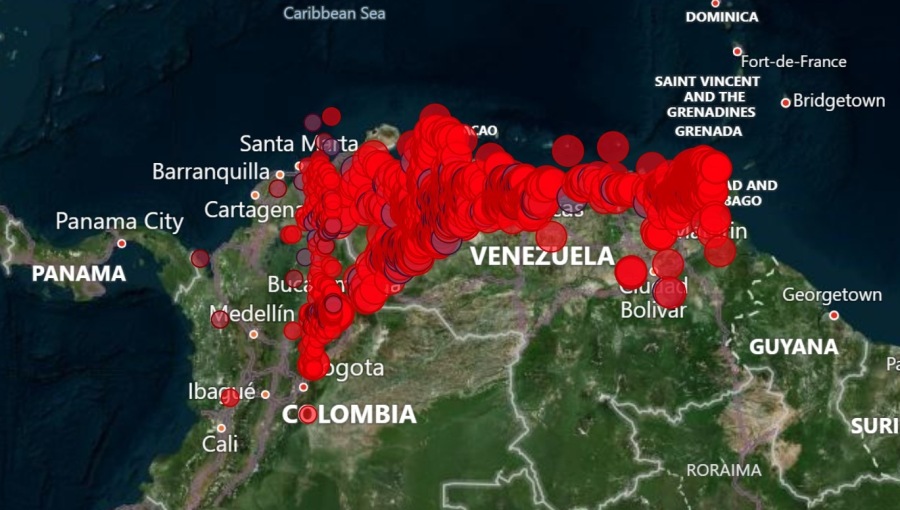
Fundación Venezolana de Investigaciones Sismológicas detail showing areas affected by the tremors. / FUNVISIS - Venezuela
By IntelliNews June 25, 2026

Two of the most powerful earthquakes to hit Venezuela in more than a century struck within minutes of each other on June 24, damaging buildings in Caracas, triggering evacuations and raising fears of significant casualties, La Nación reported.

The seismic events, recorded at magnitudes 7.1 and 7.5, occurred about a minute apart near Morón, west of the Venezuelan capital. The first quake originated 13 kilometres below the surface, followed by a second at a depth of 10 kilometres. Officials have yet to release casualty figures in the immediate aftermath.

Interior Minister Diosdado Cabello said emergency services, security forces and civil protection teams had been deployed following reports of collapsed structures across Caracas. He highlighted particularly serious incidents in the Altamira area and advised residents to remain outside while authorities evaluated the stability of affected buildings and monitored continuing aftershocks.

The earthquakes prompted a temporary tsunami alert for Puerto Rico and the Virgin Islands, although the warning was later withdrawn. The US Geological Survey cautioned that the event carried the potential for substantial loss of life.

Across the capital, office towers and apartment blocks swayed violently, triggering precautionary evacuations. Electricity service was interrupted in some districts, while tremors were reported beyond Venezuela’s borders, including in Colombia.

Witness accounts described chaotic scenes as shoppers, workers and residents rushed from buildings. In Altamira, merchandise fell from shelves and crowds poured out of a shopping complex as the ground shook. Elsewhere, people gathered in open spaces, seeking distance from structures that showed visible signs of damage.

Video footage circulating after the quake showed cracked façades, collapsed walls and debris scattered onto city streets. Dust clouds rose above several neighbourhoods, while recordings from inside homes captured furniture and household items being thrown from shelves during the shaking.

The back-to-back earthquakes rank among the most powerful recorded in Venezuela in more than 100 years. Their magnitude places them alongside some of the country’s most significant seismic events, including the San Narciso earthquake of 1900 and the Sucre earthquake of 2018.

This is a developing story - more to follow.


Bolivia's roadblocks lifted after 48 days but Morales warns "pause" is not surrender

Bolivia's roadblocks lifted after 48 days but Morales warns
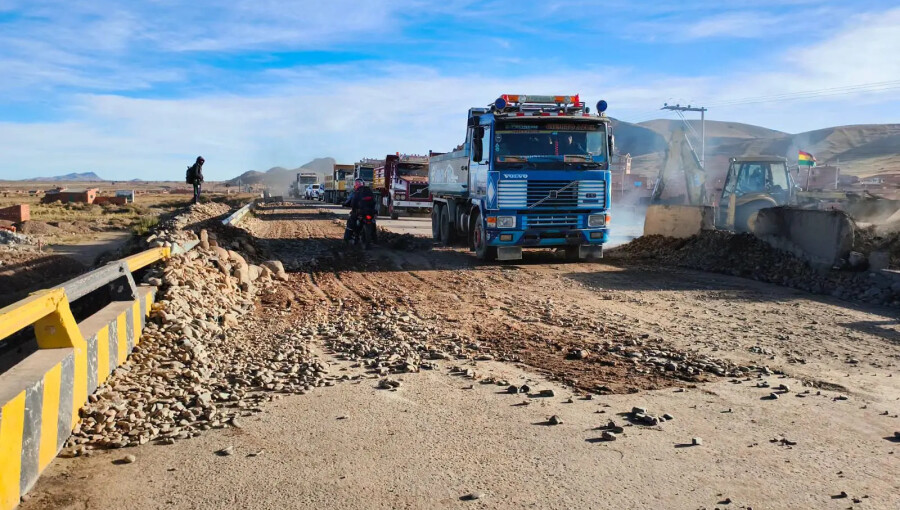
The Bolivian Highway Administration confirmed on June 24 that no active roadblock points remained, though some stretches are still impassable due to debris left from the protests.Facebook
By Mateo Palacios June 24, 2026

Bolivia emerged from its worst social crisis in decades on June 24 as the last remaining roadblocks were lifted following a pause announced by coca grower unions loyal to former president Evo Morales, leaving the country without a single active blockade for the first time in 48 days. However, analysts and opposition figures warn that the underlying tensions remain unresolved.

The cocalero federations of the Trópico de Cochabamba, the final holdout after most other protest groups reached agreements with President Rodrigo Paz's centrist government or stood down following his state of emergency declaration, announced what they termed a "cuarto intermedio," a temporary recess rather than a surrender. "For now, a pause. This is not surrender; the struggle will continue," said union leader Isidro Auca, who also directed pointed accusations at COB executive secretary Mario Argollo, accusing him of betraying the movement by reaching an earlier agreement with the government. Morales, speaking alongside federation leaders, echoed the message: "For now it is a pause," he said, maintaining his accusations that Paz intends to hand Bolivia's natural resources to US multinationals and raise fuel and utility prices, claims the government denies.

The Bolivian Highway Administration confirmed on June 24 that no active roadblocks remained, though some stretches are still impassable due to debris left by the protests. Authorities expect all routes to be fully cleared within hours. Routes linking La Paz and El Alto to Chile and Peru have been reopened, allowing long-delayed shipments of fuel, food and medical supplies to resume. Passenger bus services have restarted in major cities.

The human and economic cost of the crisis has been severe. At least 16 people died during the seven weeks of unrest, 13 of them because blocked roads prevented timely medical care. Bolivia's Cámara Nacional de Industrias estimated losses exceeding $2.5bn, equivalent to roughly 5% of GDP, while other estimates cited by the government placed the total damage above $3bn.

Defence Minister Ernesto Justiniano said the cocalero pause was the result of popular exhaustion rather than generosity. "The people told them: enough of the blockade, enough pressure, enough suffering," he said. That sentiment was reflected in an editorial published by Bolivian newspaper El País, which noted: "There are no absolute winners or losers. Social organisations retreat to reorganise. The government remains standing, yes, but considerably weakened. Bolivia once again confirms that prolonging conflicts to exhaustion rarely resolves the deep causes that originated them."

Analysts were similarly cautious about what the reopening of roads actually resolves. Evan Ellis, a Latin America expert at the US Army War College, said the state of emergency enacted on June 21 had provided useful short-term stabilisation by giving security forces a legal framework to act, but described Bolivia as trapped in multiple overlapping crises, according to the Miami Herald. "When a country is broke and continues making promises to groups that used disruption to gain concessions, that creates frustration among everyone else," Ellis said, pointing to the government's commitments on wage increases, infrastructure spending and subsidies despite limited fiscal capacity.

Ellis also warned that the protest movement's apparent success in extracting concessions from the government had set a dangerous precedent. "They held the country hostage and got results. That teaches them pressure works," he said. Bolivia is already enduring its worst economic crisis in four decades, with rising inflation, falling foreign reserves and persistent public anger over fuel prices.

Carlos Sánchez Berzaín, former Bolivian defence minister and director of the Miami-based Inter-American Institute for Democracy, offered a starker analysis. He argued that Paz had won the presidency in late 2025 but not control of the Bolivian state, with figures tied to the Morales decade-long era still deeply embedded across the judiciary, security forces, bureaucracy and prosecutorial system. "Rodrigo Paz has taken control of the government, but not of power," he said, as quoted by the Miami Herald.

At the centre of Bolivia's political paralysis, both analysts agreed, stands Morales himself. The former controversial hard-left president has remained in Chapare since October 2024, shielded by loyalists from an arrest warrant related to aggravated human trafficking charges involving a minor during his presidency. The government and the US accuse him of financing and orchestrating the blockades to destabilise Paz and force a return to power. Morales denies all the allegations. Ellis said removing Morales from the equation would be operationally complex, given the penetration of security forces by figures loyal to him in Chapare, but potentially essential. "If he solves the Evo problem, many of the other problems become manageable. If he doesn't, none of them are."