‘I think when it comes to nuclear, we are really in a good place.’ With these words, NATO Secretary General Mark Rutte described the state of the Alliance’s nuclear strategy at the pre-Summit press conference in Ankara on 6 July 2026. The phrase was intended to project stability, confidence, and reassurance. Yet, to anyone familiar with the history of the nuclear age, it reveals something far more disturbing: the dangerous normalization of the belief that more nuclear weapons, more deployments, and greater confrontation can somehow produce greater security.
This is precisely where the greatest paradox of contemporary European security policy (if there is any) lies. A continent devastated by two world wars, a continent that built its post-war institutions precisely to overcome the cycle of military rivalry, is once again embracing a logic in which military power, deterrence, and strategic confrontation are becoming the foundations of political order. Particularly alarming is the fact that the nuclear dimension of this transformation has scarcely become the subject of any meaningful debate.
Europe is gradually turning into a space where nuclear powers are moving ever closer to one another. The accession of Finland and Sweden to NATO has significantly altered the strategic geography of Northern Europe. Finland, a country that for decades based its security policy on military neutrality and careful balancing vis-à-vis the Soviet Union, has, following its NATO membership, amended its legal framework to allow for the potential deployment of nuclear capabilities on its territory. At the same time, the Baltic region is becoming one of the most heavily militarized areas in Europe.
At the centre of this new geopolitical anxiety lies Kaliningrad, the Russian exclave situated between Poland and Lithuania and surrounded by NATO member states. For Moscow, it is a crucial strategic bastion; for NATO, it is frequently portrayed as a potential launch point for Russian aggression. Precisely because of its geographical isolation and military significance, Kaliningrad has become the symbol of Europe’s most dangerous zone of confrontation. In this place, a miscalculation, an accident, or a deliberate provocation could trigger a crisis with unforeseeable consequences.
In the run-up to the Ankara Summit, numerous political and intelligence assessments and media speculations circulated, revealing precisely this atmosphere of fear and mutual distrust. One suggested that Russia might attempt to stage a limited incident in the Baltic region or near Poland to ‘test’ NATO, i.e. the Alliance’s political willingness to invoke Article 5 of the North Atlantic Treaty.
At the same time, an opposite set of speculations also emerged: that heightened tensions surrounding Kaliningrad could themselves become a pretext for false-flag operations, that is, incidents whose true origin would remain unclear but which could generate political pressure for further escalation. In such a scenario, fears of Russian aggression could be used to justify an expanded American military and nuclear presence across Europe.
Such scenarios are far from being facts. Yet their very circulation in the public sphere illustrates how dangerous the prevailing logic of confrontation has become. In an era of hybrid warfare, cyber operations, disinformation campaigns, and information warfare, the boundary between objective threats and socially constructed perceptions of insecurity becomes increasingly blurred, creating fertile ground for the political manipulation of fear and the manufacture of consent for further militarisation.
This exposes the fundamental flaws of nuclear deterrence itself. Deterrence assumes rational decision-makers, perfect information, and the ability to control crises. Yet the history of the Cold War demonstrates precisely the opposite. Humanity avoided nuclear catastrophe not because the system was inherently safe, but because, at several critical moments, individual decision-makers refused to act according to the logic of worst-case scenarios. Nuclear peace has never been the product of perfect control. It has been the repeated avoidance of disaster.
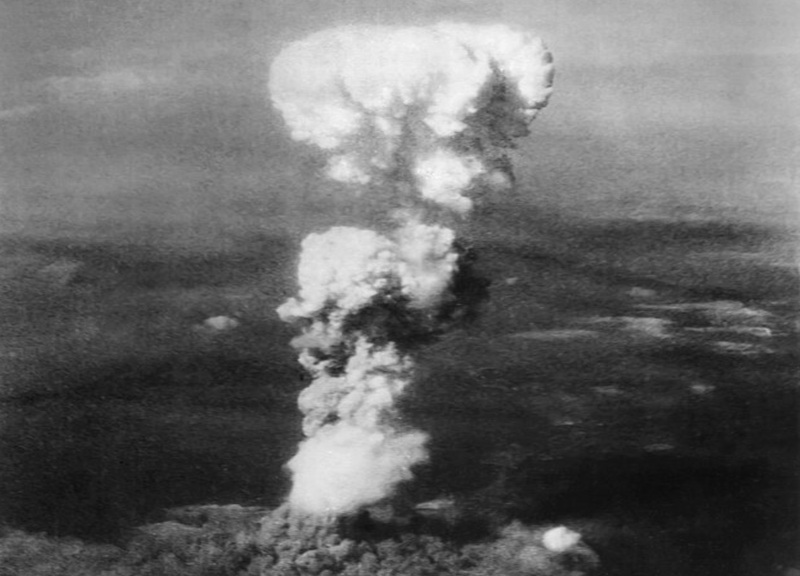
Even more troubling is the fact that this logic is no longer confined to Europe. What might be described as a ‘global NATO‘ (although it exists neither formally nor institutionally) is expanding through the so-called nuclear sharing with countries such as Japan, South Korea, etc. Across the Indo-Pacific, just as in Europe, military budgets are rising, new strategic arrangements are being forged, and greater space is being created for an expanded American military (including nuclear) presence. Japan, the only country ever to experience atomic bombing against civilian populations, is steadily moving toward the normalization of military power. South Korea increasingly debates whether to develop its own nuclear capability or rely more heavily on the American nuclear umbrella. Australia, through new security arrangements, has become an integral part of a broader strategy aimed at containing China. In this way, the Orwellian logic of ‘peace through strength’ is being replicated from the Baltic Sea to the Pacific Ocean.
The war against Iran in 2025/2026 has produced yet another dangerous consequence that few in the West appear willing to acknowledge. The military campaign was justified as a necessary measure to prevent Iran from acquiring nuclear weapons, yet its political effect may prove exactly the opposite. For many around the world, the lesson is straightforward: states without nuclear weapons remain vulnerable to external military intervention, whereas those possessing a nuclear arsenal enjoy a significant degree of immunity from direct attack. The logic is harsh, but understandable: had Iran already been a nuclear power, the likelihood of such an attack would almost certainly have been much lower. Rather than strengthening the regime of nuclear non-proliferation and ultimately nuclear abolition, this war may encourage other states to conclude that the only genuine guarantee of survival lies in possessing nuclear weapons themselves, even if under someone else’s flag.
This brings us to the central question: does the world become safer simply because it contains more nuclear flashpoints? Or does it become more vulnerable because more actors, more weapons systems, and more lines of confrontation inevitably create more opportunities for miscalculation? The answers, of course, are self-evident.
Under the banner of deterrence and protection, NATO’s European pillar risks becoming trapped in a condition of permanent confrontation. Instead of developing an autonomous European security architecture founded upon cooperation, diplomacy, arms control, and risk reduction, Europe is increasingly becoming a theatre in which the major powers test one another’s resolve.
After the Ankara Summit, therefore, the real question is not whether Europe is ‘in a good place.’ The real question is whether Europe is genuinely becoming safer or merely better armed for a future in which no one will be secure. The most dangerous illusion of the nuclear age is the belief that catastrophe can be controlled simply because it has not occurred for a long time. Genuine security begins precisely where dependence on permanent preparation for war comes to an end.
This article was produced by Globetrotter.
Eight Contradictions Behind NATO’s Summit of ‘Love’
“I just want to say there was tremendous love in that room,” President Trump declared as he wrapped up the 2026 NATO summit in Ankara.
But anyone looking beyond the carefully choreographed photo-ops saw an alliance beset by public feuds, competing visions of security, and widening political divisions.
Here are eight contradictions that defined the Ankara summit—and raise fundamental questions about NATO’s future.
1. Military Spending vs. Real Security
NATO leaders had already agreed at the previous summit to move toward spending 5 percent of GDP on military-related expenditures, but Ankara exposed how divisive that commitment remains. Trump used the meeting to chastise allies for failing to meet even the old 2 percent benchmark, arguing that most allies were not paying what they should. Spain became the main target because it refused to commit to the full 5 percent goal, prompting Trump to call it “a terrible partner in NATO” and threaten trade retaliation.
The timing made the debate especially striking. As leaders met to discuss pouring hundreds of billions more into weapons and armies, Europe was enduring one of the most severe heatwaves in its recorded history, with deadly temperatures, wildfires, strained electricity grids, and mounting pressure on public health systems. The contrast raised an unavoidable question: at a time when climate change is already killing people and overwhelming governments, why is the overriding political priority dramatically expanding military budgets instead of investing in the threats people are facing today?
2. NATO Countries Reluctant to Support Trump on Iran
The recent U.S.-Israeli war on Iran cast a long shadow over the summit. While most European leaders continued calling for diplomacy and de-escalation, the summit itself began with renewed U.S. bombing of Iranian targets after attacks in the Strait of Hormuz. During the meeting, Trump declared the U.S.-Iran memorandum of understanding “over,” dismissed further negotiations as “a waste of time,” and referred to Iran’s leaders as “scum.”
Trump also complained that European allies had failed to support Washington’s military campaign, saying, “We are there for them, but they are not there for us.” Spain was among the strongest critics of the war, and Prime Minister Pedro Sánchez refused U.S. requests to allow American bases in Spain to be used for offensive operations against Iran. Before the summit, Trump publicly feuded with Italian Prime Minister Giorgia Meloni after she likewise refused to allow Italian bases to be used for attacks on Iran. Germany and France also declined to participate militarily.
The contradiction was unmistakable: NATO presents itself as a defensive alliance, yet its most powerful member expected allies to support an offensive war against a country thousands of miles from the North Atlantic that had not attacked a single NATO member.
3. Europe Pushes Support for Ukraine as the United States Pulls Back
Missing from NATO’s final declaration was its previous pledge that Ukraine would eventually become a member of the alliance—a notable concession to Trump’s opposition. Ukraine’s prospective NATO membership, first strongly backed by President George W. Bush at the alliance’s 2008 Bucharest summit, has long been one of Russia’s central stated objections and was repeatedly cited by Putin as a justification for the 2022 invasion. Its omission from the declaration reflects a significant shift in NATO’s position.
The declaration pledged roughly $82 billion in military assistance for Ukraine in both 2026 and 2027, but unlike in previous years, the overwhelming share will come from European allies and Canada rather than the United States. After Washington poured well over $100 billion into Ukraine’s war effort, the United States is now stepping back. That reflects a growing sentiment among Trump supporters that the U.S. should stop financing what they see as another endless foreign war. Many European governments, however, continue to see Russia as a direct threat and remain committed to arming Ukraine rather than pushing for a diplomatic solution.
4. Europe Still Wants U.S. Troops While Trump Wants Fewer Overseas Commitments
Before the summit, Trump reportedly floated the idea of reducing the U.S. military presence in Europe by as much as one-third, raising questions about the future of the roughly 80,000–90,000 U.S. troops currently stationed across NATO countries.
While U.S. bases remain deeply controversial among peace movements in NATO countries such as Germany, Italy, Spain, and the United Kingdom, their governments continue to regard the U.S. military presence as essential to European security and have resisted calls for their removal. Trump’s willingness to reduce that presence exposed another growing contradiction: many European governments want Washington’s security guarantee to remain firmly in place, while many Americans increasingly question why tens of thousands of U.S. troops should remain stationed in Europe more than three decades after the Cold War ended.
5. Trump Keeps Questioning Denmark’s Sovereignty Over Greenland
Trump again insisted that the United States should control Greenland. Denmark, backed by the rest of NATO, firmly rejected the idea, insisting that Greenland’s future is for Greenlanders and Denmark—not Washington—to decide. Danish officials also note that the United States already enjoys extensive military access to Greenland under a 1951 defense agreement, making U.S. ownership unnecessary to protect its security interests.
At the NATO summit, Danish Prime Minister Mette Frederiksen reaffirmed that Denmark would “defend every inch” of the Kingdom of Denmark, including Greenland, while reiterating that the island is not for sale and that its future must be decided by Greenlanders.
The episode laid bare one of the summit’s sharpest contradictions: an alliance that claims to defend the territorial integrity of its members was forced to confront its most powerful member openly challenging the sovereignty of one of them.
6. Turkey Exposes NATO’s Democracy Dilemma
There was a striking irony in holding NATO’s summit in Turkey. Inside the conference halls, leaders celebrated democracy, freedom, and shared values. Outside, Turkish authorities banned anti-NATO demonstrations and arrested hundreds of protesters, journalists, lawyers, and activists engaged in peaceful protest. Trump praised President Recep Tayyip Erdoğan as “a very strong leader,” even as Erdoğan has spent years systematically suppressing dissent, jailing critics, restricting press freedom, and targeting political opponents.
Trump also used the summit to signal his willingness to restore Turkey’s access to advanced U.S. weapons, including the F-35 fighter jet program, from which it had been suspended after purchasing Russia’s S-400 air defense system.
Turkey, however, is hardly unique. Across NATO countries, governments that proclaim their commitment to democracy and human rights have increasingly cracked down on dissent, particularly pro-Palestinian activism. From police raids and protest restrictions to arrests, prosecutions, and efforts to silence critics in the United States, Germany, the United Kingdom, and elsewhere, NATO governments have repeatedly shown that democratic freedoms become conditional when they collide with political and strategic priorities.
7. Europe Is Expected to Defend Itself—but Still Rely on NATO
One question lingered behind the scenes throughout the summit: if Europe is now expected to invest more in its military, pay for the war in Ukraine, and prepare for a reduced U.S. military presence, what exactly is NATO’s future role? European leaders continue to describe the alliance as indispensable, but Washington increasingly expects Europe to stand on its own while remaining available to support U.S.-led military operations elsewhere.
That contradiction is fueling a broader debate across Europe. If Europeans are expected to pay more, defend themselves, and shoulder greater responsibility for their own security, why should they remain dependent on an alliance dominated by Washington?
8. Should NATO Still Exist?
The biggest question hanging over the Ankara summit was not inside the conference halls but in the streets: should NATO still exist? Created in 1949 to contain the Soviet Union, the alliance steadily expanded its mission long after the Cold War ended, intervening in places from the Balkans to Afghanistan and increasingly projecting military power far beyond its original mandate.
The protests in Ankara were part of a broader international movement represented by the No to NATO Network, which brings together peace organizations across NATO countries calling for the alliance to be replaced with a common security architecture based on diplomacy, disarmament, and cooperation.
Trump’s claim that there was “tremendous love in that room” may have made for a memorable soundbite, but it bore little resemblance to the summit itself. Ankara exposed an alliance divided over military spending, Ukraine, Iran, democracy, sovereignty, and even its own purpose.
For peace activists across NATO countries, those contradictions only reinforce what they have argued for decades: Europe needs a new security architecture based on diplomacy, arms control, common security, and cooperation, while the United States needs a foreign policy that relies on diplomacy rather than militarism. For them, the ultimate lesson is clear: the time has come to dissolve NATO and replace it with a security system that reduces tensions instead of fueling arms races and preparing for endless war.
Medea Benjamin is the cofounder of CODEPINK for Peace, and the author of several books, including Inside Iran: The Real History and Politics of the Islamic Republic of Iran.