Tuesday, July 14, 2026


Fire Aboard US Ready Reserve Vessel in Baltimore Harbor
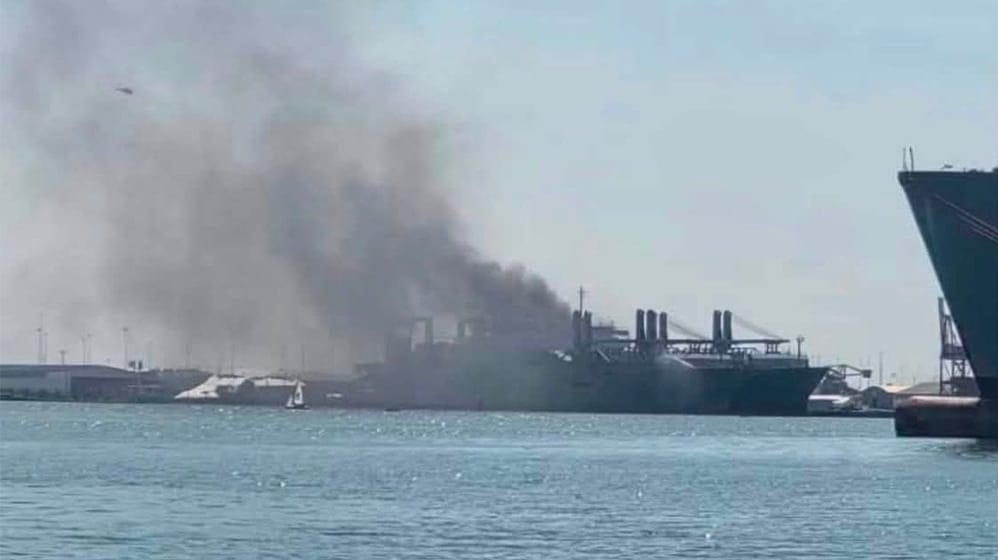
fire on cargo ship Baltimore
Smoke was seen across Baltimore from the fire on the laid-up US Government cargo ship (BCFD)

Published Jul 14, 2026 12:28 PM by The Maritime Executive


The Baltimore City Fire Department responded to reports of a fire aboard one of the U.S. military cargo ships docked in Baltimore as part of the Ready Reserve fleet.  The fire department reports it found a fully involved fire in the area of two lifeboats aboard the Charles L. Gillard when it arrived at the site at 1100 on Monday, July 13.

Built in 1972, the vessel was acquired by the U.S. Navy in the 1980s and rebuilt in the 1990s as a Large, Medium-Speed Roll-on/Roll-off capable of transporting vehicles, equipment, and supplies for the US Navy. The 955-foot (291-meter) cargo ship is 55,450 dwt fully loaded. 

The vessel was stricken from the Naval Vessel Register in May 2023 and transferred to the United States Maritime Administration (MARAD) to be part of the Ready Reserve Force. Since 2024, it has been docked in Baltimore alongside its sister ship, Gary I. Gordon.
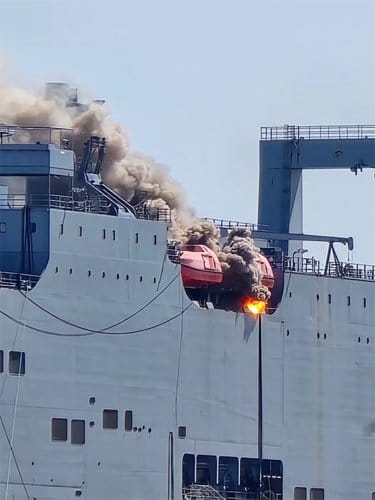
 

Fire department arrived to find a fully involved fire near the lifeboats (BCFD)


The fire department issued a second alarm for additional equipment to have it available if necessary. Pictures show the fire burning below one of the lifeboats and fire trucks with ladders to reach the blaze. The fire was extinguished with no reports of injuries. It is unclear if anyone was aboard the vessel, and the fire department reports it is investigating the cause of the fire.
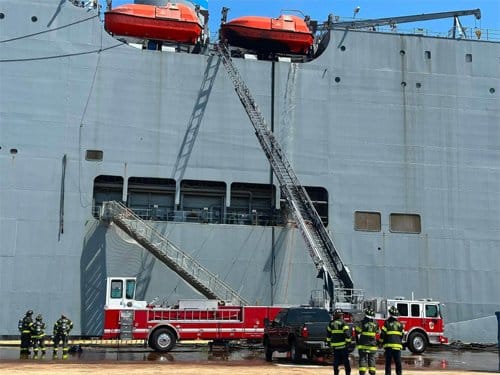


It is the second incident in recent months with vessels in the Ready Reserve Fleet in the Northwest section of Baltimore harbor. In December, Cornelius H. Charlton was ripped free of its moorings and began drifting during a windstorm. A fireboat and a commercial tug were able to secure the vessel.

 

Photos: Cameroon Reopens Primary Port After Bulker and Cargo Ship Collide

bulker sinking after collision
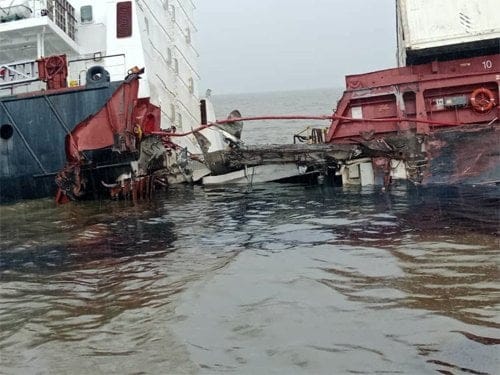
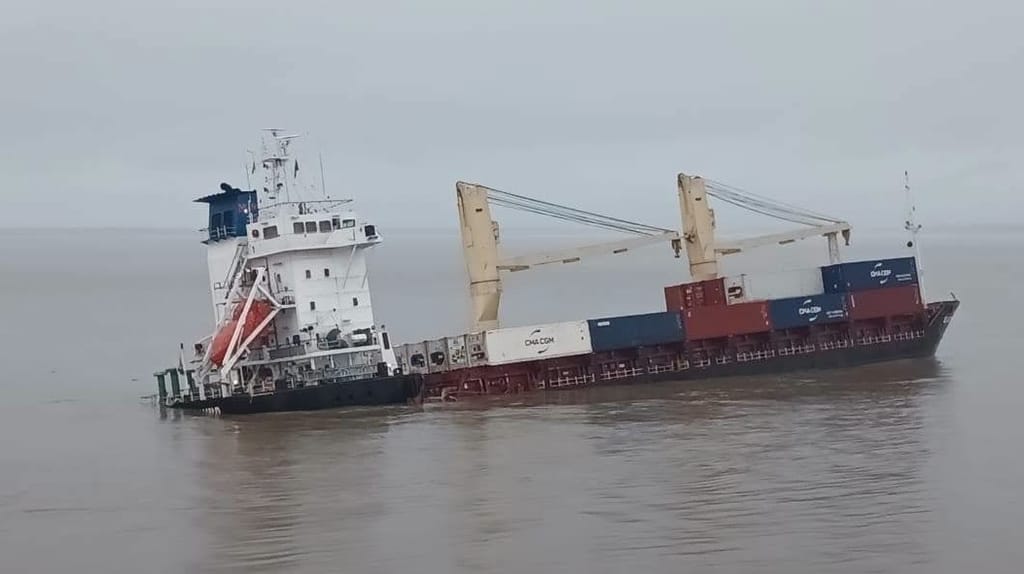
Black Rhino was struck forward of the deck house and began taking on water (Port Authority of Douala photos)

Published Jul 14, 2026 4:43 PM by The Maritime Executive


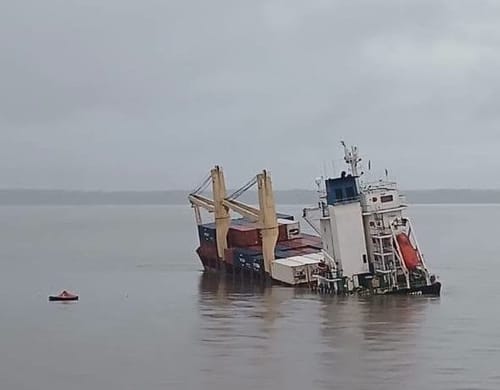
Officials in Cameroon’s Port of Douala-Bonabéri reported that they have been able to resume operations after a bulker and a cargo ship collided early on Sunday, July 12. A crisis team responded as the cargo ship Black Rhino, loaded with containers, began sinking, potentially blocking access to the country’s main port.

The Port of Douala-Bonabéri handles the majority of Cameroon’s trade. It is also a critical transshipment port, maintaining a transit corridor inland to Chad and the Central African Republic.

The Port Authority said the bulker Sea Honor (28,400 dwt) was outbound in the wee hours of Sunday morning. The Chinese vessel, which is registered in Tuvalu, was built in 1998 and is 177 meters (582 feet) in length.

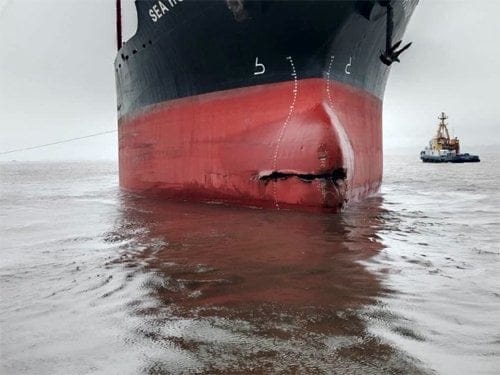
It is unclear how it happened, but the bulker rammed a small cargo ship, Black Rhino (5,113 dwt), which was inbound. The Cypriot vessel is 100 meters (330 feet) in length. Images show a large gash, and the vessel immediately began taking on water.  The bulker has a smaller gash on its bulbous bow above the waterline.


Details of the damage to Black Rhino


Sea Honor was moved to an anchorage position 


The crew of the Black Rhino abandoned their ship while the authorities worked to ground the vessel intentionally so that it would not block the channel. The Sea Honor was towed into an anchorage position. The Port Authority said there were no reported injuries among the crew aboard either vessel.

The Port Authority said that its initial investigation suggests a loss of control by the Black Rhino. A further technical investigation is continuing.


Black Rhino was grounded to prevent it from blocking the channel.


Built in 1997, the Black Rhino was cited for 31 deficiencies in a 2024 Port State inspection in Belgium and detained for 15 days. The ship, however, had two clean inspections in 2025 with no reported problems.

Cameroon’s transport minister announced on Tuesday, July 14, that port operations had resumed.


Video: Ukraine Hits 11 Russian Merchant Vessels and a Border Patrol Ship

USF
Courtesy USF

Published Jul 14, 2026 3:06 PM by The Maritime Executive


Overnight Monday, Ukraine's Unmanned Systems Forces hit another 11 Russian vessels in the Sea of Azov, extending their multi-front campaign to disrupt logistics to Russian-occupied Crimea. 

The drone force hit five tankers, five cargo ships and one tug in the Sea of Azov. As in earlier waves of strikes, most of the vessels appeared to be at anchor, undefended and unable to maneuver.

The attacks bring the total number of Russian vessels damaged by Ukrainian drones since July 5 to 116 vessels, an average of about 13 per day. 

"The goal of the operation is to systematically disrupt the enemy’s logistics chain. Disabling tankers, cargo ships, and auxiliary vessels complicates the export of oil and petroleum products, limits maritime transport capabilities, and reduces the enemy’s ability to supply fuel to its forces and occupation grouping in temporarily occupied Crimea," the USF said in a statement. 

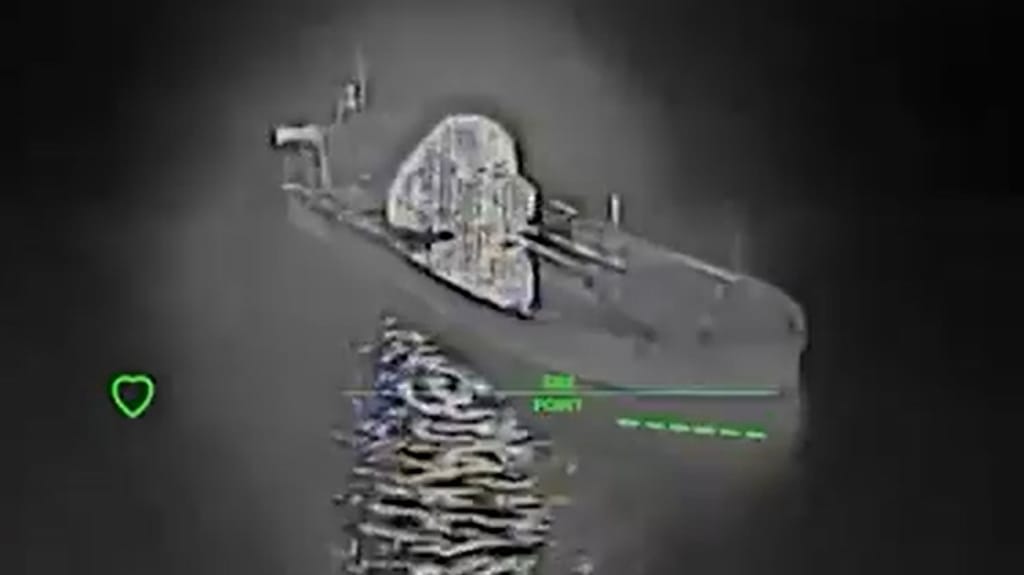
Separately, Ukraine's Navy said that it used a Sargan-3000 drone boat to hit and sink the border patrol vessel Izumrud near the port of Novorossiysk, on the south side of Kerch Strait. Some number of crewmembers were killed and injured in the attack, the service said. 

The Izumrud was a 200-foot patrol vessel of about 750 tonnes displacement, and was known for its role in the seizure of three Ukrainian military tugs during the Kerch Strait standoff of 2018. 

In that incident, several Russian border patrol vessels opened fire on Ukrainian Navy tugs that had defied an extralegal Russian closure order for the international waterway. The tugs departed Odesa, transited through the Kerch Strait - despite Russian demands to stop - and attempted to reach Mariupol on the Ukrainian shore of the Sea of Azov. Russian forces (including Izumrud) rammed and seized the tugs, arrested the crewmembers, and brought them to shore for trial in occupied Crimea. They were held captive until 2019, when they were released in a prisoner exchange. 


Video: Aging Bulker Breaks in Half and Sinks Off Bandar Abbas

Luni
Via Iranian social media

Published Jul 14, 2026 5:04 PM by The Maritime Executive


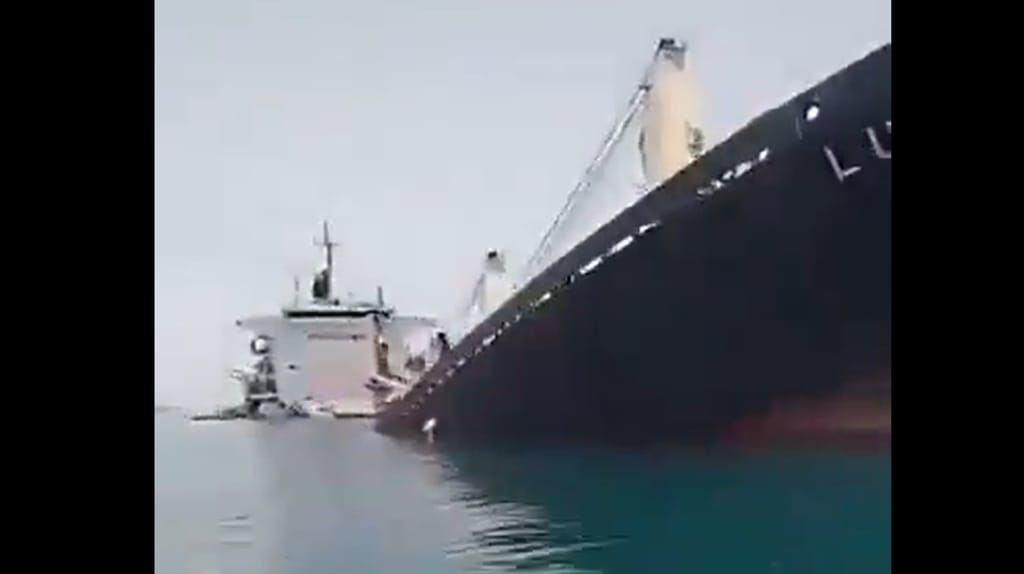
An aging bulk carrier has split in half and partially sunk off the coast of Bandar Abbas, Iran, an area of active ongoing hostilities. 

The bulker Luni (IMO 9070711) appears to have sustained a broken keel, and has settled onto the shallow bottom at an anchorage in the northern sector of the Strait of Hormuz. The ship is submerged amidships, but both her bow and stern are sticking out of the water at steep angles. 

Luni is 32 years old, well past the normal service life for a merchant vessel. No authoritative account of the sinking has been released, but anecdotal reports indicate that she was in collision with another merchant ship several days ago, causing hull damage that propagated and resulted in catastrophic failure. 

A broken keel would also be consistent with a heavy torpedo attack or a Quicksink strike. Both attack methods rely upon the detonation of a large explosive payload beneath the vessel amidships, forcing the hull upwards and cracking it in two. While U.S. forces have been conducting heavy strikes in the Bandar Abbas area, no kinetic incident affecting Luni has been reported. 

In rare and extreme cases, improperly-loaded or structurally compromised vessels can break up of their own accord - but rarely at anchor in calm conditions. 

Luni was a 1994-built bulker of 43,000 dwt capacity, flagged in St. Kitts (a Paris MoU black list flag) and operated by a Turkey-based firm. Turkish outlet Haber Deniz reports that the owners are Syrian nationals. 

Luni had a long history of port state control inspection issues, accumulating more than 50 deficiencies in the last two years alone. 


Work to Start for Removal of Masts From Famous WWII Wreck off UK

WWII Liberty Ship
SS Richard Montgomery was one of more than 4,700 Liberty Ships, but she sank loaded with explosives on the UK coast (US Archives public domain photo)

Published Jul 14, 2026 5:23 PM by The Maritime Executive


The UK Government confirmed that the project to remove the masts from a famous World War II shipwreck in the Thames Estuary has been commissioned at a cost of £9.5 million ($12.7 million). The project, which will start in July and proceed in September, seeks to remove three masts from a World War II American liberty ship that is still loaded with explosives and stabilize the wreck.

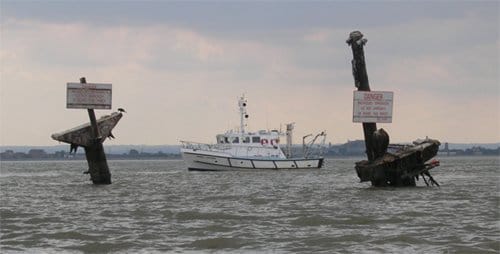
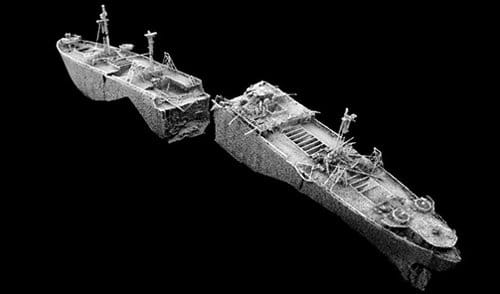
The SS Richard Montgomery has become a famous local tourist attraction, lying 1.5 miles off Sheerness in the Thames Estuary. Only the masts of the vessel remain above the surface, while the hull of the 440-foot (135-meter) vessel has broken in two and lies on the seafloor.

One of more than 2,700 WWII-built Liberty ships, a standardized design that the U.S. mass-produced to meet the needs for cargo and troops in World War II, the Richard Montgomery was commissioned in 1943 as a 10,000 dwt vessel used for cargo. Her fateful voyage began in August 1944 when she was loaded with nearly 7,000 tons of munitions. Upon her arrival in the UK, she was assigned an anchorage in the shallow Thames Estuary near the Sheerness Middle Sands. She was waiting for a convoy to proceed to Cherbourg, but on August 20, 1944, during a storm, she dragged anchor and grounded.

A salvage effort ensued, and by most estimates, at least half of the munitions were salvaged by September 25, 1944. However, the ship broke her back, and as the water rose, the efforts had to be abandoned. More recent UK surveys have estimated that there are approximately 1,400 tons of explosives contained within the forward holds.


The masts are all that remain above the water and have become a familiar marker to locals (MCA)


Officials call her “one of the United Kingdom’s most closely monitored wreck sites.” Regular surveys have been conducted, and by the early 2000s, concerns began to be raised about the deteriorating condition of the vessel. The two forward mats, which stick out of the water, are attached near the holds, and fears are growing that they will topple over. One concern is that they could displace or even cause an explosion of some of the munitions still onboard.

Resolve Marine was selected in 2025 to lead the salvage operation. The UK’s Department for Transport and the Maritime and Coastguard Agency report detailed planning has been undertaken. They are working carefully to remove the masts for preservation while also not increasing the risk posed by the remaining explosives on board.


Rendering of the wreck based on multibeam and laser data from the 2013 survey report (MCA)

Work will begin in July and will involve building an underwater platform. The masts will be dismantled and then sent to The Historic Dockyard Chatham, where specialists will oversee the preservation process. They expect the project to be completed by the end of September, but it could be delayed by weather conditions.

The government acknowledges that the masts had become a visible symbol and reminder to the local communities. It is committed to placing the masts on display in the area as another way of telling the story of the Allied war effort.


OSG: Jones Act Waiver is Only Increasing Oil Companies' Profits

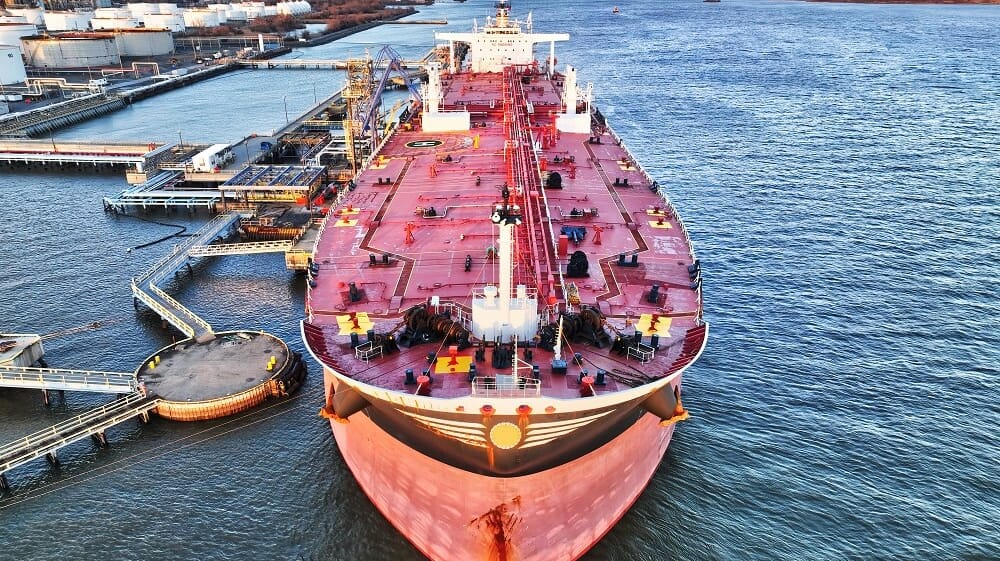
iStock tanker
iStock

Published Jul 14, 2026 7:47 PM by The Maritime Executive


The Jones Act's defenders and opponents continue to debate the outcome of the Trump administration's sweeping 150-day waiver of America's landmark cabotage law. OSG, which has interests in both domestic and foreign-flag operations, has weighed in with a new perspective: the waiver has indeed created benefits, says OSG CEO Sam Norton - but only for petroleum refiners, who are already reaping outsize profits from runaway fuel prices. 

"Perhaps the so-called champions of free markets who advocate Jones Act waivers — or even repeal — are not defending consumers at all. Perhaps they are defending the narrow economic interests of oil producers and distributors," said Nortond in a critique posted online.

Norton's suggestion is that the waiver allows oil companies to move their products at lower cost, increasing already-high margins without benefiting the consumer. He noted that the margin for refining a barrel of oil (in industry terms, the crack spread) has risen to roughly 75 percent - threefold compared to normal levels. This means that out of every $3 spent on a gallon of wholesale gasoline, the wholesaler is now paying more than $1 towards the refinery's operations and profits. The charge gets passed on to the consumer as an added cost. 

"By many estimates, ExxonMobil and Chevron’s earnings are expected to have tripled in the April-to-June quarter compared with the first quarter. Meanwhile, U.S.-flagged vessels have sat idle while lower-cost foreign-flag vessels perform domestic voyages under a continuing Jones Act waiver," said Norton. 

The Jones Act has been the defining feature of a century of U.S. domestic maritime trade, shielding American shipping from foreign competition and creating a protected market for high-wage jobs and high-value assets. Critics of the Act - some of whom are linked to a privately-held oil, chemicals and refining conglomerate - say that the cost of building and operating American ships is too much for consumers to bear, and have welcomed the waiver. Proponents say that the Act is essential for sustaining a degree of shipbuilding and sealift capacity for U.S. national security purposes, and that the waiver is hurting domestic shipping. 

"The current extended — and still continuing — Jones Act waiver creates a rare opportunity to identify the real winners and losers of a policy promoted as consumer relief but functioning, in practice, as a subsidy to the oil industry," said Norton. "U.S. maritime jobs have suffered, and the long-term health of the broader U.S. maritime industry has been weakened on multiple fronts."


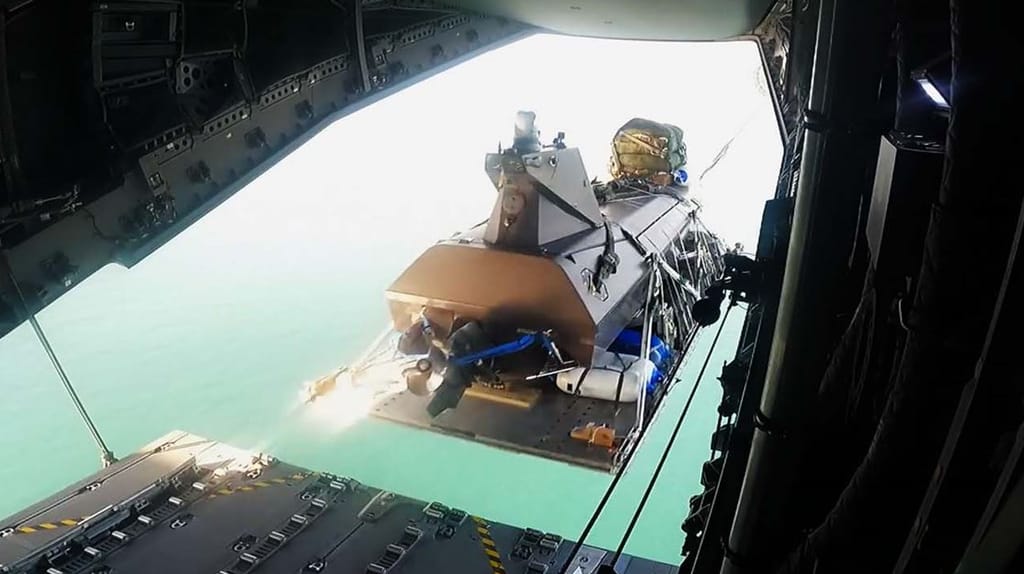
Royal Navy Drops a Drone Boat Out of a Plane

Drop
Courtesy Royal Navy

Published Jul 14, 2026 8:36 PM by The Maritime Executive


As naval forces begin to get used to the idea of unmanned surface vessels and put together a concept of operations for how to use them, some unusual experiments were bound to crop up - and inevitably, someone would end up dropping them out of an aircraft. The Royal Navy recently air-dropped a 28-foot surveillance boat from an A400 transport aircraft into the waters of the North Sea, and did it four times in a row to make sure it would work  

A favorite technique of pararescue teams, special forces and air force logistics professionals, extracted-load air drops combine long range with speed and flexibility, requiring little time to mobilize and execute. Launched over water, air-dropped drone boats could have useful applications in irregular warfare, surveillance, maritime strike and other creative roles. The Royal Navy decided to explore that possibility with manufacturer Kraken, the maker of the K3 Scout small patrol boat. Kraken supplied a Scout built to the RN's specifications, along with an airdrop kit; the Scout was loaded onto a universal airdrop sled for boats; the Royal Air Force put it on an A400M transport; and the aircrew dropped it from 1,300 feet in waters of up to sea state four. They repeated the test four times in six working days, reusing the same boat and the same platform. 

"One of the limitations of small Uncrewed Surface Vehicles is their ability to self-deploy and so we are actively looking at concepts for deployment from motherships or ‘mother aircraft,'" explained Royal Navy's Capt. Adam Ballard, a member of an R&D program dubbed Project Beehive. "Since the earliest aircraft carriers and seaplane tenders we have become accustomed to air power deploying from maritime power. We are now moving to a future where maritime power can be deployed from air power."

Other operators are also testing the possibilities of unmanned operations. This week alone, U.S. Central Command just trialed an unmanned surface vessel in a one-way attack role for the first time, striking a pier and a mini-submarine at the port of Bandar Abbas using a trio of Saronic Corsair drone boats. The U.S. Navy just undertook its first USV "underway replenishment" from a Splash Industries Typhoon drone cargo boat. And Ukrainian forces just conducted a world-first unmanned "amphibious assault" by delivering a wheeled fighting drone onto the contested Kinburn Spit with a mini-landing craft drone.

Wall Street needles Trump with bitter new joke as Hormuz debacle returns with a vengeance

AFTER TACO ITS NACHO

Tom Boggioni
July 14, 2026 
RAW STORY


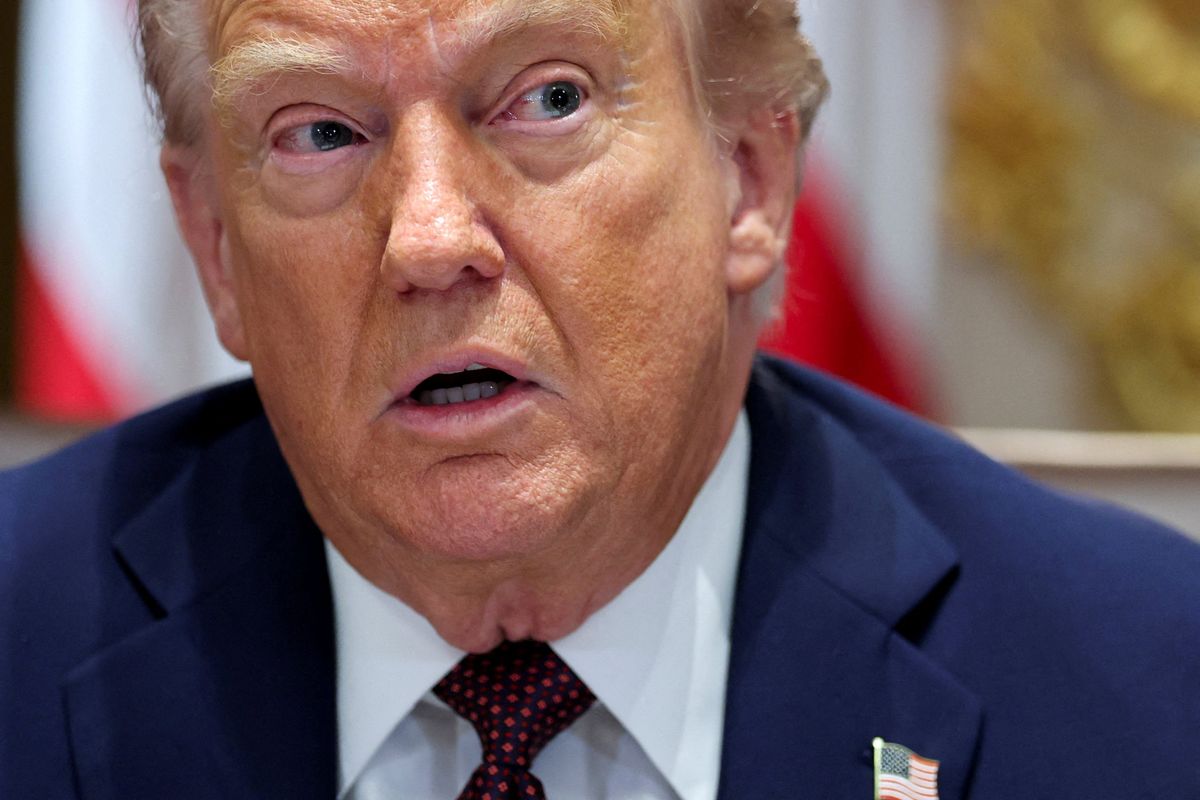
Donald Trump attends a cabinet meeting at the White House. REUTERS/Jonathan Ernst

Energy traders and Wall Street analysts are resorting to dark humor to cope with Donald Trump's foreign policy catastrophe in the Persian Gulf, where his aggressive posturing toward Iran has backfired spectacularly and destabilized one of the world's most critical shipping routes.

The situation has become so dire that financial markets have developed a bitter joke about it. Traders have coined a new term for what they now expect: the "NACHO trade" — shorthand for "Not a Chance Hormuz Opens," according to a report from the Wall Street Journal.

That acronym joins other Trump-themed market jargon, including "TACO," which stands for "Trump Always Chickens Out," revealing the contempt Trump critics have for his erratic decision-making.

The Strait of Hormuz, through which approximately 20 percent of the world's oil passes, has become the focal point of Trump's unraveling Middle East strategy. After renewed fighting over the weekend and Trump's announcement that he was reimposing a U.S. blockade on Iranian shipping, oil prices surged more than 10 percent, erasing an entire month of price declines.

"The chance of the region and Hormuz going back to the old normal is effectively zero," said Rachel Ziemba, an adjunct senior fellow at the Center for a New American Security, told the Journal. "If anything this reinforces the impetus to invest in other pathways as quickly as possible."

The core problem, according to Wall Street Journal reporting, is that Iran and neighboring countries have discovered they can easily manipulate U.S. politics by threatening to choke off shipping through the strait. That realization has fundamentally altered market calculations.

"Oil markets and Middle East producers appear to be aligning around a new reality: The Strait of Hormuz is no longer expected to return to a prewar norm," the Journal reported.

According to the Journal, "The idea behind the NACHO trade is that the shipping route through which roughly 20% of the world’s oil had passed will remain virtually shut, with only a trickle of traffic slipping through clandestine routes, until the economic costs of its closure, such as high oil prices and accelerating inflation, become untenable."
Trump rage-quits press gaggle after CNN's Kaitlan Collins questions new war strikes

Nicole Charky-Chami
July 13, 2026 
RAW STORY


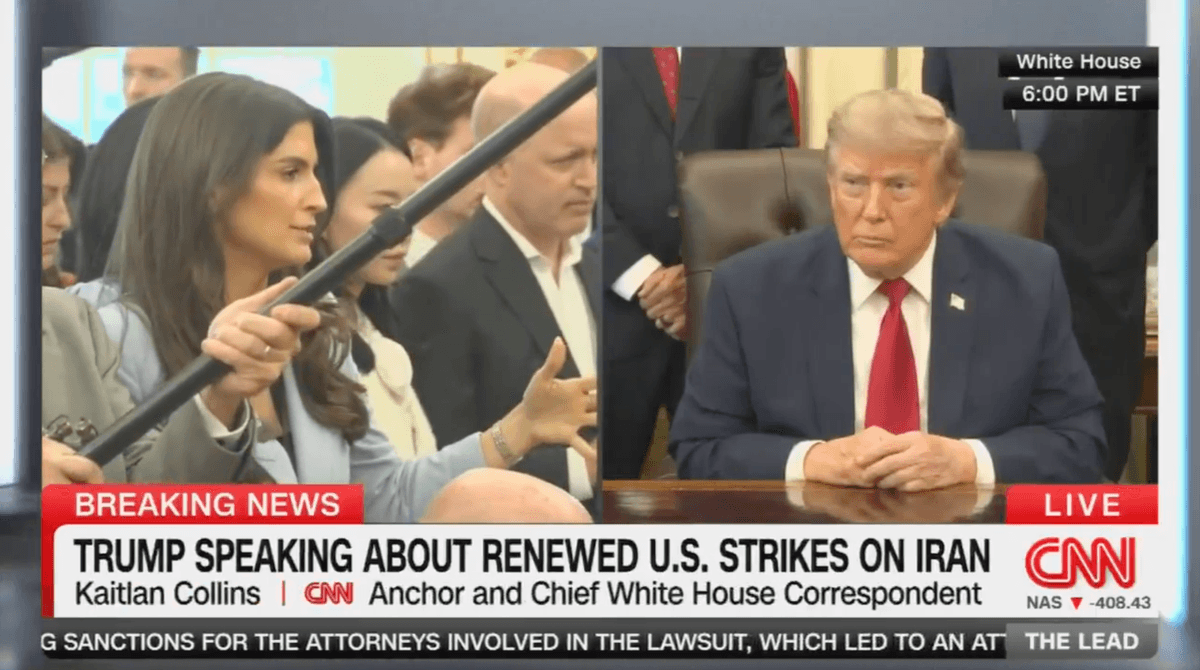
CNN anchor and correspondent Kaitlan Collins asked President Donald Trump to discuss the Iran war when he turned the conversation to attacking CNN during a White House press conference on Monday. (CNN/Screenshot)

CNN's Kaitlan Collins pressed President Donald Trump about the war in Iran when he decided to suddenly end a White House press conference on Monday.

Trump was speaking at the Oval Office to a group of reporters when he cut the questions short and lashed out against the network. The president had told reporters that the United States had plans to ramp up attacks on Iran, as Trump had ordered a new blockade against Iran in the Strait of Hormuz.

"The US is bombing Iran again. You've been bombing Iran for months now. Is this just the new normal for the American people?" Collins asked.

Trump started to complain about CNN and its coverage of the Iran war.

"All they have is fake news because the fake news would rather see us lose the war," Trump said.

Collins responded to Trump.

"You argued Iran couldn't have ballistic missiles," Collins said.

But Trump kept talking about CNN and "fake news."

"Which is really treasonous in a certain way. So we're doing another very major attack tonight," Trump said.

Trump abruptly ended the press conference after his rant to Collins, and aides hurriedly shuffled reporters out of the room.


💩LORD OF THE FLIES; BEEZLEBUB

Trump Golf Club calls fly infestation 'politically motivated' as pest problems plague locations


Nicole Charky-Chami
July 14, 2026 
RAW ST0RY


President Donald Trump's motorcade drives near Sterling en route to Trump National Golf Club, in Virginia, on June 27, 2026. REUTERS/Ken Cedeno

Health officials uncovered a serious pest control problem at the Trump National Golf Club Washington D.C., where President Donald Trump was seen last weekend, according to reports on Tuesday.
The latest discovery of flies was among several reported health violations plaguing Trump properties, NOTUS reported.

"Observed a large quantity of small flies in the storage room near the employee restrooms," a Loudoun County health inspector wrote June 30 in a report published by NOTUS.

"In another part of Trump National Golf Club Washington D.C., the health inspector flagged the property for using and storing pest control products not designed for use in a food establishment, health records indicate," NOTUS reported.

Trump National Golf Club Washington D.C. denied any wrongdoing in a statement to the outlet.

“We operate our properties to the highest health and safety standards. These so-called ‘violations’ are fabricated, politically motivated and completely without merit. We stand firmly behind the integrity of our operations and reject these baseless claims,” the golf course statement said.

Other Trump properties have had various health code violations, including Trump National Golf Club Hudson Valley in Hopewell Junction, New York, which was slapped with a "critical" violation.

Health officials, according to records obtained by NOTUS in November 2025, reported they found insects, rodents and dirty surfaces at Trump National Golf Club Westchester.

The Trump International Hotel and Tower in Chicago also violated city health codes, according to NOTUS. Last December, Chicago health inspectors reported flies, faulty dishwashers, and wastewater flooding around three prep sinks in the main kitchen.

In a lawsuit filed in December 2025, a former employee who was fired from the Bedminster, New Jersey, golf club reported finding maggots and mold in the club's soft serve machine. Trump was even apparently revolted by the discoveries at the facility.