Tuesday, July 14, 2026


Amid ICE killings, more than 100 clergy from across the US stage protest at Delaney Hall
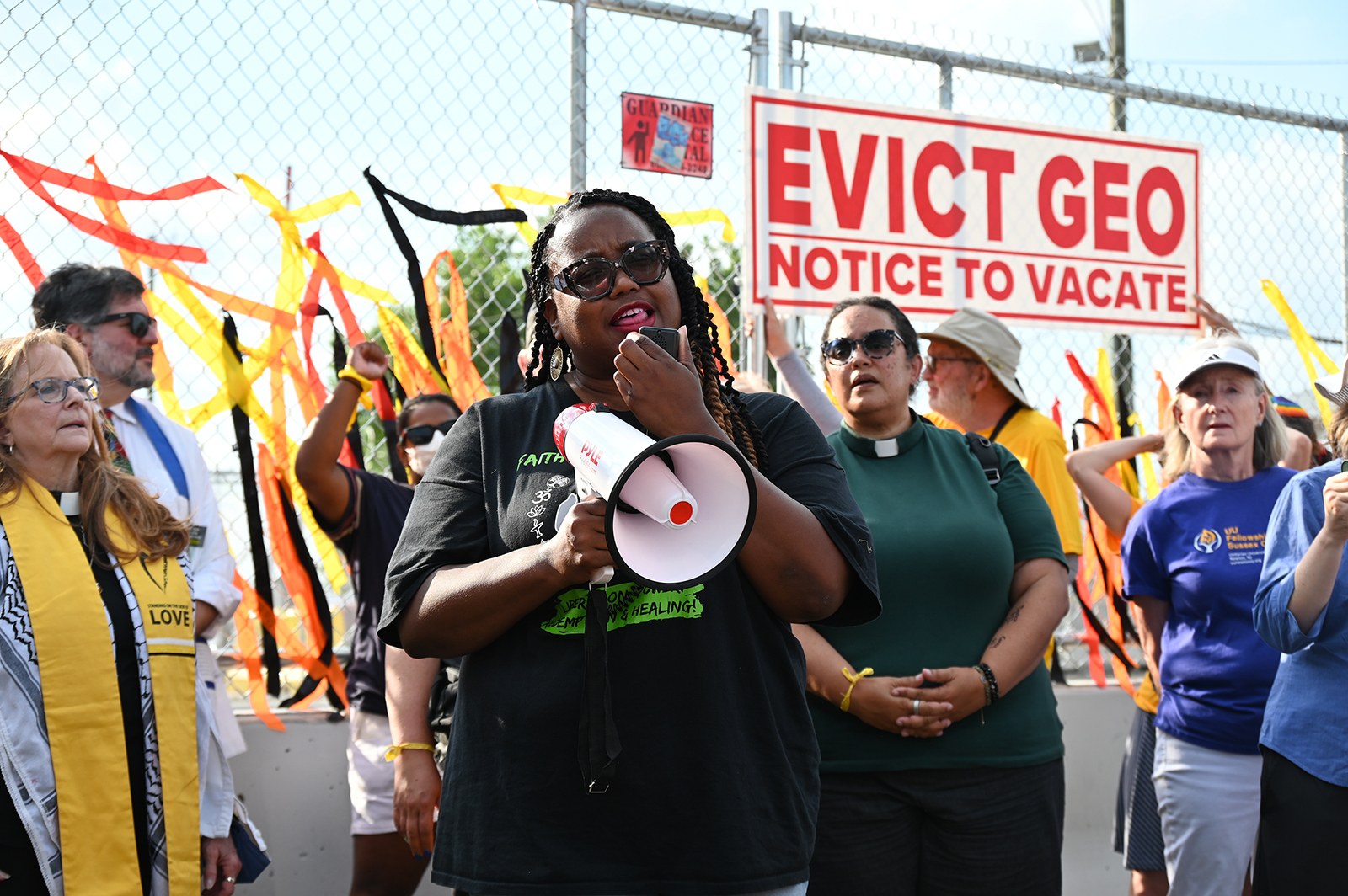
NEWARK, New Jersey (RNS) — 'I am sick and tired of waking up every morning to see another loved one is dead,' said Charlene Walker, head of Faith in New Jersey.
Charlene Walker speaks while faith leaders rally outside the Delaney Hall detention center on Monday, July 13, 2026, in Newark, N.J. (RNS photo/Jack Jenkins)

NEWARK, N.J. (RNS) — Amid the recent killings of two immigrants by immigration enforcement agents, around 100 religious leaders from across the country staged a protest outside the Delaney Hall immigrant detention center on Monday (July 13) afternoon, demanding the closure of the privately run facility over what they say are inhumane conditions.

The protest, chiefly organized by Faith in New Jersey, came after Lorenzo Salgado Araujo in Houston and Joan Sebastian Guerrero in Biddeford, Maine, were fatally shot by Immigration and Customs Enforcement agents; for about a year, there have been recurring protests outside of Delaney Hall. 

Marching to a chain link fence outside the facility on Monday, clergy in collars, yarmulkes and taqiyahs affixed banners with the image of a monarch butterfly to the barrier and tied multicolored ribbons to another gate featuring dozens of names of immigrants, including Jean Wilson Brutus, a 41-year-old who died last year shortly after being detained in Delaney Hall.

“They are in the colors of the monarch butterfly to demonstrate that migration is beautiful and that transformation can occur at any moment,” the Rev. Robin Tanner, president of the Unitarian Universalist Ministers Association and a minister who helped organize the protest, said. She explained the immigrants named had either been detained or, if their names appeared on black ribbons, killed by federal agents or died while in detention. 

“I am sick and tired of waking up every morning to see another loved one is dead,” said Charlene Walker, a Faith in New Jersey leader who was arrested last year when her group staged one of the first major protests outside Delaney Hall. “Dead at the hand of the for-profit systems that prop up this country.”

The protest was part of a three-day gathering in New Jersey of faith leaders from around the country focused on pushback to the Department of Homeland Security and ICE, who are implementing ongoing mass deportation efforts by the Trump administration. While Delaney Hall has long been a target of protests, the interfaith gathering, bringing clergy from across the country, hinted at a new, more nationally focused phase of faith-led demonstrations.

Religious leaders rally outside the Delaney Hall detention center on Monday, July 13, 2026, in Newark, N.J. (RNS photo/Jack Jenkins)


The gathering harkened back to a similar assembly in January when, after Renee Good was killed by an ICE agent, more than 600 clergy from across the U.S. assembled in Minneapolis to protest the deportation campaign in the city, also known as Operation Metro Surge. Some of the Minnesota faith leaders who organized that effort were at the New Jersey gathering, including the Rev. Ashley Horan, vice president for programs and ministries at the Unitarian Universalist Association.

“Part of what we were so clear about coming out of Operation Metro Surge in Minneapolis was that, just because they had taken our neighbors, did not mean that we were going to forget them or that we were going to stop fighting for them,” Horan told RNS. “So we have been working at March to build connections with folks here in New Jersey, with folks in Texas.”

Unlike Minneapolis gathering, the New Jersey assembly largely focused on immigrant detention. The protesters at Delaney Hall railed against Trump and DHS, but also singled out the GEO Group, the private company that operates the facility as part of a contract with DHS. At one point, the group burst into a chant of “evict GEO now.”

The same slogan was also affixed to the historic pulpit of First Presbyterian Church Newark earlier that day, where the faith leaders gathered for songs and a series of speeches championing immigrant rights. As attendees of the “All Roads Lead to Delaney Hall” event sat in the pews, many cooling themselves with church fans to cut the thick heat that filled the centuries-old sanctuary, which lacked air conditioning, speakers from various religious traditions spoke of a spiritual obligation to oppose Trump and DHS.
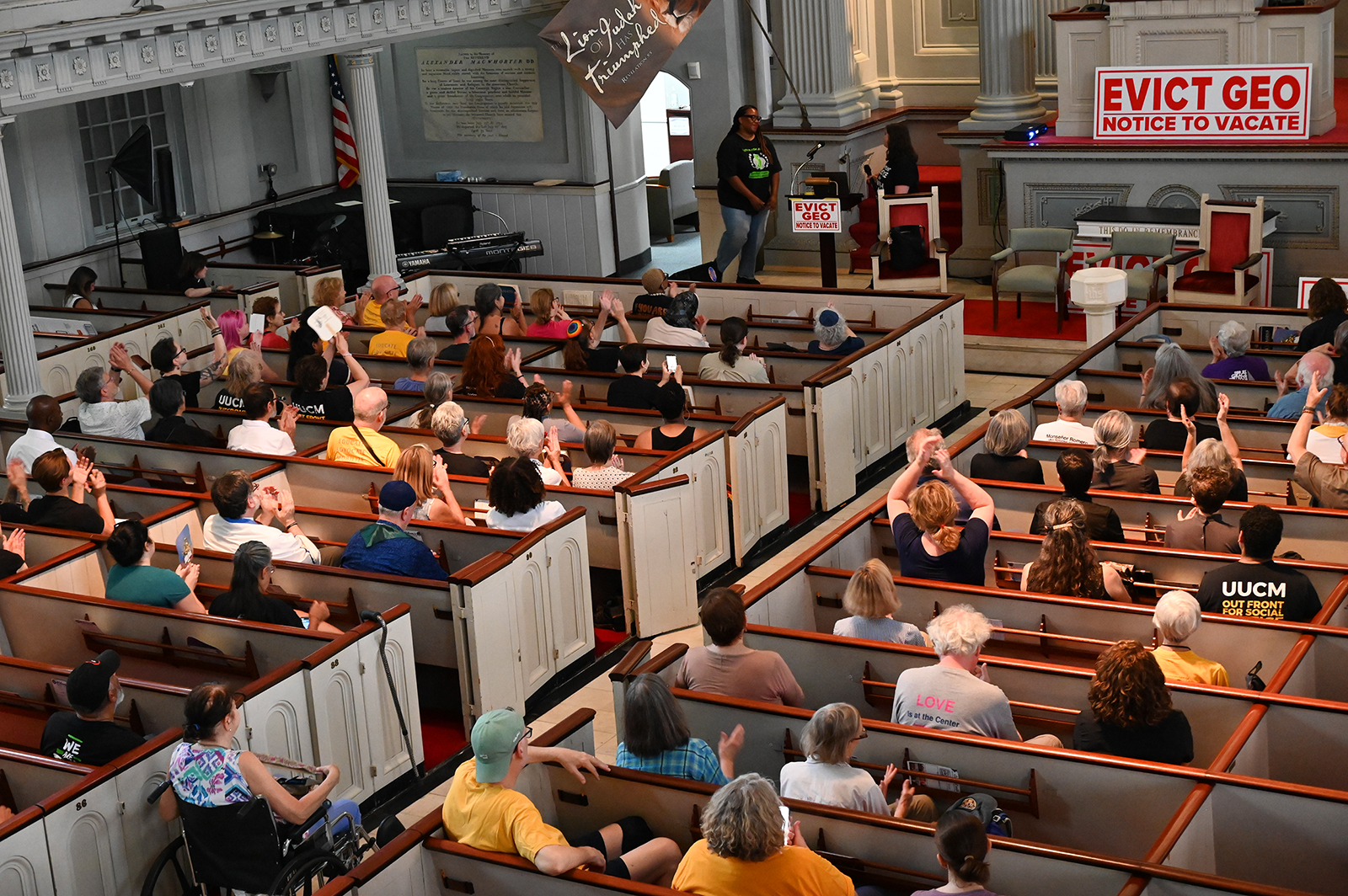
Faith leaders gather at First Presbyterian Church Newark prior to a demonstration at Delaney Hall detention center on Monday, July 13, 2026, in Newark, N.J. (RNS photo/Jack Jenkins)

One of the speakers was the Rev. Nontombi Naomi Tutu, the daughter of Archbishop Desmond Tutu, the Anglican priest who famously resisted apartheid in South Africa. An immigrant who serves as an Episcopal priest in California, the younger Tutu said she has walked around with her passport in recent months out of fear of being detained by DHS.

“I lived through apartheid in South Africa,” Tutu said. “I’m not going to live through apartheid in the U.S.”

The room erupted into applause.

Another speaker, Jamie Beran, head of Bend the Arc: Jewish Action, said American Jews are pushing back against DHS as part of a larger effort to “reassert our American Jewish values.”

“Our faith coalition, this faith coalition, has consistently shown us that there is always hope in the face of tyranny,” Beran said. “Because hope is another word for faith.”

Many faith groups were represented in the crowd, but Unitarian Universalists — including the Rev. SofĂ­a Betancourt, the president of the Unitarian Universalist Association, as well as Walker, Tanner and Horan — were a visible presence, many wearing yellow stoles commonly used by ministers in the denomination.

Several speakers tied opposition to mass deportation to broader concerns about authoritarianism, which they argued was being implemented by the Trump administration.


“This has nothing to do with immigration. This is all about fascism,” said Walker. “ICE is a paramilitary force they have chosen to build to come after each and every one of us.”

In an interview with RNS, Walker said she and other faith leaders have been exposed to pepper spray and tear gas while ministering or protesting outside Delaney Hall. Many other activists have also had violent encounters with DHS and local police who have guarded the facility, as well as GEO group employees.

At this protest, however, DHS agents were nowhere to be seen. GEO Group employees stood behind fences, largely avoiding any direct engagement with clergy during the demonstration. When the clergy moved away from the fences, GEO Group employees in blue shirts quietly removed the banners, but left the ribbons attached.

Faith leaders who have been involved in protests at Delaney Hall told RNS the lack of response was unusual, but speculated that authorities may have wanted to avoid directly confronting such a large group of faith leaders. Reached for comment, representatives for GEO Group deferred to ICE. A DHS spokesperson responded to a request for comment on the faith-led protest by pointing to a press release from May rejecting various allegations of inhumane conditions at Delaney Hall as “smears” forwarded by “sanctuary politicians” and “leftist activists.”
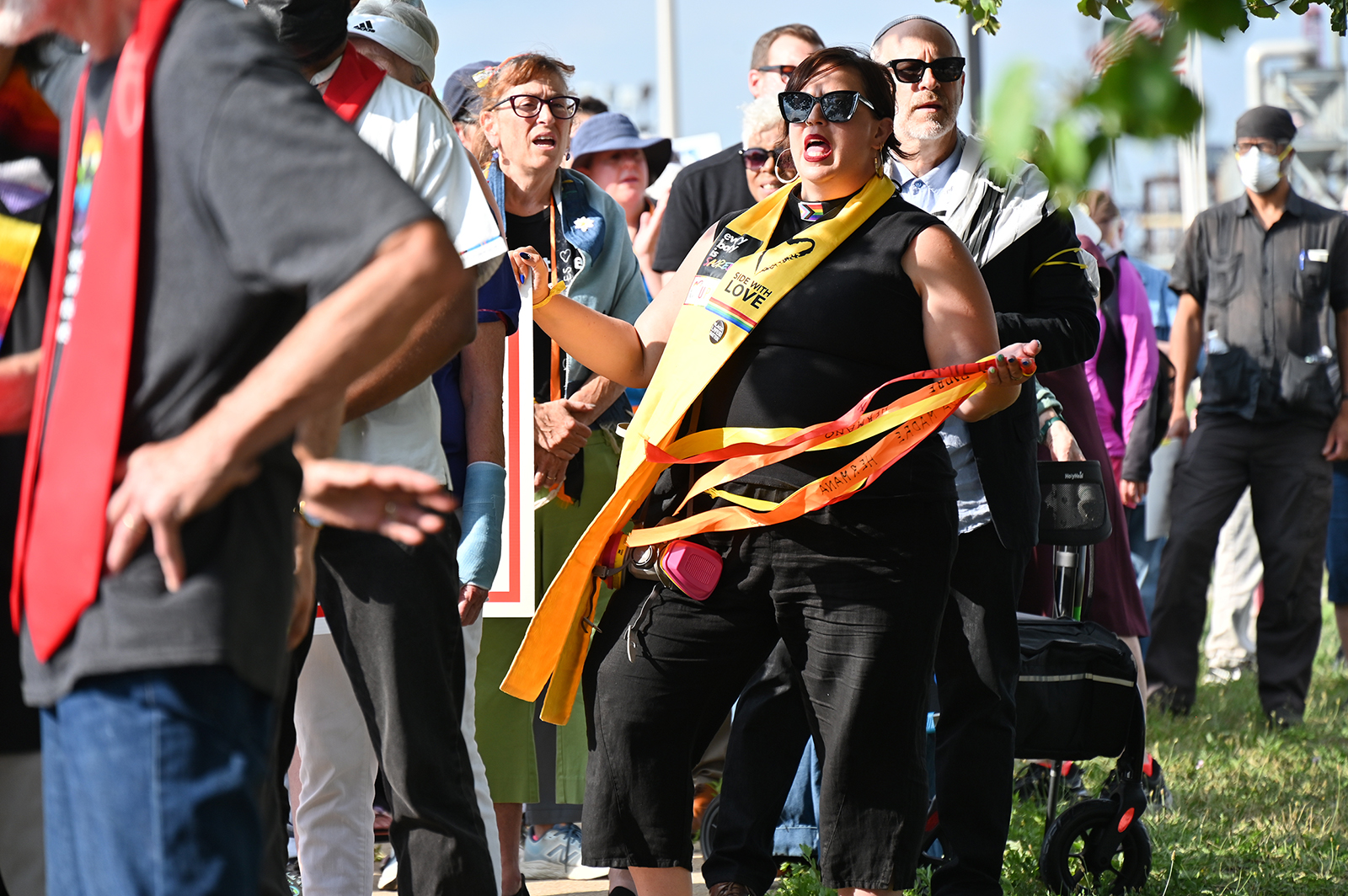
Faith leaders demonstrate outside the Delaney Hall detention center on Monday, July 13, 2026, in Newark, N.J. (RNS photo/Jack Jenkins)

About midway through the gathering, the Rev. Anya Sammler-Michael, co-minister of the Unitarian Universalist Congregation at Montclair, stood and noted that reports had emerged of a person being shot and killed in a shooting in Maine that involved ICE personnel. She led the group in a moment of silence, then offered an additional prayer.

“May it be a silence that is a reckoning, a silence that is a reckoning that moves through this room and through these people as we again come together to hold the crimes of our nation in our hearts and our bodies,” she said.

Among the last to speak was Bishop Dwayne Royster, head of the group Faith and Action Network, of which Faith in NJ is an affiliate. He urged attendees to take lessons learned from the gathering home with them and begin organizing in their own communities. 

“We’ve got to make sure that we wake up every day determined that we will not allow another person to suffer in this world,” Royster said. “We’re going to do everything that God has given us — every power that we have, every bit of agency — to make sure that we change this world into a better place.”
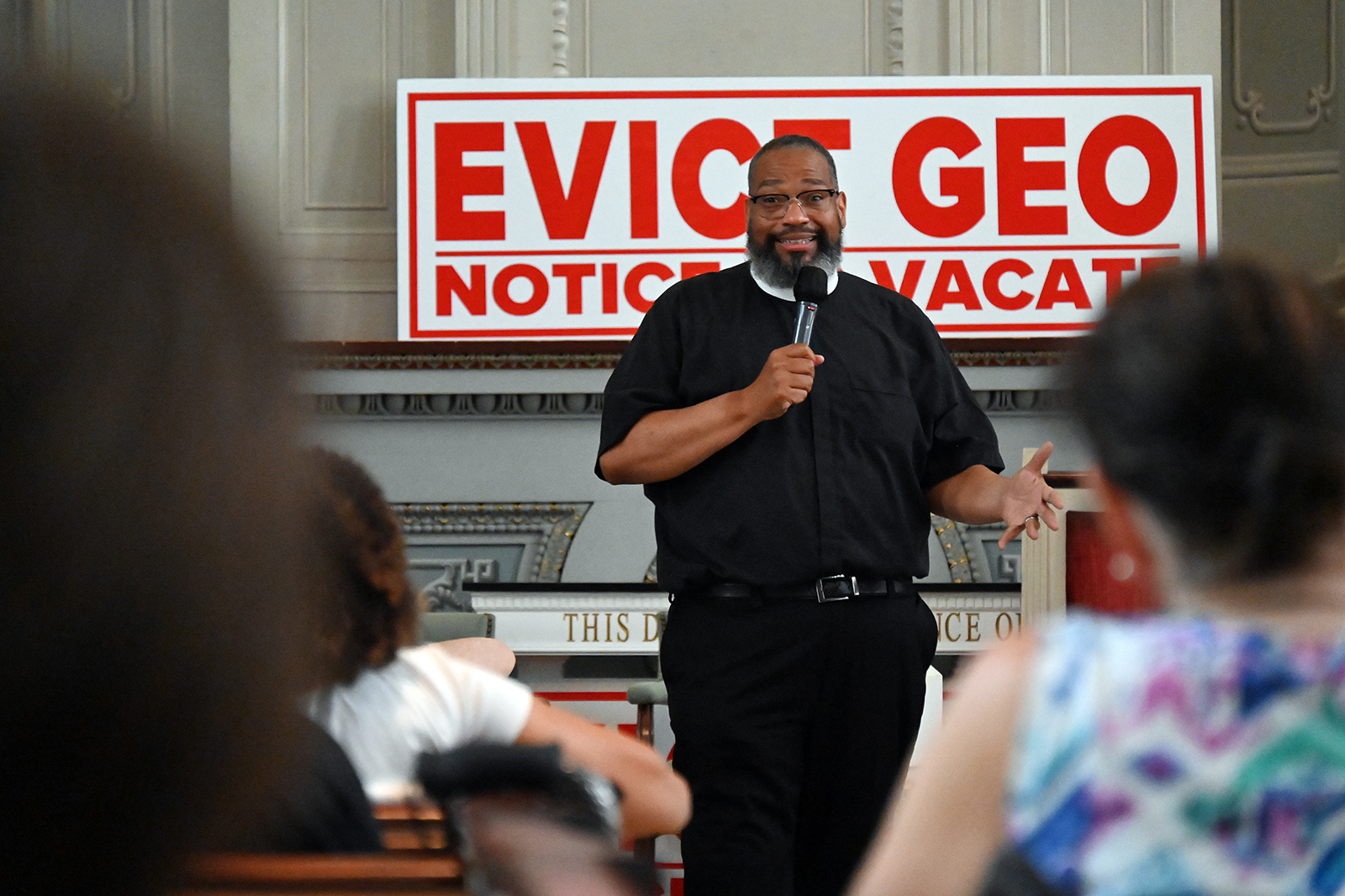
Bishop Dwayne Royster speaks at First Presbyterian Church Newark about immigrant rights on Monday, July 13, 2026, in Newark, N.J. (RNS photo/Jack Jenkins)


Building new Swiss nuclear power plant economically viable, report says


The construction of a new nuclear power plant in Switzerland would be economically viable, according to a study carried out by the BAK Economics research institute on behalf of the Swiss business federation Economiesuisse.
 
The Leibstadt plant is expected to go offline in 2044 (Image: KKL)

Currently, Switzerland's four existing nuclear power reactors - two at the Beznau plant and one each at the Gösgen and Leibstadt plants - supply about 36% of the country's electricity and nearly half of its winter electricity. Starting in the late 2030s, they will be decommissioned one by one as they reach the end of their technical service life. The final plant (Leibstadt) is expected to go offline in 2044. Meanwhile, electricity demand is projected to rise by up to one-third by 2050 due to electrification. The resulting winter electricity gap serves as the starting point for this study.

The study - titled Economic Impact of Replacing Swiss Nuclear Power Plants - examines whether the construction of new nuclear power plants, in addition to the expansion of renewable energies, would be economically viable. Using a model-based impact analysis, it quantifies the direct effects that the construction and operation of a new nuclear power plant would have on Swiss gross domestic product (GDP), employment, and tax revenues for the federal, cantonal, and municipal governments. Broader benefits arising from the infrastructure role of a nuclear power plant are assessed in the context of existing studies.

Under the current policy framework of the Electricity Act, the baseline scenario assumes the continued expansion of renewables as well as the construction of an EPR-type nuclear power plant with an installed capacity of 1.63 GW, scheduled to come online in 2050. The plant would generate 12.1 TWh of electricity annually - with around 6.7 TWh produced in winter - thereby covering about 15% of projected winter consumption. This would reduce structural import dependency and help stabilise seasonal price peaks. Despite conservative cost assumptions, risks regarding delays and cost overruns remain, as evidenced by previous EPR projects in Europe, the study says.

The model-based impact analyses reveal significant economic effects across several levels. The investments would generate a cumulative domestic value added of CHF7.4 billion (USD8.0 billion); around 51% of the construction costs would be retained within Switzerland as value added. Once operational in 2050, the plant would generate CHF1.2 billion in annual value added (both direct and indirect) along the value chain, plus an additional CHF240 million per year through dynamic effects - specifically, the impact of lower electricity costs on households, businesses, and export competitiveness. All figures are stated in 2024 prices.

The EPR life-cycle analysis indicates that, over a 60-year operational period, the project generates an annual value-added impact of CHF1.6 billion and supports 2,905 jobs. Direct taxes paid by individuals and legal entities to the federal, cantonal, and municipal governments amount to about CHF95 million per year. Thus, for every franc of subsidy invested - adjusted for the state subsidy component - there is a net GDP impact of CHF1.50 and tax revenue of CHF0.15.

When infrastructure, climate, and environmental effects are also taken into account, the total economic benefit increases to as much as CHF5.20 per franc of funding. The subsidy requirement per kWh is in a similar range to that found in other recent studies and is roughly the same as for renewable energies.

"If the current ban on new nuclear power plants were lifted, Switzerland could, if necessary, replace its existing nuclear power plants with modern facilities and thus close part of the expected winter electricity gap," Economiesuisse said.

A new Swiss energy policy was sought in response to the March 2011 accident at the Fukushima Daiichi plant in Japan. Two months later, both the Swiss parliament and government decided to exit nuclear power production. The Energy Strategy 2050 initiative drawn up by the Federal Council came into force on 1 January 2018 and calls for a gradual withdrawal from nuclear energy. It also foresees expanded use of renewables and hydro power but anticipates increased reliance on fossil fuels and electricity imports as an interim measure.

In August last year, Switzerland's Federal Council presented draft legislation that would remove the country's ban on the construction of new nuclear power.

A study by ETH Zurich and the Paul Scherrer Institute, published in late June, concluded the construction of new nuclear power reactors in Switzerland is not competitive under current conditions, but would become profitable with state subsidies, risk mitigation and significantly lower construction costs.


Fusion industry raised USD4.5 billion in past year, report says


A total of USD4.48 billion was raised by the fusion industry in the year to July, the highest total in the six years the Fusion Industry Association has been reporting the annual figure.
 
(Image: FIA)

The figure, which was included in the association's The Global Fusion Industry in 2026 report, saw 56 fusion companies surveyed and brings the total raised over the six years to USD14.24 billion.

Major contributors to this year's figure were Commonwealth Fusion Systems, which raised USD863 million, Proxima Fusion, which raised USD518 million, Helion Energy, which raised USD465 million, and Inertia Enterprises, which raised USD450 million.

Also featuring for the first time was investment in companies planning to go public, with TAE Technologies and General Fusion both having listed their shares on the Nasdaq stock market.

The Fusion Industry Association (FIA) report says that five companies have a power purchase agreement - including Microsoft with Helion Energy and Google with Commonwealth Fusion Systems - offtake agreement "or similar commercial commitment". Six have a siting agreement, with four more "evaluating options".

Among the 56 companies surveyed by the FIA, 48% are focusing on magnetic confinement, 21% on inertial confinement and 14% on magneto-inertial. And nearly three-quarters of the companies - 71% - expect to see a fusion power plant delivering power to the grid "by the 2030s".

The key short-term challenge identified was funding, with longer-term challenges led by the availability of neutron-resilient materials, power efficiency and tritium self-sufficiency.

Andrew Holland, CEO of the US-based Fusion Industry Association, which describes itself as the voice of the world's private fusion industry, said: "This year's report shows how far fusion has come - from being defined by national labs and government R&D programmes to being dominated by private fusion investment totalling over USD4 billion in just one year. I'm confident that the sector has the ability to deliver commercial fusion in the 2030s. The existence of siting agreements and power purchase agreements shows that commercial fusion energy is on the horizon.

"However, alongside private investment, fusion companies still need the support of governments to address common challenges including the availability of resilient materials and the fusion fuel cycle. The governments that update their programmes and funding priorities to meet the sector's needs today will be the ones to capitalise on this vital emerging industry."


Masdar Secures $5.1 Billion for World’s Largest Solar-and-Battery Project

Masdar on Monday announced it had lined up financing for the world’s first gigascale Round-the-Clock renewable energy project, which the renewable energy giant of the United Arab Emirates is developing in Abu Dhabi.

The project, which will need a total capital investment of $6.1 billion, will see Masdar funding $1 billion of the equity. The company now reached financial close on a $5.1 billion financing package backed by a consortium of 13 leading international and local banks.  

The banks include Abu Dhabi lenders, as well as financial institutions from China, Hong Kong, Japan, and France, including BNP Paribas and Societe Generale, as well as Standard Chartered Bank.

The financing package “demonstrates strong market confidence in both the project’s commercial viability and Masdar’s ability to deliver complex energy infrastructure at scale,” the UAE company said today.

The gigascale project will comprise a 5.2-GW solar photovoltaic (PV) plant with a 19 gigawatt-hour battery energy storage system. It is being developed by Masdar and Emirates Water and Electricity Company.

“Integrating RTC is the largest and most technologically advanced system of its kind in the world,” the UAE’s renewable energy giant said.

Masdar, which broke ground on the project in October 2025, expects it to be operational in 2027.

“The 24/7 renewable energy project remains a cornerstone of the UAE’s clean energy strategy, contributing to energy security and economic diversification,” the company said.

Currently, Masdar has a diversified portfolio of more than 65 GW in solar, onshore wind, offshore wind, battery energy storage, and hybrid solutions. 

The company aims to have 100 GW of renewable energy capacity globally by 2030 and to become one of the world’s biggest renewable energy firms. Masdar’s shareholders are Abu Dhabi’s national oil and gas giant ADNOC, Abu Dhabi’s sovereign investment company Mubadala, and state utility giant TAQA.

By Charles Kennedy for Oilprice.com


New York Imposes First Ever Moratorium On U.S. Data Centers

New York Governor Kathy Hochul has signed the country’s first-ever executive order imposing a statewide moratorium on new large-scale data centers for up to one year. The order freezes the permitting process for new data centers requiring 50 megawatts or more of electricity, placing the fastest-growing source of U.S. power demand on hold while state regulators assess its long-term impact on New York’s electric grid, water resources and surrounding communities.  

The New York Department of Environmental Conservation will use the pause to conduct a Generic Environmental Impact Statement (GEIS) study and establish uniform, statewide regulatory frameworks addressing energy grid demands, local water consumption and air quality. Smaller computing facilities used by hospitals, universities and back-office financial services are exempt from the executive order. 

The moratorium comes hot on the heels of the New York State Legislature passing its own one-year pause in June 2026 under the Responsible Data Center Development Act, which targeted facilities over 20 MW. However, utilizing an executive order allows Hochul’s administration to issue an immediate freeze while continuing to review and refine the legislature's broader statutory proposals. 

Governor Hochul also announced she is pursuing legislation to repeal sales tax exemptions for hyperscale data centers. Her administration is moving forward with rules requiring operators to either build their own dedicated on-site power generation or pay heavy premiums to prevent increased utility costs from being passed on to standard residential consumers.

New York is the latest on a burgeoning list of states facing growing backlash against power-hungry data centers. A broad, bipartisan backlash against massive AI infrastructure is sweeping across the U.S., with states introducing moratoriums, new electricity taxes, and rural zoning bans as communities push back against grid strain and high utility bills.

As the world's data center capital, Virginia, in particular, has been experiencing massive internal political division over the industry. The state’s legislature has approved a biennial budget imposing an $0.011 per kWh consumption tax, and passed legislation requiring data centers to pay for transmission infrastructure and limiting the use of noisy backup generators. Blackstone-owned QTS Realty Trust recently withdrew its final appeal to the Virginia Supreme Court to build a giant data center in the state, with the $100 billion, 2,100-acre Prince William Digital Gateway now officially dead.

In Texas, Governor Greg Abbott has urged regulators to ensure data centers do not shift energy costs to local residents and called for development bans in rural areas. Meanwhile, multiple rural counties across the state have enacted local moratoriums.

By Alex Kimani for Oilprice.com


Could Geothermal Energy Rescue Germany's Fading Coal Towns?

  • New exploratory drilling near Weisweiler suggests the site could support geothermal heating systems as the nearby coal plant prepares to close by 2029.

  • Researcher Hauke Hermann says rising EU carbon allowance prices could push Germany's coal exit to 2032, six years ahead of the legal 2038 deadline.

  • Chancellor Friedrich Merz has signaled he won't sacrifice industrial power supply for phase-out timelines, even as Europe faces its third energy crisis in four years.

Europe’s largest economy is walking a precarious tightrope toward carbon neutrality, trying to balance energy security with climate goals as this summer’s heat waves create mounting pressure on the continent’s energy grids while simultaneously highlighting the importance of mitigating emissions. The German government aims to source 100 percent of the national energy mix from renewables by 2035, but has hedged some of its energy-transition rhetoric in recent months against the backdrop of major energy market volatility.

Germany has made a legally binding pledge to phase out the dirtiest fossil fuel entirely by 2038, but there is cause for speculation that the government may be reconsidering its near-term strategy. Back in March, when the shutdown of the Strait of Hormuz began and thereby ushered in Europe’s third energy crisis in four years, Chancellor Friedrich Merz made his priorities clear: “We must supply this country with electricity. I am not prepared to jeopardise the core of our industry simply because we have adopted phase-out plans that have become unrealistic.”

However, even with the market volatility in mind, some experts think that timely the phase-out of coal in Germany is an economic inevitability, and could happen even sooner than the goal date. Hauke Hermann, a senior researcher for energy and climate action at the Institute for Applied Ecology, thinks that coal will die out in Germany by 2032. While some pundits have questioned whether the latest energy crisis will push Germany back to coal (and strengthen its dependence on natural gas), Hermann believes that the opposite is true, thanks in large part to the European Union’s emissions trading system or ETS: “Our electricity market models indicate that coal will be phased out faster than envisaged under the coal exit agreement, meaning the market is outpacing the schedule,” Hermann told Clean Energy Wire. “This is due to comparatively low gas prices until recently, and higher ETS allowance prices.”

However, Germany needs to replace that coal with clean energies instead of natural gas if it wants to achieve its decarbonization goals. The country has already made great strides when it comes to expanding wind and solar capacity as it has attempted to wean itself off of Russian fossil fuel imports in recent years against the backdrop of the War in Ukraine. But Germany will need to double down on clean energy expansion, and especially round-the-clock clean energy alternatives if the country has any hope of achieving a 100 percent renewable grid in less than ten years.

Enter geothermal energy. Capable of producing energy 24 hours a day, seven days a week with zero greenhouse gas emissions, geothermal could be a critical part of Germany's decarbonization strategy. And it looks like coal country could be the perfect place to build up geothermal capacity as coal-fired plants are phased out, creating critical opportunities for communities dependent on coal for their livelihoods and therefore offering a feasible pathway for a just transition.

Exploratory drilling New geological data gathered from exploratory drilling near Weisweiler in Germany’s Rhineland region has revealed that the site could be well-suited to geothermal energy development, and is “expected to strengthen underground models and accelerate the development of geothermal heating systems” according to a recent report from Interesting Engineering. The drilling is taking place near the site of a major coal-fired power plant that is slated to shut down by 2029.

The findings of this initial study could be the beginning of a much bigger data-gathering operation, which could kickstart a geothermal renaissance in the region. In the future, surveys will dig deeper and use seismic imaging to look for geothermal reservoirs that can be tapped for round-the-clock energy production.

“The study forms part of broader efforts to support the energy transition in Germany’s Rhineland, where former coal infrastructure is being reimagined for renewable energy applications,” Interesting Engineering goes on to say. “By reducing geological uncertainty, the new data could help attract investment in geothermal projects and strengthen the region’s shift toward cleaner, more sustainable heat production.”

By Haley Zaremba for Oilprice.com


Canada Ties New West Coast Pipeline to Oil Sands Expansion

  • Canada advances a new 1 million bpd West Coast oil pipeline, with Ottawa, Alberta, and major oil sands producers agreeing on a framework that ties the project to emissions reductions and expanded exports to Asian markets.

  • Oil sands producers commit to the Pathways carbon capture project.

  • The project reflects Canada's push to diversify away from the U.S. market.

Canada’s biggest oil sands producers, the Alberta provincial government, and the federal government have reached a new milestone in advancing the planned new West Coast pipeline that would move another 1 million barrels per day (bpd) of oil sands output from the top oil province to the British Columbia coast.

The parties on Monday unveiled the backgrounder document of the deal for the new pipeline, West Coast Oil Pipeline (WCOP). In this, “Alberta has agreed to implement financial supports to enable the oil production growth needed to underpin new export capacity, including the pipeline to Asian markets and the Trans Mountain Expansion (TMX) optimization.”

The new pipeline hinges on the five top oil sands producers, Canadian Natural, Cenovus, ConocoPhillips Canada, Imperial Oil, and Suncor, committing to the Pathways carbon capture and storage (CCS) project and to reduce their operational emissions. This was a key demand from Mark Carney’s federal government to agree to the new 1-million-bpd pipeline to expand Alberta’s oil production and Canada’s export base with new customers in Asia.

Committed to Pipeline and Emissions Reductions

In the deal, the federal government touted the emission reduction goals, the creation of jobs, and additional energy sovereignty by attracting buyers of Canada’s oil other than the United States.

The province of Alberta stressed the fact that oil sands producers have been given the green light to double oil production, and that the deal unlocks billions of dollars in investments and production needed for the new West Coast projects.

Environmental campaigners, of course, slammed the backgrounder document released on Monday as “a master class in greenwash.”

The new WCOP will need additional years and a lot of permits, including in B.C., to begin working for the oil sands companies and for Canada’s crude oil exports to Asia. But the recent major milestones, from the official approval early this month to this week’s backgrounder laying down the commitments of the parties, are moving the project closer to reality

If it weren’t for the geopolitical upheavals and crises in the past year, the project may have never cleared any hurdles beyond Alberta’s provincial government. But the U.S. trade and tariff policies and threats to Canada’s independence prompted Canadian politicians to work on making energy exports less reliant on the U.S., which imported 90% of all the oil Canada was exporting in the year before U.S. President Donald Trump returned to the White House for his second term in office

Threatened by tariffs and negative rhetoric from Trump’s White House, Canada chose to become an energy superpower by expanding its crude and LNG exports into Asia, the market that’s always hungry for energy commodities.  

Oil Pipeline Milestones

The WCOP is a major move toward bringing increased volumes of Canadian crude to the West Coast for exports to Asia. 

The milestones in the project include the commitments the governments and the industry made, which were announced by Canada and Alberta on Monday.

The government of Canada and the five top producers united in the so-called Oil Sands Alliance (OSA), have agreed to establish a regulatory working group to improve the efficiency and effectiveness of federal statutes and regulations governing oil sands development. Canada has also agreed to advance financing to support operating costs for CCS projects, including measures to enhance the durability of the Clean Fuel Regulations (CFR). In addition, the federal government has agreed to review and address technical clarifications and industry concerns related to the CCUS Investment Tax Credit.

The OSA companies have agreed to advance the emissions reduction projects in line with agreed milestones, work with Canada and Alberta to support oil sands production growth associated with the new WCOP, and to prioritize Canadian technologies, suppliers and supply chains, including Canadian steel and aluminum.

Alberta’s commitments feature the implementation of financial supports, yet to be detailed and defined, extension of its Carbon Capture Incentive Program to 2035, and issuance of a Carbon Sequestration Agreement for the Pathways CCS projects and its planned storage complex.

Alberta has also agreed to apply a 120-day approval timeline for qualified projects and establish a bilateral working group with the OSA to address provincial regulatory barriers to oil sands investment and growth.

Commenting on the backgrounder document, Danielle Smith, Premier of Alberta, said,

“The West Coast oil pipeline and Pathways Project are two critical steps towards making Canada an energy superpower and ensuring Alberta remains a destination of choice for investment, innovation and responsible energy development.”

Tim Hodgson, Canada’s Federal Minister of Energy and Natural Resources, noted that “Over the last eight months, we have been steadily delivering on each commitment in the Canada-Alberta MOU, working with Alberta and the energy industry to build major energy infrastructure, reduce emissions, create jobs and prosperity, and secure energy sovereignty.”

Alberta’s minister of Energy and Minerals, Brian Jean, said that “Growing Alberta’s energy production and reducing emissions can go hand in hand.”

But campaigners are having none of this rhetoric.

Keith Stewart, senior energy strategist at Greenpeace Canada, told The Canadian Press, “This is a master class in greenwash, as the pollution reductions committed to in this agreement are only seven per cent of current carbon pollution from the oilsands and would be dwarfed by the additional pollution enabled by a new, taxpayer-financed pipeline.”

By Tsvetana Paraskova for Oilprice.com