Tuesday, July 14, 2026


Vatican-backed priest tours US to visit immigrant advocates, community organizers
(RNS) — 'This is completely terrible, and we cannot be silent in front of this,' the Rev. Mattia Ferrari, the coordinator of World Meeting of Popular Movements, told RNS about the killing of Lorenzo Salgado Araujo.
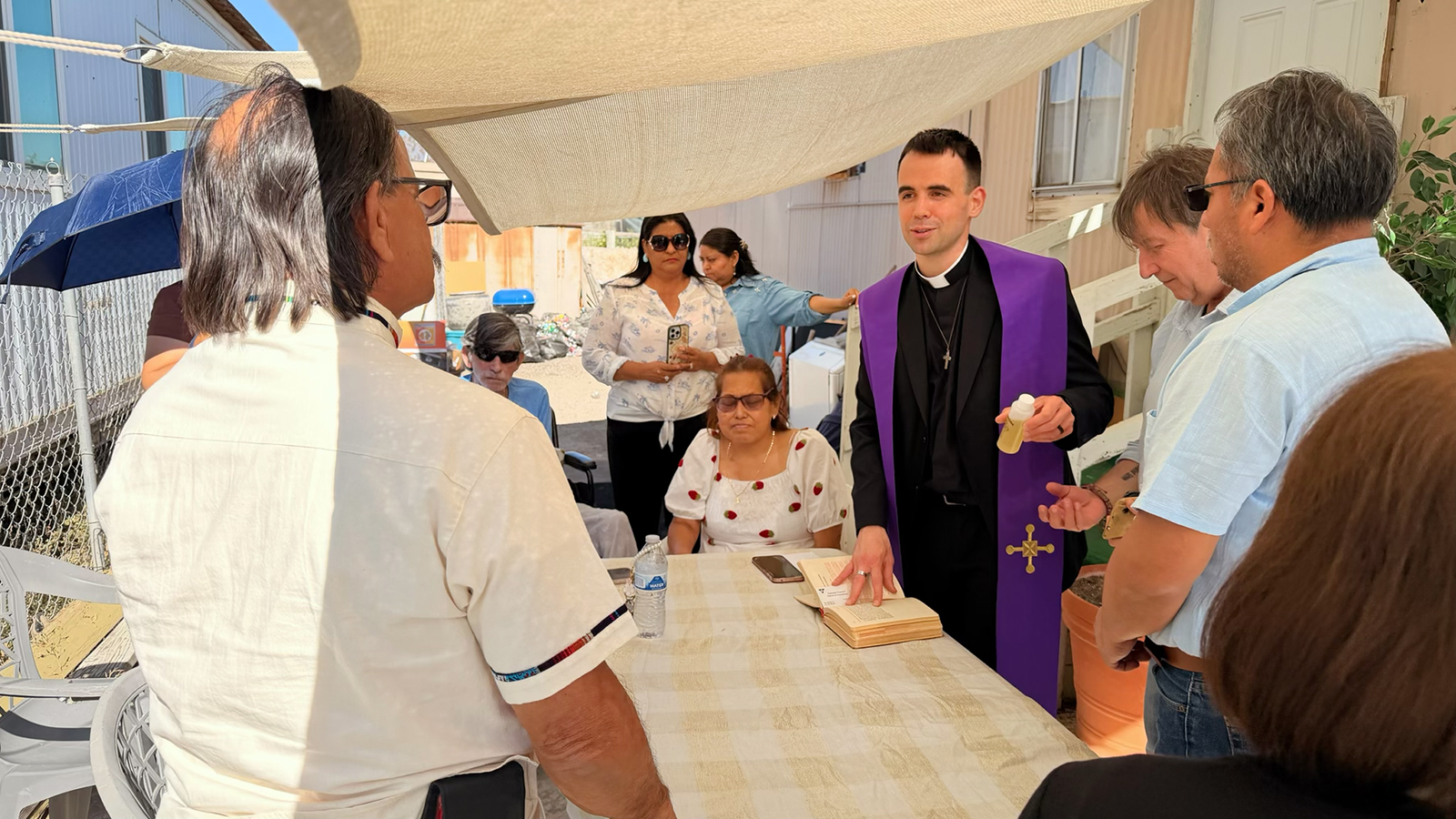
The Rev. Mattia Ferrari, center right, visits local farm workers and annoints the sick in California's Coachella Valley on June 21, 2026. (Photo courtesy of Catholics in Communion)

(RNS) — When the news broke that Lorenzo Salgado Araujo had been shot and killed by an Immigration and Customs Enforcement agent as he drove his construction crew to work in Houston last week, a Vatican representative was meeting with immigrant families at a Houston Catholic parish. The families were sharing about the intense levels of fear their community has been experiencing.

“This is completely terrible, and we cannot be silent in front of this,” the Rev. Mattia Ferrari, coordinator of World Meeting of Popular Movements, told RNS about the killing of Salgado Araujo.

On his multi-city tour of the U.S., Ferrari has heard from many immigrants experiencing fear, family separation and even detention. “They are suffering something that is completely unfair, completely unjust,” Ferrari said, calling Salgado Araujo’s death “the top of the sufferings.”

The World Meeting of Popular Movements was first convened at the Vatican with Pope Francis in 2014, and since then the Vatican’s Dicastery for Integral Human Development has “accompanied” the initiative, which emphasizes poor and marginalized people as “protagonists” in the fight for justice.

“ We are here to serve, not to lead,” said Ferrari of the church’s role, highlighting grassroots leadership.

Last fall, Pope Leo XIV told the convening, which has historically called for land, housing and work for poor people, “The Church must be with you: a poor Church for the poor, a Church that reaches out, a Church that takes risks, a Church that is courageous, prophetic and joyful!”

The Rev. Mattia Ferrari, right, meets with youth leaders in the Archdiocese of Seattle, Wednesday, July 1, 2026, during a six-week tour of the United States. (Photo courtesy of Catholics in Communion)

Leo also emphasized that the poor are at the center of the gospel. “Therefore, marginalized communities…must be involved in a collective and united effort aimed at reversing the dehumanizing trend of social injustices and promoting integral human development,” he said. 

Ferrari’s tour was planned after Ferrari expressed “curiosity” at last fall’s convening to see and hear from people on the ground who are confronting the “cost of living and immigration tension” in the U.S., said Cecilia Flores, who coordinated the tour in her volunteer role with a coalition called Catholics in Communion, which was founded late last year to respond to the “pastoral emergency” of mass deportations.

Ferrari is now halfway through a nearly six-week tour to 21 cities and regions across California, Washington state, Texas, Colorado, Pennsylvania, Minnesota, Indiana, Michigan, Louisiana, Washington, D.C., New Jersey and New York, carrying the Catholic church’s message of support to faith-based community organizing groups throughout the U.S.

He and his fellow delegation members  “sit and listen and ask just such deep questions, but in such a gentle and pastoral and loving way,” said Flores.

Ferrari is traveling with Luca Casarini, the founder of Mediterranea Saving Humans, which has reacted to the deaths of thousands of migrants crossing the Mediterranean by crewing a ship for sea rescues. Ferrari is the group’s chaplain. Leo spent July 4, the 250th anniversary of the U.S. adoption of the Declaration of Independence, at Lampedusa, a common destination for those crossings.
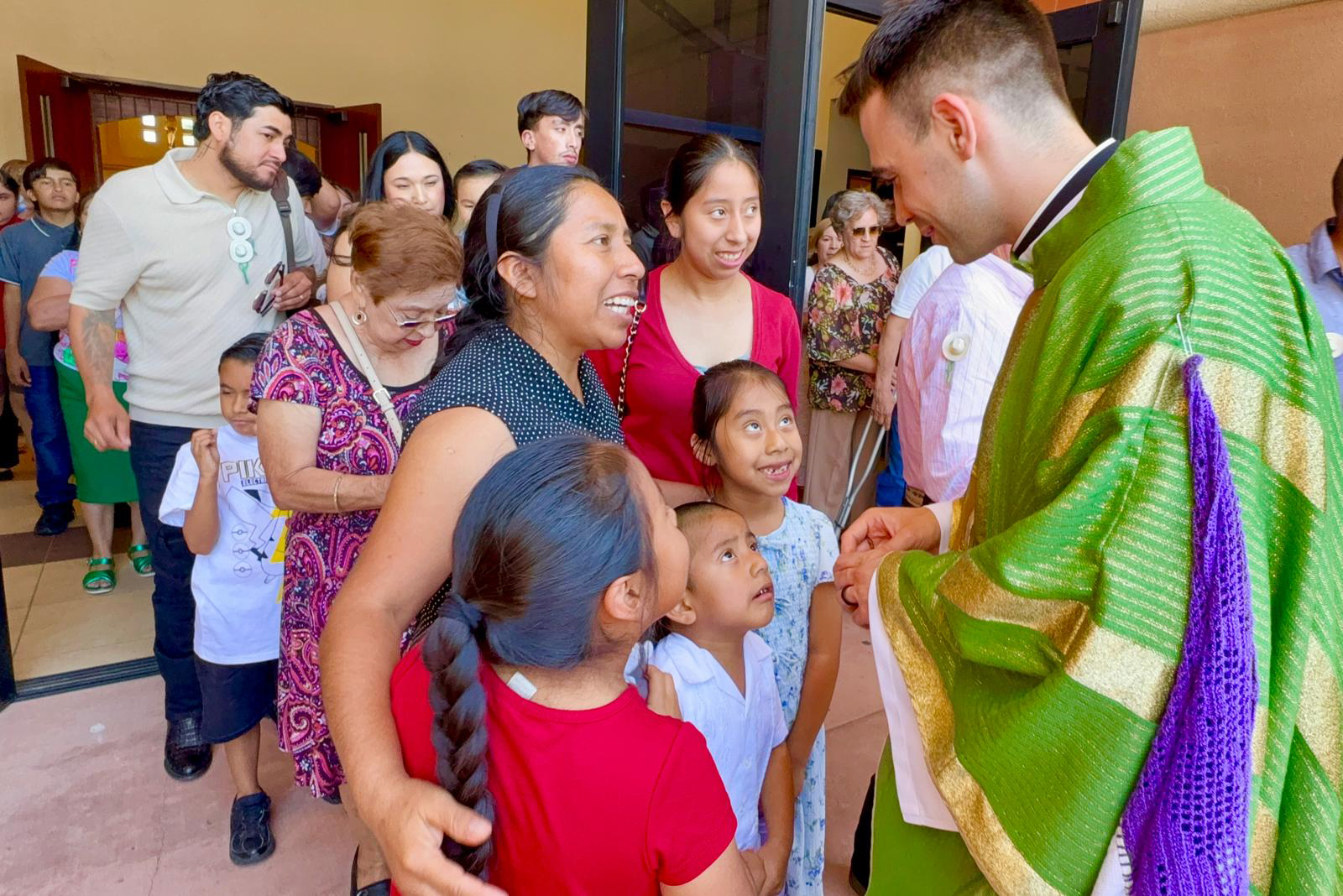
The Rev. Mattia Ferrari, right, greets parishioners after celebraing a Mass at Our Lady of Guadalupe Church, on June 21, 2026, in Mecca, Calif. (Photo courtesy of Catholics in Communion)


The third member of the delegation for the U.S. tour is César Piscoya, an adviser to the Latin American bishops’ conference’s (CELAM) Center for Pastoral Action Programs and Networks. Piscoya, a lay theologian and longtime friend of Leo’s, was a missionary with the Augustinians, Leo’s order, and then worked with then-Bishop Robert Prevost when he led the Diocese of Chiclayo, Peru.

“ Something they keep saying is, they’ve seen a suffering they didn’t really know existed in the United States,” said Flores, who is the executive director of the Catholic Volunteer Network when she isn’t volunteering with Catholics in Communion. “ A lot of people share that the image that they have learned of the U.S., whether that’s through media or how they were told growing up, they get here and they see it’s really not as easy as people might think it is.”

But the delegation is also seeing “ a church that is uniting to take care of one another and to embody what it means to be the body of Christ, to move in defense of the dignity of each person on this earth and in this country,” said Flores.

Across the U.S., immigration has been a core focus of the trip. “ This is a matter of love, a matter of human dignity, a matter of the gospel. Because what these people are suffering — this pain — is also our pain because we are brothers and sisters,” said Ferrari.

But immigration has not been the only issue raised by the tour. In Houston, the delegation visited a dialysis center for people without insurance that The Metropolitan Organization of Houston advocated for, and in Pittsburgh, Ferrari heard from local labor and environmental leaders about the challenges of abandoned gas wells and the transformation of the energy economy.
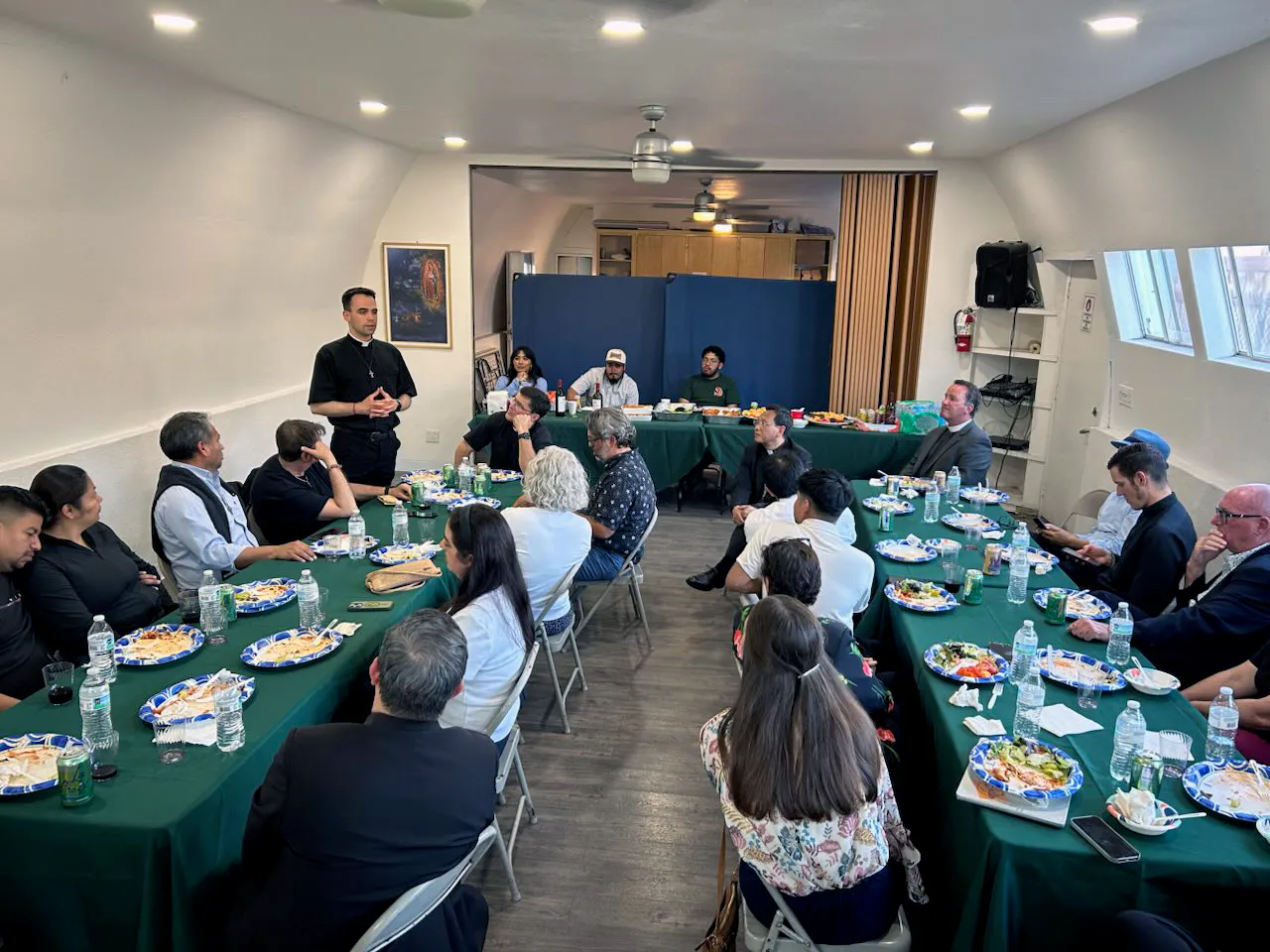
The Rev. Mattia Ferrari, standing left, addresses a gathering of bishops and community leaders, June 22, 2026, in San Diego. (Photo courtesy of Catholics in Communion)

In San Diego, the delegation joined diocesan-backed teams to accompany immigrants to court hearings and ICE check-ins. Ferrari said that he was moved by witnessing immigrants’ initial tears of fear and pain become tears of solidarity when they knew they would be joined by the volunteers.

In Monterey Bay, California, the delegation toured rural farm-working communities and attended an event at a Catholic parish to enroll immigrants without legal status in public healthcare, an initiative that the local Industrial Areas Foundation affiliate Communities Organized for Relational Power in Action had fought for.

Liz Hall, who is the supervising organizer for the IAF in Monterey Bay, recalled Ferrari’s comments that the healthcare initiative showed “the miracle of solidarity.”

“ I don’t think he realized how much that meant to the people in the room to hear someone who came from the Vatican to this very rural, kind of forgotten part of the state” say those words, Hall said. 


In Los Angeles, Ferrari’s delegation attended a public hearing hosted by local IAF affiliate One LA where immigrants shared their experiences of the mass deportation campaign, including witnessing violent detentions.
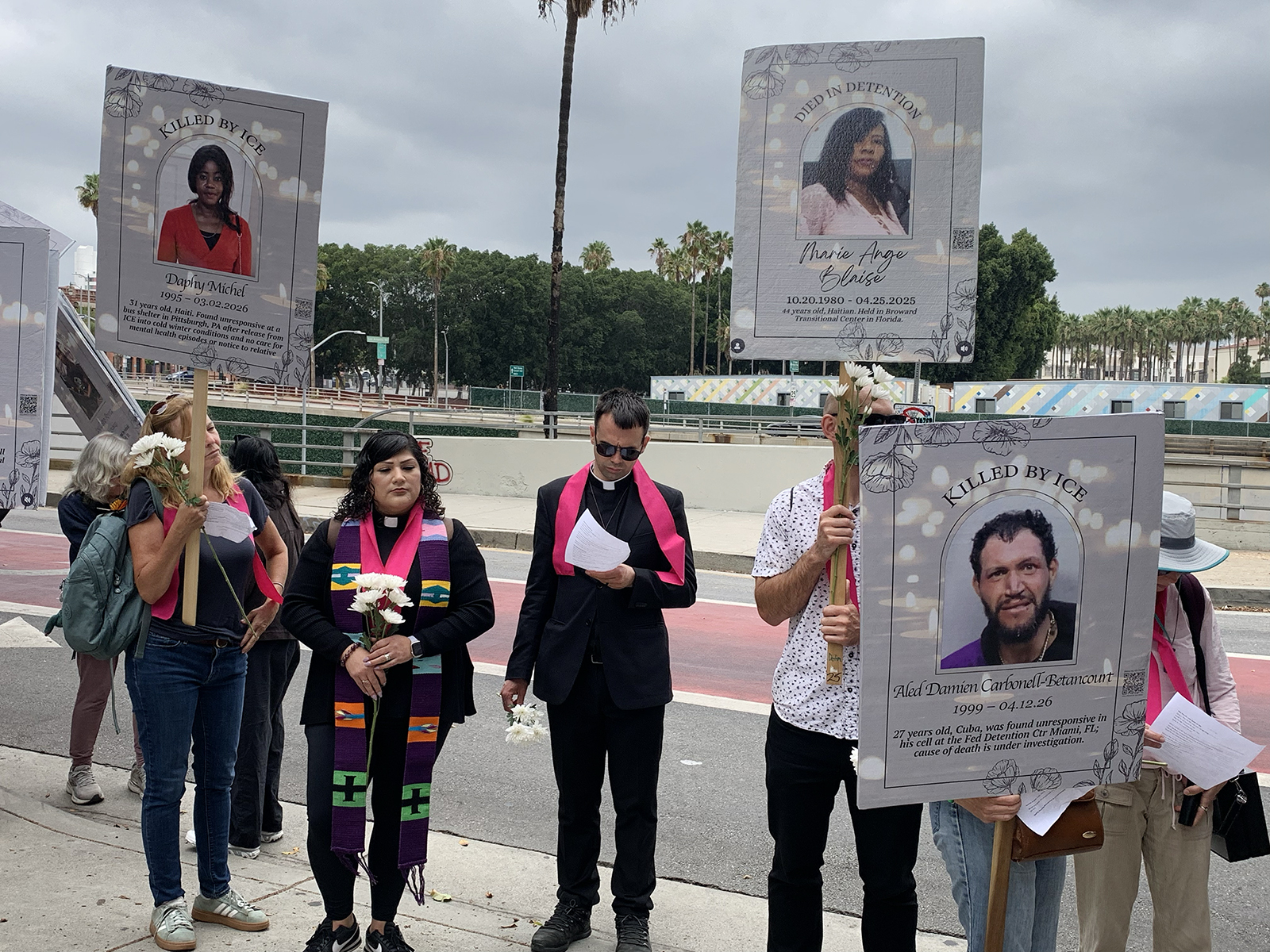
The Rev. Mattia Ferrari, center, coordinator of World Meeting of Popular Movements, attends a prayer vigil in front of the Federal Building in Los Angeles. (Photo courtesy of LA Voice)

Emily, a 21-year-old college student studying civil engineering who asked to be identified by her first name because she does not have legal immigration status, said if she had not already enrolled in university, fear of sharing her information would have prevented her from studying.

“I fear that I might just be studying in class, and because universities are public spaces, they could just come in and unfortunately just get us,” she told RNS. 

Testifying to that experience publicly for the first time at the parish she has attended since she arrived from Mexico as a baby was “vulnerable” but empowering, she said. “I just felt so much better, so much, for me to know there were more people (experiencing this) and that the church actually cared about us,” she said.

Robert Hoo, the lead organizer for One LA, said that the impact is widespread. “ It’s recognizing that the Vatican is watching, that the world is watching, that their stories are important not just to themselves and their communities, but that everybody is aware about the injustices that are happening.”

Ortencia Ramirez, a One LA leader who co-chaired the hearing, fought to hold back tears at hearing the experiences of her community. But she too felt hope because of the connection to Leo. “We asked them to take what they observed with the IAF back to the pope, and they agreed that they would,” she said.
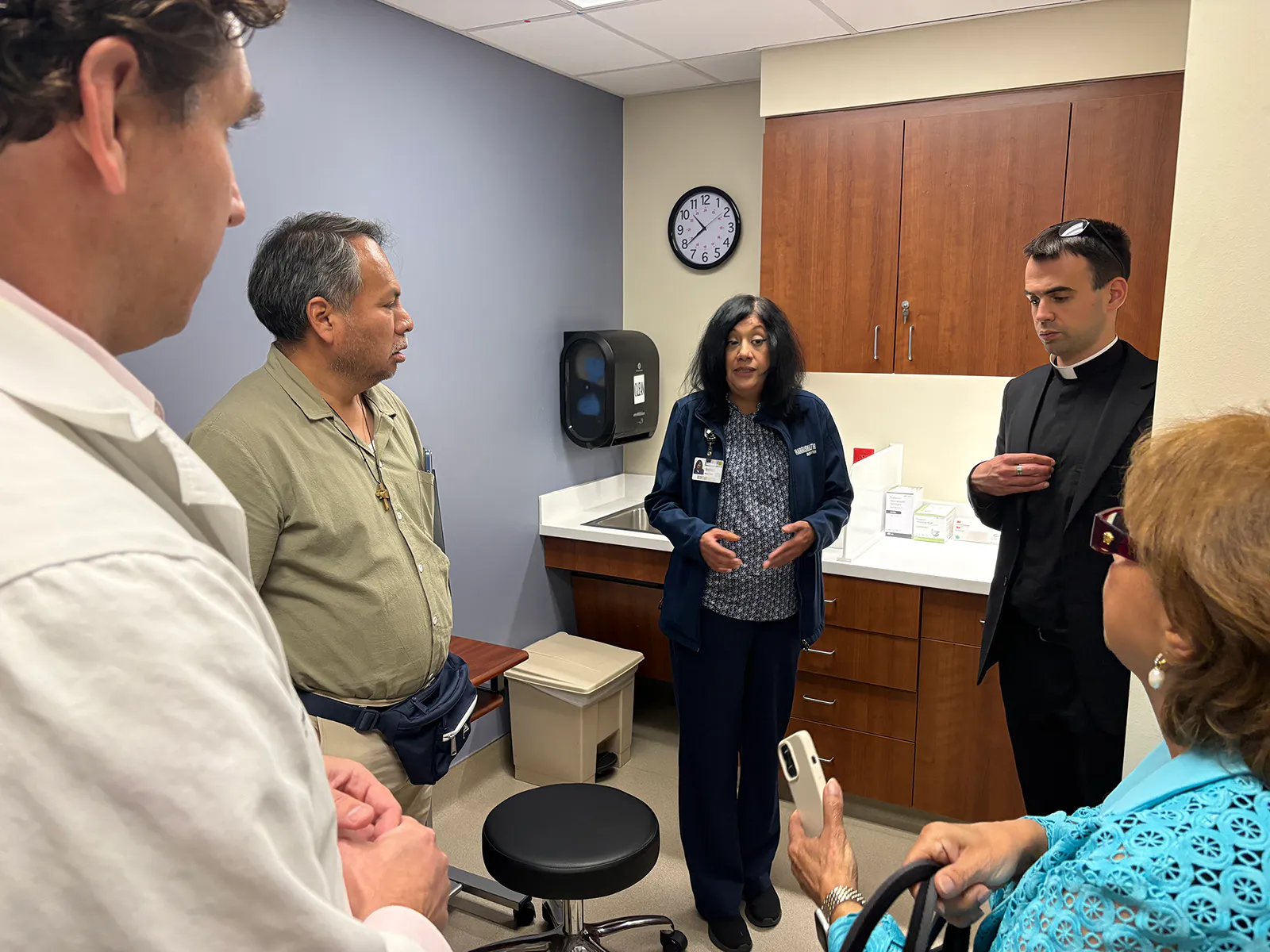
The Rev. Mattia Ferrari, top right, and a touring delegation visit a dialysis center for people without insurance in Houston. (Photo courtesy of Industrial Areas Foundation)

The delegation also participated in a panel of organizers hosted at Dolores Mission, an organizing base for another interfaith group working on immigration, LA Voice, part of the Faith in Action network. Angel Mortel, a lead organizer for the group, said they shared about their efforts to pass California bills imposing high taxes on private immigration detention companies and remove state financial benefits from companies involved in or investing in detention.

For Mortel, the collaboration between LA Voice, One LA and the archdiocese of LA to plan the trip also brought hope for the future. “ This was the first time in my eight years with LA Voice that we’ve done something together,” she said. “ Without that collaboration, it’s just too big a task to take on — to take on the forces that are coming down on us,” she said.

Flores said that connections, resource-sharing and opportunities for formation will be some of the long-lasting impacts of Ferrari’s tour, especially because of the presence of Piscoya, a representative of the Latin American bishops’ conference.

In the majority of cities, Ferrari also met with the local Catholic bishop, and in the few cities where the bishop was unavailable, a staff member.

In Houston, Elizabeth Valdez, director of the IAF in Texas, said that Ferrari and his team were impressed by the key roles that clergy play in forming lay people to be leaders in organizing. “ They had not seen or experienced that anywhere before, even in the visits that they’ve done in other parts of the country,” she said.

But even visiting 21 different cities and regions, Ferrari regretted the parts of the U.S. that he and his delegation were unable to visit. “ We have so much work to do worldwide, so we will be back surely,” he said.


Amid ICE killings, more than 100 clergy from across the US stage protest at Delaney Hall

NEWARK, New Jersey (RNS) — 'I am sick and tired of waking up every morning to see another loved one is dead,' said Charlene Walker, head of Faith in New Jersey.
Charlene Walker speaks while faith leaders rally outside the Delaney Hall detention center on Monday, July 13, 2026, in Newark, N.J. (RNS photo/Jack Jenkins)

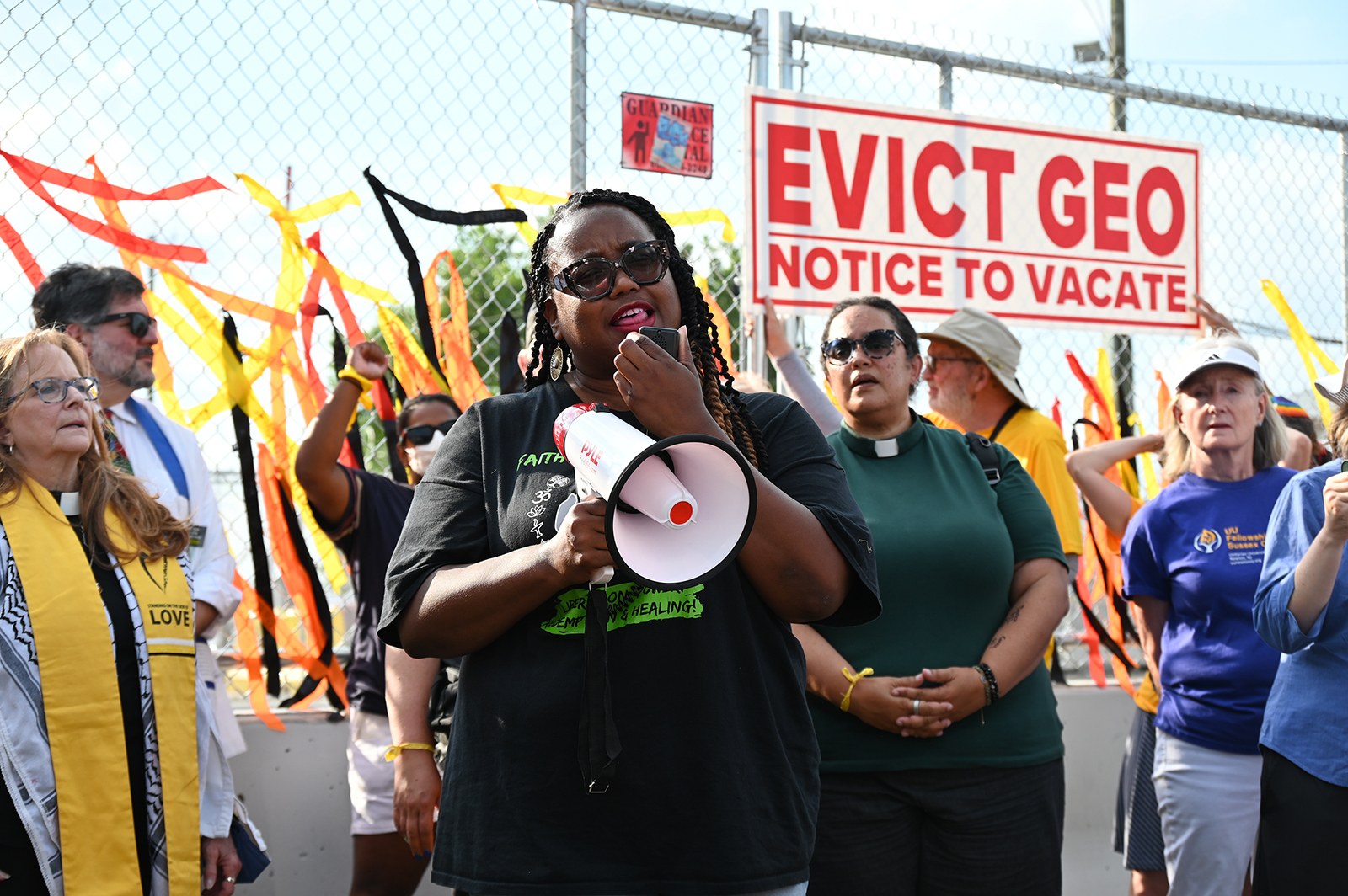
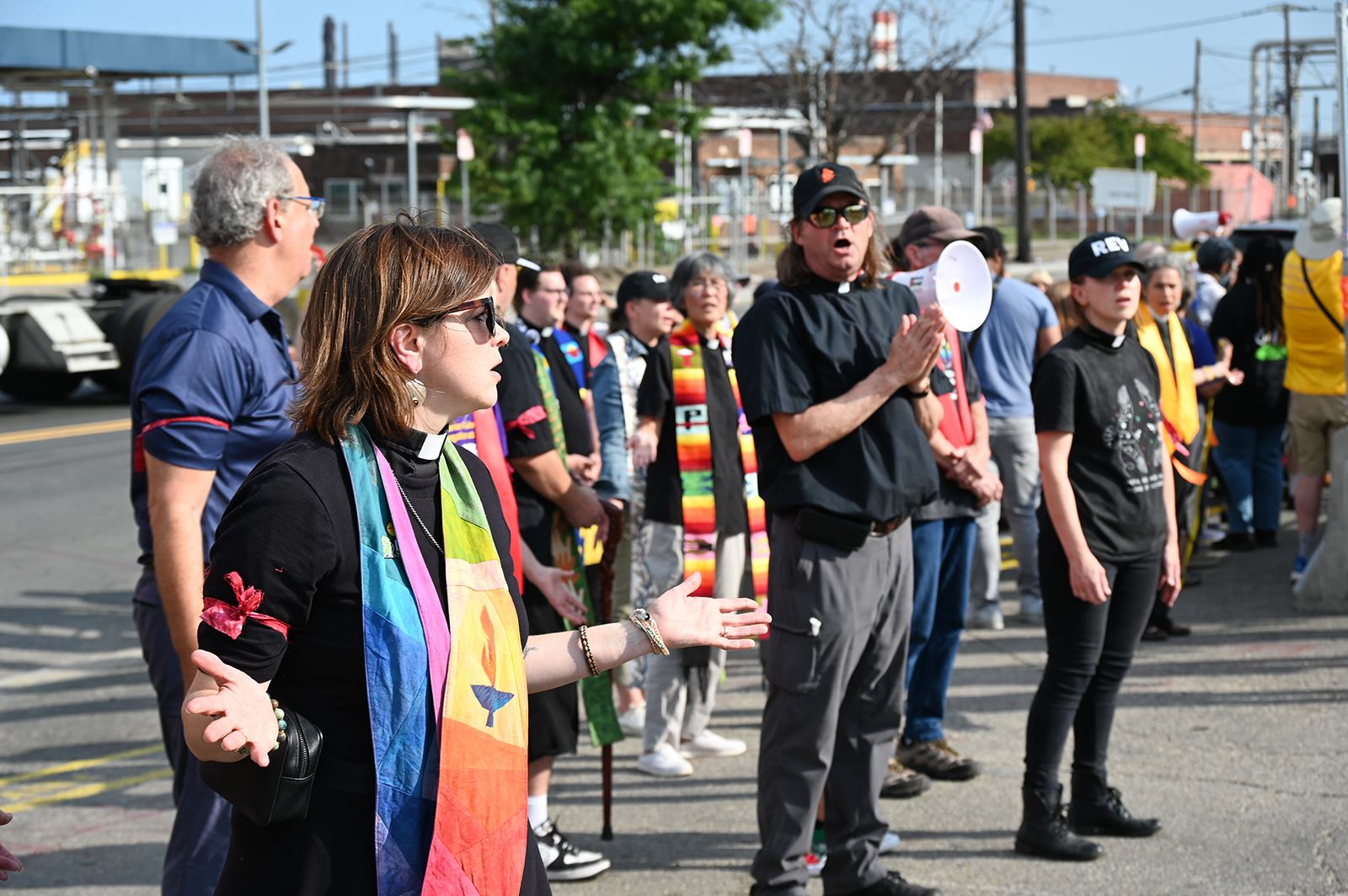
NEWARK, N.J. (RNS) — Amid the recent killings of two immigrants by immigration enforcement agents, around 100 religious leaders from across the country staged a protest outside the Delaney Hall immigrant detention center on Monday (July 13) afternoon, demanding the closure of the privately run facility over what they say are inhumane conditions.

The protest, chiefly organized by Faith in New Jersey, came after Lorenzo Salgado Araujo in Houston and Joan Sebastian Guerrero in Biddeford, Maine, were fatally shot by Immigration and Customs Enforcement agents; for about a year, there have been recurring protests outside of Delaney Hall. 

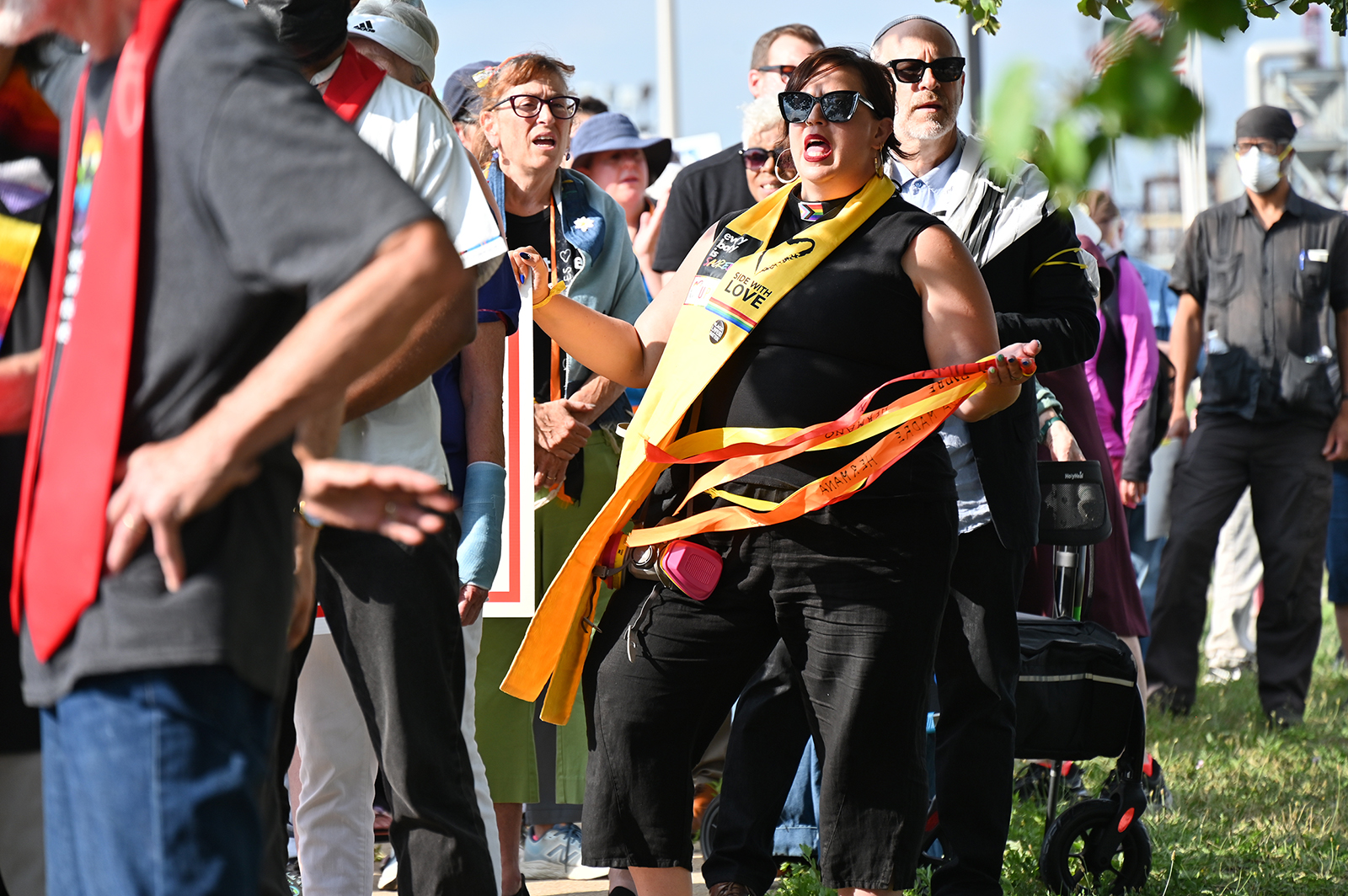
Marching to a chain link fence outside the facility on Monday, clergy in collars, yarmulkes and taqiyahs affixed banners with the image of a monarch butterfly to the barrier and tied multicolored ribbons to another gate featuring dozens of names of immigrants, including Jean Wilson Brutus, a 41-year-old who died last year shortly after being detained in Delaney Hall.

“They are in the colors of the monarch butterfly to demonstrate that migration is beautiful and that transformation can occur at any moment,” the Rev. Robin Tanner, president of the Unitarian Universalist Ministers Association and a minister who helped organize the protest, said. She explained the immigrants named had either been detained or, if their names appeared on black ribbons, killed by federal agents or died while in detention. 

“I am sick and tired of waking up every morning to see another loved one is dead,” said Charlene Walker, a Faith in New Jersey leader who was arrested last year when her group staged one of the first major protests outside Delaney Hall. “Dead at the hand of the for-profit systems that prop up this country.”

The protest was part of a three-day gathering in New Jersey of faith leaders from around the country focused on pushback to the Department of Homeland Security and ICE, who are implementing ongoing mass deportation efforts by the Trump administration. While Delaney Hall has long been a target of protests, the interfaith gathering, bringing clergy from across the country, hinted at a new, more nationally focused phase of faith-led demonstrations.

Religious leaders rally outside the Delaney Hall detention center on Monday, July 13, 2026, in Newark, N.J. (RNS photo/Jack Jenkins)


The gathering harkened back to a similar assembly in January when, after Renee Good was killed by an ICE agent, more than 600 clergy from across the U.S. assembled in Minneapolis to protest the deportation campaign in the city, also known as Operation Metro Surge. Some of the Minnesota faith leaders who organized that effort were at the New Jersey gathering, including the Rev. Ashley Horan, vice president for programs and ministries at the Unitarian Universalist Association.

“Part of what we were so clear about coming out of Operation Metro Surge in Minneapolis was that, just because they had taken our neighbors, did not mean that we were going to forget them or that we were going to stop fighting for them,” Horan told RNS. “So we have been working at March to build connections with folks here in New Jersey, with folks in Texas.”

Unlike Minneapolis gathering, the New Jersey assembly largely focused on immigrant detention. The protesters at Delaney Hall railed against Trump and DHS, but also singled out the GEO Group, the private company that operates the facility as part of a contract with DHS. At one point, the group burst into a chant of “evict GEO now.”

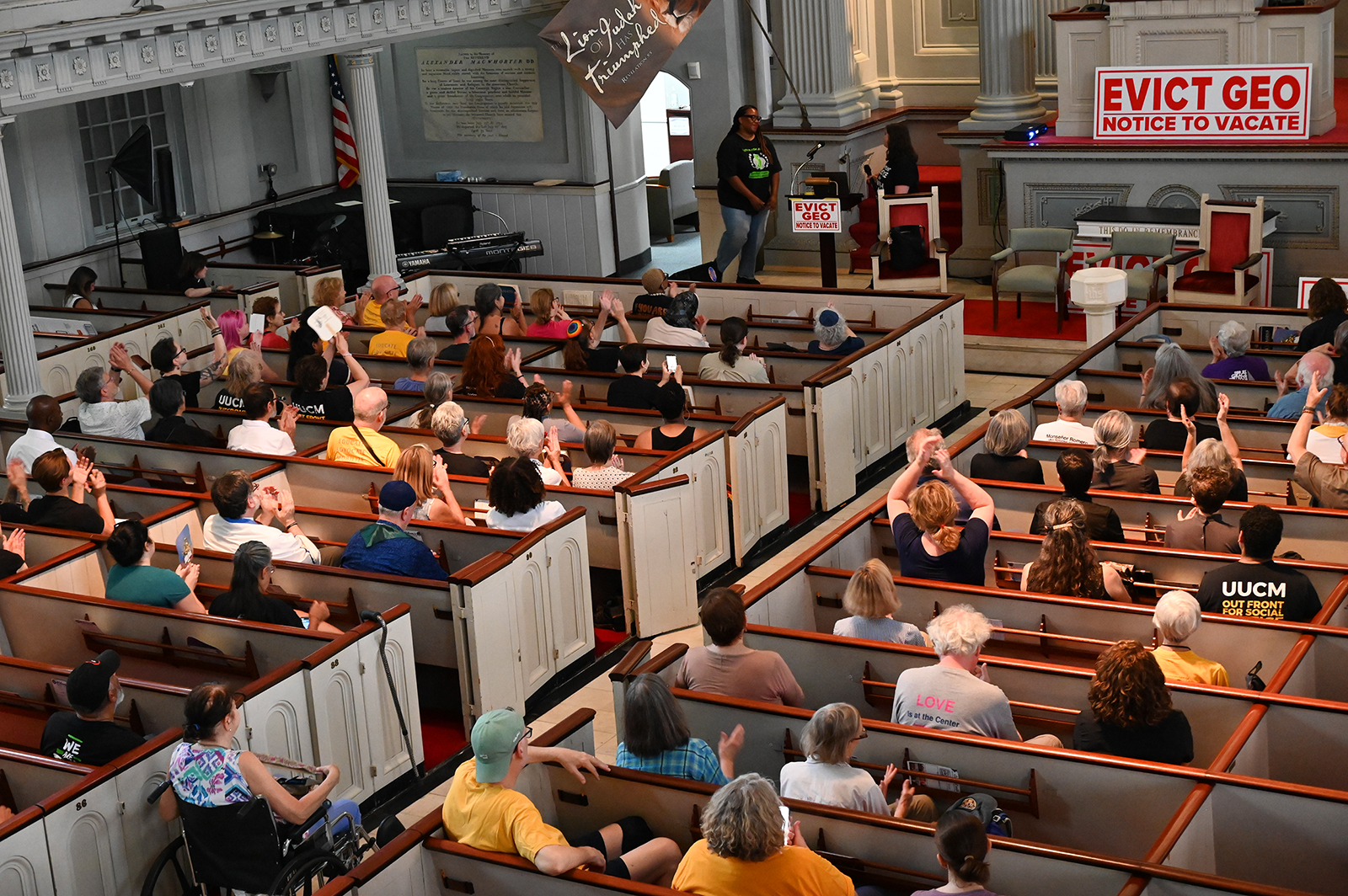
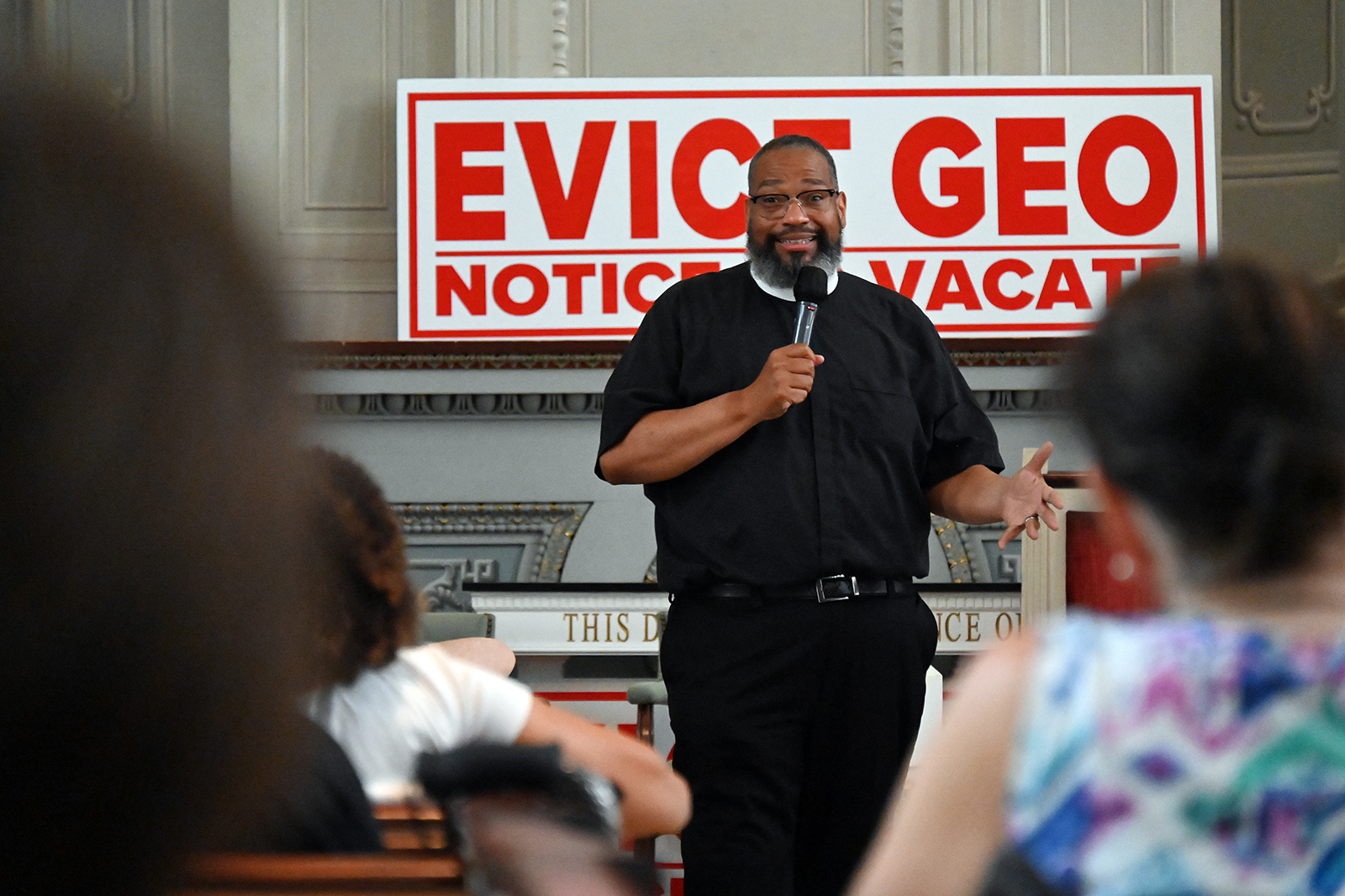
The same slogan was also affixed to the historic pulpit of First Presbyterian Church Newark earlier that day, where the faith leaders gathered for songs and a series of speeches championing immigrant rights. As attendees of the “All Roads Lead to Delaney Hall” event sat in the pews, many cooling themselves with church fans to cut the thick heat that filled the centuries-old sanctuary, which lacked air conditioning, speakers from various religious traditions spoke of a spiritual obligation to oppose Trump and DHS.

Faith leaders gather at First Presbyterian Church Newark prior to a demonstration at Delaney Hall detention center on Monday, July 13, 2026, in Newark, N.J. (RNS photo/Jack Jenkins)

One of the speakers was the Rev. Nontombi Naomi Tutu, the daughter of Archbishop Desmond Tutu, the Anglican priest who famously resisted apartheid in South Africa. An immigrant who serves as an Episcopal priest in California, the younger Tutu said she has walked around with her passport in recent months out of fear of being detained by DHS.

“I lived through apartheid in South Africa,” Tutu said. “I’m not going to live through apartheid in the U.S.”

The room erupted into applause.

Another speaker, Jamie Beran, head of Bend the Arc: Jewish Action, said American Jews are pushing back against DHS as part of a larger effort to “reassert our American Jewish values.”

“Our faith coalition, this faith coalition, has consistently shown us that there is always hope in the face of tyranny,” Beran said. “Because hope is another word for faith.”

Many faith groups were represented in the crowd, but Unitarian Universalists — including the Rev. Sofía Betancourt, the president of the Unitarian Universalist Association, as well as Walker, Tanner and Horan — were a visible presence, many wearing yellow stoles commonly used by ministers in the denomination.

Several speakers tied opposition to mass deportation to broader concerns about authoritarianism, which they argued was being implemented by the Trump administration.


“This has nothing to do with immigration. This is all about fascism,” said Walker. “ICE is a paramilitary force they have chosen to build to come after each and every one of us.”

In an interview with RNS, Walker said she and other faith leaders have been exposed to pepper spray and tear gas while ministering or protesting outside Delaney Hall. Many other activists have also had violent encounters with DHS and local police who have guarded the facility, as well as GEO group employees.

At this protest, however, DHS agents were nowhere to be seen. GEO Group employees stood behind fences, largely avoiding any direct engagement with clergy during the demonstration. When the clergy moved away from the fences, GEO Group employees in blue shirts quietly removed the banners, but left the ribbons attached.

Faith leaders who have been involved in protests at Delaney Hall told RNS the lack of response was unusual, but speculated that authorities may have wanted to avoid directly confronting such a large group of faith leaders. Reached for comment, representatives for GEO Group deferred to ICE. A DHS spokesperson responded to a request for comment on the faith-led protest by pointing to a press release from May rejecting various allegations of inhumane conditions at Delaney Hall as “smears” forwarded by “sanctuary politicians” and “leftist activists.”

Faith leaders demonstrate outside the Delaney Hall detention center on Monday, July 13, 2026, in Newark, N.J. (RNS photo/Jack Jenkins)

About midway through the gathering, the Rev. Anya Sammler-Michael, co-minister of the Unitarian Universalist Congregation at Montclair, stood and noted that reports had emerged of a person being shot and killed in a shooting in Maine that involved ICE personnel. She led the group in a moment of silence, then offered an additional prayer.

“May it be a silence that is a reckoning, a silence that is a reckoning that moves through this room and through these people as we again come together to hold the crimes of our nation in our hearts and our bodies,” she said.

Among the last to speak was Bishop Dwayne Royster, head of the group Faith and Action Network, of which Faith in NJ is an affiliate. He urged attendees to take lessons learned from the gathering home with them and begin organizing in their own communities. 

“We’ve got to make sure that we wake up every day determined that we will not allow another person to suffer in this world,” Royster said. “We’re going to do everything that God has given us — every power that we have, every bit of agency — to make sure that we change this world into a better place.”

Bishop Dwayne Royster speaks at First Presbyterian Church Newark about immigrant rights on Monday, July 13, 2026, in Newark, N.J. (RNS photo/Jack Jenkins)


Building new Swiss nuclear power plant economically viable, report says


The construction of a new nuclear power plant in Switzerland would be economically viable, according to a study carried out by the BAK Economics research institute on behalf of the Swiss business federation Economiesuisse.
 
The Leibstadt plant is expected to go offline in 2044 (Image: KKL)

Currently, Switzerland's four existing nuclear power reactors - two at the Beznau plant and one each at the Gösgen and Leibstadt plants - supply about 36% of the country's electricity and nearly half of its winter electricity. Starting in the late 2030s, they will be decommissioned one by one as they reach the end of their technical service life. The final plant (Leibstadt) is expected to go offline in 2044. Meanwhile, electricity demand is projected to rise by up to one-third by 2050 due to electrification. The resulting winter electricity gap serves as the starting point for this study.

The study - titled Economic Impact of Replacing Swiss Nuclear Power Plants - examines whether the construction of new nuclear power plants, in addition to the expansion of renewable energies, would be economically viable. Using a model-based impact analysis, it quantifies the direct effects that the construction and operation of a new nuclear power plant would have on Swiss gross domestic product (GDP), employment, and tax revenues for the federal, cantonal, and municipal governments. Broader benefits arising from the infrastructure role of a nuclear power plant are assessed in the context of existing studies.

Under the current policy framework of the Electricity Act, the baseline scenario assumes the continued expansion of renewables as well as the construction of an EPR-type nuclear power plant with an installed capacity of 1.63 GW, scheduled to come online in 2050. The plant would generate 12.1 TWh of electricity annually - with around 6.7 TWh produced in winter - thereby covering about 15% of projected winter consumption. This would reduce structural import dependency and help stabilise seasonal price peaks. Despite conservative cost assumptions, risks regarding delays and cost overruns remain, as evidenced by previous EPR projects in Europe, the study says.

The model-based impact analyses reveal significant economic effects across several levels. The investments would generate a cumulative domestic value added of CHF7.4 billion (USD8.0 billion); around 51% of the construction costs would be retained within Switzerland as value added. Once operational in 2050, the plant would generate CHF1.2 billion in annual value added (both direct and indirect) along the value chain, plus an additional CHF240 million per year through dynamic effects - specifically, the impact of lower electricity costs on households, businesses, and export competitiveness. All figures are stated in 2024 prices.

The EPR life-cycle analysis indicates that, over a 60-year operational period, the project generates an annual value-added impact of CHF1.6 billion and supports 2,905 jobs. Direct taxes paid by individuals and legal entities to the federal, cantonal, and municipal governments amount to about CHF95 million per year. Thus, for every franc of subsidy invested - adjusted for the state subsidy component - there is a net GDP impact of CHF1.50 and tax revenue of CHF0.15.

When infrastructure, climate, and environmental effects are also taken into account, the total economic benefit increases to as much as CHF5.20 per franc of funding. The subsidy requirement per kWh is in a similar range to that found in other recent studies and is roughly the same as for renewable energies.

"If the current ban on new nuclear power plants were lifted, Switzerland could, if necessary, replace its existing nuclear power plants with modern facilities and thus close part of the expected winter electricity gap," Economiesuisse said.

A new Swiss energy policy was sought in response to the March 2011 accident at the Fukushima Daiichi plant in Japan. Two months later, both the Swiss parliament and government decided to exit nuclear power production. The Energy Strategy 2050 initiative drawn up by the Federal Council came into force on 1 January 2018 and calls for a gradual withdrawal from nuclear energy. It also foresees expanded use of renewables and hydro power but anticipates increased reliance on fossil fuels and electricity imports as an interim measure.

In August last year, Switzerland's Federal Council presented draft legislation that would remove the country's ban on the construction of new nuclear power.

A study by ETH Zurich and the Paul Scherrer Institute, published in late June, concluded the construction of new nuclear power reactors in Switzerland is not competitive under current conditions, but would become profitable with state subsidies, risk mitigation and significantly lower construction costs.


Fusion industry raised USD4.5 billion in past year, report says


A total of USD4.48 billion was raised by the fusion industry in the year to July, the highest total in the six years the Fusion Industry Association has been reporting the annual figure.
 
(Image: FIA)

The figure, which was included in the association's The Global Fusion Industry in 2026 report, saw 56 fusion companies surveyed and brings the total raised over the six years to USD14.24 billion.

Major contributors to this year's figure were Commonwealth Fusion Systems, which raised USD863 million, Proxima Fusion, which raised USD518 million, Helion Energy, which raised USD465 million, and Inertia Enterprises, which raised USD450 million.

Also featuring for the first time was investment in companies planning to go public, with TAE Technologies and General Fusion both having listed their shares on the Nasdaq stock market.

The Fusion Industry Association (FIA) report says that five companies have a power purchase agreement - including Microsoft with Helion Energy and Google with Commonwealth Fusion Systems - offtake agreement "or similar commercial commitment". Six have a siting agreement, with four more "evaluating options".

Among the 56 companies surveyed by the FIA, 48% are focusing on magnetic confinement, 21% on inertial confinement and 14% on magneto-inertial. And nearly three-quarters of the companies - 71% - expect to see a fusion power plant delivering power to the grid "by the 2030s".

The key short-term challenge identified was funding, with longer-term challenges led by the availability of neutron-resilient materials, power efficiency and tritium self-sufficiency.

Andrew Holland, CEO of the US-based Fusion Industry Association, which describes itself as the voice of the world's private fusion industry, said: "This year's report shows how far fusion has come - from being defined by national labs and government R&D programmes to being dominated by private fusion investment totalling over USD4 billion in just one year. I'm confident that the sector has the ability to deliver commercial fusion in the 2030s. The existence of siting agreements and power purchase agreements shows that commercial fusion energy is on the horizon.

"However, alongside private investment, fusion companies still need the support of governments to address common challenges including the availability of resilient materials and the fusion fuel cycle. The governments that update their programmes and funding priorities to meet the sector's needs today will be the ones to capitalise on this vital emerging industry."


Masdar Secures $5.1 Billion for World’s Largest Solar-and-Battery Project

Masdar on Monday announced it had lined up financing for the world’s first gigascale Round-the-Clock renewable energy project, which the renewable energy giant of the United Arab Emirates is developing in Abu Dhabi.

The project, which will need a total capital investment of $6.1 billion, will see Masdar funding $1 billion of the equity. The company now reached financial close on a $5.1 billion financing package backed by a consortium of 13 leading international and local banks.  

The banks include Abu Dhabi lenders, as well as financial institutions from China, Hong Kong, Japan, and France, including BNP Paribas and Societe Generale, as well as Standard Chartered Bank.

The financing package “demonstrates strong market confidence in both the project’s commercial viability and Masdar’s ability to deliver complex energy infrastructure at scale,” the UAE company said today.

The gigascale project will comprise a 5.2-GW solar photovoltaic (PV) plant with a 19 gigawatt-hour battery energy storage system. It is being developed by Masdar and Emirates Water and Electricity Company.

“Integrating RTC is the largest and most technologically advanced system of its kind in the world,” the UAE’s renewable energy giant said.

Masdar, which broke ground on the project in October 2025, expects it to be operational in 2027.

“The 24/7 renewable energy project remains a cornerstone of the UAE’s clean energy strategy, contributing to energy security and economic diversification,” the company said.

Currently, Masdar has a diversified portfolio of more than 65 GW in solar, onshore wind, offshore wind, battery energy storage, and hybrid solutions. 

The company aims to have 100 GW of renewable energy capacity globally by 2030 and to become one of the world’s biggest renewable energy firms. Masdar’s shareholders are Abu Dhabi’s national oil and gas giant ADNOC, Abu Dhabi’s sovereign investment company Mubadala, and state utility giant TAQA.

By Charles Kennedy for Oilprice.com