Tuesday, July 14, 2026

 Opinion

Beyond the End Times: What evangelical support for Israel really reveals 
(RNS) — For many evangelicals, Israel is not just a sign of the End Times. It is also the homeland of a people they believe God has chosen and whom Christians are called to love. 
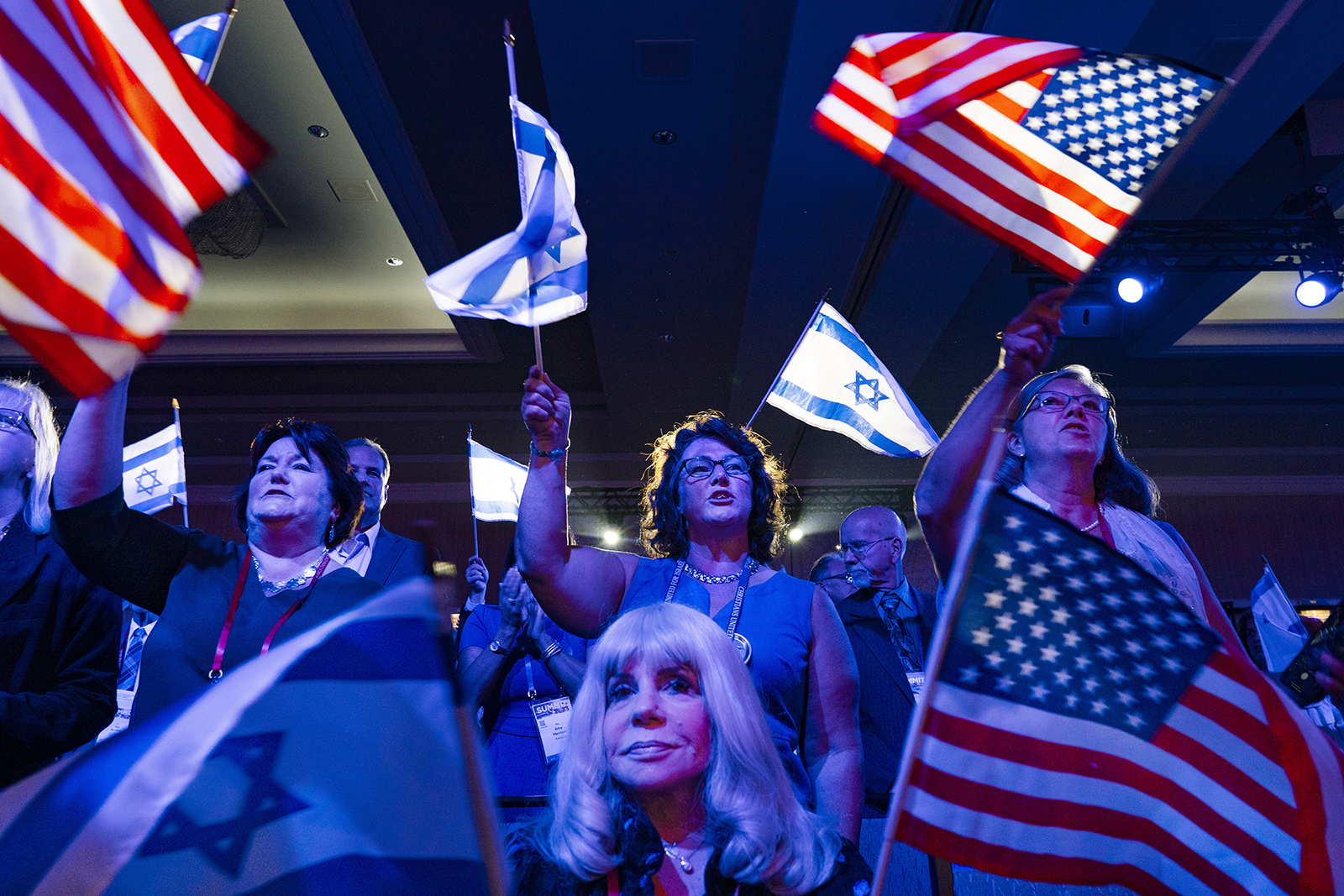
A crowd of mostly evangelical Christians wave U.S. and Israeli flags during the Christians United for Israel (CUFI) "Night to Honor Israel" event during the CUFI Summit 2023, Monday, July 17, 2023, in Arlington, Va., at the Crystal Gateway Marriott. (AP Photo/Jacquelyn Martin)


(RNS) — American evangelicals are often described as some of Israel’s strongest supporters, but also among its most misunderstood. The familiar critique is that they care about Israel because the modern Jewish state fits their expectations about the End Times and that Jewish people matter primarily because of the role they are believed to play in Christian eschatology.

That critique persists because many evangelicals hold strong beliefs about biblical prophecy, Jerusalem, the return of Christ and the theological importance of the Jewish people. Yet that is too simple. Evangelical support for Israel is often connected to theology, but that does not mean it is merely instrumental.

For the past eight years, we have studied evangelical public opinion toward Jews, Judaism and Israel. Our earlier work found that religious motivations remain the primary drivers of evangelical support for Israel but are not reducible to predictions about the imminent end of the world. They are also shaped by the belief that Jews remain God’s Chosen People today and enduringly.

Our recent survey research suggests something more surprising: Although doctrinally committed evangelicals are more likely to hold strong End Times beliefs, their support for Israel is not driven by eschatological urgency. It appears alongside, and in some ways, despite those beliefs. 

In December 2025, we commissioned an online survey of 3,800 self-identifying evangelicals and mainline Protestants in the U.S. The data was weighted to align with population estimates from Pew’s 2024 Religious Landscape Study. Credibility intervals ranged from ±1.9 to ±2.3 percentage points per question. Because the survey used non-probability sampling, we report credibility intervals rather than a traditional margin of error.

One challenge in studying evangelical opinion is that “evangelical” is both a label and a theological category. To address that complexity, we used the doctrinal framework developed by the National Association of Evangelicals (NAE). Under that framework, respondents are classified as evangelical if they strongly affirm four core beliefs: biblical authority, evangelism, Christ’s atoning death and salvation through trust in Jesus Christ alone. 


We distinguished between respondents who strongly endorsed all four statements, whom we describe here as “doctrinally evangelical” and other Protestant respondents. In our sample, 45% of self-identified evangelicals and 22% of self-identified mainline Protestants met the NAE threshold. 

As expected, doctrinally evangelical respondents were much more likely than other Protestants to connect contemporary events to biblical prophecy. Asked whether “We are living in or nearing the End Times” and whether “The Modern State of Israel represents the fulfillment of biblical prophecies,” roughly half of all Protestant respondents agreed at least somewhat. Among doctrinally evangelical respondents, agreement was much higher, ranging from 75% to 85%. 

The more important question is whether belief in prophecy necessarily means evangelical support for Israel is conditional, manipulative or indifferent to Jewish well-being in the present. Our data suggests that it does not. 

Consider the statement: “Christians should love and support Jewish people whether or not they accept Jesus as Messiah.” Nearly two-thirds of doctrinally evangelical respondents, 64.3%, strongly agreed. By comparison, 44.1% of other Protestants strongly agreed. When those who “somewhat agree” are included, 87.1% of doctrinally evangelical respondents affirmed the statement, compared with 78.6% of other Protestants. 

This matters because one common critique of evangelical support for Jews is that it is ultimately conditional on converting Jews. Our survey does not suggest that evangelicals have abandoned their missionary convictions. The doctrinal measure we used includes the belief that encouraging non-Christians to trust in Jesus Christ is personally important. But the data shows that these respondents do not see love and support for Jewish people as dependent upon Jewish acceptance of Jesus. 
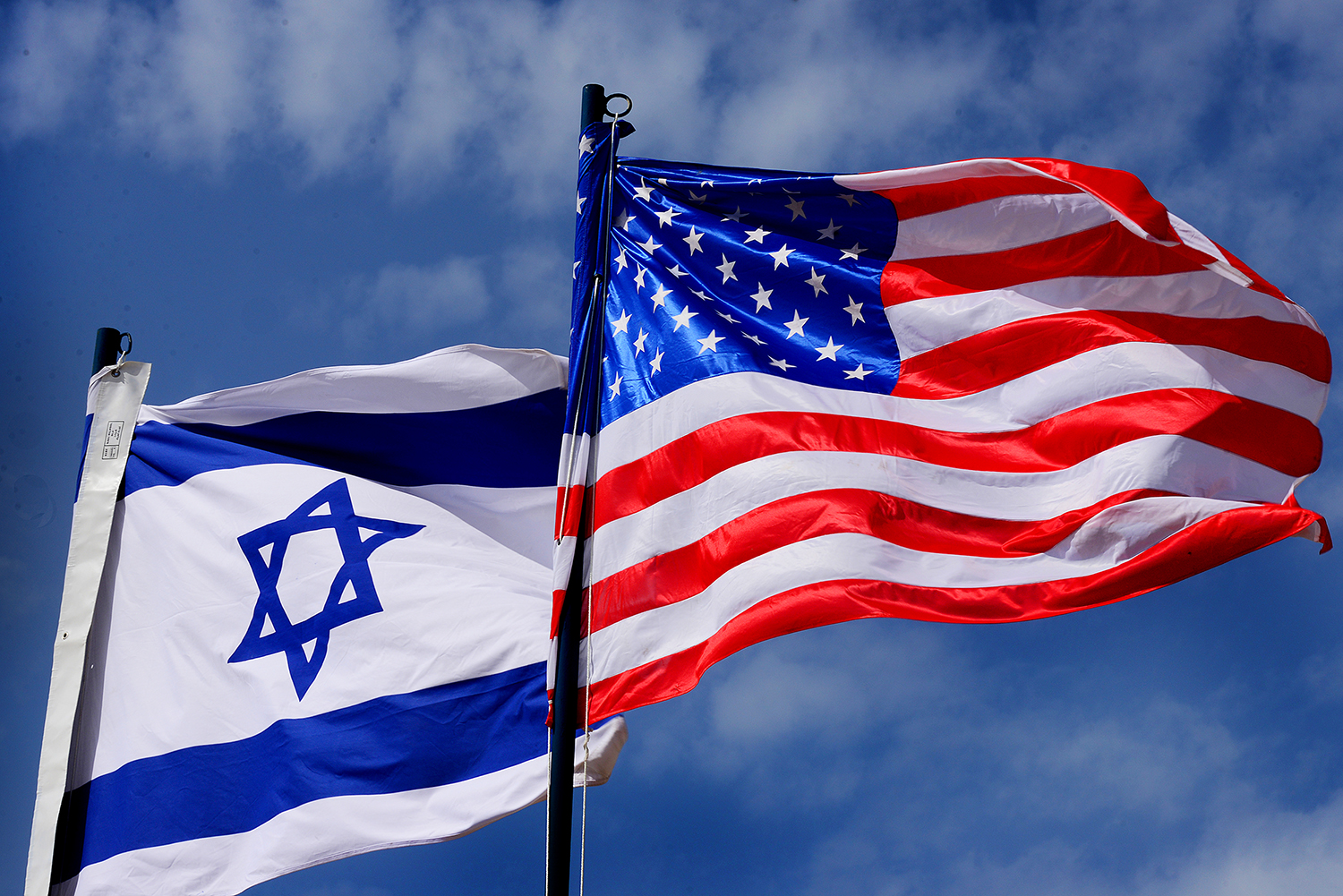
The flags of Israel and the United States wave above an Israeli Defense Forces site, Feb. 23, 2018. (U.S. Air Force photo/Tech. Sgt. Matthew Plew)

We also asked respondents to consider the statement: “My support for Israel comes from caring about the Jewish people today, not from beliefs about the End Times.” A majority of doctrinally evangelical respondents, 67.3%, agreed, slightly exceeding the share of other Protestants, 64.3%, who said the same. This is striking, because doctrinally, evangelical respondents were also most likely to hold strong End Times beliefs. More importantly, when we account for NAE theological commitment, belief in the Abrahamic covenant, religious socialization, ideology and other factors, End Times belief does not independently explain support for Israel. 

A similar pattern emerges when we ask about dignity and rights in the Holy Land. We asked whether “Christian support for Israel can be grounded in concern for the dignity and rights of all peoples in the Holy Land.” A majority of doctrinally evangelical respondents, 57.2%, strongly agreed, compared with 33.4% of other Protestants. When strong and moderate agreement are combined, 83.7% affirmed this inclusive moral framing, compared with 73.1% of other Protestants. 

That finding challenges the assumption that strong evangelical support for Israel necessarily entails indifference to Palestinian dignity or broader human rights concerns. Our data does not show that evangelicals are neutral in the Israeli-Palestinian conflict. They tend to favor Israel over the Palestinians. But their pro-Israel convictions do not automatically translate into a rejection of universal moral concern. 

The most delicate finding concerns Jewish covenantal identity. We asked whether “God offers Jews a path to Him through their covenant, just as Christians have theirs through Jesus.” A majority of doctrinally evangelical respondents, 50.9%, strongly agreed, compared with 34.2% of other Protestants. This should not be read as proof that evangelicals have adopted a formal dual-covenant theology. Such a view would sit uneasily with evangelical teaching about salvation through Jesus Christ. 

What the finding does reveal is that many doctrinally evangelical respondents express more generous views toward Jewish people than their non-NAE Protestant counterparts. Their belief in Jewish chosenness appears to shape their attitudes in ways not captured by the caricature of Jews as mere instruments in a Christian End Times drama. The impulse seems to be one of respect rather than erasure. 


Taken together, these findings invert a common stereotype. The group most likely to believe that the modern State of Israel has prophetic significance is also the group most likely to say Christians should love and support Jewish people whether or not they accept Jesus as Messiah. The group most likely to believe we are living in or nearing the End Times is also highly likely to say its support for Israel comes from caring about Jewish people today. 

None of this means evangelical support for Israel is simple, or that it should be immune from criticism. Some evangelicals speak about Israel in ways that Jewish listeners find troubling, and some Christian rhetoric about prophecy can make Jews feel viewed less as neighbors than as symbols. 

But criticism should be based on what people actually believe, not only on the most suspicious interpretation of their theology. Our survey suggests that among doctrinally committed evangelicals, support for Israel is not merely eschatological or instrumental. It is bound up with a belief in the ongoing significance of the Jewish people, a sense of moral obligation toward Jewish flourishing and a desire to honor Jewish dignity. 

For many evangelicals, Israel is not just a sign of the End Times. It is also the homeland of a people they believe God has chosen and whom Christians are called to love. 

(Motti Inbari is a Jewish studies professor at UNC Pembroke. Kirill Bumin is associate dean of Metropolitan College at Boston University. They are the authors of “Christian Zionism in the Twenty-First Century.” The views expressed in this commentary do not necessarily reflect those of Religion News Service.) 

 Opinion

AI will make war worse, Pope Leo warns

(RNS) — Technology, detached from ethics and responsibility, will make wartime decisions about life and death more rapid and impersonal, the pope writes.
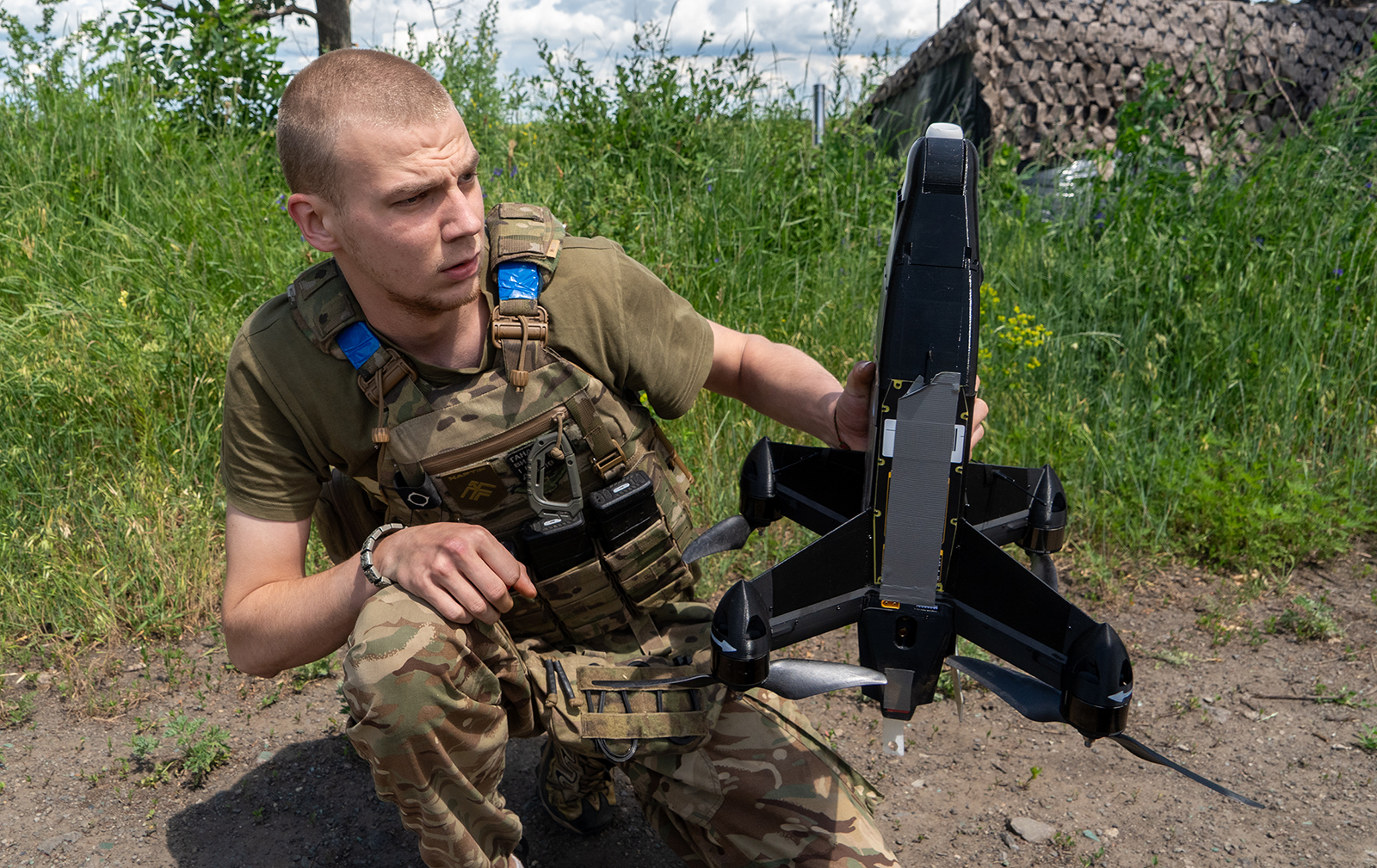
A Ukrainian serviceman of Khartia brigade launches an interceptor drone in Kharkiv region, Ukraine, Friday, June 26, 2026. (AP Photo/Andrii Marienko)


This is the fifth of a series of columns by the author on Pope Leo XIV’s first encyclical, “Magnifica Humanitas.” This piece focuses on Chapter 5. For earlier columns, see Chapter 1, Chapter 2,  Chapter 3 and Chapter 4

(RNS) — In the final chapter of “Magnifica Humanitas,” Pope Leo XIV’s first encyclical, he turns his attention to the dangers of using artificial intelligence in war.

Leo acknowledges that “AI can enhance the defense and protection of civilians.” He might be thinking Ukraine using defensive drones to knock down Russian drones attacking cities and killing civilians. Ukrainians are so good at this that Persian Gulf states are asking for Ukraine’s help defending themselves from Iranian attacks.

But in a culture of power that seeks to dominate, Leo warns, AI “can also lower the threshold for the use of force, shield people from responsibility and foster a culture in which the enemy is reduced to a statistic and the victim to ‘collateral damage.’”

“Technology, detached from ethics and responsibility,” Leo explains, “will render decisions about life and death more rapid and impersonal, and will present the use of force as an immediate and viable option.”


To make sure technologies truly serve humanity rather than subjugating it, Leo argues that they must be judged by the principles of Catholic social teaching.

What is needed, according to Leo, is a culture of love — “a social order in which justice and charity are intertwined and love becomes the guiding principle of economic, political and cultural life.” AI, in that context, must “serve to build a universal human family, with shared rights and duties, where digital proximity becomes a real opportunity for encounter and mutual care,” he suggests.

But this is made difficult by a culture of power where “the availability of resources and the ability to dominate tend to dictate the agenda and criteria for decision-making.”

Leo points out that “the past sixty years have been marked by conflicts of astonishing brutality, often affecting civilian populations on a massive scale, leading to the death of innocent victims, mass displacement, social destabilization and long-lasting wounds.”

President Donald Trump got elected after condemning these “forever wars,” but then started a war with Iran.

Leo criticizes the “military-industrial complex” and countries that supply weapons and “profit from a market that thrives precisely on conflicts.” The United States is the biggest arms exporter in the world. Meanwhile, the real cost of military spending “falls on the poorest, who see resources for health care, education and social services being reduced.” 

“Without prejudice to the right to self-defense in the strictest sense,” the pope affirms that the “just war” theory, “which has all too often been used to justify any kind of war, is now outdated.”

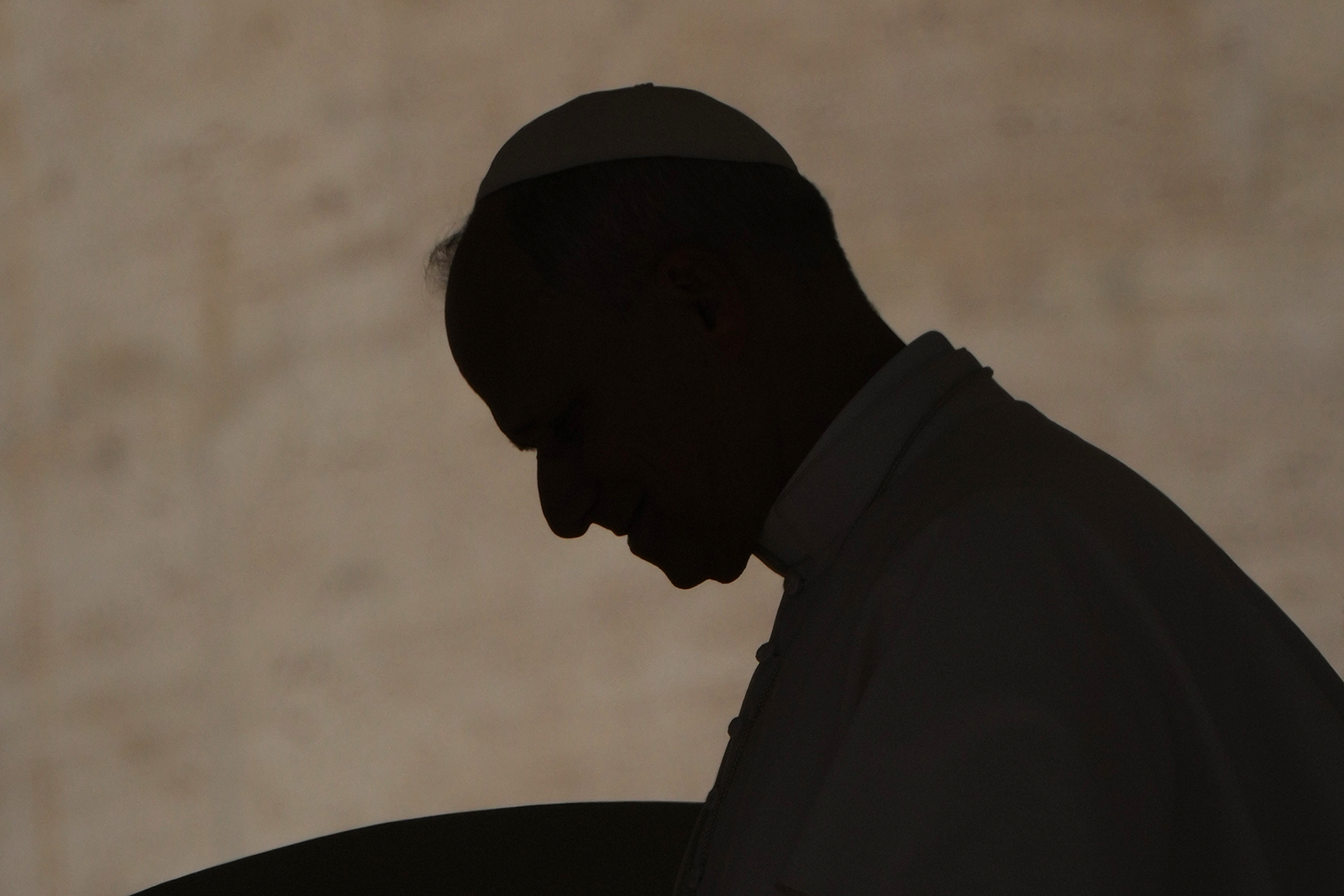
Pope Leo XIV at the Vatican, Oct. 8, 2025. (AP Photo/Andrew Medichini)

As an American, he must be aware of how conservative Catholics have used the just war theory to defend American wars in Vietnam and the Middle East. Rather, he argues, “Humanity possesses far more effective and capable tools for promoting human life and resolving conflicts, such as dialogue, diplomacy and forgiveness.”

Leo goes on to bemoan the weakening of multilateral institutions and systems responsible for the global common good. He does not mention the Trump administration, which has rejected multilateralism, but the shoe fits.

“Peacebuilding has been relegated to a secondary role,” Leo complains. “Cooperation for development, disarmament, conflict prevention and the establishment of mutual trust are neglected in the name of power politics. The achievements of humanitarian law are also being compromised. Indeed, the principle of proportionality in responding to aggression, the protection of access to water, food and essential goods, and respect for the lives of civilians, especially children, come to be regarded as naïve relics of the past.”

While fearing that autonomous weapons systems will make war “more feasible and less subject to human control,” he urges “instilling, as far as possible, values and sound judgment into the artificial systems we build.”

But when they fail, “The chain of responsibility must be identifiable and verifiable,” he says. “Those who design, train, authorize and employ technology must be held accountable for their decisions.”

Nor should speed and efficiency “be the supreme motivating force for the irreversible decisions made in the context of war,” he writes. “Target selection and the use of force must not confuse combatants and non-combatants, nor ignore the impact on defenseless populations.”

The pope brands Realpolitik — “the form of political ‘realism’ that sows in consciences and in society an attitude of resignation to the inevitability of war, and dismisses peace and dialogue as utopian or irrational positions that ignore the risks at stake” — as truly irresponsible.

Instead, Leo calls on everyone to build a civilization of love. “The civilization of love will not arise from a single or spectacular gesture,” he explains, “but from the sum total of small and steadfast acts of fidelity that serve as a bulwark against dehumanization.”

He then proposes five paths toward daily, public responsibility: “the need to disarm words, building peace through justice, adopting the perspective of victims, cultivating a healthy realism and reviving dialogue and multilateralism.”

He calls on us to “examine our conscience regarding the words we use, the prejudices we have and the explicit or implicit aggression that lies within them.”

He affirms that true peace is born of justice. Quoting St. Augustine, he writes, “Do you therefore wish to attain peace? Then practice justice!”

But in some conflicts, he acknowledges it is unjust to remain neutral. “When we witness the bombing of civilians, attacks on hospitals, schools or vital infrastructure, and violence that affects children, we are confronted with scandals that wound humanity itself,” he writes. Fighting in the Middle East too often follows this pattern, although Leo again fails to name names.

If we listen to the voices of victims, he states, we “become aware of the abyss of evil inherent in war, and generally in all forms of violence.”

Leo also calls for “a healthy realism that avoids both political idealism and cynicism.” A healthy realism “starts by clearly identifying interests, fears, constraints and power dynamics, precisely in order to determine what can be achieved, and the measures needed to achieve it.”

“There is an urgent need,” he says, “to shift from the ‘culture of power’ to a genuine ‘culture of negotiation,’ in which dialogue and diplomacy become the standard means of resolving conflicts.”

Leo believes that “if we experience authentic encounters with others, with those who are different, strangers and migrants, it becomes much more difficult even to imagine war.”

On the other hand, “Communication networks, fragmented information environments and algorithms that reward conflict,” he says, “can magnify polarization and resentment, increase propaganda and make shared discernment more difficult.”

“Cyberspace too has become a battleground,” Leo notes. “Cyberattacks, data manipulation and campaigns of influence, orchestrated with the help of AI, can destabilize entire countries even before open armed conflict erupts.”

He therefore calls for negotiations to develop “shared regulations on the use of digital technologies, in order to protect civilians and the most vulnerable from ‘invisible’ yet real forms of violence.”

Many will think that calling for diplomacy, dialogue and a civilization of love is naïve, but the alternative is constant war. Leo sees this and wants to put the Catholic Church on the side of peace. This is urgent, before AI makes war even more inevitable and dangerous, he argues.


Vatican-backed priest tours US to visit immigrant advocates, community organizers

(RNS) — 'This is completely terrible, and we cannot be silent in front of this,' the Rev. Mattia Ferrari, the coordinator of World Meeting of Popular Movements, told RNS about the killing of Lorenzo Salgado Araujo.
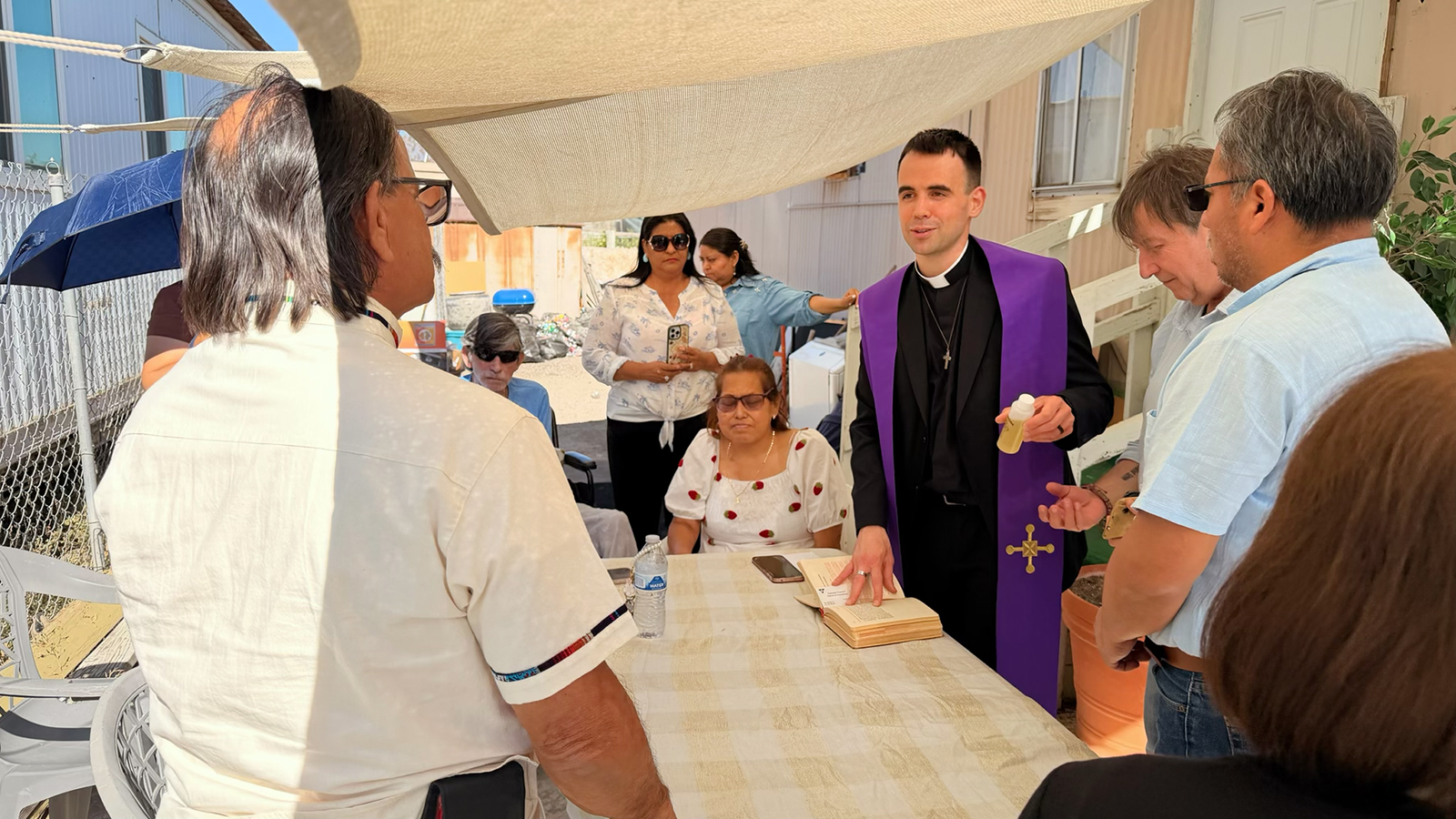
The Rev. Mattia Ferrari, center right, visits local farm workers and annoints the sick in California's Coachella Valley on June 21, 2026. (Photo courtesy of Catholics in Communion)

(RNS) — When the news broke that Lorenzo Salgado Araujo had been shot and killed by an Immigration and Customs Enforcement agent as he drove his construction crew to work in Houston last week, a Vatican representative was meeting with immigrant families at a Houston Catholic parish. The families were sharing about the intense levels of fear their community has been experiencing.

“This is completely terrible, and we cannot be silent in front of this,” the Rev. Mattia Ferrari, coordinator of World Meeting of Popular Movements, told RNS about the killing of Salgado Araujo.

On his multi-city tour of the U.S., Ferrari has heard from many immigrants experiencing fear, family separation and even detention. “They are suffering something that is completely unfair, completely unjust,” Ferrari said, calling Salgado Araujo’s death “the top of the sufferings.”

The World Meeting of Popular Movements was first convened at the Vatican with Pope Francis in 2014, and since then the Vatican’s Dicastery for Integral Human Development has “accompanied” the initiative, which emphasizes poor and marginalized people as “protagonists” in the fight for justice.

“ We are here to serve, not to lead,” said Ferrari of the church’s role, highlighting grassroots leadership.

Last fall, Pope Leo XIV told the convening, which has historically called for land, housing and work for poor people, “The Church must be with you: a poor Church for the poor, a Church that reaches out, a Church that takes risks, a Church that is courageous, prophetic and joyful!”

The Rev. Mattia Ferrari, right, meets with youth leaders in the Archdiocese of Seattle, Wednesday, July 1, 2026, during a six-week tour of the United States. (Photo courtesy of Catholics in Communion)

Leo also emphasized that the poor are at the center of the gospel. “Therefore, marginalized communities…must be involved in a collective and united effort aimed at reversing the dehumanizing trend of social injustices and promoting integral human development,” he said. 

Ferrari’s tour was planned after Ferrari expressed “curiosity” at last fall’s convening to see and hear from people on the ground who are confronting the “cost of living and immigration tension” in the U.S., said Cecilia Flores, who coordinated the tour in her volunteer role with a coalition called Catholics in Communion, which was founded late last year to respond to the “pastoral emergency” of mass deportations.

Ferrari is now halfway through a nearly six-week tour to 21 cities and regions across California, Washington state, Texas, Colorado, Pennsylvania, Minnesota, Indiana, Michigan, Louisiana, Washington, D.C., New Jersey and New York, carrying the Catholic church’s message of support to faith-based community organizing groups throughout the U.S.

He and his fellow delegation members  “sit and listen and ask just such deep questions, but in such a gentle and pastoral and loving way,” said Flores.

Ferrari is traveling with Luca Casarini, the founder of Mediterranea Saving Humans, which has reacted to the deaths of thousands of migrants crossing the Mediterranean by crewing a ship for sea rescues. Ferrari is the group’s chaplain. Leo spent July 4, the 250th anniversary of the U.S. adoption of the Declaration of Independence, at Lampedusa, a common destination for those crossings.

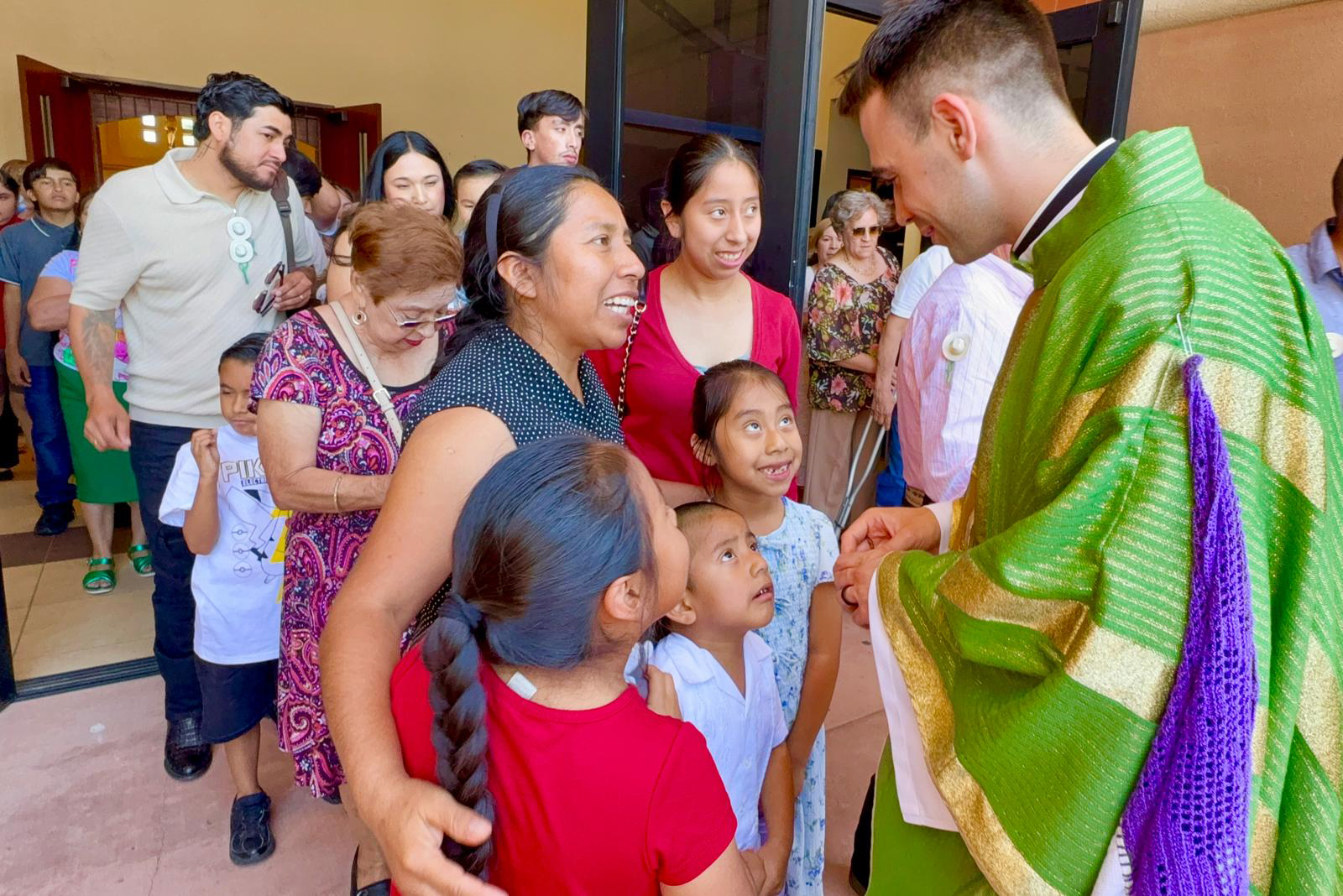
The Rev. Mattia Ferrari, right, greets parishioners after celebraing a Mass at Our Lady of Guadalupe Church, on June 21, 2026, in Mecca, Calif. (Photo courtesy of Catholics in Communion)


The third member of the delegation for the U.S. tour is César Piscoya, an adviser to the Latin American bishops’ conference’s (CELAM) Center for Pastoral Action Programs and Networks. Piscoya, a lay theologian and longtime friend of Leo’s, was a missionary with the Augustinians, Leo’s order, and then worked with then-Bishop Robert Prevost when he led the Diocese of Chiclayo, Peru.

“ Something they keep saying is, they’ve seen a suffering they didn’t really know existed in the United States,” said Flores, who is the executive director of the Catholic Volunteer Network when she isn’t volunteering with Catholics in Communion. “ A lot of people share that the image that they have learned of the U.S., whether that’s through media or how they were told growing up, they get here and they see it’s really not as easy as people might think it is.”

But the delegation is also seeing “ a church that is uniting to take care of one another and to embody what it means to be the body of Christ, to move in defense of the dignity of each person on this earth and in this country,” said Flores.

Across the U.S., immigration has been a core focus of the trip. “ This is a matter of love, a matter of human dignity, a matter of the gospel. Because what these people are suffering — this pain — is also our pain because we are brothers and sisters,” said Ferrari.

But immigration has not been the only issue raised by the tour. In Houston, the delegation visited a dialysis center for people without insurance that The Metropolitan Organization of Houston advocated for, and in Pittsburgh, Ferrari heard from local labor and environmental leaders about the challenges of abandoned gas wells and the transformation of the energy economy.

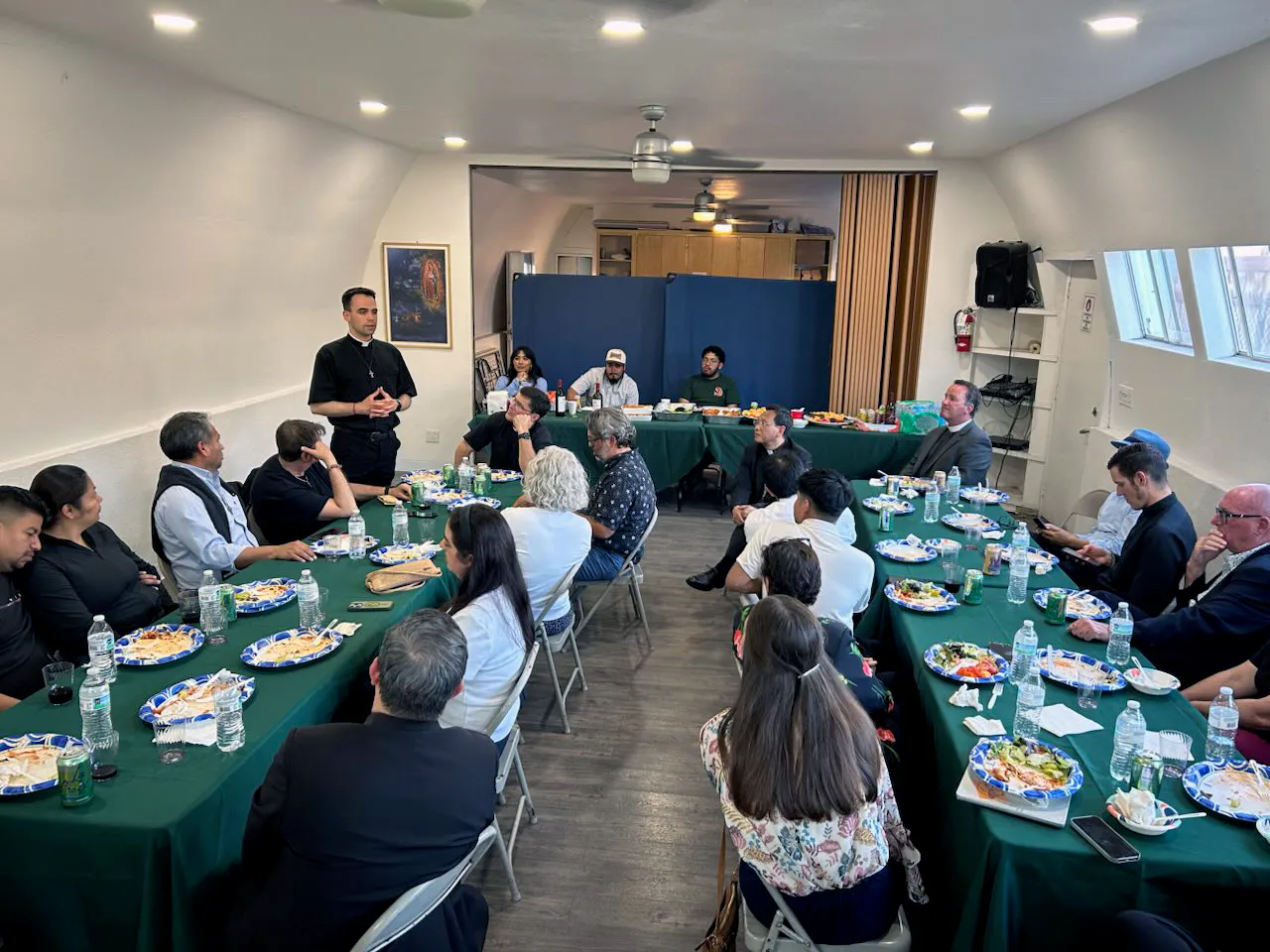
The Rev. Mattia Ferrari, standing left, addresses a gathering of bishops and community leaders, June 22, 2026, in San Diego. (Photo courtesy of Catholics in Communion)

In San Diego, the delegation joined diocesan-backed teams to accompany immigrants to court hearings and ICE check-ins. Ferrari said that he was moved by witnessing immigrants’ initial tears of fear and pain become tears of solidarity when they knew they would be joined by the volunteers.

In Monterey Bay, California, the delegation toured rural farm-working communities and attended an event at a Catholic parish to enroll immigrants without legal status in public healthcare, an initiative that the local Industrial Areas Foundation affiliate Communities Organized for Relational Power in Action had fought for.

Liz Hall, who is the supervising organizer for the IAF in Monterey Bay, recalled Ferrari’s comments that the healthcare initiative showed “the miracle of solidarity.”

“ I don’t think he realized how much that meant to the people in the room to hear someone who came from the Vatican to this very rural, kind of forgotten part of the state” say those words, Hall said. 


In Los Angeles, Ferrari’s delegation attended a public hearing hosted by local IAF affiliate One LA where immigrants shared their experiences of the mass deportation campaign, including witnessing violent detentions.

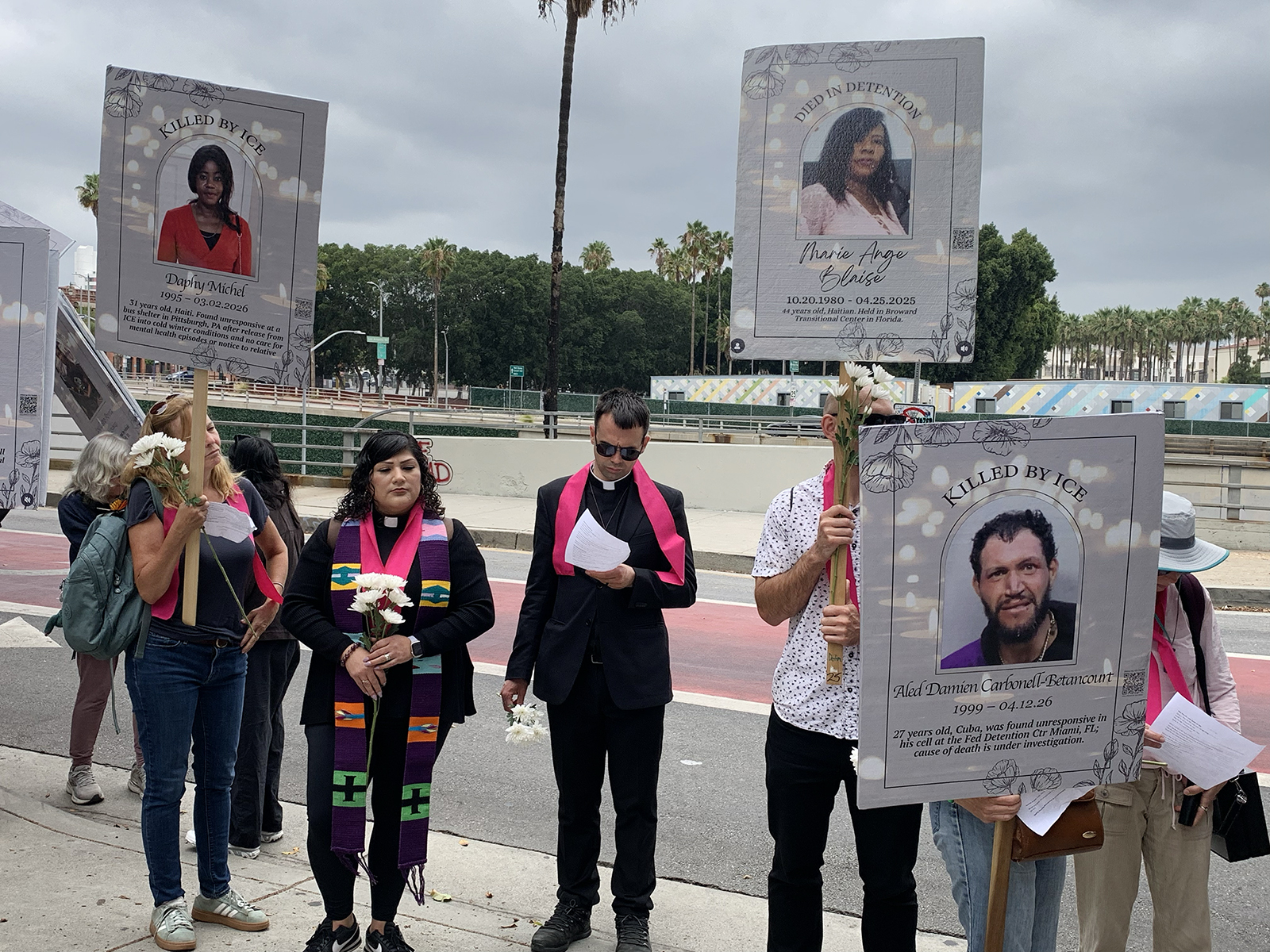
The Rev. Mattia Ferrari, center, coordinator of World Meeting of Popular Movements, attends a prayer vigil in front of the Federal Building in Los Angeles. (Photo courtesy of LA Voice)

Emily, a 21-year-old college student studying civil engineering who asked to be identified by her first name because she does not have legal immigration status, said if she had not already enrolled in university, fear of sharing her information would have prevented her from studying.

“I fear that I might just be studying in class, and because universities are public spaces, they could just come in and unfortunately just get us,” she told RNS. 

Testifying to that experience publicly for the first time at the parish she has attended since she arrived from Mexico as a baby was “vulnerable” but empowering, she said. “I just felt so much better, so much, for me to know there were more people (experiencing this) and that the church actually cared about us,” she said.

Robert Hoo, the lead organizer for One LA, said that the impact is widespread. “ It’s recognizing that the Vatican is watching, that the world is watching, that their stories are important not just to themselves and their communities, but that everybody is aware about the injustices that are happening.”

Ortencia Ramirez, a One LA leader who co-chaired the hearing, fought to hold back tears at hearing the experiences of her community. But she too felt hope because of the connection to Leo. “We asked them to take what they observed with the IAF back to the pope, and they agreed that they would,” she said.

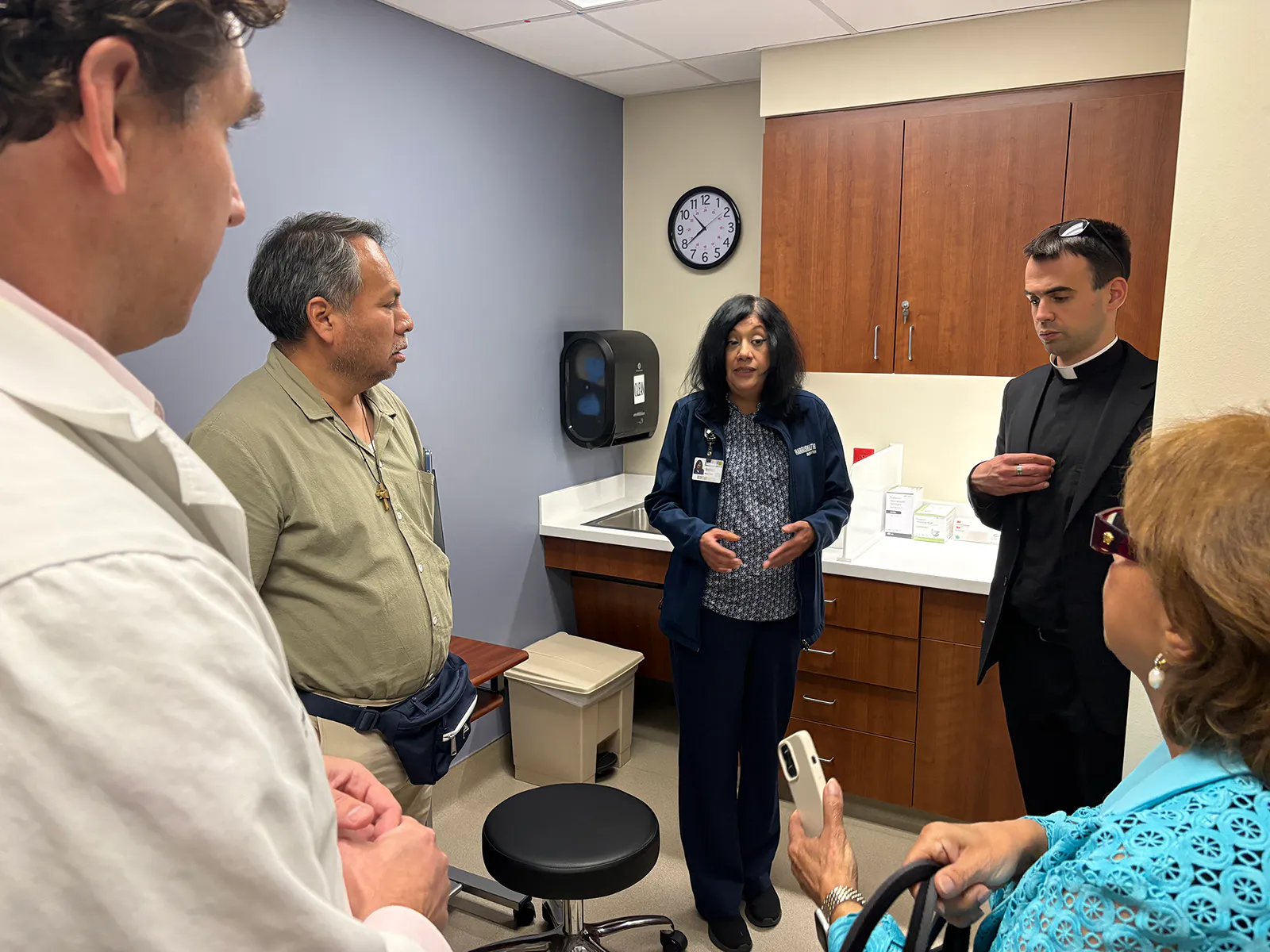
The Rev. Mattia Ferrari, top right, and a touring delegation visit a dialysis center for people without insurance in Houston. (Photo courtesy of Industrial Areas Foundation)

The delegation also participated in a panel of organizers hosted at Dolores Mission, an organizing base for another interfaith group working on immigration, LA Voice, part of the Faith in Action network. Angel Mortel, a lead organizer for the group, said they shared about their efforts to pass California bills imposing high taxes on private immigration detention companies and remove state financial benefits from companies involved in or investing in detention.

For Mortel, the collaboration between LA Voice, One LA and the archdiocese of LA to plan the trip also brought hope for the future. “ This was the first time in my eight years with LA Voice that we’ve done something together,” she said. “ Without that collaboration, it’s just too big a task to take on — to take on the forces that are coming down on us,” she said.

Flores said that connections, resource-sharing and opportunities for formation will be some of the long-lasting impacts of Ferrari’s tour, especially because of the presence of Piscoya, a representative of the Latin American bishops’ conference.

In the majority of cities, Ferrari also met with the local Catholic bishop, and in the few cities where the bishop was unavailable, a staff member.

In Houston, Elizabeth Valdez, director of the IAF in Texas, said that Ferrari and his team were impressed by the key roles that clergy play in forming lay people to be leaders in organizing. “ They had not seen or experienced that anywhere before, even in the visits that they’ve done in other parts of the country,” she said.

But even visiting 21 different cities and regions, Ferrari regretted the parts of the U.S. that he and his delegation were unable to visit. “ We have so much work to do worldwide, so we will be back surely,” he said.