Tuesday, July 14, 2026


Many US Jewish adults have experienced assault or harassment over the past year, AP-NORC poll finds
WASHINGTON (AP) — The findings highlight the vulnerability that many Jewish adults in the U.S. feel as bipartisan support for Israel erodes and significant divides emerge within the Jewish community about what constitutes antisemitism — particularly when it comes to protesting Israel.


WASHINGTON (AP) — Many Jewish adults feel unsafe in the United States, a new AP-NORC poll finds, with a majority saying they feel less safe than they did before Hamas’ Oct. 7, 2023 attack on Israel.

The survey from The Associated Press-NORC Center for Public Affairs Research points to how Jewish adults’ attitudes toward their own personal safety have changed over a relatively short period as more Americans became critical of the United States’ close alliance with Israel. The war in Gaza sparked U.S. protests over Israel’s military actions against the Palestinians in Gaza, and coincided with an increase in violent attacks against U.S. Jewish communities.

The findings highlight the vulnerability that many Jewish adults in the U.S. feel as bipartisan support for Israel erodes and significant divides emerge within the Jewish community about what constitutes antisemitism — particularly when it comes to protesting Israel.

A significant share of Jewish adults, about 3 in 10, say they or someone in their household has experienced physical assault, verbal abuse, online harassment or damaged property because of their Jewish background over the last year, according to the survey.

Hal Guberman, a 30-year-old in New Jersey, wears a kippah with some trepidation ever since a stranger in a passing car yelled a slur at him when he was walking down the street last year.

“That person, they don’t know anything about me. They don’t know my politics. They don’t know my beliefs. They don’t know my viewpoints,” Guberman said. “But they saw me being visibly Jewish, and they made an opinion about me.”

Jewish adults see prejudice against Jews as a serious problem, and many feel unsafe

About 6 in 10 Jewish adults say that prejudice against Jewish people is an “extremely” or “very” serious problem in the United States today, a view that is heightened among Jewish adults who say they are “extremely” or “very” emotionally attached to Israel.

About one-third of Jewish adults say they feel “very” or “somewhat” safe as a Jewish person in the U.S. today, while about one-third feel “very” or “somewhat” unsafe. The remaining roughly 3 in 10 say they feel neither safe nor unsafe. Those with a close connection to Israel or who identify as Jewish by religion — instead of saying they are religiously unaffiliated with a cultural, ethnic or family connection to Judaism — are more likely to feel threatened in the current environment.

About 6 in 10 Jewish adults say they feel “less safe” as a Jewish person in the U.S. than they did before Hamas’ 2023 attack, including about 7 in 10 of those who are religiously Jewish. About one-third of Jewish adults say they feel “about as safe” and very few feel safer.

Erin Baskin, a 36-year-old in Pennsylvania, said the Oct. 7 attacks didn’t change how safe she feels because she had her own experiences with prejudice before then.

“I’ve always grown up with antisemitism,” she said. “Among the rural community I’m in, they conflate Judaism with Zionism all the time. Unfortunately, that’s kind of been my experience. It’s nothing new.”

Some Jewish adults have grown wary of outwardly identifying themselves as Jewish following the Oct. 7 attacks, the survey found.

About 4 in 10 Jewish adults say they are “less likely” to wear, carry or display things that might identify them as a Jewish person than they were before Hamas’ Oct. 7 attack. About half say they are “about as likely” and about 1 in 10 say they are “more likely.”

Caitlin Rosendorn, a 24-year-old in Illinois, said they used to wear a Star of David necklace, but now worries that wearing it could give people the incorrect impression that they support Israel’s attacks against the Palestinian people.

“I don’t want to wear a Star of David to work if that’s going to alienate somebody who sees the Star of David as a symbol of Israel as opposed to a symbol of Judaism,” Rosendorn said. “I don’t want people to get the wrong idea about my views.”

Many Jews report physical assault, property damage or harassment

About 1 in 10 Jewish adults say that in the past year, they or someone in their household has been physically assaulted. A similar share had property damaged or destroyed specifically because of their Jewish background.

About 2 in 10 Jewish adults say they or someone in their household has been called a slur, threatened, verbally harassed or verbally abused. Similarly, about 2 in 10 say they experienced online harassment or cyberbullying. Overall, about 3 in 10 of Jewish adults say that they or someone in their household has experienced at least one of these incidents because of their Jewish background.

Jewish adults who attend religious services at least once a month are much likelier than Jewish adults overall to say they or someone in their household has experienced attacks or harassment over their Jewish background — a finding that comes as there have been several targeted attacks on Jewish religious spaces in recent years.

Slightly less than half of Jewish adults who frequently attend religious services say they or someone in their household has faced verbal harassment. A similar share experienced online harassment, and about one-quarter have dealt with physical attacks or property damage.

Jon Kessler, 38, of California, who grew up in the Conservative tradition of Judaism, believes non-Jews might be surprised at the extent to which Jewish adults have to consider security at community events.

“Most people when they go to church don’t have armed security, but every synagogue has an armed security guard,” Kessler said. “My son’s Jewish daycare has an armed security guard.”

Jews are divided over whether protesting Israel is a form of antisemitism

Protests surrounding speakers tied to Israel — whether Israeli Prime Minister Benjamin Netanahyu’s address to Congress or college speakers seen as either too supportive or too critical of the country — became more common following the backlash over Israel’s war in Gaza.

Jewish adults, in particular, are divided over whether protesting an event related to Israel is an act of prejudice against Jewish people generally. About half of Jewish adults say anti-Israel protests are not a form of antisemitism, but roughly 4 in 10 say they are.

Many anti-Israel protests have been tied to criticism of Israel’s military action in Gaza. More than 73,000 Palestinians have died in Gaza since Israel retaliated against Hamas’ attack in 2023, according to the Hamas-run Gaza Health Ministry, which doesn’t distinguish between civilian and militant deaths.

About two-thirds of Jewish adults say criticizing Israel for its military actions is not a form of antisemitism, but Jewish adults with a close emotional connection to Israel are more likely to say that criticism of Israel’s military actions is antisemitic. That said, relatively few Jewish adults say it’s antisemitic just to criticize Israel for “any reason.”

Americans overall are less likely to say it’s antisemitic to protest an event that is supportive of Israel, or to criticize Israel’s military actions — but they are also much less likely to have an opinion.

Jewish adults are more unified in deeming some actions as definitively antisemitic. The overwhelming majority say vandalizing synagogues or Jewish-owned businesses because of Israel’s actions is antisemitism. The same goes for denying the reality or scope of the Holocaust, putting responsibility for Israel’s actions on Jewish people in the United States, saying Israel shouldn’t exist as a Jewish state or claiming American Jews are more loyal to Israel than to the U.S.

There is less consensus among non-Jewish U.S. adults on whether some of these actions constitute antisemitism, with many saying they’re not sure.

Amanda Goldsmith, 53, who lives in Chicago, believes people have become too comfortable expressing antisemitic views online — something that she previously thought only existed in extremist spaces.

“Now, it seems like there was an undercurrent, and it’s a free-for-all, and everyone is free to say what they want,” she said. “The freedom with which people say horrible things about Jewish people is appalling.”

___

This story has been corrected to show that Caitlin Rosendorn uses they/them pronouns.

___

Associated Press writers Giovanna Dell’Orto in Minneapolis and Peter Smith in Pittsburgh contributed to this report.

___

Associated Press religion coverage receives support through the AP’s collaboration with The Conversation US, with funding from Lilly Endowment Inc. The AP is solely responsible for this content.

___

The AP-NORC poll of 3,040 adults was conducted June 11-17 using a sample drawn from NORC’s probability-based AmeriSpeak Panel, which is designed to be representative of the U.S. population. The poll included interviews with 1,022 Jewish adults. The margin of sampling error for adults overall is plus or minus 2.8 percentage points and the margin of sampling error for Jewish adults is plus or minus 5.0 percentage points.

The Inconvenient Jew Is One of Zionism’s Biggest Problems


by | Jul 14, 2026 |

Reprinted with permission from The Jason Jones Show substack.

Israeli Ambassador to the United States Yechiel Leiter recently offered what he apparently believed was a devastating answer to those decrying the genocide in Gaza.

“Jews do not use children’s blood for rituals,” Leiter said. “Jews do not poison wells. And Jews do not starve populations or commit genocide.”

The smear in this common Zionist talking point is obvious: Those who accuse the Israeli government belong in the same moral category as those who spread medieval blood libels against innocent Jews. To say the regime of Israeli Prime Minister Benjamin Netanyahu has committed genocide is not merely to criticize a government, an army, or a political ideology. It is to accuse “the Jews.”

But there is a growing problem for Zionism and its favorite smear: the moral indignation of Jews.

According to a new AP-NORC poll, 30% of Jewish adults in the United States say Israel has committed genocide against Palestinians in Gaza. Only 49% say it has not. Among religiously unaffiliated Jews, the share rises to about four in ten. Also, only about four in ten Jewish adults believe Israel’s continuing military operations in Gaza are justified, while roughly six in ten view Netanyahu unfavorably.

In light of the grave public perspective of a growing percentage of Jews, the Zionists look more and more foolish. Their go-to argument – if you can even call this substanceless insult an argument – has become an argument ad absurdum: Nearly one-third of American Jews, Zionists believe, are secretly medieval antisemites; Jewish critics of Netanyahu believe Jews poison wells; Jews who watch children starve in Gaza and call it genocide are not morally serious observers but morons trafficking in blood libel … against themselves.

But the absurdity is rapidly leading to yet another Zionist offense – as if a genocide were not enough. Since the inconvenient Jew is now one of Zionism’s biggest problems, the Jew himself – insofar as he accepts the universal human principles that genocide flies in the face of – must be treated as an impossibility.

He cannot be debated honestly, because his very existence blows the argument apart. He proves that Jewish identity does not require loyalty to Netanyahu. He proves that revulsion at starving children is not (forgive the grotesque suggestion – it is not mine but Zionism’s) an anti-Jewish prejudice.

So Zionism does to the inconvenient Jew what it does to every inconvenient person.

It erases him.

He becomes “self-hating,” “brainwashed,” “disloyal,” or – perhaps most insultingly of all – “not a real Jew.”

Insulting, yes. But I should add that to be insulted by a Zionist in 2026 – after nearly three years of genocide in the name of Zionism and yet another bloody campaign explicitly modeled on Israel’s Gaza operation now underway in Lebanon – is a badge of honor.

Let’s look again at Leiter’s formulation. He did not say “The evidence does not prove that the Israeli government has committed genocide.”

He said “Jews do not commit genocide.”

That substitution is doing all the work.

In the place of a morally indefensible government, the Zionist propaganist places an entire people — millions of human beings scattered across countries, cultures, religious practices, and political convictions — summoned as a human shield around the Netanyahu government.

Nothing could be further from a genuine defense of Jews than Zionist rhetoric. It is the opposite: A grotesque use of Jews. And worse: An attempt to make them morally complicit in what – as the polling shows – many of them reject.

Don’t get me wrong, by the way. I’m not addressing myself to Jews, as if I’m in a position to explain their own interests to them. And it should come as no surprise to anyone that, according to the same poll cited above, two-thirds of Jewish adults surveyed already understand (and said in the poll) that criticizing Israel’s military actions is not antisemitic. About half also said anti-Israel protests are not inherently antisemitic.

They get something Israel’s ambassador pretends not to get: attacking a Jewish person because he is Jewish is not the same thing as judging Zionist ideology or the actions of a government operating in its name.

I wrote recently that in light of the spread of the shocking truth about Israel’s conduct in Gaza, the ideology of Zionism is committing suicide by genocide.

This new poll reveals another reason why that’s the case: Jews are among the most convincing witnesses to the genocide. And every time Zionist spokesmen respond by erasing those Jews, they make their own fraudulence more obvious.

And so the Jew now standing in solidarity with the vulnerable Palestinian, is now vulnerable to the same attacks. But – in another twist of fate that makes the Jew very much like the Palestinian – the harder Zionism tries to make inconvenient Jew disappear, the more clearly everyone else can see him.

Your contribution helps VPP maintain the Christian presence in the Holy Land, stand with the families of Taybeh, and keep verified reporting coming from the field. Join VPP’s Save West Bank Christians campaign.

For more from Jason Jones, subscribe to the The Jason Jones Show substack.

 Opinion

Beyond the End Times: What evangelical support for Israel really reveals 

(RNS) — For many evangelicals, Israel is not just a sign of the End Times. It is also the homeland of a people they believe God has chosen and whom Christians are called to love. 
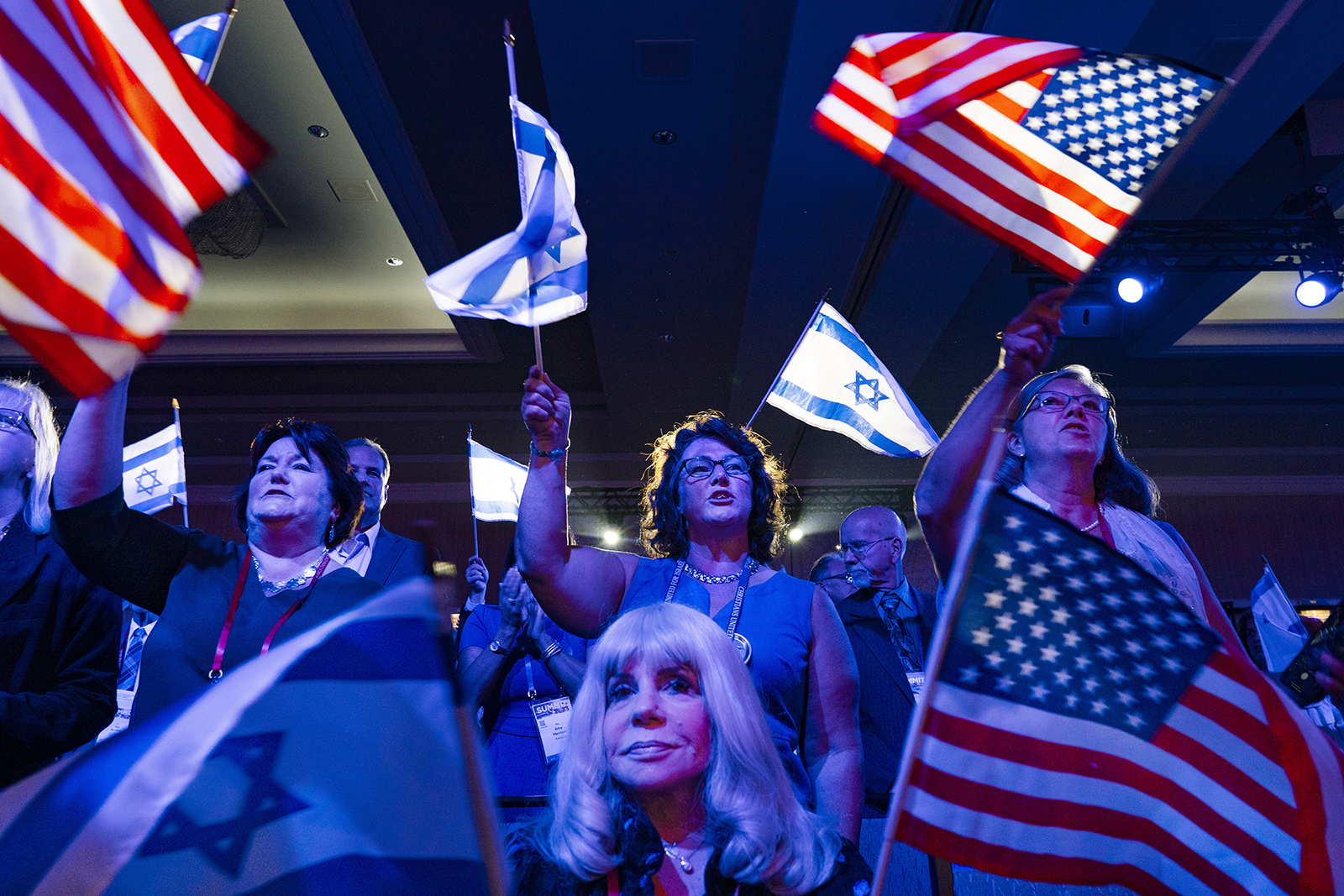
A crowd of mostly evangelical Christians wave U.S. and Israeli flags during the Christians United for Israel (CUFI) "Night to Honor Israel" event during the CUFI Summit 2023, Monday, July 17, 2023, in Arlington, Va., at the Crystal Gateway Marriott. (AP Photo/Jacquelyn Martin)


(RNS) — American evangelicals are often described as some of Israel’s strongest supporters, but also among its most misunderstood. The familiar critique is that they care about Israel because the modern Jewish state fits their expectations about the End Times and that Jewish people matter primarily because of the role they are believed to play in Christian eschatology.

That critique persists because many evangelicals hold strong beliefs about biblical prophecy, Jerusalem, the return of Christ and the theological importance of the Jewish people. Yet that is too simple. Evangelical support for Israel is often connected to theology, but that does not mean it is merely instrumental.

For the past eight years, we have studied evangelical public opinion toward Jews, Judaism and Israel. Our earlier work found that religious motivations remain the primary drivers of evangelical support for Israel but are not reducible to predictions about the imminent end of the world. They are also shaped by the belief that Jews remain God’s Chosen People today and enduringly.

Our recent survey research suggests something more surprising: Although doctrinally committed evangelicals are more likely to hold strong End Times beliefs, their support for Israel is not driven by eschatological urgency. It appears alongside, and in some ways, despite those beliefs. 

In December 2025, we commissioned an online survey of 3,800 self-identifying evangelicals and mainline Protestants in the U.S. The data was weighted to align with population estimates from Pew’s 2024 Religious Landscape Study. Credibility intervals ranged from ±1.9 to ±2.3 percentage points per question. Because the survey used non-probability sampling, we report credibility intervals rather than a traditional margin of error.

One challenge in studying evangelical opinion is that “evangelical” is both a label and a theological category. To address that complexity, we used the doctrinal framework developed by the National Association of Evangelicals (NAE). Under that framework, respondents are classified as evangelical if they strongly affirm four core beliefs: biblical authority, evangelism, Christ’s atoning death and salvation through trust in Jesus Christ alone. 


We distinguished between respondents who strongly endorsed all four statements, whom we describe here as “doctrinally evangelical” and other Protestant respondents. In our sample, 45% of self-identified evangelicals and 22% of self-identified mainline Protestants met the NAE threshold. 

As expected, doctrinally evangelical respondents were much more likely than other Protestants to connect contemporary events to biblical prophecy. Asked whether “We are living in or nearing the End Times” and whether “The Modern State of Israel represents the fulfillment of biblical prophecies,” roughly half of all Protestant respondents agreed at least somewhat. Among doctrinally evangelical respondents, agreement was much higher, ranging from 75% to 85%. 

The more important question is whether belief in prophecy necessarily means evangelical support for Israel is conditional, manipulative or indifferent to Jewish well-being in the present. Our data suggests that it does not. 

Consider the statement: “Christians should love and support Jewish people whether or not they accept Jesus as Messiah.” Nearly two-thirds of doctrinally evangelical respondents, 64.3%, strongly agreed. By comparison, 44.1% of other Protestants strongly agreed. When those who “somewhat agree” are included, 87.1% of doctrinally evangelical respondents affirmed the statement, compared with 78.6% of other Protestants. 

This matters because one common critique of evangelical support for Jews is that it is ultimately conditional on converting Jews. Our survey does not suggest that evangelicals have abandoned their missionary convictions. The doctrinal measure we used includes the belief that encouraging non-Christians to trust in Jesus Christ is personally important. But the data shows that these respondents do not see love and support for Jewish people as dependent upon Jewish acceptance of Jesus. 

The flags of Israel and the United States wave above an Israeli Defense Forces site, Feb. 23, 2018. (U.S. Air Force photo/Tech. Sgt. Matthew Plew)

We also asked respondents to consider the statement: “My support for Israel comes from caring about the Jewish people today, not from beliefs about the End Times.” A majority of doctrinally evangelical respondents, 67.3%, agreed, slightly exceeding the share of other Protestants, 64.3%, who said the same. This is striking, because doctrinally, evangelical respondents were also most likely to hold strong End Times beliefs. More importantly, when we account for NAE theological commitment, belief in the Abrahamic covenant, religious socialization, ideology and other factors, End Times belief does not independently explain support for Israel. 

A similar pattern emerges when we ask about dignity and rights in the Holy Land. We asked whether “Christian support for Israel can be grounded in concern for the dignity and rights of all peoples in the Holy Land.” A majority of doctrinally evangelical respondents, 57.2%, strongly agreed, compared with 33.4% of other Protestants. When strong and moderate agreement are combined, 83.7% affirmed this inclusive moral framing, compared with 73.1% of other Protestants. 

That finding challenges the assumption that strong evangelical support for Israel necessarily entails indifference to Palestinian dignity or broader human rights concerns. Our data does not show that evangelicals are neutral in the Israeli-Palestinian conflict. They tend to favor Israel over the Palestinians. But their pro-Israel convictions do not automatically translate into a rejection of universal moral concern. 

The most delicate finding concerns Jewish covenantal identity. We asked whether “God offers Jews a path to Him through their covenant, just as Christians have theirs through Jesus.” A majority of doctrinally evangelical respondents, 50.9%, strongly agreed, compared with 34.2% of other Protestants. This should not be read as proof that evangelicals have adopted a formal dual-covenant theology. Such a view would sit uneasily with evangelical teaching about salvation through Jesus Christ. 

What the finding does reveal is that many doctrinally evangelical respondents express more generous views toward Jewish people than their non-NAE Protestant counterparts. Their belief in Jewish chosenness appears to shape their attitudes in ways not captured by the caricature of Jews as mere instruments in a Christian End Times drama. The impulse seems to be one of respect rather than erasure. 


Taken together, these findings invert a common stereotype. The group most likely to believe that the modern State of Israel has prophetic significance is also the group most likely to say Christians should love and support Jewish people whether or not they accept Jesus as Messiah. The group most likely to believe we are living in or nearing the End Times is also highly likely to say its support for Israel comes from caring about Jewish people today. 

None of this means evangelical support for Israel is simple, or that it should be immune from criticism. Some evangelicals speak about Israel in ways that Jewish listeners find troubling, and some Christian rhetoric about prophecy can make Jews feel viewed less as neighbors than as symbols. 

But criticism should be based on what people actually believe, not only on the most suspicious interpretation of their theology. Our survey suggests that among doctrinally committed evangelicals, support for Israel is not merely eschatological or instrumental. It is bound up with a belief in the ongoing significance of the Jewish people, a sense of moral obligation toward Jewish flourishing and a desire to honor Jewish dignity. 

For many evangelicals, Israel is not just a sign of the End Times. It is also the homeland of a people they believe God has chosen and whom Christians are called to love. 

(Motti Inbari is a Jewish studies professor at UNC Pembroke. Kirill Bumin is associate dean of Metropolitan College at Boston University. They are the authors of “Christian Zionism in the Twenty-First Century.” The views expressed in this commentary do not necessarily reflect those of Religion News Service.) 

 Opinion

AI will make war worse, Pope Leo warns

(RNS) — Technology, detached from ethics and responsibility, will make wartime decisions about life and death more rapid and impersonal, the pope writes.
A Ukrainian serviceman of Khartia brigade launches an interceptor drone in Kharkiv region, Ukraine, Friday, June 26, 2026. (AP Photo/Andrii Marienko)


This is the fifth of a series of columns by the author on Pope Leo XIV’s first encyclical, “Magnifica Humanitas.” This piece focuses on Chapter 5. For earlier columns, see Chapter 1, Chapter 2,  Chapter 3 and Chapter 4

(RNS) — In the final chapter of “Magnifica Humanitas,” Pope Leo XIV’s first encyclical, he turns his attention to the dangers of using artificial intelligence in war.

Leo acknowledges that “AI can enhance the defense and protection of civilians.” He might be thinking Ukraine using defensive drones to knock down Russian drones attacking cities and killing civilians. Ukrainians are so good at this that Persian Gulf states are asking for Ukraine’s help defending themselves from Iranian attacks.

But in a culture of power that seeks to dominate, Leo warns, AI “can also lower the threshold for the use of force, shield people from responsibility and foster a culture in which the enemy is reduced to a statistic and the victim to ‘collateral damage.’”

“Technology, detached from ethics and responsibility,” Leo explains, “will render decisions about life and death more rapid and impersonal, and will present the use of force as an immediate and viable option.”


To make sure technologies truly serve humanity rather than subjugating it, Leo argues that they must be judged by the principles of Catholic social teaching.

What is needed, according to Leo, is a culture of love — “a social order in which justice and charity are intertwined and love becomes the guiding principle of economic, political and cultural life.” AI, in that context, must “serve to build a universal human family, with shared rights and duties, where digital proximity becomes a real opportunity for encounter and mutual care,” he suggests.

But this is made difficult by a culture of power where “the availability of resources and the ability to dominate tend to dictate the agenda and criteria for decision-making.”

Leo points out that “the past sixty years have been marked by conflicts of astonishing brutality, often affecting civilian populations on a massive scale, leading to the death of innocent victims, mass displacement, social destabilization and long-lasting wounds.”

President Donald Trump got elected after condemning these “forever wars,” but then started a war with Iran.

Leo criticizes the “military-industrial complex” and countries that supply weapons and “profit from a market that thrives precisely on conflicts.” The United States is the biggest arms exporter in the world. Meanwhile, the real cost of military spending “falls on the poorest, who see resources for health care, education and social services being reduced.” 

“Without prejudice to the right to self-defense in the strictest sense,” the pope affirms that the “just war” theory, “which has all too often been used to justify any kind of war, is now outdated.”

Pope Leo XIV at the Vatican, Oct. 8, 2025. (AP Photo/Andrew Medichini)

As an American, he must be aware of how conservative Catholics have used the just war theory to defend American wars in Vietnam and the Middle East. Rather, he argues, “Humanity possesses far more effective and capable tools for promoting human life and resolving conflicts, such as dialogue, diplomacy and forgiveness.”

Leo goes on to bemoan the weakening of multilateral institutions and systems responsible for the global common good. He does not mention the Trump administration, which has rejected multilateralism, but the shoe fits.

“Peacebuilding has been relegated to a secondary role,” Leo complains. “Cooperation for development, disarmament, conflict prevention and the establishment of mutual trust are neglected in the name of power politics. The achievements of humanitarian law are also being compromised. Indeed, the principle of proportionality in responding to aggression, the protection of access to water, food and essential goods, and respect for the lives of civilians, especially children, come to be regarded as naïve relics of the past.”

While fearing that autonomous weapons systems will make war “more feasible and less subject to human control,” he urges “instilling, as far as possible, values and sound judgment into the artificial systems we build.”

But when they fail, “The chain of responsibility must be identifiable and verifiable,” he says. “Those who design, train, authorize and employ technology must be held accountable for their decisions.”

Nor should speed and efficiency “be the supreme motivating force for the irreversible decisions made in the context of war,” he writes. “Target selection and the use of force must not confuse combatants and non-combatants, nor ignore the impact on defenseless populations.”

The pope brands Realpolitik — “the form of political ‘realism’ that sows in consciences and in society an attitude of resignation to the inevitability of war, and dismisses peace and dialogue as utopian or irrational positions that ignore the risks at stake” — as truly irresponsible.

Instead, Leo calls on everyone to build a civilization of love. “The civilization of love will not arise from a single or spectacular gesture,” he explains, “but from the sum total of small and steadfast acts of fidelity that serve as a bulwark against dehumanization.”

He then proposes five paths toward daily, public responsibility: “the need to disarm words, building peace through justice, adopting the perspective of victims, cultivating a healthy realism and reviving dialogue and multilateralism.”

He calls on us to “examine our conscience regarding the words we use, the prejudices we have and the explicit or implicit aggression that lies within them.”

He affirms that true peace is born of justice. Quoting St. Augustine, he writes, “Do you therefore wish to attain peace? Then practice justice!”

But in some conflicts, he acknowledges it is unjust to remain neutral. “When we witness the bombing of civilians, attacks on hospitals, schools or vital infrastructure, and violence that affects children, we are confronted with scandals that wound humanity itself,” he writes. Fighting in the Middle East too often follows this pattern, although Leo again fails to name names.

If we listen to the voices of victims, he states, we “become aware of the abyss of evil inherent in war, and generally in all forms of violence.”

Leo also calls for “a healthy realism that avoids both political idealism and cynicism.” A healthy realism “starts by clearly identifying interests, fears, constraints and power dynamics, precisely in order to determine what can be achieved, and the measures needed to achieve it.”

“There is an urgent need,” he says, “to shift from the ‘culture of power’ to a genuine ‘culture of negotiation,’ in which dialogue and diplomacy become the standard means of resolving conflicts.”

Leo believes that “if we experience authentic encounters with others, with those who are different, strangers and migrants, it becomes much more difficult even to imagine war.”

On the other hand, “Communication networks, fragmented information environments and algorithms that reward conflict,” he says, “can magnify polarization and resentment, increase propaganda and make shared discernment more difficult.”

“Cyberspace too has become a battleground,” Leo notes. “Cyberattacks, data manipulation and campaigns of influence, orchestrated with the help of AI, can destabilize entire countries even before open armed conflict erupts.”

He therefore calls for negotiations to develop “shared regulations on the use of digital technologies, in order to protect civilians and the most vulnerable from ‘invisible’ yet real forms of violence.”

Many will think that calling for diplomacy, dialogue and a civilization of love is naïve, but the alternative is constant war. Leo sees this and wants to put the Catholic Church on the side of peace. This is urgent, before AI makes war even more inevitable and dangerous, he argues.