Supreme Court Gives Trump ‘King-Like’ Power to Purge Independent Agencies
“Today’s decision in Trump v. Slaughter takes a wrecking ball to a 90-year pillar of American law,” said House Judiciary Committee Ranking Member Jamie Raskin.
“Today’s decision in Trump v. Slaughter takes a wrecking ball to a 90-year pillar of American law,” said House Judiciary Committee Ranking Member Jamie Raskin.
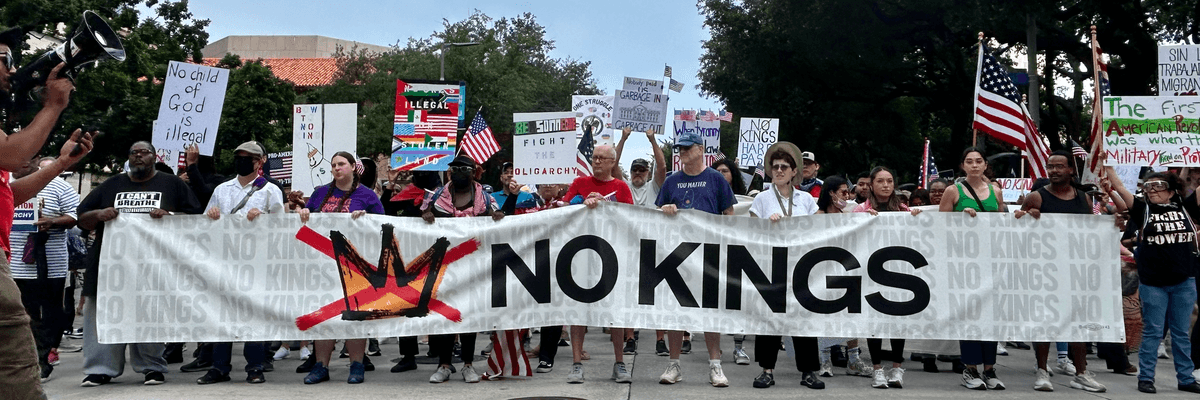
People rally in Houston for a June 14, 2025 "No Kings" protest against US President Donald Trump's policies.
(Photo by Brett Wilkins/Common Dreams)
Brett Wilkins
Jun 29, 2026
The US Supreme Court on Monday upheld President Donald Trump’s firing of Federal Trade Commissioner Rebecca Slaughter, overturning 90 years of precedent and giving the chief executive what dissenting Justice Sonia Sotomayor called “a power unknown even to the English Crown against which the Founders revolted.”
Last March, Trump fired Slaughter and Alvaro Bedoya, the two Democratic FTC commissioners at the time, without cause in what critics called yet another illegal abuse of power by the twice-impeached convicted felon.
Under the Federal Trade Commission Act (FTCA) of 1914, a president may only fire FTC commissioners “for inefficiency, neglect of duty, or malfeasance in office.” The Supreme Court’s 1935 Humphrey’s Executor v. United States ruling interpreted the FTCA to mean that the president could not remove an FTC commissioner for any other reason, such as a policy disagreement.
The justices shredded that precedent with Monday’s 6-3 decision in Trump v. Slaughter, which found that “the FTC’s for-cause removal provision is contrary to the separation of powers enshrined in the Constitution.”
Chief Justice John Roberts joined fellow conservative Justices Clarence Thomas, Samuel Alito, Neil Gorsuch, Brett Kavanaugh, and Amy Coney Barrett—the last three appointed by Trump—in the majority, while liberal Justices Elena Kagan, Sonia Sotomayor, and Ketanji Brown Jackson dissented.
Delivering the court’s opinion, Roberts wrote that the “Humphrey’s framework, in short, has not withstood the test of time.”
“We long ago abandoned the notion that there are some powers that are only partly executive,” the chief justice asserted. “Forty years have now passed, in fact, since we recognized that the FTC exercises executive power—and did so even in 1935, when Humphrey’s was decided.”
Slaughter and officials at independent executive agencies, Roberts wrote, “exercise the president’s power, not their own, and thus must be responsible to him.”
“At this point, all that is left of Humphrey’s is its observation that an agency that ‘exercises no part of the executive power’ need not fall within the rule of presidential removal,” he added. “If anything more is left of Humphrey’s, we overrule it.”
As she did last week with Mullin v. Al Otro Lado, a 6-3 ruling that affirmed Trump’s deadly policy of blocking people legally seeking asylum from entering the United States, Sotomayor took the rare step of reading her dissent in Slaughter from the bench.
“Today, this court undoes centuries of political practice and concludes that all three branches of government have been acting in open defiance of the Constitution all this time. Its conclusion is wrong,” she asserted. “The text of the Constitution, along with its history, the long-standing practices of the political branches, and the precedents of this court, make clear that Congress may limit the causes for which the heads of commissions like the FTC can be removed by the president.”
“In holding otherwise, the court gives the president a power unknown even to the English Crown against which the Founders revolted, elevating him above his once-coequal branches by transforming a duty to take care that the laws be faithfully executed into a license to act in defiance of those very laws,” she continued.
“If nothing else, the doctrine of stare decisis, which today’s decision cursorily dismisses, should have made this a profoundly easy case under Humphrey’s,” Sotomayor added, referring to the Latin legal term for “to stand by things decided,” or precedent.
Responding to the ruling, Congressman Jamie Raskin (D-Md.), the ranking member of the House Judiciary Committee, said that “today’s decision in Trump v. Slaughter takes a wrecking ball to a 90-year pillar of American law and to Congress’ power to create independent expert agencies that serve the will of the American people as expressed in federal law rather than the whimsical political agenda of one president.”
“In overturning Congress’ authority to prevent the president from removing the leaders of independent agencies at whim, the court’s right-wing majority has given President Trump sweeping new power to purge Senate-confirmed commissioners at the Federal Trade Commission and other independent agencies for no reason other than personal loyalty, political obedience, or refusal to bend the law to the personal will of the president,” Raskin added. “This decision invites presidential domination of the independent agencies Congress created to protect the people against corporate fraud, financial corruption, attacks on workers’ rights, and other abuses of concentrated economic and political power.”
Numerous civil society groups and constitutional experts also expressed alarm over Monday’s ruling, which follows the high court’s previous affirmations of expanded executive power in cases including Trump v. United States. Roberts wrote for the 6-3 majority in that 2024 case that the president enjoys prosecutorial immunity for all “official acts”—which Sotomayor said in her dissent made him “a king above the law.”
“Independent agencies are the guardians of American consumers, workers, and investors,” Robert Weissman, co-president of the consumer advocacy group Public Citizen, said of Trump v. Slaughter. “They have held wealthy corporations that rip off hardworking Americans accountable and forced dangerous products from the market. Having stripped most independent agencies of their independence, President Trump is already politicizing and weaponizing them, including agencies such as the FTC and the Federal Communications Commission, to the detriment of everyday Americans.”
At Issue One, a group dedicated to reducing the influence of money in politics, vice president of advocacy Alix Fraser said that “today, the Supreme Court greenlit further abuses of presidential power and stripped independent commissions of their independence.”
“The ruling opens the floodgates for more governing decisions based on the president’s whims and self-interest,” he added. “This ruling not only subverts the Constitution’s clear guardrails against executive overreach, it also breaks from the court’s historical precedent to uphold the FTC removal provision.”
Leah Greenberg, co-executive director at the pro-democracy group Indivisible, issued a statement calling the ruling “shocking, but sadly not surprising.”
“John Roberts and the MAGA majority are willing to set fire to history, precedent, and any consistent constitutional principle in order to give Trump more power with less oversight,” she said. “This brazen, undemocratic partisanship and corruption must be investigated, the justices must be held accountable, and the court must be reformed to disempower the current anti-constitutional majority.”
Brett Edkins, managing director of policy and affairs at the anti-corruption watchdog Stand Up America—which said the ruling “opens the door to king-like powers for Trump to fire independent watchdogs and install loyalists throughout government”—lamented that “the MAGA Supreme Court just overturned a century of law to give more power to Donald Trump.”
“Trump couldn’t find a lawful reason to fire a member of an independent agency, so he ignored the law, fired them anyway, and turned to his allies on the Supreme Court to reward his gross abuses of executive power,” he continued. “His lackeys on the court obliged.”
“Today’s ruling hands Trump sweeping power to purge independent watchdogs and install loyalists throughout the US government who will answer to him alone,” Edkins added.
Republicans have long sought a repeal of Humphrey’s. Project 2025—the Heritage Foundation-led blueprint for a far-right overhaul of the federal government—calls for the ruling to be overturned.
Trump welcomed Monday’s decision with a post on his Truth Social network claiming that he personally “won” the ruling.
Monday’s decision means Trump will now be able to fire at will leaders from agencies including the Consumer Product Safety Commission, Equal Employment Opportunity Commission, National Labor Relations Board, Nuclear Regulatory Commission, and US Postal Service.
But not the Federal Reserve Board of Governors. That’s because in a separate but related ruling released on Monday, the justices rejected Trump’s attempt to oust Federal Reserve Gov. Lisa Cook, finding 5-4 in Trump v. Cook that his bid to fire her did not comply with the Federal Reserve Act’s for-cause removal protections.
“The court’s decision in Slaughter is all the more peculiar in light of... Trump v. Cook,” Raskin said in his statement.“There, the court rightly rejected President Trump’s lawless attempt to fire Federal Reserve Gov. Lisa Cook without adequate cause, due process, or judicial review.”
While acknowledging that “central bank independence matters immensely to the American economy,” Raskin contended that “Congress’ constitutional judgments about the necessity of institutional independence should matter just as much at the FTC, the Securities and Exchange Commission, the National Labor Relations Board, the Federal Communications Commission, and the many other important independent agencies Congress has created to serve the interests of the American people.”
Indivisible’s Greenberg said that “the carveout for the Federal Reserve only shows how grossly political” the Slaughter decision is.
“Apparently, independence only matters when financial markets are at stake,” she added, “but not when agencies are protecting consumers, workers, or the public from corporate abuse.”
“Apparently, independence only matters when financial markets are at stake,” she added, “but not when agencies are protecting consumers, workers, or the public from corporate abuse.”
Trump's 'earthquake' Supreme Court win shocks legal experts: 'There's no sugar-coating it'
Travis Gettys
June 29, 2026
'Chaos will follow': Sotomayor blisters court as Trump is given 'power unknown' to kings
David Edwards
June 29, 2026

Justice Sonia Sotomayor. (Commonwealth Club/Flickr)
Justice Sonia Sotomayor accused the Supreme Court of giving President Donald Trump "power unknown even to the English Crown."
The 6-3 ruling Monday in Trump v. Slaughter wiped out a 91-year-old precedent that let Congress protect the heads of independent federal agencies from being fired at will.
"In holding otherwise," Sotomayor wrote in dissent, joined by Justices Elena Kagan and Ketanji Brown Jackson, "the Court gives the President a power unknown even to the English Crown against which the Founders revolted, elevating him above his once-coequal branches by transforming a duty to take care that the laws be faithfully executed into a license to act in defiance of those very laws."
"Perhaps worst of all, the Court today forgets its place," she continued. "Today's majority, however, decides that it knows better: better than even Hamilton, Story, Webster, Holmes, Brandeis, Frankfurter, and Rehnquist."
"Today, the majority replaces 90 years of proven, workable practice with a half-baked theory of executive power that is simultaneously all encompassing yet also subject to necessary but undefined exceptions," she wrote. "The one thing that does appear to be clear going forward is that chaos will follow."
The ruling guts the independence of more than two dozen federal agencies — including the bodies that police Wall Street, protect workers, and regulate airwaves. Trump can now fire their leaders for any reason, or no reason at all.
"In granting the President this unbridled authority, the Court upends its precedent, misconstrues our history, and sheds any pretense of judicial modesty," Sotomayor wrote, calling the decision "egregiously wrong."
The court issued a separate 5-4 ruling the same day, preserving the Federal Reserve's independence, for now.

Travis Gettys
June 29, 2026
RAW STORY
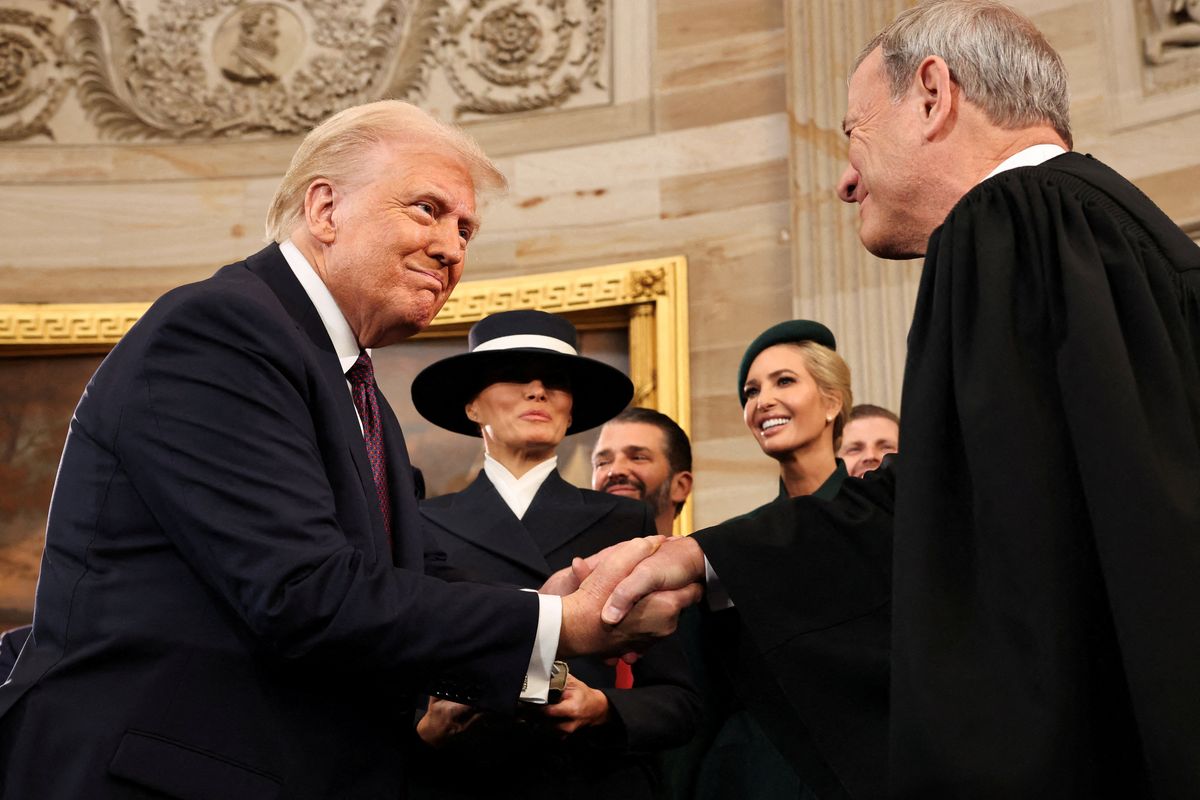
U.S. President Donald Trump shakes hands with U.S. Supreme Court Chief Justice John Roberts (R) as Melania Trump, Donald Trump Jr. and Ivanka Trump look on after being sworn in during inauguration ceremonies in the Rotunda of the U.S. Capitol on January 20, 2025 in Washington, DC. Chip Somodevilla/Pool via REUTERS/File Photo
A U.S. Supreme Court ruling issued Monday will end 90 years of court precedent that limits the president's power over independent agencies.
The conservative majority voted 6-3 to overturn a landmark 1935 ruling in the Humphrey’s Executor case that had found the president unlawfully fired a member of the Federal Trade Commission, and Justice Sonia Sotomayor wrote in her dissent that her colleagues had essentially concluded "all three branches of Government have been acting in open defiance of the Constitution all this time."
The Trump v. Slaughter case focused on the president's March 2025 firing of Rebecca Slaughter, the last remaining Democrat on the FTC, explaining by email that keeping her as a commissioner would be “inconsistent with [the] administration’s priorities."
The court ruled 5-4 in a separate case that Trump lacked the authority to fire Federal Reserve governor Lisa Cook, and legal experts puzzled over the pair of diverging outcomes – each penned by Chief Justice John Roberts.
"There's no sugar-coating Slaughter," sighed Georgetown law professor Steve Vladek. "It's an enormously important ruling (far more important than the other three decisions #SCOTUS handed down today). It's a huge win for Trump/the executive. And it's going to have massive ramifications for the functioning of the government long after Trump is gone."
"Welcome to the 'Majority overrules Humphrey’s Executor' phase of our descent into fascism," declared civil rights lawyer Joshua Erlich. "If something has been done a certain way for a hundred years and now it's suddenly unconstitutional, that really should require an amendment to the constitution. Otherwise what are we doing here."
"There's no real difference between the FTC and the FED other than Roberts likes the Fed," opined The Nation's Elie Mystal.
"Slaughter is an earthquake," warned Slate's Mark Joseph Stern. "SCOTUS has overturned a 90-year-old precedent that facilitated much of modern governance by granting many agencies meaningful independence from the president. Now SCOTUS crushes that independence ... for seemingly every agency except the Federal Reserve."
"SCOTUS will allow Donald Trump to wreck separation of powers and the rule of law, but they draw the line at wrecking capitalism," noted attorney Adam Bonin.
"This is the most transparently absurd set of twin decisions in Cook and Slaughter," marveled constitutional law professor Anthony Michael Kreis.
"American democracy has just been Slaughter-ed and Cook-ed," cracked Philadelphia Inquirer columnist Will Bunch.
"It's pretty clear they don't want Trump messing with the fed because it has the power to destroy capital if mishandled," stated Harvard law instructor Alejandra Caraballo. "The FTC protects consumers against corporate malfeasance so of course the commissioners can be fired. It's so transparent whose interests are protected by this court ... These decisions are filled with such swiss cheese logic and there are wildly disparate concurrences and dissents for each."

U.S. President Donald Trump shakes hands with U.S. Supreme Court Chief Justice John Roberts (R) as Melania Trump, Donald Trump Jr. and Ivanka Trump look on after being sworn in during inauguration ceremonies in the Rotunda of the U.S. Capitol on January 20, 2025 in Washington, DC. Chip Somodevilla/Pool via REUTERS/File Photo
A U.S. Supreme Court ruling issued Monday will end 90 years of court precedent that limits the president's power over independent agencies.
The conservative majority voted 6-3 to overturn a landmark 1935 ruling in the Humphrey’s Executor case that had found the president unlawfully fired a member of the Federal Trade Commission, and Justice Sonia Sotomayor wrote in her dissent that her colleagues had essentially concluded "all three branches of Government have been acting in open defiance of the Constitution all this time."
The Trump v. Slaughter case focused on the president's March 2025 firing of Rebecca Slaughter, the last remaining Democrat on the FTC, explaining by email that keeping her as a commissioner would be “inconsistent with [the] administration’s priorities."
The court ruled 5-4 in a separate case that Trump lacked the authority to fire Federal Reserve governor Lisa Cook, and legal experts puzzled over the pair of diverging outcomes – each penned by Chief Justice John Roberts.
"There's no sugar-coating Slaughter," sighed Georgetown law professor Steve Vladek. "It's an enormously important ruling (far more important than the other three decisions #SCOTUS handed down today). It's a huge win for Trump/the executive. And it's going to have massive ramifications for the functioning of the government long after Trump is gone."
"Welcome to the 'Majority overrules Humphrey’s Executor' phase of our descent into fascism," declared civil rights lawyer Joshua Erlich. "If something has been done a certain way for a hundred years and now it's suddenly unconstitutional, that really should require an amendment to the constitution. Otherwise what are we doing here."
"There's no real difference between the FTC and the FED other than Roberts likes the Fed," opined The Nation's Elie Mystal.
"Slaughter is an earthquake," warned Slate's Mark Joseph Stern. "SCOTUS has overturned a 90-year-old precedent that facilitated much of modern governance by granting many agencies meaningful independence from the president. Now SCOTUS crushes that independence ... for seemingly every agency except the Federal Reserve."
"SCOTUS will allow Donald Trump to wreck separation of powers and the rule of law, but they draw the line at wrecking capitalism," noted attorney Adam Bonin.
"This is the most transparently absurd set of twin decisions in Cook and Slaughter," marveled constitutional law professor Anthony Michael Kreis.
"American democracy has just been Slaughter-ed and Cook-ed," cracked Philadelphia Inquirer columnist Will Bunch.
"It's pretty clear they don't want Trump messing with the fed because it has the power to destroy capital if mishandled," stated Harvard law instructor Alejandra Caraballo. "The FTC protects consumers against corporate malfeasance so of course the commissioners can be fired. It's so transparent whose interests are protected by this court ... These decisions are filled with such swiss cheese logic and there are wildly disparate concurrences and dissents for each."

'Chaos will follow': Sotomayor blisters court as Trump is given 'power unknown' to kings
David Edwards
June 29, 2026
RAW STORY
Justice Sonia Sotomayor. (Commonwealth Club/Flickr)
Justice Sonia Sotomayor accused the Supreme Court of giving President Donald Trump "power unknown even to the English Crown."
The 6-3 ruling Monday in Trump v. Slaughter wiped out a 91-year-old precedent that let Congress protect the heads of independent federal agencies from being fired at will.
"In holding otherwise," Sotomayor wrote in dissent, joined by Justices Elena Kagan and Ketanji Brown Jackson, "the Court gives the President a power unknown even to the English Crown against which the Founders revolted, elevating him above his once-coequal branches by transforming a duty to take care that the laws be faithfully executed into a license to act in defiance of those very laws."
"Perhaps worst of all, the Court today forgets its place," she continued. "Today's majority, however, decides that it knows better: better than even Hamilton, Story, Webster, Holmes, Brandeis, Frankfurter, and Rehnquist."
"Today, the majority replaces 90 years of proven, workable practice with a half-baked theory of executive power that is simultaneously all encompassing yet also subject to necessary but undefined exceptions," she wrote. "The one thing that does appear to be clear going forward is that chaos will follow."
The ruling guts the independence of more than two dozen federal agencies — including the bodies that police Wall Street, protect workers, and regulate airwaves. Trump can now fire their leaders for any reason, or no reason at all.
"In granting the President this unbridled authority, the Court upends its precedent, misconstrues our history, and sheds any pretense of judicial modesty," Sotomayor wrote, calling the decision "egregiously wrong."
The court issued a separate 5-4 ruling the same day, preserving the Federal Reserve's independence, for now.


No comments:
Post a Comment