The defeat of two prominent pro-Israel members of Congress by challengers who were critical of Israeli policies and supporters of justice for Palestinians represents a turning point.
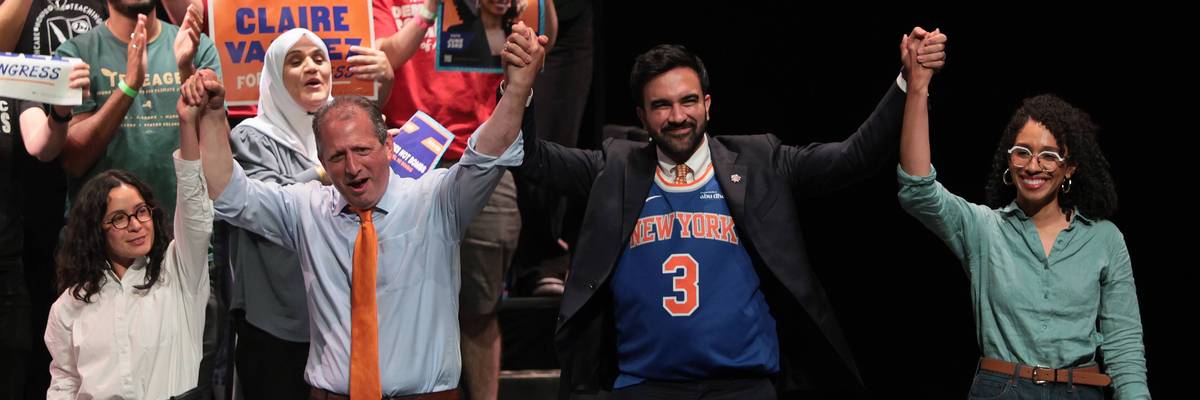
Congressional candidate Claire Valdez, Congressional candidate Brad Lander, Mayor Zohran Mamdani, and Congressional candidate Darializa Avila Chevalier raise their hands during a Get Out the Vote rally at King’s Theater on June 18, 2026 in New York City.
(Photo by Michael M. Santiago/Getty Images)
James Zogby
Jun 29, 2026
Common Dreams
For the past half century, the American Israel Public Affairs Committee, or AIPAC, largely held sway in elections in both political parties. They threatened and intimidated those who opposed them and, when a critic of Israel was defeated, they boasted of victory, holding it up for others as a lesson. Last week’s Democratic primary elections in New York City, in which three insurgent critics of Israeli policies defeated AIPAC-endorsed candidates, point to what may be the end of an era for the pro-Israel lobby.
AIPAC’s approach to politics and elections was smart. Formed by the Conference of Presidents of Major Jewish Organizations, they were connected from the outset to an impressive national network of American Jewish leaders, activists, and, more importantly, donors—all of whom they used effectively to influence members of Congress and Senators to embrace pro-Israel positions.
They didn’t just go to elected officials in Washington asking them to endorse particular pieces of legislation; they had local leaders in a congressperson’s district make the pitch. When new candidates were running, they’d have local representatives offer to help write their Middle East policy positions. Implicit in the visit and the offers were both the promise of support if the elected official or candidates did what was asked of them and the threat of opposition if they did not.
To back up their efforts, AIPAC spawned a network of PACs—political action committees—that would raise hundreds of thousands of dollars to distribute for or against candidates depending on their positions on Israel. AIPAC claimed they didn’t coordinate the work of the PACs (which would be a violation of election laws). But, as most of these PACs were headed by AIPAC board members or their families and their pattern of contributions were too obvious to have not been coordinated, it was clear that they were.
In this new era a real debate over US Middle East policy will take place.
AIPAC was also strategic in the their operations. Not everyone benefited from their largesse. Chairs of important congressional committees and very supportive members of Congress who faced tough reelections received bundled contributions. When elected officials repeatedly stepped out of line, their opponents would be the beneficiaries of large amounts of PAC monies and bundled contributions from individual pro-Israel donors with ties to AIPAC.
Overall, the amounts were not overwhelming but sufficient to send a message. Four decades ago, we found total amounts given by AIPAC’s PACs and their individual donors amounted to about $4 million in each election, with a handful of candidates receiving the bulk of this. When a few elected officials who’d been critical of Israel were defeated by opponents who’d been backed by AIPAC, the lobby would crow about their victory, whether or not their support had been a factor. Their goal was to spread the message to other electeds: “Fear us, or you too can be defeated.”
With the end of federal regulations limiting the oversight of independent expenditures in election campaigns, AIPAC and other pro-Israel groups took advantage by creating “super-PACs” that could raise and spend tens of millions of dollars in each election. Instead of the cumbersome job of stealthily coordinating dozens of federally regulated PACs limited in the amounts they could receive from individual donors and give to each candidate, these unregulated super-PACs could receive seven figure contributions from individuals and spend that same amount to help or hurt the candidates of their choosing. In 2022 and 2024 they effectively targeted a handful of candidates who were critical of Israel and spent millions to defeat each of them.
In the aftermath of Israel’s genocidal war on Gaza, we’ve witnessed a dramatic collapse of support for Israel in public opinion—especially among Democrats. In this new environment AIPAC can no longer pick and choose a few candidates to make examples. They now face new challenges weekly. Over 110 US representatives and senators have supported stopping military assistance to Israel because of its violations of Palestinian rights. Dozens of electeds have charged Israel with genocide and hundreds of congressmembers and candidates have pledged that their campaigns will reject any support from AIPAC. In fact, AIPAC has become so toxic that they’ve been forced to create new entities or rely on alternates as repositories for the funds they raise to distribute to candidates.
Despite these adjustments, the hurdles being confronted by pro-Israel forces are proving to be too much. Israel’s behaviors continue to alienate more voters. The more money AIPAC spends, the more toxic its brand has become—even when they win, they lose support for their heavy-handed tactics. Which brings us to last week’s New York primaries.
The defeat of two prominent pro-Israel members of Congress by challengers who were critical of Israeli policies and supporters of justice for Palestinians and the victory in an open race of a candidate who’d been a leader of pro-Palestinian campus protests in New York represents a turning point in US politics. It wasn’t just that AIPAC and its allies spent millions in these failed efforts—these elections were upfront about Israeli policies and Palestinian rights.
What had been the hallmark of pro-Israel groups’ past involvement in campaigns was the lengths to which they’d go to not make support for Israel a public issue. They would raise money from their supporters based on Israel, but that would not be the topic of their expenditures. They would spend money on ads criticizing a candidate’s age, their “radical agenda,” or some of their youthful improprieties. But they’d never mention that their involvement was because of the candidate’s position on Israel. This was the case in these New York contests. Many issues were important to voters, especially frustration with the tired failed policies of the Democratic Party establishment. But they were also about Israel, and voters knew it.
The reactions from the pro-Israel side have been predictable. Some have accused the targeting of AIPAC’s money and influence as unfair or even antisemitic—as if for decades AIPAC hadn’t boasted of its money and influence as the source of its power. Others have claimed that as a result of this election, “Jews no longer feel safe in New York,” ignoring the fact that in the most prominent of the three contests in which a pro-Israel Jewish member of Congress was defeated, the victor was also Jewish and a self-proclaimed progressive Zionist who strongly opposed Israel’s genocide against Palestinians. There’s also a bizarre effort to accuse pro-Palestinian candidates and voters of fracturing the Democratic Party when for decades AIPAC did its best to fracture the party and country by forcing politicians to toe the line or face defeat. Finally, there is the desperate effort to dismiss the entire election as being just about New York and having nothing to do with the rest of the US, ignoring the fact that the national political landscape has changed with these same types of contests taking place everywhere.
The bottom line is that after a half century AIPAC’s hold over politics has been weakened. It won’t go away anytime soon, but in this new era a real debate over US Middle East policy will take place. Thank you, New York voters.
Our work is licensed under Creative Commons (CC BY-NC-ND 3.0). Feel free to republish and share widely.
James Zogby
Dr. James J. Zogby is the author of Arab Voices (2010) and the founder and president of the Arab American Institute (AAI), a Washington, D.C.-based organization which serves as the political and policy research arm of the Arab American community. Since 1985, Dr. Zogby and AAI have led Arab American efforts to secure political empowerment in the U.S. Through voter registration, education and mobilization, AAI has moved Arab Americans into the political mainstream. Dr. Zogby has also been personally active in U.S. politics for many years; in 1984 and 1988 he served as Deputy Campaign manager and Senior Advisor to the Jesse Jackson Presidential campaign. In 1988, he led the first ever debate on Palestinian statehood at that year's Democratic convention in Atlanta, GA. In 2000, 2008, and 2016 he served as an advisor to the Gore, Obama, and Sanders presidential campaigns.
Full Bio >
For the past half century, the American Israel Public Affairs Committee, or AIPAC, largely held sway in elections in both political parties. They threatened and intimidated those who opposed them and, when a critic of Israel was defeated, they boasted of victory, holding it up for others as a lesson. Last week’s Democratic primary elections in New York City, in which three insurgent critics of Israeli policies defeated AIPAC-endorsed candidates, point to what may be the end of an era for the pro-Israel lobby.
AIPAC’s approach to politics and elections was smart. Formed by the Conference of Presidents of Major Jewish Organizations, they were connected from the outset to an impressive national network of American Jewish leaders, activists, and, more importantly, donors—all of whom they used effectively to influence members of Congress and Senators to embrace pro-Israel positions.
They didn’t just go to elected officials in Washington asking them to endorse particular pieces of legislation; they had local leaders in a congressperson’s district make the pitch. When new candidates were running, they’d have local representatives offer to help write their Middle East policy positions. Implicit in the visit and the offers were both the promise of support if the elected official or candidates did what was asked of them and the threat of opposition if they did not.
To back up their efforts, AIPAC spawned a network of PACs—political action committees—that would raise hundreds of thousands of dollars to distribute for or against candidates depending on their positions on Israel. AIPAC claimed they didn’t coordinate the work of the PACs (which would be a violation of election laws). But, as most of these PACs were headed by AIPAC board members or their families and their pattern of contributions were too obvious to have not been coordinated, it was clear that they were.
In this new era a real debate over US Middle East policy will take place.
AIPAC was also strategic in the their operations. Not everyone benefited from their largesse. Chairs of important congressional committees and very supportive members of Congress who faced tough reelections received bundled contributions. When elected officials repeatedly stepped out of line, their opponents would be the beneficiaries of large amounts of PAC monies and bundled contributions from individual pro-Israel donors with ties to AIPAC.
Overall, the amounts were not overwhelming but sufficient to send a message. Four decades ago, we found total amounts given by AIPAC’s PACs and their individual donors amounted to about $4 million in each election, with a handful of candidates receiving the bulk of this. When a few elected officials who’d been critical of Israel were defeated by opponents who’d been backed by AIPAC, the lobby would crow about their victory, whether or not their support had been a factor. Their goal was to spread the message to other electeds: “Fear us, or you too can be defeated.”
With the end of federal regulations limiting the oversight of independent expenditures in election campaigns, AIPAC and other pro-Israel groups took advantage by creating “super-PACs” that could raise and spend tens of millions of dollars in each election. Instead of the cumbersome job of stealthily coordinating dozens of federally regulated PACs limited in the amounts they could receive from individual donors and give to each candidate, these unregulated super-PACs could receive seven figure contributions from individuals and spend that same amount to help or hurt the candidates of their choosing. In 2022 and 2024 they effectively targeted a handful of candidates who were critical of Israel and spent millions to defeat each of them.
In the aftermath of Israel’s genocidal war on Gaza, we’ve witnessed a dramatic collapse of support for Israel in public opinion—especially among Democrats. In this new environment AIPAC can no longer pick and choose a few candidates to make examples. They now face new challenges weekly. Over 110 US representatives and senators have supported stopping military assistance to Israel because of its violations of Palestinian rights. Dozens of electeds have charged Israel with genocide and hundreds of congressmembers and candidates have pledged that their campaigns will reject any support from AIPAC. In fact, AIPAC has become so toxic that they’ve been forced to create new entities or rely on alternates as repositories for the funds they raise to distribute to candidates.
Despite these adjustments, the hurdles being confronted by pro-Israel forces are proving to be too much. Israel’s behaviors continue to alienate more voters. The more money AIPAC spends, the more toxic its brand has become—even when they win, they lose support for their heavy-handed tactics. Which brings us to last week’s New York primaries.
The defeat of two prominent pro-Israel members of Congress by challengers who were critical of Israeli policies and supporters of justice for Palestinians and the victory in an open race of a candidate who’d been a leader of pro-Palestinian campus protests in New York represents a turning point in US politics. It wasn’t just that AIPAC and its allies spent millions in these failed efforts—these elections were upfront about Israeli policies and Palestinian rights.
What had been the hallmark of pro-Israel groups’ past involvement in campaigns was the lengths to which they’d go to not make support for Israel a public issue. They would raise money from their supporters based on Israel, but that would not be the topic of their expenditures. They would spend money on ads criticizing a candidate’s age, their “radical agenda,” or some of their youthful improprieties. But they’d never mention that their involvement was because of the candidate’s position on Israel. This was the case in these New York contests. Many issues were important to voters, especially frustration with the tired failed policies of the Democratic Party establishment. But they were also about Israel, and voters knew it.
The reactions from the pro-Israel side have been predictable. Some have accused the targeting of AIPAC’s money and influence as unfair or even antisemitic—as if for decades AIPAC hadn’t boasted of its money and influence as the source of its power. Others have claimed that as a result of this election, “Jews no longer feel safe in New York,” ignoring the fact that in the most prominent of the three contests in which a pro-Israel Jewish member of Congress was defeated, the victor was also Jewish and a self-proclaimed progressive Zionist who strongly opposed Israel’s genocide against Palestinians. There’s also a bizarre effort to accuse pro-Palestinian candidates and voters of fracturing the Democratic Party when for decades AIPAC did its best to fracture the party and country by forcing politicians to toe the line or face defeat. Finally, there is the desperate effort to dismiss the entire election as being just about New York and having nothing to do with the rest of the US, ignoring the fact that the national political landscape has changed with these same types of contests taking place everywhere.
The bottom line is that after a half century AIPAC’s hold over politics has been weakened. It won’t go away anytime soon, but in this new era a real debate over US Middle East policy will take place. Thank you, New York voters.
Our work is licensed under Creative Commons (CC BY-NC-ND 3.0). Feel free to republish and share widely.
James Zogby
Dr. James J. Zogby is the author of Arab Voices (2010) and the founder and president of the Arab American Institute (AAI), a Washington, D.C.-based organization which serves as the political and policy research arm of the Arab American community. Since 1985, Dr. Zogby and AAI have led Arab American efforts to secure political empowerment in the U.S. Through voter registration, education and mobilization, AAI has moved Arab Americans into the political mainstream. Dr. Zogby has also been personally active in U.S. politics for many years; in 1984 and 1988 he served as Deputy Campaign manager and Senior Advisor to the Jesse Jackson Presidential campaign. In 1988, he led the first ever debate on Palestinian statehood at that year's Democratic convention in Atlanta, GA. In 2000, 2008, and 2016 he served as an advisor to the Gore, Obama, and Sanders presidential campaigns.
Full Bio >

No comments:
Post a Comment