Mutual aid as a component of community organizing shows us that governance begins with people: those who know their needs best, build trust with one another, and create systems capable of meeting immediate and long-term challenges.
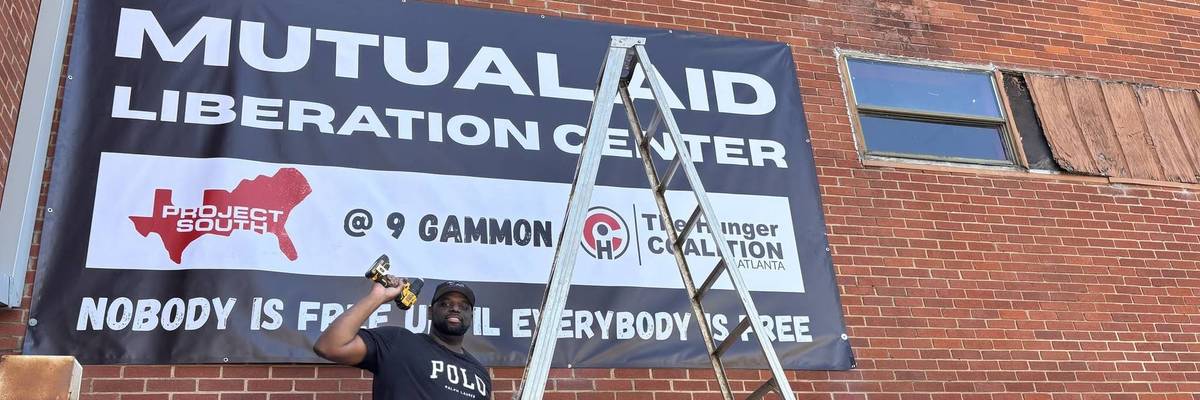
Staff install a new sign at Project South’s Mutual Aid Liberation Center.
(Photo via Project South/ Facebook)
Nwamaka Agbo
Jun 29, 2026
Jun 29, 2026
Common Dreams
Governance is how we hold power responsibly and equitably. Government is just one way we organize it—and what is abundantly clear is that good governance is not always done by a government.
Since congressional Republicans passed the “Big Beautiful Bill,” 3.5 million people have lost benefits through the Supplemental Nutrition Assistance Program (SNAP). That includes more than 800,000 children who are now at risk of going hungry.
It is just one of many ways in which the current administration has either actively harmed or abdicated responsibility for families and communities. This is a precarious moment, but it is not a moment for despair. In communities long abandoned by the public sector, mutual aid networks have emerged as models of resilience that show how people can govern effectively when love and care, rather than hate and scarcity, are placed at the center of how community members care for each other.
Governance is how we hold power responsibly and equitably. Government is just one way we organize it—and what is abundantly clear is that good governance is not always done by a government.
Since congressional Republicans passed the “Big Beautiful Bill,” 3.5 million people have lost benefits through the Supplemental Nutrition Assistance Program (SNAP). That includes more than 800,000 children who are now at risk of going hungry.
It is just one of many ways in which the current administration has either actively harmed or abdicated responsibility for families and communities. This is a precarious moment, but it is not a moment for despair. In communities long abandoned by the public sector, mutual aid networks have emerged as models of resilience that show how people can govern effectively when love and care, rather than hate and scarcity, are placed at the center of how community members care for each other.
A Long Southern Lineage of Necessity and Ingenuity
Mutual aid is a term to describe people helping each other when they cannot depend on the government. More fundamentally, it’s about reciprocal care and collective responsibility, whether or not the government shows up. It can begin as informal acts of kindness and gratitude, and grow to become enduring, formalized systems that support entire communities. The practice has long existed in the United States, especially in the South, where Black communities created their own institutions and parallel infrastructure to serve the people when dominant systems turned them away or caused them harm. From immigrants, to trans folks, to members of Indigenous communities, many marginalized groups have similar histories of using mutual aid as an organizing tool to create systems of self-governance that actually serve them.
The power of mutual aid exists in recognizing that people cannot reach liberated futures while their present needs remain unmet.
Mutual aid is not only a crisis response. It can be a vehicle to facilitate civic engagement in ways big and small, and it is a way for communities to organize to sustain one another and show up as daily stewards of each other’s well-being. Just as governance is not limited to a government, civic engagement isn’t limited to voting or holding elections. Mutual aid is intertwined with social justice movements. It brings people together to meet immediate needs through shared resources, trust, and collective responsibility—work that sustains daily life while building the relationships and political consciousness needed for long-term power.
Governance Is Already in Motion
The power of mutual aid exists in recognizing that people cannot reach liberated futures while their present needs remain unmet, and that those present needs have become politicized by a government that has made it acceptable to deny certain people care, dignity, and respect. Mutual aid is not charity, which maintains a top-down hierarchy of giver and receiver. Mutual aid when done responsibly is horizontal, and undergirded by an implicit politic that we must care for and provide for one another. Mutual aid is about shared struggle, interdependence, and collective well-being
Engaging in care as a political act is how we build collective power.
For example, Project South's Mutual Aid Liberation Center in Atlanta, Georgia stands as a living testament to the potential of mutual aid networks. The center meets community members’ basic needs while cultivating political consciousness, leadership, and collective power in the local community and for movement work across the US South. Mutual aid doesn’t separate services from organizing. In one instance, when community members came to the Liberation Center for clothes and food, they learned about a plan to install surveillance cameras in places that would disproportionately harm Black and brown folks. The same neighbors who met at the Liberation Center organized, banded together, and spoke out against the proposal at a community meeting, preventing it from becoming law.
Southerners on New Ground (SONG), an LGBTQ-led community organizing group and mutual aid network that functions across the South, is another powerful example of how mutual aid can bring folks from across the political spectrum together. The organization aims to foster real relationships between people by connecting those who need food with those who can offer it. When extreme weather events occur, those same people serve as solidarity squads who keep each other prepared and safe. The work demonstrates how relationships between people are fundamentally more important than political divisions, which become meaningless when the immediate need is a hot meal, a generator, or a safe place to sleep.
Supporting Future Governance
Mutual aid as a component of community organizing shows us that governance begins with people: those who know their needs best, build trust with one another, and create systems capable of meeting immediate and long-term challenges. Yet mutual aid is the work of community organizing that often goes unseen and unfunded.
Mutual aid networks have the ability to become the pathways of just transition toward a more just world. When we put mutual care and concern at that center of how we structure our society, then we can reimagine how we govern our resources, how we provide safety for one another, how we support each other in meeting our material needs, and how we must govern ourselves with the goal of mutual aid at the center. And, as we begin to practice this way of living on a day-to-day basis, then we can begin to establish the practices, principles and values, agreements, and social contracts that are essential for justice and liberation for all.
In this way, mutual aid is the foundation for future governance that is built on relationships between people, not politics.
Our work is licensed under Creative Commons (CC BY-NC-ND 3.0). Feel free to republish and share widely.
Supriya Lopez Pillai
Supriya Lopez Pillai is the president of the Libra Foundation.
Full Bio >
Nwamaka Agbo
Nwamaka Agbo is the CEO of the Kataly Foundation.
Full Bio >


No comments:
Post a Comment