Wednesday, July 15, 2026


As Trump Announces New Round of Sanctions Against Cuba, Democrats Warn Country Is Being ‘Strangled to Death’

Four members of Congress returned Monday from an oversight trip to Cuba, which they described as a “silent Gaza.”
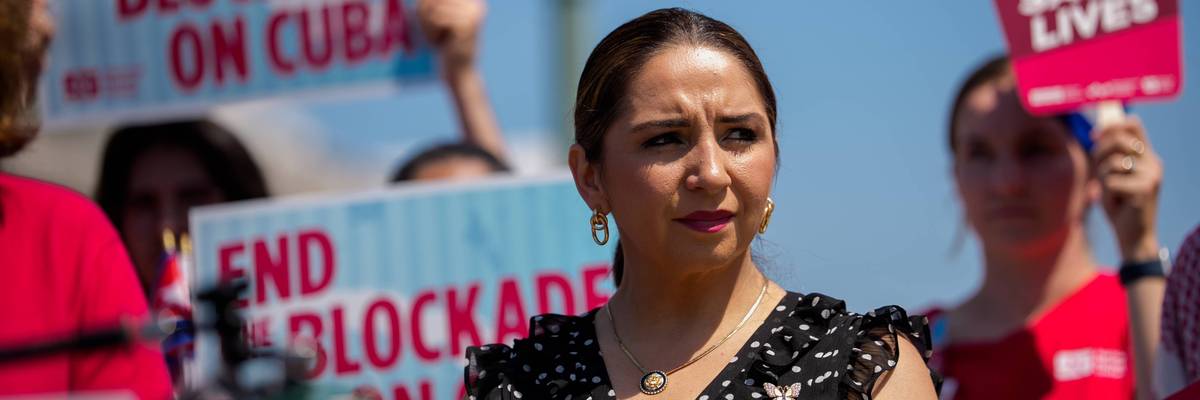

Rep. Delia Ramirez (D-Ill.) attends a news conference calling for the end to the blockade on Cuba on Capitol Hill on June 30, 2026 in Washington, DC.
(Photo by Andrew Harnik/Getty Images)


Julia Conley
Jul 14, 2026
COMMON DREAMS


As the Trump administration announced a new round of sanctions on Cuba’s tourism ministry, energy companies, and other entities on Monday, four Democratic members of Congress returned from a trip to the island and described how the oil blockade the US has imposed there for nearly six months “is producing indiscriminate pain for the most vulnerable Cubans.”

“As elected lawmakers tasked with oversight of US foreign policy, we traveled to Havana to meet with Cubans of all walks of life and political perspectives to hear about the hardships the Trump administration’s maximum pressure policies are creating for Cuban citizens,” said Reps. Delia Ramírez (D-Ill.), Teresa Leger-Fernández (D-NM), Mark Pocan, (D-Wis.), and Maxine Dexter (D-Ore.). “In our meetings with religious leaders, entrepreneurs, civil society organizations, humanitarian groups, medical professionals, and farmers, everybody we heard from... agreed on one thing: that they are being strangled to death under the current executive orders and longstanding economic blockade.”

The four Democrats traveled to Cuba last Thursday and spent several days meeting with local leaders, touring the streets of Havana, and speaking with President Miguel Díaz-Canel as the country grapples with the effects of President Donald Trump’s January executive order that baselessly claimed Cuba poses an “extraordinary” threat to US national security and threatened tariffs against any country that provides oil to the communist country.

The president had already cut off Cuba’s main energy supply by invading Venezuela, abducting its president and charging him with drug trafficking, and taking control of its vast oil reserves.

The lawmakers described how the energy blockade is “contributing to nationwide electrical blackouts—including one during our trip—buildups of trash on street corners; severe shortages of food, medicine, and public transportation; and widening inequality on the island.”

Dexter, a physician, noted that Cuba’s lauded healthcare system “is buckling under sanctions that the White House has unleashed on the Cuban people. This is creating a humanitarian catastrophe.”

“Cuba created a free, universal healthcare system that millions of Cubans and others around the world have come to expect and depend on,” said Dexter. “I will be using all the tools at my disposal to remove the barriers to delivering healthcare to the Cuban people.”

As Common Dreams has reported, the blockade has left hospitals struggling to provide care, with 96,000 people, including 11,000 children, on waitlists for surgeries.

“Over 300 pediatric surgeries per week are compromised by shortages of drugs, oxygen, anesthetics, and consumables,” wrote more than 8,000 Italian medical and scientific professionals in an open letter in June.

Leger-Fernández called Trump’s policy in Cuba, which has intensified sanctions that have been in place for years, “a siege.”

“We’re blocking medical supplies, fuel, and other essential inputs, leading its infant mortality rate to rise nearly 150% in recent years, from 4 to 9.9 per 1,000 live births,” said the congresswoman. “I doubt any American wants innocent Cuban babies to die due to our policies.”

Pocan told The Associated Press that one person he spoke to in Cuba called the crisis a “silent Gaza.”

“There may not be bombings, but there are certainly conditions that prevent people from going about their daily lives,” said Pocan. “They can’t go to work, they can’t preserve their food, they can’t access medical supplies, or live as they did before.”

Since imposing the blockade, Trump has repeatedly expressed a desire to take over the island by force and has doubled down on claims that Cuba poses a national security threat to the US.

On Sunday, United Nations Ambassador Michael Waltz claimed in a Fox News interview that China and Russia are “collecting information around our military bases in Cuba.” In May, an anonymous White House official told Axios that Cubans were “discussing plans” to launch drones at the US—even as the reporting acknowledged the country was thought to be preparing defensive, not offensive, capabilities.

As the members of Congress returned to the US and reported on the suffering they witnessed in Cuba on Monday, the administration announced a new round of sanctions on the country’s Ministry of Tourism, energy firms, a state-owned financial services company, a major foreign trade firm, and a maritime transportation company. Foreign banks, insurers, and companies will be exposed to potential penalties if they work with the entities under the sanctions.

The Trump administration, said Cuban Foreign Affairs Minister Bruno Rodríguez Parrilla, “continues to intensify the war against the people of Cuba, their living conditions, and their sources of livelihood.”

“The announcement on July 13 of additional coercive measures is a clear manifestation of the criminal and genocidal intent with which US rulers are determined to punish the entire population of the country,” he said.

The sanctions demonstrated the Trump administration’s “zeal to strangle our economy,” added Díaz-Canel. “They reinforce the aggression in search of greater harm to the people. We are facing a genocidal design plan.”



Don’t Pull the Trigger: Say, ‘No!’ to New Plutonium Pits

The rush to increase production at 80 pits per year by 2030 unnecessarily increases the risk to workers and sidelines necessary environmental cleanup at the sites that already have ongoing release of radioactive waste into the air, water, and soil from legacy activities.


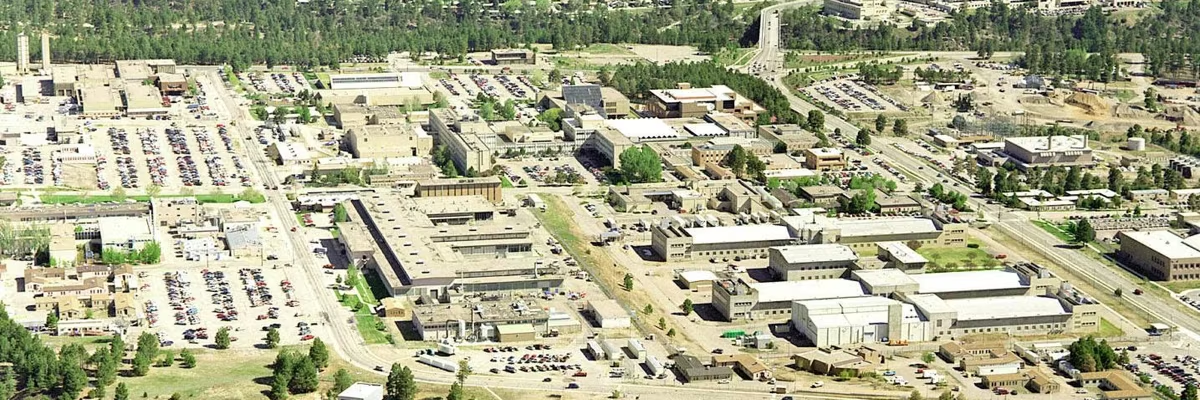
An aerial view of Los Alamos National Laboratory is shown.
(Photo by Los Alamos National Laboratory)

Robert Dodge
Jul 15, 2026
Common Dreams

Plutonium pits are the radioactive core “trigger” of every US nuclear weapon. On detonation, the plutonium sets off a nuclear chain reaction initiating a nuclear explosion. The Department of Energy’s National Nuclear Security Administration, or NNSA, plutonium pit production Programmatic Environmental Impact Statement, or PEIS, public comment period ends this Friday, July 16. Our input regarding this major component of today’s nuclear arms race is critical.

Paradoxically, on that same day, 81 years prior in 1945, the nuclear arms race began when the United States bombed New Mexico with the Trinity test. The PEIS released in April this year provides an incomplete and non-comprehensive environmental review of this accelerated race to develop new plutonium pits by 2030. The justification put forth stems from a Cold War mentality of Congress from 2014 requiring the United States to develop the capacity to produce 80 plutonium pits per year by 2030, subsequently bolstered by the 2018 Trump administration’s Nuclear Posture Review requiring the US to produce 80 pits per year by 2030; 30 at the Los Alamos National Laboratory (LANL) and 50 at the Savannah River Site.

As background, the majority of current plutonium pits completed production at the contaminated Rocky Flats plant outside of Boulder, Colorado by 1989. Therefore most plutonium pits are roughly 30-40 years old. Currently there are over 15,000 plutonium pits in reserve at the Pantex Plant near Amarillo, Texas, and over 5,000 which are suitable for use in strategic reserve. These large grapefruit size pits have at their core the incredibly hazardous radionuclide plutonium 239, which has a half life of 24,000 years.

Concerns over the aging of the current stockpile have been the impetus for building new pits. That concern was largely put to rest with the congressionally mandated 2006 JASON study, which confirmed that plutonium pits would last at least 100 years, and a subsequent 2012 Lawrence Livermore National Lab study found “...no unexpected aging issues are appearing in plutonium pits artificially aged to 150 years of age…” and they “...performed as designed.” This scientific evidence deemed as inconvenient was ignored. A subsequent new JASON Study was completed in 2025, and the NNSA has refused to release the results despite congressional demands and watchdog agency lawsuits, presumably due to the inconvenient results threatening their multibillion dollar windfall.

Historically the only thing that can be guaranteed in this proposed increased plutonium pit production plan is that it will be significantly delayed and far over budget.

As noted, this current race to rapidly expand pit production will occur at the existing, and already contaminated, sites at Savannah River in South Carolina, and the Los Alamos National Lab in New Mexico. It’s as though these communities are expendable.

The current draft PEIS only gives lip service to addressing the environmental impacts, failing to adequately take into account the dangers posed by the production of these pits to surrounding communities. According to the Union of Concerned Scientists, while the PEIS “clearly highlights an increased risk of radiation in the environment and across communities near facilities and workers it dismisses them as negligible continuing the most harmful and risky option of continued multi-site operations…. with only passing acknowledgement of the increased impacts at other sites, including nationwide transportation and impending waste management bottlenecks.”

According to a peer reviewed study published last week in the journal Science and Global Security, the Department of Energy has underestimated the potential deadly consequences if plutonium were to escape the Los Alamos National Laboratory. In the most serious case, if more than one kilogram of plutonium was to escape, the town of Los Alamos could become unlivable, and radioactive particles could spread across state lines. As many as 3,200 people could eventually get cancer with an estimated 1,000 deaths. Under certain circumstances, particles could travel as far north as Central Colorado and as far south as Southern New Mexico.

The draft PEIS fails to address the “no action” option of not producing plutonium pits, thus dismissing it outright, presuming that production moving forward is a foregone conclusion. The rush to increase production at 80 pits per year by 2030 unnecessarily increases the risk to workers and sidelines necessary environmental cleanup at the sites that already have ongoing release of radioactive waste into the air, water, and soil from legacy activities on site. In addition, most reviews have concluded that this deadline is not realistic.

In addition, the proposed production will add fuel to the current ongoing arms race and proliferation disregarding the purported mission of the NNSA to “promote international nuclear safety and non-proliferation, and reduce global danger from weapons of mass destruction.” This will further erode confidence in the sincerity of the United States and its legal obligation under Article VI of the 1970 Treaty on the Non-Proliferation of Nuclear Weapons, NPT, to work in good faith with other nations to abolish nuclear weapons.

Historically the only thing that can be guaranteed in this proposed increased plutonium pit production plan is that it will be significantly delayed and far over budget.

Imagine the international capital that could be gained by placing the entire plan on hold. Our national security would not be compromised. And there would be massive financial savings to be realized.

We must demand a more complete and transparent PEIS that addresses the entire environmental, economic, and health impacts to the communities directly at risk, as well as our entire nation and world. Absent that, we are not dealing with science, but rather opinion, conjecture, and fearmongering. Use your voice today by submitting your comments via email to PitPEIS@nnsa.doe.gov, being sure to reference Doc: DOE/EIS-0573.


Our work is licensed under Creative Commons (CC BY-NC-ND 3.0). Feel free to republish and share widely.


Robert Dodge
Robert Dodge, MD, is a family physician practicing in Ventura, California. He serves on the board of Physicians for Social Responsibility Los Angeles (www.psr-la.org), and serves as the cochair of the Committee to Abolish Nuclear Weapons of National Physicians for Social Responsibility (www.psr.org). Physicians for Social Responsibility is the US Affiliate of the International Physicians for the Prevention of Nuclear War who received the 1985 Nobel Peace Prize and is a partner organization of ICAN, recipient of the 2017 Nobel Peace Prize. He also serves on the Back from the Brink (www.preventnuclearwar.org) steering committee.
Full Bio >
The US Kicks Off World’s Largest Naval War Games: RIMPAC, China, and the Cost of War

Rather than making the region safer, the pursuit of “deterrence” risks turning the Pacific into a battlefield while diverting resources away from the urgent challenges that communities are actually facing today.


RIMPAC training exercises are shown in a still from Earth’s Greatest Enemy.
(Image via Empire Files)

Megan Russell
Jul 14, 2026
Common Dreams

June 24 marked the start of the biennial Rim of the Pacific, or RIMPAC, exercises, the world’s largest international naval war games. Led by the US, the military exercises bring together 31 countries and include more than 25,000 personnel, 40 surface ships, five submarines, and 140 aircraft. The event, which will run until July 31, marks the newest escalation of US preparations for war on China, further militarizing the Pacific and normalizing the prospect of conflict through increasingly large-scale exercises and an ever-expanding web of alliances and military bases.

At the same time, the US and partner nations kicked off the 10-day Valiant Shield 2026 exercises across Guam, the Northern Mariana Islands, Japan, and surrounding seas, submerging the entire Pacific into an intensive military operation zone.

At a moment of intensifying climate disasters and growing economic insecurity, the message from Washington is clear: There is always more money for war. RIMPAC comes as Congress is attempting to approve a staggering $1.5 trillion war budget, even as communities across the world are facing deadly heatwaves, floods, and other climate-fueled disasters.

This past week, while US military vessels practiced war off their coasts, super typhoon Bavi pummeled Guam and the Northern Mariana Islands. Coming only a week into the typical typhoon season, this is already the second major typhoon to hit the islands. Many locals were still without power from the last super typhoon Sinlaku, which killed 17 people and caused over $1.5 billion in damages.

Rather than protecting local communities, militarization leaves them more vulnerable. All the while, massive military spending diverts resources away from urgent needs such as climate relief.

Climate scientist Kristina Dahl remarked, “In both of these cases we can see the fingerprint of climate change on the storms and that has really devastating consequences for the people who are repeatedly in their paths.”

These overlapping crises reveal a profound imbalance in priorities. As Pacific communities contend with increasingly severe climate disasters, the United States continues to invest staggering sums in military expansion and war preparations. The irony is especially stark given that the US military is the world’s largest institutional consumer of fossil fuels and one of the largest institutional greenhouse gas emitters, while decades of US military activity have caused lasting environmental and human harm across Pacific Island communities.

Instead of pouring resources into preventing climate change and protecting people on the frontlines of the climate crisis, the US continues to pump money into its bloated war budget. In the Pacific, military expansion is justified by the increasing push toward war on China. The 2026 National Defense Strategy committed to “deterring China in the Indo-Pacific through strength” by “erect(ing) a strong denial defense along the First Island Chain” so that “Joint Force always has the ability to conduct devastating strikes and operations against targets.”

The US conception of “deterrence” is both illogical and hypocritical in nature. In the name of “protecting” the Pacific from a future imaginary threat, the United States is harming the very communities it claims to defend through military buildup, environmental degradation, and the transformation of islands into staging grounds for war. The narrative of an imminent Chinese takeover of the Pacific is often treated as a foregone conclusion despite there being no evidence that China seeks to invade or occupy Pacific nations. Rather than making the region safer, the pursuit of “deterrence” risks turning the Pacific into a battlefield while diverting resources away from the urgent challenges that communities are actually facing today.

A recent report by the Institute for Policy Studies found that the US military’s economic benefits to Hawaiʻi have been significantly overstated and that local communities bear enormous hidden costs from its presence. The report estimates that military demand for housing drove Oʻahu rents up by 7.1% in 2024 alone, costing non-military renters an additional $234.8 million. It also found that cleaning up PFAS contamination at just three military installations could cost at least $493 million, with broader health and environmental damages potentially reaching into the billions. Meanwhile, the Pentagon has leased more than 46,000 acres of Hawaiian land for just $1 leases, despite the land’s estimated fair market value reaching as high as $133.7 billion. Far from protecting Pacific communities, the US military buildup has contributed to housing insecurity, environmental contamination, and the dispossession of Indigenous lands.

Similarly, US militarization of Guam has severely impacted local communities. The US military controls roughly 27% of the island’s land, while decades of military activity have left behind contaminated groundwater, hazardous waste, and damaged ecosystems. PFASforever chemicals” linked to military firefighting foam have been detected in Guam’s drinking water wells, threatening the island’s primary freshwater source. Military expansion has also endangered coral reefs, sensitive coastal habitats, and wildlife.

These events, which are just a few of many examples of the environmental and human costs of militarization, reveal the deep hypocrisy of the US strategy of “peace through strength.” Rather than protecting local communities, militarization leaves them more vulnerable. All the while, massive military spending diverts resources away from urgent needs such as climate relief.

The proposed $1.5 trillion war budget will only deepen these harmful priorities, while large-scale military exercises like RIMPAC intensify US-China tensions, heighten the risk of dangerous encounters at sea, and increase the possibility of pulling the Pacific into a devastating war.


Our work is licensed under Creative Commons (CC BY-NC-ND 3.0). Feel free to republish and share widely.


Megan Russell
Megan Russell is CODEPINK's China is Not Our Enemy Campaign Coordinator. She graduated from the London School of Economics with a Master’s Degree in Conflict Studies. Prior to that, she attended NYU where she studied Conflict, Culture, and International Law. Megan spent one year studying in Shanghai, and over eight years studying Chinese Mandarin. Her research focuses on the intersection between US-China affairs, peacebuilding, and international development.
Full Bio >
Sanders Says US Must End Support for UAE—’One of Trump’s Closest Allies’—as It Fuels Genocide in Sudan

“Trump’s good friend and staunch US ally, the United Arab Emirates dictatorship, run by one of the wealthiest families in the world—has financed and enabled this genocide for years.”


US President Donald Trump greets United Arab Emirates (UAE) President Sheikh Mohamed bin Zayed Al-Nahyan during a work lunch as part of the G7 summit, in Evian, eastern France, on June 16, 2026.
(Photo by Evelyn Hockstein/Pool/AFP via Getty Images)

Stephen Prager
Jul 14, 2026
COMMON DREAMS

As the world fears another massacre by the Rapid Support Forces in Sudan, Sen. Bernie Sanders emphasized that the rebel group’s string of atrocities is being funded by a nation with deep financial ties to President Donald Trump—the United Arab Emirates—and urged an end to US military support.

“In the midst of the wars in Gaza and Iran, we cannot forget the atrocities in Sudan,” Sanders (I-Vt.) said Monday in a post to social media. “As many as 150,000 killed since 2023, 14 million driven from their homes, 30 million need humanitarian aid.”

“All of this is fueled by the UAE—one of Trump’s closest allies,” the senator continued. “We cannot be complicit in genocide.”


The warning came as RSF encircles El Obeid, a city of half a million people, including hundreds of thousands who have been displaced.

For weeks, the RSF has launched drone attacks that have killed dozens of civilians and damaged critical infrastructure including water facilities, markets, and hospitals. Food, water, and fuel supplies have been disrupted. Some civilians have begun to flee as many entry points to the city have been cut off.

The United Nations Security Council warned last month that there was an “imminent risk of mass atrocities” and demanded that the RSF halt its assault.

Human Rights Chief Volker Türk stressed that the siege tactics followed a familiar “playbook” to the RSF’s October attack on El-Fasher in which at least 6,000 people were killed in just three days as part of a campaign that UN human rights experts said bore the “hallmarks of genocide,” including ethnically targeted killings and sexual violence.


While the US State Department and other governments have similarly warned that the RSF could be on the verge of committing atrocities, Nicholas Kristof argued in a New York Times column this weekend that “officials won’t say openly... that the power behind the RSF is the United Arab Emirates.”

Despite denials from Abu Dhabi, the UAE has been extensively documented as supporting the RSF through weapons shipments routed via Chad, financing the militia, and recruiting, training, and transporting mercenaries to fight alongside the group.

Kristof pointed out that the UAE “has particularly close financial ties to the Trump family,” most notably the $2 billion investment by an Emirati firm last year that benefited his family’s cryptocurrency venture, World Liberty Financial (WLF), which has been a major source for the unprecedented growth of the president’s wealth during his second term.


Recent financial disclosures reported this month by the Wall Street Journal show that Trump received $263 million from selling half his stake in WLF to a fund backed by Sheikh Tahnoon bin Zayed Al Nahyan, one of the UAE’s most powerful royals and the brother of its president.

During his second term, Trump has rewarded the UAE with more than a billion dollars in weapons sales that were fast-tracked to get around holds imposed by Congress, and made an agreement giving the Emirates unprecedented access to hundreds of thousands of advanced computer chips per year.“Trump’s good friend and staunch US ally, the United Arab Emirates dictatorship, run by one of the wealthiest families in the world—has financed and enabled this genocide for years,” Sanders said in a statement last week. "And why is this happening? Billions of dollars of looted gold from Sudan is flowing straight into the pockets of Emirati oligarchs—making a multibillionaire family even richer."

He added that “Congress must demand that the UAE cease its military support for the RSF and work with the international community and the Sudanese people to bring an end to this horrific conflict and provide the humanitarian aid that is desperately needed there.”

As warnings about a brutal new RSF offensive have piled up, there has been a push in Congress led by Sen. Chris Van Hollen (D-Md.) and Rep. Sara Jacobs (D-Calif.) for restrictions on the United States’ ability to provide weapons to the UAE.

Last month, with help from some Democrats, the GOP-controlled Senate Foreign Relations Committee blocked two amendments aimed at halting US weapons shipments to the UAE unless it stops supporting the RSF.

The committee has passed a weaker bill that allows the president to impose optional sanctions on individuals who supply weapons to Sudan’s armed factions, which now awaits a full Senate vote. But the committee rejected Van Hollen’s amendment prohibiting arms sales to the UAE.
Mahmoud Khalil Sues Trump Officials for Conspiracy Against Pro-Palestinian Organizers

“This case will expose the scheme that sought to criminalize the Palestine solidarity movement in the US.”


Columbia University students, professors, and supporters gather to rally in support of Mahmoud Khalil, Leqaa Kordia, and the numerous other community members who have been unlawfully detained by US Immigration and Customs Enforcement in New York City on March 9, 2026.
(Photo by Selcuk Acar/Anadolu via Getty Images)


Julia Conley
Jul 14, 2026 


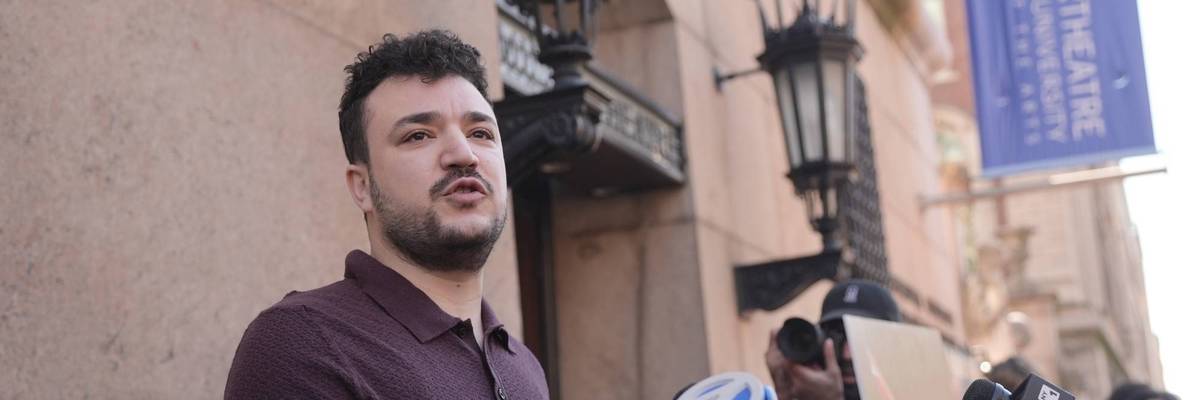
A lawsuit filed by former Columbia University student organizer Mahmoud Khalil wasn’t his first legal challenge stemming from his arrest last year for his Palestinian rights advocacy, but he emphasized that his decision to take members of the Trump administration and private pro-Israel organizations to court was “about far more than what was done to” him when he was detained for 104 days.

“This case will expose the scheme that sought to criminalize the Palestine solidarity movement in the US,” said
Khalil in a statement. “It is about a coordinated, ongoing plot to punish, silence, and intimidate everyone who dares to dissent and speak out for Palestinian liberation. We will hold them accountable.”


‘Major Escalation’: Trump Prosecutor Invokes NSPM-7 While Unveiling Charges Against 15 ICE Protesters

Represented by the Center for Constitutional Rights (CCR) and the law firm Beldock Levine & Hoffman, Khalil sued the Heritage Foundation, Canary Mission, Betar, Trump administration adviser Stephen Miller, Secretary of State Marco Rubio, Secretary of Homeland Security Markwayne Mullin, his predecessor Kristi Noem, acting Attorney General Todd Blanche, and John Armstrong, an official at the State Department’s Bureau of Consular Affairs.

The lawsuit was filed under the Ku Klux Klan Act of 1871, which was passed to stop efforts by vigilante groups like the KKK to coordinate with the government to strip individuals of their constitutional rights.

“Mahmoud is now using this statute to affirmatively challenge the illegal, anti-Palestinian, and anti-democratic public-private conspiracy to harass, intimidate, and punish Palestinians and their allies,” said CCR.


As the Trump administration continues its efforts to deport Khalil, the lawsuit traces the alleged public-private conspiracy against pro-Palestinian organizers to October 2023, when Miller “vowed to punish Palestinians and their supporters through arrest and deportation.”

A year later, the Heritage Foundation published Project Esther, which conflated criticism of Israel with antisemitism, claimed all pro-Palestinian organizers were Hamas supporters, and pledged to execute a plan to deport foreign protesters “when a willing administration occupies the White House.”

The Heritage Foundation said a “public-private partnership” would be required to carry out Project Esther. The lawsuit alleges that Canary Mission, an anonymously run Israeli surveillance and doxing organization, and Betar, a self-described vigilante group with a history of surveilling and harassing supporters of Palestinian rights, provided that partnership.

“Between March and May 2025, Miller, Rubio, Noem, and Armstrong used ICE to arrest or to try to arrest at least nine students or scholars pre-selected by the private groups,” said CCR. “The federal defendants continue to seek Mr. Khalil’s deportation and pursue the conspiracy through sham, corrupted immigration proceedings under their control. Working together, the government and private co-conspirators sought to deny Palestinians and their supporters their constitutional rights: to equal protection, to freedom of speech and travel, to freedom from punitive detention, and, ultimately, to exist in this country.”

As The New York Times reported, former Heritage Foundation national security director Robert Greenway said two months after Khalil was arrested that it was “no coincidence that we called for a series of actions to take place privately and publicly, and they are now happening.”

CCR pointed to a “range of harms” Khalil has suffered as the result of being targeted by the Trump administration, starting when he was arrested in March 2025. During three months in detention, he was sent to Jena, Louisiana—nearly 1,300 miles away from his family and lawyers—and was forced to miss the birth of his first child. He also faces “an ongoing threat to his lawful immigration status in the United States,” with his attorneys preparing to appeal his deportation case to the US Supreme Court.

Baher Azmy, legal director for CCR, said that “the brazenness of this conspiratorial plan is matched only by the exquisitely detailed and shamelessly public record the conspirators produced of a collaborative plan to silence the growing student movement protesting US support for Israel’s genocidal campaign,” referring to the country’s assault on Gaza that began in October 2023 in retaliation for a Hamas-led attack.

“The conspirators acted through forms of state repression and arbitrary detention that numerous courts have found are blatantly unconstitutional,” said Azmy. “They targeted Mr. Khalil, smeared him, and subjected him to the torment of detention for nothing other than being Palestinian and supporting Palestinian rights in order to send a message of terror across the student movement for Palestine.”

“The KKK Act was designed to prevent conspiracies to stifle advocacy for political freedom,” he added, “and together we are demanding accountability for this outrageous injustice.”

Antifa Conspiracy Hogwash: A Convenient Platform for Fascism


 July 15, 2026


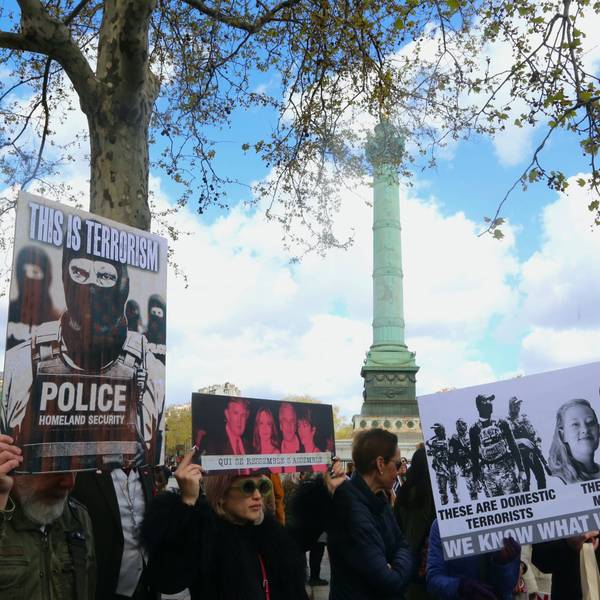
Let’s start with reality: there is no Antifa organization. There exists no Antifa “funding” that FBI director Kash Patel claims he is hunting down – he’ll be doing that from now till Kingdom Come, because it quite simply doesn’t exist. There is no shadowy Antifa conspiracy to overthrow the U.S. government and what Donald “Nail a Commie” Trump regards as its God-given mission to promote capitalism. It doesn’t exist. It’s a fascist chimera, a demagogic delusion, a convenient hallucination, a mad mirage, a demented nightmare for the boobocracy. It’s bullshit.

What there is, is people fed up with ICE. It is people, quite a few Americans in fact, who hate fascism. They are – surprise! – anti-fascist. Whoever the idiot was who cooked up the supposedly brilliant idea of making all anti-fascists targets for right-wing cuckoo-birds by tagging them with the trendy abbreviation “Antifa,” I wish he – or she – had stayed home and kept his mouth shut. Because now morons in Washington believe – or maybe some just cynically exploit – the notion that there’s a national octopus of “Antifa” revolutionaries, who, like the devious anarchists of yore, can be eliminated via domestic counter-terrorism.

So we have a problem. Government orgs like the FBI, with fascist roots reaching back over a century, are now, under Trump, laser focused on the very saleable “Antifa” conspiracy. Along the way lots of innocent anti-fascists have their lives turned upside down. Just witness the recent sentencing of the anti-ICE Prairieland protesters. According to the Intercept June 23, one so-called Antifa protestor, Daniel Sanchez Estrada was “convicted of obstructing the investigation by moving a box full of antifascist zines after the protest.” The lunatic judge threw the book at him and sentenced him to 30 years, one of eight absurdly, shockingly lengthy sentences “handed down by judges in two courtrooms in Forth Worth,” a case “widely regarded as the Trump administration’s first major victory in its crackdown on left-wing activism.” Sanchez Estrada’s wife, Maricela Rueda, got 70 years, because she allegedly asked her husband “to move the zines after her arrest.”

Patel delivered a colossally stupid statement after these harsh sentences – one of which was for 100 years – saying these punishments “show the FBI remains committed to identifying, locating and dismantling Antifa and its funding networks across the country.” Antifa has no funding networks, because it is not an organization. It is a label. And an unfortunate, troublesome, imbecilic one, at that.

So how did these eight protestors wind up with such wildly wrong sentences? They all wore black to the protest! So that’s one fashion statement you don’t want to make if you’re demonstrating against ICE. Prosecutors in this case told the jury that, per the Intercept March 12, “wearing all black at protests makes you guilty of terrorism.” What if you’re returning home from a funeral and wander into an anti-ICE-Gestapo demo? Welp, too bad for you. You’re guilty of terrorism. Also, the luckless defendants “used the Signal encrypted messaging app.” So do journalists I know of; they might want to ditch Signal tout de suite. Signal, in turn, might want to sue these prosecutors for defamation that harms its business.

In other words, the prosecution was reaching, straining to expand its weak, lousy case from “we don’t like their look and their tech” to “terrorism!” And the astounding fact is – they succeeded, not just with the jurors but with two half-wit judges. And beyond their wildest dreams; which raises the question, why? The answer, as I’ve been none too subtly suggesting, lies not just in the run-of-the-mill, bovine stupefaction of a complacently ignorant mass of Amuricans, but in the creation by the media, and the birdbrains who coined the term “Antifa,” of an “Antifa” bogeyman. The fact that using this bogeyman nets a bunch of anti-fascists is an added plus for our FBI maniacs, suspicious of Signal and those wearing black.  But my guess is anyone who calls themselves Antifa, even if no anti-fascist, would be acceptable quarry for Trump security state predators.

The Department of Justice is bursting with pride at what it has done. Its press release dated June 23 is headlined: “Leader of Antifa Cell Members in North Texas Sentenced to 100 Years in Prison for Terrorist Attack on ICE Facility.” The press release trumpets the defendants being “affiliated with Antifa.” These eight defendants all together got a combined sentence of 450 years in prison, following their 12-day trial that started February 23. One defendant “was granted a continuance and will be sentenced on July 1. Seven others…pleaded guilty prior to trial to one count of providing material support to terrorists and they will be sentenced on July 1.”

Then the DOJ finally spikes the heart of the matter: “The defendants were members of a North Texas Antifa Cell, part of a larger militant enterprise made up of networks of individuals and small groups…[who call for] the overthrow of the United States Government.” The press release repeatedly invokes this insane notion of an Antifa cell and a larger coordinated Antifa organization. But just saying something doesn’t make it so. The Trump cult can scream about a unified Antifa conspiracy all it likes, no matter: Where’s the proof Antifa is anything other than an updated, hipper locution for something that, without a nickname, might be too complicated for your average reactionary nincompoop to grasp, namely anti-fascism? As far as anyone can tell, Antifa is little more than the occasional anti-fascist punching a goth Nazi in the nose in his local bar. But unfortunately, this happened enough absolutely to enrage the far right, so that it claims a concerted Antifa org is out to undermine Amurica.

“Evidence at trial revealed that most of the ANTIFA cell involved in the Prairieland attack looked to Benjamin Song as a leader,” the DOJ hyperventilates. And Song owned guns! Ordinarily for reactionaries, gun ownership is a sacred Amurican right, worth the bloody, regular ritual slaughter of schoolchildren by psychotics with semi-automatic weapons being excused by the far right as the price we pay for our freedoms. I suppose for them sometimes the tree of liberty must be watered with the blood of toddlers. In short, it depends, I guess, who owns the guns. If the owner protests ICE abuses, then his gun ownership proves he belongs to a nefarious conspiracy to overthrow the U.S. government. DOJ also breathlessly invokes “ideologically aligned groups,” namely those luckless women who “created and distributed insurrectionary materials called ‘zines.’” Short for magazines and pamphlets. Like Antifa is short for anti-fascist. How many multi-decade prison sentences will it take before leftist bubbleheads abandon this idiotically provocative lingo?

Calling things by their names is far more likely actually to stump boneheaded reactionaries. Attacking an anti-fascist means what? That you’re attacking someone opposed to fascism? Well, such an attack is prima facie, even for rightists, a bad thing. Fascists were once Amurica’s enemies. We even fought a war against them. But if you’re attacking Antifa? Ah, now that’s another kettle of insurrectionists. It’s an amorphous term, whose provenance is obscured, and which can be slapped onto just about anything a far-right nitwit doesn’t like. You’re even supposed to pronounce it with the stress on the second syllable, making its relation to “anti-fascist” even more opaque. Cool. That makes it almost impossible to link, orally, to antifascist. Antifa is a dream-come-true for dimwit reactionaries and their judges, who think pounding its so-called followers with 100-year sentences strikes a blow against a vast, coordinated underground network of revolutionaries. Who’s gonna tell these judicial chumps? None of this stuff exists. There are just anti-fascists, who recognize that what ICE does is, well, unvarnished fascism. For that – and for moving a box of magazines – they get 70 years behind bars.

Eve Ottenberg is a novelist and journalist. Her latest novel is “Death Calls It a Day.” She can be reached at her website.


From the Haymarket 8 to the Michigan 8

How the state uses conspiracy charges to crush social movements.


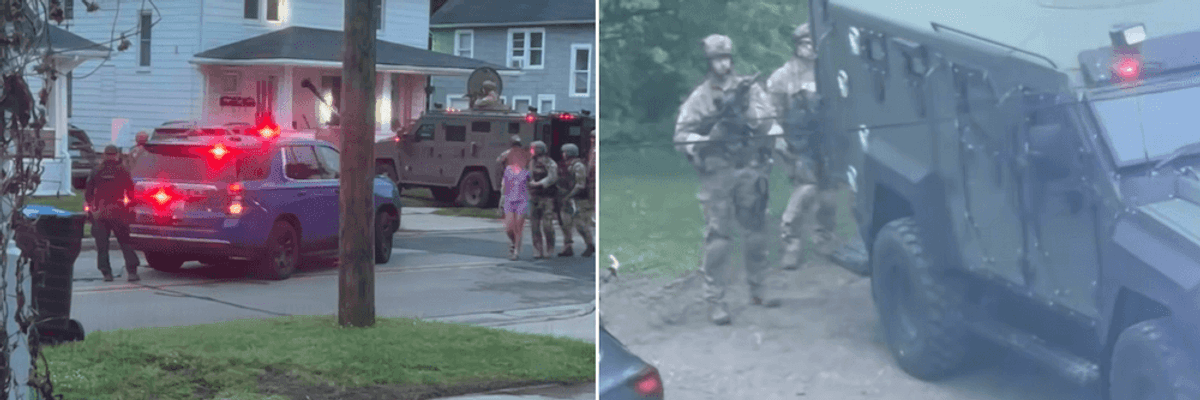
FBI raid on the home of some of the Michigan Eight defendants in Ypsilanti, Michigan on June 10, 2026.


Adi Saleem
Jul 14, 2026
Common Dream

On the morning of June 10, 2026, the FBI, together with an ensemble of local and state police departments, including the University of Michigan Police Department, conducted a series of simultaneous raids and arrests in Michigan, Illinois, and Wisconsin in spectacular militarized fashion. The operation targeted eight individuals engaged in Palestine solidarity activism at the University of Michigan.

That afternoon, FBI director Kashyap Patel announced that the targeted individuals “engaged in a coordinated campaign of violent, criminal acts seeking to pressure University of Michigan leaders and other businesses in the Eastern District of Michigan to cut off all ties with Israel.” The alleged violent, criminal acts in question? Property damage. The coordinated campaign in question? Per their indictment, “using encrypted messages, social media, and overseas collaboration platforms […] [and] the internet and social media to broadcast their message.”

To be clear, the Michigan Eight are not being charged with property damage or vandalism. Instead, they are facing charges of conspiracy to transmit a threat, conspiracy to tamper with a witness, and destruction of property to prevent seizure. Less than a week after the raids against the Michigan Eight, 15 individuals were similarly indicted in Minnesota on various conspiracy charges for their participation in community activism and mutual aid in the context of Immigration and Custom Enforcement’s (ICE) Operation Metro Surge that saw 2,000 ICE agents deployed in Minnesota, leading to over 3,000 arrests, two protesters shot by ICE agents, and one individual dead in ICE custody. The conspiracy charges faced by the Michigan Eight and the Minnesota 15 carry a maximum sentence of 5-20 years and, when there are multiple counts of it, defendants face potentially decades in prison. A week after the Minnesota 15 indictments, anti-ICE protesters were sentenced to between 30 and 100 years in prison after being convicted of various conspiracy charges related to protest activity at the Prairieland Detention Center in Alvarado, Texas.

These are just three out of several other recent cases involving social movements and conspiracy charges. What links them is not the recurrence of some crime called “conspiracy,” but the conversion of ordinary political association into proof of unlawful intent. Conspiracy charges are among the most common charges brought against social movements precisely because they represent an extremely broad, far-reaching, and powerful tool of the state. You do not need to have taken any action, nor do you need to know the other alleged co-conspirators to be found guilty. Federal prosecutors simply have to establish that at least one alleged conspirator has taken an overt (legal or illegal) act toward the alleged plan. Needless to say, virtually anything can be claimed to be an overt act.

The only conspiracy related to the Michigan Eight or the Minnesota 15 is the one that has been constructed by the federal government.

Aside from formal charges of conspiracy, there is also the more diffuse concept of conspiracy that the prosecution in these cases use more generally to paint activists as dangerous, terroristic individuals engaged in a plot against the state. For example, during the detention hearing on June 12, 2026, for four of the Michigan Eight, one of the federal prosecutors, Margaret M. Smith, assistant United States attorney at the Department of Justice, made several references to the defendants being part of a revolution and a “revolution organization.” This language, as we shall see, has a long association with conspiracy charges. It does more than just describe the alleged beliefs of defendants. It represents the bridge by which belief, affiliation, and collective organization can be made to stand in for actual evidence of particular criminal acts.

But what does the nebulous concept of conspiracy mean and why does the government keep using it and who is it meant to target? The late Michael Parenti once noted that “conspiracy means to collude together in secrecy for what are potentially illegal or immoral ends and [the ruling elites] do this all the time and they talk about the necessity of it and they even give it a name, they call it national security.” Indeed, the only conspiracy related to the Michigan Eight or the Minnesota 15 is the one that has been constructed by the federal government. In fact, across more than a century of American history, the recurring pattern that has shaped the state’s response to dissent and protest has been the tendency to treat collective organization itself as a crime. The First Amendment may protect the freedom of speech and assembly as the very conditions of democratic politics, but conspiracy charges have long made these supposed rights conditional.

The Long History of Conspiracy Charges


The state has a long history of using the concept and charge of conspiracy as a weapon against social movements that have sought to expand democratic freedoms. We must therefore place the particular case of the Michigan Eight and the Minnesota 15 in a longer history that involves the Haymarket Trial (1886-1887), the Espionage Act (1917), the Smith Act (1940), the Anti-Riot Act (1968), RICO (1970), and more contemporary post-9/11 developments such as the Patriot Act (2001). These historical moments represent the cumulative expansion in what the state can make conspiracy mean: from attributing responsibility for an unidentified act to an entire radical milieu, to treating speech as dangerous, group membership as suspicious, mundane logistical organization as evidence of criminal intent, and decentralized movements as racketeering enterprises. While, in case of the Michigan Eight, the targets are Palestine solidarity activists, and while in the case of the Minnesota 15, the targets are anti-ICE organizers, the tools that have been assembled and are still being expanded and perfected can and will be applied to other groups. What is at stake here is no less than ability to collectively organize to create a better and more just world and to resist oppression.

In 1941, the legal scholar Albert J. Harno wrote that, due to its “elasticity” and “vague boundaries,” the concept of conspiracy “presents serious potential dangers of abuse.” Only, there is nothing “potential” about its dangers. From some of its earliest applications right to the last two weeks, the charge of conspiracy has been the bane of organized labor and other broad social movements that the state has sought to repress. One facet of the seemingly endless elasticity of the concept of conspiracy relates to the category of unindicted conspirators. In the case of the Michigan Eight and the Minnesota 15, this term is constantly invoked in the indictments. Aside from the fact that unindicted conspirators cannot testify on behalf of the defense, prosecutors can introduce the out-of-court statements of unindicted conspirators in court as evidence against the defendants without these statements considered hearsay. Prosecutors can thus introduce texts, emails, phone calls, et cetera, involving unindicted conspirators as evidence against the defendants even if the defendants were not a direct party to these communications. Moreover, the shadow of not knowing whether one is or is not an unindicted conspirator introduces even more fear into social movements. This uncertainty is a feature of conspiracy law and one of its political effects, thus extending the coercive reach of an indictment beyond the courtroom.

Conspiracy and Labor Repression

Nineteenth-century labor cases show where this logic first acquired its legal form and political function. Labor Studies scholar Risa Lieberwitz notes that the charge of conspiracy has historically “provided a powerful weapon against groups advocating political and social change [and] the labor movement [in particular] was the target of many criminal conspiracy prosecutions during the 19th century, beginning with the Philadelphia Cordwainers’ Case of 1806, which was both the first criminal conspiracy trial in the United States, and the first recorded labor case.” If the Cordwainers’ Case demonstrated that workers coming together to demand higher wages could be a criminal conspiracy, the trial of the Haymarket Eight showed how conspiracy could make an entire political milieu culpable for an act that the state could not directly attribute to any one defendant.

On May 4, 1886, a bomb was thrown during a labor demonstration at Haymarket Square in Chicago. Till this day, no one can say for certain who threw that bomb. During the trial, prosecutors could not prove who threw it nor prove that the defendants had planned the bombing. They could not even, in some cases, prove that they had been present when the bomb was thrown. What they could prove was that the Haymarket Eight had given speeches, written articles, edited newspapers, belonged to radical organizations, and broadly advocated for a social revolution.

The concept of conspiracy was what allowed the prosecution to transform this into evidence of collective responsibility for the bombing. The prosecution did not need to identify the bomber; it only needed to argue that the Haymarket Eight had been part of a conspiracy to create the conditions in which such a bombing became likely. In other words, the defendants were guilty of belonging to and contributing to a radical workers’ milieu that the state had defined as dangerous. Haymarket helped established what would become a recurring pattern where membership in particular groups (whether well-defined or as vague as “antifa”) and speech (like posting messages on social media) and acts (like organizing a meeting or using the internet) can become evidence of a conspiracy.

Conspiracy, Speech, and Political Organizations

Haymarket thus supplied the basic argument that the state would repeatedly adapt: When direct proof of individual action was absent, prosecutors could substitute much fuzzier ideas. World War I expanded this basic framework under the sign of national security. The federal government used the Espionage Act of 1917 against socialists, labor organizers, anti-war activists, and others who opposed conscription or otherwise criticized the war. During this time, the Department of Justice conducted a series of mass raids and arrests, collectively known as the Palmer Raids (1919–1920), in more than 30 cities and towns, targeting thousands of individuals, particularly Italian-American and Jewish-American socialists, the so-called “hyphenated Americans” that President Woodrow Wilson railed against, warning that “any man who carries a hyphen about with him carries a dagger that he is ready to plunge into the vitals of this Republic whenever he gets ready.”

In Schenck v. United States (1919), theSupreme Court unanimously held that the First Amendment did not protect Charles Schenck, who had distributed anti-draft and anti-war flyers to draft-age men, from prosecution under the Espionage Act precisely because, as Justice Oliver Wendell Holmes Jr. concluded, “The words used are used in such circumstances and are of such a nature as to create a clear and present danger that they will bring about the substantive evils that Congress has a right to prevent.” In other words, the Supreme Court ruled that otherwise lawful speech could be punished if it was thought likely to obstruct or encourage resistance to government aims.

In Brandenburg v. Ohio (1969), the Supreme Court overturned Schenck v. United States and, on the surface, introduced a more expansive interpretation of the First Amendment, holding that advocacy of illegal action cannot be punished unless it is “directed towards inciting or producing imminent lawless action and is likely to incite or produce such action.” Yet, the so-called Brandenburg test still reveals the subjective nature of, well, law in general, its interpretation, and its enforcement. In this case, the key subjective terms are “imminent” and “likely.” Whether an action is imminent and whether speech is likely to produce an action requires a level of guesswork that is wholly reminiscent of the trial of the Haymarket Eight.

Described as a “prison for ideas” by the National Committee to Win Amnesty for the Smith Act Victims in 1954, the Smith Act of 1940 would extend this logic within the context of the Cold War. Among other things, the Smith Act criminalized “knowingly or willingly advocate, abet, advise, or teach the duty, necessity, desirability, or propriety of overthrowing any government in the United States by force or violence.” In the late 1940s and 1950s, communists in particular were prosecuted under the law, not because they had launched an armed insurrection, or even taken material steps toward an armed insurrection, but because they belonged to organizations that taught Marxist theory and advocated for communist revolution.

Like their predecessors in 1886 who did not have to prove that the Haymarket Eight had thrown the bomb, prosecutors in these cases did not have to prove that communists had entered into an agreement to commit a crime (the most basic definition of conspiracy), but that the Communist Party itself was a criminal enterprise. The state did not need to demonstrate that any communists had agreed to carry out a specific unlawful act in the near future. Instead, their membership in the party and their ideological beliefs were sufficient proof of criminal liability. Charisse Burden-Stelly summarizes it well, writing that “membership in the CPUSA automatically meant conspiracy of insurrection.”

Conspiracy and Protest


In the context of popular protests and anti-war mobilization, the Anti-Riot Act of 1968 made it a federal offense to cross state lines or use interstate facilities with the intent to incite, organize, or encourage a riot. If the Smith Act treated membership as evidence of insurrectionary conspiracy, the Anti-Riot Act adapted the same logic to the mass movements of the 1960s by treating travel, communication, planning, and assembly as evidence of an intention to produce disorder. The Chicago Seven would be the first to be prosecuted under the Anti-Riot Act and charged with conspiracy to incite a riot and crossing state lines with intent to incite a riot. Again, we see the danger in the elasticity of the key terms of the act that allowed the federal government to frame lawful activities taken to organize a protest, in this case at the Democratic National Convention in Chicago, as evidence of unlawful intent, namely, to incite a riot.

On February 18, 1970, seven defendants were acquitted on conspiracy charges, two were acquitted on all charges, and the remaining five were convicted of travelling across state lines with intent to incite a riot and sentenced to five years in prison. Over two years later, those convictions would be overturned by an appeals court panel that found numerous errors made by the judge. Yet, the damage to the defendants’ lives and to the broader public had been done. Even when defendants are acquitted or have their convictions overturned, conspiracy charges succeed in the ideological work for which they are perhaps best designed, leaving behind a public narrative in which dissent and protest are not cornerstones of democracy, but dangerous, hidden plots conducted by shadowy figures.

Even unsuccessful prosecutions impose a real material and mental cost on defendants and, more generally, they impose a heavy cost on the public at large, forcing all of us to consider whether participation in collective protest or forms of dissent may expose us to repression.

The Racketeer Influenced and Corrupt Organization (RICO) Act of 1970 would give an even more expansive tool for prosecutors to bind heterogeneous individuals and acts under the label of a single, criminal enterprise. RICO has increasingly been used by federal and state prosecutors to target labor unions and broad social movements. The statute’s breadth gives prosecutors considerable flexibility in defining a criminal enterprise and explaining how otherwise separate acts fit together.

In September 2023, Georgia prosecutors brought a sweeping state RICO indictment against dozens of activists associated with opposition to the Atlanta Public Safety Training Center, commonly known as Cop City. The indictment alleged that a broad protest movement constituted a criminal enterprise and cited a wide range of activities, including alleged acts of property destruction, distribution of literature, mutual aid, reimbursements, fundraising, communications among activists, and protests and demonstrations.

Prosecutors used the flimsiest of evidence to rope even more people into this “conspiracy” as “co-conspirators.” Signing a petition was enough to get a visit by the police and having mud on one’s shoes in a forest was taken as evidence of participation in alleged acts of property damage at a construction site. The significance of the Stop Cop City case lies less in the specific allegations, but in the indictment’s construction of a broad social movement as a unified, organized criminal enterprise. Social movements are almost by definition heterogenous and decentralized. They always comprise individuals with different goals, tactics, and levels of commitment.

The dismissal of the RICO charges against the defendants in December 2025 does not make this case any less troubling (the state could refile charges or repeal the dismissal). On the contrary, the dismissal sharpens the stakes of indictments like this. While the dismissal shows how weak the charges were in the first place, the state successfully punished the defendants. Even unsuccessful prosecutions impose a real material and mental cost on defendants and, more generally, they impose a heavy cost on the public at large, forcing all of us to consider whether participation in collective protest or forms of dissent may expose us to repression. From this perspective, it does not matter much that a court may eventually reject prosecutorial overreach when the threat of prosecution may shape the way we behave.

Responding to Repression with Trust and Solidarity

One lesson that we can learn from the historical continuity between each of these episodes is that movements for economic and racial justice, movements against wars and imperialism, and anti-fascism as a concept (through the targeting of “antifa”) have all been described, in different moments, as threats to public order. In each case, the state and its prosecutors have been able to portray individuals participating in these movements as public enemies. The language of conspiracy is especially useful in this process because it turns ordinary features of collective life into suspicion. Each of these historical cases has contributed to the ever-expanding use of conspiracy charges in state repression of social movements. Across these cases, the object of prosecution moves further and further away from identifiable unlawful acts to the social relations that make collective action possible. This past should inform our understanding of the recent cases and remind us not to take at face value the charges against the Michigan Eight and the Minnesota 15.

Like the cases from the past, the present charges are an attack on political speech and, more broadly, all those who seek to collectively work toward a more just and freer future. Isaac Sant, one of the Minnesota 15, has noted that what they are facing is “not a normal criminal trial; this is a political case, this is political repression against organizers.” The long history of conspiracy charges and state repression suggests that political repression cannot be defeated alone in the courtroom. This is because conspiracy cases do not just target the named defendants; the broader targets are concepts like trust, collective organization, and solidarity, that is to say the very bases of social movements.

Like previous generations of workers faced with political repression, we must seize the current crises as an opportunity to revitalize the labor movement from the ground up. That revitalization is not going to come from union leadership, but from you and other rank-and-file worker-organizers. As the veteran labor organizer Daniel Gross recently noted, in Unions of Our Own (2026), “A truly just society with reliable economic security, where we can live freely on a healthy planet, simply cannot happen without organized workers and liberatory unions.”

This moment threatens our very ability to collectively organize for a better world at the same time as it represents an opportunity for workers everywhere to double down on collective organization, whether it is to keep our fellow workers safe from abductions; to organize toward divestment from companies profiting from war and genocide; or to fight the daily struggles of autonomy, respect, and dignity on the shop floor. In all cases, every victory, big or small, is not a concession, but a privilege that workers have wrested from state and capital. The stakes of not meeting this moment could not be heavier.


Our work is licensed under Creative Commons (CC BY-NC-ND 3.0). Feel free to republish and share widely.

Adi Saleem
Adi Saleem teaches at the University of Michigan.
Full Bio >