Moldova’s Push To Limit Gagauz Autonomy Risks Destabilizing Southeastern Europe – Analysis
.jpeg)
Location of Gagauzia in Moldova
July 3, 2026
By Paul Goble
Key Takeaways
Chisinau frames this crackdown as necessary because Gagauz leaders have grown closer to Moscow. This move risks backfiring on Chisinau by slowing Moldova’s European Union accession process, strengthening arguments for union with Romania, and hardening Gagauz demands for independence under the 1994 framework.
Moldova’s internal affairs appear likely to escalate into a wider crisis, potentially sparking tensions in eastern Europe and even leading to a military clash between Russia and Romania, a North Atlantic Treaty Organization (NATO) member state.
Analysis
A seemingly internal dispute over election procedures in Moldova has the potential to destabilize southeastern Europe. This development could complicate Western support for Ukraine amid Russia’s war and contribute to a broader escalation of tensions between Moscow and the West. The dispute over the status of Gagauzia, officially the Autonomous Territorial Unit of Gagauzia, is unfolding as the Moldovan government seeks to further restrict the autonomy of the country’s Christian Turkic region by requiring all electoral candidates to be vetted by the central government. While such vetting is already in place in other regions, this move would eliminate one of the last remaining powers granted to the Gagauz people under the 1994 agreement that ended a civil war and preserved Moldova’s territorial integrity (Nezavisimaya Gazeta, June 29).
Chisinau argues that this step is necessary because Gagauz leaders have increasingly aligned themselves with Moscow rather than local interests, with Russia historically using Gagauzia and Transnistria as instruments to keep Moldova within its sphere of influence (see EDM, March 20, 21, September 7, 2024). The European Union has also reported that these recent developments are coming to a head, with Moldova’s Constitutional Court expected to issue a ruling on July 7, which is likely to support the central government’s position (Council of the European Union, June 15).
Chisinau’s moves are already having consequences. Moldova’s application to open European Union accession talks, already slowed by Hungary, may face further delays due to developments involving Gagauzia (Politico Europe, June 23). The European Union was among the most enthusiastic supporters of the 1994 accord between Chisinau and Gagauzia, later enshrined in Moldovan law and widely celebrated as a model for the peaceful resolution of ethnic conflicts in the former Soviet space. To the extent that Chisinau’s actions effectively void that accord and raise the possibility that violence contained may now reappear, other European countries may be less enthusiastic about admitting Moldova, particularly given the European Union’s emphasis on regional policies. That reaction, in turn, has already prompted some Moldovan officials to declare that they will pursue what they call “Plan B” by seeking EU membership through union with Romania (Euractiv, June 2). In that event, the Gagauz would likely seek independence.
Moldova’s government has sufficient police powers to suppress Gagauz protests in the short term, absent outside intervention. Using these powers could further alienate EU member states and increase the likelihood of union with Romania, effectively integrating present-day Moldova into the European Union and the North Atlantic Treaty Organization (NATO) framework. That prospect would almost certainly prompt Moscow to act quickly to avoid facing another fait accompli to its west, potentially triggering a military conflict between Russian President Vladimir Putin’s Russia and NATO and EU member country Romania. Some Russian commentators have already suggested the possibility of such a reaction (Rhythm of Eurasia, June 30).
The course of events cannot be predicted with certainty, but there is little doubt that such a scenario would deepen divisions within the West and further intensify the crisis in relations between Moscow and the West that has unfolded since Putin invaded Ukraine. If Putin seeks to attack a NATO member state, the deteriorating relationship between Chisinau and the Gagauz could make Moldova a flashpoint, even though Russia does not share a common border with the country.
The possibility that these developments could unfold in the near future is suggested by comments made during a June 29 session of the People’s Assembly of Gagauzia. Although the Assembly’s term in office ended last year amid disputes over the election, its members have continued to meet independently. Participants suggested that Chisinau’s recent actions regarding Gagauzia’s autonomous status constitute the complete cancellation of the terms of the 1994 agreement that the Moldovan government passed into law. The agreement gave the Gagauz many rights, including control over their own elections and the right to declare independence should Moldova ever decide to unite with Romania (Nezavisimaya Gazeta, June 29).
With few exceptions, that arrangement remained in place until 2020, when current Moldovan President Maia Sandu, committed to breaking with Moscow and siding with the West, came to power and began rolling back the provisions of the 1994 accord. In the view of many Gagauz, Sandu has already eliminated most of the rights guaranteed under that agreement, except control over their own elections, and there are now concerns that even this remaining power may be taken away.
The day before the assembly meeting, Moldova’s president infuriated people of the region by declaring that the Gagauz “do not have genuine autonomy” because decisions are not being made independently but rather “by someone in Moscow.” Sandu further stated that the current arrangement was invented in the Kremlin and that it must stop. Until the Gagauz “listen less to Moscow,” she said, “elections [in Gagauzia] will continue to be postponed” (Nezavisimaya Gazeta, June 29).
Participants at the Gagauz meeting responded by asserting that they are a distinct people and that all provisions of the 1994 accord must be upheld, including the right to autonomy in governing its own elections. They also warned that continued pressure from Chisinau would have serious consequences for Moldova’s future. According to Valery Yanioglo, former deputy chairman of the Gagauz Executive Committee and a participant at the meeting, “the central authorities must understand that the greater the pressure they put on the autonomous region, the stronger will be the desire of our people to resolve issues independently” (Nezavisimaya Gazeta, June 29). Such language suggests that an increasing number of Gagauz are considering independence not only as a right, recognized by the Moldovan government, but also as a possible option sooner if the central authorities continue their current drive to assert full control over the autonomy.
There is still time for compromise. The Moldovan Supreme Court could issue a decision granting the Gagauz some of their demands, Chisinau could offer concessions, and European actors could display greater understanding of the security pressures Chisinau faces from Russia. This would help avert a situation in which Russian actions involving Gagauzia derail the opening of EU accession talks. The clock is ticking, and the window for compromise is narrowing compared to the past (see EDM, February 29, 2024). This is particularly the case as the stakes remain high and Putin stands ready to exploit the situation (Rhythm of Eurasia, June 30).
About Paul Goble
Paul Goble is a longtime specialist on ethnic and religious questions in Eurasia. Most recently, he was director of research and publications at the Azerbaijan Diplomatic Academy. Earlier, he served as vice dean for the social sciences and humanities at Audentes University in Tallinn and a senior research associate at the EuroCollege of the University of Tartu in Estonia. He has served in various capacities in the U.S. State Department, the Central Intelligence Agency and the International Broadcasting Bureau as well as at the Voice of America and Radio Free Europe/Radio Liberty and at the Carnegie Endowment for International Peace. Mr. Goble maintains the Window on Eurasia blog and can be contacted directly at paul.goble@gmail.com .
View all posts by Paul Goble →
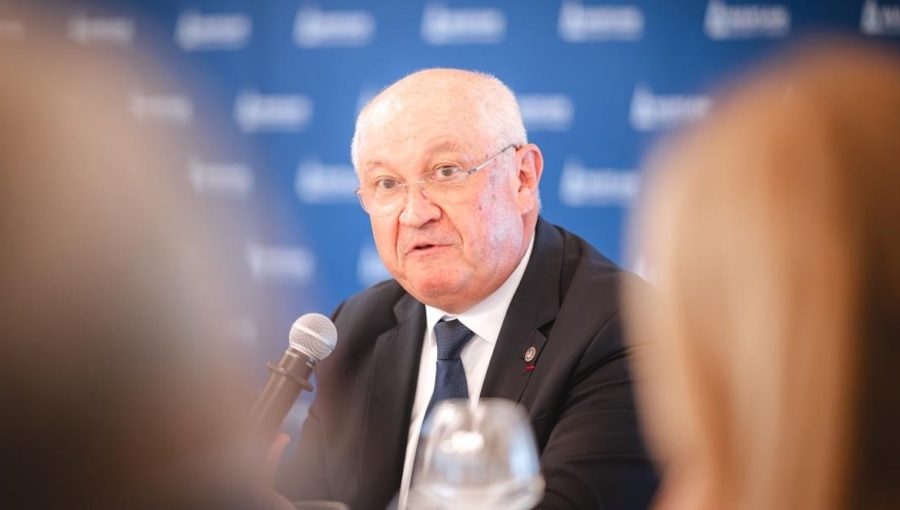
Moldovan Prime Minister Alexandru Munteanu announced his resignation on July 3, saying he could no longer carry out his mandate "in accordance with my principles and convictions", less than a year after taking office.
Munteanu steps down as Moldova prepares European Union accession negotiations amid growing political tensions and heightened scrutiny of the government's anti-corruption agenda.
"I accepted the offer to become prime minister with great responsibility and the firm belief that I could bring about positive change. When I realised that I could no longer fulfil my mandate in accordance with my principles and convictions, I decided to step down," Munteanu said, according to Deschide.md.
Under Moldova's constitution, the cabinet will continue to serve in a caretaker capacity with limited powers until a new government is sworn in.
President Maia Sandu said, at a brief press conference after Munteanu's resignation, that she expected to nominate a new prime minister within one to three weeks.
Munteanu did not disclose the reasons behind his decision. However, local media have reported unconfirmed disagreements between the prime minister and President Sandu over proposals for a broader overhaul of the management of state-owned companies and public institutions.
The resignation comes days after a corruption scandal involving state-owned air navigation company MoldATSA, where investigations uncovered irregular appointments and remuneration, including the hiring of Sandu's cousin, Anastasia Taburceanu. The affair has fuelled criticism of the government's governance practices and renewed scrutiny of Sandu's influence over appointments to senior public positions.
Sandu denied that tensions with Munteanu had prompted his resignation. "There were no contradictions. Both I and Mr. Munteanu work with integrity and honesty," she said. "This week I had several discussions with the prime minister about the reforms that have sparked numerous debates in society. There were no tense discussions at all."
She also dismissed reports of a late-night meeting preceding the resignation, saying a planned discussion had not taken place because Parliament Speaker Igor Grosu was unavailable.
Munteanu thanked ministers, civil servants and government staff for their work and said he would continue serving Moldova regardless of whether he remained in public office.
"I believe that duty to the country is not related to the position, but to the commitment we maintain," he said.
Munteanu, a businessman with previous activities in Ukraine, became prime minister on November 1, 2025, after the pro-European Party of Action and Solidarity (PAS) won the parliamentary elections.

No comments:
Post a Comment