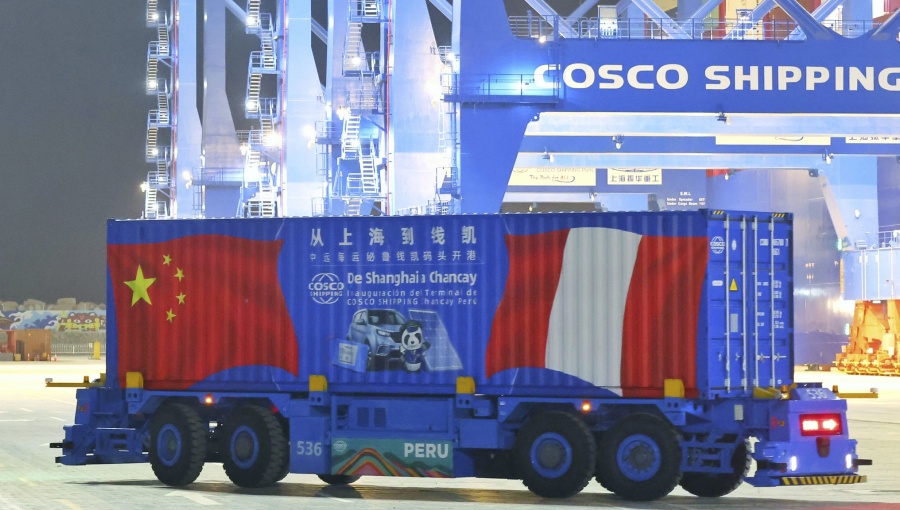
A Lima court has just done what Washington has spent months demanding: it put China's flagship South American port back under state oversight. On July 1, the Second Constitutional Chamber of the Superior Court of Lima overturned a January ruling that had stripped Ositrán, Peru's transport infrastructure regulator, of its power to inspect and sanction the $1.3bn Megaport of Chancay. For a facility built to be China's main gateway into South America, this is a serious reversal.
The ruling landed days after a separate court blocked a parallel attempt by the port's operator, Chinese state-controlled Cosco Shipping, to halt an antitrust probe by Indecopi, Peru's competition authority. Together, the two rulings end Cosco's brief run of regulatory immunity. The court's reasoning was blunt: Chancay is a public-use facility, regardless of the private ownership structure behind it.
The regulators are back
Cosco has lost its shield. For months, the terminal sat in a regulatory grey zone after the January ruling ordered Ositrán to stay away, effectively creating a private enclave on the Pacific coast. Cosco argued that a fully privately financed port, built without a state concession contract, fell outside standard public oversight law. It wanted routine disputes handled through commercial channels, not state mandates.
The appellate judges rejected that argument outright. Routine information requests and baseline administrative checks, they found, do not amount to an "imminent threat" to a private company's constitutional rights. That closes a loophole Cosco had used to play one regulator off against another. Now it faces both Ositrán and Indecopi at once, with no immunity from either.
Cosco is not done, though. Its lawyer, Ramiro Portocarrero, has confirmed the company will escalate the matter to Peru's Constitutional Tribunal through a Constitutional Grievance Recourse, arguing the state promised legal stability for a $1.3bn investment and then changed the rules mid-operation.
Peru follows Panama's script
Washington has run this play before, just five months earlier and one country north. In late January and February, the Trump administration pushed Panama's Supreme Court to nullify long-standing concessions at the ports of Balboa and Cristóbal, sitting at the Pacific and Atlantic mouths of the Panama Canal. A subsidiary of the Hong Kong-based conglomerate CK Hutchison had held those terminals for decades.
Secretary of State Marco Rubio led the public pressure, arguing Chinese port control was unacceptable on strategic grounds. The dispute peaked on February 23, when Panama's government seized the terminals by executive decree and handed interim control to Western-allied shipping lines, prompting a multi-billion-dollar arbitration claim from Beijing.
Chancay is the sequel. Washington treats Chinese control of Latin American port infrastructure as a systemic risk to Western supply chains. The method is identical to the one used in Panama: lean on domestic courts to enforce local law, reassert host-country sovereignty, and strip the legal protections shielding Chinese state-linked capital.
Washington times its message to the ballot box
The US State Department set the tone early. Its Bureau of Western Hemisphere Affairs warned publicly that "cheap Chinese money costs sovereignty". US Ambassador Bernie Navarro reinforced the point in person, delivering US-donated cargo scanners directly to Chancay's customs checkpoint, establishing a physical, symbolic American presence inside China's main South American gateway.
The timing of the ruling is political as much as it is judicial. Following Peru's June 7 elections, Navarro and Rubio moved quickly to congratulate conservative candidate Keiko Fujimori on her presidential win. They framed US engagement as a defence of transparent institutions against Chinese state firms dodging local rules. Beijing pushed back hard, with foreign ministry spokesperson Lin Jian dismissing the American statements as defamation.
None of this is coincidental. It traces a direct line back to Washington's national security establishment. Fujimori's campaign advisor in the run-up to the vote was Carlos Díaz-Rosillo, who during the first Trump administration served as White House director of policy and interagency coordination and later as the Pentagon's acting principal deputy assistant secretary of defense for international security affairs, a brief that explicitly covered defence policy for the Western Hemisphere. His move from drafting Washington's regional security doctrine to endorsing Fujimori across major Peruvian media outlets shows how tightly US security interests and Peruvian electoral politics have become intertwined. Navarro mirrored that posture on the ground: his highly visible role during the election cycle drew local criticism for pushing the boundaries of diplomatic neutrality.
Pulling Peru back from Beijing
Since Trump assumed office, Washington's focus on Peru has intensified dramatically, driven by alarm over how deeply intertwined Lima has become with Beijing. China is Peru's uncontested top trading partner, absorbing nearly 30% of Peruvian exports worth over $22bn a year, the vast majority of it copper and other minerals. Chancay was supposed to be the crown jewel cementing that architecture.
To break the alignment, the White House has deployed an aggressive, multi-layered counter-offensive. In January 2026, the Trump administration designated Peru a "Major Non-Nato Ally" (MNNA), a rare status that unlocks privileged access to US military hardware, joint defence research, and security programmes.
Washington backed that diplomatic upgrade with hard cash. The US State Department pushed through an estimated $3.42bn deal to sell F-16 fighter jets to the Peruvian Air Force, a sum roughly equivalent to Peru's entire annual defence budget, to anchor Lima's long-term military reliance on the West. The deal triggered fierce local political gridlock and internal ministerial clashes over funding timelines in April, but Peru ultimately secured its first payments to keep the purchase alive.
Simultaneously, to neutralise China's commercial maritime leverage at Chancay, Washington has shifted focus just north to Callao. The US has cleared equipment packages to modernise the naval base there and is pushing a deal for the US Army Corps of Engineers to build a brand-new main naval headquarters at Callao. Elite military access, fighter jets, and naval infrastructure: Washington is building a military firewall where it lost the economic argument.
A domestic corruption trail
While the geopolitics dominate the headlines, Peru's own state auditor has uncovered something arguably more damaging at home. An audit by the Comptroller General (Contraloría) found that officials at the National Port Authority and the Ministry of Transport and Communications possessed blueprints as early as 2021 showing the port's access tunnel was being built along an unapproved route, yet sat on that information for years while construction continued. The Contraloría has since referred several officials for criminal prosecution.
The bigger blow is a civil liability claim tied to ProInversión, the state investment agency. Auditors found officials fast-tracked a general sales tax (IGV) early-recovery scheme worth PEN527.8mn to Cosco representatives who allegedly lacked the legal authority to sign the contract. That sum, roughly $154mn, is more than a tenth of the port's entire $1.3bn construction cost.
The Contraloría has recommended the case go to Peru's Public Prosecutor's Office for Corruption Offences, naming Cosco itself as civilly responsible. Combined with a prior environmental fine and a failed beach-erosion system, the pattern points to a state regulatory system that repeatedly looked away.
The sovereignty play nobody quite believes
Peru's Constitutional Tribunal will have the final word, and Chancay's regulatory status stays provisional until it rules. Officially, this is a story about sovereignty restored: a turbulent Andean state standing up to a Chinese state giant, backed by a superpower patron cheering from the sidelines.
Read the fine print and the story gets murkier. The same officials now empowered to police Cosco are drawn from the same ministries that sat on tunnel blueprints for years and fast-tracked a $154mn tax break to representatives who, on paper, had no authority to ask for it. Sovereignty, in this telling, was for sale well before Washington decided it needed defending.
Cosco knows the routine. It has watched CK Hutchison run the same play in Panama: fight in the courts, absorb the political theatre, wait for the news cycle to move on. An appeal to the Constitutional Tribunal buys time, and time is the one resource a $1.3bn sunk investment can still spend freely.
What is being restored at Chancay is not so much sovereignty as leverage, and it now sits with whichever government official Cosco, Ositrán or Washington decides to call next. Peru did not choose sides in the US-China contest so much as it discovered, again, that its ports are worth more as chips than as ports.
July 3, 2026
Diálogo Américas
By Julieta Pelcastre
Key Takeaways
Dual-Use Concerns — Beyond commerce, 31% of Chinese-funded ports saw naval activity, rising to 41% at operator-owned facilities. Examples like Nicaragua’s Corinto port (financed then visited by Chinese naval hospital ship) raise questions about intelligence, crisis leverage, and military access.
Sovereignty & Dependence Risks — Heavy reliance on Chinese financing/operation risks ceding control over critical infrastructure. Analysts warn of long-term constraints on national decision-making and recommend diversification, stronger oversight, and regional cooperation to protect sovereignty.
Analysis
China’s global expansion of port infrastructure is widely regarded as part of a broader strategy to expand geopolitical influence, secure access to strategic supply chains, and strengthen its long-term positioning. According to the report, Anchoring Global Ambitions, published by AidData in partnership with the Center for Strategic and International Studies (CSIS), Beijing has spent the last two decades building an extensive network of ports and logistics corridors that increasingly intersect with strategic resources, critical maritime routes, and key infrastructure hubs around the world. Within this network, Latin America is becoming an increasingly important node.
Beyond facilitating trade, these investments may also provide China with greater access to strategic logistics data, increased influence over maritime chokepoints, and expanded operational leverage during periods of crisis or geopolitical tension. Analysts warn that the integration of Chinese companies into the operation, financing, and modernization of critical port infrastructure could increase regional dependence on external actors for the management of key supply chains and trade corridors.
Between 2000 and 2025, China invested some $24 billion in the development and modernization of port infrastructure across 168 ports in nearly 90 countries, according to the AidData report published in March 2026. The initiative includes not only the construction and expansion of terminals, but also more than 360 related projects involving logistics systems, cranes, scanners, and other port technologies supplied by Chinese companies, deepening Beijing’s role in the operation of strategic maritime infrastructure.
Juan Belikow, a political scientist and specialist in security and organized crime at the University of Buenos Aires, Argentina, told Diálogothat China’s port expansion reflects a long-term strategy aimed at establishing interconnected global logistics hubs.
“They are setting up a series of nodes around the world through which international trade will have to pass,” Belikow said, highlighting the concentration of trade flows in these corridors.
Latin America has become an area of growing strategic importance with China’s port expansion strategy. According to data from AidData’s CPORTS 2.0 and CFTM 2.0, at least seven ports in the region are located within 500 kilometers of Chinese-financed mining operations. These include ports in Chancay, Peru; Guayaquil, Posorja, and Bolívar in Ecuador; Buenaventura in Colombia; and a port in Guyana.
The proximity between these Chinese-backed ports and extractive projects highlight the growing integration between logistics infrastructure and natural resource supply chains. In Peru, for example, the port of Chancay is located near major mining operations such as Toromocho and Raura, strengthening China’s access to strategic minerals and export corridors critical to global supply chains.
Brazil has also emerged as an important hub within this network. Between 2009 and 2023, the country received some $505 million in Chinese investment related to port infrastructure projects. Analysts warn that this growing footprint has implications that extend beyond commerce, particularly regarding strategic logistic access, supply chain influence, and long-term dependence on infrastructure operated or financed by Chinese entities.
Naval activity and dual-use concerns
Concerns surrounding China’s global port investments are not limited to commercial activity. According to the AidData report, 31.2 percent of Chinese funded port projects worldwide recorded some form of Chinese naval activity between 2000 and 2025, including military ship visits, exercises, and official engagements. The percentage rises to 41.5 percent at port facilities where Chinese operators hold direct ownership stakes, reinforcing concerns among analysts about the dual-use nature of these projects.
One recent example is the Port of Corinto in Nicaragua. In July 2025, Nicaragua approved some $128 million in Chinese financing to modernize the port. Four months later, the Chinese naval hospital Silk Road Ark docked at Corinto, marking the first known visit by a Chinese military vessel to the country.
For analysts, cases like Corinto illustrates how commercial infrastructure projects may also support broader strategic objectives by expanding China’s access, presence, and influence in critical maritime regions.
CSIS warned in its report No Safe Harbor that China’s growing involvement in strategic ports could provide Beijing with access to sensitive logistics information and increase its ability to influence operations at key maritime hubs, particularly during crisis scenarios. The report also notes that Chinese companies operating ports abroad may create opportunities for intelligence collection, logistical support, and expanded strategic access.
Sovereignty and challenges for the region
China’s growing presence in strategic infrastructure is also raising concerns about sovereignty and operational dependence throughout Latin America and the Caribbean.
Investigative outlet Expediente Público warned that increasing reliance on Chinese-operated or Chinese-financed infrastructure could gradually limit countries’ ability to independently manage strategic logistics systems and supply chains. Analysts note that as Chinese companies become more deeply integrated into port operations, governments may face increasing difficulty maintaining full control over critical maritime infrastructure.
Belikow emphasized that ports are not merely commercial facilities, but strategic nodes capable of shaping trade flows and influencing national decision-making. “Ports are bottlenecks of international trade, allowing China not only to expand its presence but also to observe the behavior of other actors at these key points,” Belikow said.
According to Belikow, China’s financing model also reflects a long-term strategic approach that differs significantly from the shorter political and economic cycles often seen in the region. “Our leaders think from now until the next election,” he said. “China does not.”
A strategic response
As China expands its global infrastructure footprint, analysts argue that countries in Latin America will increasingly need to evaluate the long-term strategic implications associated with foreign control or influence over critical logistics infrastructure.
The report Anchoring Global Ambitions recommends that governments strengthen long-term infrastructure planning, diversify financing options through partnerships with trusted allies, and improve coordination mechanism for evaluating strategic investments.
The report also highlights the importance of strengthening regional cooperation to ensure greater oversight and resilience across critical logistics networks.
“Managing these hubs not only allows for influencing trade but also for anticipating trends and guiding decisions,” concluded Belikow, warning that, although these investments may seem attractive in the short term, “they are ceding control.” This process, according to the expert, “becomes entrenched over time and constrains states’ ability to ensure their sovereignty over key infrastructure.”
This article was published by Diálogo Américas
About Diálogo Américas
Diálogo Américas is a professional magazine published by U.S. Southern Command as an international forum for security issues in Latin America.
View all posts by Diálogo Américas →

No comments:
Post a Comment