Wednesday, April 28, 2021

Protesters at South Korea THAAD site dispersed after attempting to block delivery


Police break up a sit-in by residents and activists opposing delivery of materials to the U.S. Terminal High Altitude Area Defense base in Seongju, North Gyeongsang Province, South Korea, on Wednesday. Photo by Yonhap/EPA
-EFE

April 28 (UPI) -- South Korea's military confronted dozens of protesters while attempting to deliver construction materials and power generators to a base for the U.S. missile defense system Terminal High Altitude Area Defense in Seongju.

The military was able to bring in the materials Wednesday. Seoul said the equipment was for the purposes of "improving accommodations" for soldiers. Protesters who claimed the materials were being used to upgrade THAAD batteries attempted to block the delivery, but were dispersed, News 1 reported.

Seoul began the delivery early Wednesday, at 7:30 a.m., but protesters already had begun to gather near the entrance of the THAAD site in central South Korea at 5:30 a.m., local newspaper Chosun Ilbo reported.

The protesters were residents of Seongju and a nearby town, Gimcheon. More than 70 local civilians claimed that "battery upgrades" were, "threatening peace on the Korean Peninsula," the report said.

South Korea's defense ministry has denied the equipment was being used for upgrades. The government said Tuesday that the materials had "nothing to do with THAAD battery capabilities," according to Yonhap.

Local groups including the Council for THAAD Withdrawal and Peace said they are skeptical of government claims.

"Deploying a large number of police in a small town with many elderly residents amid the coronavirus pandemic is dangerous," the coalition of groups said, according to the Chosun. "We will fight to the end to stop them

No major injuries were reported, but at least three protesters were transferred to a nearby hospital after they suffered cuts or abrasions, the report said.

THAAD is designed to intercept intermediate-range ballistic missiles. The South's military is on guard for additional North Korea provocations after Pyongyang tested two short-range ballistic missiles March 25.

The defense ministry said Wednesday that the missiles flew 370 miles. Last month, the military said the flight range was 280 miles, according to Yonhap.
US Air Force forms teams to address LGBTQ, Indigenous issues


Maj. Gen. Leah G. Lauderback is one of the founders of the Air Force's newly formed LGBTQ Initiative Team. Photo courtesy of Air Force


April 27 (UPI) -- The Air Force has formally established two teams to identify and address issues affecting LGBTQ people and Indigenous people in the service.

The Lesbian, Gay, Bisexual, Transgender and Queer/Questioning Initiative Team and the Indigenous Nations Equality Teams were formed under the umbrella of the Air Force's Barrier Analysis Working Group, according to a press release from the service.

"Once again, our airmen and guardians are leading the way. With the addition of these two groups, we will have a better understanding of barriers to service which allows us to enhance our diversity and inclusion," said Gwendolyn DeFilippi, assistant deputy chief of staff for manpower, personnel and services for the Air Force.

The release notes that the formation of the LGBTQ initiative team comes 10 years after the repeal of Don't Ask, Don't Tell, which prohibited lesbian, gay and bisexual service members from serving openly

"I expect our group will grow-our community and allies want to help," Maj. Gen. Leah Lauderback, one of the group's founders and its military officer champion, said in the Air Force's release.

The INET's acronym is a play on words for the term "Innit," a slang term among Native Americans meaning, "Yes, I agree," according to the release.

The group is tasked with reviewing and analyzing guidelines, programs, data and other information for barriers to employment, advancement and retention of Native American and Alaska Native employees and military members.

RELATED Pentagon reverses Trump-era policies to allow transgender people to serv

"We are looking forward to representing our Airmen and Guardians who are a part of the indigenous nation's community," said Col. Terrence Adams, INET champion. "We are hoping to identify changes that will eliminate barriers affecting members within these groups. We cannot be aware of things that need to change unless we are talking about them with an open mind."

Both teams could also serve as an initial member/employer resource group for their communities, the Air Force said.

The Air Force created the BAWG in 2008 to analyze data, trends and barriers to service for the civilian workforce, with the group's focus expanding to include personnel issues in subsequent years.

A
os f March 2021, the Air Force has also established the Black/African American Employment Strategy Team, the Disability Action Team, the Hispanic Empowerment and Action Team, the Pacific Islander/Asian American Community Team and the Women's Initiatives Team.

Earlier this month the Air Force began a survey for its second Inspector General's report on diversity and disparity in its ranks.

The review follows a 2020 report, which focused on racial disparity among Black members of the military branch, where the second survey expands the focus to other ethnicities and also examines the role of gender in the branch.

The first review found that Black men at every level of the service experience disproportionately negative outcomes at nearly every level, including increased likelihood of court-martials and less likely to be placed in fields that offer opportunities for advancement.
(0) Leave a comment

upi.com/7093451
Tesla rejects environmental accusations from U.S., German regulators


A Tesla Motors factory is seen in Fremont, Calif., on May 10, 2020. The plant is the subject of environmental rule violations, according to U.S. regulators. File Photo by Terry Schmitt/UPI | License Photo


April 28 (UPI) -- Tesla Motors is facing accusations from regulators in the United States and Germany that say the electric carmaker failed to provide information related to federal pollution laws and old batteries from its vehicles.

The accusations were outlined in a financial filing the company made Wednesday.

According to the document, the Environmental Protection Agency accused Tesla this month of failing to provide proof that it's complying with pollution rules regarding the surface coating of its vehicles.

California environmental authorities have previously filed reports of air quality violations at Tesla's plant in Fremont, near San Francisco.

The paint shop at the Fremont plant has reportedly had problems of improper cleaning and maintenance. Some re-touching has taken place in an open-air tent at the factory, employees told CNBC.

Tesla defended itself against the accusation and said in its filing that it's responded to all EPA requests and "refutes the allegations."

The company said in the filing that it does not anticipate any "material adverse impact" regarding the EPA issues.

The filing also shows that Tesla has been fined 12 million euros [$14.5 million] by German regulators for failing to take back old vehicle batteries from customers and making public notifications.

Under German law, electric carmakers must take back old batteries and dispose of them in an environmentally safe manner.

In its filing, Tesla said it has "continued to take back battery packs" and that it's filed an objection to the fine.

The company said it doesn't expect the battery issue to have a :material adverse impact on our business."
CAN CHOOSE TO NOT WEAR A MASK BUT NOT TO GET AND ABORTION

Arizona gov. signs anti-abortion bill into law amid GOP push to restrict the procedure


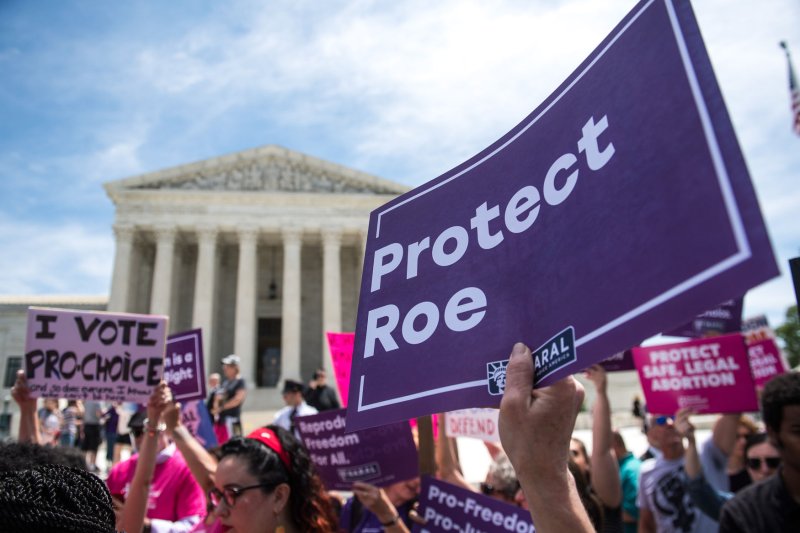
Democrats and women's rights advocacy groups accuse Republicans seeking to pass sweeping anti-abortion legislation of attempting to use the bills, which will be challenged in court, to overturn Roe vs. Wade. Photo by Kevin Dietsch/UPI | License Photo


April 28 (UPI) -- Arizona Gov. Doug Ducey has signed into law a sweeping controversial anti-abortion bill that criminalizes abortions performed due to genetic issues of the fetus amid a Republican push to limit access to the procedure.

The Republican governor signed the bill Tuesday, making it a felony for a medical provider to knowingly perform an abortion because of a fetus' "genetic abnormality," including chromosomal disorders, such as down syndrome, and morphological malformation. Exceptions are in place for "lethal fetal" conditions.

"There's immeasurable value in every single life -- regardless of genetic makeup," Ducey said in a statement. "We will continue to prioritize protecting life in our preborn children, and this legislation goes a long way in protecting real human lives."

S.B. 1457 also criminalizes the use of force to coerce a person to have an abortion because of a genetic abnormality or accept money to finance such a procedure.

Under the law, the medical practitioner must sign an affidavit stating they are performing an abortion not because of a genetic issue. They must also inform the person they are performing the procedure on that it is unlawful to have an abortion over the fetus' sex, race or genetic abnormality.

It also bans the mailing of abortion-inducing drugs and requires fetal remains from an abortion to be cremated or interned.

The Center for Arizona Policy, an anti-abortion group, celebrated the bill being signed into law as a "win" for Arizonans.

RELATED
FDA approves removing in-person requirement for abortion pill amid pandemic

"Arizonans can be proud of a state that leads the way in protecting the preborn and caring for women facing unplanned pregnancies," Cathi Herrod, the center's director, said in a statement.

The Bishops of Arizona Catholic Conference also issued a statement Tuesday, saying the bill maintains Arizona's status as "the most pro-life state in the country."

"This legislation looks forward to the day that Roe vs. Wade is overturned and shows concern for both unborn children and their mothers," the state's five bishops said in a statement, referring to the landmark 1971 ruling by the Supreme Court that legalized abortion.

The bill reached Ducey's desk after it passed the Republican-controlled House along party lines 31-29 and the Republican-controlled Senate also along party lines 16-14 on Thursday.

Reproductive health and women's rights advocates and Democratic politicians had urged the governor to not sight the bill, stating it is unconstitutional and harms both medical practitioners and women.

"S.B. 1457 will undoubtedly have unintended consequences for people who experience pregnancy loss of any kind and will force people to carry pregnancies to term against their will," Darrell Hill, director of policy at the American Civil Liberties Union of Arizona, said in a statement, stating that abortion was still legal and protected under federal law.

Progress Arizona, an organization that promotes progressive policy in the state, called the bill "horrible" for equating the rights of fetuses and embryos with full personhood to take away the rights and freedoms of the person who is carrying the fetus.

It also said it will be costly for the state as the law will be challenged in court.

"The AZ GOP knows that this bill is disgusting, extreme and wrong," the organization said in a statement. "They want to go to court and use it as an excuse to overturn Roe vs. Wade."

The bill was signed as Republican-controlled states seek to pass sweeping anti-abortion legislation and a day after the GOP governors of Oklahoma and Montana each signed into law three such bills to restrict access to medical procedure.

Arizona House Democratic leader Rep. Melody Hernandez accused Republican lawmakers of pursuing a bill no stakeholder from the disability community had asked for.

"Republicans will use anyone as pawns in their relentless effort to waste millions in taxpayer dollars defending this blatantly unconstitutional law in court hoping that the Supreme Court will upend current precedent on this essential form of healthcare and grant a fetus more rights than the person who is pregnant," she said in a statement.
Wisconsin opens investigation claims of clergy sexual abuse


Wisconsin Attorney General Josh Kaul said they are seeking accountability and to heal wounds by investigation claims of clergy sexual abuse. File Photo courtesy of Pixabay

April 28 (UPI) -- The Wisconsin Department of Justice has launched an investigation into reports of sexual abuse by clergy and faith leaders in the state, Attorney General Josh Kaul said.

Surrounded by clergy abuse survivors and advocates, the state's Democratic attorney general announced the probe during a press conference Tuesday. Kaul encouraged victims as well as family and friends who have information concerning abuses committed by the church to come forward.

"We are conducting this review to get greater accountability and to promote healing for victims, and we're conducting this review to improve the response to abuse and hopefully to prevent future cases of abuse," Kaul said.

The attorney general's office explained in a statement that the statewide investigation will be an independent review of the sexual abuse claims and will not be limited by when they occurred.

Kaul told the public that the Department of Justice will gather information on reports of abuse as well as attempts to cover up alleged criminal acts through a toll-free phone line and an online reporting tool. The investigation will include reviewing documents produced by dioceses and religious orders in Wisconsin.

"I want to stress that we strongly encourage anyone who knows anything to report," he said. "No detail is too small. If you've reported before, we would like you to contact us. If you haven't reported before, we would like for you to contact us. And if you know about abuse involving someone who can't report, we want to encourage you to report that abuse."

The investigation will begin with a review of the dioceses of the Catholic church but Kaul said that his office is seeking claims concerning leaders of any faith or institution.

RELATED Catholic bishop in Minnesota resigns after inquiry over sexual misconduct cases

"This is an opportunity for us to bring transparency and accountability to a wrong that hasn't been addressed for far, far too long and it's my hope that the diocese and religious orders will work with us," he said.

Sara Larson, executive director of Awake Milwaukee, a non-profit group of Catholics seeking to raise awareness of clergy abuse, urged other Catholics during the press conference to welcome the investigation and to face whatever it might reveal.

"It is true that the process and results of this investigation are likely to be painful for anyone who loves the church. I understand the temptation to wish that this would all just go away so we don't have to think about these horrible stories any longer," she said. "But the reality is abuse in our church is not a problem of the past."

Several of the state's dioceses responded separately to the announcement, stating the church takes issues of clergy sexual abuse seriously and has put in place several prevention and accountability measures since 2002, when abuses in Boston were widely covered.

Jerry Topczewski, chief of staff to the archbishop of Milwaukee, said the church has taken action to prevent such abuse and that he worries the investigation will negatively affect abuse survivors because of the publicity it will attract.

"There is no evidence that the church as a whole and the Archdiocese of Milwaukee hasn't already taken all possible steps in addressing issues surrounding clergy sexual abuse," Topczewski said in a statement. "We also do not understand the legal basis for the inquiry. We also question why only the Catholic church is being singled out for this type of review when sexual abuse is a societal issue."

The church understands it has made mistakes but it has since become "a model of how this issue is addressed," Topczewski said, adding that the diocese will review Kaul's requests for documents and information when it is received.

Nate's Mission, a Wisconsin-based project against clergy abuse, responded to the dioceses' statements, saying if the church is so confident it hasn't committed any crimes, then it should "be eager" to provide the attorney general with the documents his office has requested.

"The fact that they have not made any public commitment to do so raises serious questions," the organization said in a statement.

Asked during the press conference why the Department of Justice was launching the investigation now, Kaul said, "because it's the right thing to do."
SUDBURY 
Laurentian cuts threaten Women’s, Gender and Sexuality Studies, advocates say


For now, Laurentian University's restructuring process has spared Women’s, Gender and Sexuality Studies — or WGSX.


But professors, students and supporters say WGSX faces an uncertain future, especially since Laurentian is tearing up its agreements with its federated universities, including Thorneloe, where the program has been housed.

"If they are targeting core offerings (math, physics, engineering, etc.) then I wonder what’s next," said Jennifer Johnson, who chairs the department. "We worked in tandem with midwifery, and overlap with social work and Indigenous Studies. We are efficiently run and economically successful. This program is no burden to Laurentian."

“It’s such a disaster for our community. We were so blindsided with the errors that have been made.”

Laurentian is insolvent, is restructuring and has cut almost 70 programs and more than 150 professors and staff. The university, however, said students will be able to continue to study and graduate from a restructured Laurentian.

“While not among the nearly 70 programs axed last Monday at Laurentian, Women’s, Gender and Sexuality Studies is nonetheless one of the many academic programs also threatened by the LU administration’s handling of its financial crisis,” Johnson and program support Beth Mairs said in a release.

For the time being, the program remains in place and have qualified faculty to lead them.

The program is strongly networked in the community and it provides students with first-hand experiences in advancing social justice and provides exposure to work roles, and needs, within many organizations and advocacy groups.

Professor Mercedes Steedman offered the first course in Women’s Studies in 1979. Margaret Kechnie and Andrea Levan developed on-campus and distance education programs. Current enrolment is 53 program students and more than 500 taking courses towards minors, a certificate and electives every year.

A diverse range of courses and pathways has always been encouraged at Laurentian and its federated universities, at least until now. Laurentian has shared funding with Thorneloe, the University of Sudbury and Huntington; that ends May 1 when Laurentian will keep all the money.

“I think right now the administration at Laurentian is having a hard time making the connection between programs that are explicitly about gender equity and what they are actually doing to our community," Johnson said. "WGSX has been left in a precarious situation since Laurentian’s announcement April 2 that it was unilaterally cancelling the federation agreement

"The whole process that has happened at Laurentian has been so violent. My students have tried to speak, but have been shut down by the administration. It all runs counter to the mandate of the university, which is to encourage dialogue.”

Johnson said Laurentian's decision to end the federation agreements "was my signal, very clearly, that the administration does not care about Women and Gender Studies students and the program’s place within the university.

“Almost two years ago they tried to cut things at the feds (the federated universities). The day that theatre arts was closed, I cried and cried. Its closure was a direct result of the budget cuts at Laurentian. We know COVID didn’t cause the insolvency. Laurentian had problems before that.

She said the lack of certainty about the state of the program and Laurentian generally has already severely affected students, especially those near graduation and with concentrations in Women’s Studies.

“I know I am not the only student who is a stone’s throw away from graduating," said fourth-year student Courtney Nelson. "This change in programming puts us in an impossible position of needing to sacrifice our education for Laurentian's poor financial management. I am now in a position where I may have to start over again.”

Another student, April Scott-Nichols, said in a statement students and faculty within WGSX have fought against the system their entire lives.

“We were born fighters, and we will fight here for the future of our WGSX program.”

Community member Beth Mairs the program is a key to the future of gender equity in the North. “Women's and Gender Studies isn't just a program, it is a network of advocates, employers, and families, who care about these things," she said.

“That the Women’s, Gender and Sexuality Studies program speaks to marginalized groups and draws eager students from communities with historically less access to higher education, the community mobilization to preserve this program has been strong. An open letter to LU resident Robert Haché drew over 1,000 signatures in less than one week.”

The Local Journalism Initiative is made possible through funding from the federal government.

sud.editorial@sunmedia.ca

Twitter: @SudburyStar

Hugh Kruzel, Local Journalism Initiative Reporter, The Sudbury Star

Interior Department reverses Trump policies on placing Native lands in trust


U.S. Secretary of the Interior Deb Haaland on Tuesday reversed multiple policies instituted by the Trump administration, which the agency said "undermined the ability of Tribes to establish and consolidate their homelands." Photo by Jim Lo Scalzo/UPI | License Photo


April 27 (UPI) -- The Department of the Interior on Tuesday reversed several Trump administration policies it said made it more difficult for Native American tribes to place land into trust.

Interior Secretary Deb Haaland, the first Native American to lead the agency, issued an order returning authority to review and approve applications to place land into trust to the Bureau of Indian Affairs regional directors after former President Donald Trump in 2017 directed that they be handled by the Interior Department's headquarters staff.

Tuesday's order does not apply to gaming applications, the agency said.

Placing lands into trusts allows tribes to reacquire lands within or near their reservations by having the Interior Department acquire the title to the property and hold it for the benefit of a tribe or individual.

RELATED Haaland establishes missing, murdered Native American women unit

The Interior Department said the prior administration's changes increased the complexity in the decision-making process and "undermined the ability of tribes to establish and consolidate their homelands."

"At the interior, we have an obligation to work with tribes to protect their lands and ensure that each tribe has a homeland where its citizens can live together and lead safe and fulfilling lives," Haaland said. "Our actions today will help us meet that obligation and will help empower tribes to determine how their lands are used -- from conservation to economic development projects."

The agency on Tuesday also withdrew two policies it said "created an unduly burdensome process" for tribes seeking to place land into trust under the Indian Reorganization Act and one that "erroneously concluded" the secretary of the interior does not have discretionary authority to take land into trust for tribes in Alaska.

RELATED DHS launches Operation Sentinel to fight human trafficking of migrants

"The patchwork of landholdings within existing reservation boundaries can make it difficult to develop coherent law enforcement and regulatory policies on reservations, restricting the ability to sustain community and economic development," said Bryan Newland, principal deputy assistant secretary of Indian Affairs. "These important actions are a step in the right direction to restore homelands that will strengthen tribal communities."

CRIMINAL CAPITALI$M  A FAMILY AFFAIR
Facing $11B tax bill, Samsung heirs donate massive art trove

SEOUL, Korea, Republic Of — Samsung’s founding family will donate tens of thousands of rare artworks, including Picassos and Dalis, to help them pay a massive inheritance tax bill following last year’s death of company chairman Lee Kun-Hee

.
© Provided by The Canadian Press

They will also give hundreds of millions of dollars to medical projects and research in an apparent attempt to improve their public image as they proceed with a multiyear plan to inherit both the wealth and corporate power of South Korea’s richest-ever businessman.

The Lee family, including his widow and three children, expects to pay more than 12 trillion won ($10.8 billion) in inheritance taxes, which is more than half the wealth Lee held in stocks and real estate, Samsung said Wednesday. This would be the largest amount in South Korea and more than three times the country’s total estate tax revenue for last year.

Giving away the late chairman’s vast collection of art masterpieces would reduce the taxable portions of his estate.

The family plans to divide the payment in six installments over five years, while making the first payment this month.

“It is our civic duty and responsibility to pay all taxes,” the Lee family said in a statement. They had until Friday to report the extent of the inheritance and payment plans to tax authorities.

Raising cash for the tax payment is crucial for the Lee family to extend its control over Samsung’s business empire, which extends from semiconductors, smartphones and TVs to construction, shipbuilding and insurance. Some analysts say the process could result in a shakeup across the group.

The late Lee owned 4.18% of Samsung Electronics, which is one of the world’s biggest makers of computer memory chips and smartphones, but also held stakes in Samsung affiliates that collectively owned a larger share than his in the crown jewel electronics company. The complex shareholding structure has allowed Lee and his family to exert broad control over the group.

In Wednesday’s statement, Samsung did not mention how Lee’s widow and children would split his assets, and there’s speculation they haven’t reached a final agreement.

Most market analysts believe Lee’s shares will be distributed in a way that would strengthen the leadership of his only son and corporate heir, Lee Jae-yong, the de facto chief of Samsung Electronics who is currently imprisoned for bribery and other crimes. Lee’s other children are Lee Boo-jin, CEO of Samsung’s Shilla luxury hotel chain, and Lee Seo-hyun, who heads the Samsung Welfare Foundation.

The family plans to donate 23,000 art pieces from Lee’s personal collection to two state-run museums. They include old Korean paintings, books and other cultural assets designated as national treasures, and modern Korean painters such as Park Soo-keun and Lee Jung-seop. There are also the works of Marc Chagall, Pablo Picasso, Paul Gauguin, Claude Monet, Joan Miro and Salvador Dali, Samsung said.

The National Museum of Modern and Contemporary Art said the 1,488 pieces it received from the Lee family was its biggest private donation. The works included Lee Jung-seop’s “Bull,” Dali’s “Family of Marsupial Centaurs,” Monet’s “Water Lily Pond (Le Bassin Aux Nympheas),” and Chagall’s “Red Bouquet With Lovers (Les Amoureux Aux Bouquets Rouges).”

The National Museum of Korea will receive around 21,000 pieces from Lee’s collection of Korean traditional art, including paintings, ceramics and sculptures.


Hwang Hee, South Korea’s culture minister, said some of the art donated by Lee will be displayed for the public starting in June. He expressed “deep gratitude” to the Lee family for “enriching” the country's cultural assets, but he sidestepped questions on whether he thought Samsung was trying to create a positive atmosphere for Lee Jae-yong to get pardoned.

Lee family will also donate 1 trillion won ($900 million) to help fund infectious disease research and treatment for children with cancer and rare illnesses.

About half of that money will be used to help finance the establishment of a 150-bed hospital providing specialized treatment for infectious diseases. Experts had raised the need for such facilities equipped with negative pressure rooms and other advanced systems following the emergence of COVID-19.

About 300 billion ($267 million) of the funds will go into a decadelong program with the Seoul National University Children’s Hospital to help families pay for the treatment of children with cancer and rare diseases and support clinical trials and drug development.

“Members of the (Lee family) hope to honour the life of the late Chairman Lee and his commitment to corporate citizenship and co-prosperity by giving back to communities,” Samsung said.

Before his death in October, Lee was credited for transforming Samsung Electronics from a small television maker into a global giant in semiconductors and consumer electronics. But his leadership was also marred by corruption convictions that highlighted the traditionally murky ties between the country’s family-owned conglomerates and politicians. He had been hospitalized for years following a heart attack in 2014.

Lee Jae-yong, who has since helmed the group in his capacity as vice chairman of Samsung Electronics, is currently serving a 2 1/2-year sentence for bribing then-President Park Geun-hye and her close confidante to win government support for a 2015 merger between two Samsung affiliates. The deal helped strengthen Lee’s control over the Samsung group, but the revelations about his corrupt ties with the Park government fueled a 2016 corruption scandal that spurred huge protests and ousted Park from office.

The younger Lee has vowed to improve Samsung’s corporate culture, declaring that heredity transfers at the group would end and that he wouldn’t pass the management rights he inherited to his children. He also said Samsung would stop suppressing employee attempts to organize unions, although labour activists have questioned his sincerity.

A growing number of politicians, religious and business leaders have been calling for President Moon Jae-in to pardon Lee. They say it would help Lee strengthen Samsung’s global leadership in semiconductors and he could possibly use his business reach to help the country secure more coronavirus vaccines.

Critics point out that Samsung didn’t show signs of trouble when Lee was in jail in 2017 and 2018, and that prison terms have never really stopped corporate leaders from relaying their management decisions from behind bars.

Kim Tong-Hyung, The Associated Press
HIPSTER CAPITALI$M

Trumpy Billionaire Peter Thiel Is Behind the Next Psychedelics IPO


Tarpley Hitt 

4/27/2021


In the two years since the Food and Drug Administration approved the first synthetic ketamine treatment, drug developers, VC investors, and rich guys who like Burning Man have been scheming for ways to convert psychedelics from a stoner pastime into a private enterprise.

On Tuesday, New York-based company MindMed will start trading on the Nasdaq, becoming the second psychedelic company ever to go public on a major American exchange. The debut comes six months after Compass Pathways, a drug developer focusing on the psychoactive compound in shrooms, became the first, reaching a market cap of $1.33 billion.

A third company is set to follow suit. Just last week, self-described “drug growth platform” Atai Life Sciences filed an S1 application with the Securities and Exchange Commission, announcing plans to raise $100 million in an initial public offering. The German developer was founded by prodigious meme investor Christian Angermayer—a COVID skeptic who has psilocybin’s molecular structure tattooed on his forearm. In something of a mind-bending ouroboros, Atai is also the largest shareholder in Compass Pathways.

In May, Atai Life Sciences closed a financing round of $24 million backed by billionaire right-wing donor and Trump backer Peter Thiel. The German American PayPal co-founder, who later launched the big data firm Palantir, has funded a range of controversial projects––research into seasteading, various experiments in “life extension,” and the lawsuit that bankrupted Gawker.

“ATAI’s great virtue is to take mental illness as seriously as we should have been taking all illness all along,” Thiel told CNBC at the time. “The company’s most valuable asset is its sense of urgency.”

Like Thiel’s Atai, MindMed is ultimately a biotech company, focused on developing medicines derived from the compounds in shrooms (psilocybin), acid (LSD), molly (MDMA), DMT, and Ibogaine, which some believe may be useful in treating opioid addictions. It has been trading as a penny stock under the ticker “MMEDF” and for the past year, on the NEO Exchange in Canada, after arranging a reverse takeover with a British Columbia-based gold mining company.

The IPOs are riding a wave of increasing interest in developing long-restricted substances for medical application, particularly in the treatment of mental health disorders. In 2018, the FDA granted “breakthrough” status for a psilocybin-derivative called COMP360, just months before they approved Johnson and Johnson’s ketamine-derived treatment. Last year, the state of Oregon legalized psilocybin use for therapy, and several states have passed bills to decriminalize it.

Matt Zemon, who co-founded a health platform called Psychable, which connects users to legal medical providers of psychedelic treatments, told The Daily Beast that the FDA had opened the door to more research into their efficacy.

“From our perspective, we believe we’re in the middle of a psychedelic renaissance,” Zemon said. “Research now shows the transformative power of psychedelics...The response to ketamine has been showing us that people want something different, there hasn’t been a drastic change in medical treatments for mental health treatments in decades.”

But the psychotropic trading rush also arrives in the second year of what writer David Nickles dubbed, in the academic drug outlet Psymposia, the “Corporadelic Era”—a transition from an open science approach to psychedelic research to a private one, circumscribed by proprietary concerns and patent competition.

“There are groups that believe that this should be done all under a nonprofit or an open source philosophy,” Zemon said. “There are other groups that feel like to invest what needs to be invested, they need to have patents and the ability to have long term profits from them.”


This transition has been poorly received by many proponents of psychedelic treatments. A major flashpoint in the debate took place in February, when Compass Pathways filed a patent application for psychedelic therapy using the shrooms compound psilocybin. The developer attempted to stake ownership on a range of basic uses to “treat depression and other various disorders,” suggesting to some that almost any outside application of the drug might violate the patent.

As reporter Shayla Love noted in VICE, Compass had tried to claim ownership of aspects of psilocybin therapy that went beyond the chemical composition of its drug to the basic ways the psychedelic might be administered. If other providers offered shroom therapies in “a room with a substantially non-clinical appearance,” or one that comprised “soft furniture,” or was “decorated using muted colors” ––they’d risk running afoul of Compass’ patent. Other potential violations included rooms with “high resolution sound systems” or “a bed or a couch” or “wherein the subject listens to music.”

The other psychedelic developers have signaled support for Compass’ approach. In an open letter to VC investor Tim Ferriss from March, Atai Life Sciences co-founder Christian Angermayer defended the use of patents in psychedelic drug development. Patents, he wrote, “represent the best means of accelerating patient access and optionality in the midst of a mental health crisis.”

MindMed has made similar moves. Last year, the company announced a multiyear partnership with a Swiss lab, granting them exclusive rights to the lab’s research into LSD and related compounds. When co-CEO Jamon “JR” Rahn derided the movement to decriminalize psychedelics in an interview with Forbes, prominent psychedelic commentator Mike Margolies suggested the executive wanted to restrict others’ access to the compounds.

“@JamonRahn, Director of @mindmedco, wants to ‘develop IP’ securing his company's exclusivity to sell LSD and simultaneously maintain prohibition,” Margolies wrote, in a tweet later noted by Psymposia.

MindMed and Atai Life Sciences did not immediately respond to the Daily Beast’s requests for comment.

Read more at The Daily Beast.
POSTMODERN COLONIALISM

Canada's Fortuna pushes into West Africa with $884 million Roxgold deal


(Reuters) -Canada's Fortuna Silver Mines Inc said on Monday it would buy Roxgold Inc in a cash-and-stock deal valued at about C$1 billion ($884.32 million), marking its foray into the lucrative precious-metal mining region of West Africa.

Fortuna, which operates in Peru, Mexico, and Argentina, would acquire Roxgold's projects in Burkina Faso and Côte d'Ivoire with an expected annual gold equivalent combined production of 450,000 ounces.

Despite the security risks of operating in Burkina Faso, the country is attractive for gold miners as the cost of producing the metal is much lower compared with the rest of the world. At a time of high gold prices, that translates into hefty margins for miners.

Fortuna's deal comes more than five months after rival Endeavour Mining agreed to buy West Africa-focused Teranga Gold in a nearly $2 billion deal to become the region's biggest gold miner.

Roxgold's high-grade Yaramoko gold mine in Burkina Faso has a 2021 production outlook of 120,000-130,000 ounces, while its Séguéla mine in Côte d'Ivoire is projected to produce more than 130,000 ounces annually for the first six years, pending its construction decision in mid-2021.

"The combined company will be in a stronger position to continue accelerating the development of the Séguéla gold project at a lower cost," Fortuna Chief Executive Officer Jorge A. Ganoza said in a statement.

Appian Natural Resources Fund, Roxgold's largest shareholder, said it backed the deal.

Roxgold shareholders will receive 0.283 common shares of Fortuna and C$0.001 for each Roxgold common share held.

The exchange ratio implies a consideration of about C$2.73 per Roxgold share, a 42.1% premium to its last closing price.

After the merger, existing Fortuna and Roxgold shareholders will own about 64.3% and 35.7%, respectively, of the combined company.

($1 = 1.2439 Canadian dollars)

(Reporting by Arunima Kumar in Bengaluru; Editing by Ramakrishnan M.
)

4/27/2021