Wednesday, December 01, 2021

Australian Research Finds Climate Change Behind Bushfire Surge

November 29, 2021 
Phil Mercer
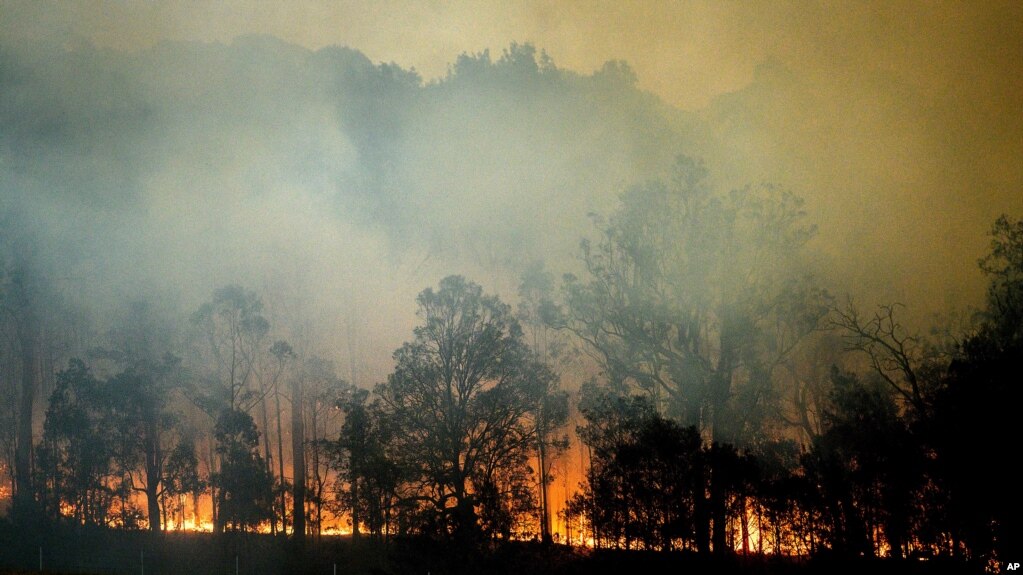
FILE - A bushfire burns in Bodalla, New South Wales, Australia, Jan. 25, 2020.

New research by Australia’s national science agency shows that climate change has driven a significant increase in bushfires over the last three decades.

Australia’s Commonwealth Scientific and Industrial Research Organization, or CSIRO, has found an 800% rise in the average annual area burned by bushfires in Australia since the 1990s. Parts of the Australian continent are some of the world’s most fire-prone areas.

The study said the “overwhelming factor” causing the spike has been climate change. There have been more extreme heatwaves and a corresponding decrease in rainfall in parts of the country. Since 1910, the research stated that Australia’s mean temperature had increased by 1.4 degrees Celsius.

The study also detailed how the annual fire season has extended before and after summer into autumn and winter, while fire activity has increased in cooler and warmer regions including alpine forests in Tasmania and tropical rainforests in Queensland.

Pep Canadell, the CSIRO’s chief climate scientist, told the Australian Broadcasting Corp., that the world’s fire-prone regions must be better prepared for the wildfire threat.

“There is a lot of things we can do, and we are working on a lot of new warning systems, increase the prediction capabilities, so we can be better prepared before the fire comes,” Canadell said. “That is probably the single-most important thing we can do.”

Australian scientists analyzed 32 years of satellite data and 90 years of ground-based research. They’ve warned that mega-fires that burn more than 1 million hectares are likely to become more frequent.

The Australian bushfire season from July 2019 to March 2020, commonly known as the Black Summer blazes, scorched 24 million hectares of land. It was Australia’s most intense bushfire season on record.

An official inquiry into the disaster said that “compounding disasters” would become more common in Australia. It warned that hazards such as fires, floods and storms could happen at the same time, or one after another.

Authorities in eastern Australia warned in October that grass and crop fires were their greatest concern ahead of the warmer summer months.
17M under threat of wildfire in Southern California as ferocious Santa Ana winds blow
Doyle Rice
USA TODAY

One location in Los Angeles County had an 89 mph gust on Thursday.
At least 17 million people live where red flag warnings remained in effect Friday.
Better weather was predicted for the weekend.

A fierce Santa Ana wind event in Southern California has led to wildfire warnings for over 17 million people and tens of thousands of power outages across the region, as officials pre-emptively shut off electricity to guard against the threat of wildfires.

The seasonal dry winds produced intense gusts on Thanksgiving Day, toppling trees and causing other damage while “public safety power shutoffs” in high-risk areas interrupted dinner plans.

One location in Los Angeles County had an 89-mph gust early Thursday. No major wildfires were reported, however.

The winds had died down somewhat Friday morning, but the threat will remain high through the day Friday, meteorologists said. "Widespread wind gusts of 35 to 60 mph are expected with damaging gusts up to 75 mph possible in the mountains and foothills," the National Weather Service said.  

   
Dry conditions and gusty winds prompted the weather service to issue a red flag warning for several Southern California counties through 6 p.m. local time Friday. Red flags signal dangerous weather conditions where wildfires can spark and spread unpredictably. Fire departments bring on additional staff while the warnings are in play.

At least 17 million people live where red flag warnings remained in effect Friday, the Weather Service said.

More than 75,000 Edison customers in Los Angeles, Orange, Riverside, San Bernardino and Ventura counties had power turned off under the power shutoff program as of late Thursday. As of Friday morning, nearly 60,000 were still powerless, according to poweroutage.us, a utility tracking website.

"These are very strong winds," said Gabriela Ornelas, a spokesperson for Southern California Edison.

Such winds can blow debris into power lines and spark fires, which is why the public safety power shutoffs were implemented.

"I'd rather have excess wind and less power than (getting) burned out of my house," Carl Pride, a Fontana resident, told CNN affiliate KABC while trying to grab his hat as the strong wind blew it away. "A minor inconvenience is nothing compared to losing my house."

Better weather was predicted for the weekend.

“There will be a few puffs of wind each morning Saturday and Sunday but nothing near advisory levels,” the weather service said.
Doctor bashes Dr. Oz as a ‘disgrace’ -- and likens electing him to catching dysentery

Sarah K. Burris
November 30, 2021


Celebrity doctor Mehmet Oz officially announced he would run for the U.S. Senate in Pennsylvania Tuesday.

Writing in the Daily Beast, a fellow physician said that he has the same amount of enthusiasm for Oz's candidacy as he would with a case of dysentery, the intestinal infection that causes bloody diarrhea.

Dr. Daniel Summers, MD, begged Pennsylvania not to do "this," meaning elect Oz.

"It’s been obvious for years that Oz is more than happy to leverage his reputation as a cardiothoracic surgeon and medical scientist in service to his own celebrity and advancement, and isn’t one to let quaint little things like facts stand in his way," he wrote. "Stroll down a checkout aisle in your local grocery store, and chances are strong you’ll see his smiling face on the cover of a magazine touting some wildly unhealthy weight-loss claim. He’s been promoting pseudoscience on his show for years, from obesity 'remedies' like green coffee and garcinia cambogia to hawking 'homeopathy starter kits,' so this is nothing new."

In fact, Oz faced criticism for hosting a show in which he debated the utility of "reparative therapy" and "forms of therapy that are designed to turn a gay person straight," even though they've been banned by many states at the urging of the American Psychological Association.

In April 2020, Oz also spurred controversy because he said that children should be sent back into schools despite the fact that the novel coronavirus pandemic had only just begun and there were no vaccines or therapeutics yet available.


“I tell you, schools are a very appetizing opportunity,” he said, claiming that resuming classes “may only cost us 2 to 3 percent in terms of total mortality," according to his "reading" of medical journals.

The mistake was so substantial that Oz later provided a kind of half-apology, saying that he "misspoke."

But what Dr. Summers finds worse is that Oz eagerly pushed treatments like hydroxychloroquine for COVID patients. He even went so far as to push the drug on Fox & Friends. It prompted Dr. Anthony Fauci, a virologist, to explain that the data simply wasn't clear at the time.

“Although there is some suggestion [of effectiveness] with the study that was just mentioned by Dr. Oz . . . I think we’ve got to be careful that we don’t make that majestic leap to assume that this is a knockout drug,” Fauci said at the time. “We still need to do the kinds of studies that definitively prove whether any intervention, not just this one . . . is truly safe and effective.”

The NIH ultimately did study the use of the drug on those suffering from COVID and found that after 14 days of taking the hydroxychloroquine vs. a placebo, there was no difference in the patients.

"Medical misinformation is literally killing people, and it is unconscionable that anyone who should know better would contribute to it. And Oz most certainly should and does know better," said Dr. Summers. "It is telling that Oz would see a space for himself in the Republican primary field. The GOP is riddled with prominent figures who undermine the seriousness of the pandemic, refute the importance of getting vaccinated, and denigrate the public health officials tasked with keeping the American people as safe and healthy as possible. Voters for those people are the ones Oz sees himself capable of wooing. That is the base he will need to capture to make his candidacy a success."

See the full piece at the Daily Beast.

Psaki tears into Trump for not disclosing his COVID diagnosis and says it shouldn't be a 'surprise' his supporters are advocating letting the unvaccinated 'infect their co-workers, our children and fill hospitals'

  • Jen Psaki on Wednesday tore into former President Donald Trump for not disclosing he had reportedly tested positive for COVID-19 
  • Former Chief of Staff Mark Meadows revealed in a forthcoming book that Trump tested positive for COVID three days before debating now President Joe Biden 
  • Trump took two COVID tests on September 26 with the first saying he was positive and the second saying he was negative - and chose to believe the latter
  • Pointing to the news, Psaki extended the criticism to Trump's allies in Congress, with conservatives threatening a shutdown over vaccine mandate funding 
  • Psaki said those Republicans wanted the unvaccinated to be free to 'infect their co-workers, our children, filling hospitals'  
Psaki tears into Trump for not disclosing his COVID diagnosis | Daily Mail Online


Joe Biden just made the shadiest comment about Donald Trump

Joe Biden channeled his inner Mariah Carey.

By Alex Bollinger Wednesday, December 1, 2021

Joe BidenPhoto: Adam Schultz / Biden for President

President Joe Biden had a very shady reply when asked about how Donald Trump may have put him at risk of catching COVID-19 last year.

Trump allegedly tested positive for COVID-19 just days before the first presidential debate on September 29, 2020, according to a new book from former White House Chief of Staff Mark Meadows. Instead of telling Biden’s campaign about it and postponing the debate, Meadows said Trump kept quiet and participated in the debate anyway because he had another test result that was negative.

Related: Joe Biden owned a rightwing journalist with a QAnon clapback & then he just walked away

“Mark Meadows has written a book revealing that former President Trump tested positive for COVID three days before your first debate,” a journalist asked Biden today. “Do you think the former president put you at risk?”

“I don’t think about the former president,” Biden replied before turning around and walking away.


Trump announced that he had tested positive for COVID-19 on Twitter on October 2, three days after the debate. The media speculated about whether Biden, who was 77 at the time, was put at risk because Trump may have had the virus for a few days before his announcement.

Trump hosted a “super-spreader” event at the White House for Supreme Court nominee Amy Coney Barrett on September 26 where at least 11 attendees were diagnosed with coronavirus shortly after, leading to speculation that Trump caught the virus that day as well.

Meadows said in his new memoir, The Chief’s Chief, that each candidate had to provide a negative coronavirus test 72 hours before the September 29 debate. He said that Trump tested positive on September 26 after the Barrett event and found out when he was en route to a rally in Pennsylvania.

Trump suspected he had a “slight cold” as he boarded Marine One. Meadows said that as the plane was taking off, he got a call from the White House doctor.

“Stop the president from leaving,” Meadows recounted the doctor saying. “He just tested positive for COVID.”

He said he immediately told Trump, who Meadows wrote replied with something that “rhyme[d] with ‘Oh spit, you’ve gotta be trucking lidding me.'” Meadows refused to write curse words in his book because he’s Christian.

He wrote that Trump took another COVID test and got a negative result that same day and decided “to press on as if nothing had happened.” Meadows said that he instructed staff members interacting with the president “to treat him as positive” throughout the trip because of the conflicting test results.

Trump called Meadows’s claim “Fake News” in a statement. “A test revealed that I did not have COVID prior to the debate,” Trump wrote.


SCHADENFREUDE
Marcus Lamb, a Christian TV network founder and preacher who discouraged vaccinations, dies after being hospitalized for Covid-19

Prominent Christian televangelist and anti-vaccine advocate Marcus Lamb died after being hospitalized with Covid-19, his family announced Tuesday.

By Carma Hassan, Michelle Watson, CNN Business 

Lamb founded Christian television network Daystar Television Network in 1997.

His wife Joni Lamb, announced the televangelist's death on Daystar's program streamed to Facebook Tuesday. She said her husband had diabetes but was healthy and was hospitalized after being diagnosed with Covid-19.

"He never talked about that, but he had diabetes, but he kept it in check. He was very healthy, he ate healthy, he kept his weight down, and always kept his sugar at a good level. But with trying to treat Covid and the pneumonia, the different protocols that are used, including many of the protocols we talked about here on Daystar, and we used those, and I used them and breezed through Covid.

It caused his blood sugar to spike and just a decrease in his oxygen and that's why he went to the hospital, so he could have oxygen," Joni Lamb said. "He 100% believed in everything that we've talked about here on Daystar and helping so many people around the world with early protocol treatments for Covid. We still stand by that, obviously."

Joni Lamb said her husband's "heart just gave out."

Marcus Lamb often spoke out against the Covid-19 vaccines on his show. In an episode earlier this year featuring anti-vaccine activists Robert F. Kennedy Jr. and Del Bigtree, Lamb said the Covid-19 vaccine was "not really a vaccine," but an "an experimental shot" that was "dangerous. Marcus Lamb alleged that people were dying or having neurological disorders from the vaccine.

The US Centers for Disease Control and Prevention say Covid-19 vaccines "are safe and effective" and that any adverse events after vaccination "are rare but may occur." People who are not vaccinated against Covid-19 were 11 times more likely to die of the disease and 10 times more likely to be hospitalized with the disease, according to a study published by the CDC.

Marcus Lamb's son, Jonathan Lamb, described his father's Covid-19 diagnosis as a "spiritual attack from the enemy" as he hosted the show on November 23. "There's no doubt in my mind that this is a spiritual attack from the enemy. As much as my parents have gone on here to kind of inform everyone about everything going on in the pandemic and some of the ways to treat Covid, there's no doubt that the enemy is not happy about that, and he's doing everything he can to take down my dad," Jonathan Lamb said.


Joni Lamb described the illness as "riding a roller coaster" on that same episode. She asked people in November to "pray specifically for [Lamb's] lungs to clear, the Covid pneumonia, and pray for his oxygen levels to continue to be strong and to go up and so that we can wean him off of oxygen and then bring him home."

A statement from Daystar Television Network said in part, "The family asks at this time that their privacy be respected as they grieve this difficult loss, and they wish to express their deep love and gratitude for all those who prayed during Marcus's health battle. Continue to lift them up in prayer in the days ahead."


Co-founder of Christian TV network that railed against vaccines dies of Covid-19

Marcus Lamb, 64, whose Daystar network reaches an estimated 2 billion viewers worldwide, had pushed alternative therapies


A Covid-19 memorial made of white flags representing lives lost to coronavirus is seen in Los Angeles. Photograph: Ringo Chiu/Zuma Press Wire/Rex/Shutterstock

Oliver Milman
THE GUARDIAN
Wed 1 Dec 2021


Rightwing radio host and anti-vaxxer dies of Covid

Marcus Lamb, the co-founder of the leading Christian TV network Daystar who railed against Covid-19 vaccines, has died of Covid-19. He was 64 years old.

Lamb, who was the chief executive of the conservative network that reaches an estimated 2 billion viewers worldwide, died on Tuesday, weeks after contracting the coronavirus.

“It’s with a heavy heart we announce that Marcus Lamb, president and founder of Daystar Television Network, went home to be with the Lord this morning,” the network announced in a tweet on Tuesday. “The family asks that their privacy be respected as they grieve this difficult loss. Please continue to lift them up in prayer.”

Under his leadership, Daystar aired repeated baseless anti-vaccine conspiracy theories and claims that vaccines were being used to take freedoms away from Christians. In July 2020, the network spent an hour of air time complaining about “censorship” around the pandemic and also gave an hour’s slot to Robert F Kennedy Jr, who has spread misinformation about the Covid vaccine.

Covid vaccines have been repeatedly found to be safe and effective at preventing severe illness from the virus. Evangelical Christians have been getting the vaccines at lower rates than the general US population, however, and several prominent Christian broadcasters have died of the virus in recent months.

Last month Lamb’s son Jonathan said that his father’s illness was due to sinister outside forces.


Tennessee radio host who criticised vaccine efforts dies of Covid-19

“There’s no doubt in my mind that this is a spiritual attack from the enemy,” he said, adding that Lamb has pushed alternative therapies and that “there’s no doubt that the enemy is not happy about that. And he’s doing everything he can to take down my Dad.”

Daystar was founded in 1998 and has more than 100 TV stations around the world. Lamb’s wife Joni, appearing on the daily Ministry Show on Tuesday, said that he had “got the Covid pneumonia”.

“He 100% believed in everything we talk about here on Daystar, things that help so many people around the world with early protocol treatments for Covid,” she said. “We still stand by those obviously.”


Immigrants needed to ease Saskatchewan’s labour pains

Located approximately 140 kilometres east of Saskatoon, the BHP Jansen Project in Saskatchewan is taking shape to be the largest potash-producing mine in the world.

The project is expected to create around 3,500 jobs annually during construction plus more than 600 jobs at the mine site and corporate office in Saskatoon.

In Yorkton, one of the fastest-growing cities in Saskatchewan, dozens of local businesses have “We are hiring” signs posted on their windows and parking lots.

“In early November, Canadian Tire, Starbucks, SaskTel, The Brick, Walmart, Mary Browns, Omega Auto Parts, Parkland College and many others had similar signs on their buildings or in their parking lots, telling locals about available jobs,” reported Sasktoday.ca

Across the prairie province known as the ‘Bread Basket of Canada’, the Canadian Agricultural Human Resource Council predicts that by 2029, Saskatchewan will have 12,300 more jobs than the domestic labour force can fill.

“Saskatchewan’s agriculture sector has limited access to foreign workers and the lowest reliance on this labour source: only 1.6% of the province’s agricultural workforce is foreign workers, compared to 17% across the entire Canadian agricultural sector workforce,” the council said in its forecast 2029 report.

Jim Bence, president and CEO of Hospitality Saskatchewan said that his industry has thousands of vacancies including almost 600 for cooks and kitchen staff.

Saying it’s a crisis or an acute problem, will be an understatement, Bence told NCM.

To address the critical shortage of workers in Saskatchewan, the provincial government last week announced a new pilot under the Saskatchewan Immigrant Nominee Program (SINP) to address hard-to-fill positions in the province.

The ‘Hard-To-Fill Skills Pilot’ will enable Saskatchewan employers to recruit workers through overseas missions, or other international recruitment activities, into select jobs that have significant recruitment challenges, the government said.

“The pilot gives employers the ability to recruit in these occupations to fill critical vacancies that can’t be filled by domestic labour or other Federal immigration programs and enables the workers to become permanent residents faster,” said Robin Speer, a spokesperson for the Government of Saskatchewan.


“The majority of the occupations under the pilot were not eligible under the SINP or any immigration program before. Five of the eligible occupations previously required the worker to work in Saskatchewan for at least six months before they could apply to the SINP and start the permanent immigration process,” he said in a written response to questions from NCM.

Speer said the Hard-To-Fill Skills (HFS) Pilot includes 23 occupations in the following sectors: Health, Hospitality, Agriculture Value Added, Primary Agriculture, Forestry, Sales and Service, Logistics and Transportation, Residential and Commercial Construction and Metal and Agriculture Machinery Manufacturing.

“In second quarter of 2021, there were 685 job vacancies for construction trades helpers and labourers, up 149% from the same quarter in 2019 (pre-pandemic base), Other occupations with a high number of vacancies that have increased over the same period are heavy equipment operators (except crane), transport truck drivers, food and beverage servers, material handlers, janitors, caretakers and building superintendents, and home support workers and housekeepers,” said Speer.

THESE JOBS ARE THE ONES THAT GET FILLED THE MOST

“We anticipate demand will increase for many of these occupations as major economic projects continue to come on stream in the forestry, mining, manufacturing, and agri-value sectors…Completion of phase one of the BHP Jansen mine alone will alone create 3,500 construction jobs.”

Bence from Hospitality Saskatchewan described the pilot program as “a much needed timely solution.”

“It’s a great move to attract immigrant talent and provides a quicker pathway to residency,” he said.

“While we always work hard to exhaust every opportunity to hire locally, we have to be creative to ensure we have the right labour supply to help our business and communities grow and thrive in Saskatchewan, something this very unique program will be especially helpful with post-COVID.”

“This new Hard-To-Fill Skills Pilot – developed in Saskatchewan for Saskatchewan – is progress on our autonomy discussions with the federal government and is going to help provide employers with greater access to international options to recruit workers,” said the province’s Immigration and Career Training Minister Jeremy Harrison, in a statement.

The pilot is scheduled to launch this month.

To be eligible, applicants to the Hard-To-Fill Skills Pilot must:

The employers in the pilot program must demonstrate they have made extensive efforts to hire domestically prior to utilizing the pilot for recruitment, demonstrate the need and benefit for their business, and fulfill requirements related to providing settlement support for the workers.

For more information on the initiative and eligibility criteria, contact 1-833-613-0485 or immigration@gov.sk.ca.

Fabian Dawson, Local Journalism Initiative Reporter, New Canadian Media
ABOUT TIME
Alberta rolls out new rules forcing industry to pay for abandoned well cleanup


CALGARY — Alberta's oil and gas regulator has rolled out new rules aimed at addressing the growing problem of inactive and abandoned wells in the province, but critics say the industry should be forced to do even more to clean up after itself.
© Provided by The Canadian Press

The Alberta Energy Regulator says the new regulations, which come into effect immediately and mark the first significant overhaul of Alberta's oil and gas well liability framework in more than a decade, represent a "major milestone."

“With these new requirements, we’re pushing industry to clean up their sites sooner and ensuring the cost and responsibility of the cleanup rests on the shoulders of industry – where it should be," said AER president and chief executive Laurie Pushor, in a news release.

Alberta's UCP government first announced the changes last year, in response to growing concern from landowners, taxpayers and environmentalists about the more than 95,000 inactive wells in the province.

According to the AER, there are also more than 73,500 wells in Alberta that have been sealed and taken out of service but not yet fully remediated.

Under the new framework, the energy industry will be required to spend $422 million next year on cleanup and remediation of old wells. That amount increases to $443 million in 2023 and by similar amounts in each of the next three years — although targets beyond 2024 are forecasts only.


Those amounts are based on the industry's past spending and are in addition to the $1 billion the federal government has made available to industry contractors working on well cleanup.

Oil and gas producers seeking licences for new wells will also be assessed to make sure they are financially healthy enough to meet cleanup and closure responsibilities. And applications to transfer well licences between companies will trigger an assessment of both companies by the regulator to ensure the receiving company can safely operate the infrastructure and reclaim it when it is no longer in use.

"These policies ... will significantly enhance the rate of closure of inactive oil and natural gas sites," said Jay Averill, spokesman for the Canadian Association of Petroleum Producers, in an email. " We continue to work with the Alberta government to advance policies and regulations which ensure substantial progress in the timely closure of inactive sites."

Critics say the new regulations don't go far enough, especially now that oil prices are higher than they've been in years.

Sara Hastings-Simon of the University of Calgary's School of Public Policy said the spending targets mandated by the new regulations will address the industry's current overall oil and gas well liability at about the rate of four to five per cent a year. That means, she said, it will take 25 to 30 years to address the extent of the problem, assuming no additional abandoned wells are created in that time.


The industry should be forced to pay more now, Hastings-Simon added, given that companies are generating significant excess cash flow due to this year's commodity price boom.


"You're talking about companies that have very strong profits on the back of the recent surge in energy prices. They're paying out significant dividends to shareholders," she said. "And I think that's a real concern around equity and fairness, with investors around the world getting these dividend payouts while the public in Canada is left holding that liability risk.'


The energy regulator pegs the province's current oil and gas well liability at about $30 billion. But the Alberta Liabilities Disclosure Project — a coalition of landowners, scientists, environmentalists and others — estimates the total cost of what it would take to clean up all inactive and abandoned wells is much higher.

Regan Boychuk, spokesman for the ALDP, said the cleanup spending targets established by the new rules amount to no more than industry "coddling."

"This is all about buying time. It’s just kicking it down the road,” Boychuk said. “Making sure the polluter pays should be the most important issue imaginable for the energy regulator. And it’s not anywhere reflected or enforced in this new regulatory program.”

According to the AER, in 2020, industry closed 6,503 wells and 625 facilities while 2,666 sites were reclamation certified.

This report by The Canadian Press was first published Dec. 1, 2021.

Amanda Stephenson, The Canadian Press

Many Sask. grain farmers couldn't fulfil their contracts: APAS
THEY CHOSE THE MARKET OVER THE CWB

An overwhelming number of respondents to a survey of Saskatchewan farmers say they fell short of this year's grain contracts.

The survey by the Agricultural Producers Association of Saskatchewan found 75 per cent of roughly 200 respondents couldn't fulfil grain contracts after a dire drought baked their fields earlier this year.

"This issue is fairly widespread across the province, just like the drought was," APAS president Todd Lewis said.

"Producers and grain companies have had to struggle with this over the last number of months."

Respondents were also concerned about the lack of transparency around calculating buyout and administrative fees.

It was a common complaint during harvest, when rural groups and the province asked grain companies to be flexible with contracts that grain farmers had no hope of fulfilling.

Reported buyout provisions ranged from $20,000 to more than $300,000. Interest rates on unpaid amounts ran up to 19 per cent, according to the survey.

The severity of this year's drought created the largest payout for crop insurance in the province’s history, to the tune of $2.4 billion, Finance Minister Donna Harpauer reported on Monday.

Wade Sobkowich, executive director of the Western Grain Elevator Association, noted the survey may not be a representative sample, but that doesn't diminish the issue.

"There's a group out there that really got caught on the wrong side of their contracts," he said.

"That's not good for them; that's not good for us."

Sobkowich said grain companies have also been losing revenue without the tonnes they expected to export.

He expects them to emphasize proper communication with farmers so both parties are making informed decisions about the risk they're taking on, he said.

"You can't go through a unique and impactful situation like we did this year and not evaluate and try and learn from it."

Recent Statistics Canada numbers comparing January to September in 2020 and 2021 show total crop receipts were up by 9.6 per cent, with non-durum wheat up roughly 14 per cent and durum wheat up about 32 per cent.

Sobkowich said that shows some farmers may have reaped the rewards from fulfilling those contracts during the drought.

"What this demonstrates is that some producers may have gained significantly at the expense of others," he said.

Nick Pearce, Local Journalism Initiative Reporter, The StarPhoenix


  1. https://www.nfu.ca/2020-hindsight-ending-the-canadian-wheat-board-was...

    2020-07-30 · 2020 hindsight: Ending the Canadian Wheat Board was an economic tragedy. August 1st 2020 marks the 8th anniversary of one of the great economic tragedies in Canadian history. This was the day the wrecking ball swung by then Prime Minister Stephen Harper and former Agriculture Minister Gerry Ritz finally destroyed one of the most important ...

    • Estimated Reading Time: 
https://www.thecanadianencyclopedia.ca/en/article/canadian-wheat-board

2006-02-06 · The Canadian Wheat Board (CWB) was an agricultural marketing board headquartered in Winnipeg, Manitoba. Established in 1935, for much of its history it was the sole


HARPER SELLS WHEAT BOARD TO US CORPORATION & SAUDI INVESTMENT FUND

Brent Patterson
6 years ago

The Harper government has sold the Canadian Wheat Board.

Council of Canadians chairperson Maude Barlow says, "Harper sells out Wheat Board to two foreign corporations. Biggest theft from farmers in Canada's history!!!"

The Globe and Mail reports, "Until Ottawa ended its monopoly in 2012, the Canadian Wheat Board was the prairie farmer’s link to food companies around the world. Now the former giant has been taken over by a U.S. agrifood company and an investment fund owned by Saudi Arabia. The $250-million deal announced on Wednesday marks the final stage in the transformation of the Canadian Wheat Board, which was formed by Parliament in 1935 to guarantee western farmers would get fair prices for their wheat and barley."

The article notes, "Global Grain Group (G3), a joint venture between food company Bunge Ltd. and a unit of Saudi Agricultural and Livestock Investment Co. known as SALIC Canada Ltd., will pay $250-million for a 50.1-per-cent stake in the grain trader. The rest of the equity in CWB will be available to farmers who sell their grain to the company."

But the Financial Post clarifies that rather than "paying for" or "buying" the CWB, "Under the terms of the deal, G3 is committed to spending $250 million in the CWB." And Global News adds, "G3 Global Grain Group will get 50.1 per cent of the company in exchange for an investment of $250 million. The other 49.9 per cent will be kept in trust for farmers who deliver grain to the board. Any farmer who does deliver will get $5 per tonne in equity in the organization. In seven years, G3 Global Grain Group has the option to buy back the shares from farmers at market value."

National Farmers Union president Jan Slomp says, "With this, the Conservative government has accomplished the biggest transfer of wealth away from farmers in the history of Canada. The CWB’s physical assets, its commercial relationships, and its good name have all been given away. The 'buyers' of the CWB actually get to keep the $250 million pittance they are 'paying' for it."

And NDP MP Pat Martin comments, "This is a strategic industry for Canada. It might be different if they sold the wheat board for billions of dollars. But they didn’t. They’re handing it over free of charge. All the assets – we’re talking the thousands of rail cars, the port terminals, the ships on the Great Lakes. ...I think it’s a sad for the Canadian grain industry. There never was a business for abolishing the wheat board to begin with, but you really have to question what kind of a business model it is to hand it over to an American agrifood giant and a Saudi agrifood giant who until recently were your greatest competitors."

The Council of Canadians has long supported the Canadian Wheat Board.

In 2005, we said, "The Government of Canada should maintain the Canadian Wheat Board and supply-management mechanisms that support family farms, protecting them from the prejudiced impact of international trade agreements." And in 2011, we participated in a court challenge that argued Section 47 of the Canadian Wheat Board Act required a vote by grain producers to remove the single-desk marketing authority of the Canadian Wheat Board. At a rally that year in front of the Canadian Wheat Board office in Winnipeg, Barlow told the large crowd assembled there, "Stephen Harper doesn't like democracy, and you know what? I don't think he likes farmers very much either."


MIGRANT WORKERS SCORE!
Cargill comes to tentative deal with union at High River, Alta. beef plant
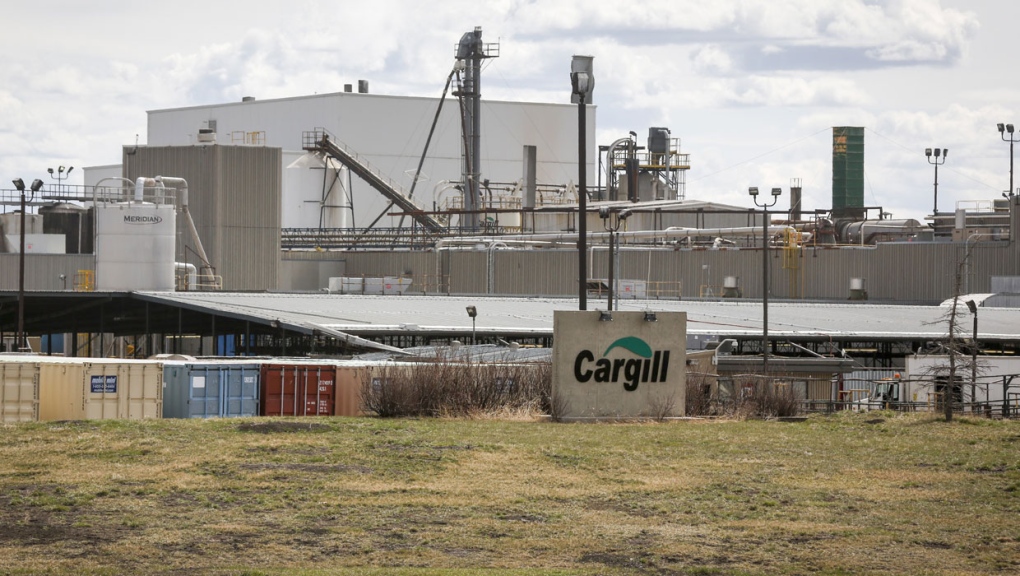
The Cargill beef plant in High River, Alta., is shown on Thursday, April 23, 2020. 
TAKEN BECAUSE THE PLANT WAS INFECTED WITH COVID
THE CANADIAN PRESS/Jeff McIntosh


Michael Franklin
CTVNewsCalgary.ca 
Senior Digital Producer
Published Dec. 1, 2021

With less than a week to go before workers were set to go on strike at Cargill's High River, Alta. beef processing plant, the company says a tentative deal has been reached.

The company announced the development on Wednesday and says it is "encouraged by the outcome" of recent talks.

"After a long day of collaborative discussion, we reached an agreement on an offer that the bargaining committee will recommend to its members. The offer is comprehensive and fair and includes retroactive pay, signing bonuses, a 21 per cent wage increase over the life of the contract and improved health benefits," Cargill wrote in a statement to CTV News via email.

The company adds it also "remains optimistic" a deal can be finalized before the strike deadline.

RELATED STORIES
'Been through hell': Alta. Cargill workers reject company's latest offer, strike action possible Dec. 6
'Couldn’t come at a worse time': Analysts worry about potential impacts from Cargill strike
'We are not afraid': Workers at Cargill's High River, Alta. meat plant vote to strike

"(We) encourage employees to vote on this offer which recognizes the important role they play in Cargill’s work to nourish the world in a safe, responsible and sustainable way. While we navigate this negotiation, we continue to focus on fulfilling food manufacturer, retail and food service customer orders while keeping markets moving for farmers and ranchers," it wrote.

The United Food and Commercial Workers' Union (UFCW) Local 401 was expected to go on strike on Dec. 6.

It rejected the most recent attempt at a deal on Nov. 25 by a 98 per cent margin.

'FAIR OFFER'


According to a statement from UFCW Local 401, the negotiating team engaged in "a marathon day" of talks with the company on Tuesday.

"Late in the evening, our bargaining committee concluded that they were in receipt of a fair offer and that they were prepared to present that offer to their coworkers with a recommendation of acceptance," it wrote in a statement.

The union says the tentative deal will "significantly improve" the lives of Cargill workers and will be the 'best food processing contract in Canada."

Highlights from the deal include:
$4,200 in retroactive pay for many employees;
$1,000 signing bonus;
$1,000 COVID-19 bonus;
More than $6,000 total bonuses for workers three weeks before Christmas;
$5 wage increase for many employees;
Improved health benefits; and
Provisions to facilitate a new culture of health, safety, dignity and respect in the workplace


While UFCW Local 401 president Thomas Hesse calls the deal "fair," he will support workers on the picket line if they decide to reject the proposal.

"If they do accept it, I’ll work with them every day to make Cargill a better workplace," Hesse said in a statement. "I will do as our members ask me to do.

"I respect all of the emotions that they feel and the suffering that they have experienced."

Employees are expected the vote on the new deal between Dec. 2 and 4.

MACHISMO MISOGYNY
Paraguay: Girls face sexual violence, pregnancies and impunity in a labyrinth with no way out


Bichofeo Estudio/Amnesty International
December 1, 2021 

Girls who are survivors of sexual violence in Paraguay face a confusing path of obstacles to rebuilding their lives and obtaining justice in a country where authorities ignore their voices, force them to carry pregnancies resulting from rape to term, while failing to listen to the expert opinions of their own professionals on sexual violence, Amnesty International concluded in a new report released today.

“By action and omission, Paraguay is turning its back on its girls and teenagers as they face unimaginable abuses. Although on paper there is a legal framework to support survivors of sexual violence, in practice they are at the mercy of a chaotic system that does not listen to them or prioritize their well-being and instead focuses on forcing girls to carry pregnancies to term,” said Erika Guevara-Rosas, Americas Director at Amnesty International.

The report, titled in Guaraní Mitãkuña ndaha’eiva’erã sy (They are girls, not mothers), analyses the failures of the system that exists in Paraguay to address cases of sexual violence against children and teenagers based on the experiences of a large number of professionals in the fields of health, education and justice.

The crisis is monumental. In 2019 alone, the Public Prosecutor’s Office received, on average, 12 reports of sexual violence against children and teenagers every day. Experts estimate that for every two cases they know of, there may be at least 10 others.

Most take place in the family environment and, in some cases, the abuse results in pregnancy. In fact, in Paraguay, an average of two girls between the ages of 10 and 14 give birth every day. At least 1,000 girls aged 14 and under gave birth in Paraguay between 2019 and 2020. In addition, more than 12,000 teenage girls between the ages of 15 and 19 gave birth in 2019. Many of these pregnancies may also have been the result of sexual violence, lack of comprehensive sexual education, inadequate information on prevention of early pregnancy or insufficient access to sexual and reproductive health services.

For girls, options are often very limited, despite the enormous risks that early childbirth can pose to their bodies and lives – girls under the age of 15 are four times more likely to die from pregnancy-related complications, in addition to being at greater risk of premature birth.

Forcing someone to continue with a pregnancy, particularly when it is the result of rape, is a form of ill-treatment that can be considered torture
Erika Guevara-Rosas, Americas Director at Amnesty International

Paraguay continues to have some of the most restrictive laws in the Americas regarding access to safe and legal abortion. Termination of pregnancy is a crime punishable by imprisonment, with the exception of cases where the pregnant woman’s life is in danger.

Without options, many girls end up living with their abusers or in children’s homes where they are often pressured to become mothers, and are subjected to further abuse, deprived of any possibility of a quality education and dignified life plans.

As a consequence of not listening to the professionals’ response to sexual violence in girls and teenagers, Paraguayan authorities are not promoting early detection, are not providing comprehensive sexual education with a gender focus and are not coordinating and streamlining their response to avoid secondary revictimization.

“Girls have the right to a life free of violence. Forcing someone to continue with a pregnancy, particularly when it is the result of rape, is a form of ill-treatment that can be considered torture,” said Erika Guevara-Rosas. “Despite some legislative advances in recent years, Paraguay has failed to put in place sufficient measures to protect the most vulnerable people in society.”

In 2018, Paraguay adopted Law 6202 to prevent sexual abuse and guarantee comprehensive care for child and teenage survivors. However, almost three years later, the roadmap for its implementation has not yet been finalized.

The authorities are also turning their back on Comprehensive Sexual Education, a key element for the prevention of early pregnancies. Although the Childhood and Adolescence Code recognizes its importance, in 2011, the authorities stopped its implementation. In 2017, the Ministry of Education and Science banned “the dissemination and use of materials…referring to gender theory and/or ideology, in educational institutions.”

Paraguay has failed to put in place sufficient measures to protect the most vulnerable people in society
Erika Guevara-Rosas, Americas Director at Amnesty International

“Paraguayan authorities must immediately introduce Comprehensive Sexual Education to ensure that girls, boys and teenagers have the necessary skills to speak out if they are threatened by sexual violence,” said Erika Guevara-Rosas.

“They must also finalize the long-awaited single pathway to provide comprehensive care for survivors of sexual abuse and prevent chronic secondary victimization and put in place a national programme to support those who become pregnant and are forced to carry the pregnancy to term, to help them rebuild their lives and overcome the severe long-term damage that sexual violence can inflict.”

For more information  duncan.tucker@amnesty.org