Michigan drops federal case against Enbridge pipeline to clear way for state court case
Tue., November 30, 2021
By Nia Williams
CALGARY, Alberta, Nov 30 (Reuters) - Michigan's governor on Tuesday said she will dismiss her lawsuit against Enbridge Inc's Line 5 oil pipeline in federal court, clearing the way for the Midwestern state's attorney general to pursue a separate case in state court.
The move is a welcome development for Enbridge in one part of the long-running battle over Line 5, but Governor Gretchen Whitmer made it clear she will continue to fight against the 68-year-old oil pipeline.
Line 5 delivers 540,000 barrels per day of crude and refined products from Superior, Wisconsin, to Sarnia, Ontario, via Michigan. An underwater section of the line runs along the lakebed of the Straits of Mackinac connecting lakes Huron and Michigan and environmentalists are concerned the aging line could rupture and leak into the Great Lakes.
Whitmer ordered Enbridge to shut down the pipeline by May this year, which the Canadian company ignored. The governor also filed a lawsuit against Enbridge to enforce the order, but suffered a setback earlier this month when a judge ruled the case would be heard in federal court.
In a statement, Whitmer said dismissing the federal case clears the way for a separate lawsuit filed by Attorney General Dana Nessel to go forward in state court. That attorney general's lawsuit was originally filed in June 2019, but was paused while the governor's lawsuit, filed in 2020, proceeded.
"I believe the people of Michigan, and our state courts, should have the final say on whether this oil company should continue pumping 23 million gallons of crude oil through the Straits of Mackinac every day," Whitmer said.
Dropping the federal case should speed up the attorney general's state court case, said environmental group FLOW, which described Michigan's move as a "strategic step."
"The state's legal fight and the citizen-led movement to protect the Great Lakes, jobs, and a way of life continue full speed ahead," said FLOW Executive Director Liz Kirkwood.
Calgary-based Enbridge said it is pleased by Michigan's decision to drop the federal lawsuit.
Earlier this year the Canadian government waded into the dispute by intervening in the court case in support of Enbridge, and last month invoked a 1977 pipeline treaty with the United States to trigger negotiations between Ottawa and Washington over the pipeline's fate.
Government officials did not immediately respond to a request for comment.
(Reporting by Nia Williams; Editing by Sonya Hepinstall and Andrea Ricci)
Thursday, December 02, 2021

Chevy Bolt EVs Are Still Combusting Like This One At Chevy Dealer
Andrei Nedelea 11 hrs ago
No, this one had not had its battery replaced as part of the recall yet, obviously.
Another day, another Chevy Bolt EV fire, this time right outside a Chevrolet dealership in Clarksville, Maryland. Apparently, the vehicle actually belonged to an employee and the vehicle, predictably, had not had its battery pack replaced as part of the massive recall issued by General Motors for the Bolt EV and Bolt EUV models.

Andrei Nedelea 11 hrs ago
No, this one had not had its battery replaced as part of the recall yet, obviously.
Another day, another Chevy Bolt EV fire, this time right outside a Chevrolet dealership in Clarksville, Maryland. Apparently, the vehicle actually belonged to an employee and the vehicle, predictably, had not had its battery pack replaced as part of the massive recall issued by General Motors for the Bolt EV and Bolt EUV models.
© InsideEVs Bolt EV fire
GM has narrowed down the cause of all these electric vehicle fires to either a torn anode tab or a folded separator within one of the 288 lithium-ion cells that make up the pack. Now, at the start of November, it finally started to replace the battery packs in affected models, after previously only giving owners recommendations (like how much to charge or to not park it inside overnight) or software updates.
#MaryLed pic.twitter.com/6vQQzqX5rQ— Zack (@BLKMDL3) November 30, 2021
And while this is sure to be a hassle for owners to have to take their vehicles in, at least the replacement pack will give their Bolt extra range, up from 238 to 259 miles. This is thanks to an increase in overall capacity from 60 kWh to 65 kWh, so while owners may not be pleased their vehicle has been recalled, at least they get a free range bonus and a brand new battery pack.
Owners are now eagerly awaiting to be informed when it is their turn to have their Bolt’s battery replaced. However, until the last possibly defective battery is replaced, we will still see Bolts catching fire because there are around 110,000 affected vehicles, so it will take GM months to go through them all.
GM has narrowed down the cause of all these electric vehicle fires to either a torn anode tab or a folded separator within one of the 288 lithium-ion cells that make up the pack. Now, at the start of November, it finally started to replace the battery packs in affected models, after previously only giving owners recommendations (like how much to charge or to not park it inside overnight) or software updates.
#MaryLed pic.twitter.com/6vQQzqX5rQ— Zack (@BLKMDL3) November 30, 2021
And while this is sure to be a hassle for owners to have to take their vehicles in, at least the replacement pack will give their Bolt extra range, up from 238 to 259 miles. This is thanks to an increase in overall capacity from 60 kWh to 65 kWh, so while owners may not be pleased their vehicle has been recalled, at least they get a free range bonus and a brand new battery pack.
Owners are now eagerly awaiting to be informed when it is their turn to have their Bolt’s battery replaced. However, until the last possibly defective battery is replaced, we will still see Bolts catching fire because there are around 110,000 affected vehicles, so it will take GM months to go through them all.
12 Nuclear Plants? 113 Dams? That’s How Much Canada Is Short Of Its Green Energy Needs, Report Says
On Dec 2, 2021

OTTAWA—Highlighting the need for a massive expansion of clean electricity over the next 28 years, a new report urges the federal government to quickly set up new rules to push fossil fuels out of Canada’s power grids and funnel more money to energy sources that don’t cause climate change.
According to the report published Wednesday by the think tank Clean Energy Canada, the country needs to roughly double the amount of clean electricity it produces to fulfil the government’s goal to reduce greenhouse gas emissions to “net zero” before 2050.
That means adding electricity from clean sources equivalent to almost 12 times the output of Ontario’s Bruce nuclear power plant, or 113 times the output of the Site C dam on the Peace River in northeast British Columbia.
The report does not put a price tag on the cost, but says it will require “significant” spending from governments and electricity providers, as well as swift action from Ottawa on the promised “clean electricity standard.”
The governing Liberals made the standard a key pledge on climate change in this year’s federal election, vowing to pass regulations to make Canada’s electricity grids run entirely on non-emitting sources of power by 2035.
Mark Zacharias, a special adviser with Clean Energy Canada, said it is “critical” for Ottawa to set these regulations before the end of 2023. That would send a clear signal to utilities and provincial governments about what is required on the path to achieving 100-per-cent non-emitting electricity, he said.
It would also make clear that the era of powering grids by burning fossil fuels is coming to a close.
“There’s no use establishing or standing up new fossil fuel electricity generation, because you’re not going to be able to use it in 15 years, so that’s quite critical right now,” Zacharias said by phone this week.
In a recent interview with the Star, Environment Minister Steven Guilbeault said the government would launch consultations on the new electricity rules “in the coming months” and work to implement them “as fast as we can.”
The Clean Energy Canada report also bills the switch spurred by this promised regulation as a “generational opportunity” for jobs and climate action. Getting to 100 per cent non-emitting electricity will require building out clean power to fuel the country’s energy needs in the coming decades, which will in turn create jobs in wind, solar, geothermal and other renewable industries, the report says.
Clean Energy Canada predicts more than 200,000 jobs can be created in the clean energy sector by 2030.
The report points to other potential economic advantages of cleaning Canada’s electricity grids.
The European Union is already mulling tariffs on products associated with higher greenhouse gases, so if Canada’s heavy industry can use cleaner electricity to make goods like steel and cement, they could get prioritized over dirtier alternatives from other countries, the report says.
The United States is also pushing for a non-emitting grid by 2035. Since the majority of U.S. electricity is still from emitting sources like coal and natural gas, the report says that opens the door for Canada to sell more clean electricity south of the border.
On top of that, cleaning the grid could take care of emissions that account for eight per cent of Canada’s annual total — a sizable chunk of the goal of reducing them by at least 40 per cent by 2030 — and make it easier to reduce emissions from the transportation, home heating and heavy industry, the report says.
To fuel the switch, the report calls on Ottawa to prioritize federal funding for projects that accelerate the adoption of clean power rather than “perpetuate fossil fuel use and development.” The federal government should also include promised tax credits for renewable energy and power storage in its 2022 budget, and direct agencies like the Canada Infrastructure Bank to funnel money to a “national clean electricity system.”
“Canada has a tremendous economic opportunity, not just a climate opportunity, to leverage our ability to create clean electricity,” Zacharias said. “We need to seize it.”
Eighty-three per cent of Canada’s electricity grid is already powered by non-emitting sources. Sixty per cent is from hydro projects like dams, while 17 per cent is from nuclear power and six per cent comes from wind, the report notes, citing 2020 data from Statistics Canada.
The government is already requiring provinces to phase out coal-fired power — which accounts for eight per cent of Canada’s electricity supply — by 2030, leaving natural gas as the prime source of emitting power.
But that national average papers over significant regional differences. Quebec, British Columbia and Ontario, for instance, are already powered almost entirely by non-emitting electricity, while the majority of electricity supplies in Alberta and Saskatchewan come from coal and natural gas.
For Zacharias, this makes collaboration between governments vital to the success of the switch, including through construction of power lines to share clean electricity across provincial borders.
“The clean electricity standard will really incentivize these discussions and basically light a fire under everyone to start talking,” he said.
Credit: Source link
On Dec 2, 2021

OTTAWA—Highlighting the need for a massive expansion of clean electricity over the next 28 years, a new report urges the federal government to quickly set up new rules to push fossil fuels out of Canada’s power grids and funnel more money to energy sources that don’t cause climate change.
According to the report published Wednesday by the think tank Clean Energy Canada, the country needs to roughly double the amount of clean electricity it produces to fulfil the government’s goal to reduce greenhouse gas emissions to “net zero” before 2050.
That means adding electricity from clean sources equivalent to almost 12 times the output of Ontario’s Bruce nuclear power plant, or 113 times the output of the Site C dam on the Peace River in northeast British Columbia.
The report does not put a price tag on the cost, but says it will require “significant” spending from governments and electricity providers, as well as swift action from Ottawa on the promised “clean electricity standard.”
The governing Liberals made the standard a key pledge on climate change in this year’s federal election, vowing to pass regulations to make Canada’s electricity grids run entirely on non-emitting sources of power by 2035.
Mark Zacharias, a special adviser with Clean Energy Canada, said it is “critical” for Ottawa to set these regulations before the end of 2023. That would send a clear signal to utilities and provincial governments about what is required on the path to achieving 100-per-cent non-emitting electricity, he said.
It would also make clear that the era of powering grids by burning fossil fuels is coming to a close.
“There’s no use establishing or standing up new fossil fuel electricity generation, because you’re not going to be able to use it in 15 years, so that’s quite critical right now,” Zacharias said by phone this week.
In a recent interview with the Star, Environment Minister Steven Guilbeault said the government would launch consultations on the new electricity rules “in the coming months” and work to implement them “as fast as we can.”
The Clean Energy Canada report also bills the switch spurred by this promised regulation as a “generational opportunity” for jobs and climate action. Getting to 100 per cent non-emitting electricity will require building out clean power to fuel the country’s energy needs in the coming decades, which will in turn create jobs in wind, solar, geothermal and other renewable industries, the report says.
Clean Energy Canada predicts more than 200,000 jobs can be created in the clean energy sector by 2030.
The report points to other potential economic advantages of cleaning Canada’s electricity grids.
The European Union is already mulling tariffs on products associated with higher greenhouse gases, so if Canada’s heavy industry can use cleaner electricity to make goods like steel and cement, they could get prioritized over dirtier alternatives from other countries, the report says.
The United States is also pushing for a non-emitting grid by 2035. Since the majority of U.S. electricity is still from emitting sources like coal and natural gas, the report says that opens the door for Canada to sell more clean electricity south of the border.
On top of that, cleaning the grid could take care of emissions that account for eight per cent of Canada’s annual total — a sizable chunk of the goal of reducing them by at least 40 per cent by 2030 — and make it easier to reduce emissions from the transportation, home heating and heavy industry, the report says.
To fuel the switch, the report calls on Ottawa to prioritize federal funding for projects that accelerate the adoption of clean power rather than “perpetuate fossil fuel use and development.” The federal government should also include promised tax credits for renewable energy and power storage in its 2022 budget, and direct agencies like the Canada Infrastructure Bank to funnel money to a “national clean electricity system.”
“Canada has a tremendous economic opportunity, not just a climate opportunity, to leverage our ability to create clean electricity,” Zacharias said. “We need to seize it.”
Eighty-three per cent of Canada’s electricity grid is already powered by non-emitting sources. Sixty per cent is from hydro projects like dams, while 17 per cent is from nuclear power and six per cent comes from wind, the report notes, citing 2020 data from Statistics Canada.
The government is already requiring provinces to phase out coal-fired power — which accounts for eight per cent of Canada’s electricity supply — by 2030, leaving natural gas as the prime source of emitting power.
But that national average papers over significant regional differences. Quebec, British Columbia and Ontario, for instance, are already powered almost entirely by non-emitting electricity, while the majority of electricity supplies in Alberta and Saskatchewan come from coal and natural gas.
For Zacharias, this makes collaboration between governments vital to the success of the switch, including through construction of power lines to share clean electricity across provincial borders.
“The clean electricity standard will really incentivize these discussions and basically light a fire under everyone to start talking,” he said.
Credit: Source link
United States is world's biggest plastic polluter, report finds
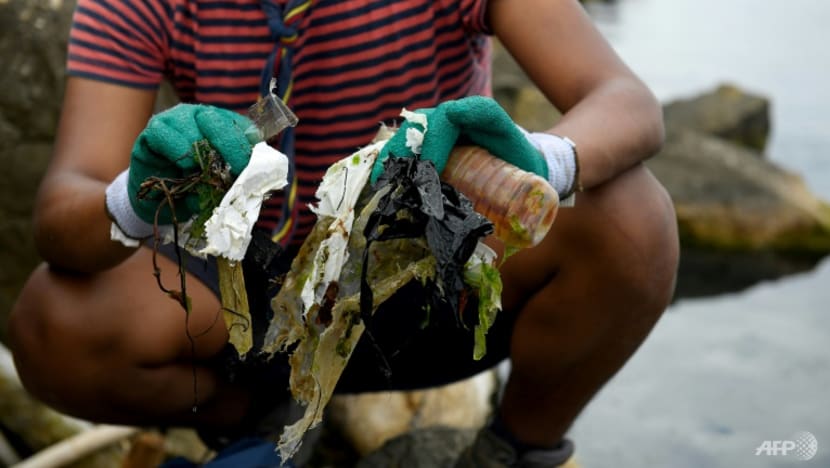
At the current rate, the amount of plastics discharged into the ocean could reach up to 53 million tonnes per year by 2030, roughly half of the total weight of fish caught from the ocean annually, a US report said. (File photo: AFP/Nicolas TUCAT)
02 Dec 2021
WASHINGTON: The United States is by far the biggest contributor to global plastic waste in the world, according to a new report submitted to the federal government on Wednesday (Dec 1) that called for a national strategy to tackle the growing crisis.
Overall, the US contributed around 42 million tonnes in plastic waste in 2016 - more than twice as much as China and more than the countries of the European Union combined, according to the analysis.
On average, every American generates 130kg of plastic waste per year, with Britain next on the list at 99kg per person per year, followed by South Korea at 88kg per year.
Entitled Reckoning with the US Role in Global Ocean Plastic Waste, the report was mandated by Congress as part of the Save Our Seas 2.0 Act, which became law in December 2020.
"The success of the 20th century miracle invention of plastics has also produced a global scale deluge of plastic waste seemingly everywhere we look," wrote Margaret Spring, chief science officer of Monterey Bay Aquarium, who chaired the committee of experts that compiled the report.
She added global plastic waste was an "environmental and social crisis" that impacted inland and coastal communities, polluted rivers, lakes and beaches, placed economic burdens on communities, endangered wildlife and contaminated waters that humans depend on for food.
Global plastic production rose from 20 million tonnes in 1966 to 381 million tonnes in 2015, a 20-fold increase over half a century, the report said
Initially, attention to ocean waste focused solely on ship and marine-based sources, but it is now known that almost any plastic on land has the potential to reach the oceans via rivers and streams, the report added.
Related:

The eco-entrepreneurs waging war on plastic pollution in oceans
Research has shown nearly a thousand species of marine life are susceptible to plastic entanglement or to ingesting microplastics, which then make their way through the food web back to humans.
The report said an estimated 8 million tonnes of plastic waste enters the world annually, "the equivalent of dumping a garbage truck of plastic waste into the ocean every minute".
At the current rate, the amount of plastics discharged into the ocean could reach up to 53 million tonnes per year by 2030, roughly half of the total weight of fish caught from the ocean annually, it said.
Part of the reason is that while the generation of plastic waste in municipal solid waste has exploded, particularly since 1980, the scale of recycling has not kept up, resulting in more and more plastic finding its way into landfills.
The report offered a number of steps to address the crisis - first among them, reducing virgin plastic production, for example by establishing a national cap.
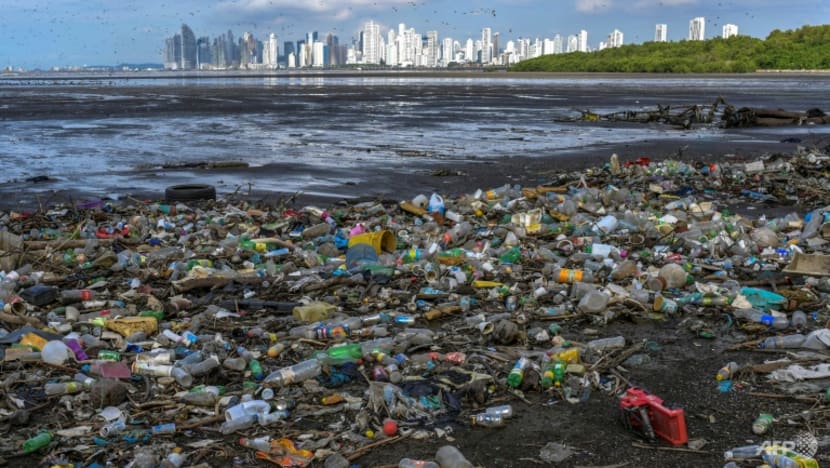
At the current rate, the amount of plastics discharged into the ocean could reach up to 53 million tonnes per year by 2030, roughly half of the total weight of fish caught from the ocean annually, a US report said. (File photo: AFP/Nicolas TUCAT)
02 Dec 2021
WASHINGTON: The United States is by far the biggest contributor to global plastic waste in the world, according to a new report submitted to the federal government on Wednesday (Dec 1) that called for a national strategy to tackle the growing crisis.
Overall, the US contributed around 42 million tonnes in plastic waste in 2016 - more than twice as much as China and more than the countries of the European Union combined, according to the analysis.
On average, every American generates 130kg of plastic waste per year, with Britain next on the list at 99kg per person per year, followed by South Korea at 88kg per year.
Entitled Reckoning with the US Role in Global Ocean Plastic Waste, the report was mandated by Congress as part of the Save Our Seas 2.0 Act, which became law in December 2020.
"The success of the 20th century miracle invention of plastics has also produced a global scale deluge of plastic waste seemingly everywhere we look," wrote Margaret Spring, chief science officer of Monterey Bay Aquarium, who chaired the committee of experts that compiled the report.
She added global plastic waste was an "environmental and social crisis" that impacted inland and coastal communities, polluted rivers, lakes and beaches, placed economic burdens on communities, endangered wildlife and contaminated waters that humans depend on for food.
Global plastic production rose from 20 million tonnes in 1966 to 381 million tonnes in 2015, a 20-fold increase over half a century, the report said
Initially, attention to ocean waste focused solely on ship and marine-based sources, but it is now known that almost any plastic on land has the potential to reach the oceans via rivers and streams, the report added.
Related:
The eco-entrepreneurs waging war on plastic pollution in oceans
Research has shown nearly a thousand species of marine life are susceptible to plastic entanglement or to ingesting microplastics, which then make their way through the food web back to humans.
The report said an estimated 8 million tonnes of plastic waste enters the world annually, "the equivalent of dumping a garbage truck of plastic waste into the ocean every minute".
At the current rate, the amount of plastics discharged into the ocean could reach up to 53 million tonnes per year by 2030, roughly half of the total weight of fish caught from the ocean annually, it said.
Part of the reason is that while the generation of plastic waste in municipal solid waste has exploded, particularly since 1980, the scale of recycling has not kept up, resulting in more and more plastic finding its way into landfills.
The report offered a number of steps to address the crisis - first among them, reducing virgin plastic production, for example by establishing a national cap.
Garbage, including plastic waste, is seen at the beach of the Costa del Este neighbourhood in Panama City, on Jun 8, 2020. (File photo: AFP/Luis ACOSTA)
REDUCE SINGLE-USE PLASTICS
Other suggested actions include using materials that degrade more quickly and are more easily recycled, the reduction of certain single-use plastics, and improved waste management, such as techniques to remove microplastics from wastewater.
Improving waste capture technology would stop plastics in waterways, while stemming plastic disposal directly into the ocean itself also remains a priority.
Data collection is also a critical priority, the report added, calling for the US to establish tracking and monitoring systems to identify waste sources and hotspots.
The authors called for the country to develop its national strategy no later than the end of 2022.
"This is the most comprehensive and damning report on plastic pollution ever published," said Judith Enk, president of the Beyond Plastics non-profit.
"It is a code red for plastics in the ocean and documents how litter clean-ups are not going to save the ocean," she continued, adding it was urgent that policy makers and business leaders read the report and take action.
"The finger-pointing stops now. We can no longer ignore the United States' role in the plastic pollution crisis, one of the biggest environmental threats facing our oceans and our planet today," added Christy Leavitt, Oceana's plastics campaign director.
REDUCE SINGLE-USE PLASTICS
Other suggested actions include using materials that degrade more quickly and are more easily recycled, the reduction of certain single-use plastics, and improved waste management, such as techniques to remove microplastics from wastewater.
Improving waste capture technology would stop plastics in waterways, while stemming plastic disposal directly into the ocean itself also remains a priority.
Data collection is also a critical priority, the report added, calling for the US to establish tracking and monitoring systems to identify waste sources and hotspots.
The authors called for the country to develop its national strategy no later than the end of 2022.
"This is the most comprehensive and damning report on plastic pollution ever published," said Judith Enk, president of the Beyond Plastics non-profit.
"It is a code red for plastics in the ocean and documents how litter clean-ups are not going to save the ocean," she continued, adding it was urgent that policy makers and business leaders read the report and take action.
"The finger-pointing stops now. We can no longer ignore the United States' role in the plastic pollution crisis, one of the biggest environmental threats facing our oceans and our planet today," added Christy Leavitt, Oceana's plastics campaign director.
'Flee' sketches human face of Afghan refugee crisis

The Taliban's seizure of power again in Afghanistan in summer 2021 has been "Flee" feel more "sadly relevant," its director says (AFP/Hector RETAMAL)
Andrew MARSZAL
Wed, December 1, 2021
"Flee," an award-winning film about a gay Afghan refugee undertaking the perilous journey to Europe, puts a real-life human face on the country's decades-long crisis while simultaneously keeping its subject anonymous -- through animation.
Jonas Poher Rasmussen's hybrid documentary, which won the Sundance festival's jury prize and is Denmark's official candidate for next year's Oscars, stems from his teenage friendship with "Amin."
"I had the curiosity about his past ever since I met him when we were 15 years old, and he arrived to my Danish hometown," said Rasmussen, now 40.
While Amin was initially not interested in telling his story for film -- fearing risking his asylum status and being seen as a victim -- the idea to animate their interviews came to Rasmussen, a radio documentary-maker, in 2013.
"This way he can share his story, and still meet people on a clean slate -- people wouldn't know his innermost secrets, know his traumas."
The telling of those traumas are abundant in "Flee," from the disappearance of Amin's father in a 1980s Kabul under communism, to his family's desperate decision to abandon the Afghan capital as the Taliban encircled the city in 1996.
Archive newsreel footage used within the film evokes obvious parallels with the Taliban's seizure of power again in Afghanistan this summer.
"It became sadly relevant all of a sudden," said Rasmussen, who said Amin has watched in despair as "a new generation (of) Afghans (gets) pushed out (of the) country, and they're gonna be in the same limbo he was -- probably even worse."
But the film focuses more on another familiar news story -- the thousands of refugees risking their lives to reach Europe from conflict zones.
In one harrowing sequence depicted in eerie, minimalist sketches, Amin's sisters are trapped in an airtight shipping container, trying to reach Scandinavia aboard a Baltic Sea cargo ship.
Later, Amin attempts the same crossing on a crowded, leaking vessel, but is intercepted by the Estonian coastguard.
Animating the event "felt somewhat more honest" than hiring actors to play police officers arresting the migrants, said Rasmussen.
"In a more surreal way, it's good to dive into his emotion... more show his fear, because that is really what took over there."
- 'A human being' -
Rasmussen was also inspired by "Waltz with Bashir," the Israeli Oscar-nominated film which animates interviews with veterans of the 1982 invasion of Lebanon.
Watching that earlier film, Rasmussen found it was easier to "take in the stories" without seeing real "human faces suffering" -- a sight that audiences are sadly too exposed to by constant news footage.
"The fact that you have this animation medium in between made me not block it out as I would probably normally do," he said.
Animation also lends itself to another, unexpected aspect of the film -- humor.
Amin's recollection of listening to 1980s pop music on his pink Walkman as a young boy in Kabul prompts a joyful childhood sequence styled on the famous pencil-sketch animation sequence of A-ha's "Take on Me" music video.
Jean Claude van Damme and Bollywood movie stars -- Amin's secret boyhood crushes -- are shown winking at him from posters and screens.
"You're also allowed to laugh with him, you're allowed to laugh at him," said Rasmussen.
"I'm really hoping that this will crack open the experience of the refugee story.
"That it's not just about someone who needs something, but it's about a human being who was in a position in life at some point where he couldn't control what happened."
"Flee" is released in US theaters Friday.
amz/caw
The Taliban's seizure of power again in Afghanistan in summer 2021 has been "Flee" feel more "sadly relevant," its director says (AFP/Hector RETAMAL)
Andrew MARSZAL
Wed, December 1, 2021
"Flee," an award-winning film about a gay Afghan refugee undertaking the perilous journey to Europe, puts a real-life human face on the country's decades-long crisis while simultaneously keeping its subject anonymous -- through animation.
Jonas Poher Rasmussen's hybrid documentary, which won the Sundance festival's jury prize and is Denmark's official candidate for next year's Oscars, stems from his teenage friendship with "Amin."
"I had the curiosity about his past ever since I met him when we were 15 years old, and he arrived to my Danish hometown," said Rasmussen, now 40.
While Amin was initially not interested in telling his story for film -- fearing risking his asylum status and being seen as a victim -- the idea to animate their interviews came to Rasmussen, a radio documentary-maker, in 2013.
"This way he can share his story, and still meet people on a clean slate -- people wouldn't know his innermost secrets, know his traumas."
The telling of those traumas are abundant in "Flee," from the disappearance of Amin's father in a 1980s Kabul under communism, to his family's desperate decision to abandon the Afghan capital as the Taliban encircled the city in 1996.
Archive newsreel footage used within the film evokes obvious parallels with the Taliban's seizure of power again in Afghanistan this summer.
"It became sadly relevant all of a sudden," said Rasmussen, who said Amin has watched in despair as "a new generation (of) Afghans (gets) pushed out (of the) country, and they're gonna be in the same limbo he was -- probably even worse."
But the film focuses more on another familiar news story -- the thousands of refugees risking their lives to reach Europe from conflict zones.
In one harrowing sequence depicted in eerie, minimalist sketches, Amin's sisters are trapped in an airtight shipping container, trying to reach Scandinavia aboard a Baltic Sea cargo ship.
Later, Amin attempts the same crossing on a crowded, leaking vessel, but is intercepted by the Estonian coastguard.
Animating the event "felt somewhat more honest" than hiring actors to play police officers arresting the migrants, said Rasmussen.
"In a more surreal way, it's good to dive into his emotion... more show his fear, because that is really what took over there."
- 'A human being' -
Rasmussen was also inspired by "Waltz with Bashir," the Israeli Oscar-nominated film which animates interviews with veterans of the 1982 invasion of Lebanon.
Watching that earlier film, Rasmussen found it was easier to "take in the stories" without seeing real "human faces suffering" -- a sight that audiences are sadly too exposed to by constant news footage.
"The fact that you have this animation medium in between made me not block it out as I would probably normally do," he said.
Animation also lends itself to another, unexpected aspect of the film -- humor.
Amin's recollection of listening to 1980s pop music on his pink Walkman as a young boy in Kabul prompts a joyful childhood sequence styled on the famous pencil-sketch animation sequence of A-ha's "Take on Me" music video.
Jean Claude van Damme and Bollywood movie stars -- Amin's secret boyhood crushes -- are shown winking at him from posters and screens.
"You're also allowed to laugh with him, you're allowed to laugh at him," said Rasmussen.
"I'm really hoping that this will crack open the experience of the refugee story.
"That it's not just about someone who needs something, but it's about a human being who was in a position in life at some point where he couldn't control what happened."
"Flee" is released in US theaters Friday.
amz/caw
Tunisia women mix beats and break taboos


![]()
Olfa Arfaoui (R), set up the DJ Academy for Girls in 2018. She says that in three years, the academy has trained about 100 young women (AFP/Fethi Belaid)More
Francoise Kadri
Wed, December 1, 2021, 7:33 PM·3 min read
Fouchika Junior adjusts her headphones, flicks a slider and seamlessly drops the next tune: one of Tunisia's rare female DJs, she is helping other women break into a male-dominated world.
"DJing isn't very common among women," she said.
"I'm trying to give them an opportunity so they understand that a woman can be a DJ in Tunisia -- or anywhere."
The 29-year-old, whose real name is Yasmina Gaida, works in cinema by day.
But since taking a three-day DJing course five years ago, she has mastered the decks and now plays various styles of house music in clubs across Tunis.
At the French Institute in central Tunis recently, she was giving Nada Benmadi, 25, her first lesson in mixology.
"I want to bring music lovers together to dance and spread positive energy," said Benmadi, an aspiring sound engineer who wants to one day open her own production studio.
But "being a female DJ in Tunisia, that makes most families afraid," she said.
"You get home late at night, and it's mostly a male thing."
- 'Toxic' environment -
Fouchika, whose DJ name means "hyper" in Tunisian Arabic, said club owners were sometimes wary of hiring a female DJ for a night.
"When it's a man, they say 'OK, send me your profile on SoundCloud', and they can go and mix," she said, referring to the streaming platform where DJs and musicians can share their work.
"But when it's a girl, they ask, 'have you ever mixed before?'"
"They see it as a technical thing and so not really made for girls," said the DJ, wearing a loose blue shirt and her hair in an Afro.
Fouchika said her parents -- a make-up artist and a hotel entertainer -- didn't stand in the way of her passion, but some of her students face more resistance.
"Sometimes I have to go and meet their families to tell them, 'everything's OK, we're not doing anything bad, just music'," she said.
While Benmadi said family members had encouraged her to do what she loves, many women in Tunisia face obstacles to pursuing their interests.
"DJing isn't seen as 'safe' for Tunisian women," said Olfa Arfaoui, who set up the DJ Academy for Girls in 2018.
"It's seen as a difficult trade dominated by men, and which happens in an environment that can be toxic or even violent for women."

Fouchika, whose DJ name means 'hyper' in Tunisian Arabic, said club owners were sometimes wary of hiring a female DJ for a night (AFP/Fethi Belaid)
- 'Social change' -
But now, she added, "women have started entering the clubbing space, which is getting used to their presence".
In three years her academy, which she said was the first in the Arab world, has trained about 100 young women.
And in a country with 40 percent youth unemployment, and where only 28 percent of women work, the hobby allows some "to use their passion for music to earn money", Arfaoui added.
The academy also offers courses on sound engineering and design as well as music production.
Arfaoui said it all helped boost students' self-confidence.
"Music helps them speak more freely and puts them at ease," she said, adding that it can also be "a tool for social change, and to create more diversity and equality."
Former student Roua Bida, 33, said she wanted to fight against men who "think we're going to take away their space".
Along with Fouchika and others, they are setting up a collective of female DJs.
"If we each battle on our own, we'll always have the same problems, but if we're united... people will give us a chance," she said.
fka/par/lg
Olfa Arfaoui (R), set up the DJ Academy for Girls in 2018. She says that in three years, the academy has trained about 100 young women (AFP/Fethi Belaid)More
Francoise Kadri
Wed, December 1, 2021, 7:33 PM·3 min read
Fouchika Junior adjusts her headphones, flicks a slider and seamlessly drops the next tune: one of Tunisia's rare female DJs, she is helping other women break into a male-dominated world.
"DJing isn't very common among women," she said.
"I'm trying to give them an opportunity so they understand that a woman can be a DJ in Tunisia -- or anywhere."
The 29-year-old, whose real name is Yasmina Gaida, works in cinema by day.
But since taking a three-day DJing course five years ago, she has mastered the decks and now plays various styles of house music in clubs across Tunis.
At the French Institute in central Tunis recently, she was giving Nada Benmadi, 25, her first lesson in mixology.
"I want to bring music lovers together to dance and spread positive energy," said Benmadi, an aspiring sound engineer who wants to one day open her own production studio.
But "being a female DJ in Tunisia, that makes most families afraid," she said.
"You get home late at night, and it's mostly a male thing."
- 'Toxic' environment -
Fouchika, whose DJ name means "hyper" in Tunisian Arabic, said club owners were sometimes wary of hiring a female DJ for a night.
"When it's a man, they say 'OK, send me your profile on SoundCloud', and they can go and mix," she said, referring to the streaming platform where DJs and musicians can share their work.
"But when it's a girl, they ask, 'have you ever mixed before?'"
"They see it as a technical thing and so not really made for girls," said the DJ, wearing a loose blue shirt and her hair in an Afro.
Fouchika said her parents -- a make-up artist and a hotel entertainer -- didn't stand in the way of her passion, but some of her students face more resistance.
"Sometimes I have to go and meet their families to tell them, 'everything's OK, we're not doing anything bad, just music'," she said.
While Benmadi said family members had encouraged her to do what she loves, many women in Tunisia face obstacles to pursuing their interests.
"DJing isn't seen as 'safe' for Tunisian women," said Olfa Arfaoui, who set up the DJ Academy for Girls in 2018.
"It's seen as a difficult trade dominated by men, and which happens in an environment that can be toxic or even violent for women."
Fouchika, whose DJ name means 'hyper' in Tunisian Arabic, said club owners were sometimes wary of hiring a female DJ for a night (AFP/Fethi Belaid)
- 'Social change' -
But now, she added, "women have started entering the clubbing space, which is getting used to their presence".
In three years her academy, which she said was the first in the Arab world, has trained about 100 young women.
And in a country with 40 percent youth unemployment, and where only 28 percent of women work, the hobby allows some "to use their passion for music to earn money", Arfaoui added.
The academy also offers courses on sound engineering and design as well as music production.
Arfaoui said it all helped boost students' self-confidence.
"Music helps them speak more freely and puts them at ease," she said, adding that it can also be "a tool for social change, and to create more diversity and equality."
Former student Roua Bida, 33, said she wanted to fight against men who "think we're going to take away their space".
Along with Fouchika and others, they are setting up a collective of female DJs.
"If we each battle on our own, we'll always have the same problems, but if we're united... people will give us a chance," she said.
fka/par/lg
Canada diplomats say Ottawa mishandled 'Havana Syndrome' crisis
PARANOID PSYCHOSOMATIC SYNDROME
CIA CONTAGION
AFP

After completing stints in Cuba, nearly 20 Canadian diplomats complained of violent headaches, visual troubles and nausea -- and they claim their government has failed them and others who are still falling ill with the mysterious "Havana Syndrome".
Officially, the Canadian authorities only recognize 14 cases of the unexplained affliction, with the last recorded in December 2018.
But the stricken diplomats, who are suing the government in Ottawa for taking too long to evacuate them and provide them with treatment, say the number is closer to 30 -- and rising.
Paul Miller, a Toronto lawyer representing 18 Canadian diplomats claiming more than 28 million Canadian dollars (about $22 million USD) in damages and interest, told AFP he continues to receive calls from alleged victims.
"We have some very recent cases, from 2021," he said.
A source close to the case told AFP there were two reports just this year of diplomats forced to end their tours of duty in Havana earlier than scheduled after experiencing symptoms.
Cases of the puzzling affliction dubbed "Havana Syndrome" in the media first emerged in Cuba in 2016.
Diplomats from the United States and Canada -- some of whom claimed they heard very high-pitched sounds -- started complaining of migraines, vertigo and nausea.
In some, brain lesions were diagnosed.
Later, cases were also reported among diplomats working in Australia, Austria, China, Colombia, Germany, Russia and even Washington.
- 'Weird vibrations' -
A former Canadian diplomat, who lived in Cuba for four years, recounted waking up one morning in 2017 suffering from vertigo and "bad nose bleeds."
"I hadn't had a nose bleed since I was a child," the woman told AFP on condition of anonymity.
The symptoms worsened, she said: "I realized I was not able to carry on working at that time so that's when I left."
Another said she started "feeling weird vibrations in my ears around the same time every night" just weeks after arriving in Havana in 2017, and noticed a deterioration of her formerly perfect eyesight.
"I've never had glasses, never had any visual problems whatsoever and since Cuba I now have to wear green-tinted glasses as much as possible, and even then my eyes are blurry at times," she said.
- 'Collective hysteria' -
Several hypotheses have been put forward to explain the symptoms -- from electronic weapons possibly wielded by a US rival such as Russia, to collective hysteria induced by stress or the effects of insecticides.
There has been no definitive conclusion, and Cuban authorities deny the existence of a syndrome.
In September, a 16-member expert panel convened by the communist government in Havana issued a report saying the claims were not "scientifically acceptable."
It said "neither the Cuban police, nor the FBI, nor the Royal Canadian Mounted Police have discovered evidence of 'attacks' on diplomats in Havana despite intense investigations."
In Washington, the case is far from closed.
Last month, Secretary of State Antony Blinken pledged to "get to the bottom" of the matter and appointed two veteran envoys to coordinate a response and ensure anyone reporting symptoms received the appropriate medical care.
- No help -
Afflicted Canadian diplomats say their complaints have not been treated with the same level of urgency.
"I think our biggest complaint is that we weren't offered any kind of help," said one.
Another, who said she was instructed not to speak about her health concerns to anyone, not even medical personnel, said: "I think Canada was very reluctant to say: 'Yes, our diplomats... are affected'. I think they prioritized the relationship with Cuba over their own people."
While Cuba's relations with the United States are notoriously tense, apart from a brief period of detente between 2014 and 2016, those with Canada are warm.
Ottawa has never broken off ties since the revolution led by Fidel Castro in 1959, and is historically the main source of tourists to the island.
Miller agreed the treatment of American and Canadian presumed victims was "very different."
"Here (in Ottawa), the government said: 'We're going to do everything to take care of our diplomats.' They haven't."
In a written response to AFP: the Canadian foreign ministry said it "takes the health, safety and security of Canadians very seriously" and "continues to monitor the health and safety of its diplomatic staff stationed in Havana."
In January 2019, Canada announced it had reduced its staffing at the embassy to about half as a result of the unexplained symptoms, but has since started upping numbers and expects to soon return to full staffing.
ka-tib/mlr/sst

After completing stints in Cuba, nearly 20 Canadian diplomats complained of violent headaches, visual troubles and nausea -- and they claim their government has failed them and others who are still falling ill with the mysterious "Havana Syndrome".
Officially, the Canadian authorities only recognize 14 cases of the unexplained affliction, with the last recorded in December 2018.
But the stricken diplomats, who are suing the government in Ottawa for taking too long to evacuate them and provide them with treatment, say the number is closer to 30 -- and rising.
Paul Miller, a Toronto lawyer representing 18 Canadian diplomats claiming more than 28 million Canadian dollars (about $22 million USD) in damages and interest, told AFP he continues to receive calls from alleged victims.
"We have some very recent cases, from 2021," he said.
A source close to the case told AFP there were two reports just this year of diplomats forced to end their tours of duty in Havana earlier than scheduled after experiencing symptoms.
Cases of the puzzling affliction dubbed "Havana Syndrome" in the media first emerged in Cuba in 2016.
Diplomats from the United States and Canada -- some of whom claimed they heard very high-pitched sounds -- started complaining of migraines, vertigo and nausea.
In some, brain lesions were diagnosed.
Later, cases were also reported among diplomats working in Australia, Austria, China, Colombia, Germany, Russia and even Washington.
- 'Weird vibrations' -
A former Canadian diplomat, who lived in Cuba for four years, recounted waking up one morning in 2017 suffering from vertigo and "bad nose bleeds."
"I hadn't had a nose bleed since I was a child," the woman told AFP on condition of anonymity.
The symptoms worsened, she said: "I realized I was not able to carry on working at that time so that's when I left."
Another said she started "feeling weird vibrations in my ears around the same time every night" just weeks after arriving in Havana in 2017, and noticed a deterioration of her formerly perfect eyesight.
"I've never had glasses, never had any visual problems whatsoever and since Cuba I now have to wear green-tinted glasses as much as possible, and even then my eyes are blurry at times," she said.
- 'Collective hysteria' -
Several hypotheses have been put forward to explain the symptoms -- from electronic weapons possibly wielded by a US rival such as Russia, to collective hysteria induced by stress or the effects of insecticides.
There has been no definitive conclusion, and Cuban authorities deny the existence of a syndrome.
In September, a 16-member expert panel convened by the communist government in Havana issued a report saying the claims were not "scientifically acceptable."
It said "neither the Cuban police, nor the FBI, nor the Royal Canadian Mounted Police have discovered evidence of 'attacks' on diplomats in Havana despite intense investigations."
In Washington, the case is far from closed.
Last month, Secretary of State Antony Blinken pledged to "get to the bottom" of the matter and appointed two veteran envoys to coordinate a response and ensure anyone reporting symptoms received the appropriate medical care.
- No help -
Afflicted Canadian diplomats say their complaints have not been treated with the same level of urgency.
"I think our biggest complaint is that we weren't offered any kind of help," said one.
Another, who said she was instructed not to speak about her health concerns to anyone, not even medical personnel, said: "I think Canada was very reluctant to say: 'Yes, our diplomats... are affected'. I think they prioritized the relationship with Cuba over their own people."
While Cuba's relations with the United States are notoriously tense, apart from a brief period of detente between 2014 and 2016, those with Canada are warm.
Ottawa has never broken off ties since the revolution led by Fidel Castro in 1959, and is historically the main source of tourists to the island.
Miller agreed the treatment of American and Canadian presumed victims was "very different."
"Here (in Ottawa), the government said: 'We're going to do everything to take care of our diplomats.' They haven't."
In a written response to AFP: the Canadian foreign ministry said it "takes the health, safety and security of Canadians very seriously" and "continues to monitor the health and safety of its diplomatic staff stationed in Havana."
In January 2019, Canada announced it had reduced its staffing at the embassy to about half as a result of the unexplained symptoms, but has since started upping numbers and expects to soon return to full staffing.
ka-tib/mlr/sst
#METOO DOWN UNDER
Australian minister suspended over accusations of abusing staffer

Former government staffer Rachelle Miller accused Education and Youth Minister Alan Tudge of emotional and physical abuse during their relationship in 2017 (AFP/TORSTEN BLACKWOOD)
Wed, December 1, 2021
An Australian cabinet minister has been removed from his post while allegations he was abusive toward a former staffer during their relationship are investigated, Prime Minister Scott Morrison announced Thursday.
It comes just days after a high-profile inquiry found that sexual harassment and bullying are rife in Australia's parliament, with both lawmakers and staff affected by the institution's "sexist" culture.
Former government staffer Rachelle Miller on Thursday accused Education and Youth Minister Alan Tudge of emotional and physical abuse during their relationship in 2017 -- allegations he has denied.
Miller, who first publicly disclosed the consensual affair last year, told reporters in Canberra it was also an "emotionally and on one occasion physically abusive relationship" that was "defined by significant power imbalance".
She described Tudge allegedly kicking her until she fell out of bed onto the floor after she answered a work call at about 4:00 am, saying he was "furious" at losing sleep following a night of drinking together.
"I felt someone kicking me on the side of my hip and leg, as I tried to sit up in bed. It was the minister," she said.
Just hours after Miller's statement to journalists, Morrison told parliament that Tudge had agreed to stand aside while the allegations are probed through an "independent and fair process".
"Given the seriousness of the claims made by Ms Miller, it's important these matters be resolved fairly and expeditiously," the prime minister said.
"This is the appropriate action for me to take under the ministerial standards. I note that Minister Tudge has welcomed this process."
Tudge earlier denied the allegations, saying in a statement to local media that he "completely and utterly" rejected Miller's version of events.
The working culture at Australia's parliament has been under increased scrutiny since parliamentary staffer Brittany Higgins alleged she was raped inside a minister's office in 2019 after a night out with conservative Liberal Party colleagues.
Her allegations -- which are now before the court -- fuelled nationwide demonstrations and demands for reform.
A subsequent government-backed report released Tuesday said just over half of the people currently working at parliament had experienced bullying, sexual harassment or actual or attempted sexual assault.
The report made 28 recommendations in response, including a formal statement of acknowledgement by political leaders, targets to increase gender diversity and "a proactive focus on safety and wellbeing".
hr/djw/jah
Australian minister suspended over accusations of abusing staffer
Former government staffer Rachelle Miller accused Education and Youth Minister Alan Tudge of emotional and physical abuse during their relationship in 2017 (AFP/TORSTEN BLACKWOOD)
Wed, December 1, 2021
An Australian cabinet minister has been removed from his post while allegations he was abusive toward a former staffer during their relationship are investigated, Prime Minister Scott Morrison announced Thursday.
It comes just days after a high-profile inquiry found that sexual harassment and bullying are rife in Australia's parliament, with both lawmakers and staff affected by the institution's "sexist" culture.
Former government staffer Rachelle Miller on Thursday accused Education and Youth Minister Alan Tudge of emotional and physical abuse during their relationship in 2017 -- allegations he has denied.
Miller, who first publicly disclosed the consensual affair last year, told reporters in Canberra it was also an "emotionally and on one occasion physically abusive relationship" that was "defined by significant power imbalance".
She described Tudge allegedly kicking her until she fell out of bed onto the floor after she answered a work call at about 4:00 am, saying he was "furious" at losing sleep following a night of drinking together.
"I felt someone kicking me on the side of my hip and leg, as I tried to sit up in bed. It was the minister," she said.
Just hours after Miller's statement to journalists, Morrison told parliament that Tudge had agreed to stand aside while the allegations are probed through an "independent and fair process".
"Given the seriousness of the claims made by Ms Miller, it's important these matters be resolved fairly and expeditiously," the prime minister said.
"This is the appropriate action for me to take under the ministerial standards. I note that Minister Tudge has welcomed this process."
Tudge earlier denied the allegations, saying in a statement to local media that he "completely and utterly" rejected Miller's version of events.
The working culture at Australia's parliament has been under increased scrutiny since parliamentary staffer Brittany Higgins alleged she was raped inside a minister's office in 2019 after a night out with conservative Liberal Party colleagues.
Her allegations -- which are now before the court -- fuelled nationwide demonstrations and demands for reform.
A subsequent government-backed report released Tuesday said just over half of the people currently working at parliament had experienced bullying, sexual harassment or actual or attempted sexual assault.
The report made 28 recommendations in response, including a formal statement of acknowledgement by political leaders, targets to increase gender diversity and "a proactive focus on safety and wellbeing".
hr/djw/jah
Wednesday, December 01, 2021
Global warming not responsible for Madagascar famine: study
Paris, France | December 2, 2021, Thursday| By: AFP
(AFP) - Global warming played only a minimal role in the famine that has hit Madagascar, according to a new study published Thursday which contradicts a UN description of the crisis as a "climate change famine".
The southern Indian Ocean island off Africa has been hit by its worst drought in four decades.
The UN's World Food Programme said last month that more than 1.3 million people there were considered to be in a food security crisis or emergency as a result.
In June the WFP said Madagascar is the "first country in the world that is experiencing famine-like conditions as a result of the climate crisis".
Last month Madagascar's President Andry Rajoelina said: "My countrymen are paying the price for a climate crisis that they did not create."
But the findings of the new study, published on Thursday by the World Weather Attribution (WWA) network of scientists, do not back up the theory that Madagascar's famine was induced by climate change.
According to the study by the WWA, which has pioneered ways to speedily link extreme weather events to climate change, the rainy seasons of both 2019/20 and 2020/21 saw just 60 percent of normal rainfall across southern Madagascar.
"This lack of rain over the 24 months from July 2019 to June 2021 was estimated as a 1-in-135 year dry event, an event only surpassed in severity by the devastating drought of 1990-92," the study said.
"Based on observations and climate modelling, the occurrence of poor rains as observed from July 2019 to June 2021 in Southern Madagascar has not significantly increased due to human-caused climate change."
- 'Not surprising' -
Those findings correspond with the results of a report released in August by the UN's Intergovernmental Panel on Climate Change, which indicated that global warming is not expected to affect levels of drought in Madagascar until it reaches two degrees Celsius above the pre-industrial era. At present the increase is around 1.1 C.
"Our results are not surprising, they are very much in line with previous studies," Friederike Otto of Oxford University's Environmental Change Institute told AFP.
"I was more surprised by the UN branding this as clearly as climate change induced," she added, saying "extreme events are always a combination of things".
"It's really important not to automatically assume that every bad thing that is happening is because of climate change, it's not true."
Climatologist Robert Vautard, head of France's Pierre-Simon Laplace Institute and another of the study's authors, agrees.
In the Madagascar case "if there is any influence by climate change it is minimal," even too small to be detectable, he told AFP.
According to the WWA report, "poverty, poor infrastructure and dependence on rain-fed agriculture, combined with natural climate variability, are the main factors behind the Madagascar food crisis, with climate change playing no more than a small part."
However no one is questioning the seriousness of the situation.
"They have been hit by a major drought two years in a row, with people forced to leave their land. It's a dramatic situation," said Vautard.
"And since we are relatively confident that droughts will increase in Madagascar at least from +2C onwards, we must still be concerned and try to limit climate change," he continued.
Maarten van Aalst, director of the International Red Cross Red Crescent Climate Centre, said that the events in Madagascar show that "in many cases we are not even prepared for today's climate".
"Addressing the vulnerability in the region and improving the living conditions of the population remains critical."
© Agence France-Presse
Paris, France | December 2, 2021, Thursday| By: AFP
(AFP) - Global warming played only a minimal role in the famine that has hit Madagascar, according to a new study published Thursday which contradicts a UN description of the crisis as a "climate change famine".
The southern Indian Ocean island off Africa has been hit by its worst drought in four decades.
The UN's World Food Programme said last month that more than 1.3 million people there were considered to be in a food security crisis or emergency as a result.
In June the WFP said Madagascar is the "first country in the world that is experiencing famine-like conditions as a result of the climate crisis".
Last month Madagascar's President Andry Rajoelina said: "My countrymen are paying the price for a climate crisis that they did not create."
But the findings of the new study, published on Thursday by the World Weather Attribution (WWA) network of scientists, do not back up the theory that Madagascar's famine was induced by climate change.
According to the study by the WWA, which has pioneered ways to speedily link extreme weather events to climate change, the rainy seasons of both 2019/20 and 2020/21 saw just 60 percent of normal rainfall across southern Madagascar.
"This lack of rain over the 24 months from July 2019 to June 2021 was estimated as a 1-in-135 year dry event, an event only surpassed in severity by the devastating drought of 1990-92," the study said.
"Based on observations and climate modelling, the occurrence of poor rains as observed from July 2019 to June 2021 in Southern Madagascar has not significantly increased due to human-caused climate change."
- 'Not surprising' -
Those findings correspond with the results of a report released in August by the UN's Intergovernmental Panel on Climate Change, which indicated that global warming is not expected to affect levels of drought in Madagascar until it reaches two degrees Celsius above the pre-industrial era. At present the increase is around 1.1 C.
"Our results are not surprising, they are very much in line with previous studies," Friederike Otto of Oxford University's Environmental Change Institute told AFP.
"I was more surprised by the UN branding this as clearly as climate change induced," she added, saying "extreme events are always a combination of things".
"It's really important not to automatically assume that every bad thing that is happening is because of climate change, it's not true."
Climatologist Robert Vautard, head of France's Pierre-Simon Laplace Institute and another of the study's authors, agrees.
In the Madagascar case "if there is any influence by climate change it is minimal," even too small to be detectable, he told AFP.
According to the WWA report, "poverty, poor infrastructure and dependence on rain-fed agriculture, combined with natural climate variability, are the main factors behind the Madagascar food crisis, with climate change playing no more than a small part."
However no one is questioning the seriousness of the situation.
"They have been hit by a major drought two years in a row, with people forced to leave their land. It's a dramatic situation," said Vautard.
"And since we are relatively confident that droughts will increase in Madagascar at least from +2C onwards, we must still be concerned and try to limit climate change," he continued.
Maarten van Aalst, director of the International Red Cross Red Crescent Climate Centre, said that the events in Madagascar show that "in many cases we are not even prepared for today's climate".
"Addressing the vulnerability in the region and improving the living conditions of the population remains critical."
© Agence France-Presse
MLB owners lock out players, 1st work stoppage since 1995
By RONALD BLUM and STEPHEN HAWKINS
1 of 4
By RONALD BLUM and STEPHEN HAWKINS
1 of 4
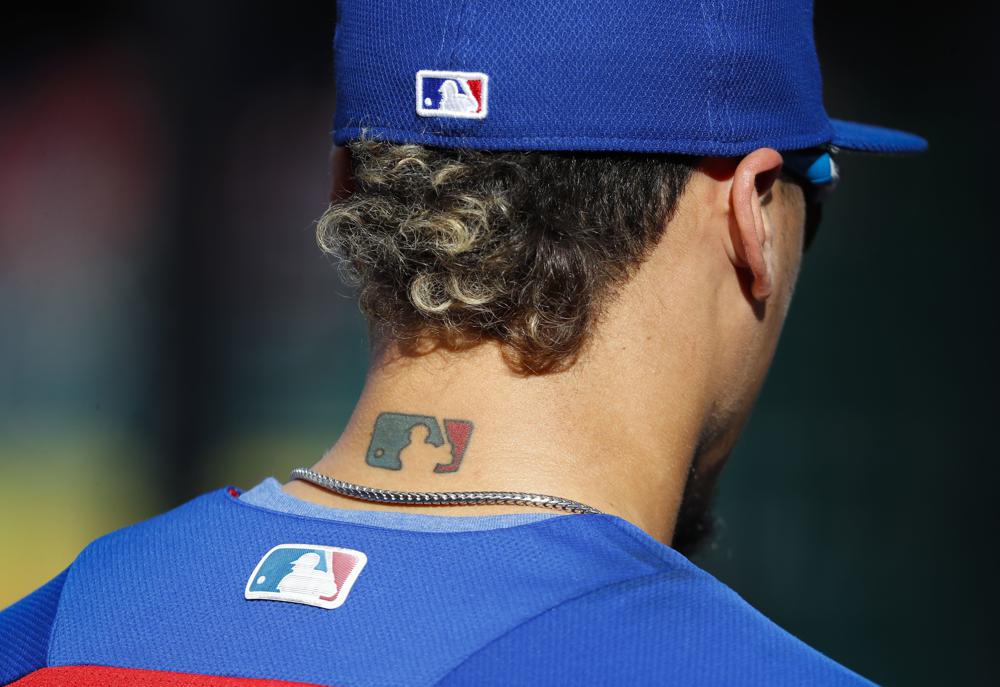
FILE - Then-Chicago Cubs' Javier Baez sports an MLB logo tattoo and logos on his hat and jersey as he waits to take batting practice before Game 2 of baseball's National League Division Series against the Washington Nationals at Nationals Park, Saturday, Oct. 7, 2017, in Washington. The clock ticked down toward the expiration of Major League Baseball’s collective bargaining agreement at 11:59 p.m. EST Wednesday night, Dec. 1, 2021, and what was likely to be a management lockout ending the sport’s labor peace at over 26 1/2 years. (AP Photo/Pablo Martinez Monsivais, File)
IRVING, Texas (AP) — Major League Baseball plunged into its first work stoppage in a quarter-century when the sport’s collective bargaining agreement expired Wednesday night and owners immediately locked out players in a move that threatens spring training and opening day.
The strategy, management’s equivalent of a strike under federal labor law, ended the sport’s labor peace after 9,740 days over 26 1/2 years.
Teams decided to force the long-anticipated confrontation during an offseason rather than risk players walking out during the summer, as they did in 1994. Players and owners had successfully reached four consecutive agreements without a work stoppage, but they have been accelerating toward a clash for more than two years.
“We believe that an offseason lockout is the best mechanism to protect the 2022 season,” baseball Commissioner Rob Manfred wrote in a letter to fans. “We hope that the lockout will jumpstart the negotiations and get us to an agreement that will allow the season to start on time. This defensive lockout was necessary because the players’ association’s vision for Major League Baseball would threaten the ability of most teams to be competitive.”
Talks that started last spring ended Wednesday after a brief session of mere minutes with the sides far apart on the dozens of key economic issues. Management’s negotiators left the union’s hotel about nine hours before the deal lapsed at 11:59 p.m. EST.
MLB’s 30 controlling owners held a brief digital meeting to reaffirm their lockout decision, and MLB delivered the announcement of its fourth-ever lockout — to go along with five strikes — in an emailed letter to the Major League Baseball Players Association.
“This drastic and unnecessary measure will not affect the players’ resolve to reach a fair contract,” union head Tony Clark said in a statement. “We remain committed to negotiating a new collective bargaining agreement that enhances competition, improves the product for our fans, and advances the rights and benefits of our membership.”
This stoppage began 30 days after Atlanta’s World Series win capped a complete season following a pandemic-shortened 2020 played in empty ballparks.
The lockout’s immediate impacts were a memo from MLB to clubs freezing signings, the cancellation of next week’s annual winter meetings in Orlando, Florida, and banishing players from team workout facilities and weight rooms while perhaps chilling ticket sales for 2022.
The union demanded change following anger over a declining average salary, middle-class players forced out by teams concentrating payroll on the wealthy and veterans jettisoned in favor of lower-paid youth, especially among clubs tearing down their rosters to rebuild.
“As players we see major problems with it,” New York Mets pitcher Max Scherzer said of the 2016 agreement. “First and foremost, we see a competition problem and how teams are behaving because of certain rules that are within that, and adjustments have to be made because of that in order to bring out the competition.”
Eleven weeks remain until pitchers and catchers are to report for spring training on Feb. 16, leaving about 70 days to reach a deal allowing for an on-time start. Opening day is set for March 31, and a minimum of three weeks of organized workouts have been required in the past.
Management, intent on preserving salary restraints gained in recent decades, rejected the union’s requests for what teams regarded as significant alterations to the sport’s economic structure, including lowering service time needed for free agency and salary arbitration.
“We offered to establish a minimum payroll for all clubs to meet for the first time in baseball history; to allow the majority of players to reach free agency earlier through an age-based system that would eliminate any claims of service time manipulation; and to increase compensation for all young players,” Manfred wrote. “When negotiations lacked momentum, we tried to create some by offering to accept the universal designated hitter, to create a new draft system using a lottery similar to other leagues.”
Many clubs scrambled to add players ahead of the lockout, committing to more than $1.9 billion in new contracts — including a one-day record of more than $1.4 billion Wednesday.
Two of the eight members of the union’s executive subcommittee signed big deals: Texas infielder Marcus Semien ($175 million) and Scherzer ($130 million).
“This is actually kind of fun,” Scherzer said. “I’m a fan of the game, and to watch everybody sign right now, to actually see teams competing in this kind of timely fashion, it’s been refreshing because we’ve seen freezes for the past several offseasons.”
No player remains active from the 232-day strike that cut short the 1994 season, led to the first cancellation of the World Series in 90 years and caused the following season to start late.
The average salary dropped from $1.17 million before the strike to $1.11 million but then resumed its seemingly inexorable rise. It peaked at just under $4.1 million in 2017, the first season of the latest CBA, but likely will fall to about $3.7 million when this year’s final figures are calculated.
That money is concentrated heavily at the top of the salary structure. Among approximately 1,955 players who signed major league contracts at any point going into the regular season’s final month, 112 had earned $10 million or more this year as of Aug. 31, of which 40 made at least $20 million, including prorated shares of signing bonuses.
There were 1,397 earning under $1 million, of which 1,271 were at $600,000 or less and 332 under $100,000, a group of younger players who shuttle back and forth to the minors.
A union statement claimed the lockout “was specifically calculated to pressure players into relinquishing rights and benefits, and abandoning good-faith bargaining proposals that will benefit not just players, but the game and industry as a whole. ... We have been here before, and players have risen to the occassion time and again — guided by a solidarity that has been forged over generations.”
The union has withheld licensing money, as it usually does going into bargaining; cash, U.S. Treasury securities and investments totaled $178.5 million last Dec. 31, according to a financial disclosure form filed with the U.S. Department of Labor.
Some player agents have speculated that management’s credit lines already may be pressured following income deprivation caused by the coronavirus pandemic, but the clubs’ finances are more opaque publicly than that of the union, making it difficult to ascertain comparative financial strength to withstand a lengthy work stoppage.
Manfred succeeded Bud Selig as commissioner in 2015 following a quarter-century as an MLB labor negotiator. He was unusually critical publicly of the union’s stance.
“They never wavered from collectively the most extreme set of proposals in their history,” he said, “including significant cuts to the revenue-sharing system, a weakening of the competitive balance tax, and shortening the period of time that players play for their teams. All of these changes would make our game less competitive.”
IRVING, Texas (AP) — Major League Baseball plunged into its first work stoppage in a quarter-century when the sport’s collective bargaining agreement expired Wednesday night and owners immediately locked out players in a move that threatens spring training and opening day.
The strategy, management’s equivalent of a strike under federal labor law, ended the sport’s labor peace after 9,740 days over 26 1/2 years.
Teams decided to force the long-anticipated confrontation during an offseason rather than risk players walking out during the summer, as they did in 1994. Players and owners had successfully reached four consecutive agreements without a work stoppage, but they have been accelerating toward a clash for more than two years.
“We believe that an offseason lockout is the best mechanism to protect the 2022 season,” baseball Commissioner Rob Manfred wrote in a letter to fans. “We hope that the lockout will jumpstart the negotiations and get us to an agreement that will allow the season to start on time. This defensive lockout was necessary because the players’ association’s vision for Major League Baseball would threaten the ability of most teams to be competitive.”
Talks that started last spring ended Wednesday after a brief session of mere minutes with the sides far apart on the dozens of key economic issues. Management’s negotiators left the union’s hotel about nine hours before the deal lapsed at 11:59 p.m. EST.
MLB’s 30 controlling owners held a brief digital meeting to reaffirm their lockout decision, and MLB delivered the announcement of its fourth-ever lockout — to go along with five strikes — in an emailed letter to the Major League Baseball Players Association.
“This drastic and unnecessary measure will not affect the players’ resolve to reach a fair contract,” union head Tony Clark said in a statement. “We remain committed to negotiating a new collective bargaining agreement that enhances competition, improves the product for our fans, and advances the rights and benefits of our membership.”
This stoppage began 30 days after Atlanta’s World Series win capped a complete season following a pandemic-shortened 2020 played in empty ballparks.
The lockout’s immediate impacts were a memo from MLB to clubs freezing signings, the cancellation of next week’s annual winter meetings in Orlando, Florida, and banishing players from team workout facilities and weight rooms while perhaps chilling ticket sales for 2022.
The union demanded change following anger over a declining average salary, middle-class players forced out by teams concentrating payroll on the wealthy and veterans jettisoned in favor of lower-paid youth, especially among clubs tearing down their rosters to rebuild.
“As players we see major problems with it,” New York Mets pitcher Max Scherzer said of the 2016 agreement. “First and foremost, we see a competition problem and how teams are behaving because of certain rules that are within that, and adjustments have to be made because of that in order to bring out the competition.”
Eleven weeks remain until pitchers and catchers are to report for spring training on Feb. 16, leaving about 70 days to reach a deal allowing for an on-time start. Opening day is set for March 31, and a minimum of three weeks of organized workouts have been required in the past.
Management, intent on preserving salary restraints gained in recent decades, rejected the union’s requests for what teams regarded as significant alterations to the sport’s economic structure, including lowering service time needed for free agency and salary arbitration.
“We offered to establish a minimum payroll for all clubs to meet for the first time in baseball history; to allow the majority of players to reach free agency earlier through an age-based system that would eliminate any claims of service time manipulation; and to increase compensation for all young players,” Manfred wrote. “When negotiations lacked momentum, we tried to create some by offering to accept the universal designated hitter, to create a new draft system using a lottery similar to other leagues.”
Many clubs scrambled to add players ahead of the lockout, committing to more than $1.9 billion in new contracts — including a one-day record of more than $1.4 billion Wednesday.
Two of the eight members of the union’s executive subcommittee signed big deals: Texas infielder Marcus Semien ($175 million) and Scherzer ($130 million).
“This is actually kind of fun,” Scherzer said. “I’m a fan of the game, and to watch everybody sign right now, to actually see teams competing in this kind of timely fashion, it’s been refreshing because we’ve seen freezes for the past several offseasons.”
No player remains active from the 232-day strike that cut short the 1994 season, led to the first cancellation of the World Series in 90 years and caused the following season to start late.
The average salary dropped from $1.17 million before the strike to $1.11 million but then resumed its seemingly inexorable rise. It peaked at just under $4.1 million in 2017, the first season of the latest CBA, but likely will fall to about $3.7 million when this year’s final figures are calculated.
That money is concentrated heavily at the top of the salary structure. Among approximately 1,955 players who signed major league contracts at any point going into the regular season’s final month, 112 had earned $10 million or more this year as of Aug. 31, of which 40 made at least $20 million, including prorated shares of signing bonuses.
There were 1,397 earning under $1 million, of which 1,271 were at $600,000 or less and 332 under $100,000, a group of younger players who shuttle back and forth to the minors.
A union statement claimed the lockout “was specifically calculated to pressure players into relinquishing rights and benefits, and abandoning good-faith bargaining proposals that will benefit not just players, but the game and industry as a whole. ... We have been here before, and players have risen to the occassion time and again — guided by a solidarity that has been forged over generations.”
The union has withheld licensing money, as it usually does going into bargaining; cash, U.S. Treasury securities and investments totaled $178.5 million last Dec. 31, according to a financial disclosure form filed with the U.S. Department of Labor.
Some player agents have speculated that management’s credit lines already may be pressured following income deprivation caused by the coronavirus pandemic, but the clubs’ finances are more opaque publicly than that of the union, making it difficult to ascertain comparative financial strength to withstand a lengthy work stoppage.
Manfred succeeded Bud Selig as commissioner in 2015 following a quarter-century as an MLB labor negotiator. He was unusually critical publicly of the union’s stance.
“They never wavered from collectively the most extreme set of proposals in their history,” he said, “including significant cuts to the revenue-sharing system, a weakening of the competitive balance tax, and shortening the period of time that players play for their teams. All of these changes would make our game less competitive.”
MLB locks out players, officially initiates baseball's first work stoppage since 1994-95 strike
Hannah Keyser,Zach Crizer
MLB locked out its players just after midnight ET Thursday, triggering the league’s first work stoppage since the 1994 strike that canceled the World Series. It is a long expected, but still significant, escalation of the tense negotiations to craft a new collective bargaining agreement and shape the future of the sport.
The existing CBA, an expansive document that governs everything from payroll rules to travel accommodations, expired Wednesday at 11:59 p.m. ET. Minutes later, the league moved to lock out its players — a move that commissioner Rob Manfred strongly hinted at last month, reflecting the league’s preference to control the timing of a work stoppage and avoid missing games. Team owners across American sports have come to favor the approach of initiating a lockout in the offseason rather than allowing players the opportunity to gain leverage and wreak havoc on the season by going on strike when games are on the schedule.
After committing more than $1.4 billion to free agents this week in a feeding frenzy headlined by Max Scherzer’s record-setting deal with the New York Mets, the team owners chose to freeze transactions and all other major-league business. They could have continued CBA negotiations while allowing the offseason to continue under the old rules.
Manfred released a letter to fans offering an explanation for the lockout via the league's official site — which was simultaneously scrubbed of references to current players. It read, in part:
Simply put, we believe that an offseason lockout is the best mechanism to protect the 2022 season. We hope that the lockout will jumpstart the negotiations and get us to an agreement that will allow the season to start on time. This defensive lockout was necessary because the Players Association’s vision for Major League Baseball would threaten the ability of most teams to be competitive. It’s simply not a viable option. From the beginning, the MLBPA has been unwilling to move from their starting position, compromise, or collaborate on solutions.
The union also released a statement, pointing out that the lockout was not required, and calling it a "drastic measure, regardless of timing."
What does a work stoppage mean for MLB?
This is the fourth MLB lockout since Marvin Miller and the MLBPA brought collective bargaining to professional sports in 1968. Because they are timed in the offseason, none of the previous lockouts — in 1973, 1976 and 1990 — resulted in any missed games.
MLB has also experienced five strikes, the player-initiated equivalent of a lockout. Three of those — 1972, 1981 and 1994 — resulted in missing games, with the most severe being the 1994-95 strike that wiped out the World Series and cut into the following season.
In the 1994 negotiations that led to the strike, the league played on despite an expired CBA. The union went on strike in August as the league sought a salary cap to mirror other American sports. In December, MLB unilaterally implemented the cap and set off a legal challenge. Ultimately, federal Judge Sonia Sotomayor (now a Supreme Court justice) ruled that MLB had negotiated in bad faith and issued an injunction that quickly ended the strike in April 1995 by restoring the terms of the previous CBA as negotiations continued.
CBA negotiations in 2001, 2006, 2011 and 2016 were completed without work stoppages, but tension over the economic ground players have lost in the past decade have come to a head this time around.
What are MLB, players at odds over?
The labor reckoning that has now arrived has been growing on the horizon for several years, bursting into clear view over the past two seasons. The MLB Players Association has added negotiating heft in recent years, and showed increased player engagement and unity during 2020 skirmishes over the pandemic-shortened season.
Average and median salaries for major leaguers have declined since the outgoing CBA took effect in 2016, and players have grown increasingly frustrated at what they perceive as teams’ non-competitive management tactics.
The union is seeking significant changes to recalibrate the economic balance of the game, which has swung decidedly toward the team owners and calculating front offices in recent seasons. Among the players’ priorities:
Ensuring young players — who account for a mounting share of production — have a chance to earn salaries commensurate with their performance earlier in their careers.
Disincentivizing the practice of tanking, which many teams use as reason to sit out free agency for years at a time, and implementing policies that push more teams to spend competitively. That could mean reshaping the draft, revenue sharing and the competitive balance tax that teams treat like a soft salary cap.
The league has floated several proposals that address these topics, but the sides remain far apart on those core economic issues.
How did they leave the negotiations?
A vast oversimplification of the bargaining timeline thus far this year goes as follows: The union made a proposal in May, the league countered in August. The union rejected that proposal and the league made another series of proposals last week before Thanksgiving. This week, the two sides met outside Dallas, where the union was holding its annual executive board meeting. The union made its most recent economic proposal on Tuesday.
Wednesday morning, the league told the union that it would only counter if the union agreed to drop some of its key demands. In exchange for taking proposed changes to the players’ pensions off the table, the league wanted the union to take revenue sharing and reserve system changes off the table. The players rejected that request, no counter was made, and ultimately the talks were over more than nine hours before the expiration of the existing CBA.
The sides will have to continue to negotiate at some point, but as we head into a lockout, here’s where they stand on some of the key issues:
Path to free agency
Currently, players are eligible for free agency after six years of major league service. The union is concerned that this often means players are artificially underpaid during their most productive years and also that teams will manipulate a top prospect’s service clock by keeping them in the minors just long enough to get a seventh year of discounted services.
MLB: The league has proposed replacing service time with an age-based system that would grant all players free agency at the end of the season in which they surpass the age of 29 1/2. Alternatively, it’s happy with the status quo, and would point to the unprecedented $1.4-plus billion dollars handed out in free agency in deals that were finalized on Wednesday alone as a sign that the current system is working.
Union: In its latest proposal, the union laid out a system by which a player can reach free agency either by accruing six years of service time or by accruing five years of service and reaching a certain age. In the first year of the new CBA, the system would remain the same as now — six years for free agency. In the next two years, players could reach free agency by crossing six years of service time or accruing five years and being at least 30 1/2 years old. In the final two years of the CBA, it would be six years or five years of service and at least 29 1/2 years old.
The union also made a proposal designed at combating service time manipulation wherein rookies who were held down at the start of the season could still accrue a full year of service if they achieve certain performance metrics — such as a WAR threshold or winning certain awards.
Competitive balance
The current competitive balance tax threshold is $210 million, with escalating penalties for teams that run payrolls surpassing that figure in multiple consecutive seasons.
MLB: Earlier in the negotiations, the league proposed a lowered $180-million threshold with higher penalties for exceeding it. The idea was to pair that change with a payroll minimum of $100 million per club. More recently, it proposed raising the existing CBT to $214 million in 2022, getting up to $220 million by the final season of the next CBA.
The league proposed eliminating the draft penalties for teams that sign free agents who rejected qualifying offers. Previously, free agents who had been extended the qualifying offer and rejected it would cost the teams that signed them a draft pick.
Union: The union has proposed raising the threshold to $245 million in the first year of the next CBA, reaching $273 million by the final season.
The union proposed changes to the revenue-sharing system that are ostensibly designed to encourage teams to use the money received to generate further revenue and field a competitive team. The league has rejected all changes to the revenue sharing system, concerned that it would further stratify the big- and small-market teams.
Salary arbitration
Currently players reach arbitration, where they’re eligible for the first significant raises, after three years of major-league service (plus the top 22% of players with at least two years but not three full years of service).
MLB: The league likes the status quo, which is a central tenet in getting valuable production at a below market-value price. It has also proposed replacing the entire arbitration system with a WAR-based algorithm to determine salaries for players under team control. As a concession, players who are currently eligible for arbitration under the outgoing CBA would be grandfathered in and have the choice of taking the algorithm’s raises or going to arbitration.
Union: The union proposed starting arbitration eligibility after two years of major-league service. It also proposed a pool of money pulled from central revenues to reward top performers amongst players who don’t qualify for arbitration.
The league countered with a smaller pool, funded, at least partially, from revenues currently earmarked for other union benefits.
Draft
Both sides seem to agree — or at least be amenable to addressing the ways that — the current draft system incentivizes tanking by rewarding the worst teams with the top picks.
MLB: The league proposed an NBA-style lottery for the top three picks. It had previously proposed a system wherein teams couldn’t receive a top-five pick three consecutive seasons (to prevent recidivism tanking) and that proposal is still technically on the table as well as an alternative.
The league also proposed an international draft to replace the current system of international amateur free agency.
Union: The MLBPA proposed a draft order that relies on a lottery for more than just the top three picks, and also includes incentives for small-market teams that do well and penalties for teams that repeatedly finish at the bottom of the pack.
Postseason
The current playoff field is 10 teams: Three division winners per league plus two wild cards with the best records among non-division winners per league.
MLB: The league proposed a 14-team postseason structure: three division winners and four wild cards per league. The division winners with the best record would receive a bye for the three-game wild-card round. The other two division winners would get to select their opponents from the bottom-three wild-card teams, with the second-best division winner going first. The best wild-card team would face whichever of the other three wild cards was left after those selections.
Union: The union proposed a 12-team postseason structure based on divisional realignment — each league would be split into two divisions of seven and eight teams.
Among other miscellaneous proposals, the league would package a universal designated hitter with its version of the expanded postseason, and the union pitched allowing the league to put advertisement patches on uniforms to generate further revenue.
Hannah Keyser,Zach Crizer
MLB locked out its players just after midnight ET Thursday, triggering the league’s first work stoppage since the 1994 strike that canceled the World Series. It is a long expected, but still significant, escalation of the tense negotiations to craft a new collective bargaining agreement and shape the future of the sport.
The existing CBA, an expansive document that governs everything from payroll rules to travel accommodations, expired Wednesday at 11:59 p.m. ET. Minutes later, the league moved to lock out its players — a move that commissioner Rob Manfred strongly hinted at last month, reflecting the league’s preference to control the timing of a work stoppage and avoid missing games. Team owners across American sports have come to favor the approach of initiating a lockout in the offseason rather than allowing players the opportunity to gain leverage and wreak havoc on the season by going on strike when games are on the schedule.
After committing more than $1.4 billion to free agents this week in a feeding frenzy headlined by Max Scherzer’s record-setting deal with the New York Mets, the team owners chose to freeze transactions and all other major-league business. They could have continued CBA negotiations while allowing the offseason to continue under the old rules.
Manfred released a letter to fans offering an explanation for the lockout via the league's official site — which was simultaneously scrubbed of references to current players. It read, in part:
Simply put, we believe that an offseason lockout is the best mechanism to protect the 2022 season. We hope that the lockout will jumpstart the negotiations and get us to an agreement that will allow the season to start on time. This defensive lockout was necessary because the Players Association’s vision for Major League Baseball would threaten the ability of most teams to be competitive. It’s simply not a viable option. From the beginning, the MLBPA has been unwilling to move from their starting position, compromise, or collaborate on solutions.
The union also released a statement, pointing out that the lockout was not required, and calling it a "drastic measure, regardless of timing."
What does a work stoppage mean for MLB?
This is the fourth MLB lockout since Marvin Miller and the MLBPA brought collective bargaining to professional sports in 1968. Because they are timed in the offseason, none of the previous lockouts — in 1973, 1976 and 1990 — resulted in any missed games.
MLB has also experienced five strikes, the player-initiated equivalent of a lockout. Three of those — 1972, 1981 and 1994 — resulted in missing games, with the most severe being the 1994-95 strike that wiped out the World Series and cut into the following season.
In the 1994 negotiations that led to the strike, the league played on despite an expired CBA. The union went on strike in August as the league sought a salary cap to mirror other American sports. In December, MLB unilaterally implemented the cap and set off a legal challenge. Ultimately, federal Judge Sonia Sotomayor (now a Supreme Court justice) ruled that MLB had negotiated in bad faith and issued an injunction that quickly ended the strike in April 1995 by restoring the terms of the previous CBA as negotiations continued.
CBA negotiations in 2001, 2006, 2011 and 2016 were completed without work stoppages, but tension over the economic ground players have lost in the past decade have come to a head this time around.
What are MLB, players at odds over?
The labor reckoning that has now arrived has been growing on the horizon for several years, bursting into clear view over the past two seasons. The MLB Players Association has added negotiating heft in recent years, and showed increased player engagement and unity during 2020 skirmishes over the pandemic-shortened season.
Average and median salaries for major leaguers have declined since the outgoing CBA took effect in 2016, and players have grown increasingly frustrated at what they perceive as teams’ non-competitive management tactics.
The union is seeking significant changes to recalibrate the economic balance of the game, which has swung decidedly toward the team owners and calculating front offices in recent seasons. Among the players’ priorities:
Ensuring young players — who account for a mounting share of production — have a chance to earn salaries commensurate with their performance earlier in their careers.
Disincentivizing the practice of tanking, which many teams use as reason to sit out free agency for years at a time, and implementing policies that push more teams to spend competitively. That could mean reshaping the draft, revenue sharing and the competitive balance tax that teams treat like a soft salary cap.
The league has floated several proposals that address these topics, but the sides remain far apart on those core economic issues.
How did they leave the negotiations?
A vast oversimplification of the bargaining timeline thus far this year goes as follows: The union made a proposal in May, the league countered in August. The union rejected that proposal and the league made another series of proposals last week before Thanksgiving. This week, the two sides met outside Dallas, where the union was holding its annual executive board meeting. The union made its most recent economic proposal on Tuesday.
Wednesday morning, the league told the union that it would only counter if the union agreed to drop some of its key demands. In exchange for taking proposed changes to the players’ pensions off the table, the league wanted the union to take revenue sharing and reserve system changes off the table. The players rejected that request, no counter was made, and ultimately the talks were over more than nine hours before the expiration of the existing CBA.
The sides will have to continue to negotiate at some point, but as we head into a lockout, here’s where they stand on some of the key issues:
Path to free agency
Currently, players are eligible for free agency after six years of major league service. The union is concerned that this often means players are artificially underpaid during their most productive years and also that teams will manipulate a top prospect’s service clock by keeping them in the minors just long enough to get a seventh year of discounted services.
MLB: The league has proposed replacing service time with an age-based system that would grant all players free agency at the end of the season in which they surpass the age of 29 1/2. Alternatively, it’s happy with the status quo, and would point to the unprecedented $1.4-plus billion dollars handed out in free agency in deals that were finalized on Wednesday alone as a sign that the current system is working.
Union: In its latest proposal, the union laid out a system by which a player can reach free agency either by accruing six years of service time or by accruing five years of service and reaching a certain age. In the first year of the new CBA, the system would remain the same as now — six years for free agency. In the next two years, players could reach free agency by crossing six years of service time or accruing five years and being at least 30 1/2 years old. In the final two years of the CBA, it would be six years or five years of service and at least 29 1/2 years old.
The union also made a proposal designed at combating service time manipulation wherein rookies who were held down at the start of the season could still accrue a full year of service if they achieve certain performance metrics — such as a WAR threshold or winning certain awards.
Competitive balance
The current competitive balance tax threshold is $210 million, with escalating penalties for teams that run payrolls surpassing that figure in multiple consecutive seasons.
MLB: Earlier in the negotiations, the league proposed a lowered $180-million threshold with higher penalties for exceeding it. The idea was to pair that change with a payroll minimum of $100 million per club. More recently, it proposed raising the existing CBT to $214 million in 2022, getting up to $220 million by the final season of the next CBA.
The league proposed eliminating the draft penalties for teams that sign free agents who rejected qualifying offers. Previously, free agents who had been extended the qualifying offer and rejected it would cost the teams that signed them a draft pick.
Union: The union has proposed raising the threshold to $245 million in the first year of the next CBA, reaching $273 million by the final season.
The union proposed changes to the revenue-sharing system that are ostensibly designed to encourage teams to use the money received to generate further revenue and field a competitive team. The league has rejected all changes to the revenue sharing system, concerned that it would further stratify the big- and small-market teams.
Salary arbitration
Currently players reach arbitration, where they’re eligible for the first significant raises, after three years of major-league service (plus the top 22% of players with at least two years but not three full years of service).
MLB: The league likes the status quo, which is a central tenet in getting valuable production at a below market-value price. It has also proposed replacing the entire arbitration system with a WAR-based algorithm to determine salaries for players under team control. As a concession, players who are currently eligible for arbitration under the outgoing CBA would be grandfathered in and have the choice of taking the algorithm’s raises or going to arbitration.
Union: The union proposed starting arbitration eligibility after two years of major-league service. It also proposed a pool of money pulled from central revenues to reward top performers amongst players who don’t qualify for arbitration.
The league countered with a smaller pool, funded, at least partially, from revenues currently earmarked for other union benefits.
Draft
Both sides seem to agree — or at least be amenable to addressing the ways that — the current draft system incentivizes tanking by rewarding the worst teams with the top picks.
MLB: The league proposed an NBA-style lottery for the top three picks. It had previously proposed a system wherein teams couldn’t receive a top-five pick three consecutive seasons (to prevent recidivism tanking) and that proposal is still technically on the table as well as an alternative.
The league also proposed an international draft to replace the current system of international amateur free agency.
Union: The MLBPA proposed a draft order that relies on a lottery for more than just the top three picks, and also includes incentives for small-market teams that do well and penalties for teams that repeatedly finish at the bottom of the pack.
Postseason
The current playoff field is 10 teams: Three division winners per league plus two wild cards with the best records among non-division winners per league.
MLB: The league proposed a 14-team postseason structure: three division winners and four wild cards per league. The division winners with the best record would receive a bye for the three-game wild-card round. The other two division winners would get to select their opponents from the bottom-three wild-card teams, with the second-best division winner going first. The best wild-card team would face whichever of the other three wild cards was left after those selections.
Union: The union proposed a 12-team postseason structure based on divisional realignment — each league would be split into two divisions of seven and eight teams.
Among other miscellaneous proposals, the league would package a universal designated hitter with its version of the expanded postseason, and the union pitched allowing the league to put advertisement patches on uniforms to generate further revenue.
Subscribe to:
Posts (Atom)