Friday, December 03, 2021

University of Maryland prof Marjoleine Kars wins McGill-run Cundill History Prize

© Provided by The Canadian Press

MONTREAL — University of Maryland professor Marjoleine Kars has won the US$75,000 Cundill History Prize.

Kars received the honour on Thursday for "Blood on the River: A Chronicle of Mutiny and Freedom on the Wild Coast," published by the New Press.

Raised in the Netherlands and based in Washington, D.C., Kars is noted for her work on the history of slavery.

In a news release, jury chair Michael Ignatieff praised the book as "superbly researched and narrated."

The international Cundill prize, which is run by McGill University, recognizes non-fiction history writing in English.

This year's runners-up, who each receive US$10,000, were U.K.-based Canadian scholar Rebecca Clifford for "Survivors: Children's Lives after the Holocaust,'' from Yale University Press, and Paris Nanterre University professor Marie Favereau for "The Horde: How the Mongols Changed the World,'' published by Belknap Press.

This report by The Canadian Press was first published Dec. 2, 2021.

Blood on the River: Uncovering a forgotten slave rebellion

Author Marjoleine Kars wins the prestigious 2021 Cundill History Prize

CBC Radio · Posted: Dec 02, 2021 

Historian Marjoleine Kars is the winner of the 2021 Cundill History Prize for Blood on the River: A Chronicle of Mutiny and Freedom on the Wild Coast. The award honours the best history writing in English. (Jasmine Nelson/The New Press)


Ideas53:59 Cundill History Prize 2021: Marjoleine Kars
Historian Marjoleine Kars wins $95K historical writing prize for book about a 'dramatic' 1763 slave revolution

It was the biggest and most successful slave rebellion in the Caribbean — until Haiti's revolution decades later. And it likely would have been completely forgotten, were it not for a chance discovery by historian Marjoleine Kars.

Her book about the uprising, Blood on the River: A Chronicle of Mutiny and Freedom on the Wild Coast, was announced today as this year's winner of the Cundill History Prize, with its award of $75,000 US ($95,494 Cdn).

She recounted her startling discovery to IDEAS host Nahlah Ayed.

"I was in the national archives in The Hague. I'm Dutch… And so I was poking around, and I found all these records about a place I had never heard of — called Berbice," she said.

Berbice was a series of Dutch plantations founded in the mid-eighteenth century in what's now Guyana, named for the river along which the plantations were situated. It was also the site of an astonishing slave rebellion in 1763.

"Most rebellions are quickly suppressed. They don't last very long: hours, maybe days. And this one went on for more than a year."

Professor Kars asks in her book: "How did they pull this off?" The answer is complex, but the reason is simple: life as a slave was absolute misery.
Slave rebellion

After enduring the horrors of being captured and surviving the transatlantic crossing, West African slaves brought to Berbice had to toil in the blazing sun for 10 hours a day, six days a week, with maybe a day off at Christmas. Disease was rampant, while whippings and torture — even of children — were commonplace.

After a localized insurrection was put down in 1762, resentments boiled over a year later. Rebelling slaves began their attacks on a Sunday morning, while the Dutch were at church. Some of them had just enough time to bury their valuables before fleeing.

 Dutch slave ship disembarks with a group of slaves for sale, Jamestown, Virginia, 1619. (Hulton Archive/Getty Images)

Kars traveled to the sites, many of which remain unexcavated. Yet she could touch the history of Berbice with her own hands, as the ground — especially after it rains — will yield up "all kinds of pottery shards and pieces of clay pipes that would have been used by enslaved men and women."

Those who didn't escape were often dealt with as harshly as the slaves had been.

"The rebels also set their sights on plantation managers and overseers… because of their predatory behavior toward enslaved women. Plantation managers in general were notorious for raping women under their command," Kars writes.

The rebelling slaves were led by a man named Coffij. He envisioned a kind of dual state arrangement: the Dutch would stay on their side of the Berbice River, the now-free slaves on the other, and the two sides could even establish trade relations.
Coffij, the leader of the largest slave rebellion in the Caribbean to date... slipped out of history with barely a notice. - Marjoleine Kars

But life as rebel slave was nearly as hard as being a slave. They had to feed and arm themselves, as well as procure and train their own armed forces. At times, they forced other slaves into service — and in doing so, came to resemble the overlords they were fighting against.

A similar reversal took place on the Dutch side. Help from across the Atlantic was slow to come, and the delays meant that the few soldiers they did have had to do the work of the escaped slaves. So one group of soldiers actually mutineed, and joined the rebels.
A coup that ended a dream

After over a year of fruitless negotiations with the Dutch, internal divisions and exhausted spirits, a coup was mounted against the leader, Coffij. In keeping with West African tradition, he killed himself.

"Coffij, the leader of the largest slave rebellion in the Caribbean to date, a man who had dared to dream of a new colonial order, who, had he succeeded, might well have governed the first Black republic, slipped out of history with barely a notice."

A 1763 monument of the slave rebel leader Coffij stands in the Square of the Revolution in the Guyanese capital of Georgetown. (Shutterstock / La Rose Photography)

The Dutch later interrogated hundreds of the surviving slaves, leaving behind exceedingly rare records that reflect the voices of slaves from over two and a half centuries ago. They also convey the complexity of their lives:on the one hand, their factionalism, and conflicted self-interest; and on the other, their astounding bravery and resilience.

In all, 124 people were executed. It was grisly, as Kars notes: "Some of the condemned were to have every bone broken on the rack with an iron bar, before dying from either a 'mercy blow' to the heart or a merciless blow to the skull. Others were to be burned at the stake with a regular fire, which took an hour, or with 'small fire,' where the victim smoldered alive for four hours. Some faced the additional torture of having their flesh ripped with hot pincers. The 'lucky' ones were hanged, their heads staked."

The remainder were pressed back into slavery. Up to a third didn't survive the uprising. And it was a "death trap" for European soldiers as well. "It seems unlikely that more than a third survived," Kars speculates.
Historical truth

Berbice never recovered economically under the Dutch.

But as dark as the history of Berbice is, the study of that history may represent a shaft of light. As a result of Kar's efforts, the historical records in The Hague along with their English transcriptions have been made free for Guyanese scholars to access. Kars also hopes that one day, the Dutch government may fund such scholars as a gesture of reparation so they can come to the Netherlands, learn Dutch and study the records in the original language.

Marjoleine Kars is resolute in her assessment of the: "I think beyond Guyana itself that this story has meaning."

The reason: history as a discipline of authentic inquiry is endangered, with attempts by the political right in the U.S. to suppress historical initiatives like the 1619 podcast and Critical Race Theory, or China's continued efforts to rewrite its own history to reflect the Communist party's interests and obliterate all other accounts. So for Marjoleine Kars, the study of history couldn't be more important than it is now.

"As more people claim a seat at the table and want to know more about their own history," she says, "I think that these attempts at simplifying the stories and making them all glorious, and making them all about the accomplishments of white people... just will not fly."

*This episode was produced by Greg Kelly.


Podcast with Marie Favereau, author of “The Horde: How the Mongols Changed the World”
 
Marie Favereau

Most of our understanding of the Mongol Empire begins and ends with Chinggis Khan and his sweep across Asia. His name is now included among conquerors whose efforts burn bright and burn out quick: Alexander the Great, Napoleon, and so on.

The Horde: How the Mongols Changed the World, Marie Favereau (Harvard University Press, April 2020)

Except the story doesn’t end with Chinggis’s death. As Professor Marie Favereau notes in The Horde: How the Mongols Changed the World, the empire that he built continued to shape, incubate and grow the political cultures it conquered. Even as the empire formally splintered, the ties that bound together the Mongols continued to play a critical role in the growth of new identities and cultures.

More information can be found in Marie’s article for Quillete: How the (Much Maligned) Mongol Horde Helped Create Russian Civilization.


In this interview Marie and I talk about the empire the Mongols built: how it grew, what it covered, and how it changed. We discuss how the Mongols changed those they ruled and those they bordered against, and the geopolitical system they built.

Marie Favereau is Associate Professor of History at Paris Nanterre University. She has been a member of the French Institute of Oriental Archaeology in Cairo, a visiting scholar at the Institute for Advanced Study, and a research associate at the University of Oxford for the major project Nomadic Empires. Her books include The Golden Horde and the Mamluk Sultanate (published in French) and the graphic novel Gengis Khan.

Nicholas Gordon has an MPhil from Oxford in International Relations and a BA from Harvard. He is a writer, editor and occasional radio host based in Hong Kong.

“The Horde: How the Mongols Changed the World” by Marie Favereau


Bryn Hammond 12 May 2021  Non-Fiction


There is an aphorism, reported to have been spoken by minister Yelu Chucai to Ogodei Khan, Chinggis Khan’s first successor: “You can conquer an empire on horseback, but you cannot govern it on horseback.” Writers on the Mongols are fond of this line, usually inserted when Mongols begin to set up administrations in the settled lands they have acquired control over. The line’s wisdom is rarely questioned: historians, after all, tend to be sedentary themselves, and invested in a written culture that presumes paperwork must be the basis of office. It is accepted as a truism that steppe nomads had to get down off their horses in order to learn from settled states how to run an empire.

Yelu Chucai certainly tried to instill in the Mongols a conformity to Chinese-style administration. A scholar-official astray in nomad lands, his exertions to civilize them by his own lights easily win the sympathy of historians—a champion of written culture, of a classical tradition. But Yelu Chucai’s dictum was wrong, and he had no eye for the unwritten rules of an alternative, nomadic tradition.

Government from horseback? Yes, it was entirely possible for Mongols. Some, in Iran and China, can be said to have dismounted, although even here they felt themselves contiguous to the steppe. In areas less removed from their origins it is easier to focus on how Mongols governed in a distinctively nomadic way: the center, while it lasted, of the Great Mongol Ulus; among the states it split into, Chagatay in Central Asia, and Ulus Jochi or the Golden Horde, based on the Qipchaq steppe. In The Horde, Marie Favereau sets out to demonstrate how Mongols did indeed govern from horseback in the vast territory granted to Jochi and his heirs.


While researching this book, Favereau was an associate in a project called Nomadic Empires: A World-Historical Perspective at Oxford University, exploring “the role of expansionist equestrian regimes in world history”. The principle investigator was Pekka Hämäläinen, whose 2008 title The Comanche Empire captured the public imagination and won several awards with its vision of a Comanche hegemony that deserves the name of empire—one suggestively similar to the Mongols, that operated on trade and gift exchange, where we see a horse people in control even over European colonies—just as Genoa’s and Venice’s ports on the Black Sea were guests of the Golden Horde. The Nomadic Empires project sought


to understand nomadic regimes on their own terms… and to rethink world history from supposedly peripheral vantage points, such as grasslands, steppe world, deserts.


The Horde: How the Mongols Changed the World, Marie Favereau (Harvard University Press, April 2020)

The Horde: How the Mongols Changed the World, Marie Favereau (Harvard University Press, April 2020)

Now Marie Favereau has given the same treatment to the Golden Horde. Like the Comanche, the Golden Horde practiced “the longstanding Mongol policy of ruling through trade.”

Favereau’s keywords are flexibility, adaptability, plasticity. These qualities she sees as inherent to a nomadic outlook, the reason why nomads’ states remained robust through changing circumstances and conditions. We tend to call the Mongol Empire short-lived, both in its united form and as successor states. Seen “on their own terms”, however, disintegration from unity was not a failure but a time-honored tactic, divide and survive: a preventative, like strategic withdrawal. Such flexibility Favereau compares with the Lakota, political “shapeshifters”, of Hämäläinen’s follow-up book, Lakota America: A New History of Indigenous Power.

Nomadic empires had a light footprint.

Nomadic empires had a light footprint—not only in records kept by writing cultures, which tended to ignore them, but on the ground (in spite of rhetoric around Mongol hooves). By a light footprint, I mean they were non-interventionalist by preference, only concerned to extract taxes, not to make societies over in the image of themselves.


Leading houses were less interested in regulating the daily lives of subjects than in enhancing their productivity.
      The Jochids did not try to impose their vision of the land on sedentary peoples. When called upon to settle disputes, the khan’s judges usually respected local laws, including customary Slavic and Islamic law.


Favereau renames the well-known Pax Mongolica. For one thing, peace wasn’t a necessary part of it: “internal tensions were not incompatible with economic success.” Timothy May in The Mongol Conquests in World History had already proposed “the Chinggis exchange” as a replacement. Favereau removes attribution to the single figure of Chinggis Khan, and makes “the Mongol exchange”.


The Mongols enabled, maintained, and grew the most extensive exchange in people, goods, and ideas in the premodern world… This was truly the Mongol exchange; the various participants knew it was the Horde that made the network run, and they courted the khan in hopes of improving their own fortunes.


The “Golden Horde” was the Russian name for the Ulus of Jochi. “Horde” itself comes from the Mongol ordo (with variants orda and horda), meaning a court camp. Favereau adopts subjects’ and visitors’ shorthand of “the Horde” to refer by extension to the state. Since she presents non-nomad subjects, such as Russians, as members and participants of the state rather than merely its victims, this largely Russian usage is as valid as the name Mongols called it by, Ulus Jochi.

Beyond this state title, though, Favereau makes “horde” the basic word for Mongol political units everywhere. Recent books by Anne Broadbridge (Women and the Making of the Mongol Empire, previously reviewed in the ARB) and Bruno de Nicola (Women in Mongol Iran) have a special focus on ordos, in the word’s first sense of  “court camps”, as owned and managed by women. In her advocacy for a general use of “horde” to apply to states and smaller outfits, Favereau does not engage with this work. The confusion of terms, then, has yet to be reconciled.

Still, her reasons to urge a replacement for the common “khanate” to signify a Mongol state are sound. Favereau argues that we need a collective word (for which “ulus”, with a sense of “people”, also qualifies).


Struggling to understand the alien political institutions the Mongols created, Persian administrators coined “khanate”, modeling it on their own “sultanate.” Persians thus emphasized the position of the khan. But while the khan was a leading figure, each regime was a collective power. Jochi’s ulus, Tolui’s ulus, and all the other uluses were jointly ruled…
      Given the distributed nature of authority in Mongol society, terms such as “horde” and “ulus” are more useful in describing nomadic power formations than is “khanate”. And many contemporaries writing about Mongol rule did use the term “horde” to name this changeable sort of empire built on mobility, expansion and assimilation, diplomacy, and trade.


Power-sharing was an important tool of statecraft. This runs contrary to an instance of the “oriental despotism” trope that attributes Russia’s historical autocracy and continued cult of the strongman to Asian sources — to Russia’s Mongol age. On the contrary, khanship was consultative, and in Favereau’s story of the Golden Horde, later khans’ recourse to autocracy was a feature of its decline, weakening traditional institutions. Indeed, the concept of qubi (a “share” or “apportionment”) is key in Mongol political and economic arrangements. Favereau writes of circulation as a spiritual concept:


Trade was not intended to benefit the khan personally but rather to provide health for the empire and welfare for the people – health that was measured as much financially as spiritually, for circulation was intimately tied to the Mongol belief system…
      The Mongols saw commodities as receptacles or mediums of something immaterial, and circulation of this immaterial something was essential to the cosmic balance of the world. Specifically, the qubi, the redistribution system, supported not only the living but also the dead… Through this complex interplay of the imminent, the transcendent, and the reborn in this world, the Mongols conceived of the things they shared, apportioned, and circulated among themselves as having a direct impact on the wellbeing of the society… It is hard to reconstruct how the medieval Mongols defined collective happiness, but they certainly believed that the circular movement of things was crucial in producing it. And that meant that the khan could hardly have a more important task than ensuring the fluidity of the redistribution system.

In modern English idiom “horde” has taken on a derogatory cast.

The book doesn’t always shift our gaze to see from a nomads’ perspective. Notably on diplomacy, more time was spent on reception and perception of strange Mongol diplomatic missives (one of these was actually called “perverse” in the narrative, which is certainly the recipient’s point of view!), rather than on Mongols’ internal logic and their view of causes of war. This was especially stark in the Chinggis section, being a briefly-told prequel before the main story of the Golden Horde.

In modern English idiom “horde” has taken on a derogatory cast. After all, with the stigma attached to steppe nomads, such terms as “swarms” and “breeding grounds” have been thought acceptable for use in respectable history into the 21st century. But Favereau gives us a Horde that was admired and celebrated by non-nomad subjects and outsiders in its own day. How did history forget, or learn to denigrate, what it owed to the geopolitical giant that was the Golden Horde? Favereau points to an anti-nomad turn in a later age of imperialism:


This legacy was eventually lost in transmission because of the anti-nomadic policies and ideologies that marked the Eurasian imperialism of the seventeenth through twentieth centuries. Latter-day empires understood agriculture and industry as superior to nomadism, economically and morally, and asserted that only from sedentary and urban circumstances could cherished notions of political consensus and religious freedom emerge. In the historical imagination fostered by liberalism, nationalism, and humanism—cast in Christian and Islamic terms—consensus-building and toleration were the exclusive province of the “civilized” and the “modern”, leaving the Mongols mere pirates of the land. That Mongol rulers developed unique, effective, and humane approaches to political negotiation and social integration became unthinkable.


Is it possible to govern from horseback—govern an empire with a range of peoples from urban to mobile? Yes indeed. This book answers Yelu Chucai’s “self-evident truth”, long retailed in histories of nomad-sedentary interactions. One can imagine a Mongol, back in the day, giving such a retort to the minister—that went unrecorded, as does much in settled people’s written archives. The Horde is a model of history that consults anthropology—the study of culture, to better interpret those historical stalwarts, politics and war. A Mongol enthusiast can only hope this book catches on with a general audience as have Hämäläinen’s related books on the Comanche Empire and the Lakota.



Hammond writes the Amgalant series, historical fiction based on the Secret History of the Mongols.

Books, Arts & Culture (asianreviewofbooks.com)

PRIVATIZATION PUTSCH
Can India's privatization push revive its economy?


Moves to privatize India's public services are being met with strong opposition.

However, proponents of the plans say privatization can streamline services and boost the economy.


Government-owned carrier Air India was finally sold after several attempts over the years


The Indian government's deal to sell its flagship Air India was touted by supporters as a landmark move in a drive to privatize the debt-laden airline, and other public services.

Critics say privatization could mark a decline in the quality of government-supported organizations.

Air India's privatization drive had been in the works for about four years. However, past attempts to offload the loss-making airline hit several roadblocks, including government insistence on retaining some shares in the airline, and political backlash from left-wing parties.

Ultimately, it was Tata group, India's oldest conglomerate, that agreed to pay $2.4 billion (€2.1 billion) for the carrier in October 2021, with the sale expected to close in December.
Push for privatization

The government's most determined push for privatization came during Finance Minister Nirmala Sitharaman's budget speech in February, in which she unveiled an ambitious plan to sell large state-owned companies.

The minister announced that with the exception of four strategic sectors, the government would either privatize or close all public sector enterprises.

These strategic sectors include atomic energy, space, and defense; transport and telecommunications; power, petroleum, coal and minerals; and banking, insurance, and financial services.

However, even in these four strategic sectors, the government would retain "a bare minimum" number of firms, Sitharaman said.

As elsewhere, privatization in India has become a politically sensitive issue. It was one of the key reforms in 1991 when the government opened up the Indian economy, saving it from the brink of collapse.

It gained fresh momentum around 2000 under the right-wing government led by the Bharatiya Janata Party (BJP).

But divestment has courted political and legal controversies.

"The fear among the political class is that when the public sector enterprise is privatized, a lot of the jobs are lost," said Shankkar Aiyyar, a political economy analyst and author of "The Gated Republic: India's Public Policy Failures and Private Solutions."

"But what they are unwilling to accept is that 100% of the jobs are lost when the company has sunk into the ground," Aiyyar told DW.

Successive governments were hesitant to pursue privatization until it was revived by the current government.

"Every political party, when in government, promotes privatization — and opposes it when in the opposition," Aiyyar said. "This 'Jekyll and Hyde' personality of Indian politics persists."

"If enough jobs were being created elsewhere in the economy, privatization would not have so much resistance and pushback," he added.


Oil and energy are considered by the government to be a strategic sector

The case for privatization

The underlying rationale behind privatization of government-run companies is that they would perform better in private hands.

Proponents of the plan also argue that selling large companies would raise billions of dollars that could bolster the government's resources.

"We need to have success in liquidating some of these companies, closing them, selling the land and the assets. This we have yet to achieve," said Ajay Shankar, a retired senior bureaucrat who led the government's Department of Industrial Policy and Promotion.

The proceeds could fund new infrastructure and replenish government finances battered by the coronavirus pandemic, Shankar argued.


Privatization proponents argue that selling off public companies could help finance infrastructure projects

Profit not the only goal

Opponents of privatization say public sector enterprises were formed with all kinds of objectives, and profit-making is not among the primary goals.

Prabhat Patnaik, a Marxist economist and former professor at New Delhi's Jawaharlal Nehru University, argues that even if a public company is not profitable, this is not necessarily a symptom of inefficiency.

"Some of these companies were formed to develop technological self-reliance, others to tap the mineral resources of the country and make sure that the proceeds of the resource come to budget," he told DW.

On the other hand, a foreign company in India could be highly profitable, but still not bring value to the Indian economy, he pointed out.

Patnaik described privatization as akin to handing over the nation's wealth to a "bunch of private oligarchs" in the name of reform.


Government ownership of companies usually promotes an underlying commitment to public welfare.

In many cases, public sector enterprises maintain prices for their goods and services that are affordable to the general public.


Yet economists have long called for reform within public sector enterprises.

"The government can give financial autonomy and streamline the functioning of these companies, but it cannot simply hand over public sector enterprises for a song," said Patnaik.

"The amount that the government is getting in every case is just a tiny fraction of the assets of the company."

Divestment rather than privatization?

As the government faces a fiscal deficit and a slowing economy made worse by the pandemic, the need to raise funds has become more pressing.

But Patnaik argues that from a macroeconomic standpoint, privatizing an asset is the same as a fiscal deficit.

"Handing over a public enterprise means putting equity into the hands of a private buyer," he said.

"Fiscal deficit means putting bonds into the hands of a private buyer. The macroeconomic consequences of the two are exactly the same."

"The whole argument that selling private companies gives the government resources is a false one," Patnaik added.


The government, according to officials, is expecting 500 billion rupees (€6 million or $6.7 million) in dividends from public sector companies in the current fiscal year.

Many have called for divestment as an alternative. This would mean that the government sells some of the shares and assets in its companies, transferring control to the private sector without a change in ownership.

Supporters of this alternative additionally argue that a public-private partnership would attract the best professional managers from the market to publicly funded companies.

"There is every reason for the government to own what it owns, but there is not enough justification for it to manage what it owns," Aiyyar said.

"Ultimately, the fewer economic entities managed by politicians, the better it is for the economy," he said.

Edited by: Leah Carter
AFRICA
Burkina Faso caught between terror and protests for change


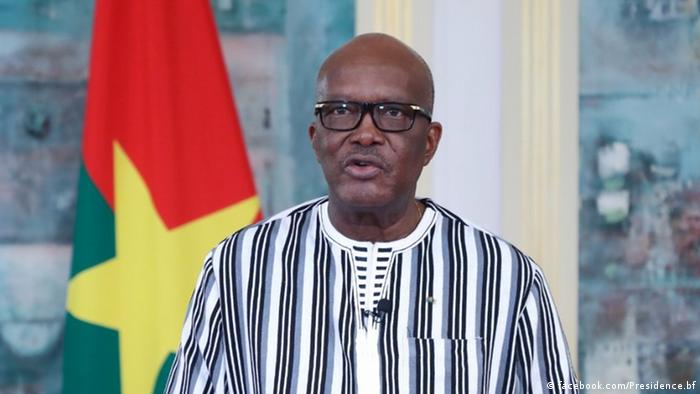
Following protests in Burkina Faso, President Roch Marc Christian Kabore has vowed to step up the fight against terrorism. Many people feel these are empty words, and are calling for his resignation.


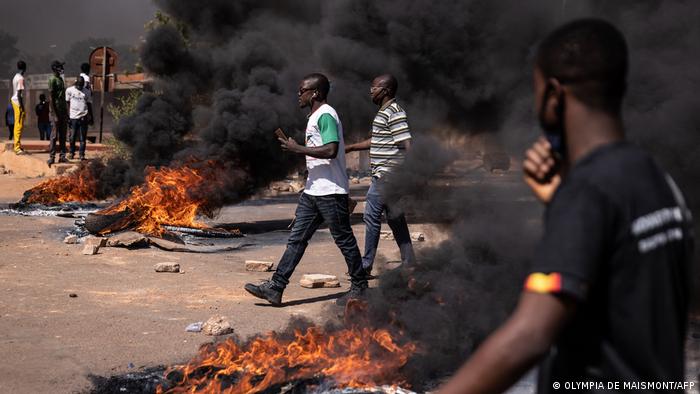
Demonstrators call for a change in government during protests in November


A surge of Islamic militant violence in Burkina Faso is taking on a new dimension.

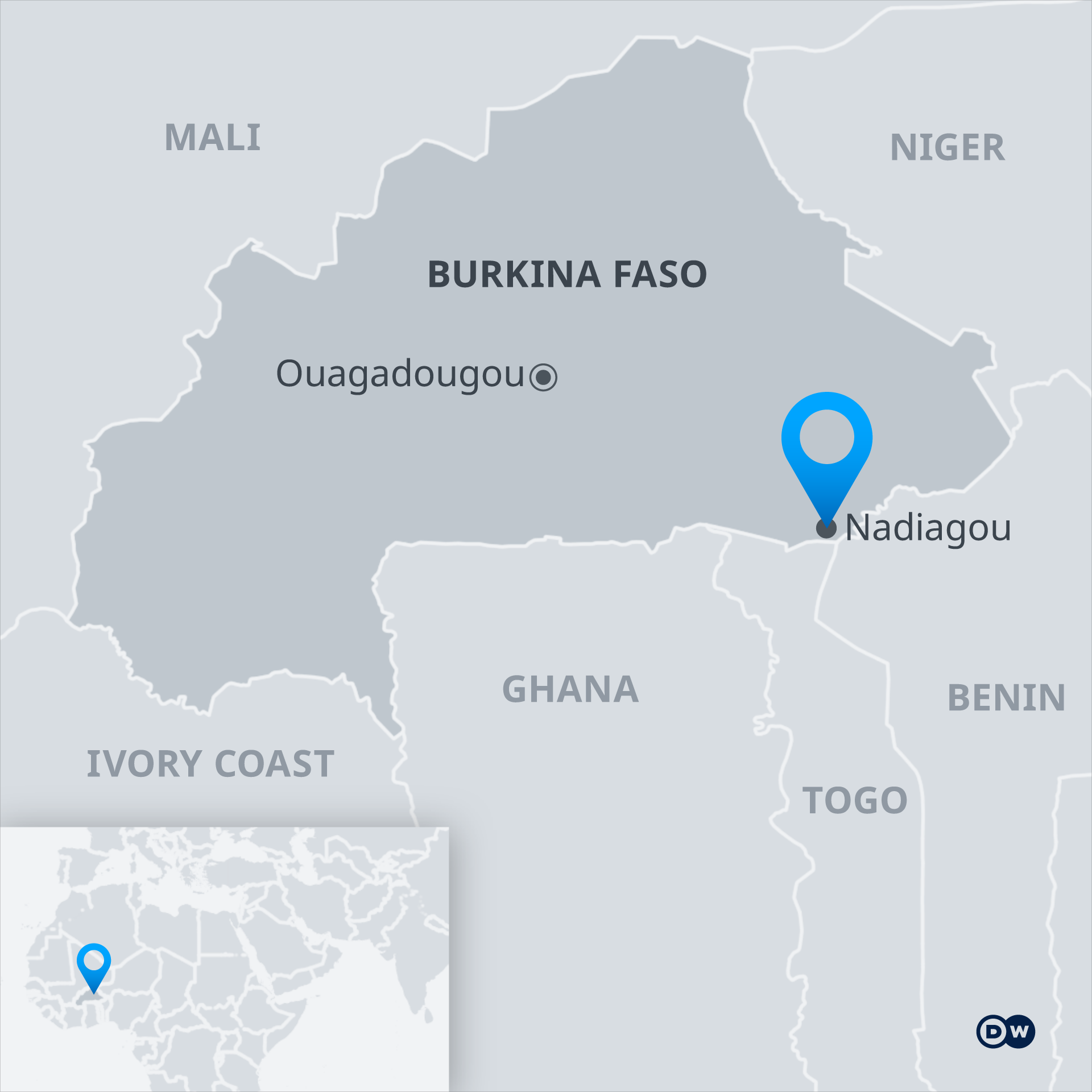
The situation is particularly worrying in Nadiagou, located in the southeast, not far from the border with Benin and Togo.

DW reported on how the al-Qaida-linked jihadist militia group JNIM, which originated in Mali, brought a town under its control for the first time. The men fled, the churches closed.

Protesters are frustrated with the state's failure to stop the violence.

"The jihadists control the village," said a resident who fled to the capital Ouagadougou, but remained in contact with relatives, to DW.

"Only women, children, and old people are left."

While this could not be officially confirmed, a reliable source in security circles corroborated the account.

This development shows how easily militias appear to have spread their grip in the region. JNIM has carried out attacks in the north and northwest, while the Islamic State in the Greater Sahara (ISGS) is mainly active in the east and in the border region of neighboring Niger.

"Our country is at war, and it is disappearing more and more. We have already lost a large part of the land," said Ibrahima Maiga, who now lives in the United States and is a cofounder of the movement Sauvons le Burkina Faso (Save Burkina Faso).


Calls for President Kabore to quit

For weeks, the civil society group has been exerting massive pressure on the government of Kabore, who has been in power since 2015.

This weekend, Sauvons le Burkina Faso plans to organize new demonstrations.

"We have decided to keep protesting until there is real change. For us, this is only possible if President Kabore steps down. That is why we are maintaining this momentum," Maiga told DW.

In Burkina Faso, more than 2,000 people have died as a result of terrorism since 2016. Some 285 people died between July and September alone, according to the United Nations children's agency UNICEF.

Nearly 1.5 million people are on the run, about 2,700 schools are closed, and some 300,000 children and young people can no longer receive an education.

The terror threat is the most significant security crisis in the country since Burkina Faso gained independence from France in 1960.

The attack that changed everything

The trigger for the current pressure on the government was a November 14 attack on security forces in Inata in the north, near the border with Mali.

The assault was the deadliest attack security forces in Burkina Faso have endured since the insurgency began in 2015.

Jihadis killed at least 49 police officers and four civilians.

The attack has fueled anger against both the government in Ouagadougou as well as the French military forces that support it. Since then, protests against Kabore's government have flared up sporadically.

For many Burkinabes, including Prosper Nikiema, the militants had finally crossed a line. He said the ambush on a military police post showed that something had been wrong for far too long.

"Of course, there have always been signs of danger. But these have not been taken seriously at all," Nikiema told DW.

For him, there is only one logical conclusion: Kabore's resignation. However, he thinks that Kabore lacks the courage to take that step.

Nikiema suggests fight terrorism more efficiently — for example with a transnational anti-terrorist operation.

On Tuesday, security minister Maxime Kone announced that Ghana, Togo, and the Ivory Coast had created such a mission, with more than 5,700 soldiers. They arrested at least 300 suspects and confiscated illegal firearms. That operation had been planned before recent protests.


Burkina Faso has become a target of frequent terror attacks, including this one in the capital Ouagadougou

Fighting across borders

Amadou Diemdioda Dicko, a member of parliament for the opposition Union for Progress and Change (UPC) party, believes cross-border initiatives are crucial.

"The situation is also very similar in Mali and Niger," Dicko told DW. "People need to understand that we can only fight terrorism together."

In his opinion, it is not only the government's responsibility: "The population must be involved — for example, by reporting suspicious people. Weapons alone will not bring a solution."

This is evident in neighboring Mali. Despite international military missions and training programs for the armed forces, the security situation has deteriorated in recent years.

To set an example quickly, Kabore appointed Lieutenant Colonel Wendwaoga Kere as inspector general to remedy grievances within the armed forces. For parliamentarian Diemdioda Dicko, Kere's appointment is a step in the right direction.

"Action is demanded of the president, after all," he said.


President Kabore is under increasing pressure to resign due to his government's botched handling of jihadist attacks

New faces instead of fundamental changes

For Ibrahima Maiga of the movement Sauvons le Burkina Faso, that is not enough: "He has changed the chief of staff four times. He had four defense ministers. We have tried and replaced everything. Just not him yet."

Maiga, instead, called for a government of national unity. At the same time, he acknowledged the difficulties in finding a head. "The opposition and the government are the same," he pointed out.

Eric Ismael Kinda, spokesperson for the citizens' movement Balai Citoyen (Citizen's Broom), agreed that replacing ministers is insufficient. Instead, he said, specialized expertise was necessary.

Balai Citoyen led peaceful protests that forced former President Blaise Compaore to resign in 2014. However, as Burkina Faso's best-known civil society organization, it has not yet joined the demonstrations.

"No organization has contacted us about this," Kinda told DW.

Balai Citoyen has always prided that its power lies in grassroots support. It remains to be seen how many people Sauvons le Burkina Faso will mobilize for future protests.


NINE NOTABLE MOSQUES IN AFRICA
Massalikul Jinaan mosque, Senegal
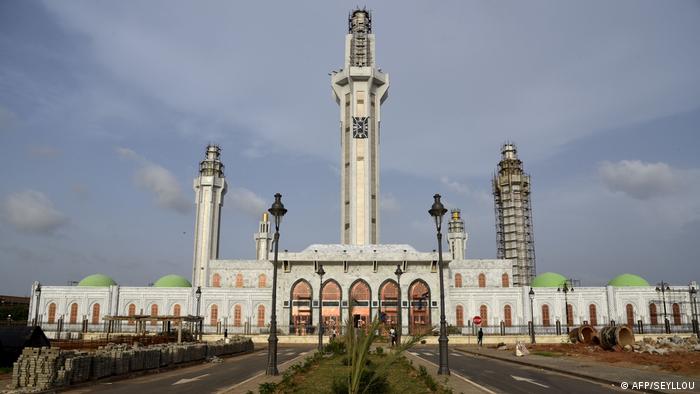
At over $33 million (€30 million), the new Massalikul Jinaan mosque was completed in September 2019 by the Mouride Brotherhood. It is the largest in West Africa capable of holding 15,000 worshippers inside, and another 15,000 on an outside esplanade. The name is derived from the title of a poem by Sheikh Ahmadou Bamba Mbacke, the 19th-century founder of the Brotherhood and revered as a saint.
123456789
Elle magazine to drop fur from all international editions

The magazine, which originated in France, is the first major fashion publication to take the step. Elle said it wants to "foster a more humane fashion industry."


Elle says younger generations expect fashion to be more sustainable and humane

Elle magazine announced on Thursday at a UK fashion conference that it will stop using fur in its publications worldwide.

Elle is a monthly lifestyle magazine owned by French media group Lagardere. It will be the first major fashion publication to remove fur from all its editorial and advertising content.
Why is Elle dropping fur?

Elle's international director, Valeria Bessolo Llopiz, said that fur was no longer acceptable. "The presence of animal fur in our pages and on our digital media is no longer in line with our values," she told the conference.

"It's time for Elle to make a statement ... rejecting animal cruelty."

Instead, she said the magazine wanted to "foster a more humane fashion industry."

Elle has already dropped fur from 13 of its editions. Twenty more will remove fur from their content starting on January 1, 2022, and the remaining editions will follow a year later.

"Fur has become old-fashioned," Bessolo Llopiz said.

She added that younger generations have different demands when it comes to fashion. "We are in a new era and Gen Z, which is the golden target for fashion and luxury, has huge expectations in terms of sustainability and ethics," she said.

PJ Smith, director of fashion policy for the Humane Society of the United States, said he welcomed Elle's announcement and looked forward to other fashion magazines following suit.

"This announcement will ignite positive change throughout the entire fashion industry and has the potential to save countless animals from a life of suffering and a cruel death," he told the conference.

"Fur promotions belong only in the back copies of fashion magazines from days gone by," Elisa Allen, the UK director of animal rights organisation PETA, told the AFP news agency.


Public opposition to animal fur being used in fashion has been mounting

What is the public attitude towards fur?

The decision comes as the fashion industry has faced pressure from activists to stop the use of fur on humane grounds. Smaller fashion weeks in Amsterdam, Oslo, Melbourne and Helsinki have banned fur, but the larger Paris, Milan and New York fashion weeks currently leave the choice up to designers.

Public opposition to fur has been mounting: a 2020 YouGov survey found that 93% of British people refuse to wear fur and a Research Co poll showed that 71% of Americans were against killing animals for their fur.

Similar figures have come out of EU countries: a FOP poll showed that 90% of people in France were against fur, a Eurispes survey found the same opinion was shared by 86% of Italians, and a 2020 Kantar survey found 84% of Germans were against the trade.

A number of major brands, including Gucci, Versace and Prada have already gone fur free.

In June, Israel became the world's first country to ban the sale of fur to the fashion industry.
US sues to block chipmaker Nvidia's $40 billion merger with Arm

US regulators believe the takeover would undermine competition in the computer chip industry.


The merger was announced in 2020 but has faced stiff opposition, especially amid the global semiconductor shortage


The US Federal Trade Commission (FTC) is suing to block Nvidia's $40 billion (€35 billion) merger with UK chip design firm Arm, it announced on Thursday.

It said the merger would undermine competition by handing one chip giant control over technology and designs that competitors rely on to develop their own competing chips.

Arm licenses its blueprints to major chipmakers such as Apple Inc, Qualcomm Inc and Samsung Electronics Co Ltd. It was sold to Japan's SoftBank in 2016.

FTC Bureau of Competition Director Holly Vedova said the regulator was suing "to block the largest semiconductor chip merger in history to prevent a chip conglomerate from stifling the innovation pipeline for next-generation technologies."

"This proposed deal would ... allow the combined firm to unfairly undermine Nvidia's rivals" and ultimately drive up prices, Vedova said in a statement.

"The FTC's lawsuit should send a strong signal that we will act aggressively to protect our critical infrastructure markets from illegal vertical mergers that have far-reaching and damaging effects on future innovations."

Nvidia responded by saying it would try to prove that the merger was in the interests of the public.

"As we move into this next step in the FTC process, we will continue to work to demonstrate that this transaction will benefit the industry and promote competition," the company said in a statement.

Market watchers had expected the deal to fall through after it faced widespread opposition in the chip industry. The FTC said it was working closely with regulators in the European Union, the United Kingdom, Japan and South Korea.

The world is currently facing a shortage of semiconductors, and the Biden administration has promised to ramp up domestic production.

aw/nm (AFP, Reuters)
Snakes are saved from witchcraft rituals in Kenya

Some people consider snakes as cursed, which motivates their capture for witchcraft rituals. It has led to the creation of a rescue group that's already making important discoveries with the recovered animals.


Snakes are killed for witchcraft in Kenya. Reptiles are poached for rituals. Rare animals are captured by sorcerers. Those recovered are brought to Nairobi's Snake Park zoo.

Generally people are afraid of snakes in Kenya. This is not only because of the risk of a poisonous bite. There is a belief that snakes are cursed. This Egyptian snake was rescued by veterinarians. The snakes' fangs are suspected to have been cut off. Wizards often do this to safely handle the animals. Veterinarians have found that the fangs regenerate.
Merkel taps 'highlight' by punkrocker for farewell parade


Angela Merkel surprised observers with an eclectic choice of music for her farewell (AFP/John MACDOUGALL)More

Thu, December 2, 2021

With a hit by the "godmother of punk" Nina Hagen, Germany's military saluted a visibly moved Angela Merkel during a ceremonial farewell Thursday, just a week before she is due to bow out of politics after 16 years in office.

Soldiers in full regalia and carrying flaming torches took part in the carefully choreographed evening event, accompanied by a marching band performing traditional military music and Merkel's own playlist.

The ceremonial send-off came just days before Germany's parliament is due to officially elect Social Democrat Olaf Scholz as Merkel's replacement, putting the centre-left politician in charge after 16 years of conservative-led rule.

At the ceremony, Merkel said her four terms were "eventful and often very challenging years.

"They have challenged me politically and humanly and at the same time, they were also fulfilling."

Alluding to the challenge of countering fake news as Germany fights the relentless coronavirus pandemic, she underlined the "great significance of trust in politics, science and societal discourse -- and also how fragile all that is".

Stressing that democracies live on "solidarity and trust -- also from trust in facts", she said that where scientific facts were being denied and where conspiracy theories abound, they must be energetically countered.

- 'Highlight of my youth' -


Known for her regular attendance at Bayreuth opera festival, dedicated to the composer Richard Wagner, Merkel had surprised military band leaders and political commentators alike with her unusual playlist for the military pomp.

While Helmut Kohl opted for Beethoven's "Ode to Joy" and Gerhard Schroeder plumped for Frank Sinatra's "My Way" when it was their turn to bow out, Merkel chose East German pop song "Du hast den Farbfilm vergessen" (You forgot the colour film) by Nina Hagen.


Asked at a press conference Thursday about the pick, Merkel said it harked back to her younger days in communist East Germany.

"The song was a highlight of my youth... The song also came from East Germany and, coincidentally, it is still played in a region that used to be my constituency. So everything fits today," the 67-year-old said.

Merkel was born in the port city of Hamburg, but her father, a Lutheran clergyman and a schoolteacher, moved the family to a small-town parish in the communist East at a time when tens of thousands were headed the other way.

Hagen, who began her career in the East, emigrated to West Germany and became a leading figure in the punk scene of the 1980s.

In the song, Hagen complains that because her boyfriend forgot to bring colour film for the camera on their holiday, "no one would believe how beautiful it was here".

An orchestral arrangement of the song, first released in 1974, was specially written by a music corps clarinetist for the ceremony.


- 'Unexpectedly sentimental' -

While few were surprised by Merkel's pick of the hymn "Grosser Gott, wir loben dich" (Holy God, we praise thy name), commentators also raised their eyebrows over the third song, touching sixties ballad "Fuer mich soll's rote Rosen regen" (It should rain red roses for me) by Hildegard Knef.


The tear-jerker is "unexpectedly sentimental for a woman with the sensible, pragmatic style of government," noted Spiegel.

Its lyrics may hint at Merkel's future, said Spiegel, citing the stanza: "Let it rain red roses for me, let me encounter new wonders, let me unfold anew from the old."


Her choices reflected Merkel's ability to "send messages better with gestures than with words", the German Sueddeutsche daily wrote.

The veteran leader, who once said her dream back behind the Iron Curtain had been "to see the Rocky Mountains, drive around in a car and listen to Bruce Springsteen," has been tight-lipped about what she'll do next.


But she has said she pictures herself reading and maybe taking "a little nap".

The military ceremony, known as a "grosser Zapfenstreich", has its origins in the 16th century and is the highest tribute paid by the German army.


sea-hmn/cdw
 

Angela Merkel's surprising choice of farewell music

On Thursday an elaborate military ceremony will bid Chancellor Angela Merkel farewell. One song chosen by Merkel for the occasion, by punk legend Nina Hagen, has surprised many.


Merkel leaves office after 16 years

Angela Merkel is finally bidding farewell to the office of German chancellor after 16 years in the top job.

Although she will remain in office on an interim basis until the next chancellor is confirmed, Thursday evening will see her attend a military tattoo in her honour.

The so-called "Großer Zapfenstreich" is the highest military ceremony in Germany and comes complete with a torchlight procession, soldiers performing music and marching with clockwork precision.

Like her predecessors, Merkel has been allowed to request three songs for the military marching band to play.

Two are unlikely to raise eyebrows: The 18th-century Christian hymn "Großer Gott, wir loben dich" ("Holy God, We Praise Thy Name") — likely a nod to her political party's Christian roots and her upbringing with a Protestant pastor for a father.


The other is the popular song by German singer Hildegard Knef "Für mich, soll's rote Rosen regnen" ("It should rain red roses for me"). It's a wistful tune about teenage dreams and ambition, with lyrics such as "I want all or nothing."

Anthem by punk legend Nina Hagen

Yet one song chosen by the chancellor may come as a surprise to many — the 1974 East German hit sung by punk rocker Nina Hagen, "Du hast den Farbfilm vergessen" ("You forgot the color film").

An iconoclastic pop star back in the German Democratic Republic, Nina Hagen became the punk icon of West Germany after the fall of the Berlin Wall.

It's a unique selection, not least because Merkel has rarely referred to her East German upbringing in Templin, a town in the region of Brandenburg in the former East. During her youth she listened to the song in which Hagen sings an angry lament to her boyfriend for only taking black and white film on a vacation.

It was such a hit at the time that many who lived in the former East still remember the lyrics, especially the famous line: "No one will believe how beautiful it was here."

Although it was not censored by the government, the song was widely understood as a criticism of the dark and drab German Democratic Republic, where color film was a rare commodity.

The choice could finally see Merkel revealing her "Ostalgie" — nostalgia for East Germany. Or perhaps the chancellor was showing her humorous side. 

In fact, around 30 years ago, Angela Merkel, then federal minister for women and youth, met Nina Hagen on a TV talk show. During a discussion about drug addiction, Hagen blew up at her on camera: "I'm fed up with your lying, with your hypocrisy" she said. Merkel has likely since forgiven her.

A military farewell with a long history

Bidding farewell to German chancellors, presidents and defense ministers with a military tattoo is a tradition dating back to the 16th century. Back then the ceremony in military camps was marked by much drinking and gambling.

A routine had to be introduced to signal the end of the festivities: An officer or sergeant, accompanied by a drummer and a piper, walked through the camp and struck the taps of alcohol barrels with his saber or baton, meaning no more beer, schnapps or wine could be served. Those who did not comply were subject to severe punishment.

'COVER GIRL' CHANCELLOR: ANGELA MERKEL IN THE PRESS
Euro branding iron or whip?
In 2011, in the midst of the euro crisis, the Spanish satirical magazine "El Jueves" portrays the German chancellor as a tough dominatrix. "(Euro) branding iron or whip?" she asks Spain's head of government, Mariano Rajoy. "It depends," he whimpers back. With the cartoon, the magazine wanted to highlight the very strict conditions via which Merkel would grant Spain financial aid.

Down the years, the "Zapfenstreich" has developed into the ceremony it is today. However, some see it as an inappropriate adherence to symbolism that dates back to darker times.

For example, when German soldiers returning from Afghanistan this year were met by a torchlight military procession featuring hundreds of steel helmets gleaming in front of the Reichstag, some critics said it reminded them of Nazi marches.

Playlists of the past

In recent decades. the music requests have lightened up the ceremony. Former Defense Minister Thomas de Maiziere, for example, had 1985 euro dance hit "Life is Life" by the band Opus on his playlist — a song popular with German vacationers in the party hotspots of Mallorca.

When President Christian Wulff had to resign from his office after just 20 months following a scandal, he was met with the jarring sound of vuvuzelas played by spectators venting their displeasure. The Bundeswehr orchestra bravely played "Somewhere Over The Rainbow" in an attempt to drown out the noise.

Former Chancellor Gerhard Schröder challenged the orchestra with the 1920s ballad "Mack the Knife" from Bertolt Brecht and Kurt Weill's "The Threepenny Opera," and George Gershwin's "Summertime." Schröder was also ridiculed for his choice of the languorous Sinatra classic, "My Way".

Yet one song seems to be a favorite among outgoing politicians: The anthem "Ode to Joy" by Ludwig van Beethoven. It's been requested three times, including by former German Defense Minister and current President of the European Commission, Ursula von der Leyen.

Hopes for the future

The closing lyrics of Hildegard Knef's "It should rain red roses for me," chosen by Angela Merkel for this week's farewell ceremony, perhaps indicate something of the chancellor's hopes for the future: "I should submit, be content … I still want to win; want all or nothing."

Angela Merkel will retire from politics when she leaves office. But, if the song's lyrics are any clue, it's far from the end of the 67-year-old's journey.


Angela Merkel honored by German


military with punk rock sendoff


By Nadine Schmidt, CNN 2 hrs ago

Germany's military honored Chancellor Angela Merkel with their highest ceremony for a civilian on Thursday, complete with an eclectic mix of music personally selected by the outgoing leader and punctuated by an emotional speech.


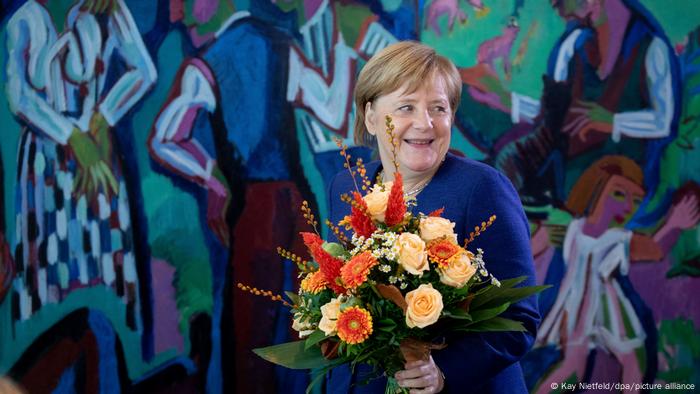
© Friedemann Vogel/EPA-EFE/ddp images/Sipa USA German Chancellor Angela Merkel makes a speech at the Defence Ministry during the Grand Tattoo (Grosser Zapfenstreich), a ceremonial send-off for her in Berlin on December 2, 2021.
 EPA-EFE/FRIEDEMANN VOGEL/POOL (Photo by ddp images/Sipa USA)

During the "Großer Zapfenstreich," or the Grand Tattoo ceremony -- which was pared back due to the Covid-19 pandemic -- members of the armed forces played a 1960s song that includes the words "I can't acquiesce, can't make do, I still want to win," and the song "You Forgot The Color Film," which was first performed by East German punk artist Nina Hagen, Reuters reported.

Merkel is due to officially step down next week after 16 years in office. She will be succeeded by Social Democrat Olaf Scholz, who is expected to be sworn in as chancellor after lawmakers give him the final green light.

In a heartfelt speech at the ceremony in Berlin, Merkel said that her time in power had "challenged" her both politically and personally.

"But at the same time, it was a deeply satisfying position," she said.

She also thanked frontline workers for their efforts throughout the Covid-19 pandemic, and applauded the country's ability to engage in constructive pro-democratic discourse throughout the last two years.

''Our democracy lives from the capacity to engage critically with the ideas and to correct its path and it lives from balancing out the respect that we have for one another and for the interest we have for one another -- based on solidarity, and trust -- and also trusting in facts and trusting that wherever scientific understanding is denied and conspiracy theories are pursued and incitement to hatred is pursued. ''

Merkel also said that the pandemic has demonstrated "just how important trust in politicians, in science and in public discourse and society is. But also just how fragile those things can be."

She concluded her speech saying that it was now down to the next government ''to find answers that challenge us," and wished her successor the very best in leading Germany into the future.

Merkel, 67, grew up under Communism in East Germany, and trained as a scientist, earning a doctorate in quantum chemistry before making a move into politics following the fall of the Berlin Wall. She won a seat in the Bundestag, Germany's parliament, in the first election after reunification.

She has navigated Germany and Europe through multiple crises over her tenure and has been hailed as a champion of liberal values and a stalwart of democratic values by supporters.

But while Merkel is seen as a bold and accomplished crisis manager, critics say she risked alienating the conservative voter base of her own party, the CDU, by taking left-of-center positions on key topics including nuclear energy, foreign policy and immigration.


570-million-year-old fossils discovered in St. John's. 

Think you can find more?

Johnson Geo Centre launches fossil-finding contest

Nfld. & Labrador·Video
CBC News · Posted: Dec 01, 2021 


Are you a fossil finder?

Ancient fossilized organisms were discovered in the boulders around Quidi Vidi lake two weeks ago. Scientists are asking the public to help them find more. 2:10

The boulders lining Quidi Vidi Lake in St. John's showcase some of the oldest signs of life anywhere in the world, according to Memorial University earth sciences professor Duncan McIlroy.

The armour stone rocks are roughly 570 million years old, he said, and there are only about a dozen places on the planet where you can see fossils in rocks of that age.

McIlroy discovered fossils at Quidi Vidi Lake two weeks ago, and the Johnson Geo Centre is running a contest, hoping people will walk the lake on the lookout for more fossils before the snow falls.

See some of the fossils and learn more about the prehistoric discovery — and the ongoing contest — in the video .