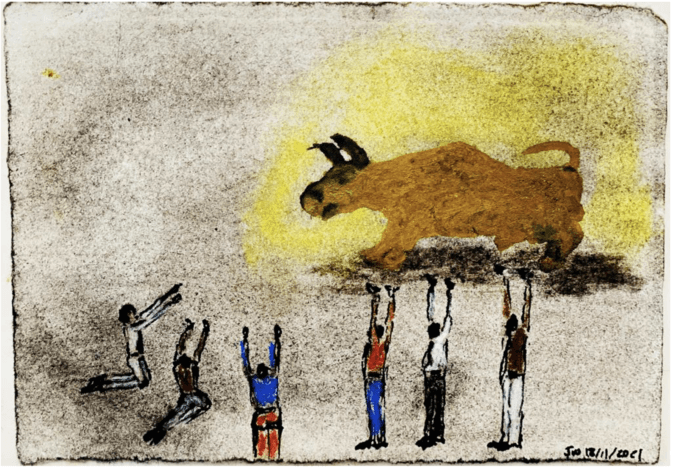
Painting by Jean Wyllys, January 2024.
Take photos of a gold Lamborghini, or of a golden cupcake (which, if eaten near Blenheim Palace, could be pooed into Maurizio Cattelan’s solid gold toilet called “America” … before it was stolen, that is), or that photo of the gilded horror called home by Donald Trump (for whom even normal urine has to be a golden shower), complete with besuited child sadly perched on a lion, and it’s not difficult to conclude that there’s something wrong about gold. Norman O. Brown got close to it in Life Against Death: “[…] practically never found in natural conditions […] gleaming gold takes away from the scene, the life and the body their substantial being”.
Now take a photo of an Amazon gold mining site, reduced to dead and deadly red clay and slurry. A gorgeous rainforest, throbbing with life and nature’s music, home to thousands of species including humans, Midas-touched to deadness. The lesson learned by the foolish, greedy king of Phrygia, when his golden touch led to his own threatened starvation because he couldn’t eat gold, and the death of living things, including his beloved daughter, seems to have been lost. Marx wrote in Das Kapital, “Gold and silver thus become of themselves social expressions for superfluity of wealth”. It’s a statement that needs unpacking to reveal the crimes, awfulness, and madness contained in these “social expressions for superfluity of wealth”.
The gold trade isn’t only about murder, mercury poisoning, displacement of Indigenous peoples, and destruction of the environment, but also the utter folly of societies and individuals that value gold so highly that they commit heinous crimes and knowingly harm the planet to get some. These are social expressions of the malignant disease of gold idolatry. For Brown, the “salient characteristic” of gold is its “absolute uselessness for all practical purposes”. It’s an “imaginary value” in “vague talk about ‘economic necessity.’” The basic necessity is food. Yet, “it is inherent in the money complex to attribute to what is not food the virtue that belongs to food. In Freud’s succinct formula, excrement becomes aliment”.
In Das Kapital, Volume III, Marx speaks of gold fetishism. “This social existence assumes the aspect of a world beyond, of a thing, matter, commodity, by the side of and outside of the real elements of social wealth”. It’s a false thing of false value that kills the real elements of social wealth. Brown’s useless surplus becomes a commodity that’s so highly valued that, thanks to the climate catastrophe it has helped to create, it destroys the conditions for the production of the necessary real food in real societies. The result: 828 million people go hungry every day, 40% of them at acute levels; 2.3 billion don’t have adequate access to food; 9 million people, many of them children, die of hunger-related causes every year (more than 1,000 per hour); 149 million children under the age of 5 are stunted.
For the Yanomami of the mountains and rainforests of northern Brazil and southern Venezuela, gold isn’t just useless. It’s lethal. Now numbering about 35,000 living in an area covering 9.6 million hectares in Brazil and speaking six distinct languages and sixteen dialects, the Yanomami had little contact with outsiders until the twentieth century. In Brazil, the first direct encounters were from 1910 to 1940, with balata gum and piassava palm extractors, hunters, border soldiers of the Frontiers Commission, the Indian Protection [sic] Service (SPI) workers, and a few foreign travelers. After this, they increased with permanent contact when the government sent teams to mark out the border, soon followed by more SPI workers, the Border Commission (1959), New Tribes Mission (1967), other missions, and the Perimetral Norte road in the states of Roraima and Amazonas (1973-1974). Then, in the late 1970s and 1980s, came state projects involving more roads, settler projects, farmsteads, sawmills, prospectors and, consequently, wholesale epidemiological shock with many Yanomami deaths, general deterioration in health conditions, and serious damage to their social expressions. In the 1970s, infectious diseases killed more than half the population.
Soil fertility is poor but a 1975 survey found that the subsoil is rich in minerals. By 1980, gold was discovered. The road allowed invasion and deforestation of Yanomami land, especially when wildcat gold miners (garimpeiros), some 50,000 of them, had arrived by 1989. The Yanomami were murdered, their villages destroyed and, in just seven years, 20% of the people died of disease, including tuberculosis (in epidemic proportions by the 1980s), and rampant malaria (thanks to miners’ stagnant ponds that were greatly appreciated by mosquitos). Although the miners were expelled in 1992 and Yanomami land in Brazil was demarcated as their territory, the garimpeiros have now returned. The nature of gold mining damage was more widely recognized after the Haximu massacre of 1993 when sixteen people, mainly women and older adults, and a baby were murdered, shot and killed by machete blows. In a rare court ruling, this attack was described as genocide.
The Yanomami, whose name comes from yanõmami thëpë (human beings), are being exterminated by other human beings because of something lying in the mud of their land, a metal, an inert thing they have no use for as their land is a living thing, made up of living beings. They build circular communal houses, each family group with its own hearth, around a shared central space, and home to as many as 400 people. Equality is a core principle of their social expression. They are hunter-gatherers and shifting cultivators and only need to work fewer than four hours a day to satisfy basic needs. They have time for social life and decision-making by consensus in which everyone can speak. It’s a society which, until the 1900s, was defined by an absence of external force, a subsistence economy that respects nature which, as Pierre Clastres observes, means “refusal of a useless excess, the determination to make productive activity agree with the satisfaction of needs”. If a surplus of, for example, cultivated plants is produced, it’s consumed for political and social purposes.
When the first garimpeiros came to Yanomami territory, the people didn’t have a word for “miners”. Their first impression expresses a tremendous clash of values in which power, the power of death, was all on one side. At first they called them peccaries because they came in packs and grubbed in the soil. But they soon realized their error: “peccaries are animals, and they don’t leave marks like that. They don’t provoke anger.” Peccaries don’t bring violence, disease, prostitution, and alcohol. Bolsonaro championed the garimpeiro as a plucky frontier man (like his own garimpeiro father was supposed to have been) but also inoffensively poor, just grubbing around for something shiny and hoping for a better future. Big lies are often built on a grain of truth. With higher poverty rates in states of the north and northeast, some unemployed inhabitants feel they have no choice but to mine, and many people from Maranhão, Brazil’s most impoverished state, are attracted by the promise of minerals in the northwest. But the other part of the story, involving the rich and powerful who manage funds, politicians, police, planes, and heavy equipment (like backhoe shovels, jet nozzles, dredges, and fuel) as well as these armies of the poor, tends to be ignored.
A survey conducted by the Brazilian thinktank, Igarapé Institute shows that, between 2016 and 2021, mostly covered by Bolsonaro’s mandate, there was an exponential rise in five major environmental crimes: illegal deforestation, land grabbing, illegal logging, environmentally damaging farming, and illegal mining (89%). The impact is devastating; loss of vegetation; changes in the river courses; huge holes dug (“like flesh-eating wounds, and the hole keeps getting bigger”, as shaman Davi Kopenawa Yanomami describes it); large mammals dying or fleeing the region; land grabbing in areas of shifting cultivation and collecting seasonal; food becoming scarce; rivers contaminated with mercury; and fish, tortoises, alligators, and many other riverine animals poisoned. Food insecurity sets in.
The invasion of miners brings other grief for Yanomami social expressions. Apart from land grabbing, murder, sexual and other violence, alcohol, drugs, and prostitution, they introduce sexually transmitted diseases, infectious respiratory illnesses like influenza, pneumonia, tuberculosis, and COVID-19, and processed foods laden with sugar, fat, and sodium, causing in malnourished communities, diabetes, hypertension, as well as destroying the foundation of Yanomami social life built around the basic necessity of food. During the COVID-19 pandemic, the situation was “out of control” and government policy towards these people who were inconveniently living atop gold-ridden mud was to conceal, in a “deliberate policy of under-reporting of cases and, above all, of the deaths caused by the disease [with figures] … almost 20% lower in the case of confirmed patients and 60% lower in the case of recorded deaths.” Not only were deaths denied, but eternal mourning was inflicted on the Yanomami because they weren’t allowed to bury their dead. “Disposing of a dead body without traditional funeral rituals is, for the Yanomami … an inhumane and therefore infamous act.” Another mechanism of wholesale social destruction.
Mercury contamination is one of the basic causes of the Yanomami health crisis, and it isn’t one that can be easily cured. Mercury persists in soil for centuries. If forests are clear-cut or burned, stored mercury can be released into nearby rivers and lakes. In river dredging, miners dig up sediment containing small pieces of gold. These are separated out by mixing then with liquid mercury, which coats the gold. The mercury is then burnt off, emitting large amounts into the atmosphere. Artisanal gold mining accounts for more than 35% of all mercury emissions caused by humans. Fumes are inhaled, absorbed into the bloodstream, and damage lungs, brain, kidneys, and endocrine glands.
The effects keep spreading. Once in the atmosphere, mercury can dissolve in rainwater, fall on the forest floor, and coat or filter into leaves, later to be absorbed into the ground when they fall. It’s then metabolized by microbes into a methylated form that can enter the food chain. Everything is contaminated, from rodents, bats, and ocelots, to titi monkeys. Songbirds eating soil-contaminated fruit and insects near mining sites have up to twelve times higher mercury concentrations in their bodies than others further away. For birds, this means lower reproductive rates, impaired development, behavioral changes, and high death rates. One gram of mercury is enough to contaminate an eight-hectare lake.
From the faraway end of the chain, the human damage wrought by a mercury-born gold Lamborghini is great. Methylmercury in the central nervous system can cause “irreversible sensory, motor, and cognitive alterations”, with symptoms like “hypoesthesia, tremors, abnormal gait, weakness, dizziness, seizures, vision and hearing deficits, headache, tinnitus, metallic taste in the mouth, sleep disorders, anxiety, depression, tachycardia, and hypertension”. It can cause fetal death in pregnant women. Babies surviving the contaminated pregnancy can be born with cerebral palsy and other deformities, and show delays in sitting up, crawling, first steps, first words. Then come social difficulties with other children and learning problems, all of which make adulthood difficult for the individual and further damage traditional social expressions. A study published in May 2019 describes the nutritional deficits of Yanomami children as “the most severe ever reported among Indigenous children on the American continent … The prevalence of stunting, underweight and wasting that we report have no precedents in the specialized literature”. Since the Amazon is one of Earth’s vital organs, illegal gold mining on Yanomami land is not just a local matter. The mercury dumped in rivers contaminates fish that are sold in city market, including the state capital Boa Vista and as far afield as Peru, Bolivia, and in Venezuela.”
Speaking about why gold is so valuable, the Bloomberg journalist, Joe Weisenthal, gives a fairly standard Western appreciation. Gold’s hard to get (and keep). You need “to be good at warfare”, to “marshal an extensive human workforce to mine it”, manage global supply and logistics, “command guards who will watch your gold and not steal it”, and know how to get it out of the ground, “which is expensive and cumbersome”. He concludes, “Gold, then, is a very specific proof of work. If you can get gold, you’ve proven that you have the ability to run a state or some state-like entity.” Which tells us quite a bit about state leaders. Most texts about gold, ignoring the social and environmental effects of gold mining, also overlook its powerful criminal appeal as a symbol of power and royalty, a coveted, even worshipped material, its potential as a means of exchange in case of currency collapse, an “asset” that keeps its value, its malleability (ease of disguising), durability, rareness, all of which keeps its prices high. Central banks around the world go along with this and hold about 35,000 tons (worth about $US67 million per metric ton) or 20% of the total amount ever mined. The United States holds a reserve of more than 8,000 metric tons.
Weisenthal’s gold-getting advice portrays the big-time criminal as well as the state leader. Organized crime is a main ingredient in the social expression of gold mining, quite apart from the illegal nature of the mining itself. Brazilian criminal organizations sell “fresh” gold in neighboring countries or specialist shops in Boa Vista, but if it is to be magicked into a “legal” commodity, it must be moved to cities because the Central Bank supposedly regulates who can buy mined gold by means of eight official companies running more than 90 buying stations (DTVMs) in seven states but, interestingly, not in Roraima. The 2013 law on purchase, sale, and transport of gold in Brazil exempts buyers from responsibility by counting on sellers’ “good faith”, thus making it easy to launder the gold. Hence, one of the world’s ritzy jewelry chains, HStern, a big buyer of gold mined on Yanomami land, can stay squeaky clean. With 159 stores in Latin America, United States, Europe, and Asia, its pieces are given an extra celebrity gleam by the likes of Angelina Jolie, Beyoncé, Eva Longoria, Rihanna, Angelina Jolie, Cate Blanchett, Sharon Stone, and Catherine Zeta-Jones. This isn’t to say that people shouldn’t wear or enjoy gold items but to draw attention to the social expressions of gold and, in particular, its excessive use as “superfluity of wealth” and power, the ugliness of which defiles any beauty it might have. There’s plenty of gold already mined and in circulation, as well as the thousands of tons of hoarded gold. The problem, as always, is the concentration of assets, which leads the rich to actively promote or turn a blind eye to the dreadful results of gold mining today.
Between 2015 and 2020, Brazil traded 229 tons of illegal gold (about $15,343 billion), more than half from the Amazon. Four main companies, all based in São Paolo, buy illegal gold from the Amazon: F.D’Gold, OM (Ourominas), Parmetal, and Carol. Gold trading is, of course, a highly concentrated and therefore “confidential” business. But to give a taste of connections and how it works, the head of F.D’Gold, Dirceu Frederico Sobrinho, offers an illustrative case. Once a wildcat miner and now “King of Gold” who was close to senior officials of the Bolsonaro government (but arrested in September 2022), he has connections throughout the gold chain, including extraction and refining companies, air transport, a holding company, intermediation and participation companies, as well as 32 unregistered mining operations in Pará, and 137 registered with requests for operations in Itaituba and Jacareacanga. He was president of ANORO (National Gold Association), which includes the big player BP Trading. Demand comes from international buyers placing orders with trading companies. These exporters turn to DTVMs, which buy the metal from miners. The Brazil operation is financed by Banco Paulista (BP). And Banco Paulista is now being investigated for laundering money for the construction company Odebrecht (known for one of the biggest corruption cases in Latin American history) but, naturally, for such is the way of things, its senior employees were recycled to work at BP Trading.
BP Trading, on the ANORO board and co-founded in 2015 by Álvaro Augusto Vidigal (whose family created Banco Paulista), and Tarcísio Rodrigues Joaquim, the bank’s foreign exchange director, both presently accused of organized crime, money laundering and active corruption, grew fast in the Bolsonaro years and doubled its revenue in 2019. Its main suppliers are F.D’Gold and Carol DTVM which, with Ourominas, account for 70% of the illegal or potentially illegal product. If BP Trading is the main exporter of gold from wildcat mines, it’s not the biggest exporter overall. The whoppers are AngloGold Ashanti (named the world’s “most evil” company for its human rights abuses and environmental devastation) and Kinross Gold (another human rights abuser and destroyer of environments), which operate throughout the chain from extraction to export (and to extinction).
Then there’s the gold and drugs nexus, which can be personified by Heverton Soares Oliveira, aka “Grota”, a Pará investor in farms, cattle, and mining. But it turns out that he and his business partner controlled dozens of aircraft and clandestine airstrips used to transport gold and cocaine, thus revealing the connections between drug traffickers, wildcat miners, police, and businessmen, all of them involved in the narcogarimpos, a model used by Amazon drug cartels to launder money through the gold trade with all its with inspection lacunae, official contacts, and opportunities for criminal practices. Police inquiries into Grota’s activity, starting in 2020, unearthed suspicious assets worth more than $5.5 million and 236 aircraft. Laundered drug money moved through aliases and shell companies buying and selling farms, cattle, mines, and machinery. One of Grota’s close associates is lawyer Helenice Carvalho who’s married to the superintendent of Civil Police in Itaituba, which was handy when Grota needed to escape arrest. Owing to a legal technicality (or maneuvering) Grota escaped prosecution and returned to Itaituba as a cattle rancher. Repórter Brasil found that at least 2,000 head of cattle passed through his farm between 2020 and 2022. Cattle, environmentally disastrous in these lands, are also four-legged drug money launderers.
Brazil’s gold production increased more than fivefold between 2015 and 2020 and exports of gold ore extracted in the Amazon almost doubled between 2017 and 2022, coinciding with the mandate of Jair Bolsonaro. After campaign promises to simplify procedures and allow mining in protected areas, once in power he swiftly cut funding and curtailed powers of federal agencies responsible for environmental protection and Indigenous affairs. The Yanomami reserve was soon invaded by some 20,000 miners. In 2022, Bolsonaro issued a decree promoting “artisanal gold mining” while ordering the National Mining Agency to simplify the licensing process. He used unconstitutional maneuvers, challenged laws, encouraged the spread of fake news, and blatantly urged acts of plunder and violence in defiance of Supreme Court decisions protecting the Yanomami. Indeed, the official discourse was open about eliminating any ethnic groups that obstructed “development”.
A year into Luiz Inácio Lula da Silva’s third presidential term, wildcat miners, although fewer of them, are still in Yanomami territory, often mining under cover of night. In the first three months, 61 Yanomami, many of them young, died as a result of preventable diseases like malnutrition and malaria. On December 14, Brazil’s Congress, dominated by powerful agribusiness and mining interests, pushed through a new law with anti-Indigenous measures, annulling land rights and opening traditional territories to mining and agribusiness, as well as embracing the notorious Marco Temporal (Time Frame) which means that, unless Indigenous populations can prove that they physically occupied demarcated land before 5 October 1988, when the Federal Constitution was promulgated, their rights will be nullified.
This is also a story about peccaries which, for the Wari’ people, are ancestral spirits. For the Juruna, they are transformed hunters and, through shamans, connections with the cosmos, quite apart from their scientifically provenrole as custodians of the rainforest where they contribute to biomass and seedling density by consuming and excreting seeds and moving the soil with their sharp hooves. The garimpeiros, far from being the benevolent creatures of Indigenous cosmologies they were first mistaken for, are grubbers of gold that feed idolatry, bring about ecocide that severs Indigenous people’s deep connections with the local world and universe, and could end up causing the death of everything. Paulo Cesar Basta reiterates what climate scientists have long been warning. “[A] consensus has been reached: preserving the Amazon is the only chance for human beings to survive on the planet and a unique opportunity for Brazil to reduce historic inequities and earn international respect and credibility”.
Lula accused Bolsonaro of genocide against the Yanomami. Seeing shocking photos of emaciated Yanomami children and adults, he told reporters, “The photos really shook me because it’s impossible to understand how a country like Brazil neglects our Indigenous citizens to such an extent”. But it’s his duty to understand and follow the money is a good start. He then pledged, “There will be no more genocides”. If he is to keep this promise and “earn international respect”, Lula must understand what the genocide of the Yanomami really means, and see that it’s ecocide, a whole criminal system from top to bottom of Brazil’s social expression. It’s not just about expelling garimpeiros. It means taking on a reality, a rotten system that is the social expression of wealth, power, corruption, murder, violence, drugs, criminal gangs, destruction, poison, and pollution, all emanating from the worship of a postmodern golden calf or solid gold Lamborghini.