Thursday, February 01, 2024

The Crisis in the Teamsters

 
 FEBRUARY 1, 2024
Facebook

Last summer, the Teamsters were riding a wave of goodwill and favorable publicity. The union’s year-long contract campaign at UPS raised expectations for a potential transformative national strike at the country’s largest private-sector employer. Much of the US Left, especially the Democratic Socialists of America (DSA), encouraged dozens of their members to get jobs at UPS, while over one hundred of their branches pledged support for their Strike Ready campaign. However ill-defined, the DSA and many other socialist activists expected to play an important role in the coming battle as the National UPS-Teamsters national contract expiration date loomed on July 31st.

Expectations collapsed quickly with a last minute deal was cut between Teamsters General President Sean O’Brien and UPS negotiators, that while notable for some important wage gains, struck many people as underwhelming. Many of the younger radicals that got jobs on some of the most socially isolating shifts at Big Brown, were left confused and in some cases very demoralized by their experience, while vote no campaign failed to catch any traction. The Teamsters contract campaign, while notable for its bloviating, looked hollow compared with the UAW “Stand Up Strikes” against the former Big Three automakers that soon followed the deal cut between UPS and the Teamsters.

Sean O’Brien’s courting of the far right, including meetings with Ohio J.D. Vance and Missouri’s Josh Hawley, and a private dinner with former President Donald Trump at his seaside Mar-a-Lago estate, has not been addressed publicly by those in the U.S. Left, who spent the last several years promoting him. Led by the Teamsters for a Democratic (TDU), the longstanding reform group, that bears the bulk of the responsibility for cleaning up O’Brien’s previous image as a thug, and presenting him to the wider world as a militant labor leader, with the broad left media, including Labor Notes, Jacobin, and In These Times.

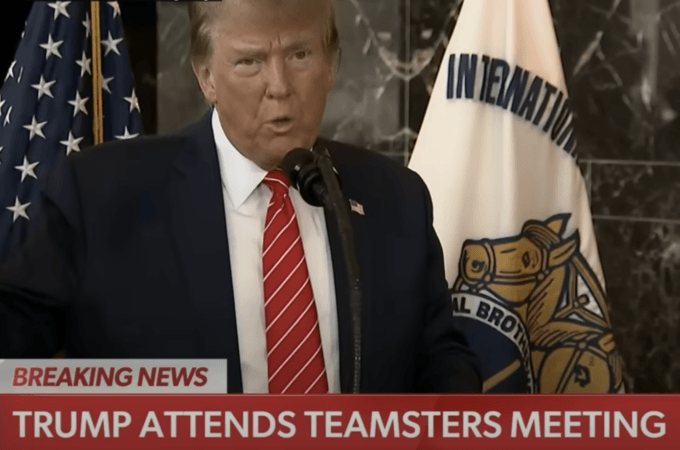
A few liberal media sites led by the Guardian and the Washington Post have made the effort to publicize O’Brien dalliance with the far right, and seek out opposition among the Teamster membership, led by John Palmer. Palmer, an International Vice-President from Texas, is the sole member of the union’s General Executive Board who publicly broke with O’Brien over meeting Trump privately, and then with O’Brien’s demand that the entire GEB meet with Trump. Palmer and possibly one other GEB member voted against O’Brien’s proposal to donate $42,000 to the RNC shortly after his meeting with Trump.

This emerging crisis in the Teamsters became visible to the whole world on Wednesday, January 31st, when the Guardian revealed that a racial discrimination lawsuit by former Teamsters International Organizers was recently settled by the union. Meanwhile, on the same day the Teamsters leadership met with Trump and allowed to hold a press conference in the Teamsters International headquarters afterward. I can’t say I’m surprised by either development given the long history of racism in O’Brien’s home Local 25 in Boston, especially the notorious Top Chef incident, or month’s long, open courting of the far right.

None of this bodes well for the future of TDU. It was upheld for decades as the model for rank and file reformers to emulate through the U.S. trade union movement. What does it exist for any longer? TDU even tabled at its November convention a motion for a ceasefire in Gaza put forward by members of Teamsters Mobilize (TM), a much smaller network of Teamsters activists. One member of TM was banned from the TDU convention for criticizing it. TM has done more to campaign for $25 an hour start pay for part-timers and Palestine than TDU.

The crisis in the Teamster leadership threatens to overwhelm recent strike victory strikes at DHL and US Foods, as well as a local organizing campaign in Virginia at Costco. Future projects like organizing Amazon have already stagnated. The dalliance with Trump and other far right notables along with the revelation of the racial discrimination lawsuit will not be easily swept under the rug, and maybe the beginning of prolonged political battle in the Teamsters.

Silence Is Dangerous in the Current Age of Rising Fascism in the US

Social movements are creating powerful new languages for confronting tyranny. We must resist the plague of silence.


This week’s revelation that Donald Trump is already plotting new ways to try to put himself permanently above the law is just the latest reminder of the looming threat of lawless and emboldened right-wing forces in the United States. Trump’s new scheme to expand a Nixon-era policy memo to prohibit the Justice Department from prosecuting presidents, even after they leave office, is just a tiny hint of the greater threat. In recent months, several scholars have sounded the alarm that the United States is “sleepwalking towards authoritarianism.” The concern is not unfounded given that in his run for the presidency in 2024, Trump has boldly telegraphed his aspirations to impose an authoritarian future on the United States. He has repeatedly injected authoritarian language, extremist ideas and threats of violence into the mainstream. Moreover, he has done so to “create a climate of trepidation and powerlessness that discourages mobilization by the opposition,” in the words of scholar Ruth Ben-Ghiat. Forecasting his authoritarian intentions, Trump has openly stated that he intends to terminate portions of the U.S. Constitution, calls his political enemies “vermin” and boldly proclaims he will make himself a dictator “on day one.” On Truth Social, he claimed without irony that a president should have blanket authority and total immunity “even for events that ‘cross the line.’” He has repeatedly stated that if he regains the White House, “it will be a time for retribution” and revenge.

Taking pages from Hitler’s speeches, Trump has also said that the biggest threat to the United States “is from within.” In this instance, he reproduces a version of McCarthyite slander with his claim that the country is being overrun by “communists, Marxists, fascists and the radical left thugs that live like vermin within the confines of our country, that lie and steal and cheat on elections, and need to be rooted out.” His constant attacks on what he labels as the “enemy within” are meant to incite his MAGA followers to wage violence against people of color, critics, progressives, LGBTQ+ Americans, news networks, immigrants, feminists, and any other group that does not buy into Christian nationalist, white supremacist views.

Trump’s discourse overflows with the genocidal language used in the Third Reich. The historian Heather Cox Richardson rightly notes that Trump’s “use of language referring to enemies as bugs or rodents has a long history in genocide because it dehumanizes opponents, making it easier to kill them. In the U.S., this concept is most associated with Hitler and the Nazis, who often spoke of Jews as ‘vermin’ and vowed to exterminate them.”

Trump has claimed that immigrants “are poisoning the blood of our country” and polluting his notion of white Christian culture, and he’s indicated that, if reelected, he plans to make them undergo “ideological screening” in order to enter the country legally (assuming here that he wants to make sure they would not vote for the Democratic Party). If his vision were carried out, millions of undocumented immigrants would be barred from the country while others would be rounded up, put into what amount to Gulag camps, and subjected to unimaginably harsh policies. Given Trump’s calls to shoot shoplifters, impose death penalties on drug dealers, and his suggestion that his former chair of the Joint Chiefs of Staff, Mark Milley, “deserves to be executed,” there is no reason to doubt Trump’s authoritarian designs.

On the campaign trail, Trump repeatedly echoes the language of autocrats such as Hungarian Prime Minister Viktor Orbán, who embraces the concept of “illiberal democracy,” and claims, as The Guardian points out, that the biggest threat to Hungary and other nations is “the ‘mixing’ of European and non-European races.” Trump and the GOP, like many of the authoritarian politicians they admire, believe that equality is a weakness endemic to democracy and destroys society. Trump’s contempt for the law and desire for absolute power is not only evident in his remarks about wanting to be a dictator; it was also on full display when his legal team argued before a D.C. Circuit Court that unless Trump is impeached, he could not be held responsible for “selling pardons, military secrets, or simply having people assassinated.” As Thom Hartmann put it, “Trump’s lawyer argued before the DC Appeals Court that if Trump became president again, he could order SEAL Team Six to assassinate Joe Biden or Liz Cheney and nobody could do anything about it.” While Trump’s lawlessness is central to his grab for unchecked power, there are also displays of the delusions and aspirations of a Nazi-infested politics.

RELATED STORY

MLK Was a Philosopher of Hope. He Reminds Us That Apathy Is a Dead End.
On MLK Day, the U.S. should painfully interrogate its monumental failure to address systemic injustice.
By George Yancy , TRUTHOUT   January 15, 2024


What is especially disturbing about the emerging fascism in the United States is the lack of general public outrage that accompanies it. Such silence extends from almost the entirety of the Republican Party, the mainstream media, 84 percent of white Evangelicals, and a number of the wealthiest American billionaires and corporate tycoons. While the Democratic Party, including President Joe Biden, have called out Trump as a fascist, they have been silent about their support for decades of neoliberal economic policies, the ravages of deindustrialization, a staggering rise in economic inequality and cuts to social programs. Such policies have produced the conditions that have accelerated the rise of authoritarianism in the United States. Wedded to the interests of the banks, corporate ideology and the financial elite, their silence should come as no surprise. At the same time, such policies have produced enormous economic hardships and a diminished sense of agency that creates an enforced silence among the most impoverished populations and often results in their inevitable retreat from politics, especially in relation to voting in national elections.

In the current historical moment, language has increasingly forfeited its obligation to a politics of truth, justice, equality and freedom, and in doing so has turned cannibalistic and cruel. As political horizons and public life wither under the assault of an emerging fascism and a mainstream media that refuse to confront it, language appears to fail in the presence of what Zygmunt Bauman called “the emergence of modern barbarity.” A continuing series of crises — political, cultural, economic and ecological — are translated into emotional plagues of fear, lies and violence produced by right-wing spectacles that have undermined the ability of the U.S. public to address critically the endless attacks by tyrannical forces on democratic ideas, values and institutions. Matters of historical context, interconnections, informed judgment and critical analysis that refuse to divorce themselves, in the words of Winifred Woodhull, “from social institutions and material relations of power and domination” are either ignored or disappear from public view. Language in the age of gangster capitalism and fascist politics is under siege, functioning less as a vehicle of audacious truth and moral witnessing than as a tool to purge democracy of its ideals. In the face of a politics of enforced silence, the United States is experiencing an era marked by what Brad Evans calls “a closing of the political,” grounded in the assumption that “nothing can be done.”

The poisonous shadow of authoritarianism has entered the public imagination in spectacular fashion as a normalized political discourse. A boisterous creed of “annihilating nihilism” marked by a politics of vacuousness, resentment, historical amnesia, self-interest and freedom from responsibility has become a dominating force in U.S. politics. A right-wing vocabulary of hatred, bigotry, lies and conspiracy theories has produced a brutalizing politics whose rhetoric and polices echo a dark and horrifying period of history unlike anything we have seen since the 1930s in Europe. The mobilizing passions of fascism are now being produced, circulated and legitimated though all aspects of the mass media, which are increasingly under the control of a billionaire class. How else to explain not only Trump’s public courting of white supremacists and antisemites, such as Nick Fuentes and Kanye West, but also Nikki Haley’s claim that slavery was not the cause of the Civil War? Such comments reveal the GOP’s fascist tendency not only to whitewash and seek to erase the relevance of the history of racism, but also to endorse the poisonous ideologies of white nationalism and white supremacy. As Czech dissident Václav Havel once remarked, “the disorder of real history is replaced by the orderliness of pseudo-history.… Instead of events, we are offered non-events.”


Diverse social movements … produced a language that allows us to recognize ourselves as agents, not victims.

Extremist language that was once considered unimaginable and relegated to fringe groups has been elevated to the center of power, politics and everyday life. For instance, billionaire Elon Musk’s recent racist comments echo the racial eugenicist movements in the U.S. in the 19th and 20th centuries, from which Hitler took inspiration. Yet, little is said in the mainstream press connecting Musk’s comments to a shameful past that gave us the Tuskegee experiments and provided a rationale for Jim Crow and racial segregation laws. Enforced silence is a tool for the repression of history and the wiping out of historical consciousness and memory, especially those moments in history we associate with segregation, exploitation, disposability and genocide. Fascist discourse is currently abetted and affirmed by ongoing public displays of the detritus of fascist politics, which makes visible that which the United States has forgotten and of which it should be ashamed — that is, a society in which collective morality and the ethical imagination appear to no longer matter.

Beyond bold and unapologetic public displays of fascist rhetoric, beliefs and policies, there are relentless right-wing assaults against democracy that are barely recognized in the media and in public discourse for the danger they pose to democracy. A short list includes book censorship, turning libraries into student detention centers, voter suppression laws, threatening election workers, assaulting reproductive rights, enacting cruel policies against queer and trans people and harassing critical educators. In addition, schools are turned into indoctrination centers, torrents of propaganda replace facts, history is whitewashed, dissent is suppressed and those who provide medical care to trans people and people in need of abortions are criminalized.

These authoritarian aggressions have become embedded in United States culture to the degree that they fail to garner any alarm or concern from the wider public. As fascist beliefs, values and language multiply, so do attacks by far right politicians, reactionary pundits and white supremacists against diversity, equality and inclusion, all the while promoting a white nationalist notion of who counts as a citizen. As Toni Morrison once noted, this is a language constrained by the “weary and wearying vocabulary of racial domination.” It is “a dead language” trapped in sordid silence regarding the racist ideology that drives its claims to “exclusivity and dominance.”

A dangerous silence now often accompanies a language at war with democratic ideals and the public imagination. This is an enforced silence among the larger public that purposely mutes matters of critical agency, moral responsibility, reason, justice and the demands of keeping alive a substantive democracy. It is a language where moral outrage disappears, is silenced or both, while concealing the danger that this fascist language portends. This is a depoliticizing silence that clouds lies and untruths in mindless theater, spectacles and a flood of evasions. Under such circumstances, community is emptied of any substance, reduced to notions of the social organized around the merging of lies and violence. The loneliness and social atomization produced under neoliberalism provide fodder for the dictatorial energies that offer forms of the false promise of community rooted in hate, bigotry and lies, often resulting in habitual ignorance to justice. Mainstream institutions such as schools, the media and online platforms that should trade in imaginative ideas and provide a critical culture are under siege. One consequence is the breakdown of civic culture, egalitarian values and politics itself. What many Americans fail to realize is that this reactionary mode of silence is a form of complicity that creates a political climate marked by cruelty, violence and lawlessness. How else to explain the lack of public outrage against an extremist Republican Party that rejects free summer lunch programs for food-insecure youth, weakens child labor laws and restricts voting rights?

Liberal and conservative Americans are immersed in a crisis of silence that ignores the fact that politicians such as Trump embrace totalitarian values — the language of dictators — and advocate for violence as a tool of political opportunism. This is not to suggest that all forms of silence function to erase the scourge of racism, white supremacy and the misery imposed by neoliberal capitalism.

Silence can be contemplative, offer consolation, and provide the space for close analysis, thinking critically and mobilizing modes of critical agency. However, in an era marked by a massive flight from ethical and political responsibility, a particular kind of administered silence emerges, one that subverts any sense of critical agency and abandons a more noble message regarding a warning of the dangers to come and the lessons to be addressed. Under such conditions, silence operates increasingly within oppressive relations of power. Tyrannical relations of power are now at the center of U.S. politics and radiate a contempt for dissent, integrity, compassion and liberty which, as Bauman notes in his book Babel, ejects “any sense of critical agency and [refuses] to recognize the bonds we have with others.”

In the face of injustice, silence has become ethically mute, and exhibits a dehumanizing indifference to human suffering in the midst of dangerous politics. Enforced silence, both as a subjective stance and as a political space of organized moral irresponsibility and self-deception, increasingly legitimates and helps to produce a society that has lost its moral bearings and wallows in a repudiation of civic courage and human rights. This current politics of enforced silence is happening at a time when many Americans seem oblivious to the threat posed to democracy by Trump, the GOP, far right foundations, reactionary cultural apparatuses and neoliberal educational institutions.

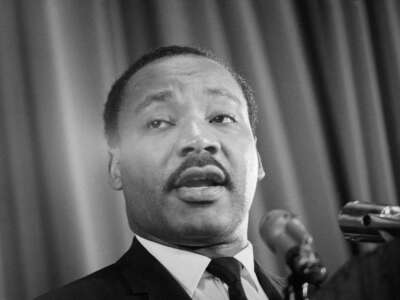
Silence today has become part of a politics of disappearance where critical ideas are buried along with dangerous memories, and the bodies of journalists, poets and those who lead the fight against oppression in its diverse modes. As Spanish painter Francisco Goya once warned of the degree to which truth and informed judgments are overcome by ignorance, superstition and falsehoods, “the sleep of reason produces monsters.” Martin Luther King Jr. gave a contemporary valence to Goya’s warning in his famous 1967 speech, “Beyond Vietnam: A Time to Break the Silence.” His words alerted Americans to the dangers of refusing to speak out in the face of militarism, racism and massive poverty. Stating that “a time comes when silence is betrayal,” King was clear regarding how the refusal to speak out eviscerates both the idea of democracy and the promise of resisting the mobilizing passions of fascism, especially militarism, poverty and racism. The challenge posed by King’s call to resist a complicitous silence in the face of injustice is exceptionally relevant today. At the heart of this challenge is the need to not only make detectable the current threats to democracy but also to understand how silence in the face of tyranny legitimates authoritarianism along with the risks it poses to any viable notion of justice, equality and freedom.

It is important to note that fascism not only arrives through the language of hate, bigotry, dehumanization and military dictatorships as it did in Chile and Argentina in the 1970s; it also arrives through the everyday acceptance of an ethically debilitating silence. In the current moment, such silence accompanies authoritarian threats to democracy. A politics of silence facilitates a tsunami of manufactured ignorance advanced by the repression of dissent, the cowardice of the mainstream media, the unaccountability of social media platforms steeped in the astonishing toxicity of hatred, and a disdain for equality, freedom and truth in a society, notes Jonathan Crary, governed by the corrupting force of the billionaire elite.

Given the current threat posed to U.S. democracy, enforced silence should be analyzed within the uniquely current threats to liberty, basic human rights and equality that sabotage any viable notion of democracy. Such a challenge is especially crucial at a time when the habits of democracy are being replaced by what David Graeber called the “habits of oligarchy, as though no other politics are possible.” The politics of silence increasingly works through multiple sites and seemingly contrasting impulses, often aligning itself with a reactionary disdain for the public good. In part, it does so by refusing to address the growing (yet to some, seemingly unrelated) issues of Trump’s full embrace of fascist politics, the growing attacks on freedom of expression and the struggle for social justice.

This is all the more reason to reclaim the language of the common good; to protect public and higher education from a fascist takeover; to reject the privatization of public goods; expand the power of unions and the rights of workers, people of color, women, immigrants, queer and trans people, and all those others considered excess and disposable. The plague of silence has to be broken so as to inject the struggle for human rights back into the language of politics, and to fight for a socialist democracy built on the anti-capitalist values of equality, social justice, liberty and human dignity. The words of Frederick Douglass are prescient here and worth remembering. He writes:


If there is no struggle, there is no progress. Those who profess to favor freedom and yet deprecate agitation are men who want crops without plowing the ground. They want rain without thunder and lightning. They want the ocean without the roar of its mighty waters.

If the plague of silence is to be overcome, Americans need to tap into a language that makes clear that they will not look away or refuse to stand up in the face of fascist aggression. The brilliant writer Maaza Mengiste argues for such a language with his call for a vocabulary that “will take us from shock and stunned silence toward a coherent, visceral speech, one as strong as the force that is charging at us.”

Fortunately, especially since the Occupy movement in 2011, a number of social movements have emerged to provide a language that both exposes and makes the ruthless power of the financial elite and other anti-democratic forces accountable through a discourse of critique and hope. The Occupy movement made the discourse of inequality and class differences a more central part of a national political narrative. In the last decade, workers have used the language of economic justice, solidarity and fair play to reenergize the labor movement. The resurgence of the labor movement provided a discourse that exposes how neoliberalism benefits the wealthy and privileged.


Silence has become the language through which people are either depoliticized or are willingly complicit with the economic and racial forces of totalitarianism.

Meanwhile movements such as the movement for Black lives have highlighted the language of structural racism along with making visible a history of slavery, racial abuse and police violence, and crafting a nuanced and multidimensional discourse of liberation.

The #MeToo movement created new discourses to make visible the pervasive extent of sexual assault, violence and harassment across a wide variety of sites and greatly advanced gender justice.

The abolitionist movement has provided a contextual and relational language highlighting the punitive nature of highly racialized criminal legal system and the carceral state while instituting a national movement to defund the police.

Trans and queer people have invigorated a movement and language that critiques the right-wing weaponization of marginalized and ostracized identities.

Climate activists have exposed the danger fossil fuels pose to the planet, and how the most vulnerable populations, especially Black and Brown communities, pay a heavy price for the abuses of the oil and gas industries. In doing so, they have inserted the language of climate justice into the public sphere and made clear how capitalism is creating a murderous future for human beings by destroying the environment.

Black and Brown theorists working with the idea of intersectionality have provided a new language highlighting how every social movement is “shaped by multiple intersecting inequalities and power dynamics,” which draw “attention to unmarked categories” of both oppression and resistance. All of these movements have imaginatively offered a new language of politics and continue to further expand and sharpen such discourses.

Equally promising is the increased political activism of young people, who are voicing a language and pedagogy of disruption, critique and possibility. As I stated more than a decade ago in Truthout, theirs is a language “that recognizes that there is no viable politics without will and awareness and that critical education motivates and provides a crucial foundation for understanding and intervening in the world.” Young people recognize that they have been written out of the script of democracy for too long and are now creating spaces and enacting a language in which to expand individual and social agency through collective forms of resistance as starting points to build a new democratic social order.

Fortified with the energy and language of these dynamic movements, it is incumbent upon the broader left and its various social movements to continue to develop a language that not only highlights social injustices but also includes a vocabulary that moves people, allows them to feel compassion for “the other” and gives them the courage to talk back. Beyond highlighting the wide range of social injustices, all of us on the left must continue to develop a vocabulary that speaks to people’s needs in a way that is moving, affirming, recognizable and enables them to confront the burden of conscience in the face of the unspeakable, and to do so with a sense of dignity, self-reflection and the courage to act individually and collectively in the service of a radical democracy.

One important contribution of these diverse social movements is that they all produced a language that allows us to recognize ourselves as agents, not victims. In doing so, they have expanded the discourse of radical democratic politics. Of course, there is more at stake here than a struggle over meaning; there is also the struggle over power, over the need to create a formative culture that will produce new modes of critical agency and contribute to a broad social movement that will translate meaning into a fierce struggle for economic, political and racial equality. While there is a new energy among youth and a number of powerful social movements, there is the ongoing challenge of confronting with renewed vigor a culture of silence and indifference that has become the most powerful educational force of the emerging fascism.

Writing about the civil rights struggles of the ‘60s, Martin Luther King Jr. was prescient in acknowledging that the tyranny and violence of authoritarianism feeds on silence, moral apathy and the collapse of conscience. Given the fierce urgency of the times, the struggle against an enforced silence is especially crucial when people refuse to speak up in the face of injustice. Silence has become the language through which people are either depoliticized or are willingly complicit with the economic and racial forces of totalitarianism. As King notes, it is the language of those “who accept evil without protesting against it.”

The new social movements in the face of an emerging fascism have done us a great theoretical and political favor in making clear that any viable mode of resistance must embrace a language that translates into power — a critical language that expands the power of education, agency and resistance. This is a language that imaginatively rethinks the forces of militarism, capitalism, racism and sexism in light of the dramatic changes taking place technologically, culturally and politically. There will be no justice or democracy in the United States unless a mass multiclass social movement emerges that combines political and individual rights with economic rights — that joins a movement for gender and racial equality with a movement for economic justice.

At the same time, many new social movements need to further a language that is not only theoretical and critical but also passionate. In many ways, they do this, but a politics of passion needs a greater place in their politics. Central to such a language is a politics of emotion that addresses what Ruth Ben-Ghiat refers to as communities of belonging. This is a language that invites joy while mobilizing emotions that embrace compassion, justice and hope. What might be called a politics of identification and emotion is particularly important at a time when many people living in a neoliberal society are atomized, feeling alienated, lonely, invisible, and subject to far right emotional appeals to forms of allegiance rooted in hatred, bigotry and a poisonous nationalism.

Anand Giridharads claims that today’s left is often too cerebral and too suspicious of what he calls empowering emotional appeals. He writes that much of the left today is “suspicious of the politics of passion” and “doesn’t do emotional appeals,” adding:


Can those who defend the rule of law and pluralism and economic justice and human rights not only articulate those ideas but also appeal to the more basic human needs to belong, to have anxieties soothed, to have fears answered, to feel hope, or just to feel something at the end of bleak and tedious days?… In an era [of anxiety and future dread] such as this, leaving the politics of emotion, of passion, to aspiring autocrats is a dangerous abdication.

It is worth emphasizing that the struggle against fascism and for a socialist democracy will not take place if education is not made central to politics. Any attempt to further the language of social, economic and racial justice will not be effective if it does not construct a language of critique, possibility and desire. We need a language that pedagogically moves people, makes power visible and creates communities of belonging, justice and compassion. We need to continue to fight aggressively the plague of silence with what Gayatri Chakravorty Spivak argues is “the power to think the absent.” It is only then that a critical public consciousness can be awakened, and a multiracial working-class movement can begin to bring into fruition a democratically socialist society.


HENRY A. GIROUX  currently holds the McMaster University Chair for Scholarship in the Public Interest in the English and Cultural Studies Department and is the Paulo Freire Distinguished Scholar in Critical Pedagogy. His most recent books include: American Nightmare: Facing the Challenge of Fascism (City Lights, 2018); The Terror of the Unforeseen (Los Angeles Review of books, 2019), On Critical Pedagogy, 2nd edition (Bloomsbury, 2020); Race, Politics, and Pandemic Pedagogy: Education in a Time of Crisis (Bloomsbury 2021); and Pedagogy of Resistance: Against Manufactured Ignorance (Bloomsbury 2022). Giroux is also a member of Truthout’s Board of Directors.
Why Are Major News Outlets Sidelining Abbott’s Border Defiance?


As the right celebrates the Texas governor’s actions and legal scholars worry about a constitutional crisis, two big papers and a major wire service have clearly underplayed the standoff’s significance.


ARI PAUL
Jan 31, 2024
FAIR

The United States is on the verge of a constitutional crisis, one that enlivens the nationalist fervor of Trump America and that centers on a violent, racist closed-border policy.

In January, the Supreme Court, with a five-vote majority that included both Republican and Democratic appointees, ruled that federal agents can “remove the razor wire that Texas state officials have set up along some sections of the U.S./Mexico border” to make immigration more dangerous (CBS, 1/23/24). The state’s extreme border policy is not merely immoral as an idea, but has proven to be deadly and torturous in practice (USA Today, 8/3/23; NBC, 1/14/24; Texas Observer, 1/17/24).

In a statement (1/22/24), Texas Attorney General Ken Paxton decried the decision, saying that it “allows Biden to continue his illegal effort to aid the foreign invasion of America.” Paxton, a Republican, vowed that the “fight is not over, and I look forward to defending our state’s sovereignty.”

For a great many people, a Southern state invoking its “sovereignty” over the federal government in defense of violent and inhumane policing of non-white people sounds eerily familiar to the foundation of the nation’s first civil war.

Texas Gov. Greg Abbott, also a Republican, “is doubling down, blocking the agents from entering the area,” the PBS “NewsHour” (1/25/24) reported. PBS quoted Abbott declaring that the state’s constitutional authority is “the supreme law of the land and supersedes any federal statutes to the contrary.”

‘Dangerous misreading’

For a great many people, a Southern state invoking its “sovereignty” over the federal government in defense of violent and inhumane policing of non-white people sounds eerily familiar to the foundation of the nation’s first civil war. And 25 other states are supporting Texas in defying the Supreme Court (USA Today, 1/26/24), although none of them are states that border Mexico.

Texas media are sounding the alarm about this conflict. The Texas Tribune (1/25/24):
From the Texas House to former President Donald Trump, Republicans across the country are rallying behind Gov. Greg Abbott’s legal standoff with the federal government at the southern border, intensifying concerns about a constitutional crisis amid an ongoing dispute with the Biden administration.

Houston public media KUHF (1/24/24) said this “could be the beginning of a constitutional crisis.” University of Texas law professor Stephen Vladeck said in an op-ed in the Houston Chronicle (1/26/24) that Abbott’s position is a “dangerous misreading” of the Constitution.

Other legal scholars are watching with concern. Erwin Chemerinsky, dean of the law school of the University of California at Berkeley, told FAIR, “I think that this is reminiscent of Southern governors disobeying the Supreme Court’s desegregation decisions.” He added, “I agree that it is a constitutional crisis in the sense that this is a challenge to a basic element of the Constitution: the supremacy of federal law over state law.”

But The New York Times has not covered the issue since the Supreme Court decision came down (1/21/24). The Associated Press (1/27/24) framed the story around Donald Trump, saying the former president “lavished praise” on the governor “for not allowing the Biden administration entry to remove razor wire in a popular corridor for migrants illegally entering the U.S.” The Washington Post (1/26/24) did show right-wing politicians and pundits were using the standoff to grandstand about a new civil war. NPR (1/22/24) covered the Supreme Court case, but has fallen behind on the aftermath.

‘MVP of border hawks’

Meanwhile, Fox News (1/25/24, 1/25/24, 1/27/24) has given Texas extensive and favorable coverage of its feud with the White House, citing its own legal sources (from America First Legal and the Edwin Meese III Center—1/25/24) saying that Texas was in the right and the high court was in the wrong.

Breitbart celebrated Abbott’s defiance as a states’ rights revolution, with a series of articles labeled “border showdown” (1/24/24, 1/24/24, 1/24/24, 1/25/24, 1/28/24) and several others about Republican governors standing with Texas in solidarity (1/26/24, 1/28/24).

The white nationalist publication American Renaissance (1/25/24) stood with Abbott but lowered the temperature, saying that it is “unclear whether this could cause a constitutional crisis, but the optics are not great for the White House in an election year.” “This will not be a ‘Civil War’ or anything close to it unless someone on the ground wildly miscalculates by firing on the Texas National Guard,” the openly racist outlet asserted. Rather, the publication saw Abbott as recentering the immigration debate as a way to weaken President Joe Biden’s reelection chances. “We couldn’t hope for a better start to the election-year campaign,” it said.

The National Review (1/28/24) admitted that Abbott is probably wrong on the constitutional question. Nevertheless, it called him the “MVP of border hawks” for orchestrating a public relations coup by forcing the federal government’s hand:
Abbott has managed to get the federal government in the position of actually removing physical barriers to illegal immigration at the border and insisting that it is imperative that it be permitted to continue doing so. This alone is a PR debacle for the administration, but it comes in a controversy—with its fraught legal and constitutional implications—that will garner massive attention out of proportion to its practical importance.

This is impressive by any measure.

The support of Republican states for Abbott elevates the matter further, but this also is a relatively small thing. The backing for Abbott is entirely rhetorical at this point and perhaps not very serious on the part of some Republican governors. It nonetheless serves to elevate a conflict over security on a small part of the border into what feels like a larger confrontation between all of Red America and the federal government.

Underplayed Significance


As noted, AP and The Washington Post haven’t completely ignored the story—although the Times, as of this writing, has more or less looked the other way. But as the right celebrates Abbott’s defiance and legal scholars worry about a constitutional crisis, the two big papers and the major wire service have clearly underplayed the standoff’s significance.

Given that former President Donald Trump is now the likely Republican presidential nominee, with his neo-fascist ideas (ABC, 12/20/23; NBC, 12/22/23) about immigration the centerpiece of his campaign, one would think centrist news outlets would give this story more attention.

Even if American Renaissance and the National Review are right that this standoff is more rhetorical than a pre-staging of the next civil war, given that nearly half the states are backing a state’s defiance of the Supreme Court in an election, the major news outlets should be a part of that conversation.

© 2023 Fairness and Accuracy In Reporting (FAIR)

ARI PAUL is a New York-based journalist who has reported for the Nation, the Guardian, the Forward, the Brooklyn Rail, Vice News, In These Times, Jacobin and many other outlets.
Full Bio >

Migrants struggle to get through razor wire erected at the U.S./Mexico border in Texas.
(Photo: Herika Martinez /AFP via Getty Images
Wall Street Strikes Again With Mass Media Layoffs

There is one real solution to creating a modicum of job stability: Taming Wall Street’s greed.


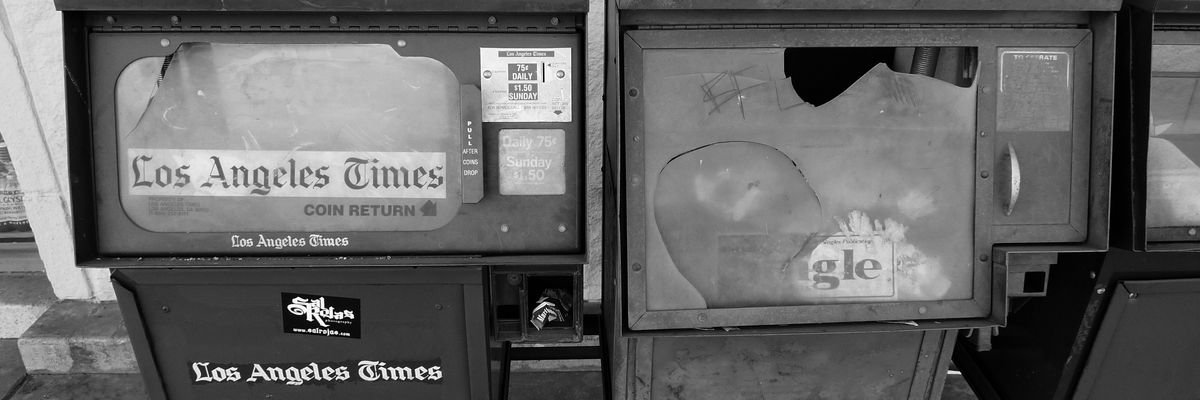
An abandoned Los Angeles Times vending machine is seen in Covina, California
(Photo: Johndhackensacker3d/CC BY-SA 3.0)


LES LEOPOLD
Jan 31, 2024
Common Dreams

Mass layoffs are ripping through the news industry. More than 20,000 media jobs were cut in 2023 with many more on the chopping block. Just this past week, the Los Angeles Times announced the layoffs of 20% of its newsroom employees.

Time Magazine said it will terminate 15% of its unionized editorial staff.

Sports Illustratedlaid off most of its staff.

Business Insider cut 8% of its staff and Forbes another 3%.

The unionized staff at Conde Nast (publisher of Vanity Fair, Vogue, GQ, Bon Appetit, Glamour, Architectural Digest, The New Yorker, and Teen Vogue) walked out to protest looming layoffs, while chanting, “Bosses wear Prada, workers get nada!”

And private equity and hedge funds like Alden Global Capital are buying up newspapers and gutting staffs, again and again.

The reason is obvious, right? Social media is eating into newspaper revenues. Advertisers have discovered that you can reach more people and sell more products by paying influencers and running ads on social media, Amazon, and Google. And many people prefer to get their news for free from their algorithm-informed social media feeds, rather than from the traditional press. At first glance it appears these mass layoffs of journalists might be nothing more than the pain and suffering that goes with technological progress, just like the obsolescence of elevator operators or turnpike toll collectors.

Well, tell that to the workers in the tech sector who create and staff the online mega-stores and build those marketing algorithms, the pride and joy of the new knowledge economy. In 2023, a year in which the U.S. had historically low unemployment, rising wages, and declining inflation, approximately 262,000 workers in the tech industry lost their jobs, and another 24,500 have joined them so far in January 2024. These mass layoffs are taking place even though these companies have been earning record profits and achieving record valuations.

It’s high time for politicians of all stripes to realize that their policy choices created this dangerous and enlarging inequality, and it should now be their duty to protect the livelihoods of the American people, not the enormous profits on Wall Street.

The research for my book, Wall Street’s War on Workers, reveals a full-scale epidemic hitting all sectors of the economy. We estimate that approximately 30 million U.S. residents have experienced mass layoffs since 1996. Add in the indirect effects on their families and communities and more than half of the U.S. workforce has felt the enormous adverse financial, health, and emotional stresses and strains caused by mass layoffs (defined as 50 or more workers laid off at one time for at least a month).

Wall Street’s Two-Pronged War


The “new high-tech economy,” it turns out, operates on a long-established Wall Street value: unabashed greed. And mass layoffs, high-tech and low, media and industrial, are caused by that greed. To enrich themselves, the leaders of Wall Street hedge funds, private equity firms, and investment banks demand that corporations go into the stock market and repurchase their own shares—stock buybacks. This causes their stock prices to immediately rise, since future earnings expectations are now spread over a smaller number of shares. Rising stock prices transfer enormous amounts of corporate wealth to the largest investors and top company officers, who are compensated with stock incentives.

To pay for these stock buybacks that exclusively benefit shareholders, publicly traded corporations cut costs, most often and effectively through mass layoffs of their employees. You’ll find this at all the big-name high-tech companies, including Google, Apple, Facebook, and Microsoft. You’ll also find it in manufacturing (Siemens), retail (Toys R Us), banking (Wells Fargo), pharmaceuticals (Roche), and services (Marriott International). Citigroup just announced the layoff of 20,000 employees. In 2023, it conducted $1.5 billion in stock buybacks.

Leveraged buyouts, which have negatively affected so many journalists, are another form of financial pillage. When private equity firms and hedge funds buy up companies the deals are financed largely with borrowed money, debt that is then put on the books of the company that was purchased. Servicing that debt becomes a major corporate expense, most often paid for by cutting costs through mass layoffs. Again, in almost all cases, there’s a connection between leveraged buyouts and mass layoffs. Just ask the former employees at Twitter, who got X-ed out because of the enormous debt load Elon Musk added after he purchased the company. The same is true for all those working for newspapers acquired in recent years by Alden Global Capital.

The Public Wants Mass Layoffs to Stop


Most policymakers in both major political parties continue to view mass layoffs as a product of the unstoppable forces of technology and globalization. That’s the story their Wall Street donors tell them. But the victims of wave after wave of mass layoffs are not buying this. Americans believe, and rightfully so, that working people should not have to be put in a position of abandoning their communities and move because of mass layoffs. They understand that policy choices inspired by greed, not unstoppable economic laws, are at play.

As recent polling reports: “Seventy percent of respondents preferred a focus on ’helping struggling areas to recover’ while only 30% chose ‘helping people move to opportunity.’ Views were broadly similar across nearly all demographic breakdowns, including class, region, gender, party, and generation.”

Overall, 62% of respondents said they were willing to pay higher prices as a result of policies that “strengthen American manufacturing by ensuring that more of the things I buy are made in America.” Perhaps they would even pay more to see their local newspapers freed from Wall Street vultures.

The real divide that is tearing us apart is between the wealthy with secure livelihoods and those who have seen their entire world turned upside down by mass layoffs.

Nevertheless, politicians and pundits alike continue to ignore mass layoffs. Instead, they attribute working class anger to what they argue is increasing polarization between the educated and uneducated (those without college degrees). Supposedly, the educated, especially in urban areas, are moving more to the Democratic Party, while the uneducated are joining the angry MAGA hordes.

As one think tank leader put it, “The fetish for manufacturing is part of the general fetish for keeping white males of low education outside the cities in the powerful positions they’re in in the U.S.” And when workers objected to the 2024 proposed purchase of U.S. Steel by Japan’s Nippon Steel, former Secretary of Commerce Wilbur Ross dismissed it by saying, “There is no real concern other than xenophobia.”

But, as we show clearly in Wall Street’s War on Workers, the data is extremely flimsy for trashing the working class in this fashion. In fact, working class people are growing more liberal on social issues (including immigration), and do not form a disproportional percentage of the dreaded MAGA base. The same is no doubt true for many of the journalists who are out in the street.

The real divide that is tearing us apart is between the wealthy with secure livelihoods and those who have seen their entire world turned upside down by mass layoffs.

Taming Wall Street’s Greed

There is one real solution to creating a modicum of job stability: Taming Wall Street’s greed. We should:Outlaw stock buybacks because they are stock price manipulation, as they were before their deregulation in 1982.

Curtail leveraged buyouts by limiting the amount of debt that can be used.

Provide aid to areas devastated by mass layoffs, with direct public investments that offer not just job training, though that helps, but also needed and secure jobs. Every American willing and able to work should have a right to a decent, stable job.

As for the media, the newspaper industry needs a new system like those proposed in Canada and Australia, where companies like Google and Facebook must pay for all the journalistic content they are grabbing for free in the U.S. And artificial intelligence should pay for using news content to train its generative programs.

Such solutions may seem obvious, once we look closely at these issues, but we’re not close to adopting reforms. Neither major political party is willing to support policies that might upset their Wall Street donors. And few politicians are eager to close the revolving door to future jobs in high finance.

The disconnect with the American public is enormous. Another recent poll revealed that 85% of Americans believe that mass layoffs have a negative impact on workers, and 71% believe mass layoffs harm the overall economy.

Clearly, the American people want elected politicians of both major parties to face up to the obvious: Layoffs hurt working people and increase Wall Street’s domination of our economy. It’s high time for politicians of all stripes to realize that their policy choices created this dangerous and enlarging inequality, and it should now be their duty to protect the livelihoods of the American people, not the enormous profits on Wall Street.

It will take guts for the political establishment to wean itself from Wall Street cash. But if our democracy keeps failing to provide a modicum of job stability, our democracy itself will be endangered.


Our work is licensed under Creative Commons (CC BY-NC-ND 3.0). Feel free to republish and share widely.


LES LEOPOLD is the executive director of the Labor Institute and author of the forthcoming book “Wall Street’s War on Worker s: How Mass Layoffs and Greed Are Destroying the Working Class and What to Do About It.” Read more of his work on his substack here.