Friday, February 02, 2024

Meet the newscaster in drag making LGBTQ+ history in Mexican television


1 / 20  Mexico Drag News Anchor
News anchor Guillermo Barraza combs his hair as he gets ready to go to work, at his home in Mexico City, Wednesday, Oct. 11, 2023. Growing up gay in the hyper-conservative northern city of Culiacán, Sinaloa, Barraza never saw gay characters he identified with on a deeper level staring back at him from the screen of his family’s television. 
(AP Photo/Aurea Del Rosario)

MEGAN JANETSKY and FERNANDA PESCE

Thu, February 1, 2024


MEXICO CITY (AP) — Guillermo Barraza buzzes with a nervous energy as he watches himself transform.

Hands delicately paint stripes of bright pink eyeshadow onto Barraza’s angular face as newscasters and makeup crews bustle around him.

Tonight, in a small studio set in the heart of Mexico City, Barraza is making history.

Through his drag character Amanda, the 32-year-old journalist is the first-ever drag queen to host a news program for Mexican TV.

By stepping out under the glow of the studio lights, Barraza has sought to push the boundaries of society in a place where both LGBTQ+ people and journalists are violently targeted. And he is doing it at a moment when the issue has roared back into the public discourse with the violent death of one of the very guests on his program, one of the most prominent queer figures in the country who was later found dead along with their partner with dozens of cuts across their body.

“Having an alter ego, you have fewer problems because they can’t harass a character. You have more freedom to speak out,” he said. “There are many things that Guillermo wouldn’t do or say that Amanda wouldn’t think twice about.”

As he says it, his makeup artist helps him pull on a bright blonde wig, and Barraza shrugs on a purple sequined blazer. Each piece goes on like another layer of sparkle-studded armor until all that remains of Barraza is a playful smile under purple lipstick.

“Let’s go, let’s go,” Barraza says, striding through the halls, each clack of his leather boots ringing out like an act of defiance to a society that has long rejected people like him.

“Rock star,” he adds, pushing through the heavy metal doors and onto his set.

___

From its inception, the program “La Verdrag” was meant to radically transform the way the LGBTQ+ communit y is viewed in Mexican society. First broadcast in October, the program goes against the grain in a highly “macho” country where nearly 4 in every 5 people identify as Catholic.

The program — a play on words in Spanish mixing the word “truth” and “drag” — first came to fruition when Barraza, a journalist of 10 years, took the helm of the newscast of his public television station, Canal Once, during Mexico’s Pride celebration in June dressed in drag.

The crush of hate comments that followed first scared Barraza, who had already received two death threats working as a journalist in northern Mexico. But it soon pushed him and the TV station to create a show to make a space to discuss LGBTQ+ issues with a serious tone.

“This just years ago, would be completely unthinkable, talking about transsexuality, gender, drag,” said Vianey Fernández, a news director at Canal Once. “We want to open up spaces for the LGBTQ+ community, and we need to do it with a serious perspective, recognizing not just their rights but also their abilities."

In Mexico, drag — the act of dressing up in exaggerated outfits that challenge gender stereotypes — has been long employed in entertainment and comedy shows like “El Show de Francis,” “Las Hermanas Vampiras” and “Desde Gayola.”

The shows would often use gay slurs and cartoon-like stereotypes. Still, they took key steps in carving out space for the queer community in Mexico, said Jair Martínez, researcher for the Mexican LGBTQ+ rights organization Letra S.

“They’re pioneers, showing how you can transform yourself from a victim to someone with agency, with the capacity to resist,” he said.

Growing up gay in the hyper-conservative northern city of Culiacán, Sinaloa, Barraza never saw gay characters he identified with on a deeper level staring back at him from the screen of his family’s clunky television.

On news channels, the only time gay people were brought up was following a hate crime or a brutal murder. In school, people would go out of their way to not appear gay. With a family that continues to struggle to accept his public gender expression, Barraza said he only grew into himself when he became involved in a theater community, where his character of Amanda was born.

“In Sinaloa, they teach you not to be gay.” Barraza said. “Historically, we were always ridiculed, an object of entertainment.”

In other countries, with the rise of shows like “RuPaul’s Drag Race,” drag has gradually mixed with mainstream culture. But drag has long been used as a tool or resistance when the LGBTQ+ community is “under attack”, explained Michael Moncrieff, a University of Geneva researcher who has studied the history of drag queens.

Early examples date back to 18th century England’s “molly houses,” secret meeting places where people would cross dress and which were often raided by authorities when homosexuality was still a capital offense. Later, drag would become an integral part of the so-called Harlem Renaissance, and the faces of resistance in key moments like the McCarthy-era.

In the past 15 years, the practice has rippled across the world from Israel to Moscow to parts of Africa, Moncrieff said, and continues to be used in the U.S. to combat a wave of anti-LGBTQ+ legislation and bans.

“These are the fighters of their community,” Moncrieff said. “Drag queens were willing to do the things that no one else wanted to do.”

___

Barraza opens his program with a characteristic flourish, standing on a stage surrounded by three hefty broadcast cameras and earpiece-donning producers counting down “four, three, two, one.”

Today, wrapped in a puffy blue-and-purple ball gown, Barraza spins around, looks into the camera with his chin tilted upward and says: “Welcome to La Verdrag, the program where minorities turn into a majority.”

Running 40 minutes in length, Barraza's show cycles through the day’s biggest headlines – gender in Mexico’s 2024 elections, human rights in a historic migration to the U.S., and violence against queer populations. He pivots the rest of the program to deeply reported stories and interviews that each pull back a different layer of the world of queerness in Mexico.

One week, it’s a deep dive on transgender youth in Mexico, the next it’s an interview with Ociel Baena, the first openly nonbinary person in Latin America to hold a judicial position. One of most recognizable LGBTQ+ figures in the country, Baena smashed through barrier after barrier, becoming emblematic of the fight for visibility long championed by drag queens of the past.

“This hate speech against me continues to grow and grow. I’ve seen it on social media. What’s most regrettable are the death threats I’ve been receiving recently,” Baena said. “They’re ingredients that create a breeding ground for homicides.”

Donning a blazer, silver pumps shrouded by a white skirt and their signature rainbow fan, it would be the last TV interview the magistrate would ever give. Just weeks later, Barraza would be reminded that breaking out of that box in a place like Mexico can come with deadly consequences.

Baena was found dead next to their partner in their home in the conservative central Mexican state of Aguascalientes. What appeared to be nearly two dozen razor cuts slashed across their body, haunting Barraza and many queer people in Mexico.

Just hours after Baena’s body was found, local prosecutors quickly described the deaths as a murder-suicide, a move often made by authorities to dub a case a crime of passion and quickly shelve cases in a country where nearly 99% of crimes go unsolved.

Local prosecutors said it appeared that Baena's partner had killed the magistrate then killed himself, a theory quickly rejected by other Mexican officials and Mexico’s LGBTQ+ community, which said it was just another attempt by authorities to brush aside the violence against them.

Activists continue to demand a deeper investigation, taking into account the mounting death threats against Baena and historical violence against LGBTQ+ populations. In the first month of 2024, authorities and rights groups registered at least three more transgender people killed.

___

Gathered with a group of friends in his Mexico City apartment after watching the first broadcast of “La Verdrag,” Barraza flicks through rows of hate comments flooding Canal Once’s social media, something that would only continue to grow with each broadcast.

“‘God prohibits perversion, only Satan is happy with the rotting of this world. What a disgusting creep,’” Barraza reads with a roar of laughter, tossing out jokes with his characteristic ease.

Behind it is a blanket of fear, a reminder of the weight of what he’s undertaking.

In addition to being one of the deadliest places to practice journalism in the world, Mexico has some of the highest rates of violence against LGBTQ+ communities in Latin America, a region where hate crimes and gender-based violence already run high.

“I wouldn’t be the first journalist to be killed and I wouldn’t be the last,” he said. “My biggest fear is that what I’m doing is going to hurt other people, my partner, my mom, my brother.”

Over the past six years, the rights group Letra S has documented at least 513 targeted killings of LGBTQ+ people in Mexico. Cases of violence have only risen in the past year, said Martínez, the Letra S researcher tracking the deaths.

Slayings of gay and transgender people are often characterized by a particular brand of brutality, bodies left mutilated by their victimizers. While a normal homicide victim in Mexico may be stabbed once and show signs of beatings, Martínez said he’s seen cases of gay people being stabbed up to 20 times, their genitals cut off and hate messages written across their bodies.

“They don’t just try to put an end to the victim, but rather send a message to the entire population. This brutality is intended to sort of discipline or to make an example of what could happen to other LGBTQ+ people,” Martínez said.

___

Barraza peers down at a sea of thousands of mourners carrying candles and Pride flags in mid-November, a somberness painted on his normally animated face.

Speckling nearly every surface are photos of the magistrate Baena, who just weeks before sat across from Barraza speaking about mounting death threats they received for their activism.

Their violent death sent shockwaves through Mexico’s gay community, that once looked to Baena as a vocal leader in their fight for visibility. Chants of “justice, justice!” floated over Barraza, whose mind cycled through the hate comments popping up on La Verdrag’s social media.

“They’re both sick in the head,” read one. “Divine justice.”

“One week drunk celebrating their killing, the world is a better place,” another would read.

He sees flashes of Baena smiling and laughing next to him behind the cameras of his studio.

“My mom wrote to me this morning incredibly worried. A couple friends wrote to me saying, ‘Man, step out of the spotlight. Don’t talk politics. Protect yourself,’” Barraza said. “I don’t want my mom to have to be the one out here marching.”

As Barraza marches alongside thousands of others winding through Mexico City’s main artery, tears begin to stream down his face. His partner, Francisco, wraps his arms around Barraza and they step forward hand-in-hand, walking until the wind whipping around them dries their tears.

“In this country, no one is safe,” Barraza said. “The more visible you are, the more you want to fight for change, the more you put a target on your own chest. And if we have to put our lives on the line, that’s what we’ll do, because we won’t let fear win.”

___

Follow AP’s coverage of Latin America and the Caribbean at https://apnews.com/hub/latin-america


Investigation into killings of 19 burros in Southern California desert hits possible breakthrough

Associated Press
Updated Thu, February 1, 2024 

This photo provided by The Bureau of Land Management shows video surveillance of vehicles federal investigators want to talk to the owners of: a gray or silver 2008 Toyota extended cab pickup with flared fenders and a white 2008 Toyota extended cab pickup with a white camper shell and white rims, in relation to the killing of wild burros in 2019. Nineteen burros were found shot to death along a Interstate 15 northeast of Los Angeles in August 2019. 
(The Bureau of Land Management via AP)


NEEDLES, Calif. (AP) — There may finally be a breakthrough in a long-running investigation into the killing of wild burros in California’s Mojave Desert nearly five years ago, federal authorities said Thursday.

Nineteen burros were found shot to death along a 50-mile (80-kilometer) stretch of Interstate 15 northeast of Los Angeles on Aug. 13, 2019.

Wild burros are protected under federal law. They are also an iconic symbol of the American Southwest, dating to their days as pack animals for people flocking to California during the Gold Rush.

The Bureau of Land Management said its investigators want to talk to the owners of two vehicles of interest: a gray or silver 2008 Toyota extended cab pickup with flared fenders and a white 2008 Toyota extended cab pickup with a white camper shell and white rims.

Both pickups were recorded on video traveling together on that stretch of the highway the day of the killings and were last seen in the parking lot of Whiskey Pete's Hotel and Casino in Primm, Nevada, the agency said in a statement.

In addition, investigators identified the weapon used to kill the burros as a .30-06 caliber rifle, “possibly vintage based on the rifling of the projectiles recovered, that could have been manufactured by Browning, Remington, Springfield, U.S. Military Arms, or Winchester,” the statement said.

“Special agents also believe the person or persons responsible used reloaded ammunition marked with red/orange paint on the bottom of their cartridges,” according to the bureau.

A $10,000 reward was offered and officials asked anyone with information on possible suspects to contact the bureau.

ICYMI
The planet is dangerously close to this climate threshold. Here's what 1.5°C really means

Hayley Smith
Thu, February 1, 2024 

Storm clouds loom over downtown Los Angeles in January. 
(Brian van der Brug / Los Angeles Times)

The alarm bells are loud and clear.

Federal and international climate officials recently confirmed that 2023 was the planet’s hottest year on record — and that 2024 may be even hotter.

With a global average temperature of 58.96 degrees, Earth in 2023 was within striking distance of a dangerous limit: 2.7 degrees of warming over the preindustrial period, or 1.5 degrees Celsius, according to the European Union’s Copernicus Climate Change Service.


The benchmark is significant. In 2015, the United States was among 195 nations that signed the landmark Paris agreement, an international treaty drafted in response to the worsening threat of climate change.

The parties agreed to hold the increase in the global temperature to a maximum of 2 degrees Celsius over preindustrial levels — and preferably below 1.5 degrees Celsius — in order to reduce the worst effects of climate change.

The preindustrial period refers to an era before humans began to meaningfully alter the planet’s climate through fossil fuel and other heat-trapping emissions. Most agencies measure this using temperature data from between 1850 and 1900.

But last year’s simmering temperatures make it clear the 1.5-degree Celsius benchmark is slipping away.

An A380 jumbo jet disappears into the clouds after taking off from LAX in December. (Luis Sinco / Los Angeles Times)

“At this point, it is really difficult to see a path to keeping warming below 1.5 degrees,” said Kristina Dahl, a principal climate scientist with the Union of Concerned Scientists.

To do so, she said, would necessitate a more than 40% reduction in global greenhouse gas emissions by 2030.

“That requires a pace of emissions reductions that’s really inconsistent with what we see on the planet to date,” Dahl said. “At the same time, it’s really important that we continue to strive for that goal, even if we know we’re not going to make it.”

Read more: Earth reaches grim milestone: 2023 was the warmest year on record

Critically, the limit set under the Paris agreement is not about a single day, month or even year of warming, Dahl said. Rather, it refers to sustained warming over two or three decades. (The agreement does not specify a time frame, and has been interpreted differently by different scientists.)

“Remember, passing this threshold as defined in the Paris Agreement is supposed to reflect when human-caused global warming consistently exceeds 1.5 degrees Celsius compared to preindustrial times,” the National Oceanic and Atmospheric Administration wrote in a recent report.

NOAA noted that global surface temperatures can be influenced not only by human-caused climate change, but also by natural climate factors such as El Niño and random weather, which can briefly push monthly or even yearly temperatures above the 1.5-degree Celsius threshold.

“To know when Earth has passed that threshold, we have to look at longer timescales,” the agency said.

What is clear, however, is that each additional degree — or even tenth of a degree — of warming will have impacts beyond those already occurring, including increased tree mortality, biodiversity loss, worsening wildfires, longer heat waves, extreme rainfall and heavy floods.

Read more: U.N. report warns of catastrophic climate tipping points. California is nearing several

In 2018, the United Nations Intergovernmental Panel on Climate Change released a special report on the 1.5-degree Celsius threshold that outlined a number of potential futures based on different levels of emissions reductions and subsequent warming.

In one middle-of-the-road scenario, delayed action around emissions leads the planet to experience a warmer decade in the 2020s before peaking at 2 degrees Celsius of warming around the middle of the century. The warming then begins to decrease due to improved global efforts and technology.

In that world, deadly heat waves would strike major cities such as Chicago, while droughts would plague southern Europe, southern Africa and the Amazon, the IPCC report says. The destruction of key ecosystems including coral reefs, tropical forests, mangroves and sea grass beds would lead to reduced levels of coastal defense from storms, winds and waves, and Asia and other places would experience major flooding.


The bleached tips of this staghorn coral show signs of distress from the hot water temperature in the Florida Keys. (Carolyn Cole / Los Angeles Times)

That scenario also predicts that steadily rising sea levels, increased water stress and declining crop yields would put pressure on global food prices and lead to prolonged famines in some African countries. The world would also see increasing levels of public unrest and political destabilization, the report says.

Such possibilities illuminate the need for urgent action, as well as the consequences of a half-degree Celsius increase from 1.5 to 2 degrees of warming. For example, about 75% of the world’s coral reefs are expected to be lost at 1.5 degrees of warming, versus 99% at 2 degrees, Dahl said.

Antarctic ice sheets are also sensitive to that half degree, and would see exponential melting at 1.5 degrees Celsius and beyond. Their melting would be “a tipping point in Earth’s climate system that would be really difficult to recover from,” Dahl said.

Other differences include millions of additional people exposed to sea level rise, heat waves and water stress, according to a separate report from the U.K.-based group Carbon Brief, which compiled data from dozens of studies.

At 1.5 degrees Celsius of warming, the planet would soon see about 19 inches of sea level rise, a 16% increase in hot days and an 8% decline in Northern Hemisphere snowpack, the report says. But at 2 degrees Celsius, those numbers would increase to 22 inches of sea level rise, a 25% increase in hot days and an 11% decline in snowpack, among other effects.

Read more: Earth surpasses critical 2-degree warming threshold, European climate officials say

The current best estimate for when Earth will surpass the 1.5-degree benchmark is between now and 2040, according to the IPCC’s 6th climate change assessment, released last year.

Yet the planet is not only nearing that limit, it surpassed 2 degrees Celsius for the first time on record on two days in 2023 — Nov. 17 and 18, according to Copernicus.

Humanity has never before “had to cope with a climate this warm,” the agency’s director, Carlo Buontempo, said recently.

“There were simply no cities, no books, agriculture, or domesticated animals on this planet last time the temperature was so high,” Buontempo said. “This calls for a fundamental rethink of the way in which we assess our environmental risk, as our history is no longer a good proxy for the unprecedented climate we are already experiencing.”

In November, world leaders gathered in Dubai for COP28 — the same annual climate conference where the Paris agreement was established in 2015. At Dubai, nearly 200 nations agreed for the first time to move away from planet-warming fossil fuels.


A tractor-trailer rolls past an almond orchard in Buttonwillow in November. (Brian van der Brug / Los Angeles Times)

Dahl, of the Union of Concerned Scientists, said it’s a step forward. What’s more, she said, it doesn’t necessarily matter where emissions reductions come from. While every country should do its part, places that are lagging can be bolstered by places that are making deeper cuts, such as California.

“If we, as a country, can recognize our culpability as being the world’s historically largest emitter, and really take the lead on aggressively reducing emissions, that will have a significant impact,” Dahl said.

Limiting sustained warming to below 2 degrees Celsius is still within reach, she added — so long as countries continue to strengthen and implement their pledges to reduce emissions.

“Every tenth of a degree really matters,” she said.

And while the 1.5-degree threshold is likely to be surpassed, it’s important to keep working toward it. Dahl likened it to getting her kids to school in the morning when they’re already running late — noting that it’s better to be late by one minute than one hour.

“That’s how I think of the 1.5 C goal,” she said. “At this point, it would be incredibly difficult to achieve that, and we have to keep trying.”

This story originally appeared in Los Angeles Times.

 This Superconducting Experiment Just Broke Physics


Jackie Appel
Wed, January 31, 2024 

SAKKMESTERKE/SCIENCE PHOTO LIBRARY - Getty Images


Researchers just witnessed a superconductor behavior that defies our current understanding of physics.


At a certain electron density, quantum fluctuations—the phenomena that make superconductors stop being superconductors—just… stop.


The team behind this discovery has no idea why it happens, but looks forward to finding new physics to explain their discovery.


When ice melts into water, it changes. It behaves differently, it moves differently, and the atoms are organized differently. These are all effects of a phase change, and while they don’t change what a material is, they can definitely change how it works.

The same thing—or at least a similar thing—happens in the quantum realm, and these quantum phase changes are extremely interested to researchers studying superconductors. “How a superconducting phase can be changed to another phase is an intriguing area of study,” Sanfeng Wu, who studies these transitions, said in a press release. “And we have been interested in this problem in atomically thin, clean, and single crystalline materials for a while.”

In order to turn that interest into more scientific knowledge, as the research team describes in a study recently published in the journal Nature Physics, they turned to a material known as tungsten ditelluride and shaved it down until it was just three atoms thick. Then, they made it cold. Really cold. -459.58 F° cold.

One it was cold enough, the team added a few extra electrons to the material and made themselves a superconductor. “Just a tiny amount of gate voltage can change the material from an insulator to a superconductor,” Tiancheng Song, lead author of the paper, said in a press release. “This is really a remarkable effect.”

But it wasn’t the only remarkable effect. It turns out that at certain electron densities, something really weird happened—something the team was really not expecting.

See, in this study, the team wanted to take a close look something called quantum fluctuations. They occur right at the threshold between superconductor and non-superconductor, and they destroy superconductivity. Superconductivity is an inherently organized state of being, and fluctuations are the exact opposite. Bring on the fluctuations, you kill the superconductivity.

So, the team wanted to get a good look at these disruptive little buggers. In order to do so, they heated one side of their material until it was no longer behaving as a superconductor, but instead acting as an insulator. This causes the quantum fluctuations to produce quantum vortices—little whirlpools of magnetic field that researchers can track to study fluctuations.

Throughout this entire experiment, the team had been maintaining a certain density of electrons flowing through the material. And after they established their gradient, they began to change those density levels. And here’s where it gets weird: at a certain density, the quantum fluctuations just… stopped. Poof.

And no one knows why. According to physics as we know it, that really shouldn’t have happened. “We expected to see strong fluctuations persist below the critical electron density on the non-superconducting side, just like the strong fluctuations seen well above the BKT transition temperature,” Wu said in the press release. “Yet, what we found was that the vortex signals ‘suddenly’ vanish the moment the critical electron density is crossed. And this was a shock. We can’t explain at all this observation—the ‘sudden death’ of the fluctuations.”

If particle physicists are saying they have no idea what’s going on, things have gotten really complicated. As Wu told Popular Mechanics in an email, this situation “requires new understanding of the superconducting quantum phase transition.”

All new understanding. That’ll certainly be an exciting puzzle for the team to try and solve.
‘Mind-blowing’ new images reveal 19 Spiral Galaxies ‘down to the smallest scales ever observed’

Ashley Strickland, CNN
Thu, February 1, 2024 

The James Webb Space Telescope has captured scintillating images of 19 spiral galaxies — and the millions of stars that call them home — in unprecedented detail never seen before by astronomers.

Webb’s singular ability to observe the universe in different wavelengths of infrared light, such as near-infrared and mid-infrared, showcases the stars, gas and dust within the intricate structure of each galaxy.

Astronomers believe that about 60% of all galaxies are spiral galaxies — and our solar system resides in one of the spiral arms of the Milky Way galaxy. Webb’s observations can help astronomers better understand star formation and the evolution of spiral galaxies like our own.

Seen face-on, each galaxy in the new images has spiral arms laden with stars. The center of each galaxy features clusters of old stars or supermassive black holes.

The James Webb Space Telescope captured images of 19 spiral galaxies in near- and mid-infrared light. - NASA, ESA, CSA, STScI, Janice Lee (STScI), Thomas Williams (Oxford), PHANGS Team

The observations were made as part of the PHANGS, or the Physics at High Angular resolution in Nearby GalaxieS, project. More than 100 astronomers around the world participate in the program, which also looks at data from the Hubble Space Telescope, the European Space Observatory’s Very Large Telescope’s MUSE instrument and the Atacama Large Millimeter/submillimeter Array in Chile.

Data from the different telescopes enables astronomers to make observations across different wavelengths of visible, ultraviolet and radio light. Adding Webb’s infrared insights can help address some of the observational gaps.

“Webb’s new images are extraordinary,” said Janice Lee, PHANGS core member and a project scientist for new missions and strategic initiatives at the Space Telescope Science Institute in Baltimore, in a statement. “They’re mind-blowing even for researchers who have studied these same galaxies for decades. Bubbles and filaments are resolved down to the smallest scales ever observed, and tell a story about the star formation cycle.”
Peering inside the spirals

Astronomers used Webb’s Near-Infrared Camera to observe millions of stars, seen in sparkling blue, grouped together in clusters and spread throughout the arms of the 19 galaxies as well. Meanwhile, Webb’s Mid-Infrared Instrument puts the spotlight on glowing dust surrounding the stars, as well as red still-forming stars cocooned in the very gas and dust that aids stellar growth.

“These are where we can find the newest, most massive stars in the galaxies,” said Erik Rosolowsky, PHANGS core member and a professor of physics at the University of Alberta in Edmonton, in a statement.

This image shows both Webb (top left) and Hubble (bottom right) telescope observations of the galaxy NGC 4254. - NASA, ESA, CSA, STScI, Janice Lee (STScI), Thomas Williams (Oxford), PHANGS Team

The spiral arms are practically incandescent with orange and red gas in Webb’s imagery. The images will be used to help astronomers determine the distribution of gas and dust in spiral galaxies, as well as how galaxies both nurture and cease the formation of stars.

“These structures tend to follow the same pattern in certain parts of the galaxies,” Rosolowsky said. “We think of these like waves, and their spacing tells us a lot about how a galaxy distributes its gas and dust.”

Webb also captured large, spherical shell-shaped voids among the galactic gas and dust that were likely sculpted by the explosions of stars.

“These holes may have been created by one or more stars that exploded, carving out giant holes in the interstellar material,” said Adam Leroy, PHANGS core member and a professor of astronomy at the Ohio State University in Columbus, in a statement.
The anatomy of a galaxy

Astronomers think that galaxies form from the inside out. Star formation begins at the galactic center before rippling across the arms in a spiral. That means a star’s distance from the heart of the galaxy is relative to its age, so younger stars are likely farther from the galactic core. Groupings of blue stars near the centers of each galaxy indicate older stars.

Meanwhile, some galaxies have pinkish-red spikes near their centers.

“That’s a clear sign that there may be an active supermassive black hole,” said Eva Schinnerer, PHANGS core member and a staff scientist at the Max Planck Institute for Astronomy in Heidelberg, Germany, in a statement. “Or, the star clusters toward the center are so bright that they have saturated that area of the image.”

Scientists are most excited about studying the massive number of stars revealed by Webb’s new images, according to Leroy.

“Stars can live for billions or trillions of years,” Leroy said. “By precisely cataloging all types of stars, we can build a more reliable, holistic view of their life cycles.”

Scientists in awe of detail in telescope photos

Galya Dimitrova - BBC News
Thu, February 1, 2024 

The gas and dust stand out in stark shades of orange and red, thanks to JWST's infrared instruments

Highly detailed images of 19 spiral galaxies have been released by Nasa.

They were captured by the James Webb Space Telescope (JWST) and are being analysed by scientists from the University of Oxford.

The telescope was launched into orbit two years ago and is fitted with highly sensitive instruments that allow it to view older and more distant objects than Hubble.


The university said the "extraordinary images will provide several new puzzle pieces for astronomers and astrophysicists around the world".

The telescope captured millions of stars in the images, with older stars appearing blue and clustered at the galaxies’ cores

Thomas Williams, a postdoctoral researcher at the University of Oxford's physics department, has been leading work on processing data from the latest pictures.

"The amount of detail in these images is overwhelming - in a good way," he said

"It means that we may be able to fill in more of the gaps in our knowledge about the structure and evolution of galaxies, star formation, the life-cycle of stars and so much more."

The image of NGC 4254 shows a densely populated face-on spiral galaxy anchored by its central region, which has a light blue haze

He added that working with the data so early in the JWST's lifecycle had been a "privilege and a challenge".

"The images, I think, speak for themselves: this is the sharpest view we have ever had of galaxies at these wavelengths."

They were made public on Monday by scientists involved in a project called Physics at High Angular resolution in Nearby GalaxieS (PHANGS) that operates across several major astronomical observatories.


Shades of white, yellow, orange, and red are all vivid in the "messy" NGC 5068 spiral galaxy


Spiral galaxies, evidence of black holes: See 'mind-blowing' images snapped by NASA telescope

Eric Lagatta, USA TODAY
Wed, January 31, 2024 


Galaxies brimming with stars and even evidence of supermassive black holes can be seen in stunning new photos unveiled by NASA captured by its James Webb Space Telescope.

The Monday release of 19 images depicting spiraling galaxies comes nearly two years after the arrival of the first images captured by Webb, and a little more than two months after NASA's counterpart in Europe released images from its own groundbreaking telescope.

The collection depicts millions of stars clustered at galaxies' cores in near- and mid-infrared light, serving as the latest example of Webb's astonishing capabilities to reveal distant, mysterious corners of our universe.

In a statement, Janice Lee, a project scientist for strategic initiatives at the Space Telescope Science Institute in Baltimore, called the images "mind-blowing, even for researchers who have studied these same galaxies for decades."

“Webb’s new images are extraordinary,” Lee said. "Bubbles and filaments are resolved down to the smallest scales ever observed, and tell a story about the star formation cycle.”

Commercial spaceflight: Calif. man says Virgin Galactic spaceflight was 'dream of a lifetime'

James Webb photos show spiral galaxies, millions of stars


This collection of 19 face-on spiral galaxies from the James Webb Space Telescope in near- and mid-infrared light shows millions of stars clustered at the galaxies’ cores.

Astronomers have for decades been able to observe these nearby spiral galaxies, but this is the first time images of them have been presented to the public, NASA said.

Webb’s high-resolution images – captured with a NIRCam (Near-Infrared Camera) – show millions of stars, which sparkle in blue tones. Some stars are spread throughout the spiral arms, but others are clumped tightly together in star clusters.

Shades of orange and red indicate where the telescope’s MIRI (Mid-Infrared Instrument) observed glowing dust existing around and between stars. The MIRI also spotlights stars appearing bright red that haven’t fully formed, but are rather encased in gas and dust that help them grow, according to NASA.

The recent photos depict millions of stars clustered at galaxies' cores in near- and mid-infrared light, serving as the latest example of the James Webb Space Telescope's astonishing capabilities.

“These are where we can find the newest, most massive stars in the galaxies,” Erik Rosolowsky, a professor of physics at the University of Alberta in Edmonton, Canada, said in a statement.


Scientists also believe that several galaxy cores displaying pink-and-red diffraction spikes serve as signs that these galaxies may have central active supermassive black holes.

Scientists hope to learn more about star formations


Astronomers have for decades been able to observe these nearby spiral galaxies, but this is the first time images of them have been presented to the public, according to NASA.

The spiral galaxies are Webb’s first contributions to the Physics at High Angular resolution in Nearby GalaxieS (PHANGS) program, which is supported by more than 150 astronomers worldwide.

By studying these structures, astronomers hope to gain new insights into how stars form within galaxies.

Teams of researchers are now studying the images to uncover the origins of these intricate structures. Forthcoming research should ultimately help humanity better understand not only star formation, but the evolution of spiral galaxies, NASA said.

“Stars can live for billions or trillions of years,” Adam Leroy, a professor of astronomy at the Ohio State University in Columbus, said in a statement. “By precisely cataloging all types of stars, we can build a more reliable, holistic view of their life cycles.”
Many discoveries made possible by Webb

A woman takes a video of the gians screens displaying images captured by The James Webb Space Telescope in Times Square on July 12, 2022 in New York. -Released one by one starting from 10:30 am Eastern at the Goddard Space Flight Center, the new images demonstrated the full power of the $10 billion observatory, which uses infrared cameras to gaze into the distant universe with unprecedented clarity.More

Ever since the James Webb Space Telescope launched in 2021 into space, astronomers have increasingly turned to the powerful observatory to make new cosmic discoveries.

In Webb's three years, the telescope has offered stunning views of our solar system's planets, galaxies, stars and other parts of the universe never glimpsed before.

From ancient ghost galaxies to strangely synchronized orbiting planets, last year was one teaming with cosmic discoveries made possible by the publicly-available data from Webb's observations. Thanks to Webb, researchers last year learned more about mysterious star-orbiting exoplanets outside our solar system including one that rains down sand.

Scientists have also been able to turn to Webb to aid the discovery of exoplanets similar to our own and even to uncover evidence of a possible ocean world larger than Earth with conditions that could support life.

The powerful Webb telescope has also helped scientists yield valuable insights into enigmatic black holes.

Last year, researchers were able to pinpoint the oldest black hole ever discovered, confirming the theory that supermassive black holes were part of the early universe. Formed 470 million years after the Big Bang, the supermassive black holes are 10 times bigger than the black hole in our own Milky Way.

Eric Lagatta covers breaking and trending news for USA TODAY. Reach him at elagatta@gannett.com

This article originally appeared on USA TODAY: NASA unveils Webb images of galaxies, stars, black holes: See photos


Dark energy is forcing the universe to expand. This new observatory may show us how

Monisha Ravisetti
Thu, February 1, 2024

The silhouette of an observatory sits atop a dark hill beneath the milky way stretched across a starry sky.


As our universe poofs out in every direction like an indestructible balloon — thanks to dark energy, a force fully hidden to the human eye — Dillon Brout is an astrophysicist trying to make sense of it all.

Brout wishes to unveil the strange correlation that exists between the invisible and visible universe, understand how the fabric of spacetime flows and perhaps finally reveal the truth about whatever's causing the cosmos to bubble outward faster and faster by the day.

To do this, he collects supernovas.


When picking out which supernovas to add to the shelf, however, Brout isn't interested in them all. These star explosions are typically divided into two main categories: Type 2 and Type 1a. Brout wants the Type 1a's, and his reasoning is actually pretty simple:

"They're not all exactly the same, but they're very similar," he told Space.com.

Related: How fast is the universe expanding? New supernova data could help nail it down

In essence, to solve all those aforementioned space mysteries, you need to measure some distances on cosmological scales. Only then can you know, for instance, how far and how quickly dark energy seems to have forced space to expand. Reverse calculate from there, and maybe you learn something about the nature of dark energy itself, too. Yet, to measure even such grand distances and elusive concepts, to probe how far back we can see and how much farther back that point is traveling, you still need something as basic as a ruler.

Fortunately, because they're so standardized in brightness and general behavior, Type 1a supernovas are like the ticks on light-years-long rulers plunging through space. In fact, astronomers like to call them "standard candles" for this reason. They're perfect lighthouses that guide us as we calibrate our equations and search for some answers. The more we have, the better.

a yellow gaseous star is being stretched and eaten by a bigger, blue star, which quickly engulfs the yellow and enlarges by several scales.

Looking for efficiency and accuracy, Brout fills up his supernova collection by employing machine learning algorithms that vigorously scout out as many Type 1a's as possible. (Yet another reason why Type 1a standardization is helpful. Consistent algorithms love consistency.)

He's part of the Dark Energy Survey collaboration, and earlier this month, the team announced their algorithms managed to detect 1,500 of these luminous natural markers — in only five years. That's a pretty big deal. For context, Brout says it took scientists 30 years of regular Type 1a searching (aka, through using a trusty spectrograph) to find the previous 1,500 total subjects. DES got the same result within about a sixth of that timeframe.

"One of the main things that made DES so special is that it covered so much area on the sky," Brout said, adding that he trusts his algorithms enough to say cross-checking the same parameters is more or less not needed.

But things are about to heavily ramp up.

Though DES yielded an impressive amount of Type 1a's, its associated instrument, the Dark Energy Camera, only covered 30 square degrees of sky. That's a relatively small fraction, Brout says. Enter: The Rubin Observatory.

Or, more specifically, the Legacy Survey of Space and Time that'll be created in part by using the state-of-the-art LSST Camera starting next year.

two dimly lit observatories sit as stunted domes beneath a vibrant night sky and a stretch of blue hued milky way.

"LSST is going to observe the entire observable southern night sky," Brout said. "You're going to go from DES discovering 1,500 to LSST discovering a million alerts, and we're going to filter that down, hopefully, using machine learning and other algorithms to get a few 100,000 Type 1a supernovas."

One specific question waiting to be answered

Fortunately once more, the Rubin Observatory is officially on track to be totally built later this year and the LSST will begin its journey early-to-mid next from the top of a Chilean summit, Victor Krabbendam, the observatory's construction project manager said during the 243rd meeting of the American Astronomical Society in January 2024. "We're about 10 years into the actual construction phase," he said. "The sun is setting and we're getting close."

And actually, Brout already has a specific puzzle waiting to be solved with the LSST.

With their major 1,500 Type 1a supernova haul announced this month, Brout and fellow researchers sort of confirmed what we presently know about what's called "the cosmological constant," which you can think of as the value that represents dark energy in the universe's expansion equations. It accounts for the acceleration bit that normal physics can't totally explain. This "confirmation" might sound disappointing at first, but in a way, it's quite good progress. It means that one of the most precise calculations of the universe's expansion is telling us that we're probably right about everything we know concerning dark energy so far.

Maybe more interesting, however, is that the team's work sort of hinted at a weird pattern, too. "We do have a section in the paper that combines all of the available probes of dark energy, not just supernova, and what we see is a lot of them are pointing towards a slightly larger value of the 'equation of state' of dark energy, which would imply that it's not a cosmological constant."

In other words, that'd mean there isn't a value to blanket represent dark energy. Maybe it's flexible.

"One of the major benefits we get from this new LSST analysis is that we get a lot more supernovas in the nearby universe, and that's because we're covering so much area of the sky," Brout said. "If you think about it, the nearby universe is the universe that, because of the speed of light, we're seeing the galaxies much closer to as they are today. If you're looking at the faraway universe you're seeing the universe when it was much younger."

That's important, he explains, because the effect of dark energy is believed to be strongest in the recent universe. Why? Here's where it gets really weird.

"Dark energy, we think, is a property of space itself," Brout said. "That's kind of what the cosmological constant embodies, which is like the energy of empty space."

Thus, if dark energy is a property of empty space, that'd mean there's more dark energy in the universe today than there was in the past. This is because the universe is expanding, thereby creating more "space."

"We think it does not dilute as the universe expands," Brout said, "so that means, relative to the amount of matter in the universe and dark matter in the universe, you're getting more and more dark energy."

At this point, like I was, you might be wondering: I'm sorry, what? I thought the universe is contained? Where is the new dark energy coming from? It can't just pop into existence, right?

"That's the million dollar question," Brout said. "Is it just a property of space? Is this a fundamental property of the universe? That as space itself expands, you would just naturally get more dark energy along with it?"

And to get to the bottom of this, we'll soon have a multi-million dollar camera waiting.
2025's golden observatory

There are four major steps left before Brout can start counting the days leading up to LSST's first light. First, the Rubin team must get some key mirrors ready to go. Then, the crew must get the glass necessary for the Simonyi Telescope — which reportedly has flown through tests without even the proper glass component — and mount the commissioning camera thereafter. Finally, the approximately $200 million LSST camera, currently being put together on the West Coast, will earn its spot.

a tiny person in a full white jumpsuit peers into a giant lens attached to metal supports in a white, dimly lit room.

"You still have to get that from California to the summit. It's a very delicate instrument. It's special in the sense that it's a $200 million camera — irreplaceable," Krabbendam told Space.com.

"It is a massive camera," he said. "It's 3.2 gigapixels for a focal plane."

Related Stories:

The mysteries of the dark universe could be solved by the Rubin Observatory

We still don't know what dark matter is, but here's what it's not

Hypothetical 'dark photons' could shed light on mysterious dark matter

One gigapixel, for context, is equal to one billion pixels; a standard DSLR camera works on scales of megapixels, or millions of pixels. To really drive this home, consider how a million seconds is 12 days; a billion seconds is 31 years. So… picture that resolution of camera power scanning the entire observable southern sky.

This is why the observatory, built with about $500 million of National Science Foundation funding and a few $100 million of Department of Energy funding — the latter of which is particularly interested in dark energy studies like Brout's — is so highly anticipated.

So highly anticipated.

Update 2/1: 1 million seconds is equal to 12 days, this article has been updated to reflect that.
'It's getting closer and closer for sure.' How SETI is expanding its search for alien intelligence (exclusive)

Leonard David
SPACE.COM
Wed, January 31, 2024 

Large satellite dishes point upward at the night sky.


To spot potential intelligent life out there in the great beyond, first you must cast a net wide by using an array of techniques and technologies.

Any "fishing expedition" for E.T. includes close-in studies of life in extreme environments right here on Earth, to help us recognize any signatures we might find on Mars or deep diving through the icy shell of Jupiter's moon, Europa. The search can also blend in the use of space-based telescopes to inspect Earth-like planets circling their home stars. Then there's cupping a proverbial ear to the cosmos using radio telescopes to pick up any bustling interstellar civilization or perhaps look for far-off laser-pulsed communiqués from extraterrestrial homebodies.

These and other efforts are actively pursued by the SETI Institute in Mountain View, California, right there in the high-tech heartbeat of Silicon Valley. More than a hundred institute scientists are busily carrying out research in astronomy and astrophysics, astrobiology, as well as exoplanets, climate and bio-geoscience and the Search for Extraterrestrial Intelligence (SETI).


Related: SETI scientists begin huge new hunt for intelligent aliens

Space.com caught up with Bill Diamond, President and CEO of the SETI Institute for an exclusive, mind-stretching close-encounter discussion regarding the mounting evidence for extraterrestrial intelligence.

Spoiler alert! It's not that old tried, true and tired query "are we alone?" Rather, it's more like "just how crowded is it?"

Early stages


There's a lot going on today in terms of searching for and trying to understand potential extraterrestrial life in the universe, Diamond said.

"Much of the first several decades of SETI, the effort has been quite minimal, looking with fairly 'insensitive' instruments in fairly narrow parts of the radio spectrum in random parts of the sky. So hardly anything that could be considered a comprehensive endeavor," said Diamond.

But even today, in many ways, SETI work is still in the early stages. However, more and more is taking place with an increasing number of instruments and technologies around the world. "There's an extensive and expanded effort ongoing now," Diamond said.
COSMIC collaboration

For example, there's the Commensal Open-Source Multimode Interferometer Cluster Search for Extraterrestrial Intelligence — mercifully shortened to COSMIC SETI.

All 27 antennas that constitute the Very Large Array (VLA) in New Mexico have been outfitted with new gear to perform 24/7 SETI observations under a collaboration between the SETI Institute and the National Radio Astronomy Observatory, the group that operates the VLA.

Yes, that's the same VLA showcased in the 1997 sci-fi film "Contact," replete with actress Jodie Foster adorned with a tight-fitting stereo headset. In reality, the VLA was never used for SETI, Diamond noted, but now it is.


a large white satellite dish sits in a grassy field before a large snowing mountain in the background of a blue sky.

Detectable signatures

"COSMIC is really the most comprehensive SETI search on a single instrument in history. That's very exciting," Diamond said, and gives the COSMIC effort access to a complete and independent copy of the data streams from the entire VLA.

COSMIC will analyze data for the possible presence of "technosignatures" - detectable signatures and signals that shout out the presence of distant advanced civilizations.

In scientific circles, technosignatures are viewed as a subset of the far more established search for "biosignatures" — evidence of microbial or other primitive life loitering on some of the billions of exoplanets we now know exist.
Newly augmented

"For classical radio SETI, there's more going on now around the world than there has ever been," Diamond said. That uptick also includes the SETI Institute's newly augmented Allen Telescope Array situated northeast of San Francisco. It was named after Paul Allen, co-founder of Microsoft, given his generous financial backing of the facility in its early phases.

The Allen Telescope Array (ATA) has undergone antenna redesign and now is outfitted with high-end computers, signal processors, and other electronics making it far faster than ever before, Diamond adds. "The instrument is performing at a level that it has never performed at since it was built. All of that is fairly new in the two to three years."

One output from ATA has been its use by SETI Institute scientists to delve into powerful Fast Radio Bursts (FRBs), a head-scratching phenomenon wanting of explanation.
Philanthropic gift

A passionate booster in ATA's overhaul was Franklin Antonio, a co-founder of Qualcomm, a communications chip company. Antonio's support as an institute technical advisor continues with his philanthropic gift to the SETI Institute of $200 million after his passing last May.

That bequest is sparking an action plan that will enhance the institute's multi-disciplinary, multi-center research, education and outreach make-up, Diamond said.

Also on the institute's agenda is taking in and evaluating ideas from SETI researchers anywhere in the world to tap into a pool of money for such things as technology, software, or to run an experiment.

"If we like what you're doing, we'll fund it," Diamond said. "We will kind of take the place of NASA for the time being as the only place in the world where you can submit a proposal to do SETI work."

Those three words

Roll back time to Columbus Day in 1992 when NASA initiated a formal, more intensive, SETI program. But less than a year later, Congress short-circuited the program.

Is it time for the government to re-embrace the search for extraterrestrial intelligence?

"Yes, absolutely," Diamond responded. NASA, he said, has a trio of science questions it's spearheading: How does the Universe work? How did we get here? Are we alone?

Almost every time NASA leadership publicly speaks, said Diamond, they invoke those three words — Are we alone?

"We all want to know. NASA clearly wants to know as it's one of their science priorities," Diamond said. "So isn't it time they get back in the business of trying to answer that question?"

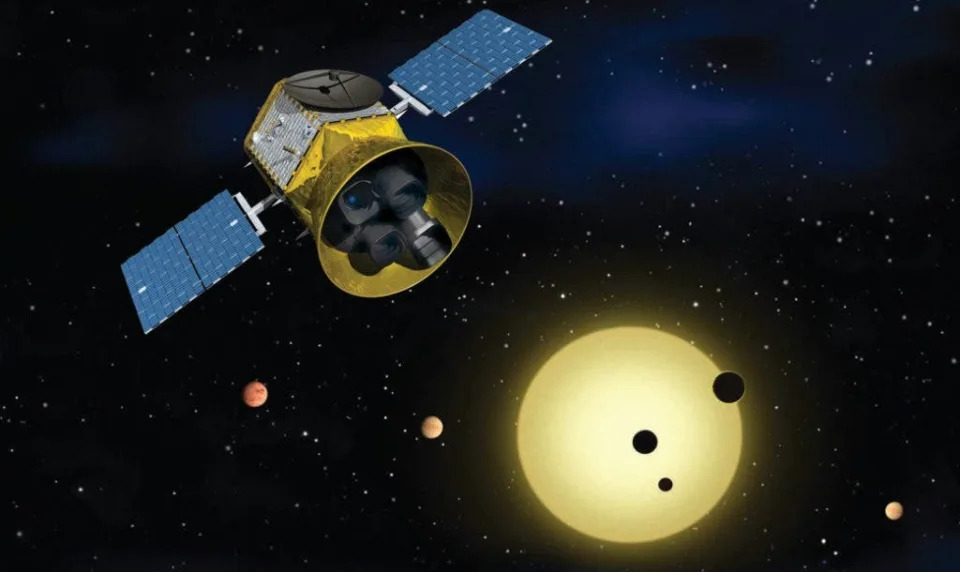
a gold-bowled space probe with four camera mounts and two solar panels gazes downward at a star and smaller orbiting planets in space.


Planets are everywhere

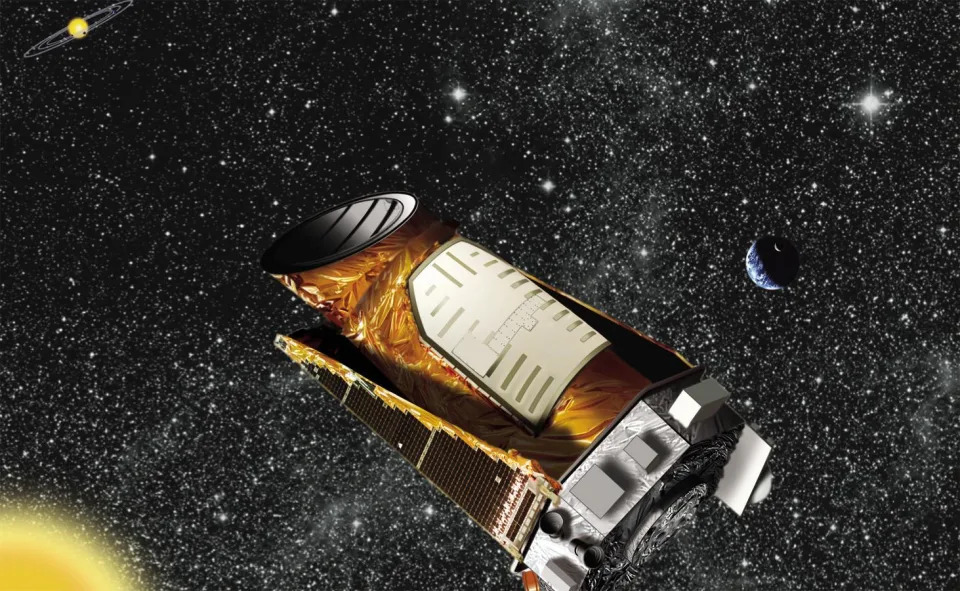
NASA's own Kepler space telescope served as the space agency's first planet-hunting mission. During nine years of deep space scoping, Diamond emphasized, it showed our galaxy contains billions of exoplanets. "It told us that planets are everywhere and a lot of them are potentially habitable."

NASA is starting to chip away at SETI work, Diamond noted. A NASA-funded grant to a SETI Institute scientist is using observations from the space agency's Transiting Exoplanet Survey Satellite (TESS). The intent is to purge out of the TESS data possible technosignatures aided by artificial intelligence/machine learning tools.

"So yes, I think the winds of change are blowing a little bit in favor of the government getting back into this business. And, in my opinion, I think they should step up and do it," Diamond said.

a space telescope of coper with a grey base leans upward amidst a starry black backdrop.


Neighborhood watch


RELATED STORIES:

The search for extraterrestrial intelligence gets a new home at Oxford

SETI scientists begin huge new hunt for intelligent aliens

SETI's 1st 'conversation' with a humpback whale offers insight on how to talk to E.T.

With all the in-motion SETI research underway, just how prepared are we for a confirmed, door-ringing neighborhood watch revelation?

"The straight answer to that question is no, we are not necessarily ready, although it depends on what the answer is," Diamond responded. It's only a matter of time before this question is answered, he added, at one level or another.

We should begin to think about how we convey this information, possible impacts to society, to religion, to politics, to technology, to governments, said Diamond.

"I do think that with all these technologies, modalities, instruments looking in different ways," Diamond concluded, "it's getting closer and closer for sure."
Japan's SLIM moon lander snaps final photos before going dormant during lunar night

Andrew Jones
Thu, February 1, 2024 

Black and white photos of the rocky grey surface of the moon.


Japan's historic SLIM moon lander has powered down ahead of a likely mission-ending cold lunar nighttime — but not before grabbing some final images and loads of science data.

SLIM, short for "Smart Lander for Investigating Moon," nailed its precision touchdown on the rim of Shioli crater on Jan. 19, despite engine troubles that saw it land nose-down. As a result, the spacecraft's solar cells face westward and are unable to receive the expected levels of sunlight, initially cutting operations on the lunar surface very short. But SLIM triumphantly reawakened nearly 10 days after landing, as the sun finally shone on its panels.

Related: Japan's SLIM moon lander photographed on the lunar surface — on its nose (image)


Image of the lunar surface captured by a japanese lander, showing gray dirt, small rocks and a hill in the distance. Some of the rocks are circled in yellow.


The Japan Aerospace Exploration Agency (JAXA), which operates SLIM, has spent recent days scanning the nearby lunar surface with the spacecraft's Multi-Band Camera (MBC) to learn about its composition.

MBC is designed to scope out olivine and other minerals through analyzing the light signatures, or spectra, of reflected sunlight, according to the nonprofit Planetary Society.

JAXA's SLIM account on X, formerly Twitter, posted a final image taken by SLIM's navigation camera on Jan. 31 Japan time, while stating that the agency confirmed the spacecraft had entered a dormant state as expected.

JAXA will need to wait out the roughly 14.5-Earth-day-long lunar nighttime and then wait for favorable lighting and temperature conditions later in the next lunar daytime (which starts around Feb. 15) before SLIM can potentially be revived once more. For the probe to awake again, however, its electronics must hold up in the face of equatorial lunar nighttime temperatures of around minus 208 degrees Fahrenheit (minus 130 degrees Celsius).

But whether or not SLIM wakes up, the spacecraft has hit its full and extended mission goals by achieving a precision landing, deploying a pair of small rovers and demonstrating their interoperability, and obtaining a wealth of science data.

SLIM's X account also posted labeled images of targets of MBC's spectroscopic imaging, showing the various rocks and regolith that are being studied.


closeup view of a large rock on the lunar surface, with smaller rocks surrounding it.

RELATED STORIES:

'We proved that you can land wherever you want.' Japan's SLIM moon probe nailed precise lunar landing, JAXA says

Why Chandrayaan-3 landed near the moon's south pole — and why everyone else wants to get there too

Not dead yet: Japan prepares for possible recovery of SLIM moon lander

"Based on the large amount of data we have obtained, we are proceeding with analyses to identify rocks and estimate the chemical composition of minerals, which will help solve the mystery of the origin of the moon," a Google machine translation of a Feb. 1 JAXA statement read.

"We will announce scientific results as soon as they are obtained," the statement added.

Lunar night puts Japan's lander back to sleep

AFP
Thu, February 1, 2024 

Japan's SLIM lunar lander seen in an image credited to JAXA, Takara Tomy, Sony Group Corporation and Doshisha University (Handout)


After a brief awakening, Japan's Moon lander is out of action again but will resume its mission if it survives the two-week lunar night, the space agency said Thursday.

The unmanned Smart Lander for Investigating Moon (SLIM) touched down last month at a wonky angle that left its solar panels facing the wrong way.

As the sun's angle shifted, it came back to life for two days this week and carried out scientific observations of a crater with its high-spec camera.

"After completing operation from 1/30 (to) 1/31, #SLIM entered a two week dormancy period during the long lunar night," space agency JAXA said on X, formerly Twitter.

"Although SLIM was not designed for the harsh lunar nights, we plan to try to operate again from mid-February, when the Sun will shine again on SLIM's solar cells."

JAXA said SLIM was able to "successfully complete observations... as originally planned" with its multiband spectroscopic camera and could study more target areas than initially expected.

The space agency also on Thursday posted a black-and-white photo of the rocky surface taken by the spacecraft.

It followed other grainy images sent back from the mission to investigate an exposed area of the Moon's mantle, the inner layer usually deep beneath its crust.

SLIM, dubbed the "Moon Sniper" for its precision landing technology, touched down within its target landing zone on January 20.

The feat was a boon for Japan's space programme after a string of recent failures, making the nation only the fifth to achieve a "soft landing" on the Moon, after the United States, the Soviet Union, China and India.

But during its descent, the craft suffered engine problems and ended up on its side, meaning the solar panels were facing west instead of up.

Russia, China and other countries from South Korea to the United Arab Emirates are also trying their luck to reach the Moon.

US firm Astrobotic's Peregrine lunar lander began leaking fuel after takeoff in January, dooming its mission. It likely burned up in the Earth's atmosphere on its return.

NASA has also postponed plans for crewed lunar missions under its Artemis programme.


Japan’s SLIM Lunar Lander Is Still Alive, Despite Landing Upside-Down

Cassidy Ward
Wed, January 31, 2024 

The events of SYFY’s The Ark (streaming now on Peacock) take a few liberties with their portrayal of space exploration, but the show gets one thing absolutely correct: things go wrong in space. All of the planning, testing, and dress rehearsals can’t compare to actually launching something into the abyss, and it’s almost guaranteed that mission controllers will run into problems they didn’t account for.

The 4.2 light-year trip to Proxima centauri provides plenty of opportunities for our fictional crew to encounter mishaps, but real-world scientists run into similar problems much closer to home. Recently the Japan Aerospace Exploration Agency (JAXA) launched a lunar lander to the surface of the Moon, and things didn’t go according to plan. For a minute there, it seemed that the agency’s SLIM lander, short for Smart Lander for Investigating Moon, was basically dead on arrival.

In actuality, it just needed a little nap while waiting for more favorable conditions. After more than a week in stasis, SLIM woke up and is busily snapping pictures from the surface of the Moon.
SLIM’s Trip to the Moon was a Mixture of Failure and Success

SLIM launched September 6, 2023, and took a leisurely, several-month trip to the Moon. It entered into lunar orbit toward the end of the year and made its final approach, landing on January 19, 2024. After a tense descent, SLIM touched down at Shioli Crater, near the Moon’s equator. The achievement made Japan only the fifth nation to successfully soft-land a craft on the lunar surface, but it wasn’t without speed bumps.

For More on the Moon:
The Moon Is Shrinking, Triggering Fault Lines and Moonquakes
Watch Russia's Crashed Luna-25 Punch a New Crater into the Moon's Surface
India's Chandrayaan-3 Successfully Lands on the Moon's South Pole

An image of the SLIM lander on the Moon, captured by Lunar Excursion Vehicle 2 (LEV-2)
Photo: JAXA

Something went wrong in the last moments of descent, and it wasn’t immediately clear what had happened. Mission controllers knew that the solar cells weren’t collecting energy from the Sun as planned, but it took days to figure out why. Over the course of the first few hours, the lander’s onboard battery fell to 12% charge and JAXA made the decision to power the lander down. It was a strategic move, leaving enough energy in the batteries to power the lander back up if and when the solar cells caught light.

In the meantime, JAXA confirmed that SLIM achieved its primary mission, landing approximately 55 meters from its intended target, making it the most precise landing ever achieved on the Moon. For contrast, Apollo 11 touched down roughly 6 kilometers (3.7 miles) away from its target.


JAXA's SLIM Lander Wakes Up After 9 Days in Stasis

An ongoing investigation into the cause of the Moon mishap suggests that one of the lander’s main engines lost thrust about 50 meters from the surface. It seems that the engine loss caused the lander to start flying sideways, tip over, and land on the Moon upside-down. Fortunately, two autonomous probes that detached from SLIM before things went sideways provided an outside perspective into what went wrong.

One of the probes, dubbed LEV-2, was able to snap a photo of the lander on the surface (above), confirming its upside-down orientation. Moreover, the solar cells were pointed away from the Sun, explaining why they didn’t start juicing the batteries after landing. That’s obviously not what JAXA was hoping for, but it also provided some hope that the lander might wake up at some future date. To understand why, let’s consider the sundial.

Sundials work by casting a shadow to mark the time. It’s an effective, if archaic, way of telling time because the sunlight’s angle of approach changes as a planet (or moon) rotates around its axis. On Earth, that happens once every 24 hours (give or take), but a day on the Moon is much longer. Because the Moon is tidally locked to the Earth, it only completes a circuit once every orbit, roughly every 29.5 Earth days. If SLIM had any chance of waking up, it would be when the Sun’s angle of attack shifted to hit the solar cells.


Surface of the moon.

A lunar surface scan mosaic image captured by the SLIM-mounted MBC. Rocks of interest have been given nicknames taken from various dog breeds. Photo: JAXA, RITSUMEIKAN UNIVERSITY, THE UNIVERSITY OF AIZU

On January 28, JAXA announced on X (the website formerly known as Twitter) that the lander had woken up. After 9 days in limbo, the solar cells picked up sunlight and the topsy-turvy lander made contact. Despite being head over heels, SLIM fired up its multi-band camera and started taking pictures of the nearby lunar surface. It will keep snapping photos, investigating the mineral composition of the nearby landscape, until the Sun sets on that part of the Moon and SLIM goes to sleep, probably forever.

Already, the precision landing made SLIM an incredible success and a feather in JAXA’s cap, but its ability to land on its head and just keep going is a monument to engineering. Not bad, SLIM. Not bad.