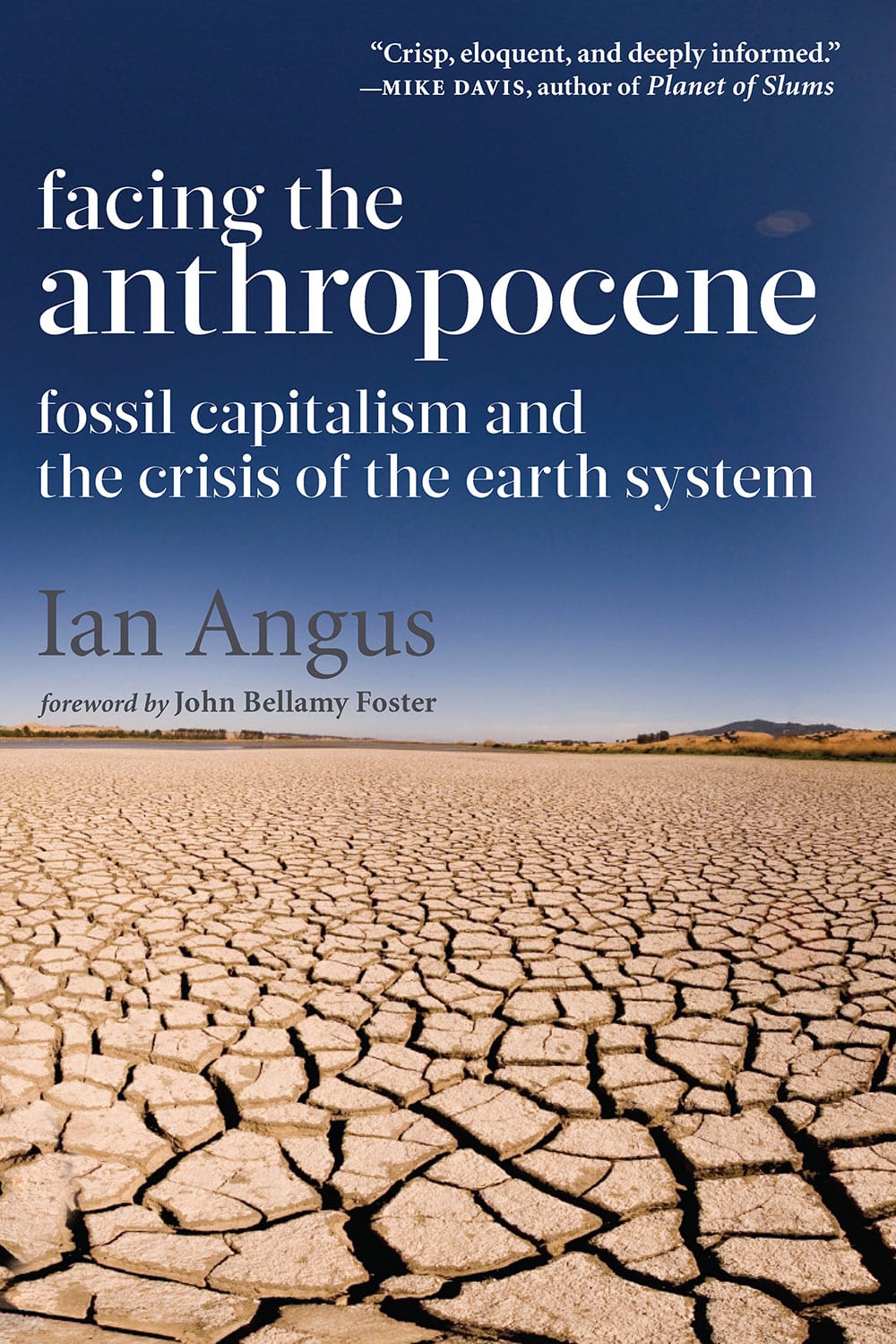
Ian Angus is editor of the online ecosocialist journal Climate & Capitalism and a founding member of the Global Ecosocialist Network. He is the author of Facing the Anthropocene: Fossil Capitalism and the Crisis of the Earth System (Monthly Review Press, 2016) and, most recently, The War Against the Commons: Dispossession and Resistance in the Making of Capitalism (Monthly Review Press, 2023).
This interview was published simultaneously in Portuguese, Spanish, and English by the Brazilian journal Sumaúma in September 2024. It has been lightly edited for publication here.
In this interview with Sumaúma, Ian Angus talks about the ideas set out in Facing the Anthropocene and explains the origin of his thought. The interview took place in late March 2024, shortly after the Sub-commission on Quaternary Stratigraphy, part of the International Union of Geological Sciences, rejected the proposal to formally endorse the idea that we are in a new geological epoch, the Anthropocene. The term, which derives from the Greek word anthropos, or human, is already broadly used by scientists and environmentalists to designate an era when human activities interfere directly with Earth’s structure and speed up climate change.
Claudia Antunes: Many people have questioned the decision by the International Union of Geological Sciences’ sub-commission not to endorse the idea that we have entered the Anthropocene. Could this decision lend support to climate change deniers?
Ian Angus: You have to understand that this formal process took place within the geological organization, which has historically been very conservative. From the beginning of this discussion of the Anthropocene, many in the older generation of geologists have been hostile to the whole process. First, because the discussion did not start with geologists; it started with Earth System scientists, so it came from outside. Second, this is a social and economic crisis, in addition to a natural crisis, and many opponents of the Anthropocene concept spent their whole lives working for oil companies or mining companies. Since that is what geologists mostly do, there is resistance to any change at all as well as to this particular proposal. In addition, political currents that are strongly opposed to social change influenced the process. So, it is not surprising this happened.
CA: What political effects will that have?
IA: I suspect the people who deny climate change will use this. They will say: “See, the geologists don’t agree with you.” But in fact, the concept of the Anthropocene, whether or not the geologists formally endorse it, has been widely accepted in the world of the earth sciences. Most other disciplines and very large numbers of geologists have already accepted the concept.
CA: Some claim the sticking point was about when the Anthropocene began. Some argue that, more broadly, it can be said that the Earth System began changing with agriculture. Does this argument make sense?
IA: That argument ignores the distinction between change and qualitative change to the system. There is no question that human beings have been changing their environments for thousands of years. What we have not had before the past seventy years is change that actually alters the way the Earth System works, an actual break with the conditions that have been dominant on Earth for some twelve thousand years.
I do not think most of these people are climate change deniers. They would say, yes, the climate is changing, but technology is going to fix it. The basic argument is: we have changed the planet before, we have invented new ways of doing things, and we will continue to do so. In some sense, they have taken the word Anthropocene, which comes from “human” in Greek, and say humans have been doing things forever. They have rejected the idea that the new epoch is the result of radical changes in human society that are modifying Earth.
CA: In Facing the Anthropocene, you offer a clear explanation of the previous role of carbon in the atmosphere, and how this has changed in recent decades as a result of human activities. Could you summarize this explanation a little?
IA: If we go back some two billion years, there have been times when the earth was frozen solid and other times when the whole earth was tropical and even more than tropical. These shifts occurred naturally, as a result of the way the earth’s orbit works and other factors. But we know that for the past two to three million years at least, the level of carbon dioxide in the atmosphere has only varied within very narrow limits.
Somebody has described carbon dioxide as our thermostat: Turn it up a little bit, it gets hotter; turn it down a little bit, it gets colder. We can look at the record of carbon dioxide, which is preserved mainly in the ice in Antarctica and Greenland, and we can show how the earth’s climate has changed closely in line with the variation in the amount of carbon dioxide. The range of changes was very small. During the last Ice Age, which ended twelve thousand years ago—a very short time in Earth history—the amount of carbon dioxide in the atmosphere was not much less than it has been until recently. It only took a small shift for the transition to the Holocene to occur.
In the last 11,700 years, the earth’s climate has been relatively stable. All of the great human civilizations developed during this period, when you had a climate warm enough for agriculture, when ice was restricted to certain limited parts of Earth, and so on. We have had variations, but small ones.
Then, in the past century—and really just in the past forty or fifty years—the amount of carbon dioxide in the atmosphere has soared. It is getting close to double what it was for that long period. We can already see the consequences of this. The climate is shifting in real time, much, much faster than has ever happened by natural processes. Changes that took hundreds of thousands or millions of years in the past are now occurring in years or decades.
CA: You mentioned that some people believe humans will invent technology to deal with this. But even the International Energy Agency, formed of thirty-one member countries and thirteen association countries, does not think so. According to the agency, carbon capture technologies fall far short of what is needed to control global heating and extreme weather events.
IA: Exactly. Part of capitalist ideology is that no matter what the problem, there is a technical fix. Because if there is no technical fix, then there is something wrong with the society, and the defenders of the society do not want to believe this.
Even if tomorrow we invented a carbon capture technology that would remove CO2 from the atmosphere effectively and quickly, it would still probably be centuries before it had any significant effect. Today, a very small number of carbon capture projects are removing carbon dioxide from the atmosphere, and the amount collected is the equivalent of taking a few hundred automobiles off the roads. It is nothing compared with the size of the problem.
CA: I would like to situate the ideas about ecosocialism that you set out in your book, including your emphasis on the concept of metabolic rift in the history of anticapitalist thought. What kind of current of thought do you represent and who are your predecessors? Who has inspired your thinking?
IA: In the 1960s and ’70s, when I was first involved in socialist movements, we tended to say socialism would solve everything—sort of the socialist equivalent of the capitalist idea that technology would solve it all. The environmental issue was not considered a big deal. Now that is not fair to the whole of the left. John Bellamy Foster, in The Return of Nature: Socialism and Ecology, shows that there were radical scientists from the time of Karl Marx into the late twentieth century who were seriously looking at these questions and showing how economic and ecological change are related and need to be addressed together. From the 1980s onward, a growing layer of socialists started to call attention to environmental destruction. Initially, they did not talk so much about global warming, but about pollution, loss of biodiversity, and the overexploitation of nature.
CA: But did Marx talk about this in his works?
IA: There has been a tendency to think Marxism had nothing to say about this. Sometimes I think it is because people have read only three or four books by Marx. But Marx wrote an enormous amount, as did Frederick Engels. In this debate, the people who influenced me the most were two U.S. scholars. One is Foster, whom I have just mentioned, a professor at the University of Oregon and the editor of Monthly Review. The other was Paul Burkett, who was a professor at the Indiana State University.
Almost simultaneously, but working separately, they published two very powerful books. Foster’s was Marx’s Ecology: Materialism and Nature, and Burkett’s was Marx and Nature: A Red and Green Perspective. What they did was go back to Marx’s work to see what Marx actually had to say, not what people thought he had to say.
Do not forget that a lot of what people thought Marx said actually reflected the Soviet Union’s intensive production policies, which tended to copy what the capitalist countries had done. People who were environmentally conscious looked at that and concluded that there was no difference between capitalism and socialism. They wrote off Marxism because of the activities of one specific group of Marxists.
What both Burkett and Foster did, from very different angles, was to show that Marx’s work contained a deep ecological analysis, even though the word “ecology” had not been invented, and Marx never wrote “I am an ecologist.”
Marx was a materialist. His starting point was that people have to eat before they can do anything else. We have to eat; we have to meet our physical needs. In order to do that, we have to produce, and it is the economy at large that actually creates humans. It is our interaction with nature that makes all this possible. All of that is in Marx and Engels’s works, but people did not look for it because they were not thinking about the environmental issue. Foster, Burkett, and then other people who followed them did.
An important thing that came out of this research, that Foster particularly emphasized, is how much Marx used the concept of metabolism, which was a brand-new idea.
The word originally appeared in German as Stoffwechsel in 1815. Around the 1840s, it started to become a big thing in science. Scientists discovered the cell, they discovered how soil worked, and they realized all life depended on a constant exchange and interaction of energy and material. Life was not possible without taking matter and energy materials from nature, and returning them in changed forms to nature. These processes were cyclical; if nature did not constantly recycle everything, life would not have lasted.
CA: Did Marx follow this debate?
IA: The life sciences developed rapidly in the 1840s and ’50s, at the same time that Marx was writing. He probably got the term metabolism from Roland Daniels, a communist who took part in the uprisings of 1848 in Germany. Daniels was a doctor and scientist, and wrote a book called Mikrokosmos that took the concept of metabolism and applied it to society. Marx had already been using the concept, but without the word itself. In the 1850s, however, he began integrating it into his more general analysis of society and the economy. This appears in the texts he wrote in the 1850s, in the Grundrisse, and particularly in the 1860s, when he was writing Capital.
Marx was especially influenced by Justus von Liebig, a German chemist who is known as the father of organic chemistry. English agriculturalists, who had a problem with declining agricultural productivity, invited Liebig to examine the problem. He told them: “You’re taking all of the nutrients out of the soil and you’re not putting any back. You can’t do that forever. There’s a metabolism here that you have to maintain.” Marx read Liebig carefully—in the 1860s, when he was working on Capital, he wrote to Engels and said he had learned more from reading Liebig than all the economists put together.
CA: How did he use Liebig’s observations in his writings?
IA: He said that there is a universal metabolism. All of nature works this way, not just agriculture, and what we see in agriculture is a rift, a break between the nutrients we take out and the nutrients we put back in. In the natural world, plants grow, they die, animals eat the plants, they die, and their bodies go into the land, which then uses them to grow plants again, but as agriculture became a mass industry, that cycle was broken. Food was shipped to large cities, and then everybody’s waste was dumped in the river. All of those nutrients, instead of going back to the land, polluted rivers and ended up in the ocean.
That’s the origin of the concept that has come to be called “metabolic rift theory,” the idea that many of our environmental problems result from breaks and disruptions in the normal cycles that make life possible on Earth. For hundreds of millions of years, we breathed in oxygen, we breathed out carbon dioxide, and plants did the opposite. That was a fairly stable cycle, but now we are pumping out far more carbon dioxide than nature can absorb by its natural processes. Something else has to change, and that is the planet’s temperature.
CA: At the time, Marx was writing in an intellectual environment that was increasingly separating the world of humans from the world of nature and emphasizing human control over it. In the book Less Is More: How Degrowth Will Save the World, the anthropologist Jason Hickel calls this “dualism.” Did Marx and other socialists of the time buy into that idea?
IA: The word “dualism” can be a little tricky to use, but Marx wrote in one of his earlier works that to say that humans change nature is simply to say that humans change themselves because we are part of nature. But he also said that we are something new; prior to our arrival, there was no species that had the ability to change the environment on the scale that we have. So, although we are part of nature, we are also changing nature, which is also changing us. From a Marxist point of view, the issue is not “dualism” or “monism” but “dialectics,” that is, the relationship between the part and the whole. We are part of the whole, but we are also a unique part that is changing the whole.
CA: You are proposing an “ecological society” or “ecological civilization.” Why do you think an ecological society has to be socialist?
IA: Let us start off with capitalism. The main driving force of capitalism is to make a profit, to increase the wealth of a small layer of people. That is its whole objective. Many things follow from that. One of them is a society with a short-term view of everything. From the point of view of a capitalist, if I can make money today, it is better than making money tomorrow, and I am always competing with other capitalists in order to increase my wealth or income, or even just to stay in business. I must constantly find ways to generate more capital, more revenue to make my capital bigger. It is a society that ultimately cannot plan except for short-term gains in wealth.
Only by eliminating the profit motive as the driver of the economy is it going to be possible to stop large-scale destruction of the environment, because ultimately, the way you get richer is by destroying the environment, taking the natural world and converting it into money. That is what socialism aims to change, eliminating the profit motive as the central driver of the economy.
Many other things, obviously, go along with socialism, but that is fundamental: shift the drivers of economic and social decisions to, in Burkett’s term, “sustainable human development.” Our aim is a better world for humans to live in that is sustainable in the long term.
Marx says that we do not own the earth, we are just its temporary possessors, and we must leave it in good condition for future generations. We only have to look at our world now to recognize that we are in a social and economic system for which future generations just do not count. It is today that counts. You never see a politician give a speech that does not talk about economic growth. They say we need more, but it is not more leisure time, or more and better medical care for everybody. It is not more literature or a better way of life. It is more wealth, specifically, more capital.
CA: When you say an ecological society has to be socialist, that we have to remove profit and growth from the equation, do you also identify with the movement calling for “degrowth”?
IA: It is important to understand that the ecosocialist movement that started in the 1990s developed in parallel to the degrowth movement, which was happening mainly in Europe. A lot of the early work in degrowth assumed that all of this growth was just a problem of bad ideas; all we have to do is tell everybody: “No, do it this way,” and everybody will. They tended not to have a social or economic analysis. Some of them did very good work describing what the problems were but not explaining them.
That has shifted over time. I do not agree with everything Hickel writes, but I think that he is hitting the right points. Foster recently wrote a major article about the need to plan for degrowth. He took the idea that we need degrowth but put it in the context of the social and economic changes that are necessary to get there. It is not going to happen because you wish for it. It is only going to happen when we have a society that breaks with the profit motive and moves toward planning for sustainable human development.
We need to look at degrowth as a social issue and think about advertising, military spending, and other things that produce profit but also produce a negative effect on ordinary people’s lives, whether they realize it or not.
CA: You talk about this at length in your book.
IA: Yes, I talk about the things that we could stop doing easily. It would not cause anyone grief if there were no television commercials. Except, of course, the people who were selling things on television. That part of the economy that is entirely given over to selling things and creating new wants is extraordinarily large. Of course, the amount of the economy that is devoted to killing people through military industries is also extraordinarily large. You could cut it by 50, 90, or 100 percent, and the impact on ordinary people would be very slight.
CA: The linguist and leftist intellectual Noam Chomsky does not like the term “degrowth” because it frightens people, especially in the Global South, where many people have nothing. Is it not a way to avoid saying “postcapitalism” directly?
IA: I am also not a fan of the term, but like “Anthropocene,” it is the word we have. The issue is not simple degrowth but rather how to redirect resources to the 90 percent of the world’s population who do not have enough by any measure. We need to level out the global use of resources in a planned way to create the least environmental disruption possible.
CA: The historian Adam Tooze, who is not a Marxist, gave a lecture about the Anthropocene at the end of 2023 at Princeton University, where he said that despite President Joe Biden’s proposed spending on his “climate package,” economic growth in the United States is still being propelled by military spending. At the same time, the fossil fuel emissions of the U.S. military have yet to be mentioned in global climate agreements. This is an issue you also explore in your book.
IA: John Maynard Keynes, the great British economist, argued that the capitalist economy could be kept going simply by the government spending lots of money whenever there was an economic downturn. What we actually got was what has been called “military Keynesianism.” Since the Second World War, the economies of the major capitalist countries have been heavily dependent on military spending. They spend far more than ever shows up in the budgets, because it is not just what is earmarked for the Armed Forces or weapons, but everything that supports those activities. Military spending has been responsible for a good part of what is called growth in capitalism.
Setting aside the benefit of not having wars, redirecting military spending would free up so many resources to solve the issue of inequality in the Global South, to overcome poverty worldwide, to defeat diseases, and so on. It would give us the ability to decide, “we’re not taking this out of nature anymore,” and use the money to reforest, clean the oceans, etc. It is only a handful of countries that have such high military budgets—the United States, according to some estimates, spends more on the military than all of the other countries in the world put together. If you want to define where you would start with degrowth, that is the place to start.
CA: Many people who promote a postcapitalist economy emphasize something called a “care economy,” where there would be increased investments in people, communities, and services that care for nature, the elderly, children, and the sick. What do you think?
IA: Without even going into that particular economic analysis, I think the concept is important. The Big Fail: What the Pandemic Revealed about Who America Protects and Who It Leaves Behind, by Joe Nocera and Bethany McLean, shows brilliantly how in this society the benefits always go to a tiny minority. I assume this is true in Brazil, and I know it is true in Canada, where I live. Here in Ontario, one of the richest provinces in Canada, when COVID-19 began, there were signs everywhere saying “thank you” to nurses and doctors. Politicians gave speeches about how the frontline health care workers were so essential and important. But at the same time, the government of Ontario passed a law preventing nurses from negotiating higher wages. So, in reality, the politicians did not really care. I think a large driver of socialist society will be ensuring that nobody falls through the cracks.
CA: A question of great importance to Brazil is how the current system of food production results in deforestation and soil contamination. There is now a lot of discussion about the need to change the system we adopted during the so-called Green Revolution. In your work on an ecological society, have you ever explored this term?
IA: I wrote an article in 2023 about soy cultivation and its gigantic impact not just on Brazil, but on South America and the world in general. There is a lot of talk of “feeding the world,” except the money is not being invested in food for people. Huge expanses of the natural world are being used mainly to feed chickens and pigs. It is an incredibly inefficient form of production because you are using a high-energy product to feed domestic animals, which are only then used to feed people. You lose energy at every level.
It is a really destructive way to feed the world. Soy growers cut everything down and create huge plots to grow soy and nothing else. We are mostly not talking about individual farmers as the problem here, but giant agricultural corporations. Many people who live off the land are deprived of access to it.
You mentioned the Green Revolution, which was supposed to solve the so-called problem of overpopulation in the Global South by replacing peasant farming with large-scale chemical farming based on large inputs of artificial fertilizers and large-scale extraction of water. This increase in the production of maize, wheat, or several other products was made possible by environmental destruction on a massive scale.
CA: We would need a radical reduction in the use of fossil fuels to limit the rise in the planet’s temperature to below 2 degrees Celsius by the end of the century, compared to pre-industrial levels. In this context, how do you evaluate where we are in the global discussion of ecosocialism?
IA: The Italian Marxist Antonio Gramsci spoke of “pessimism of the intellect, optimism of the will.” That was his attitude to life, and it is the attitude I try to have myself. When I look at the current situation and the apparent complete unwillingness of our rulers to make any substantive changes in the right direction, I feel very unhappy with the world my children and grandchildren will inherit. I do not see how we could keep global warming under 1.5 degrees Celsius or even 2 degrees.
However, history shows that the world can change rapidly. The key question is: Are we going to see large numbers of people start moving for change? Ecosocialists aim to help people in thinking about this and figuring out what to do.
A few years ago, there were plans to run a pipeline through the town where I live. It would have carried substantial amounts of tar sands oil, really dirty oil. Even though this is a very conservative town, we had meetings and rallies, and we stopped the project. Now that was a small victory for a small town, but we need to build on such victories before time runs out.