AMERIKA STABS ALLIES IN THE BACK
Trump in disinformation bubble: Zelenskyy day after US-Russia talks without him
Ukrainian President Volodymyr Zelensky dismissed Donald Trump's claims about his approval ratings, accusing the US President of being trapped in a Russian 'disinformation bubble'.
Volodymyr Zelensky
India Today News Desk
New Delhi,
Written By: Ajmal Abbas
In Short
Zelensky urges Trump's team to seek truth about Ukraine
Ukraine dismisses Riyadh talks on ending war with Russia without its input
Ukrainian President Volodymyr Zelensky slammed Donald Trump, saying the former US President is trapped in a "disinformation bubble" and asserted that efforts to replace him amid the war with Russia will fail. Zelensky was responding to Trump's claim that his approval ratings are declining, a day after the US and Russia met in Riyadh and discussed ending the Ukranian war.
The US President on Wednesday claimed that Zelensky's rating was just four per cent, despite the latest poll putting his approval rating at 57 per cent. His remarks came after Zelenskyy dismissed the outcome of Wednesday's Riyadh talks, asserting that Ukraine would reject any decision made without its involvement.
Dismissing Donald Trump's claims, Zelenskyy asserted that the Republican leader is trapped in a disinformation bubble created by Russia against him.
“If someone wants to replace me right now, it won’t work. The statements about his approval rating at 4 per cent is Russian disinformation. Trump is trapped in this disinformation bubble," Zelenskyy told Ukrainian TV.
Zelenskyy commented he “would like Trump’s team to have more truth about Ukraine,” adding that no one in Ukraine trusts Russian President Vladimir Putin.
Zelenskiy further said that Ukraine's army was resilient enough, adding that the overwhelming majority of Ukrainians would not support concessions to Russia.
advertisement
"The army is quite resilient, and it is the most resilient in Europe... and it guarantees us the opportunity to speak with dignity and on an equal footing with other partners - allies or non-allies," he added.
In a significant international diplomatic development, US Secretary of State Marco Rubio and Russian Foreign Minister Sergei Lavrov met in Saudi Arabia’s capital on Tuesday and agreed to improve bilateral relations between their countries, which have recently hit rock bottom. As the first step toward mending ties, both sides agreed to work towards ending the Ukraine-Russia war.
At the meeting, Russia firmly rejected the presence of any NATO forces in Ukraine and opposed Ukraine’s NATO membership, a longstanding demand by President Zelensky.
Immediately after the outcome of the meeting became public, Zelensky asserted no one can "decide anything behind our backs" and postponed his visit to Saudi Arabia in order to not give "legitimacy" to the Riyadh meeting.
"We want no one to decide anything behind our backs... No decision can be made without Ukraine on how to end the war in Ukraine," he said, adding, "We were not invited to this meeting, it was a surprise for us". He also demanded Turkey and Europe be involved in talks.
Zelenskyy's stance drew a rebuke from the US President, who accused his Ukrainian counterpart of "starting" the war. Trump labelled Zelenskyy a "grossly incompetent" leader and a poor negotiator, adding that he should have struck a deal to end the conflict with Russia nearly three years ago.
Zelenskyy claps back at Donald Trump after his calls for Ukraine election; ‘Living in this…’
By Shweta Kukreti
Feb 19, 2025
Volodymyr Zelenskyy claimed that US President Donald Trump was “living in this disinformation space.
Ukrainian President Volodymyr Zelenskyy claimed that US President Donald Trump was “living in this disinformation space,” following the latter's suggestion that the war-torn nation should conduct an election, according to the BBC.

Speaking to reporters on Tuesday, Trump surprisingly backed Russian President Vladimir Putin, saying that Zelenskyy's approval rating was “down at 4 percent”. He even mentioned that the war-torn nation was under “martial law.
On being asked if the United States would back Russia's reported demands that Ukraine should conduct elections as part of a peace agreement, Trump said, “Yeah, I would say that, you know, when they want a seat at the table you could say the people have to, wouldn't the people of Ukraine have to say, like, 'you know, it's been a long time since we've had an election'.”
Later on Wednesday, Zelenskyy, who was elected to a five-year term in 2019, responded to Trump's assertion. Citing a survey that indicated 58 percent of Ukrainians have faith in him, the Ukrainian President claimed to have a strong approval rating. He went on to say that there was proof Russia was disseminating false information regarding the approval rating of 4 percent
Hitting back at Trump, he said, “With all due respect to President Donald Trump as a leader...he is living in this disinformation space.”

Russian Foreign Minister Sergei Lavrov attends a press conference following the talks with U.S. Secretary of State Marco Rubio, U.S. National Security Advisor Mike Waltz, and U.S. Middle East envoy Steve Witkoff, in Riyadh, Saudi Arabia February 18, 2025.
Feb 19, 2025
MOSCOW - Russian Foreign Minister Sergei Lavrov lauded U.S. President Donald Trump on Wednesday for saying that previous U.S. support of Ukraine's bid to join the NATO military alliance was a major cause of the war in Ukraine.
Trump has said that he saw no way that Russia could have allowed Ukraine to join NATO, and blamed former Democratic President Joe Biden for allegedly changing the U.S. position on NATO membership for Ukraine.
"He is the first, and so far, in my opinion, the only Western leader who has publicly and loudly said that one of the root causes of the Ukrainian situation was the impudent line of the previous administration to draw Ukraine into NATO," Lavrov told lawmakers.
"No Western leaders had ever said that, but he had said it several times. This is already a signal that he understands our position when President (Vladimir) Putin," Lavrov said.
Amid talks with the United States in Riyadh on Tuesday, Russia demanded NATO scrap its 2008 promise to one day give Ukraine membership of the U.S.-led alliance and dismissed the idea that NATO member forces could be keepers of the peace under some sort of ceasefire deal. REUTERS
Zelenskiy freezes US minerals deal, reaches out to Arab nations

Ukrainian President Volodymyr Zelenskiy has frozen a proposed concession to mine Ukraine’s considerable mineral resources worth several trillion dollars after the US side offered little in return, and travelled to the Middle East to reach out for new investors.
Zelenskiy said that the proposed agreement reached with US Treasury Secretary Scott Bessent last week “does not adequately protect the country’s interests” and has not been signed.
US President Donald Trump has demanded access to $500bn of Ukrainian minerals in compensation for US support during the three-year-long war, but has failed to offer security guarantees demanded by Zelenskiy as a key part of any deal.
The Ukrainian leader has been clear that the US minerals deal must encompass not only subsoil resources but also security guarantees and foreign investment in Ukraine, all of which must be legally articulated, and it is becoming increasingly clear that none of his allies are willing to offer a genuine security deal.
Zelenskiy's relationship with Trump got off to a rocky start in the first weeks of the new administration and got considerably worse during the Munich Security Conference (MSC) at the weekend when the US announced Europe is out of the Ukraine ceasefire talks that began in Riyadh on February 18. Special envoy to Ukraine retired Lieutenant General Keith Kellogg said that “of course” Ukraine would be at the table when talks started, but no Ukrainians were present when Russian Foreign Minister Sergei Lavrov kicked off the talks in the the Kingdom of Saudi Arabia (KSA) capital with his counterpart, Secretary of State Marco Rubio.
Kyiv has already promised not to recognise any agreements that will be reached at the meeting. "Ukraine is not participating. Ukraine did not know anything about this. Ukraine regards any negotiations about Ukraine without Ukraine as having no results. We cannot recognise any agreements about us without us. And we will not recognise such agreements," Zelenskiy said before the meeting started.
During the preliminary talks, the Russian and US delegates outlined the scope of the talks that will also include energy and business. Rubio said an agreement could unlock “historic” gains for Russia that would "be good for Russia and good for the world."
The parties have agreed among other things to begin "to engage in identifying the extraordinary opportunities that exist should this conflict [in Ukraine] come to an acceptable end," according to Rubio.
Analysts have speculated that Trump is hoping to cut a larger deal that extends beyond simply bringing the conflict in Ukraine to an end. The Secretary of State said that should the countries come to terms on a Ukraine deal, this would pave the way to "work together on other geopolitical matters of common interest and some pretty unique, potentially historic economic partnerships."
Russia is also heavily involved in the Middle East where it has reportedly just closed a deal with the new Syrian leader Ahmad Hussein al-Sharaa to keep its military bases in that country. Moscow is also close to Tehran, as a fellow sanctioned pariah, and it has also been suggested that Trump hopes to negotiate with the Iran theocracy through Russian President Vladimir Putin.
Looking for new partners
In the meantime, Zelenskiy has been left scrambling to rescue something from his rapidly deteriorating position.
During a working visit to the UAE, Zelenskiy announced the signing of a bilateral trade agreement that will simplify trade between the two countries. According to the Ministry of Economy, this marks the first agreement in Ukraine’s history with a Gulf nation.
"This is a historic event, as it is the first agreement in the most economically advanced region of the Middle East. It covers not only the UAE, but the Gulf regions in general. This is not just an agreement between two countries, it is an entry into the global market, as the UAE is an important economic, trade and financial hub in the Middle East. The implementation of the Agreement, which covers virtually the entire range of bilateral trade, will allow increasing the production and export of Ukrainian products by removing tariff barriers in trade between the two countries," said Minister of Economy of Ukraine Yulia Svyrydenko.
Zelenskiy noted that this significant economic pact, saying it, “liberalises access to the UAE market for nearly all Ukrainian goods.”
He continued by saying that Ukrainian companies will now find it easier to sell their products in the UAE. The agreement facilitates free trade between Ukraine and the UAE and increases access to commodity markets in both countries. Ukrainian goods will enjoy full access to 96.6% of commodity lines in the UAE market.
The Ministry of Economy also mentioned that favourable conditions could help maintain a positive trade balance, which reached $51.5mn in 2023. This agreement could accelerate real GDP growth by 0.1% in the medium to long term.
Zelenskiy is also due to arrive in Riyadh on February 19 but won’t participate in the US-Russian talks. A Ukrainian delegation in Saudi Arabia arrived a few days ago and opened discussions to deepen economic cooperation with nearly 100 local entrepreneurs. They presented these businesses with promising investment opportunities in Ukraine worth $500mn in energy, agriculture, agro-processing, and infrastructure. Collaboration in public-private partnerships and the involvement of Saudi Arabian companies in privatisation were also discussed.
The Minister of Economy, Yulia Svyrydenko said that Saudi Arabia actively supports Ukraine, noting that it has already allocated $500mn for reconstruction.
“Now we can illustrate the call to invest in Ukraine without waiting for the war to conclude, showcasing particular businesses from Saudi Arabia. For instance, FAS Energy invested in renewable energy in Ukraine, and last year, SALIC became a co-owner of one of the largest Ukrainian agro-holdings, MHP, acquiring 12.6% of the company’s shares,” she added. According to the minister, exports to Saudi Arabia rose from $291mn in 2023 to $368mn in 2024.

The terms of Trump’s mineral deal are extremely harsh, amounting to reparations on terms worse than those imposed on Germany following WWI, reports The Daily Telegraph. At the same time Europe and the US are developing divergent three-stage plans to end the conflict in Ukraine. /
The mineral deal that US President Donald Trump has offered Ukraine “amounts to reparations” that are worse than those imposed on Germany in the Versailles Treaty at the end of WWI, The Daily Telegraph reported on February 19, having obtained a copy of the draft agreement.
“If this draft were accepted, Trump’s demands would amount to a higher share of Ukrainian GDP than reparations imposed on Germany at the Versailles Treaty, later whittled down at the London Conference in 1921, and by the Dawes Plan in 1924. At the same time, he seems willing to let Russia off the hook entirely,” The Daily Telegraph’s leader writer Ambrose Evans-Pritchard reported.
Trump has demanded a $500bn “payback” from Ukraine, and Ukrainian President Volodymyr Zelenskiy has been trying to entice the US into continuing its support for Ukraine, specifically including a genuine security guarantee, in exchange to Ukraine’s considerable mineral resources. However, after seeing the draft agreement presented last week in Kyiv he ordered his staff not to sign the deal and since has left on a whirlwind tour of the Middle East reaching out to the Arab nations for investment and trade deals.
Trump’s deal goes far beyond US control over the country’s critical minerals. It covers everything from ports and infrastructure to oil and gas, and the broader resource base of the country, Evans-Pritchard says.
“The terms of the contract that landed at Volodymyr Zelensky’s office a week ago amount to the US economic colonisation of Ukraine, in legal perpetuity. It implies a burden of reparations that cannot possibly be achieved. The document has caused consternation and panic in Kyiv,” Evans-Pritchard wrote.
The deal covers most of what is valuable in Ukraine including: “mineral resources, oil and gas resources, ports, other infrastructure (as agreed)”, leaving it unclear what else might be encompassed. “This agreement shall be governed by New York law, without regard to conflict of laws principles,” it states.
And the terms are harsh. Kyiv would have to pay half of anything that is earned not only on the US joint venture contracts, but on all concessions that Ukraine might sign with other countries as well. In addition it grants a lien on all revenues. In other words, if Ukraine fails to pay its share then the US takes full ownership of the deposits. “That clause means “pay us first, and then feed your children”,” one source close to the negotiations told Evans-Pritchard.
The deal grants the US the right of first refusal for the purchase of exportable minerals for all future licences and Washington will have sovereign immunity and acquire near total control over most of Ukraine’s commodity and resource economy.
The fund “shall have the exclusive right to establish the method, selection criteria, terms, and conditions” of all future licences and projects. In other words, the US will take full control of all Ukraine’s natural resources, Evans-Pritchard reports.
According to Trump, the US has spent some $300bn on the war so far, which the US president says he wants to recover. In fact the total approved by Congress has been some $177bn, of which Zelenskiy complained earlier this month $100bn is “missing” and has not arrived in Kyiv yet. Trump said it would be “stupid” to hand over any more money, threatening that if Ukraine rejects the deal, it may be handed to Russia on a plate.
“[Ukraine] may make a deal. They may not make a deal. They may be Russian someday, or they may not be Russian someday. But I want this money back,” Trump said last week in the run-up to the start of the ceasefire talks between the US and Russia in Riyadh, to which neither the EU nor Ukraine were invited.
EU vs US three-stage plans
Europe has been left scrambling to respond to Trump’s aggressive and self-serving tactics. French President Emmanuel Macron called an emergency meeting of key military EU powers in Paris on February 18 to work out a response to being excluded from talks in Riyadh that got bogged down in a discussion of who could send peacekeepers to Ukraine in the event of a ceasefire.
What has emerged is both the EU and the US are proposing a three-stage path to peace, but the two versions are very different. Fox News' White House correspondent, quoting sources at the talks, reported that the US plan calls for a ceasefire, followed by presidential elections, and only then will a peace agreement be signed.
Russian Foreign Minister Sergei Lavrov told reporters that he "has not seen information" regarding the "three-stage peace plan" described by Fox News sources.
Given Zelenskiy’s popularity has been sinking as the situation on the battlefield continues to deteriorate and the state’s conscription drive becomes increasingly aggressive due to a chronic manpower shortage, if elections were held this weekend the formerly heroic figure would probably lose to former commander-in-chief General Valerii Zaluzhnyi.
The Kremlin would welcome a change of leadership and has called Zelenskiy “illegitimate” since his term in office officially expired last May, although the Ukrainian constitution forbids elections while the country is under martial law. The Bell speculates that the Kremlin believes that it could engineer the election of a replacement president who would be much more compliant in the subsequent negotiations.
The US and Russia view conducting elections in Ukraine as a key requirement for successfully ending hostilities, but not included in the EU version of its plan.
"Putin assesses the likelihood of electing a puppet president as quite high and believes that any candidate other than the current president of Ukraine will be more flexible and open to negotiations and concessions," diplomatic sources told The Bell.
Trump has also noted that Zelenskiy's popularity has been falling suggesting he sees the wartime leader as an obstacle to ending the conflict quickly.
Europe has also suggested a three-stage process to bring the conflict to an end, but on very different terms. The President of Finland Alexander Stubb outlined the three steps for achieving peace in Ukraine at the Munich Security Conference (MSC) but from a position of strength:The first stage involves preliminary negotiations, during which allies should rearm Ukraine and apply sanctions pressure on Russia.
The second stage includes a ceasefire monitored externally by Europe and the US. If Russia attacks Ukraine again, it should automatically receive Nato membership.
The third stage comprises peace negotiations, which may take some time. This stage will address more complex issues, including territorial disputes, security guarantees, and compensation.
The EU is trying to prepare the ground for its version and is proposing to provide Kyiv with one of the largest military aid packages since the beginning of the war with the immediate transfer of €6bn worth of military aid and setting up an enormous €700bn support package to sustain the country thereafter, according to German Foreign Minister Annalena Baerbock, who added that the details will not be disclosed until after the German general election on February 23.
Politico reported the €6bn military support package will include 1.5mn artillery shells, air defense systems, and other military equipment. Depending on the contribution of individual countries, the total amount could grow to €10bn. The decision is likely to be made by a coalition of Ukraine supporters and not at the EU level as Hungary has already said it will block any new EU military support packages. The issue will be discussed at a meeting of EU foreign ministers next week.
For once Ukraine is currently in good financial health, which will allow it to sustain the war for the rest of this year at least. For the first time since hostilities broke out, Ukraine has received its annual foreign aid in advance from the EU. Thanks to the $50bn Extraordinary Revenue Acceleration (ERA) programme financed by Russian frozen assets, Ukraine will fully cover its $38bn budget deficit this year, according to the Center for Economic Strategy. Consequently, the country's parliament can allocate an additional $5bn-7bn for defence using income received from frozen Russian assets.
Sanctions relief
Relation between the EU and US will be further strained as the talks proceed after Secretary of State Marco Rubio suggested in comments following the Riyadh talks that the US might unilaterally lift some of the thousands of sanctions on Russia. bne IntelliNews reported, these are one of the most effective bargaining chips available to the White House.
However, sanctions against Russia will not be lifted until an agreement is reached to end the war in Ukraine, Rubio assured European diplomats, but at the same time Rubio said that ending the conflict could “unlock a historic US-Russia economic alliance”. The two sides gave few details of the discussion, but did admit that energy and business were on the agenda.
Answering a journalist's question, Rubio also suggested that the White House didn’t intend to coordinate sanctions relief with the EU: "The sanctions were imposed as a result of this conflict. To end any conflict, all parties must make concessions. We cannot say in advance what they will be. We are definitely not discussing this today or at this press conference. But there are other parties that have imposed sanctions [on Russia]. The EU should also be at the negotiating table, because there are sanctions imposed by them."
The big win for Russia on sanctions relief would be to return to the SWIFT messaging service that in effect would allow Russia to send and receive dollars.
Russian media jumped on the comments as a signal that some sanctions would be lifted. TASS came out with the headline: "Rubio: The West will have to lift sanctions against Russia in the event of a settlement".
The US plan also does not seem to include peacekeepers in a mooted demilitarised zone (DMZ), whereas that is a key element of the plan being developed by the EU. However, Russian Foreign Minister Sergei Lavrov once again ruled out peacekeepers as part of any deal. He said in Riyadh that the presence of Nato troops in Ukraine is "unacceptable" to Russia.
"The presence of troops from Nato countries, whether under foreign flags, EU flags, or their own national flags, does not change anything. This is, of course, unacceptable to us," Lavrov said during a press conference following negotiations with US officials.
Copyright Euronews
By Sasha Vakulina
Published on 19/02/2025
Ukrainian journalist and one of the country's most prominent human rights activists, Maksym Butkevych, spent more than two years in Russian captivity.
He enlisted in the Ukrainian military in February 2022, when Russia started its full-scale invasion of Ukraine. Butkevych took part in the defence of Kyiv, and when the Russian forces were pushed away from the capital, he was sent to eastern Ukraine.
In June 2022, he was captured by the Russian army near the occupied towns of Zolote and Hirske in the Luhansk region in Ukraine's east.
Russian outlets reported his capture on 24 June, releasing a propaganda interrogation video. In September of the same year, the Russian Ministry of Defence officially acknowledged his deten
Russian-appointed authorities in occupied Luhansk and Donetsk regions of Ukraine sentenced Butkevych to 13 years in prison for fabricated charges in March 2023.
On 18 October 2024, he returned to Ukraine as a part of a prisoner-of-war exchange.
After a brief rehabilitation of four weeks, Butkevych is back to what he always wanted to do: defending human rights. He is focusing on protecting the rights of illegally detained civilians and prisoners of war, countering Russian propaganda and hate speech.
Euronews caught up with Butkevych in Brussels on the day Russia and the US had their first face-to-face meeting about a possible deal about Ukraine — without Ukraine, "playing right into Russian ideology", Butkevych said.
“Modern Russian ideology, and I have seen from within, both in prison and in captivity, is: everything is decided by the state and the leaders of the state. People are expendable materials, tools who have no will of their own. And in fact, the resistance that Ukraine put up at the beginning of the full-scale invasion was infuriating for the Russians”.
He says Russia has been trying to spread the narrative that Ukraine and Ukrainians are "a tool" controlled by the Americans and Europeans. At the same time, Russia thinks it belongs to Moscow and has tried to take it back under its control.
“And the instrument, this tool suddenly showed its will. The instrument suddenly became independent, active and said it is community of people who want to be free.”
This reality, he says, is so inconsistent with the ideology of "Russkiy Mir," or the "Russian World," that it even caused anger in the way Russian prison guards treat Ukrainians.
“The fact that it is the people who are in charge of making decisions, the people who are in charge of their own future, causes misunderstanding and anger among those who captured us and those who guarded us,” Butkevych explained.
And this is why any meetings about Ukraine without Ukraine fall into the same line.
“I'm afraid that other international actors and international players who are treating Ukraine this way now are showing the same — let's call it what it is — imperial approach that deprives Ukraine, Ukrainians of its own subjectivity," he said.
"And in this worldview, they are very close to (Russian President) Vladimir Putin, the war criminal, the initiator of the worst, bloodiest massacre in Europe since World War II.”
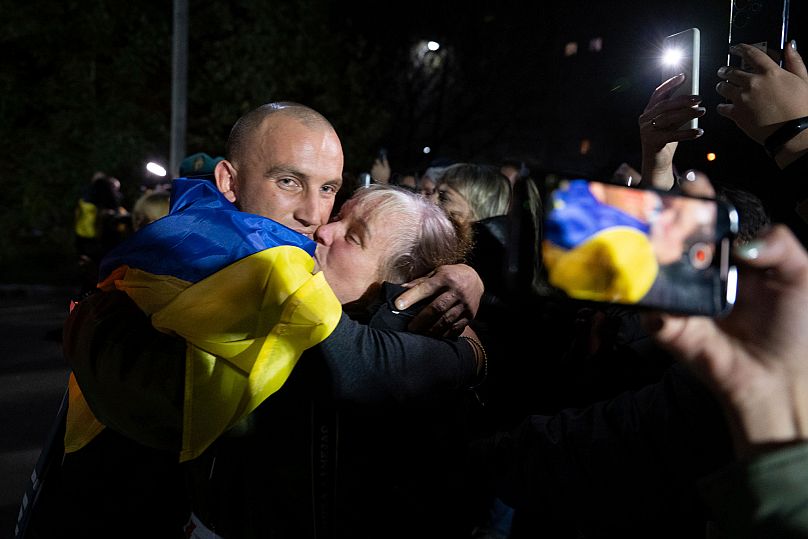
This is why he says Ukraine cannot be forced into any territorial concessions. “If we agree that parts of the currently occupied territory should be given to the aggressor state, we will actually be defeating the security system that was created in Europe after World War II."
This would be a "successful" case of one state invading the territory of a neighbouring state, "killing many people, taking parts of the territory and keeping them for itself. And everyone agrees with that."
But for Butkevych, whose nom de guerre is "Moses" even this is not the biggest fear. “I have no fetish for territory,” he explained, adding that his greatest concern is for millions of Ukrainians who live on these territories.
Butkevych was held in a penal colony in the Russian-occupied Luhansk region of Ukraine, and judging by what he saw, especially with regards to civilians in Russian custody, “everyone who is in the occupied territories is a hostage of the Russian regime.”
These are people who live in conditions in which they can be deprived of their liberty at any time and in which their rights can be violated.
“This can happen on a systemic level, and they do not receive any protection,” Butkevych said. Moreover, human rights mechanisms can and probably will be turned on their head and used against them, he says.
Inhuman rights in Russian captivity
Over 90% of Ukrainian prisoners of war do not receive any visits from international institutions, including the International Committee of the Red Cross, and therefore, there is no monitoring of the conditions of detention.
Ukrainian Prosecutor General's office revealed last year that up to 90% of all returned POWs stated they had been subject to torture in Russian prisons.
Butkevych says he and other Ukrainians in the same penal colony were told directly, especially during the first six months of their detention, that no one had access to them except the prison guards.
“They use this as a means to undermine our morale and explain that they can do anything to us. No one would know about it, let alone hold them accountable for it. And we knew it was true because it was true.”
Butkevych says in the summer of 2022, right after he was captured, he met a representative of the UN human rights mission. Before the visit, Ukrainians had been given instructions and threats on “what would happen to us if we suddenly said something wrong.”
He never met the International Committee of the Red Cross reps, who he says the POWs initially hoped for.
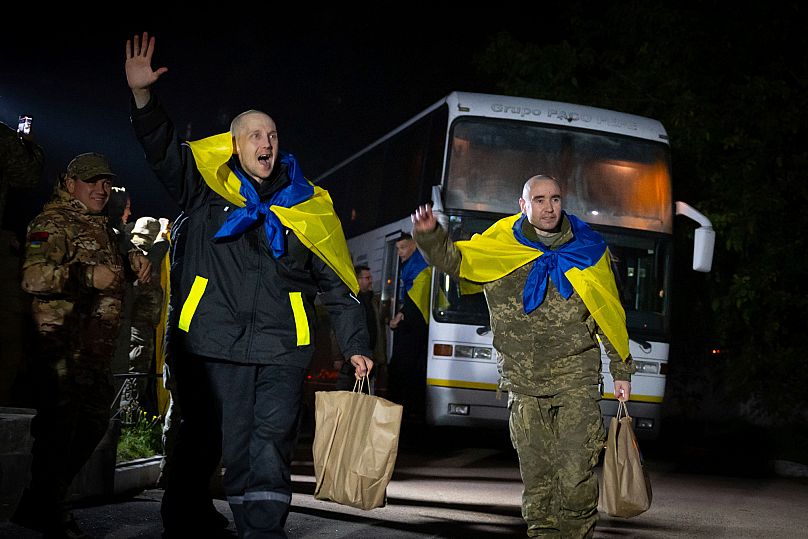 Ukrainian servicemen shout, "Glory to Ukraine," with National flags after returning from captivity during a POWs exchange in an undisclosed location, Ukraine. AP Photo
“We eventually started to joke, sometimes not politely about it, but simply because it was probably the only non-governmental organisation whose mandate was enshrined in international humanitarian law that was supposed to visit us. And this has never happened,” Butkevych recalled.
According to Butkevych, the Russians are only mentioning the Geneva Convention as a "tool for bullying and making false accusations."
Butkevych himself heard about it twice; he recalls: the first time when he was transported with the other Ukrainian pows to the penal colony in the Luhansk region.
“Russian officers told us that we were not prisoners of war at the moment, that we had just disappeared in the war zone and we would become prisoners of war when we were brought to our destination, meaning we could just disappear if we behaved inappropriately," he said.
For the second time, Butkevych says he heard about the Geneva Convention when he was falsely accused of violating it. “It was the second time I saw a reference to the Geneva Convention, but the fourth time to the treatment of civilians in the indictment in the fabricated case against me and in the verdict."
"That is, I was accused of violating the Geneva Convention, on the basis of which I was declared and convicted as a war criminal. This is the only thing they use the Geneva Convention for."
Civilian prisoners in Kremlin's hands
Fully back to his advocacy, Butkevych told Euronews his number one focus and priority is Ukrainian civilians in captivity on Russia-occupied territories.
“If you take into account all those who are looking for their loved ones and struggle to find them, hundreds of thousands of people are concerned about the need to release our civilians who are in Russian captivity. They should be released as soon as possible through an exchange or otherwise,” he said.
And until then, he says, there should be an independent monitoring mechanism to check the conditions of their detention “because, unfortunately, I know about the conditions of detention firsthand from my own experience.” He told the European Parliament about this experience in Brussels.
His specific message to Europe? Stop considering it a local Russian-Ukrainian story.
“Russian activity is now aimed at confirming and destroying the foundations of fundamental values and what is left of the system of international humanitarian law and the international security system, which is important for all other countries in the world," Butkevych said.
"And that is why Ukraine needs to help protect these values of this system."
Three years ago, most of the world gave Ukraine just a handful of days before it would fall to Russia.
However, since then, “Ukrainians have surprised everyone so many times already and have enormous resources to continue to surprise anyone who has a short memory," Butkevych pointed out.
But there is another point, he says, that is less optimistic, especially when it comes to some European countries.
“If, strictly hypothetically, Ukraine fails to achieve its goals without assistance from abroad, it will mean that the ‘Russian World’ will come to them, and they would be surprised, but it may be too late,” Butkevych concluded.
Polish Foreign Minister Radoslaw Sikorski told the Munich Security Conference that any unfavourable peace deal for Ukraine could embolden China in its pursuit of Taiwan.

Poland’s foreign minister Radosław Sikorski has called US President Donald Trump’s decision to hold direct talks with Russian President Vladimir Putin a “mistake”.
Sikorski claimed that failure to ensure a balanced peace deal for Ukraine would weaken US credibility and encourage China to attack Taiwan.
The minister who, along with Polish Prime Minister Donald Tusk, has been highly critical of Trump, made his remarks on February 15 at the Munich Security Conference alongside his British, French and German counterparts.
“I think the call was a mistake,” Sikorski said of Trump’s conversation with Putin on February 12, adding that he had “argued against an early summit”. He claimed it may also “vindicate Putin and lower morale in Ukraine.”
He went on to say that if Trump allowed Putin “to vassalise Ukraine, that will send a message to China that you can recover what you regard as a renegade province – and that would have direct consequences for US grand strategy, for the US system of alliances and for the future of Taiwan”.
He noted that Trump’s predecessor Joe Biden had “planted the US flag in downtown Kyiv and declared on behalf of the United States that the US will be with Ukraine for as long as it takes until Ukraine secures its independence”.
This, according to Sikorski, meant the US was honour bound to seek a fair deal for Kyiv.
“Therefore, the credibility of the United States depends on how this war ends – not just the Trump administration, but the United States,” he said.
Responding to concerns that European leaders would be excluded from peace talks between Ukraine, Russia and the US, Sikorski reminded listeners that Trump had said European troops would need to be in Ukraine as part of a peacekeeping force that would underpin any deal.
“We’ll have to be asked to supply them, so sooner or later we’ll have to be involved,” he said.
That was despite the fact that the Polish Government, while being supportive of Ukraine, has so far refused to entertain the prospect of sending troops to any peacekeeping mission in Ukraine.
As for Trump’s attitude to Europe, Sikorski said he felt the US President was testing his allies.
“President Trump has a method of operation ,which the Russians call ‘razvedka boyem’, ‘reconnaissance through battle’: You push and you see what happens and then you change your position,” he said.
“These are legitimate tactics and we need to respond to them,” Sikorski added.
Finally, in a reference to rumours that the US President was eyeing the Nobel Peace prize, Sikorski quipped that the US President needed to remember “that we Europeans control the Nobel Peace Prize, so if you want to earn it, the peace has to be fair”.
US envoy Keith Kellogg on February 15 said European states would not be present at the negotiations initiated by Trump but, as Sikorski acknowledged when he spoke to reporters on February 16, the US has let its allies know what the negotiating strategy with Russia was to entail.