Thursday, January 08, 2026

Canada Cites Democracy to Support


Trump’s Coup in Venezuela


As part of justifying Donald Trump’s crass imperial aggression in Venezuela, Canadian officials have taken up the mantra of “democracy”.

In one post on the weekend Mark Carney opined about “the democratic will of the Venezuelan people” while in a follow-up statement the prime minister boasted that “Canada has not recognised the illegitimate regime of Maduro since it stole the 2018 election.” But Canadian hostility to the independent, socialist minded government dates to a time when no credible observer questioned the government’s electoral legitimacy.

Ottawa has been hostile to the Venezuelan government for over two decades. The Jean Chretien government wasn’t overly concerned about democracy in April 2002 when the military took President Hugo Chavez prisoner and imposed an unelected government. Ottawa passively supported a coup, which lasted only 48 hours before popular demonstrations, a split within the army and international condemnation returned Chavez. While most Latin American leaders condemned the coup, Canadian diplomats were silent. “In the Venezuelan coup in 2002, Canada maintained a low profile, probably because it was sensitive to the United States ambivalence towards Venezuelan president Hugo Chavez,” writes Flavie Major in Promoting Democracy in the Americas.

Taking up his post three months after the coup, Canada’s ambassador to Venezuela, Allan Culham was hostile to Chávez. According to a WikiLeaks publication of US diplomatic messages, “Canadian Ambassador Culham expressed surprise at the tone of Chavez’s statements during his weekly television and radio show ‘Hello President’ on February 15 [2004]. Culham observed that Chavez’s rhetoric was as tough as he had ever heard him. ‘He sounded like a bully,’ said Culham, more intransigent and more aggressive.”

The US cable quoted Culham criticizing the national electoral council and speaking positively about the group overseeing a presidential recall referendum targeting Chavez. “Culham added that Súmate is impressive, transparent, and run entirely by volunteers,” it noted. The name of then head of Súmate, Maria Corina Machado, was on a list of people who endorsed the coup against Chavez, for which she faced charges of treason. Machado signed the now-infamous Carmona Decree that dissolved the National Assembly and Supreme Court and suspended the elected government, the attorney general, comptroller general, and governors as well as mayors elected during Chavez’s administration. It also annulled land reforms and reversed increases in royalties paid by oil companies.

In January 2005, Global Affairs invited Machado to Ottawa. Machado oversaw Súmate, an organization at the forefront of efforts to remove Chavez as president. Just prior to this invitation, Súmate led an unsuccessful campaign to recall Chavez through a referendum in August 2004.

Canada also financed Súmate. According to disclosures made in response to a question by NDP foreign affairs critic Alexa McDonough, Canada gave Súmate $22,000 in 2005. Minister of International Cooperation José Verner explained that “Canada considered Súmate to be an experienced NGO with the capability to promote respect for democracy, particularly a free and fair electoral process in Venezuela.”

In fact, alongside large sums from Washington, Canada has provided millions of dollars to groups opposed to the Venezuelan government over the past two decades. According to a 2010 report from Spanish NGO Fride, “Canada is the third most important provider of democracy assistance” to Venezuela after the U.S. and Spain. In a 2011 International Journal article Neil A. Burron describes an interview with a Canadian “official [who] repeatedly expressed concerns about the quality of democracy in Venezuela, noting that the [federal government’s] Glyn Berry program provided funds to a ‘get out the vote’ campaign in the last round of elections in that country.” You can bet it wasn’t designed to get Chavez supporters to the polls.

The Stephen Harper government didn’t hide its hostility to Chavez. When Chavez was re-elected president with 63 per cent of the vote in December 2006, 32 members of the Organization of American States — which monitored the election — supported a resolution to congratulate him. Canada was the only member to join the U.S. in opposing the message.

Just after Chavez’s re-election, Harper toured South America to help stunt the region’s rejection of neoliberalism and U.S. dependence or as a Global Affairs official told Le Devoir “to show [the region] that Canada functions and that it can be a better model than Venezuela.” During the trip, Harper and his entourage made several comments critical of the Chavez government. Afterwards the prime minister continued to demonize a government that had massively expanded the population’s access to health and education services. In April 2009 Harper responded to a question regarding Venezuela by saying, “I don’t take any of these rogue states lightly.” A month earlier, the prime minister referred to the far-right Colombian government as a valuable “ally” in a hemisphere full of “serious enemies and opponents.”

After meeting opposition figures in January 2010, Minister for the Americas Peter Kent told the media, “Democratic space within Venezuela has been shrinking and in this election year, Canada is very concerned about the rights of all Venezuelans to participate in the democratic process.”

The head of Canada’s military joined the onslaught of condemnation. After a tour of South America in early 2010, Walter Natynczyk wrote: “Regrettably, some countries, such as Venezuela, are experiencing the politicization of their armed forces.” (A Canadian general criticizing another country’s military is, of course, not political.)

After Chavez died in 2013, Harper declared that Venezuelans “can now build for themselves a better, brighter future based on the principles of freedom, democracy, the rule of law, and respect for human rights.” But when Maduro won the presidential election later that year Ottawa called for a recount, refusing at first to recognize the results.

In response to Venezuela’s economic troubles, the rightward shift in the region and Donald Trump’s hawkishness, Canada ramped up its bid to oust Venezuela’s elected president in 2017. Under Chrystia Freeland’s direction, Canada helped create the Lima Group, imposed sanctions, broke off diplomatic relations, took Venezuela to the International Criminal Court and recognized a marginal opposition figure as president in January 2019.

None of this had anything to do with an equal voice for every Venezuelan. Rather it was about trying to keep a country trying to go its own way in line with the US empire.

Canadian support for the kidnapping of Nicolas Maduro has nothing to do with “democracy”.

Yves Engler is the author of 13 books. His latest book coauthored with Owen Schalk is Canada's Long Fight Against DemocracyRead other articles by Yves.


The US Propaganda Campaign to Smear Venezuela’s New President Delcy Rodriguez


The US “regime change” operation against Venezuela has been defeated. The Bolivarian Revolution remains firmly in power. Now, Washington’s campaign against the Chavistas attempts to paint Interim President Delcy Rodriguez as compromising on the heritage of Presidents Nicolas Maduro and Hugo Chavez. The Wall Street Journal ran an article Venezuelan Regime’s New Strategy: Appease Trump to Survive, referring to Delcy Rodriguez’ official statement January 4 (below).

The Washington Post on January 6 could state “the Trump administration appears to have quietly settled on Delcy Rodríguez, Nicolás Maduro’s right hand, as the figure it prefers to lead Venezuela after Maduro’s fall. This was not an improvised choice. Reportedly, it is the result of prolonged negotiations in which she presented herself as the natural successor to Maduro.” In fact, Venezuela operated according to its constitution, approved in a national referendum, where the vice president takes office if the President cannot fulfill his duties. The vice president is Delcy Rodriguez. Her becoming president follows Venezuela’s highest law. Trump had nothing to do with it.

Trump’s remarks on January 3 that Rodríguez had spoken with Secretary of State Marco Rubio and appeared “quite courteous,” saying “we’re going to do whatever you need,” aimed to sell the story of her acquiescing to Washington. But Rodríguez swiftly contradicted that story hours later, appearing on state television to declare that “there is only one president in this country, and his name is Nicolás Maduro Moros.”

January 5, the Wall Street Journal escalated the campaign to smear now acting President Delcy in an article that came out two days after she assumed presidential powers. It claimed the CIA viewed Delcy as the best-positioned short-term successor to President Maduro. The intention is to make us think the CIA has a special connection with her. In fact, by this time, she was already interim president, and Washington saw it could do nothing about it but sell the story she is there by US choice.

This US fake news campaign seeks to sow division in the Chavista movement and among defenders of Venezuela by instigating rumors that the kidnapping of Maduro involved a “mole,” and that Delcy Rodriguez had a deal with the CIA and Trump.

In addition, much is made of part of her January 4 statement out of its context: “We invite the US government to collaborate with us on an agenda of cooperation oriented towards shared development within the framework of international law to strengthen lasting community coexistence.” Some interpret this as compromising if not a step towards capitulation. In fact, she emphasized Venezuela does not want war, but a “respectful international relationship between the United States and Venezuela, and between Venezuela and the countries of the region, based on sovereign equality and non-interference…That has always been the position of President Nicolás Maduro and it is the position of all of Venezuela at this time.” This is also exactly what Cuba has always asked of the United States.

Her whole statement: Message from Venezuela to the World and to the United States

Venezuela reaffirms its commitment to peace and peaceful coexistence. Our country aspires to live without external threats, in an environment of respect and international cooperation. We believe that global peace is built by first guaranteeing peace within each nation.

We consider it a priority to move toward a balanced and respectful international relationship between the United States and Venezuela, and between Venezuela and the countries of the region, based on sovereign equality and non-interference. These principles guide our diplomacy with the rest of the world.

We extend an invitation to the US government to work together on a cooperation agenda aimed at shared development, within the framework of international law, and to strengthen lasting community coexistence.

President Donald Trump: our peoples and our region deserve peace and dialogue, not war. That has always been the position of President Nicolás Maduro and it is the position of all of Venezuela at this time. That is the Venezuela I believe in, to which I have dedicated my life. My dream is for Venezuela to be a great power where all good Venezuelans can come together.

Venezuela has a right to peace, development, sovereignty, and a future.

Delcy Rodríguez, Acting President of the Bolivarian Republic of Venezuela

Unfortunately, many who should know better fell for the US rulers’ propaganda campaign. A Consortium News piece declared, “Did Venezuela VP Hand Over Maduro in Deal With the US?” Rather than exposing US psyops, which earned it its high reputation, here it gives it legitimacy. Another, Tariq Ali, once a respected Trotskyist anti-war activist, claimed on X that “the US is backing Delcy who has promised them whatever they want.” And reposts long discredited Eva Golinger, “Internal Coup? Was Maduro Betrayed by his VP?” And, “Sure seems like Delcy Rodriguez was the CIA source on the inside who set Maduro up and handed him over to the United States.” None of these smears are based on any evidence.

On January 4, President Trump declared, “If she doesn’t do what’s right, she is going to pay a very big price, probably bigger than Maduro.” Delcy Rodriguez has responded, “The Venezuelan people are a people who do not surrender, and we do not give up…President Nicolas Maduro’s instructions have been given. Let’s go out and defend our homeland…We are ready to defend Venezuela…We will never again be slaves.”

Manolo de los Santos’ excellent article explains who Delcy Rodriguez is. “The Rodríguez family’s revolutionary credentials are etched in struggle. Their father, Jorge Antonio Rodríguez, a leader of the Socialist League, a Marxist-Leninist organization, was tortured and murdered by the Punto Fijo regime in 1976. Both Delcy and her brother Jorge (the President of the National Assembly) emerged from this tradition of clandestine and mass struggle for socialism. President Maduro himself was a cadre of the same organization. To suggest betrayal among them or capitulation born of cowardice or opportunism ignores four decades of shared political formation, persecution, and leadership under relentless imperialist aggression and the class character of their revolutionary leadership.”

Now, not only do we have the US government repudiating the world and international law by invading a country and seizing its president for admitted concocted reasons. We must face the fact that the US psyops system continues to be so effective that it is able to dupe leading long-time opponents of the US empire, like Tariq Ali, into being mouthpieces for its own “regime change” propaganda.

Stansfield Smith, ChicagoALBASolidarity.com, stansfieldsmith100@gmail.com. Stan has been involved in anti-war organizing for 45 years, and has written a number of articles about Venezuela, Bolivia, Cuba, Nicaragua, as well as previous articles related to the subject here. They have appeared in Monthly Review online, Orinoco Tribune, Dissident Voice, Counterpunch, Popular Resistance, and others. Read other articles by Stansfield.

Kidnapping Blues: The Maduro Abduction Precedent

Once done, it remains, by nature and fact, irreversible. The precedent of indicting and abducting a serving head of state and his spouse, dropping them into the jurisdiction of another country to face criminal charges of inventive pedigree (narcoterrorism foremost among them), is the stuff of nightmares in international statecraft. With the now former Venezuelan President Nicolás Maduro and his wife Cilia Flores facing such charges in New York, other world leaders are doubtless feeling a prevailing gloom. Is there anything stopping US President Donald Trump from deploying the US military and law enforcement agents from nabbing the next sitting leader in the middle of the night? Even more broadly, is there anything stopping other States from doing the same?

This is something that has excited discussion in various political quarters, notably in East and Southeast Asia. Regarding the sullen, fleshy North Korean despot, Kim Jong-Un, the question is a pressing one. Certain lawmakers certainly think so. South Korean Rep. Lee Jun-seok, leader of the Reform Party, noted the brazen indifference the Trump administration had taken to renaming Maduro as a “leader of a transnational crime ring” instead of accepting him as a legitimate head of state. “The logic applied to President Maduro could also be applied to the North Korean leader,” reasoned Lee on Facebook. The US Justice Department had, after all, indicted North Korean hackers in 2021, using rather hyperbolic language in describing them as the “world’s leading bank robbers”.

The former mayor of Daegu, Hong Joon-pyo, was similarly confident that the North Korean leader “must have been startled by this.” Here, we were witnessing “a return to the logic of power and the era of imperialism”. That said, the tendency of brutish US power to apprehend and dispose of sovereign heads of state, was not spanking, new exercise. “There was the invasion of Panama in 1989, the arrest of [Manuel] Noriega in 1990, and the United States has also played the role of world’s police in events such as the case of Chile [the overthrow of the Allende government in 1973] and the execution of [Saddam] Hussein.” A truly sterling record.

Kim Dong-yub of the University of North Korean Studies also considered the Maduro precedent “deeply concerning” for Pyongyang, offering the following, tormented formulation: “When an adversary believes decapitation can arrive without warning, under the guise of policing or asset recovery, the rational response is to automate retaliation and compress decision time.” Leaving aside the torturous prose, the nervousness at the prospect of such a fate inflicted by so fickle a world leader is bound to be palpable.

The North Korean leader, for his part, responded to the events in Venezuela with military drills involving the firing of two hypersonic missiles into the Sea of Japan. The activity in question was, according to him, “clearly aimed at gradually putting the nuclear water deterrent on a high-developed basis”. This was “necessary” because of “the recent geopolitical crisis and complicated international events”. Kim also expressed pride in the “important achievements” that had been made in preparing the country’s nuclear forces “for an actual war”.

North Korea’s Foreign Ministry was less oblique in a statement on Maduro’s fate. “The incident is another example that clearly confirms once again the rogue and brutal nature of the US, which the international community has so frequently witnessed for a long time”.

In Southeast Asia, the abduction precedent particularly troubled the Malaysian Prime Minister Anwar Ibrahim. “The leader of Venezuela and his wife were seized in a United States military operation of unusual scope and nature,” he brooded in a social media post. “Such actions constitute a clear violation of international law and amount to an unlawful use of force against a sovereign state.” Irrespective of the reasons behind the move, “the forcible removal of a sitting head of government through external action sets a dangerous precedent”, eroding “fundamental restraints on the use of power between states and weakens the legal framework that underpins international order.”

Malaysia’s neighbour, Indonesia, was similarly troubled by the Maduro precedent. A January 5 statement from the Ministry of Foreign Affairs expressed “grave concern over any actions involving the use or threat of force, which risk setting a dangerous precedent in international relations and could undermine regional stability, peace, and the principles of sovereignty and diplomacy.”

In the Philippines, the official response, given the security ties between Manila and Washington, was less testy. It was left to various lawmakers to state a few troubling truths. Rep. Perci Cendaña of the left-wing Akbayan Party-list saw the actions of the Trump administration as birds of a feather with the “similar aggressive acts of Russia in Ukraine and China in the West Philippine Sea”.

Mamamayang Liberal Party-list Rep. Leila de Lima considered the operation against Venezuela one of disturbing redux, the US having again morphed “into an aggressor state” and sabotaging the rules-based international system. In doing so, its conduct had normalised the actions of Russia in the ongoing Ukraine War, Chinese expansionist aggression in the South and East China Seas, and Israel’s genocidal policy against the Palestinians. It was time, she opined gravely, to consider her country’s reliance on the US “for moral leadership on the world stage and as an ally for regional security and a rules-based international order.”

With the thuggish Donroe Doctrine running with strapping vigour, and the Trump administration hungering for additional scalps in its name, de Lima’s sentiments, along with those of her colleagues, are hard to fault.

The US Justice Department, Fake Cartels, and Maduro


A Shameful Sham


The Trump administration is increasingly resembling a government previously abominated by the current US president as entangling, bumbling, and prone to fantasies. President George W. Bush was well versed in baseless existential threats stemming from Mesopotamia, supposedly directed by the Iraqi dictator Saddam Hussein. There was a critical problem in this assessment: in his dry drunk state, Bush was criminally wrong, proposing a doctrine in response to the attack by al-Qaeda on the United States on September 11, 2001 heavy on violence and slim on evidence.

The patchy formulation came to be known as the Bush Doctrine, permitting the United States to unilaterally and pre-emptively attack any country allegedly posing a threat to its security despite never evincing any genuine means of doing so. There would also be, Bush stated in his address to the nation, “no distinction between the terrorists who committed these acts [of 9/11] and those who harbor them.”

Such streaky reasoning eventually fastened upon Iraq’s alleged Weapons of Mass Destruction (WMDs), apparently at the ready to strike the US and its allies. If not Baghdad, then certainly an opportunistic terrorist proxy would be more than willing to deploy them. In his 2003 State of the Union Address, Bush solemnly stated that “the gravest danger facing America and the world, is outlaw regimes that seek and possess nuclear, chemical, and biological weapons.” Such weapons might be used “for blackmail, terror, and mass murder” or provided or sold “to terrorist allies, who would use them without the least hesitation.”

As the 2003 US-led invasion of Iraq proceeded with its increasingly bloody bill of sale, there were no WMDs to be found. Saddam, foolishly as things would have it, destroyed or disarmed those weapons he had made free use of in the Iran-Iraq War. This hardly mattered. There was shoddy intelligence aplenty, including false claims that Iraq had tried to purchase 500 tons of yellowcake uranium powder from Niger, and cloudy lines of cooperation between Baghdad and al-Qaeda. With school boyish enthusiasm being shown by the evangelical UK Prime Minister, Tony Blair, the Saddam threat ballooned for Bush. Neoconservatives rejoiced at this chance of cratering, erasing and reforming the Middle East.

The Donroe Doctrine, childishly envisaged and clumsily applied, has an unmistakable analogue with that of Bush. In repurposing the Monroe Doctrine for the Western Hemisphere, excluding threatening foreign interests in Latin America and extinguishing governments adversarial or unsympathetic to the United States, Trump scorns the evidence. A fundamental reason for abducting President Nicolás Maduro of Venezuela, by way of example, was accusing him of being a narco-terrorist amenable to nasty foreign interests. Elevating his stature as a threat, he was accused of being a figure of the Cartel de los Soles (Cartel of the Suns).

This pattern stretches back to the first Trump administration, when a grand jury indictment alleged that Maduro, along with other officials, “participated in a corrupt and violent narco-terrorism conspiracy between the Venezuelan Cártel de Los Soles and the Fuerzas Armadas Revolucionarias de Colombia”. Five years later, when the Treasury Department retrieved the initial text, the Cartel was designated a “terrorist organization”. Come November 2025, US Secretary of State Marco Rubio directed the State Department to do the same.

With an eerie sense of the past cantering into the present, we find the US Justice Department conceding that there was no link between Maduro and this sinister cartel. This stands to reason, given that the group does not exist as a tangible organisation. The allegation has long been contentious, but those close to Trump were not willing to be swayed by that dullest compendium of subject matter unfashionably called “the facts”.

Believers in virgin births, tooth fairies and Sky Gods sometimes intrude into the making of American foreign policy, and Rubio, in justifying extrajudicial killings of those on board alleged narco-vessels in the Caribbean Sea by US military forces had this to say: “We will continue to reserve the right to take strikes against drug boats that are bringing drugs toward the United States that are being operated by transnational criminal organisations, including the Cartel de los Soles.”

The 2020 indictment mentioned the cartel no fewer than 32 times. The new indictment makes a mere two references to a term that has ceased to be an entity and become a concept, revised as a “patronage system run by those at the top.” It does not feature as an organisation along with the list of alleged “narco-terrorists” outlined in the fourth paragraph.

Those versed in the slippery argot of drug trafficking in Latin America have concluded that the Cartel de los Soles is a colloquialism minted by Venezuelan media to out despoiled officials sporting the sun insignia on their uniforms. It became a matter of usage in the 1990s, making it less a description of organisational reality than identifying a broader system of corruption.

From the outset, Venezuelan figures such as interior and justice minister Diosdado Cabello dismissed the cartel as the product of a fevered imagination. In August last year, he coolly remarked that US officials, when bothered, would name the target of their indignation “the head of the Cartel de los Soles”. The organisation makes no appearance in the United Nations’ annual World Drug Report, preferring to reference Mexico’s Sinaloa Cartel, and Brazil’s Primeiro Comando Capital (PPC) and Comando Vermelho (CV). The US Drug Enforcement Agency’s annual National Drug Threat Assessment makes reference to the Venezuelan Tren de Aragua, “a violent criminal organization founded between 2012 and 2013” that “mainly operates within Venezuelan migrant communities” in the United States. No favours are done naming the Cartel de los Soles, however.

The rewritten indictment against Maduro reveals how presidential doctrines can be used to force evidence upon a Procrustean bed, sawing or extending it to fit the set dimensions of a dogma. The crime of aggression against Iraq in 2003 was based upon forged evidence, implausible links and flimsy assumptions. The crime of aggression against Venezuela on January 3 reprised the performance. Instead of a uranium hoax, we got the Cartel of the Suns.

Binoy Kampmark was a Commonwealth Scholar at Selwyn College, Cambridge. He lectures at RMIT University, Melbourne. Email: bkampmark@gmail.comRead other articles by Binoy.


(Statements): Oppose US imperialism’s assault on Venezuela


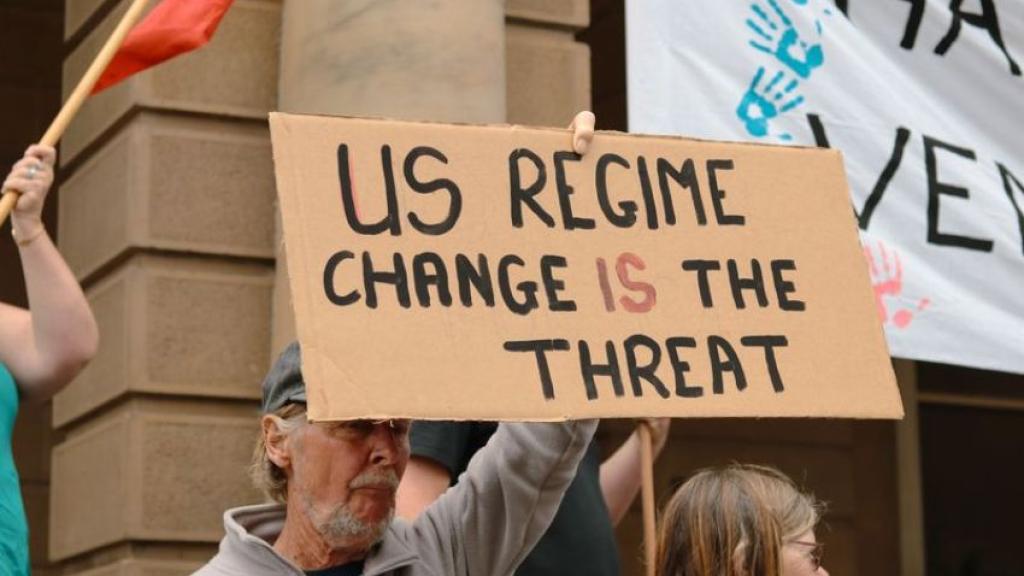
US regime change is the threat

Statements opposing the US military assault on Venezuela and kidnapping of President Nicolas Maduro and National Assembly MP Cilia Adela Flores de Maduro from Socialist Alliance (Australia), United Left Platform (United States), Indonesian left groups and trade unions, Partido Lakas ng Masa (The Philippines), Socialist Party of Malaysia, Communist Party of India (Marxist-Leninist) Liberation, and Social Movement (Ukraine)

Australia: No war on Venezuela! Scrap AUKUS!

Socialist Alliance, January 4

Socialist Alliance strongly condemns United States President Donald Trump’s military invasion of Venezuela and demands that the Australian Labor government rejects the US’ flouting of international law and breaks the AUKUS war alliance.

We stand with the people of Venezuela who are defending their sovereignty and support the emergency protests being organised across the country.

The US’ bombing of at least two military bases in Venezuela’s capital, Caracas, and its abduction of Venezuelan President Nicolás Maduro and his wife Cilia Adela Flores de Maduro is a reminder of Trump’s lawlessness and lack of commitment to democracy.

This latest act of war comes after illegal attacks over the past few months, including the US navy blowing up small boats near the Venezuelan coast and Colombia’s Pacific coast. More than 100 people have been killed this way.

The US military build-up, including warships, planes and soldiers in the Caribbean, is being posed as necessary to fight drug trafficking and narcoterrorists, despite no evidence being produced.

US imperialism’s plan is to impose full dominance through various means including: military (target strikes, threats of war); economic (tariffs, naval blockade); and political (support for far-right allies).

For more than 20 years, the US has been trying to overthrow the government of Venezuela, which was led by President Hugo Chavez from 1999 until his death in 2013, and which is now led by Maduro.

It has supported attempted coups and imposed an economic blockade preventing Venezuela from participating in international trade. The US sanctions have caused great suffering to the Venezuelan people.

The attack on Venezuela is US imperialism’s latest attempt to install a pro-US government there, even though the Trump administration has said it would rule Venezuela for now.

Venezuela and Colombia have criticised Trump’s policies in the Middle East, including US support for Israel’s genocide in Gaza.

The US has repeatedly declared it wants control of Venezuela’s oil deposits - one of the largest in the world. It also made this clear by seizing Venezuelan oil tankers.

Socialist Alliance is also deeply concerned by the outright flouting of international law this attack represents and the lack of criticism from the Labor government.

Labor must immediately condemn the US extrajudicial attacks and break the US war alliance – which AUKUS represents.

The US has said Colombia, Mexico and Cuba are next in line for such aggression. Australia must not agree to Trump’s new Monroe doctrine. Albanese must call out the US’s attack on a sovereign country.

All those who support democracy and the rule of law should step up solidarity with the peoples of the Americas and help build the broadest possible campaigns to defend self-determination there.

We must also pressure Labor to break its alliance with US imperialism, including cancelling the AUKUS agreement and closing US military bases.

Socialist Alliance encourages you to join your local “Hands off Venezuela” rallies.

We support a foreign policy based on peace and justice therefore we demand;

  • Stop US attacks on Venezuela!
  • Stop the US military operations in the Caribbean and withdraw all warships, planes and troops!
  • Stop all US interference and interventions in Latin American domestic politics!
  • Shut down US military bases in Australia!
  • Scrap AUKUS now and break from the US military alliance!
  • Immediate release of Nicholas Maduro and his wife Cilia Adela Flores de Maduro

United States: United Left Platform calls for mass resistance to US imperialist attack on Venezuela

The United Left Platform, January 6

The United Left Platform, a coalition of revolutionary socialist organizations in the U.S., completely and unequivocably condemns the Trump administration’s illegal and unwarranted military attack on Venezuela and kidnapping of President Nicolás Maduro and his wife, Cilia Flores, the former President of Venezuela’s National Assembly. This aggression poses an ominous threat to any power or person that stands in the way of Trump’s effort to secure U.S. imperial control over Latin America, its most important “sphere of influence.”

In the dead of night in the early morning of January 3, U.S. military forces attacked the Fuerte Tiuna military base in Caracas where Maduro was thought to be residing as well at the La Carlota airport and Higuerote airport to the east of Caracas. Air strikes by planes and helicopters were also reported at La Guaira and Aragua states. The elite army unit Delta Force captured Maduro and Flores and flew them in chains to a prison in New York.

In comments made hours after the assault, code-named Operation Absolute Resolve, Trump made it clear that the attack is but the beginning of his effort to take direct control of Venezuela. “We will run the country until we have a just transition—we can’t take the chance that someone other than us takes over Venezuela,” he stated, adding, “we are willing to wage a second and much larger attack—we are ready to do so right now.”

We should be under no illusions that Trump intends to allow any political power or personage to run Venezuela that is not under the control of the U.S. This is not just regime change—it is a formula for possible occupation, beginning with the U.S. taking total control of Venezuela’s oil and mineral resources.

Whether or not the Trump regime succeeds in this outrageous display of imperial arrogance depends on developing the strongest and broadest possible opposition to his efforts by those of us in the U.S., in Venezuela, and internationally. We urge everyone opposed to war and neocolonial domination to make your voices of opposition heard in the streets, workplaces, and unions.

As revolutionary socialists, we have no illusions about the nature of the Maduro regime, which was neither revolutionary nor socialist. However, the present and future of Venezuela is not for anyone to decide other than the people of Venezuela. We stand with all who seek to defend its right to self-determination.

Trump’s claim that the administration is motivated by controlling the shipment of drugs to the U.S. has no more basis in reality that his assertion that “crime has been totally eliminated” in Washington, DC and other cities by sending in the national guard. Less than 10% of drugs entering the U.S. come from Venezuela, while Trump recently pardoned one of the biggest drug kingpins in Central America, former President Juan Orlando Hernández of Honduras. His attacks on vessels off the coast Venezuela that have killed 110 people in recent months, like the January 3 assault and kidnapping that has killed untold numbers of others, is largely driven by his desire to obtain control of a country with the largest known oil reserves on earth.

However, the attack on Venezuela is not only about oil. Also in play is the effort to enact the Trump Doctrine that proclaims the U.S. now has the right to intervene anywhere it wishes at any time to secure total control of its most important spheres influence—while acknowledging Russia’s and China’s efforts to dominate their respective spheres so long as it coincides with U.S. interests. This is the multipolar imperialism that has now emerged with the collapse of the much heralded (but failed) neoliberal world order. As Trump declared in boasting of the U.S. seizure of Maduro, “America will never again allow foreign powers to drive us out of our own hemisphere.” We must combat this reactionary agenda by engaging in mass resistance to the U.S. attack on Venezuela.


Indonesia: Stop US imperialist military aggression, free Maduro!

Initiated by GEBRAK, January 8

On Saturday, January 3, 2026, at 2:00 a.m. local time, the United States (US) imperialists launched a military attack on Caracas, El Higuerote, Miranda, La Guaira, and Aragua, Venezuela. The attack was accompanied by the kidnapping of President Maduro and his wife. The attack killed at least 40 Venezuelans. US President Donald Trump also ordered a blockade of all oil distribution in and out of Venezuela. This demonstrates the true intentions of the US imperialists in attacking Venezuela. This step is the culmination of a series of criminal acts by US imperialists against the sovereign nation of Venezuela, which has never provoked and has never posed a direct military threat to the United States.

A series of recent US imperialist operations have included outright piracy on the high seas, bombing and shooting at small boats in the Caribbean, and the massacre of Venezuelan citizens on board. These victims were almost certainly innocent fishermen. These actions also included the seizure of tankers carrying Venezuelan oil – and the seizure (read: theft) by the United States. All of these operations were carried out under the pretext of eradicating Venezuelan drug gangs, culminating in Maduro being accused of being a ' narcoterrorist'. Although there has never been any hard evidence to prove this.

The US monopoly seeks to impose its interests through threats, economic warfare, illegal blockades, political pressure, and brutal military force. These plans constitute coercive measures that not only violate sovereignty and international law but also threaten the peace, stability, and right to life of the Venezuelan people and the security of the Latin American region as a whole. These actions are the most blatant manifestation of modern imperialism, which seeks to shackle a free nation.

Equally important, as members of the working class and people's movements, we affirm that imperialism, war, and blockades have deepened the oppression of women. The US stranglehold has worsened access to food and healthcare, increased the burden of unpaid care work, and increased the risk of sexual violence, reproductive health damage, and structural impoverishment.

War and militarism are the most extreme manifestations of women's oppression, a system that normalizes violence, domination, and conquest. Within the framework of imperialism, women's bodies, the bodies of the people, and nature are treated as legitimate objects to be controlled, exploited, and sacrificed for the sake of power and capital accumulation. US imperialists openly stated in front of the mass media that they were targeting Cuba, Mexico, and also Colombia. This is an alarm for world democracy and international law. US imperialists clearly violated Article 2 paragraph (4) of the UN Charter which states:

Each member state is prohibited from using or threatening the use of force against the territorial integrity or political independence of any other state, or in any manner inconsistent with the purposes of the United Nations.

The military attack on Venezuela and the statement sent a clear message that the US intends to dominate and subjugate the entire continent by mercilessly punishing any government that stands in its way. A method more akin to the mafia than to international peace.

Today, we must face the reality that Venezuela, a small Latin American country, is at a significant disadvantage when confronted with the overwhelming military might of US imperialism. The solidarity of the working class and people worldwide is urgently needed to delegitimize US imperialist aggression. Therefore, GEBRAK and the organizations listed in this statement declare:

  1. Reject military intervention against Venezuela!
  2. Free Maduro immediately!
  3. Stop the US economic embargo on Venezuela!
  4. Stop cooperation with US imperialists!

On behalf of the Labor Movement with the People and supported by:

KASBI CONFEDERATION, KPBI, ​​SGBN, KSN, SYNDICATION, JARKOM SP BANKING, KPA, SEMPRO, KPR, FPBI, SMI, LMID, FIJAR, LBH JAKARTA, YLBHI, FSBMM, FSPM, FKI, SPAI, WALHI, GREENPEACE, TREND ASIA, COMRADE, ALLIANCE OF INDEPENDENT JOURNALISTS, KONTRAS, BEM STIH JENTERA, SPK, RUMAH AMARTYA, PEMBEBASAN, LIPS, MAHARDHIKA WOMEN, KSPTMKI, DFW, PKBI, SOCIALIST UNION, SOCIALIST YOUTH ORGANIZATION, PPR, FMN, GMNI JAKSEL, SPRI, SEMARAK UPNVJ, AMP.


The Philippines: Oppose the criminal US attacks on Venezuela!

Partido Lakas ng Masa, January 4

There is only one word to describe the United States’ attack on Venezuela: criminal. Invading a sovereign country, bombing its cities, and kidnapping its elected president are crimes under international law. These actions are not an aberration—they express the true character of the US empire, which rules through war, coercion, and terror.

A bipartisan war on Venezuelan sovereignty

The current assault is the product of a US bipartisan politics of decades-long campaign to destroy Venezuelan sovereignty since the people elected Hugo Chávez in 1998. That democratic choice initiated a redistribution of wealth, expanded popular education, and guaranteed free healthcare to millions long denied these rights—directly challenging imperial control over Venezuela’s resources and future.

The Clinton administration applied political pressure and financed right-wing opposition forces. The George W. Bush administration backed the failed 2002 coup. After Chávez’s death, the Obama administration escalated sanctions and in 2015 branded Venezuela an “extraordinary threat.”

Trump intensified economic warfare and open threats, while the Biden administration largely preserved the sanctions regime that devastated popular living conditions. Trump pulled the trigger, but every administration before him loaded the gun.

The Monroe Doctrine reborn: NSS 2025

This aggression is now openly codified in US doctrine. The 2025 National Security Strategy explicitly revives and hardens the Monroe Doctrine:

After years of neglect, the United States will reassert and enforce the Monroe Doctrine to restore American preeminence in the Western Hemisphere… We will deny non-Hemispheric competitors the ability to own or control strategically vital assets in our Hemisphere.

The “Trump Corollary” on the Monroe Doctrine is clear: total domination of the Americas, control of strategic assets and supply chains, and the replacement of independent governments with compliant ones. Venezuela—rich in oil, minerals, and strategic position—is a primary target.

Sanctions as economic warfare

Sanctions have been a central weapon in this war. They were designed to strangle the economy, deepen hardship, and break popular resistance. Yet despite immense suffering, Venezuela has endured, reorganized, and pursued greater self-sufficiency under siege.

War for profit: US corporations move in

The motives are no longer hidden. Even as bombs fall, US corporations are already circling like vultures.

According to the Wall Street Journal, senior figures from hedge funds and asset management firms are preparing a trip to Venezuela to scope out “investment opportunities,” particularly in energy and infrastructure.

This is imperial war in practice: destruction first, privatization and plunder next.

Escalation across Latin America

The danger does not stop at Venezuela. According to the New York Times, the real problem is not Washington’s aggression, sanctions, or regime-change policy—but Cuba. In a familiar Cold War reflex, socialist Cuba is once again cast as the hidden hand behind Venezuelan resistance, blamed for undermining “democracy” and obstructing US objectives.

This serves one purpose: to deflect responsibility from US imperialism and reassert the doctrine that no independent political project in Latin America is acceptable unless approved by Washington.

Trump is now openly threatening Mexico and Colombia, laying the groundwork for further intervention. He has declared: “The cartels are running Mexico… something is gonna have to be done with Mexico.”

Trump called out Colombian President Gustavo Petro by name, accusing him without evidence of “making cocaine and sending it to the United States.” “So he does have to watch his ass,” the US president said of Petro, who condemned the Trump administration’s Saturday attack on Venezuela as “aggression against the sovereignty of Venezuela and Latin America.”

This is the language of imperialist prerogative—the assertion that Washington alone decides which governments are legitimate and which countries require US military action. It signals a widening assault on sovereignty across the hemisphere.

Kidnapping, killings, and lies

We denounce the US kidnapping of President Nicolás Maduro and First Lady Cilia Flores. Maduro is now being paraded in Trump’s media establishment in a dehumanizing way as an example to threaten other countries’ opposition to the US imperial might. Any detention, disappearance, or removal of Venezuela’s elected leadership is a grave crime and an act of war.

We condemn the killing of Venezuelan civilians and military personnel and honor those who have died defending their homeland.

We categorically reject the use of fabricated pretexts—including false drug accusations and recycled anti-Cuba hysteria—to justify imperialist violence. These lies are standard tools of intervention and plunder.

A call to oppose imperialist war

This attack must be opposed by all who claim to stand for peace.

Those on the Left who have disagreements with the Maduro government must set them aside and oppose imperialist aggression without qualification.

The assault on Venezuela is part of a wider global escalation. The United States has attacked Nigeria, threatened Iran, and continues to arm Israel as it carries out genocidal violence against Palestinians while bombing Lebanon and Syria. The world is being driven toward a broader war.

History shows where unchecked imperial aggression leads. The last time the world stood this close to catastrophe was when fascist powers invaded their neighbors with impunity. Those acts were rightly condemned as reckless and criminal. The same judgment applies today.

Our demands

We call on peoples and movements worldwide to mobilize in active solidarity with Venezuela—with Latin America, and all nations under threat—to resist this criminal assault on sovereignty, peace, and self-determination.

Now is the time for Left and progressive forces worldwide to unite against imperialist aggression.

We specifically demand that the Government of the Philippines publicly condemn this attack and uphold the principles of national sovereignty and non-intervention.

US Hands Off Venezuela!
Release Maduro Now!
Hands Off Latin America!
No More Wars for Oil!
Imperialism Will Not Prevail!


Malaysia: PSM condemns the US invasion of Venezuela

Parti Sosialis Malaysia, January 3

Parti Sosialis Malaysia (PSM) condemns in the strongest terms the United States’ blatant military invasion of Venezuela- a sovereign country. This act is a violation of international law, the UN Charter, and the fundamental right of nations to self-determination.

The United States has once again revealed its true face , a global bully driven not by human rights or democracy, but by an insatiable greed for oil and minerals. Venezuela’s only “crime” in the eyes of Washington is its vast natural wealth, which the American empire now seeks to plunder by force.

This is not an isolated incident but part of a long, brutal pattern: the U.S. destabilizes, invades, and installs puppet regimes across the world from Iraq and Libya to Latin America; leaving behind chaos, suffering, and broken nations.

We stand in solidarity with the people of Venezuela and their legitimately elected government. We reject all forms of foreign intervention, subversion, and regime-change operations orchestrated by Washington and its allies.

We call on the international community, the United Nations, and all justice-loving nations to support Venezuela’s sovereign right and Demand an unconditional U.S. withdrawal from Venezuelan territory.

If the world remains silent today, no sovereign nation will be safe tomorrow. This is not just Venezuela’s fight from American imperialism. Either we unite to resist this aggression, or we risk neocolonial subjugation once again.

The time for solidarity is now. Stop the invasion. End U.S. imperialism.

S. Arutchelvan
Deputy Chairperson


India: Condemn the US imperialist war on Venezuela! Stand with the people of Venezuela in defence of their sovereignty!

CPI(ML) Liberation, January 3

The people of Venezuela are under attack! In the early hours of January 3, U.S. under the Trump administration unleashed a criminal war of aggression against the people of Venezuela. Reports confirm brutal bombing and military invasion targeting the capital city of Caracas. A social media post by Donald Trump even claims that President Maduro and his wife have been captured and flown out of Venezuela. 

This war is not just against Venezuela, but an open threat against every people in the region and across the world who strive to determine their own future free from imperialist dictates. 

The same lies used to justify the invasion of Iraq, the seizure of its oil, and the devastation of its people are now recycled as so-called “narco-terrorism” to justify a regime-change operation against President Maduro and the plunder of Venezuela, a country with largest oil reserves in the world.

Trump’s war on the people of Venezuela aims to impose a U.S.-backed colonial order. It seeks to crush the Bolivarian Revolution that overthrew a U.S.-supported oligarchy and returned the nation’s oil wealth to the people. The war is to seize Venezuela’s oil once again for U.S. multinational corporations and install a puppet government to serve imperialist interests.

This war is the latest chapter in the bloody history of U.S. intervention across Latin America and the Caribbean, manipulating elections, overthrowing democratically elected governments, subjugating people’s movements, unleashing bloodshed, and imposing destruction. From Guatemala to Chile, from Grenada to Panama, the U.S. Monroe Doctrine, which treats the Latin American region as its “personal backyard” and which Trump seeks to reinforce, has always meant subjugation, exploitation, and repression, denying the peoples of the region their right to sovereignty and self-determination.

Stand in unyielding solidarity with the people of Venezuela as they defend their sovereignty and their right to determine their own political and economic course, free from imperialist interference.

We call upon all democratic and peace-loving forces worldwide to stand against this imperialist aggression and the attempts to impose a new order of colonial subjugation under the Trump regime.

Hands off Venezuela!
Down with U.S. imperialism!


Ukraine: Oppose US aggression against Venezuela

Social Movement, January 3

The morning of 3 January marks the beginning of a widespread attack on democracy and the relative peace of the peoples of Latin America – and far beyond.

The events in Venezuela, where US military operations led to the capture of President Nicolás Maduro and the declaration of a state of emergency with mobilisation, are yet another manifestation of the escalating imperialist confrontation, the consequences of which will be felt by millions of people across the continent.

The actions of Donald Trump’s administration cannot be viewed as an isolated incident or a ‘forced response’ to the crisis. As before – from the bombing of small vessels in the Caribbean and Pacific Oceans to the sanctions blockade – this is a demonstration of the United States’ power and complete readiness to use violence without trial, investigation or any regard for international law. Pretexts such as the fight against drug trafficking and cartels are used to legitimise aggression. Until recently, the majority of drug precursors were produced in China. The share of drug trafficking through Venezuela is negligible compared to other countries in the region and sea routes.

Excuses about fighting against the ‘drug cartel-linked leadership’ seem particularly cynical in light of Trump’s recent amnesty of former Honduran President Hernández from an American prison – he was sentenced to a long term for involvement in cocaine trafficking, but was released to help his allies in the last election. As in the case of the ‘fight against terrorism,’ the real goal is not protection, but control over oil and mineral resources and the establishment of a regime loyal to Washington.

At the same time, it is necessary to call a spade a spade: Nicolas Maduro’s regime is authoritarian, repressive and deeply corrupt. It has nothing to do with socialist democracy, hiding behind the legacy of Hugo Chavez and Bolivarian rhetoric. Along with the devastating US sanctions, it is the Maduro government’s policies that are responsible for the economic collapse, social catastrophe, extrajudicial killings, malnutrition and mass emigration of millions of Venezuelans. The Maduro leadership has nullified the achievements of the mass movements and social programmes of the Chávez era, instead discrediting left-wing ideas in the region. Parasitising on the population, the regime is sustained by the security forces, restrictions on freedoms and external support, primarily from Russia.

The Kremlin has become one of Caracas’ key allies in maintaining its authoritarian model of government. Russian Foreign Minister Sergey Lavrov has visited Venezuela on numerous occasions, including in April 2023, as part of a tour of Brazil, Venezuela, Nicaragua and Cuba aimed at mobilising political support for Russia’s war against Ukraine. Although not as notorious as Daniel Ortega, the traitor of the Sandinista revolution in Nicaragua, President Maduro declared his ‘full support’ for Russia from the very beginning of the full-scale invasion, and state institutions and the media actively promoted the Kremlin’s interpretation of events.

However, it would be a grave mistake to equate the Maduro regime with Venezuelan society.

Despite widespread propaganda, most Venezuelans did not accept pro-Russian narratives. In the early days of Russia’s invasion of Ukraine in 2022, people took to the streets to protest against the aggression – in a country where demonstrations are regularly criminalised and dispersed. Venezuelans carried Ukrainian flags, chanted ‘Stop Putin’ and openly criticised their government’s alliance with the Kremlin.

This solidarity with Ukraine has deep roots. Since the days of Euromaidan, many Venezuelans have seen the Ukrainian struggle as close and understandable – a struggle against corrupt authorities, external control and authoritarianism. Sympathy for Ukraine stems not only from anti-war sentiments, but also from a rejection of foreign influence, which is crucial to the survival of Maduro’s regime, as well as that of Vladimir Putin – both of whom are under investigation by the International Criminal Court.

Despite widespread propaganda, most Venezuelans did not accept pro-Russian narratives. In the early days of Russia’s invasion of Ukraine in 2022, people took to the streets to protest against the aggression – in a country where demonstrations are regularly criminalised and dispersed.

Since 1999, Ukraine and Venezuela have been building friendly relations, which began under Ukrainian Foreign Minister Borys Tarasyuk, who was received by then-Venezuelan President Hugo Chávez. It is noteworthy that José David Chaparro, the Venezuelan consul in Russia during Chávez’s time, joined the International Legion of Territorial Defence of Ukraine in 2022 and was involved in rebuilding cities destroyed by Russian troops.

That is why the current US aggression cannot be justified even by criticism of Maduro. By proclaiming in its recent National Security Strategy its desire to return Latin America and the Caribbean to the role of a subordinate ‘backyard’ in the spirit of the Monroe Doctrine, American imperialism seeks to ‘clean up’ the region of any regimes that do not fit in with its economic and geopolitical interests, while at the same time strengthening the far-right forces.

That is why the current aggression of the United States cannot be justified even by criticism of Maduro. By proclaiming in its recent National Security Strategy its desire to return Latin America and the Caribbean to the role of a subordinate ‘backyard’ in the spirit of the Monroe Doctrine, American imperialism seeks to ‘clean up’ the region of any regimes that do not fit in with its economic and geopolitical interests, while strengthening ultra-right forces.

The isolation of Colombia’s progressive government and threats to a similar government in Mexico, the strengthening of an alliance with the far-right regime in Argentina at the expense of American taxpayers, support for neo-fascist revanchists in Brazil led by Jair Bolsonaro, and the use of Bukele’s notorious mega-prison in El Salvador to hold deportees from the United States are all part of a single strategy to restore Washington’s hegemony in Latin America.

It is significant that during Trump’s previous term, Venezuelan affairs were overseen by the same Elliot Abrams who was responsible for training, during the Reagan era, the ‘death squads’ of anti-communist dictatorships that carried out more than 90% of the crimes of civil wars in Central American states, such as the murder of about a thousand residents of the village of Mosote in El Salvador.

An externally imposed ‘regime change’ will only deepen the social catastrophe. Like Trump’s racist policy towards Venezuelan refugees, this war is a continuation of a policy of contempt for human life. Even if there are no immediate mass casualties (the 1989 invasion by US Marines to remove the dictator and drug trafficker Noriega, who until recently had been a CIA client in the fight against revolutionary movements in the region, resulted in at least hundreds of civilian deaths), external destabilisation will result in further internal turmoil.

In addition, the potential rise to power of the ‘Trumpist’ wing of the opposition poses a danger. Just as Maduro is a caricature of socialism, the ultra-right and ultra-capitalist course of María Corina Machado is a caricature of the democratic movement. After receiving the Nobel Peace Prize, she emphasised in every way possible that she would prefer to give it to Trump and would support his intervention against her own country. In contrast, the left-wing opposition to Madurism, which is increasingly attracting disillusioned former supporters of the Bolivarian revolution, emphasises the unacceptability of a military scenario and the fact that the fate of Venezuela should be decided by Venezuelans themselves, not by imperialist leaders.

The struggle against Maduro’s dictatorship and the struggle against American imperialism are not mutually exclusive. These are two sides of the same conflict, in which nations become hostages to geopolitical games. That is why today we must speak of solidarity with the people of Venezuela – the same solidarity that Venezuelans showed towards Ukraine in its resistance to Russian aggression.

The people of Venezuela are fighting against the imperialist yoke and are hostages of Maduro’s predatory regime.

Venezuela, we too are resisting imperialism!


There’s more to oil: Why Venezuela demands a deeper analysis of US imperialism


US tanker

First published at TNI.

The slogan “No Blood for Oil” has echoed through anti-war demonstrations for decades, crystallising a powerful intuition about capitalist imperialism: that great powers wage war for resource control. Trump’s seizure of Nicolás Maduro invites the familiar framing. Yet the logic unfolding in Venezuela reveals something more complicated than straightforward resource extraction. Understanding it requires moving beyond the twentieth-century narrative of crude-seeking colonialism that still dominates left analysis of global politics and economics.

Marco Rubio stripped away the ambiguity. Speaking to NBC News, he declared: “We will not allow the oil industry in Venezuela to be controlled by opponents of the United States.” He named China, Russia, and Iran. The Western Hemisphere, he insisted, “belongs to us.” This is geopolitical containment language. Venezuela matters because it has become one of Beijing’s “all-weather strategic partners” in Latin America – a phrase Washington has come to regard as a regional challenge to its authority. China has extended roughly $106 billion in loans to Venezuela since 2000, placing it fourth among recipients of Chinese official credit globally. That financial binding and China’s growing influence in the region are what the US operation targets, not the oil itself.

The material reality of Venezuelan crude further complicates any straightforward extraction narrative. Three-quarters of the 300 billion barrel reserve consists of extra-heavy Orinoco crude: bituminous, viscous, heavily sulphurous, and prohibitively expensive to extract and refine. Global oil majors built the US Gulf Coast’s complex refineries specifically to process this grade, but at realistic long-term prices, the economics are punishing. When oil prices peaked during 2005-2014, Venezuela inflated its “proved reserves” on paper through optimistic assumptions that have since collapsed. Today, with institutional capacity eroded by underinvestment and purges, reconstruction would demand $185 billion over 16 years and complete confidence from international capital, unlikely under any managed transition.

The arbitration claims by ExxonMobil and ConocoPhillips, now presumably to be weaponised by Washington, add layers of legal and financial complexity. These cases rest on $45 billion in damages for contract restructuring around 2000, despite congressional conditions that unambiguously reserved Venezuela’s sovereign rights and rendered the corporate legal position indefensible. Trump’s invocation of “stolen American oil” resurrects private loss as state policy.

What matters is supply diversion and forcing Beijing to compete for alternative sources at disadvantageous terms. Currently, Venezuela exports roughly 600,000 barrels daily to China; US refineries consumed 2 million daily in the late 1990s. Even now, Venezuelan crude accounts for less than 4 per cent of China’s total oil consumption. Redirecting supply chains would force Beijing to source crude elsewhere at higher prices during an era when both superpowers compete for energy cheapness as the foundation of industrial competitiveness. This is Trump’s gambit: not extracting Venezuelan wealth but denying it to a strategic rival whilst simultaneously strengthening the US refineries concentrated in politically loyal states: an industry supporting 3 million jobs despite employing only 80,000 directly. The refinery sector has the highest employment multiplier of any US industry: each direct job supports forty-five others.

The old anti-imperialist critique captures something real but remains incomplete. Resource imperialism remains a persistent feature of global capitalism rather than a relic of the past, but Venezuela’s contemporary fate stems less from straightforward resource hunger than from geopolitical subordination within a fragmented multipolar system where control over resource flows matters as much as extraction itself. A hegemon no longer capable of competing through financial leverage reaches for direct military coercion instead. That this violence comes wrapped in claims about hemispheric property rights and restoring national assets shows how imperialism adapts rather than disappears. Understanding it demands analysis grasping the intersection of strategic competition, financial leverage, and institutional collapse, not simply equations of blood and barrels.

Washington sends a message: the Western Hemisphere remains its sphere, rivals will pay for any foothold, and authority matters more than economics. That the message requires bombing and kidnapping reveals its underlying fragility.

Daniel Chavez, a Uruguayan political economist, is an Ikerbasque Distinguished Professor at the University of the Basque Country (UPV-EHU). He is an associate of the Transnational Institute (TNI) in Amsterdam and Principal Investigator of the ERC Advanced Grant project S-OIL, which investigates the future of petroleum-dependent countries in the Global South.