Thursday, January 08, 2026

Net Zero: Fantasy, Red Herring, or Reality?

 January 7, 2026

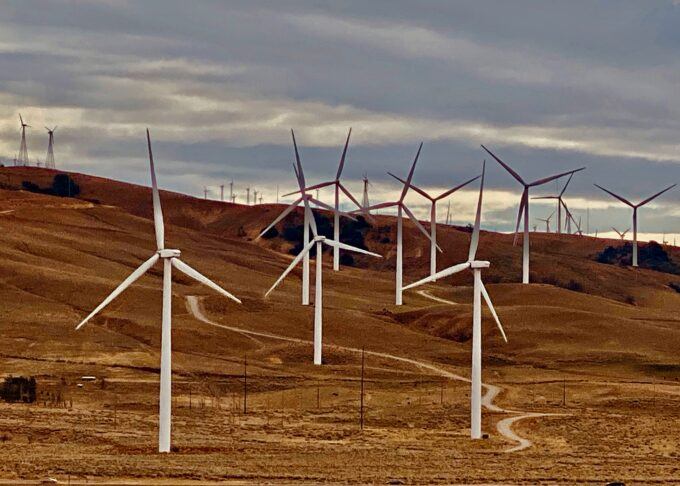
Wind farm near Tehachapi Pass, California. Photo: Jeffrey St. Clair.

Ten years after the 2015 Paris Agreement provided a framework to keep average global temperatures from rising 1.5 °C (2.7 °F) above pre-industrial levels, the world continues to advance towards climate breakdown. Time is running out on a human-induced Anthropocene: a decade of record high temperatures, more disastrous climate events per year, 428.2 ppm atmospheric carbon dioxide (up 3 ppm in 2025). Why can’t we improve our lot rather than making things worse? We have the technology. “Net Zero” is a fundamental concept for good clean living.

Falsehoods abound as vested interests distract from the growing dangers, encouraging business as usual to keep oil sales in the black: Ronald Reagan claiming that trees cause more pollution than cars, George W. Bush rebranding “global warming” as “climate change,” and Donald Trump’s ongoing nonsense about clean coal, cancerous wind mills, and electric vehicle “mandates.” Instead of a change from dirty to clean, the energy transition is becoming an add-on, keeping the cash registers whirling on a 165-year-old petroleum-run world that burns over 80 million barrels each day. The assault on truth goes unchecked, ensuring that a lucrative hydrocarbon-based economy continues to pay out, rather than providing clean green energy for industry, transportation, and buildings.

Others have even done an about-turn, such as Microsoft co-founder Bill Gates, whose 2021 book How To Avoid A Climate Disaster: The Solutions We Have And The Breakthroughs We Need sounded promising, but has shown himself to be more interested in making money than stopping an increasingly warming world. On the nasty issue of transportation emissions (28% in the US), Gates did note, “It’s rare that you can boil the solution for such a complex subject down into a single sentence. But with transportation, the zero-carbon future is basically this: Use electricity to run all the vehicles we can, and get cheap alternative fuels for the rest.” He also added that natural gas cannot act as a bridge fuel if we are serious about net zero by 2050, stating that such “gradualism” throws good money after bad and locks us into a mistaken direction by providing short-term gain yet long-term failure.

Gates had supported all-out zero-carbon electricity and wide-scale electrification, “everything from vehicles to industrial processes and heat pumps” and for greenhouse gas emissions to reach net zero by 2050 to avoid the “catastrophic” impact of man-made global warming. But the world’s formerly richest person now thinks our “doomsday outlook” on global climate is too focussed on reducing emissions, oddly stating that more spending on health is needed to combat the warming world.

Tesla CEO Elon Musk also plays both sides as the progenitor of a clean electric-vehicle future, starting with the 2008 all-electric Lotus Elise inspired Roadster, stuffed full of lithium-ion batteries. Despite having gone off the rails with his anti-government rants (standard billionaire libertarian policy to avoid paying for shared infrastructure) and far-right support (smoke-screen for small, no-regulation government), Musk will be remembered for kick-starting the twenty-first century revolution revolution as well as the global market for chemical battery storage (another potential trillion-dollar industry that conditions power for an intermittent grid). The Ford Motor Co. may have ditched its all-electric F-150 Lightning pickup for now, but is banking on the rapidly expanding electric storage market to the tune of $2 billion (lithium iron phosphate cells, 5 MWh packs).

Musk is also exploring ways to block the sun in an ill-conceived solar radiation management geo-engineering project, literally pie-in-the-sky madness, rather than selling solar for all on hundreds of millions of roofs and thousands of Tesla charging stations. Gates also called for similar, high-investment, centrally controlled solutions, as unworkable as they are unfeasible. Musk’s idea is a satellite array to block the sun, while Gates supports sun-reflecting aerosols.

Trump’s fire-fuel thinking is retrograde in the extreme, including increased oil subsidies, resurrecting dead coal plants (more than 2 times as expensive as solar), and laughable “national security risks” as the reason to “pause” five east-coast offshore wind projects, one of which was almost 70% complete, policies that raise energy costs for consumers and make everyday living less affordable. Commodore Trump is even putting the United States on a collision course with Venezuela – a founding OPEC member that first called for a 50-50 agreement with foreign oil companies to make a return on its own natural resources – as the assembling American “Armada” aims to control the world’s largest petroleum reserves (300 billion barrels, 18%).

War used to be the last resort, but is now being touted as an answer to socialism in the Western Hemisphere by a politically renegade US that calls on foreign citizens to rise up against their governments under the threat of attack. The quaint cover story is to stop fentanyl from destroying American lives, more slimy and brazen than any past US-led coup.

The Russia-Ukraine war has lasted almost four years, refashioned from an EU/NATO bulwark “special military operation” into a natural gas turf war between the United States and Russia (who together control more than one-third of the natural gas export market), driven by American sanctions and tariffs in an old-fashioned, mob-style protection racket. Trump’s simplistic petroleum-centred view hinders American dominance in the growing trillion-dollar green economy, now led by China and Europe. Relishing his role as a green Grinch and Big Oil bagman, Trump even had a bike-sharing hub removed from outside the White House.

Not all free-marketers think green energy is a “scam.” In a 1989 speech to the United Nations, UK prime minister Margaret Thatcher noted that environmental issues had “grown clearer than any other in both urgency and importance.” Berkeley physics professor and former climate skeptic Richard A. Muller did his own global warming study, calculating that average temperatures were increasing because of human activity despite decreasing at a third of the 36,866 test locations, highlighting how weather does not equal climate. Commercial artist Damien Hirst, famous for pickling large animals, fingered waste as a symbol of our times, ever more petroleum-based plastic garbage entering the environment abetted by uncaring and unregulated packaging companies – more than 400 million tons per year!

Unfortunately, the transition is being slowed by private interests and a lunatic American idea that the past is somehow the way forward. Affordability is no longer an issue as electric vehicles (EVs) have already achieved parity with and now undercut internal combustion engine (ICE) gasmobiles. Nor is efficiency a problem with EVs at 95% (conversion of input energy to mobility) compared to a maximum 50% in an ICE gasmobile (mostly lost heat). The efficiency (or inefficiency) of a gasmobile is in fact negative when all externalities are included (extraction, shipping, refining, storage, delivery, pumping, with millions of miles of piping along the way). The same is true for LEDs versus incandescent bulbs (5 times less efficient) – direct conversion of energy to light without heat loss.

What customers and manufacturers want (“letting the market decide”) can’t be the only factor without including all externalities, such as pollution and greenhouse gas emissions. Repealing long-standing fuel-economy standards that increased a woeful miles-per-gallon inefficiency of combustion engines (more completely burning higher-octane gasoline) means more pollution on the streets – more deaths, disease, and dementia from particulate matter, carbon monoxide, NOx, volatile organic compounds, lead, arsenic, …. Pretending plug-in hybrids are a solution is a red herring that postpones the switch to EVs, doing little to counter toxic pollution and global warming. Hybrids are almost as bad as gasmobiles, while an EV is better for the environment after only two years.

While the US goes backwards, Europe is also slowing the transition, calling for a delay in a mandated rollout of 100% EVs by 2035 to 90%. The delayed EU EV transition pleases European carmakers, yet will make manufacturing less competitive with China as does the Trump-backed US about-face on electric vehicles. The EV growth curve is still positive, but manufacturing uncertainty hurts competitiveness and hampers the growth of new supply chains. The 2024 EU Critical Raw Materials Act is of little use if China remains in charge, while supply chains based on old oil routes also increases the likelihood of future conflicts, chiefly with energy-rich Russia.

The rapid increase in the sales of battery-only trucks in China over diesel and natural gas is already impacting oil revenues (9% of sales in the first half of 2024, 22% in 2025, and an expected 60% in 2026), continuing the downward pressure on an uncertain market, while increasing China’s leadership in the green economy. As the post-war rise of Japanese electronics undermined Western dominance in technology, so too will Chinese EVs surpass Western car manufacturing as new sales move from Detroit, Wolfsburg, and Yokohama to Shanghai. Global EV sales in 2025 were 25% (90% in China, 16% EU, and 10% US).

In “Net Zero by 2050,” the International Energy Agency called for “a rapid shift away from fossil fuels” and “huge declines in the use of coal, oil and gas,” while the goals to achieve net zero included “halting sales of new internal combustion engine passenger cars by 2035, and phasing out all unabated coal and oil power plants by 2040.” Of course, the ongoing pushback keeps fossil-fuel industry assets from becoming stranded as more oil investments are curtailed that reduce profitability and increase the financial risk to Big Oil.

According to a 2025 Nature Sustainability report on power plants stranded by climate mitigation, “The top 25 most-exposed firms hold $770 billion in stranded assets under a 1.5°C scenario and $224 billion under a 2°C scenario. Together they emit 4.0 Gt CO2 annually, equivalent to 11% of global emissions. State-owned enterprises dominate the list, with China’s Big Five power producers accounting for $79–134 billion in at-risk coal assets alone.” The fire-fuel industry isn’t ready to trade away the world’s most lucrative commodity.

Happily, there is a viable and profitable future for green energy – new installations in 2025 were 85% renewables and only 5% oil. Although oil still powers more than 50% of all installations, the green count grows year on year. A number of countries recorded 100% renewable days in 2025, including Denmark, Norway, Portugal, Spain, and the UK. Ireland, Germany, and the Netherlands are all more than 40% renewables. Ditto 100% renewable days in California, the world’s fifth-largest economy (after the US, China, Germany, and Japan), while Texas is more than 40% green (mostly wind-powered). Soon, one will talk about varying shades of green states instead of blue and red.

A disruptive design revolution is also helping to reshape a century of oil-centred living in our overcrowded and underfunded urban environments. More people-oriented communal green street spaces (“parklets”) and cycle lanes are cropping up in newly remodelled city landscapes, redefining the idea of street property within the old commons. Noise, exhaust fumes, and me-first living are being challenged as more green space helps us to de-stress amid a fast-pace commuter culture that puts cars before people. Once considered a luxury, the garage may need to be refashioned – workshop, studio, person-cave.

The sharing economy is also growing as drivers look for new ways to get from A to B. Reduced ownership is upsetting mobility trends as high prices impact new sales. Gen Z and Millennial buyers don’t need to spend $50,000 on a lifestyle option that sits in a garage nor the $10,000 associated annual costs, standing a long-established sales model on its head and reducing gasoline demand. Free electrified public transit also helps lower toxic pollution, global warming, and urban congestion as started in 2020 in the city of Luxembourg.

“Paris 1.5” is dead (now +1.55 over 1890 levels), but clear objectives and achievable targets are needed to keep industry from lagging behind the technical competence and needed goals: green transportation, buildings, cement, and steel. As the US slows the transition, EVs remain at a disadvantage, upsetting design to road time, but we can all work together on a green economy that limits the damage of the petroleum era. “Paris 2.0” may be the last gasp.

Why is the concept of “net zero” hard to understand? The two main issues are pollution and warming. Possibly because it is hard to see a slow rise in average temperature within seasonal ups and downs and our own childhood nostalgia. The signal is there (as in any data fit to the temperature record since the start of the Industrial Revolution), but is thought of as noise. Atmospheric warming is also a two-stage concept, where carbon dioxide is added to the atmosphere that then absorbs outgoing infrared radiation and raises temperatures.

Pollution is an easier concept to understand as burnt fossil fuels release a witches brew of toxins directly into the atmosphere (as well as heat-absorbing carbon dioxide and methane) that kills 9 million people per year and contributes to respiratory problems, cancer, dementia, and numerous health issues (90% of the global population are exposed to excessive levels). The atmosphere is also very large and 3 parts per million may seem small. Think of that once-happy frog in a pot of slowly warming water.

Carbon capture and sequester (CCS) also seems like a simple solution, but allows the polluters and warmers to continue polluting and warming. Direct-air-capture CCS could be a solution if it was easy and cheap, but is hard and expensive. One underappreciated possibility is a two-stage CCS process using the oceans and seas. It is easier to remove carbon from water that then reabsorbs carbon from air. Sadly, the oceans are also high in carbon.

Changing from polluting and warming gasmobiles to electric vehicles is simple. The technology and economies of scales exist. Parity has been achieved. And only two years to see the environmental benefit. There is much opposition from the established oil industry supported by beholden politicians. Hence the rise of the hybrid, sold as a solution to keep the refineries and gasoline companies in business. 100 million cars worldwide sold per year ($3 trillion), 20 million barrels of oil a day ($1.2 billion/day). Change was never going to be easy.

The pace of change is always uneven. In the US, widespread adoption of urban electrification took 50 years and another 25 years for American farms to reach 90%. What we take for granted today took decades to achieve after the opening of Thomas Edison’s groundbreaking 1882 Pearl Street Power Station. Same for the personal computer, internet, and cellphone as luxury turns to everyday: affordable, efficient, and reliable.

We can also do our own bit. Less is more, helping define the rebellion against the constant selling of things – the greenest dollar is the one not spent. We must all find a way to net zero. No more denial or delay.

John K. Whitea former lecturer in physics and education at University College Dublin and the University of Oviedo. He is the editor of the energy news service E21NS and author of The Truth About Energy: Our Fossil-Fuel Addiction and the Transition to Renewables (Cambridge University Press, 2024) and Do The Math!: On Growth, Greed, and Strategic Thinking (Sage, 2013). He can be reached at: johnkingstonwhite@gmail.com


UKRAINE

The reality of the front belies the Kremlin’s little music


Monday 5 January 2026, by Daniel Tanuro


‘Russia can only win the war’, ‘Russia has never been beaten’, ‘How naive to think that we could defeat a country that has atomic weapons’... etc etc.

This little (inaccurate) tune, which originated in the Kremlin, is emphatically disseminated by the right, the extreme right and a certain “radical” left.

This was recently illustrated in Belgium when all the parties represented in Parliament, from Vlaams Belang to the PTB, supported De Wever in the case of the Russian assets frozen at Euroclear.

Only a few courageous individuals, such as Cogolati, refused to join forces. The others should ask themselves serious questions: by their attitude, they have helped to strengthen the most right-wing, violently anti-social and anti-democratic coalition the country has seen since the 2nd World War. You only have to read the praise for the Prime Minister in the press to understand this. At a time when trade unions are mobilising against austerity, this support for De Wever-Bouchez is a nasty snub to the social movement.

What’s worse is that we’re hearing more and more of the same, even though it doesn’t correspond to the reality on the battlefield. Of course, Russia dominates (what a surprise, given that it is the second most powerful army in the world!). But it is only nibbling, not breaking through. And it is nibbling ever more slowly, at the cost of terrible losses in men (1.4 million!) and equipment. Whether in armoured columns or by small groups of infantrymen, the Russian attacks are decimated by the drones, which the Ukrainians manoeuvre brilliantly.

The Ukrainian resistance is truly admirable, despite the Western brakes. It is more than just resistance. In Kupiansk, the counter-offensive drove the Russians out of the town that Putin himself claimed to have definitively won. A real slap in the face for the Kremlin! In Pokrovsk, the Putin soldiers are still not in control (after 700 days of assaults!). North of Pokrovsk, the Ukrainian army has retaken 5 villages. In Ulaipole, the invaders boasted that they had won, and even occupied the territorial defence HQ. That’s true, but Ukrainian troops are counter-attacking and have regained a foothold in the town.

It’s a war of attrition. Russia is holding out mainly because its neo-fascist regime has completely atomised society, because it attracts goons with salaries several times higher than the average wage (thanks to oil revenues, etc.), because Trump and his henchmen support it and because Europe is relying on Putin to maintain order just in case. Ukraine is holding on because its people have enjoyed the freedoms won since 1991, after decades of colonial oppression (the Tsar, Stalin, Hitler, then Stalin again and his successors...). The vast majority of the population, despite the terrible difficulties, the bombing of their towns and the power cuts, do not want to be subjected to this neo-fascism, the effects of which they can see in the occupied territories... and on the tortured bodies of the prisoners of war exchanged from time to time with Moscow.

Which of the two will crack? Trump is clearly doing everything to ensure that it is Ukraine. The neo-fascist and extreme right-wing international supports him, as does China under a bureaucratic dictatorship. Nothing but normal. What is not “normal” is that most of this left that calls itself “radical” and “authentic”, or even “Leninist”, led by the PTB, is in practice on the same line as the worst enemies of the working class: against the right of peoples to self-determination! A right which Lenin, to remind the Marxist-Leninists, considered to be an ‘absolute principle’, without which ‘there is no internationalism’...

Which of the two will crack? It is quite possible that it will be Russia. Behind all the talk of Russia being ‘invincible’, things are indeed going badly for Putin. Very bad indeed. Oil refineries are burning, ghost oil tankers are sinking and the war industry can no longer compensate for the losses in tanks, radars and other equipment. That’s why the music is getting louder and louder. This is also why there is no question of the Kremlin agreeing to a ceasefire, let alone a territorial compromise on the basis of what it has acquired by totally destroying it.

Why is there no question of this? Because, if Putin doesn’t get at least the whole of Donbass, people in Russia - the crippled veterans and their families in particular - will rise up and demand an accounting: 1.4 million dead and crippled for that? The news from the front shows that Putin is a long, long way from getting the Donbass. Trump, Witkoff and Kushner wanted to force Zelensky to hand it over, but it won’t work. Zelensky is a liberal, but not a puppet. He is not prepared to commit hara-kiri so that Trump and his gang can do juicy business with the Kremlin. Ukraine cannot agree to give Putin what he has been unable to conquer, despite all his cruelty. And the EU cannot afford to ignore Ukraine’s refusal.

‘You have no cards’, Trump told Zelensky last February. In reality, it is Putin who is holding fewer and fewer cards in this game. Putin, and consequently also Trump, his accomplice.

So, is Ukraine an impossible victory? In the 20th century, at least two small countries - Vietnam and Afghanistan - won against superpowers with nuclear weapons. Quite apart from the obvious differences, these two countries won because their invaders, despite having enormous resources at their disposal, were unable to prevail. The political and economic cost of their gun-toting policies became unbearable. Who will be surprised if the extreme right tries to erase these historical facts from people’s minds? On the other hand, it is painful, and in fact shameful, to have to remind left-wing activists of them, especially when they claim to be anti-imperialists.

SLAVA UKRAINI! SOLIDARITY WITH THE UKRAINIAN PEOPLE!

27 December 2025

Translated by International Viewpoint from Facebook.


Attached documentsthe-reality-of-the-front-belies-the-kremlin-s-little-music_a9351.pdf (PDF - 908.9 KiB)
Extraction PDF [->article9351]

Russia
Fighting for the Least Unjust Peace
“We Wanted to Show the Whole Range of Anti-War Resistance in Russia”
Army Contract and Draft: the New Architecture of Military Conscription
India after the Tianjin summit and in the midst of the climate crisis – an overview
The BRICS and de-dollarisation


Daniel Tanuro  a certified agriculturalist and eco-socialist environmentalist, writes for “La gauche”, (the monthly of Gauche-Anticapitaliste-SAP, Belgian section of the Fourth International). He is also the author of The Impossibility of Green Capitallism, (Resistance Books, Merlin and IIRE, 2010) and Le moment Trump (Demopolis, 2018).


Philippines

From Flood Fund Plunder to Environmental Plunder – On the Moral, Political, and Ecological Crises Shaping the Philippines


Thursday 8 January 2026, by Filipino Fourth Internationalists


Almost six months ago, Philippine President Ferdinand R. Marcos, Jr. was compelled to launch his anti-corruption campaign amidst the continuous heavy rainfall in July and the devastation caused by super typhoons Tino and Uwan. These events exposed weak and ghost flood control projects, as well as collusion among public works personnel, political figures, and contractors. Yet, six months later, with no major results, two commissioners of the Independent Commission for Infrastructure (ICI), which he had created to address the issue, have already resigned.


In recent developments, President Marcos signed the General Appropriation Act for 2026 (6.793 Trillion), which includes unprogrammed appropriations (242.5 billion pesos)—A.K.A perks—and 4 billion pesos in confidential funds for the Office of the President.

Can we really rely on the corrupt individuals and entrenched political dynasties who have built this system to punish themselves and fix the mess they created?

The Philippines is caught in a self reinforcing three fold crisis.

First, the state set aside roughly ₱1.9 trillion for flood control projects between 2021 and 2025, yet investigations show that ₱700 billion–₱1.4 trillion disappears each year or ₱3.5 trillion in 5 years through congressional insertions, rigged contracts, and the opaque Confidential & Intelligence Funds (CIF).

Second, dynastic families dominate both the legislature and local governments—most provincial governors and a majority of district representatives belong to political clans—creating a powerful nexus that diverts public money into private hands.

Third, rampant environmental destruction—deforestation, illegal mining, unregulated logging, and the conversion of critical lands for agribusiness and tourism—erodes the natural flood buffers that could mitigate disasters. Greenpeace Philippines estimates that ₱1.089 trillion of climate tagged spending has been siphoned, branding the perpetrators “climate criminals.”

Nationwide protests sparked by the “Baha sa Luneta” and the “Trillion Peso March” on September 21 and November 30, 2025 respectively have been met with harassment, red tagging, and judicial warrants against student leaders.

The above-mentioned crises have not shown signs of reaching resolution. In fact, the government in action has intensified the crises which morphed into other forms because people’s oppositions have continued to launch all kinds of activities except efforts of uniting themselves.

The anti corruption movement remains fragmented: progressive “Resign All” groups such as Partido Lakas ng Masa (PLM) demand the complete removal of the current leadership, while “Oust All” factions like BAYAN and NUPL push for coordinated impeachment or recall procedures. The broader Trillion Peso March coalition—comprising civil society organizations, labor unions, student groups, and faith based entities—frames the struggle as a nationwide demand for accountability, transparent budgeting, and swift prosecution of corrupt officials and contractors.

In the current situation where each faction speaks a different narrative and language, the ruling elite continue to enjoy and manipulate the system with impunity.

Easier said than done, the only realistic path forward is principled unity: a coalition of democratic forces based on agreed basis of unity and focused on concrete, non ideological actions—swift prosecutions, truly independent oversight, abolition of the CIF, and a genuine anti dynasty law. Such a coalition must create upscaling of consciousness of the broadest possible section of the populations and break the feedback loop of debt driven fiscal capture, environmental plunder, and geopolitical exploitation while advancing democratic reforms aligned to the totality of transforming the Philippine economic and political system. Such movement should have an all of peoples and sectors approach based and strengthen in small victories for concrete unified action.
The systematic hijack

Investigations by the Senate and Malacañang confirm that the ₱1.9 trillion flood control budget has been systematically hijacked. Between July 2022 and May 2025 the government allocated ₱545.64 billion to 9,855 projects, yet more than 6,000 of those projects (worth over ₱350 billion) lack any description of the structures being built.

Approximately ₱100 billion—about 20 % of the total—was funneled to just fifteen contractors, many linked to the Marcos and Duterte families during 2016-2022, they used to call themselves Uniteam; a single firm tied to the Duterte camp alone received ₱3.5 billion between 2022 and 2024. Investigations further exposed bigger chunks link to the Malacanang and its closest allies.

These figures reveal a budget hijacking architecture rather than isolated embezzlement, with annual losses dwarfing the entire 2025 education budget of 1.055 trillion pesos and rivaling the Department of Public Works and Highways’ yearly allocation, leaving the state without the resources needed for genuine disaster risk reduction and basic social services.
How hijacking is done?

Dynastic entrenchment creates a closed patronage loop that intertwines campaign financing, contract awards, and legislative priorities, shielding corrupt networks from electoral punishment. Hence, the cycles of corruption have continued to thrive from one administration to the other.

Congressional insertions—such as the ₱142 billion added to the 2025 General Appropriations Act—bypass normal committee scrutiny, turning the national budget into a private cash flow mechanism for allied and preferred contractors.

The contractor legislator nexus sees firms linked to powerful families secure hundreds of projects worth tens of billions of pesos, often delivering “ghost projects” like a flagged ₱279 million contract in Bulacan, generating revenue that has financial further political campaigns of the proponent politicians.

Finally, the unaudited Customer Information File (CIF) acts as a secret channel for kickbacks, allegedly offering a 60 % rebate for corrupt actors. Together, these pillars create a self reinforcing system: dynastic politicians allocate funds to loyal contractors; contractors deliver substandard or phantom work; the proceeds fund additional campaigns, cementing the dynasty’s grip on power and perpetuating the cycles of corruption.
Environmental plunder and corruption

The flood control crisis cannot be separated from a broader pattern of ecological destruction. Nationwide deforestation, illegal mining, unregulated logging, and the conversion of critical watersheds for agribusiness and tourism strip away natural flood buffers, degrade soil stability, and increase river sedimentation, making engineered flood control works both more necessary and more prone to failure.

Corrupt flood control projects are estimated to cost the nation ₱42.3 billion–₱118.5 billion per year (2023 2025). Greenpeace Philippines argues that this theft cripples the ability of millions to survive escalating climate threats, labeling the perpetrators “climate criminals.” The loss of ecosystem services—carbon sequestration, water regulation, biodiversity habitat—has a multiplier effect, deepening poverty, fueling migration, and intensifying food crisis and social unrest. At the same time, sovereign debt has surged from ₱12.8 trillion (June 2022) to ₱16.1 trillion (Nov 2024), with projections exceeding ₱17.4 trillion by the end of 2025. Rising debt squeezes fiscal space for genuine climate resilient investments, pushing policymakers toward quick fix, corruption prone infrastructure projects and perpetuating a vicious cycle of debt, environmental degradation, and graft.
The geopolitical dynamics: US-China proxies

Domestically, the rivalry between the Marcos and Duterte families has become a local manifestation of the broader U.S.–China strategic competition.

The Duterte camp cultivates close ties with China, exemplified almost giving away West Philippine Sea by the Philippine Offshore Gaming Operations (POGO) sector and Chinese linked advisers such as Michael Yang. Conversely, the Marcos administration reaffirms a strong alliance with the United States, expanding the Enhanced Defense Cooperation Agreement (EDCA), defending the West Philippine Sea against Chinese claims, and invoking historic U.S. support since the formed declaration of country’s independence.

This geopolitical tug of war turns the Philippines’ internal power struggle into a venue where the United States and China vie for influence, shaping policy choices on infrastructure financing, security cooperation, and diplomatic posture ahead of the 2028 presidential elections.

Opposition to this entrenched system has splintered into three distinct currents.

“Resign All” groups call for the complete removal of President Bongbong Marcos Jr., Vice President Sara Duterte, and all senior legislators who oversaw the budget insertions.

“Oust All” advocates push for a coordinated parliamentary ouster—impeachment, recall, or no confidence vote—targeting every elected official implicated in the flood fund and environmental scandals while preserving constitutional continuity.

The Trillion Peso March movement, a broad cross sector coalition, emphasizes nationwide accountability without prescribing a specific procedural route; its platform demands swift prosecution of corrupt contractors and legislators, transparent, itemized budgeting for all flood control and climate related expenditures, and the creation of an independent watchdog body with real enforcement powers.

Because each camp speaks a different strategic language, that justified their own narrative, the overall anti corruption effort lacks a unified rallying point, allowing the elite to exploit divisions and continue plundering public resources.

A viable way forward is principled unity, which means uniting democratic forces around non ideological, actionable goals that all factions can endorse without sacrificing core values. Groups can actually find common ground while simultaneously unleashing the truth and consolidating their power.

Campaigns and possible steps which can help unify are:

Immediate and genuine prosecution: accelerate criminal cases against the fifteen favored contractors, the Duterte linked firm that received ₱3.5 billion, and any legislators identified in COA and DOJ investigations; establish an Independent Flood Control Oversight Commission outside the DPWH and congressional committees, granting it subpoena power and a mandate to audit all flood control contracts since 2015.

Anti dynasty reform: pass legislation banning immediate family members from holding simultaneous elective offices, create a transparent candidate disclosure registry that publishes financial and relational information online, and pursue a constitutional amendment—through a citizen initiated process—that permanently embeds anti dynasty provisions.

Environmental restoration and climate justice investment: freeze the assets of implicated contractors and redirect the recovered ≈ ₱1 trillion to a National Ecosystem Restoration Trust overseen by an independent civil society board; fund reforestation, watershed rehabilitation, responsible, green and sustainable livelihood generation, and community managed climate resilience projects; make nature based solutions a mandatory component of all flood control budgeting; and create an Independent Commission for Infrastructure Law to vet large scale projects for environmental compliance and anti corruption safeguards.

These steps satisfy the moral and political demands for accountability, provide a concrete, law based pathway for reform (appeasing civic groups), and deny either external power bloc a foothold in domestic politics. By channeling recovered funds into ecosystem restoration, the plan directly tackles the climate justice dimension and breaks the debt corruption feedback loop.

In conclusion, the Philippines stands at a crossroads where systemic corruption, environmental plunder, and great power rivalry intersect to threaten democratic governance and human survival. The ₱1.9 trillion flood fund plunder is the most visible symptom of a deeper architecture: dynastic capture of the budget, a contractor legislator nexus, and unaudited discretionary funds.

Fragmented opposition cannot dismantle this architecture. Principled unity—centered on swift prosecutions, independent oversight, anti dynasty legislation, and ecosystem restoration—offers a realistic, non ideological pathway that respects the rule of law, neutralizes external geopolitical manipulation, and restores fiscal space for genuine resilience, while consolidating cells or collectives and communities of people’s power.

Only by transcending factionalism, sectarianism and collectively demanding accountability, as articulated by the Trillion Peso March Movement’s nationwide call, can the Filipino people turn moral outrage into lasting institutional change and upscaling it into substantial and structural transformation. The stakes extend beyond politics; they encompass the nation’s democratic soul, its climate future, and the lives of the most vulnerable citizens.

The time for principled united action is urgent!

The year 2026 is the continuity of more daring and concrete democratic and unifying campaigns.

January 5, 2026


Attached documentsfrom-flood-fund-plunder-to-environmental-plunder-on-the_a9354.pdf (PDF - 900.5 KiB)
Extraction PDF [->article9354]

Philippines
Women and girls fear for their safety in the Philippines, as earthquake aftershocks continue to rock Northern Cebu
After Typhoon Tino (Kalmaegi): Mourn and Rage for Accountability and demand for ecological transformation
Manifesto for an Ecosocialist Revolution: Possible consequences in the Philippines
Introduction to the Manifesto for an Ecosocialist Revolution: Work Less, Live Better
Social revolts and environmental issues in South Asia

Filipino Fourth Internationalists