Sunday, February 01, 2026

After Greenland Dispute, EU Wants to Reduce Dependence on American LNG
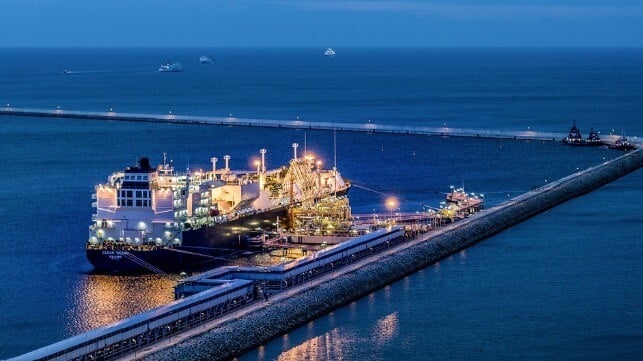
An LNG carrier delivers a cargo from the United States at a terminal in Poland, 2020 (PGNiG / Maciej Margas / CC BY SA 4.0)

Published Jan 29, 2026 8:12 PM by The Maritime Executive


The European Union's top energy official is actively looking to source LNG from outside of the United States, the EU's biggest supplier, because of recent announcements from the White House that have deep implications for Europe's security. 

Europe's energy ties with the U.S. have strengthened since the Russian invasion of Ukraine began in February 2022. Several months after Russian troops marched on Kyiv, Russian national gas company Gazprom broke its long-term supply agreements with European utilities, cutting off Europe from inexpensive pipeline gas. In the four years since, the EU has phased out most remaining sources of Russian gas, and it plans to complete that ramp-down by the end of 2027.  

To fill the gap, Europe increased its pipeline gas imports from Norway and invested significantly in expanding LNG import capacity. The largest share of the extra LNG has come from one longtime trade and security partner - the United States, which has a booming LNG export industry on the Gulf Coast. Today, nearly 60 percent of European LNG imports come from American suppliers.

That urgently-needed energy supply has allowed European industry to keep running without dependence on Gazprom, an essential factor given the current and predicted levels of conflict with Russia. But the imports have also made EU energy markets dependent on America, and on American decisionmakers, to a degree that now makes some European leaders unsettled.

In a press conference Wednesday, EU energy chief Dan Jørgensen told reporters that after recent interactions with U.S. leadership, Europe is actively looking to source gas from other high-potential exporters, including Canada, Qatar and Algeria. Europe doesn't want to cut off American LNG, he said, but it has decided that it now needs to find additional strategic options. In particular, it is motivated by "the strained relationship to the U.S. and the fact that we have an American president that does not exclude using force against Greenland." 

The White House's recent statements about an American need to "own" Greenland - "the hard way" if necessary, with "utilizing the U.S. military" a possible option - have pushed the EU to rethink the assumption that its U.S. gas supply will be secure, Jørgensen said. (U.S. leadership has since disavowed the idea of using force to acquire Greenland.)

The White House told Bloomberg this week that the U.S. remains Europe's most secure energy source. "Thanks to President Trump, U.S. suppliers are the best, most reliable partners, and we will continue to work with European nations to meet their energy demands with U.S. LNG," White House spokeswoman Taylor Rogers said. 

Analysts see further signs of European unease in the flurry of diplomatic activity with other partners, like the EU-India "mother of all deals" trade agreement revealed on Tuesday. While the agreement was in the works for months, the timing and the terms have been widely seen as a strategic move to diversify and reduce EU reliance on the U.S. market. China may also stand to benefit from an increased European interest in alternative partners.

"While there are exceptions, there appears to be a trend of America's traditional allies derisking from [the] United States," commented Ryan Hass, a senior fellow in foreign policy at Brookings, in a recent post. "The flow of leaders to China is striking. French, Canadian, Irish, British, Korean, Finnish, and soon German leaders visiting Beijing in recent weeks. Beijing isn't making its offering more attractive or growing less aggressive. It is presenting a predictable alternative."

Top image: An LNG carrier delivers a cargo from the United States at a terminal in Poland, 2020 (PGNiG / Maciej Margas / CC BY SA 4.0)


EU Faces Hard Choices after LNG “Wake-Up Call”

  • Europe is growing uneasy over its heavy reliance on U.S. LNG, with EU officials warning that energy security risks are shifting rather than disappearing.

  • Diversification options are limited: sanctions on Russian gas and strict EU methane regulations effectively rule out major suppliers like Russia, Qatar, and much of U.S. LNG.

  • Gas costs and policy contradictions are rising, as Europe pushes for diversification while remaining locked into record U.S. LNG imports

The European Union needs to diversify its natural gas sources, Brussels’ energy commissioner said this week, expressing a growing unease in European capitals that the EU has become too dependent on liquefied natural gas from the United States. Yet succeeding in that diversification drive will be tricky because of the bloc’s emissions-focused energy policies – and the sanctions on Russia.

“We are speaking to countries around the world that are able to deliver LNG to us,” Energy Commissioner Dan Jorgensen told media in Brussels this week, as quoted by Bloomberg. “I definitely hear this when speaking to energy ministers and heads of state from all over Europe that there is a growing concern.”

The situation represents an interesting reversal of sentiment from just four years ago. Back in 2022, the European Union declared it would switch from Russian pipeline gas as punishment for the invasion of eastern Ukraine and start buying U.S. liquefied gas instead. EU officials hailed the decision as a big step towards energy independence and praised U.S. LNG producers—and the U.S. federal government—as a reliable business partner and energy supplier.


Now, the European Union is the biggest regional buyer of U.S. liquefied gas, which seems to have been the plan all along—but that gas is coming at a steep cost, and with the federal government very different from the one of four years ago, the image of the reliable business partner and energy supplier has changed quite radically.

It was the Greenland affair that played the role of the alarm clock that woke Brussels and national capitals up. Until that point, the European leaders had apparently assumed that Trump would keep doing business with their countries—and the EU—as Biden had before him, namely by continuing the security guarantees and preferential trade arrangements that had been the hallmark of trans-Atlantic relations for decades. Only Trump did not feel like that. Trump demonstrated early on that he was coming to collect—higher NATO spending, import tariffs, and, finally, Greenland.

The myth of the friendly American LNG that could replace all Russian gas and ensure energy security for a continent was, however, dispelled even before Greenland, by Trump’s top energy man. Secretary Chris Wright stated plainly that U.S. producers of liquefied gas have no intention of complying with the EU’s new methane regulation. The regulation requires constant monitoring, tracking, and reporting of methane leaks along the LNG supply chain—and U.S. LNG producers are not investing in that. Incidentally, neither is QatarEnergy.

During his talk with reporters, Commissioner Jorgensen said that European gas buyers were eyeing Qatar, Canada, and Algeria as potential avenues for gas supply diversification. But Qatar, for one, has made it as clear as the U.S. that it will not be doing methane tracking and reporting. And it has done so repeatedly. And with the world’s two biggest LNG exporters out of the methane-reporting experiment, the EU is really short on options—especially now that the top brass in Brussels approved the total ban on any and all Russian gas imports, beginning next year. Of course, it’s still January 2026, and a lot of things could change over the next 12 months, with some observers of the EU arguing that it will soon change its tune on Russian gas. Until this argument finds factual backing, however, the EU is off Russian gas—and unless it drops the methane regulation, it is also out of Qatari and most U.S. gas, too. Alternatively, U.S. gas will simply become even more expensive, raising the question of just how long the EU would be able to afford it.

The bigger question is what the realistic alternatives to U.S. LNG are. The answer, alas, is unpleasant. There is no large enough LNG supplier to step in and take the place of the United States, not economically, at least. This means gas buyers in Europe would be scouring the world for LNG from now on in a bid to advance the new diversification vision of the Brussels political establishment.

Meanwhile, however, there is that trade deal that Commission President Ursula von der Leyen signed with President Trump last year that calls for $250 billion worth of U.S. energy imports into the EU every year until 2027. One could argue whether Trump knew the EU could not physically buy so much U.S. energy, but wanted to make them buy more oil and LNG—which is what he got, by the way. European Union imports of American LNG hit an all-time high last year, though their price was nowhere near $250 billion.

Trump probably knew the Europeans couldn’t buy $250 billion worth of oil and LNG. But if the Europeans get really serious about that diversification, the Greenland deal may be canceled in favor of another, more direct option. If anything, President Trump has proven repeatedly that he follows his own rules.

By Irina Slav for Oilprice.com


The Coming LNG Supply Wave Is Good News for Europe 

  • Europe’s gas storage is draining at its fastest pace in years, with inventories likely to end winter at their lowest level since 2022.

  • The EU is forced to secure unusually high LNG imports through summer 2026 to meet storage targets.

  • Relief is expected from a looming global LNG supply wave, led by new U.S. and Qatari export capacity.

Europe’s natural gas storage sites are depleting at the fastest pace in years, suggesting stocks would end this winter at their lowest level since 2022.

End-of-winter supply in storage at the lowest in four years means that Europe will need very high imports in the shoulder seasons and the summer to replenish the stocks to adequate levels of 80-90% full storage by November 2026, as per the EU regulations.

It’s a good thing then for Europe that the global LNG market will tilt into oversupply from this year until late this decade, as analysts and forecasters expect.


The bad news for Europe is that the current futures price curve of the European benchmark for gas trading, Dutch TTF, shows higher prices for the summer of 2026 than for the winter 2026/2027. In this market structure, backwardation, prices for nearer contracts are higher than the ones further out in time, discouraging stockpiling.

If this backwardated structure remains after the current winter ends, storing gas for the next winter would be uneconomical for operators and policy makers may have to intervene with some kind of support.  

Summer gas prices in Europe are high not without a reason.

This winter, gas storage sites in Europe are draining at the fastest pace in five years, amid below-average winter temperatures which drive heating and power demand higher. 

EU gas storage sites were less than 43% full at end-January, according to data from Gas Infrastructure Europe as of January 28. 

LNG cargo arrivals were at less than half of the daily volumes withdrawn from storage in January. 

The end-January stock levels of 42-43% are well below the 58% average for this time of the year of the past few years, signaling that Europe will have to import more gas in the summer to replenish storage supplies.   

With two more months of winter heating demand and higher gas demand for power amid low solar generation, Europe is likely to find itself with just 30% full storage on April 1. This would be the lowest level for end-of-winter stocks since 2022.

So Europe will need more gas supplies for the rest of this year to meet immediate demand and store supply for the next winter. That’s why summer 2026 prices are high—higher than the winter 2026/2027 prices.

Thankfully for Europe, there is a supply wave coming this year and continuing until at least 2029 as major LNG export projects in the top exporters, the United States and Qatar, are scheduled to come online.

Europe is expected to import a record-high volume of LNG this year as stronger demand for replenishing storage sites, the phase-out of Russian supply, and continued pipeline exports to Ukraine will drive increased demand, the International Energy Agency (IEA) said in its Gas Market Report Q1 2026 last week.

After setting a record in 2025, European LNG imports are poised to reach a new all-time high of over 185 billion cubic meters (bcm) in 2026, the agency noted.

Europe’s LNG imports hit an all-time high of over 175 bcm in 2025, surging by 30% (or 40 bcm) from 2024, the report found. Key factors in the record imports were stronger domestic demand, lower piped gas imports, and higher storage injections in April-October.

European LNG netback prices remained mostly at a premium compared with key Asian markets, which incentivized flexible LNG cargoes to flow towards Europe, according to the IEA.

As global LNG supply is set to jump this year, flows to Europe should not be an issue this summer. The coming oversupply could ease market concerns about Europe’s rate of refills ahead of the next winter and flip the futures curve into favoring gas storage.   

By Tsvetana Paraskova for Oilprice.com


Pope Leo XIV urges ethical mining in Vatican talks


Pope Leo XIV. (Image by Edgar Beltrán, The Pillar, CC BY-SA 4.0 Wikimedia Commons.)

Pope Leo XIV met senior mining and energy executives at the Vatican on Saturday to press for more ethical approaches to resource extraction, signalling a shift in tone between the Church and the global extractives industry.

The private audience brought together more than a dozen industry leaders, including BHP (ASX, LON, NYSE: BHP) chief executive Mike Henry, Vale chief executive Gustavo Pimenta and Ivanhoe Mines (TSX: IVN) executive chair Robert Friedland and Sigma Lithium (NASDAQ: SGML) CEO Ana Cabral.

Leo, the first US-born pope and the son of Peruvian parents, has spoken frequently about Latin America’s role in supplying minerals critical to the global economy.

The meeting formed part of the Vatican’s Building Bridges Initiative, which aims to align economic development with social and environmental justice. Discussions focused on ethical mining practices, human rights, decent work and what the Church describes as “integral ecology,” echoing themes from Pope Francis’s landmark Laudato Si’ encyclical on care for creation and workers.

Church officials said the Vatican is seeking a more active role in global economic debates, urging companies to adopt humane and sustainable approaches to resource extraction. Initiatives such as Borgo Laudato Si’ are intended to turn those principles into practical engagement with industry and communities.

Collaborative shift

The outreach marks a contrast with the more confrontational stance sometimes taken by Leo’s Argentinean predecessor. In 2018, Francis told the heads of BP and ExxonMobil to stop exploring for new fossil fuels, warning that unchecked energy use could destroy civilization.

Mining companies have spent more than a decade trying to improve relations with faith groups, including the Catholic Church, as scrutiny of environmental and social impacts has intensified. Leo has acknowledged that modern technologies depend on minerals, while condemning the conditions under which many are extracted.

In an October speech, he cited coltan from the Democratic Republic of Congo as an example, noting that while it underpins everyday devices, its extraction is often linked to paramilitary violence, child labour and the displacement of communities. “The dynamisms of progress should always be managed through an ethic of responsibility,” he said.


Madagascar lifts 16-year ban on new mining permits, excludes gold

Madagascar. (Stock image by jordieasy.)

Madagascar has lifted a 16-year moratorium on new mining permits for most minerals, the government said late on Thursday, but the suspension on gold permits will remain due to regulatory challenges.

The suspension, imposed to allow a review of the country’s mining governance and legal framework, has kept the issuance of new licences on hold since 2010.

Mining is a cornerstone of Madagascar’s economy, with key exports including nickel, cobalt, graphite and ilmenite.

The Ambatovy nickel-cobalt project remains the country’s flagship mining operation, attracting significant foreign investment and contributing a major share of export earnings.

“Mining permit is an essential working tool that allows operators and investors to operate legally,” Carl Andriamparany, Madagascar’s Minister of Mines, told a press conference late on Thursday.

“That is why we have decided to lift the suspension on issuing permits,” he said.

As of 2023, some 1,650 applications for mining permits were pending with the mining administration, according to Madagascar’s most recent Extractive Industries Transparency Initiative (EITI) report published at the end of 2025.

However, the government decided to maintain the moratorium on gold mining permits. Andriamparany cited substantial discrepancies between officially reported gold production and the scale of artisanal mining.

“According to official statistics for the past year … the volume of gold declared amounts to just over 13 kilograms,” he said, calling the figure “negligible” compared with the intensity of mining activity nationwide.

“In light of this situation, the government has acknowledged our current inability to effectively regulate the sector and establish a rigorous monitoring system.”

(By Lovasoa Rabary and Vincent Mumo Nzilani; Editing by Tomasz Janowski)

AU

Paulson lifts stake in International Tower Hill with Alaska gold project

Work on the Livengood gold project in Alaska. Credit: International Tower Hill Mines

International Tower Hill Mines (TSX: ITH, NYSE-AM: THM) tapped leading shareholder and hedge fund Paulson and Co. to raise a large chunk of its financing this week for the Livengood gold project in Alaska that’s also bolstered by rising prices for the yellow metal.

The Vancouver-based company raised $118 million including $74.8 million in its offering of common shares at $2.22 in the US while Paulson completed a $40 million private placement at the same price. The hedge fund then injected a further $3.3 million to increase its stake to 35%.

Tower Hill’s 2023 technical report for Livengood anticipated a $1.93 billion initial capex and a $2.35 billion after-tax net present value at a gold price of $2,500 per ounce. It found that slight decreases in the base case gold price could make the project uneconomic, as a previous 2017 study had demonstrated.

In addition to advancing feasibility studies and major permitting work for the gold resource, Tower Hill plans to expand testing to determine whether it can recover antimony from its stibnite veins. The company said in a filing this week that while extensive work is required before recoverability, or tonnage, grade, and resource estimates could be developed, initial metallurgical study supports more testing. It also plans to assess potential flowsheets, flotation methods, and concentrate characteristics.

Shares gain

Shares in International Tower Hill Mines hit a new all-time high of C$4.15 on Wednesday in Toronto after the capital raising before easing to C$4.07 the next day. It has a market capitalization of C$1.05 billion ($760 million).

The company has allocated about $50 million for feasibility and technical studies, $35 million for permitting and community engagement and the rest for general purposes, it said this week. Tower Hill’s 2024 and 2025 budgets allowed just over $3 million in spending on community engagement and environmental work in support of future permits.

Gold prices have sailed past major milestones in the past year, topping $5,000/oz. this week as central banks and other investors have shored up reserves in the face of increasing economic uncertainty.

Partner sought

The company had said in its most recent annual report that it was open to an alliance to develop the project” with a “strategic partner with a long-term development horizon who understands the project is highly leveraged to gold prices.” It hasn’t shared further details.

Paulson already owns 40% of another Alaska gold project, Donlin, which is located about 550 km from Livengood.

Located in southwest Alaska’s Kuskokwim gold belt, Donlin is expected to become one of the biggest producers of the yellow metal in the Americas. Majority owner Novagold Resources (TSX: NG) expects construction at Donlin to begin in 2027, with commercial gold production starting in 2031 and lasting 27 years.


El Salvador adds $50M in gold to reserves

Stock image.

El Salvador’s central bank has added about $50 million worth of gold to its reserves as part of the nation’s strategy to increase holdings of the metal.

In a statement on Thursday, the Banco Central de Reserva said it bought another 9,298 troy ounces of gold for its reserves, bringing its total holdings to 67,403 ounces. At current prices, the value of those gold holdings is estimated at $350 million.

Gold is “a universally strategic reserve asset” that supports long-term financial stability and helps protect the economy from structural shifts in global markets, the central bank said in its statement.

President Nayib Bukele welcomed the gold purchases. “We just bought the other dip,” he responded in post on X, referring to the metal’s sharp decline during the session.

The purchase follows the central bank’s 13,999-ounce buy last September — its first since 1990. At the time, the gold purchase was valued also at $50 million.

In a further boost to its reserve holdings, El Salvador’s government said it also purchased more Bitcoin. The Central American is the first and only country to adopt the cryptocurrency as legal tender alongside the US dollar.

Arkham data shows that its current Bitcoin stack stands at 7,547, which at market prices are valued at $620 million.

CU

Polish copper miner KGHM dismisses CEO

Image courtesy of KGHM

Polish copper miner KGHM dismissed CEO Andrzej Szydlo and deputy CEO Piotr Stryczek on Friday, the company said in a statement, without providing a reason.

As of 11:22 GMT, shares of the company were down 7.5%, as the leadership overhaul coincided with a sharp correction in copper and precious metal prices.

Analyst Jakub Szkopek from Erste Group said the CEO dismissal was unexpected.

“It will certainly not help KGHM’s share price,” Szkopek said, noting that the change creates uncertainty just as the company was preparing to update its strategy.

Szydlo had led the state-controlled miner since March 2024.

The supervisory board has delegated its member Remigiusz Paszkiewicz to temporarily perform the CEO duties for up to three months until a permanent appointment is made, KGHM said.

(By Rafal Nowak; Editing by Milla Nissi-Prussak)


Copper rally boosts 2026 earnings outlook for miners: report

El Soldado copper mine in Chile. (Image courtesy of Anglo American |Flickr.)

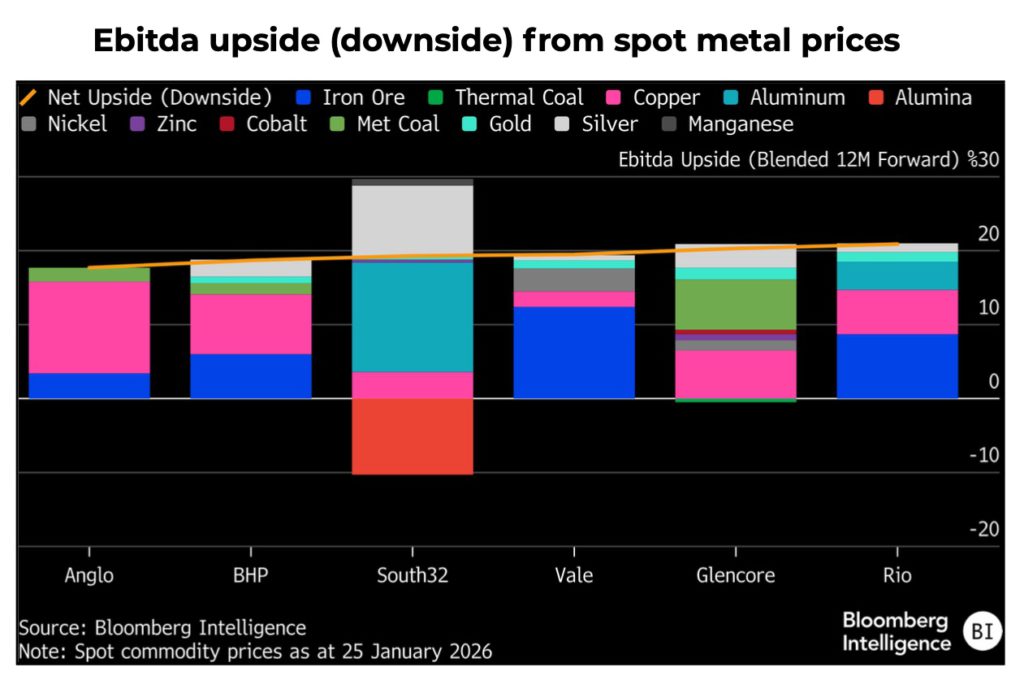
Rising spot metal prices are setting up one of the strongest earnings years in recent memory for diversified miners, with Rio Tinto (ASX: RIO, LON: RIO) and Glencore (LON: GLEN) leading on upside potential, according to a report by Bloomberg Intelligence.

Spot prices imply 18%–21% upside to one-year forward consensus Ebitda across major diversified miners if current levels hold, marking the largest earnings upside since early 2025. Bloomberg Intelligence says Rio Tinto and Glencore screen best, with roughly 20%–21% upside implied.

“Major miners’ consensus Ebitda upgrades should accelerate, led by Rio Tinto and Glencore,” said Alon Olsha, senior industry analyst at Bloomberg Intelligence, adding that stronger earnings revisions could support more scrip-funded M&A but also raise execution risk, particularly for Rio.

Quality matters

The composition of earnings growth matters as much as its size, with investors likely to place a higher value on upside driven by copper and precious metals than by iron ore, where consensus still assumes softer pricing.

For Glencore, strong metallurgical coal and copper prices account for about two-thirds of its spot-implied Ebitda upside, while gold and silver add more than 4% despite not being core earnings drivers.

Rio Tinto has seen particularly strong earnings momentum, with consensus forecasts lifting its 2026 Ebitda by 18% over the past six months, well ahead of peers, while spot prices still imply a further 21% upside. That strengthens Rio’s relative position but raises the bar for any large, scrip-funded acquisition as earnings upgrades increasingly reflect self-help and copper exposure.

By contrast, Glencore’s 2026 Ebitda has risen just 5% over the same period, suggesting greater scope for positive revisions if spot prices persist.

From Dr. to King

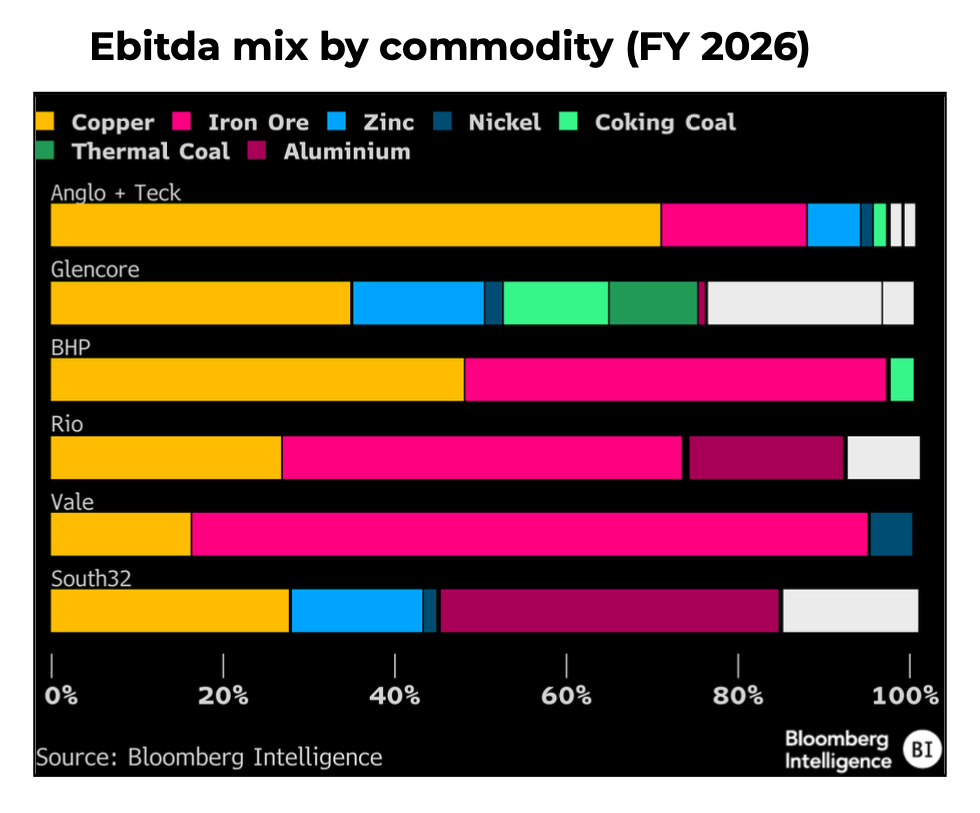
Copper’s growing dominance is reshaping the sector’s earnings mix, transforming the former “Dr. Copper” into what Bloomberg Intelligence now calls the king of commodities. Copper is set to account for more than 35% of diversified miners’ Ebitda in 2026, up about 14% from eight years ago, driven largely by higher prices and portfolio simplification rather than volume growth.

Rio Tinto stands out on production, having lifted copper output by 54% since 2019 with the ramp-up of Oyu Tolgoi, compared with an 11% increase at BHP (ASX: BHP, LON: BHP). The race to secure copper-heavy pipelines has intensified, pushing miners toward organic growth and M&A before assets are fully de-risked and rerated.

Anglo American’s (LON: AAL) transaction with Teck has accelerated its shift toward copper, with pro-forma earnings set to exceed 70% from the metal, followed by BHP at nearly 50% and Glencore at about 35%. Rio’s copper exposure has risen through sustained investment but still trails peers at roughly 26%, with iron ore dominating at 47%.

Bloomberg Intelligence expects diversified miners’ Ebitda to rise across the board in 2026, led by Glencore and Anglo at 24–28% growth.

Copper remains the key lever, with prices seen rising 25% versus 2025 under Bloomberg Intelligence’s scenario, or about 16% on consensus, while Glencore’s marketing division adds upside if volatility stays high.

Higher prices also bring cost risks, particularly labour, but for miners with precious metals by-products, stronger gold and silver prices should more than offset those pressures.

Road ahead

Execution will define the year as miners push major projects forward. Glencore must deliver cleaner operating performance while advancing Coroccohuayco and the Alumbrera restart. Anglo faces a critical phase completing its Teck merger and simplifying its portfolio. BHP needs to steady Jansen, clarify its Australian copper strategy and deliver the Vicuna technical study in the first quarter. Rio Tinto will focus on lithium integration, advancing in-flight projects and concluding its minerals segment strategic review, while Vale (NYSE: VALE) continues work on its plan to double copper output by 2030.

Macro trends favour base metals over bulk commodities, with resilient demand from electrification, AI and defence spending, alongside supply constraints and expected interest rate cuts. Iron ore faces a tougher outlook as supply growth accelerates and Chinese steel exports encounter rising global trade barriers.


US copper tariffs less likely after critical minerals decision: Macquarie

Stock image.

US tariffs on copper look increasingly unlikely after Washington opted to prioritize supply negotiations over trade penalties for processed critical minerals, Macquarie said, a stance that could eventually unwind stockpiles built on fears of import restrictions.

Earlier this month, the White House concluded a Section 232 investigation into imports of processed critical minerals and their derivative products by directing the Commerce Department to pursue supply agreements, while keeping tariffs as a future option if talks fail.

This decision, according to Macquarie commodities strategists led by Alice Fox, “significantly weakens the case for copper tariffs,” although it cannot be ruled out entirely.

For the time being, the US is likely to maintain “status quo” and postpone its decision on copper tariffs, the analysts wrote in a note published last week.

Cautionary signal

While copper is subject to its own Section 232 review, Macquarie said the fallout from the broader critical minerals decision — and its impact on silver markets — offers a cautionary signal.

Last year, concerns over potential US tariffs led to a sharp build in Comex silver inventories, tightening liquidity on the London Bullion Market Association (LBMA) and pushing lease rates sharply higher. That dislocation drove metal flows from New York to London as price arbitrage between exchanges reversed.

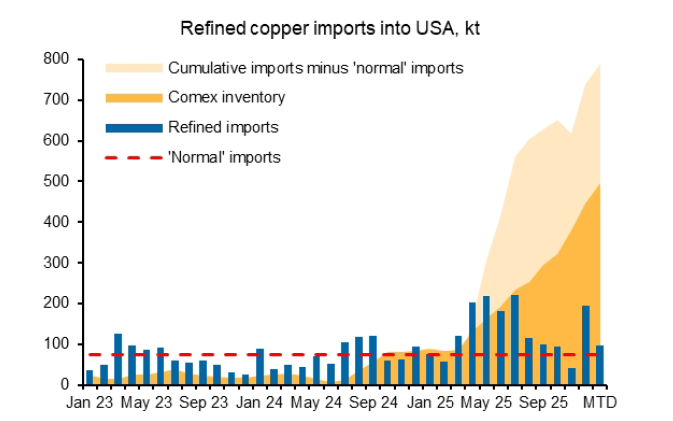
A similar dynamic is emerging in copper, Macquarie noted. Comex copper inventories have risen by about 412,000 tonnes since December 2024, with an estimated additional 375,000 tonnes held off-exchange. At the same time, the CME-LME arbitrage for January through March has fallen to zero or turned negative, reducing incentives for further US-bound arbitrage trades in the first quarter.

Data Source: IHS Markit, TDM, Comex, Bloomberg. Image Source: Macquarie

Instead, the negative arbitrage has begun to draw metal out of US warehouses, with London Metal Exchange stocks in New Orleans and Baltimore rising by 8,700 tonnes in the past week. Elevated premiums in Europe are also attracting contract metal that had been scheduled for delivery to the US, the Macquarie strategists said.

While copper already held in the US is not yet sufficiently incentivized to be re-exported, those stocks could become available if markets outside China tighten, as occurred in silver, the bank added.

Supply agreements

Despite minimal progress on rebuilding the US domestic copper production, Macquarie pointed to improvements in supply security through recent international agreements, such as the joint venture between the Democratic Republic and trading house Mercuria being backed by the US International Development Finance Corporation.

Under that deal, US end-users will have rights of first refusal on output, with Mercuria estimating annual sales of about 500,000 tonnes of copper and 40,000 tonnes of cobalt — equivalent to nearly 70% of US net refined copper imports in 2024.

Macquarie’s strategists concluded that the US could still delay a final tariff decision until the end of the year while negotiations continue, a scenario that would preserve the current market structure, with imports diverted and US-held stocks effectively sidelined.

However, if tariffs are ultimately ruled out, the copper arbitrage trade would likely reverse, releasing accumulated US inventories back into the market and potentially triggering a sharp correction in prices, they added.

Glencore says key issues remain in Horne smelter talks

NATIONALIZE IT UNDER WORKERS CONTROL

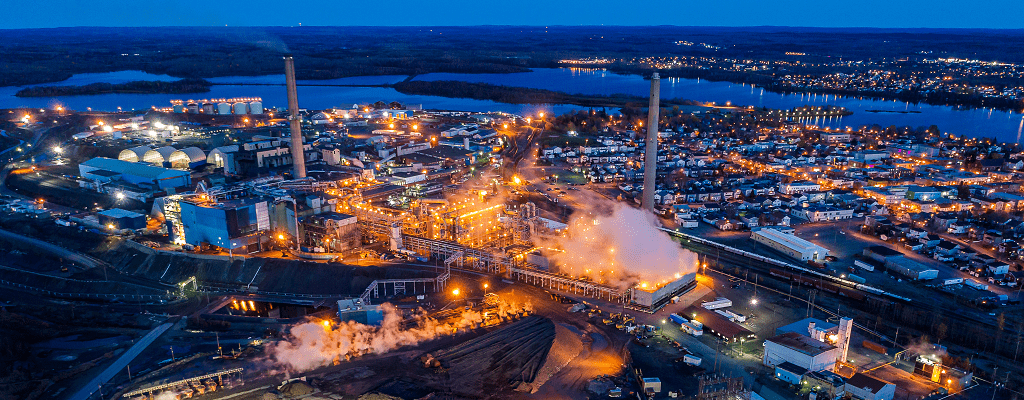
The nearly 100-year-old Horne copper smelter. Credit: Glencore.

Glencore (LSE: GLEN) said it remains at loggerheads with Quebec over the future of its controversial Horne smelter on the eve of a self-imposed deadline to settle the century-old facility’s fate.

“At this time, certain key elements remain unresolved. It is critical to break the current impasse without delay to secure the continuation of operations and the investments required to support the future of the Horne smelter” and a company-owned refinery in Montreal, Glencore said Friday in a statement.

Swiss-based Glencore said three weeks ago it had given the smelter until Jan. 31 to complete preparatory work aimed at cutting pollutant emissions. Modernizing the facility to lower emissions would cost about C$300 million ($200 million), Glencore said in December.

Glencore has repeatedly come under fire in the province due to the pollution that Horne causes in Rouyn-Noranda.

Although Horne greatly exceeds provincial standards for arsenic emissions, it benefits from special agreements with the provincial government. Under the most recent ministerial authorization, Horne must produce no more than 45 nanograms of arsenic per cubic metre of air for the fiscal year ending in March. From 2027 onwards, the target will be 15 nanograms – five times the provincial standard.

Transition period

Glencore has requested an 18-month “transition period” to reach 15 nanograms per cubic metre. It also wants assurances that the target won’t be lowered in ensuing years.

“Glencore Canada reiterates its willingness to invest in its facilities, but a financial commitment of this magnitude requires stability and predictability,” the company said Friday. “This is contingent on finding a path forward towards a stable and realistic regulatory framework for the years ahead — at a minimum for the duration of the next ministerial authorization.”

The next steps in the process “will depend on the parties’ ability to reach agreement quickly on viable conditions that both enable the company to deliver on its commitment to continuous improvement and support the long-term sustainability of its operations,” Glencore added.

Deal needed

Two Quebec unions last week urged Premier François Legault to strike a deal with Glencore over the smelter before relinquishing his post this spring. Legault announced in early January he would resign as soon as a successor has been chosen.

Horne and another Glencore facility, Montreal’s Canadian Copper Refinery (CCR), form Canada’s only complete copper-smelting and refining chain. Horne processes copper concentrate from mines, churning out about 210,000 tonnes a year of copper and precious metals.

Unions warn that CCR would also shut its doors if Horne closes down since the Rouyn-Noranda plant is its main supplier.

In October, the Quebec Superior Court authorized a class-action lawsuit brought by two Rouyn-Noranda residents against Glencore and the provincial government. The plaintiffs say emissions produced by Horne have caused various types of damage.

LIBERTARIAN GOLD BUG

Op-ed: Bretton Woods principles without Bretton Woods politics

Stock image.

Long before modern states claimed monopoly control over money, international trade depended on trusted systems that operated outside sovereign authority.

In medieval Europe, merchants travelling between cities and kingdoms faced a familiar challenge. Transporting physical gold, much as today, was dangerous, inefficient, and vulnerable to theft, seizure, or political interference. In that environment, the Knights Templar emerged as an unexpected solution.

Stripped of modern lore and conspiracy, their rise was driven by practical economics. Acting as a trusted, non-state custodian of gold and silver, the Order allowed merchants to deposit bullion in one location and draw against it in another, even minting its own coins. In effect, the Templars built an early asset-backed settlement network beyond state control, enabling commerce across political boundaries.

As debate intensifies over the US dollar’s role as the global reserve currency and speculation grows about possible successors, a more fundamental question emerges. Instead of replacing one sovereign-controlled reserve currency with another, should the world revisit the idea of a gold-backed reserve system not controlled by any sovereign actor at all?

Sound principles, unsustainable solution

The postwar Bretton Woods system rested on a correct insight: global trade needs a stable monetary anchor, and gold performs that role better than any alternative. By tying the US dollar to gold and other currencies to the dollar, the system imposed discipline and predictability on international commerce. For a time, it worked.

What Bretton Woods failed to account for was political reality. The system required one nation to subordinate its domestic priorities indefinitely to the needs of the global economy. That was never sustainable, nor a moral failing of the United States. As fiscal pressures, geopolitical commitments, and internal demands accumulate, strict gold convertibility becomes untenable for any country.

The collapse of Bretton Woods is better understood not as a rejection of asset-backed money, but as recognition of immutable political limits. When monetary discipline collides with political imperatives, politics always wins.

Fiat dominance, false exits and a doomed BRICS proposal

More than 50 years after gold convertibility ended, the US dollar remains the world’s dominant reserve currency. Deep capital markets, unmatched liquidity, and relatively predictable legal institutions have made it the least bad option for global trade and settlement.

That dominance does not imply satisfaction. Inflation, sanctions, and geopolitical tension have repeatedly revived predictions of the dollar’s decline. While those forecasts have proven premature, they reflect real discomfort with a reserve system anchored to a fiat currency shaped by the domestic politics of a heavily indebted and increasingly unpredictable United States.

Proposed exits from the current system tend to fall into two camps: restoring a gold-backed US dollar or shifting to another sovereign currency. Both approaches share the same flaw. They assume the problem can be solved by choosing a better sovereign steward.

A re-gold-backed dollar would again require the United States to place monetary discipline above domestic politics indefinitely, a constraint that was unsustainable decades ago and is even less plausible today.

The latest alternative is a proposed gold-backed BRICS currency. The logic resembles replacing a biased referee with one hired by the opposing team. It changes who benefits from the bias without eliminating it. Replacing dollar dominance with BRICS dominance merely redistributes political influence over money.

That is why, despite loud rhetoric, the world is unlikely to settle trade in a BRICS currency anytime soon, just as it will not see the return of a gold-backed US dollar.

Tether’s gold accumulation is a signal

Tether has reported accumulating roughly 140 tons of physical gold, stored in secure Swiss vaults repurposed from underground nuclear shelters. Purchases often exceeding $1 billion a week show little sign of slowing, suggesting some sophisticated actors are preparing for continued erosion of confidence in fiat reserves.

This does not make Tether the heir to the global reserve currency. Its holdings remain far smaller than those of major central banks, and questions persist around governance, transparency, and regulation. The issuer matters less than the signal. Tether’s strategy highlights the convergence of two elements historically difficult to combine at scale: a politically neutral reserve asset and a modern, globally interoperable settlement system.

Gold offers unmatched credibility as a reserve asset but has long struggled as a medium of exchange. Stablecoins excel where gold falls short, providing speed, divisibility, and low-friction cross-border settlement. Tether’s move raises the possibility that a gold-backed stablecoin, independent of sovereign control, could eventually reappear in a modern form.

Bitcoin proponents argue that Bitcoin already solves this problem. While its non-sovereign, censorship-resistant design has appeal, reserve currencies are chosen for stability and institutional acceptance, not ideological purity. Price volatility, protocol-based governance, and limited central bank tolerance make Bitcoin ill-suited as a primary global reserve asset. Progress does not always require abandoning the past.

Seen this way, Tether’s gold accumulation functions less as a forecast than as a provocation. It forces a serious reconsideration of whether gold’s credibility and crypto’s infrastructure can be combined into a more durable global system.

Revival of rules-based order

At recent gatherings in Davos and elsewhere, leaders have warned of the breakdown of the rules-based international order. The debate often focuses on bad actors breaking rules or good actors failing to enforce them. That framing misses the deeper problem.

Rules that rely on political self-restraint are not rules but expectations, and expectations fail when incentives change. Bretton Woods collapsed not because its principles were flawed, but because it depended on a sovereign consistently acting against its own political interests.

If a rules-based order is to endure, its core functions must rest on constraints, not discretion. In global finance, that points to a system where trust is anchored in assets and architecture rather than national power or goodwill. Bretton Woods principles without Bretton Woods politics may sound ambitious, but in a world increasingly aware of the limits of discretion, it may be the only viable path forward.


* Erik Groves is Corporate Strategy and In-House Counsel at Morgan Companies.The views and opinions expressed in this column are those of the author and do not necessarily reflect the official position of MINING.COM or The Northern Miner Group.

 MONOPOLY CAPITALI$M

Rio and Glencore set to extend deadline for talks on mega deal

(Image courtesy of Rio Tinto.)

Rio Tinto Group and Glencore Plc are poised to seek more time to work on a deal to create the world’s biggest miner as they wrangle over the premium that Rio would need to pay, people familiar with the matter said.

The two sides have been in talks since at least the start of this month to form a behemoth that would be among the world’s largest copper producers. While both remain keen on a deal, more time will likely be needed to hash out a valuation — requiring the UK’s Takeover Panel to extend a deadline for talks — according to the people, who asked not to be identified as the negotiations are private.

The potential combination is the latest in a series of attempted mega mergers between the top miners as executives look to bulk up in copper and grow in size to gain more relevance with global investors. With Rio and its smaller rival Glencore having a combined market valuation of about $235 billion, a tie-up would represent the industry’s largest-ever deal.

For Rio, the attraction is clear. It would get to roughly double its existing copper output at a time when prices of the metal that’s crucial metal for the energy transition are near a record high. It would also add about 1 million tons of future copper growth into its portfolio. Mining bosses have long warned that future supplies will be tight as demand is forecast to grow amid a dearth of new mines.

There are also wider appeals. Glencore’s sprawling coal business — until recently a taboo commodity for most major miners — adds huge cashflows, while its marketing business will help Rio become more commercially minded, a key ambition for Rio chairman Dominic Barton.

Any deal faces potential hurdles from Rio’s shareholders, who want it to remain disciplined in M&A, while Glencore is pushing for a premium that reflects it being bought by a bigger peer, some of the people said.

Rio and Glencore declined to comment.

Copper business

A particular concern for Rio is how to value Glencore’s copper business, the people said. The part of the company has underperformed, with output falling for four straight years amid a series of missed goals and operational setbacks.

Glencore in December outlined plans to almost double copper output over the next decade though expanding existing mines and a new project in Argentina. Investors seemed to buy into that narrative, and combined with a surge in the copper price, that sparked fresh interest from Rio. The two also held discussions in 2024, but they were abandoned after failing to agree on valuation.

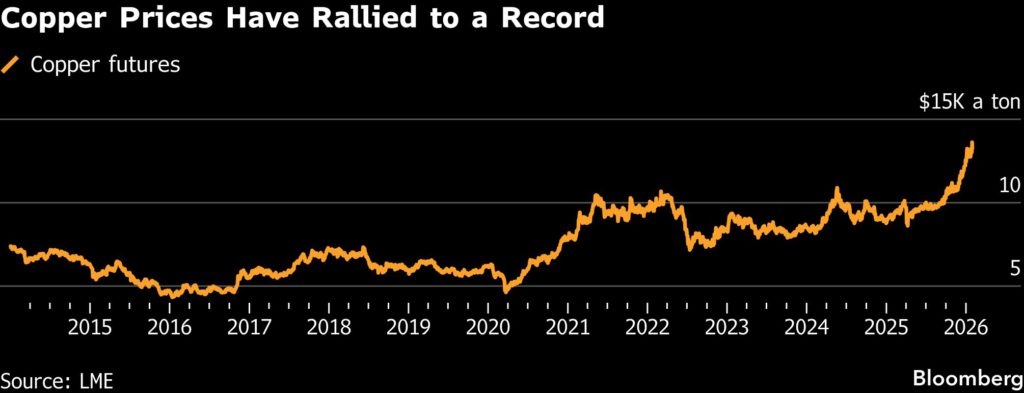
Copper’s surge continued this week, topping a record $14,500 a ton on Thursday on the back of a wave of buying from Chinese investors. Prices pulled back on Friday, but are still up about 45% over the past year.

Glencore has yet to appoint a bank to help with the deal but is talking with advisers, the people said. Potential advisers have met with the Swiss firm this week, according to some of the people.

Rio is working with Evercore Inc., JPMorgan Chase & Co. and Macquarie Group Ltd., Bloomberg has reported.

Clock ticking

The talks became public in early January, and UK takeover rules mean Rio has until Feb. 5 to confirm it will make an offer or walk away for six months — unless Glencore requests an extension. People close to the deal see an extension request as highly likely. However, the situation remains fluid and could still change, the people said.

A key priority for Rio is keeping its Australian shareholders — who own almost a fifth of the company — onside, some of the people said. They’re seen by the Rio as being more conservative than its other investors when it comes to deals.

Another important issue is whether both firms can demonstrate synergies to justify the size of the premium.

While people familiar with the matter said a combination of two huge companies is attractive to many senior people at Rio on a macro level, there are fewer direct synergies that normally make paying a takeover premium appealing to investors. For example, they have few operational overlaps — where neighboring mines can share infrastructure, logistics or combine ore bodies — the sort of factors that often drive deals.

Instead, people close to the talks see Rio trying to build a case for broader synergies, including operating Glencore’s mines more efficiently and better developing growth projects. Rio also sees synergies from leveraging Glencore’s marketing business, the people said.

(By Thomas Biesheuvel, Dinesh Nair, Paul-Alain Hunt and Aaron Kirchfeld)