Sunday, April 26, 2026


How the International Community Obtained a Nuclear Weapons-Free Agreement with Iran – and Lost It Thanks to Donald Trump


by  | Apr 23, 2026 | 

If the objective of the U.S. war upon Iran is to ensure that that country does not develop nuclear weapons, that goal was attained more than a decade ago through a far different approach than the one now being followed by the Trump administration.

Iran, as a signer of the Nuclear Nonproliferation Treaty of 1970, had agreed to forgo the development of nuclear weapons.  Even so, fears grew during the early 21st century that Iran’s uranium enrichment program, used for peaceful purposes, might be diverted to the development of the Bomb, thereby throwing the volatile Middle East into yet another crisis, including a frenzied nuclear arms race.

As a result, the five permanent members of the UN Security Council (the United States, Russia, China, Britain, and France) and Germany began lengthy negotiations with Iran, offering it various incentives to halt uranium enrichment.  A key incentive was the lifting of international sanctions, which were having a severe impact on sales of Iran’s oil and, thus, its economy.  After the election in 2013 of an Iranian reformer, Hassan Rouhani, as president, the negotiators came to a preliminary accord to guide their talks toward a comprehensive nuclear agreement.

The final agreement, formally known as the Joint Comprehensive Plan of Action, was negotiated by the five permanent members of the UN Security Council, Germany, and the European Union.  Signed in July 2015, it granted Iran sanctions relief in exchange for significant restrictions on its nuclear program.  These included Iran’s agreement to ban production of highly enriched uranium or plutonium, ensure that its key nuclear facilities pursued only civilian work, and limit the numbers and types of centrifuges that it could operate.  In addition, Iran agreed to allow inspectors from the International Atomic Energy Agency (IAEA), the UN’s nuclear watchdog, unfettered access to its nuclear facilities and undeclared sites.

In the United States, the Iran nuclear agreement was strongly supported by the Obama administration, which played a key role in securing it, and by Democrats, but denounced by Republicans.  Jeb Bush, then a leading presidential contender, called it “dangerous, deeply flawed, and short-sighted,” while U.S. Senator Lindsey Graham claimed that it was a “death sentence for the state of Israel.” Indeed, Benjamin Netanyahu, Israel’s Prime Minister, lobbied ferociously against U.S. acceptance of the Iran agreement, furiously attacking it as a “historic mistake.”

Despite the opposition, the agreement went into effect in January 2016 and, initially, had smooth sailing.  The IAEA certified that Iran was keeping its commitments, nations repealed or suspended their sanctions, Iran’s oil exports surged, and the United States and European nations unfroze about $100 billion of Iran’s frozen assets.

In May 2018, however, Donald Trump, Obama’s successor as President, breaking with America’s European allies, unilaterally withdrew the U.S. government from the Iran agreement and announced the reimposition of oil and banking sanctions.  “It is clear to me that we cannot prevent an Iranian nuclear bomb under the decaying and rotten structure of this deal,” Trump announced.  Assailing the Iran agreement as “defective to its core,” Trump condemned it for failing to deal with Iran’s ballistic missile program and its proxy warfare in the Middle East, as well as for the agreement’s 10-year sunset provision.

In response, Iranian President Rouhani, stating that the U.S. government had failed to “respect its commitment,” declared that he had “ordered the Atomic Energy Organization of Iran to be ready for action if needed, so that if necessary we can resume our enrichment on an industrial level without any limitations.”  Even so, he promised, he would wait to speak about this with allies and the other signatories to the agreement.

Thereafter, things went downhill.  Although France, Germany, and Britain sought to keep the agreement alive by evading the U.S. banking sanctions through a barter system, this effort eventually collapsed.  Meanwhile, Trump got into a verbal brawl with Rouhani, threatening Iran with what he called “CONSEQUENCES THE LIKES OF WHICH FEW THROUGHOUT HISTORY HAVE EVER SUFFERED BEFORE.”  Ultimately, Iran began exceeding the agreed-upon limits to its stockpile, enriching uranium to higher concentrations, and developing new centrifuges.

Although Joe Biden, as a 2020 presidential candidate, promised to rejoin the Iran nuclear agreement and “to work with our allies to strengthen and extend it,” by the time he was in office the relationship with Iran had deteriorated too far to make this feasible.  Coming under a new, more reactionary leadership, the Iranian regime grew more repressive, as well as more distant from the United States and more politically toxic.  As a result, a new agreement was increasingly out of reach.

In retrospect, are there any lessons that can be learned from these events?

One is that, to the degree that the development of nuclear weapons by Iran is a currently a problem, it is a problem of Trump’s making.  Or as Biden put it years ago, Trump’s pullout from the 2015 Iran nuclear agreement was “a self-inflicted disaster.”

Another is that getting a country to forgo nuclear weapons development is easier to accomplish through international―and especially UN Security Council―action than through unilateral action.  A threat from one nation to another can easily be viewed and dismissed as bullying.  But pressure from a worldwide organization representing the community of nations has greater impact.

More generally, if nations are going to be asked (or pressured) to forgo development of nuclear weapons, it is useful to have a framework that treats nations equally.  The Nuclear Nonproliferation Treaty fosters this equality through a bargain, in which the non-nuclear nations forgo building nuclear weapons in exchange for the nuclear nations eliminating their own nuclear arsenals.  The next time Donald Trump and Benjamin Netanyahu threaten to annihilate Iranian civilization, someone might remind them of that.

Lawrence Wittner is professor of history at the State University of New York/Albany and a contributor to Foreign Policy In Focus. His latest book is Confronting the Bomb: A Short History of the World Nuclear Disarmament Movement (Stanford University Press).


The Gallows Law: Israel Moves Toward Executing Palestinian Children


by  | Apr 23, 2026 | 

According to Israel’s new death penalty law, Palestinian children, like adults, could, in practice, find themselves facing the gallows. This might take some by surprise, or even be dismissed as an exaggeration. Sadly, it is neither.

The death penalty law, passed by Israel’s Knesset on March 30, mandates capital punishment for Palestinians convicted of carrying out deadly attacks. The legislation, often referred to as the ‘Death Penalty for Terrorists’ law, requires that executions be carried out swiftly, within 90 days, while sharply limiting avenues for appeal or commutation, according to human rights organizations including Amnesty International and Human Rights Watch.

It resolves a long-standing political demand by Israel’s far-right leadership to formalize execution as a tool of control over Palestinians. As extremist Israeli National Security Minister Itamar Ben-Gvir has repeatedly argued, those accused of such acts “deserve death,” framing the law not as an exception, but as a necessary policy.

Though the law itself does not explicitly mention children, it does not exclude them either. Knowing Israel’s treatment and legal classification of Palestinian children, this distinction is not minor – it is decisive.

Under Israel’s military court system, Palestinian children as young as 12 are prosecuted. In practice, they are often treated as adults within a system that offers few safeguards and operates with an extremely high conviction rate.

Defense for Children International – Palestine reported in its 2023 briefing Arbitrary by Default that the Israeli military detention system subjects Palestinian minors to “systematic”, institutionalized and “widespread ill-treatment.”

Reports by Amnesty InternationalHuman Rights Watch, and other rights organizations describe consistent patterns of abuse, including night arrests, physical violence, threats, and psychological pressure.

Many children, these groups note, are interrogated without adequate legal safeguards, in conditions that facilitate coercion and the extraction of confessions.

Under international law, children are protected persons, entitled to special safeguards under the Fourth Geneva Convention and the Convention on the Rights of the Child – both of which prohibit cruel, inhuman, or degrading treatment.

Not in Israel, however – a state that has consistently treated international law not as binding, but as an obstacle to its political and military objectives.

For Israel, Palestinian children are often framed not as civilians, but as potential threats. This framing represents a profound assault on basic humanity and fundamental rights – one that goes even further than the cynical language of ‘collateral damage’, by preemptively stripping children of their civilian status.

Israeli officials have made such views unmistakably clear.

In 2015, former Israeli Justice Minister Ayelet Shaked shared and endorsed a text declaring that “the entire Palestinian people is the enemy,” including its children, and that Palestinian mothers should not give birth to “little snakes.” Her statement was not an aberration, but a reflection of a political discourse in which dehumanization is normalized.

This, too, has often been dismissed as routine racism in Israeli politics. It is not.

Since October 7, 2023, Gaza’s children have been killed in staggering numbers: at least 21,289 children among more than 71,800 Palestinians killed, and over 44,500 wounded, according to UNICEF’s February 2026 update.

In the occupied West Bank, the pattern persists, with Palestinian children increasingly killed during Israeli military raids and settler violence.

All of this in mind, it should not be surprising that the death penalty law does not exempt children from the horrific fate it envisions for Palestinians who resist Israeli occupation.

To be clear, the death penalty law is neither about punishment nor deterrence. Israel does not require a law to kill Palestinians – whether those engaged in armed resistance, or, as has often been the case, civilians with no involvement in hostilities.

For decades, Israel has carried out assassinations, extrajudicial killings, and large-scale military operations that have resulted in thousands of Palestinian deaths.

The killing of Palestinians in Israeli prisons is no longer incidental, but documented. Since October 2023, at least 98 detainees have died in custody – many under conditions linked to torture, abuse, and medical neglect, according to Physicians for Human Rights–Israel.

The law, therefore, is about something else: the projection of power.

It is not fundamentally different from the performative brutality associated with figures like Ben-Gvir, whose rhetoric and conduct toward Palestinian prisoners have emphasized domination, humiliation, and control.

But within this projection of power lies a deadly consequence: Many people stand to be killed – including children.

Though some voices in the international community have spoken out against the law, these reactions have been limited and short-lived, quickly overshadowed by other developments.

Without sustained pressure, Israel has no reason to refrain from carrying out executions – decisions that will be made by military courts that lack even the most basic standards of fairness or adherence to international law.

Once this, too, is normalized, the threshold will shift again. And children will inevitably be drawn into it.

Israel has already normalized practices once deemed unthinkable. If it now normalizes the execution of children, it will cross a threshold even many colonial regimes did not openly breach.

There must be a limit – because its continuation will not only devastate Palestinians, but reverberate far beyond, eroding the most basic protections of human life itself.

Dr. Ramzy Baroud is a journalist, author and the Editor of The Palestine Chronicle. He is the author of six books. His forthcoming book, ‘Before the Flood,’ will be published by Seven Stories Press. His other books include ‘Our Vision for Liberation’, ‘My Father was a Freedom Fighter’ and ‘The Last Earth’. Baroud is a Non-resident Senior Research Fellow at the Center for Islam and Global Affairs (CIGA). His website is www.ramzybaroud.net

The Pope Is Right – The US-Israeli War With Iran Violates Just-War Theory

by  | Apr 24, 2026 | 

On April 10thPope Leo XIV posted on Twitter/X, “God does not bless any conflict. Anyone who is a disciple of Christ, the Prince of Peace, is never on the side of those who once wielded the sword and today drop bombs. Military action will not create space for freedom or times of #Peace, which comes only from the patient promotion of coexistence and dialogue among peoples.”

The Pope’s condemnation of war drew the ire of the self-proclaimed “Peace President” and his allies. On TruthSocial, President Trump described the Pope as “Weak on Crime, Weak on Nuclear Weapons” and “terrible for Foreign Policy.” At a Turning Point USA event, Vice President J.D. Vance remarked, “When the pope says that God is never on the side of people who wield the sword, there is more than a 1,000-year tradition of just war theory.” Speaker of the House Mike Johnson was likewise “taken a little bit aback.” He told reporters, “It’s a very well-settled matter of Christian theology. There’s something called the just war doctrine.”

Yet just war is precisely the Pope’s point. As Bishop James Massa, the chairman of the US Conference of Catholic Bishops’ Committee on Doctrine, said in a statement:

“For over a thousand years, the Catholic Church has taught just war theory and it is that long tradition the Holy Father carefully references in his comments on war. A constant tenet of that thousand-year tradition is a nation can only legitimately take up the sword ‘in self-defense, once all peace efforts have failed’ (Catechism of the Catholic Church, no. 2308). That is, to be a just war it must be a defense against another who actively wages war, which is what the Holy Father actually said: ‘He does not listen to the prayers of those who wage war.’

Ultimately, this appeal to Just War Theory by Vance and Johnson is a desperate retort from a historically sinful administration. To date, Trump has authorized military strikes in 10 countries: Afghanistan, Iraq, Yemen, Pakistan, Somalia, Libya, Syria, Venezuela, Nigeria, and Iran. Currently, the Pentagon is reportedly preparing for military action against Cuba – a nation that Trump has repeatedly threatened to “take.” This invasion would come months after the Trump administration imposed a total oil blockade that is causing widespread suffering and starvation there. No interpretation of Just War Theory would ever justify such rampant and senseless violence.

Just War Theory

Modern versions of Just War Theory are split into three components: first, jus ad bellum, or the conditions under which a nation may justifiably wage war. This includes: (i) a just cause (e.g., self-defense, protecting the innocent), (ii) war must be a last resort, (iii) right intention (i.e., the war must be conducted for the sake of justice – not self-interest or personal gain), and (iv) declared by a proper authority.

The second component is: jus in bello, or how a just war is waged. This includes: (i) distinguishing between civilians and combatants and (ii) proportionality (i.e., deploying the minimum amount of violence necessary to achieve one’s goal – no matter how righteous the cause, excessive destruction is unjust).

Finally, the third component is: jus post bellum, or how nations ought to act once the fighting has stopped, including during a ceasefire. This includes: (i) not punishing civilians, (ii) respecting the rights and traditions of the defeated, (iii) not exploiting the defeated nation, and (iv) rehabilitating the aggressor to avoid future violence.

Trump’s wars consistently fail these criteria. Consider the US-Israeli war with Iran.

Jus Ad Bellum

Trump alleges that this war was necessary to stop Iran from developing nuclear weapons. However, he had previously alleged that Operation Midnight Hammer had “significantly degraded Iran’s nuclear program.” There is no evidence that Iran was developing a nuclear weapon, had ambitions to develop nuclear arms, or that they posed an immediate threat to the US. There is no just cause here.

This war was also not a last resort. Not only was Iran negotiating with the US, but they also made major concessions to the Trump administration regarding their nuclear program. Omani Foreign Minister Badr bin Hamad Al Busaidi, who was mediating these talks, said, “I have seen a lot of flexibility on both sides, and I believe it’s really a matter of just keeping at it, keeping negotiating to get that to that finishing line.” Trump, however, unilaterally decided to stop these productive talks based on a “feeling” – not necessity.

The Trump administration has provided several, often conflicting, reasons for this war. Notably, Israeli Prime Minister Benjamin Netanyahu expressed that he has “longed” for this war “for 40 years.” President Trump has repeatedly insisted that, “If it were up to me, I’d take the oil, I’d keep the oil, it would bring plenty of money.” This is, after all, what he did in Venezuela after kidnapping President Nicolás Maduro. As Trump put it, after (rightfully) not winning the Nobel Peace Prize, he “no longer feel[s] an obligation to think purely of Peace.” His actions in Iran, Venezuela and elsewhere reflect this. They are not guided by the pursuit of justice or peace, but rather personal and financial gain.

As for proper authority, the Constitution is clear: Congress alone has the power “to declare War.” No congressional approval means no just war.

Jus In Bello 

On the very first day of the war, the US struck a girl’s elementary school killing more than 175 people. The International Federation of Red Cross and Red Crescent Societies reports that at least 1,900 people have been killed and 20,000 injured in Iran since the start of US-Israeli attacks. On March 9th, Iranian Deputy Health Minister Ali Jafarian reported that 52 health centers, 18 emergency service locations and 15 ambulances had been damaged or destroyed. US-Israeli strikes also “completely destroyed” a synagogue in Tehran and at least 30 universities have been impacted. Trump has even gone as far as to threaten that, “A whole civilization will die tonight, never to be brought back again.” Clearly, no distinction between civilians and combatants is being observed.

In clear violation of international law, Secretary of War Pete Hegseth pledges “no quarter, no mercy for our enemies.” On March 2ndhe remarked, “No stupid rules of engagement, no nation-building quagmire, no democracy building exercise, no politically correct wars. We fight to win, and we don’t waste time or lives.” There will be “no apologies, no hesitation” for “we are not defenders anymore. We are warriors, trained to kill the enemy and break their will.” By his own admission, Trump is likewise “not at all concerned about war crimes.” The point here is clear: excessive violence is this administration’s first resort.

Jus Post Bellum 

At the time of this writing, the US and Iran have agreed to a ceasefire. After the first round of talks, Vance, who was heading the US delegation, said Iran chose “not to accept our terms.” He remarks, “The bad news is that we have not reached an agreement, and I think that’s bad news for Iran much more than it’s bad news for the United States of America.” Vance’s wording makes clear that the US is not negotiating with Iran as equals. This is unsurprising. Throughout this conflict, Trump has repeatedly referred to Iran’s leaders as “lunatics” and “crazy bastards.” Secretary of State Marco Rubio has described them as “lunatics,” “insane” and “religious zealots.” This lack of respect for the Iranian people will only serve to further tensions and make a lasting peace less possible.

Indeed, the US initially sought to escalate hostilities during this ceasefire by imposing its own blockade on the Strait of Hormuz. The purpose here was clear: by blocking their oil exports, the US was hoping to coerce Iran into submission. Because of sanctions, the Iranian economy is already fragile – a blockade could have major financial and humanitarian consequences. Even during a ceasefire, the Trump administration’s first instinct is to cause collective suffering.

Amid the Lebanon ceasefire, Iran has agreed to open the Strait; however, Trump has declared that the American blockade on Iranian ships and ports “will remain in full force.”

Ultimately, this is not a war of self-defense. It is not a preemptive war against a legitimate threat. It is a war of glory and conquest. It is a war of sin.

The violence and suffering that the US and Israel have caused can never be undone. Yet, we can and must hold the responsible parties accountable. Trump, Netanyahu and everyone in their administrations who enabled this war must be brought to justice. They have shown themselves time and time again to lack the moral character necessary to lead a nation. Justice likewise demands that reparations be made. While no compensation can ever make up for the loss of innocent life, Iran must be provided with the tools and resources necessary to rebuild their nation.

On April 16th, Pope Leo XIV remarked, “The world is being ravaged by a handful of tyrants, yet it is held together by a multitude of supportive brothers and sisters.” Once again, the Pope is right – we must never stop striving towards building a more peaceful and just world. A world where people are elevated, not buried under rubble; a world where children grow up safe and sound without fear of “Epstein’s Fury”; a world where love, compassion and respect for others trumps war, death and destruction.

Originally published at Common Dreams.

Jordan Liz is an Associate Professor of Philosophy at San José State University. He specializes in issues of race, immigration and the politics of belonging.

Trump tried to bully the Pope — and failed spectacularly: NYT analysis


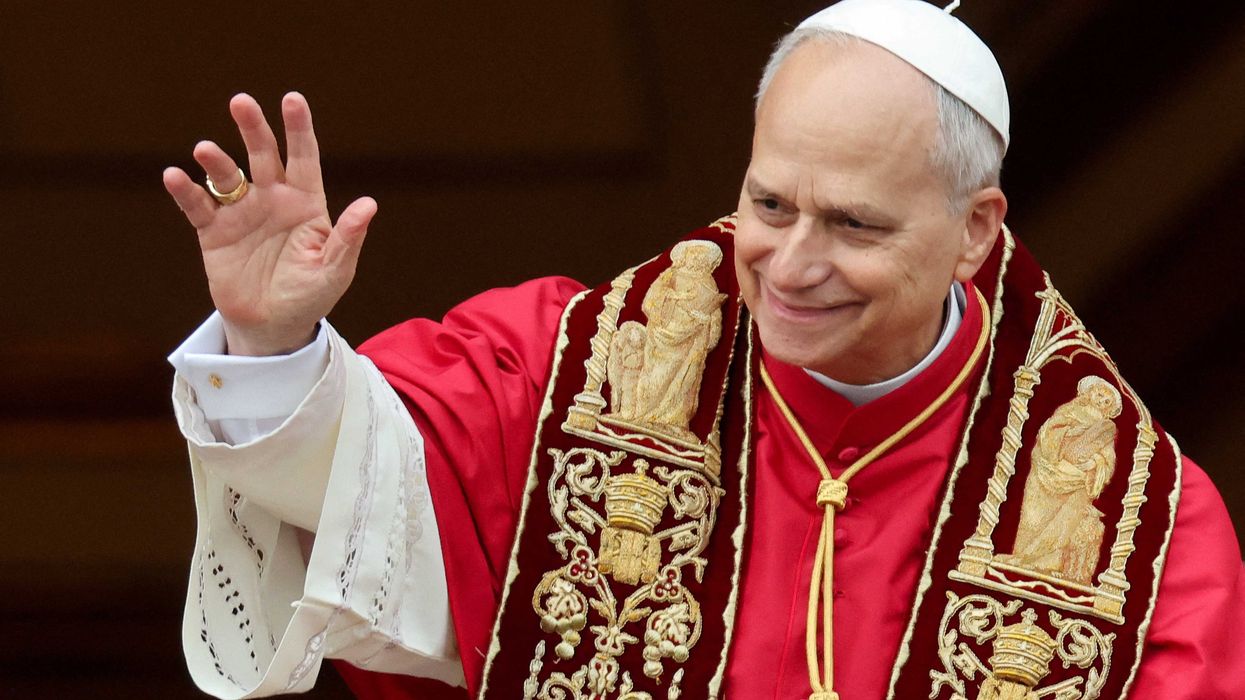
Pope Leo XIV gestures after delivering the traditional Christmas Day Urbi et Orbi speech to the city and the world from the main balcony of St. Peter's Basilica at the Vatican, December 25, 2025. REUTERS/Yara Nardi
April 24, 2026
ALTERNET

One thing that the ongoing spat between President Donald Trump and Pope Leo XIV did was expose the hollow core of the Christian nationalism in his administration, one columnist argued on Thursday.

The New York Times' David French wrote that the spat between Trump and Pope Leo "may be the most important theological debate of my lifetime" for revealing how the administration's faith serves as a political prop but crumbles when confronted with actual Christian doctrine on war and morality.

Writing as the Pope finished up his packed 10-day trip across Africa, French explained that the one thing the new pontiff has exposed is that there is no real Christianity in Christian Nationalism.


His back and forth with Trump made it clear where he stands on war and peace, and his speeches across Africa on "global moral responsibility," aid for the poor, mentally ill, prisoners and others hammered the message home. He urged unity among all people, not just Catholics, calling on Christians in Algeria to strengthen ties with Muslims.

The result of Trump treating the pope "the way he would a freshman Republican congressman — trying to bully and bluster him into silence—" was outright failure, French said.


Trump brought the pope to the center of a national conversation about the war. A trip across Africa wouldn't normally have garnered much attention outside of religious publications and those who already follow it. But thanks to Trump, every word the pope said on the trip was reported, broke into the mainstream, and laid bare the "profound contrast between the two men."

"In this contest between a pope and a president, the president looks weak and erratic. He looks small. Between Trump and Pope Leo, there is only one man who is demonstrating strength and moral consistency on the world stage," French said.

The debate also made it clear that, despite its memes and public prayers, when the Christian part of "Christian nationalism" comes into conflict with the nationalist part, the latter prevails.


French cited Jesus’ words in Matthew 15: “These people honor me with their lips, but their hearts are far from me.”

Further, the columnist said, Pope Leo raised the level of debate about war beyond Catholics, with a public debate about philosophy and religion regarding the nuances of "just war theory."

French pointed to the Catechism of the Catholic Church, making the theory clear: “The strict conditions for legitimate defense by military force require rigorous consideration. The gravity of such a decision makes it subject to rigorous conditions of moral legitimacy.”


He then compared it to the Department of Defense's Law of War Manual, which describes the "just war doctrine" as part of a “philosophical foundation” of the law of war.

“The just war tradition remains relevant for decisions to employ U.S. military forces and in warfighting," the manual says.

French cited Edward Feser, a Catholic philosophy professor, who penned a piece not long after the war began, to explain how Trump's decision failed the just war test. Even if there was a "just" reason for the war as a preemptive strike to protect future people, the administration hasn't made that case.

"If you’re going to argue that you intend to liberate the Iranian people, you have to show how your intervention — no matter how well intentioned — won’t actually increase their suffering," said French.


While it might focus on Iran now, it goes beyond just war doctrine and international law because it can bind nations in a moral alliance if they agree to follow only that doctrine.

"It helps bind together alliances. It enhances the effectiveness of the armed forces. American history demonstrates that national unity in a conflict is almost directionally proportionate to the justice of the cause. Contrast, for example, the unambiguous virtue of defending ourselves from Imperial Japanese and Nazi aggression with the far hazier justifications for our extended war in Vietnam," wrote French.

He noted that if a just war can bring allies together, then an unjust war can certainly tear them apart. A good example is NATO's response to Trump's Iran war compared to NATO's willingness to help the U.S. after Sept. 11, 2001.

All of this draws a clear line between the rhetoric that the Trump administration uses about Christianity to justify "corrupt and lawless actions" and the realities of Christian theology.


"The administration wants all the benefits of religion and none of the burdens. It wants to be seen as godly while acting godlessly," French closed.

Trump admin just exposed their contempt for Christians: analysis
April 22, 2026
ALTERNET

President Donald Trump and his administration talk a big game about their devotion to and support for religion, but in practice, their "high-octane condescension" exposes their "contempt toward Christianity," according to a new analysis from The Bulwark.

Mona Charen is a veteran writer and journalist who previously worked as a staffer for former President Ronald Reagan and as a speechwriter for First Lady Nancy Reagan. She is now an outspoken critic of Trump and his political agenda, writing for The Bulwark on Wednesday about the ways in which he has "revealed MAGA's anti-Christian nature."

"The past few days have featured the vice president of the United States lecturing the pope on morality and church doctrine; Sean Hannity making it official that he worships at the Church of Trump; Pete Hegseth quoting made-up verses from Pulp Fiction as if they were actual scripture; and Trump styling himself as Jesus Christ," Charen wrote. "A few years ago, one might have wondered how these acts of contempt toward Christianity would go down with the religious right, but after 10 years of cultishness, it would be foolish to expect many defections."


Speaking from her own background in the conservative movement, Charen called it "dizzying" to see "people who used to venerate religious leaders of all stripes" morph under Trump's influence into people who now "smack-talk the pope and commit what some have characterized as blasphemy." She took particular exception to Vance's "swipes at the vicar of Christ," in which he urged Pope Leo XIV "to stick to matters of morality," and "let the president of the United States stick to dictating American public policy," a set of assertions especially galling considering Vance's much publicized late-in-life conversion to Catholicism.

"You do Mass and baptisms and such and let us handle war and peace. That’s some high-octane condescension, but if he had stopped there, it would only have registered as normal MAGA insolence," Charen continued. "But no, Vance wasn’t finished. Speaking the next day at a Turning Point USA event, Vance rebuked the spiritual leader of 1.4 billion Christians (including himself: Vance converted to Catholicism in 2019) for his theology!"


While she herself is Jewish, Charen explained that she had always had an admiration for "serious Christians" and their commitment to doing good. In the face of Trump's contamination of right-wing religiosity, she called it "One of the sad revelations of our time" how MAGA has exposed "the shallowness of many Christians’ professed faith," becoming another in a long line of historical examples of faith being "perverted to enable cruelty and even atrocities."

"But the particular sacrilege that late stage Trumpism has adopted must be tearing at some hearts," Charen concluded. "From Trump’s declaration that unlike Erika Kirk, he doesn’t forgive his enemies, to his crude attacks on the pope as 'weak on crime,' to his insane AI rendering of himself as Jesus, he seems to be deliberately testing Christians’ forbearance. Above all, his threat to commit war crimes by deliberately targeting civilian infrastructure in Iran (bridges, power plants) and culminating in the maniacal vow to destroy Iranian civilization in one night ought to have produced a recoil in any nation with a conscience. Time to consider that he might be a false prophet—if people can distinguish truth from falsehood anymore."
Trump vows to investigate UFO scientist deaths —but experts warn it's a trap


Matthew Rozsa
April 26, 2026
ALTERNET


President Donald Trump has promised to look into the mysterious deaths of officials and scientists studying UFOs — but experts say this is one enigma that has more to it than appears to be the case at face value.

“The accounts were published breathlessly online in social media but also by rightwing press accounts,” reported The Guardian’s Edward Helmore on Sunday. “Trump himself was asked about the story and promised to look into it. Soon, Republican lawmakers joined the debate demanded in a letter that the FBI, the Department of Energy, Nasa and other agencies investigate a ‘possible sinister connection’ in the disappearances.”

The “disappearances” in question include those of retired US air force major general William “Neil” McCasland, 68, who in February walked out of his Albuquerque, New Mexico home, never to be seen since; Michael David Hicks, a scientist who worked at the NASA jet propulsion lab from 1998 to 2022 and died in 2023 at age 59 of unknown causes; Monica Reza, a scientist who disappeared last June after serving as director of the NASA lab’s materials processing group; astrophysicist Carl Grillmair, who was shot dead on his porch; Amy Eskridge, an Alabama-based researcher who claimed to be working on “gravity-modification research” and was found dead by an apparent suicide in 2022 despite telling NewsNation that “if you see any report that I killed myself, I most definitely did not”; MIT physicist Nuno Loureiro, who was killed by a former classmate; and Jason Thomas, a chemical biologist at drugmaker Novartis, who disappeared in December with his remains being discovered in March.


“Then, last week, UFO researcher David Wilcock, 53, used a gun to kill himself outside his home in Boulder county, Colorado,” Helmore reported. “Tennessee congressman Tim Burchett responded to a social media post announcing Wilcock’s death by writing: ‘Not cool.’ Burchett told the Daily Mail: ‘I just don’t think there’s any chance that this is just all coincidental.’”

Speaking to The Guardian, Penn State history and bioethics professor Greg Eghigan contextualized the UFO scientist story within the broader paradigm of American conspiracy theory history.


Greg Eghigian, professor of history and bioethics at Penn State and author of After the Flying Saucers Came, is different from the New Jersey drone scare of late 2024.

“It’s one of those things that get folded into other kinds of concerns and conspiracy theories that are out there about science and medicine that have been circulating around since Covid,” Eghigian explained. “That fold neatly into the decades-old notion that UFOs are spotted around nuclear facilities and some of these facilities may be masking UFO-related projects.”

He added that a convergence of factors make UFO-based conspiracy theories so appealing at this specific juncture in American history.


“So when people want to connect these dots it falls readily into a sweet spot for UFO lore because you have all the elements that have always been there – the military, state secrets, nuclear facilities and technologies, and fear of figures that are missing,” Eghigian said. “What is it? Are they being abducted? Assassinated because they know too much? The seeds of this were planted decades ago.”

Speaking to this journalist for Salon last year, Haley Morris, co-founder of the military pilot-led nonprofit Americans for Safe Aerospace, the world's largest UFO advocacy organization, argued that Trump should declassify those documents, echoing an argument made by Senate Minority Leader Chuck Schumer. Yet she also warned that those declassifications may disappoint UFO fans.

“Keep in mind that declassification doesn’t necessarily come with explanations,” Morris said at the time, adding that the “best case is that with transparency, people can see the [UFO] mystery for themselves and hard data is made available for the scientific community to try and get some answers.”
The connection between Trump and violence is undeniable —and last night proved it


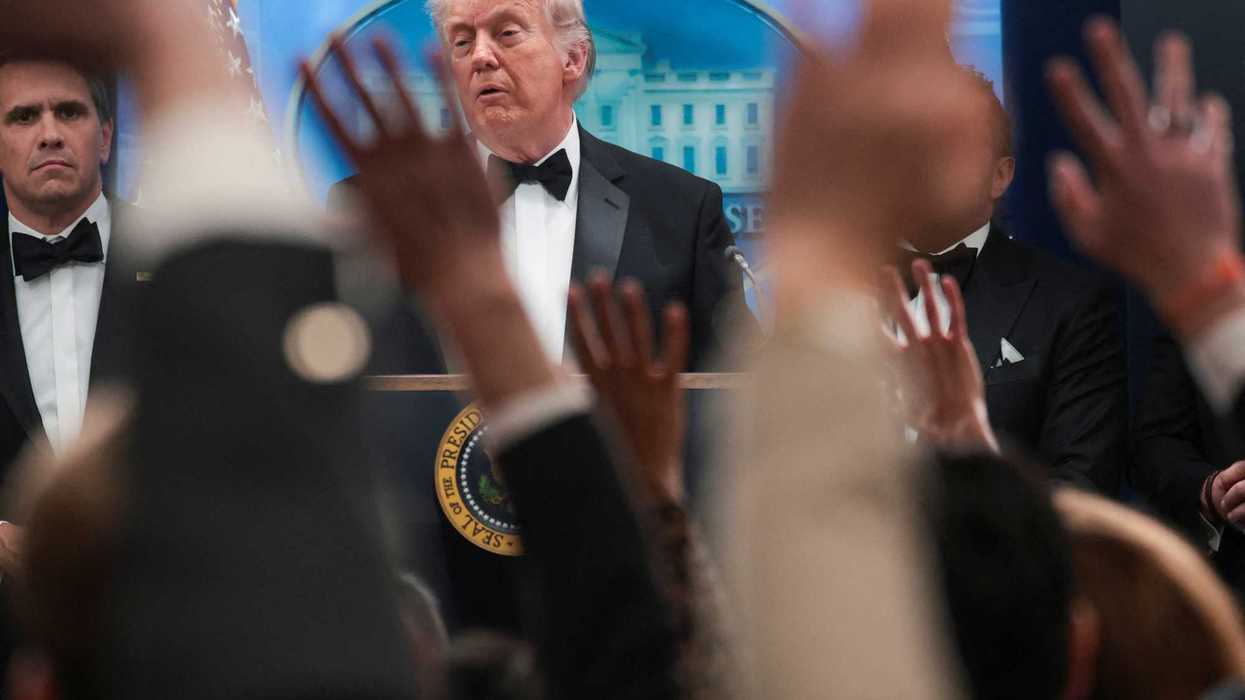
Journalists raise hands to ask questions as U.S. President Donald Trump holds a press briefing at the White House, following a shooting incident during the annual White House Correspondents’ Association dinner, in Washington, D.C., U.S., April 25, 2026 REUTERS/Jonathan Ernst
April 26, 2026
ALTERNET

For as long as I can remember, the White House Correspondents dinner was where the Washington press corps and Washington officials basked in each other’s celebrity.

Last night’s ended abruptly with gunshots, Secret Service officers screaming at attendees to “get down,Trump and other officials being rapidly ushered out of the ballroom, plates crashing and chairs falling, and general pandemonium.

Last night, the celebrities became normal people feeling panic and fear.

Most of the time, Washington is a stage on which actors take on roles and dress up for assigned parts. I remember wearing an uncomfortable tuxedo to the White House Correspondents Dinner, trying to make pleasant conversation with people who had skewered me that very morning.

The glamor and swish of the event was at such sharp odds with the hard daily slog of my job that the event seemed strangely disembodied, as if everyone had been given a script that they knew was total bull----.

Trump has changed much of this. He has brought a grim hostility to the jobs of doing the public’s work and reporting on those who do the public’s work. This was the first White House Correspondents dinner he agreed to attend, and by all accounts he was prepared to give the media pure hell in his remarks.

And then hell erupted in the form of another crazed gunman. As I write this, it appears that one Secret Service agent was injured but none of the luminaries was hurt.

There is a close relationship between Trump and violence — not just the attempts on his life but also the violence he’s unleashed on the world, the violence his ICE and Border Patrol agents have caused inside America, the violence he has incited among his followers. (A few of last night’s attendees were in Congress on January 6, 2021 when Trump’s thugs attacked the U.S. Capitol.)

Trump’s violence has resulted in thousands of deaths and injuries. That is no justification for last night’s attack, of course, but it is part of what he has wrought in America. He has changed the script in Washington.

It is no longer the hard slog I remember. The drama in Washington is now a chaotic tragedy, most of whose actors — those who make the news and those who report it — live in continuous uncertainty and turmoil.

Robert Reich is a professor of public policy at Berkeley and former secretary of labor. His writings can be found at https://robertreich.substack.com/.
A flesh-eating bacteria was just discovered all over Long Island


Computer illustration of bacteria of different shapes, including cocci and rod-shaped bacteria. (Photo credit: Kateryna Kon/Science Photo Library)
April 26, 2026
ALTERNET

A flesh-eating bacteria known as Vibrio was discovered all over Long Island — and authorities are issuing warnings about it.

Causing the disease vibriosis, people infected with Vibrio can suffer symptoms including nausea, diarrhea, cramps, nausea, chills and sometimes even death, according to Grist. On average there are 80,000 cases of vibriosis each year, with roughly 100 fatalities.

“Vulnificus is so potent it can squeeze through a pinhole-sized cut in the skin and lead to death in just 24 hours,” Grist explained. “In the last five years, the CDC registered 429 such vulnificus cases, plus 136 foodborne cases. But even though foodborne cases are less numerous, the patients that contract vulnificus by eating contaminated shellfish are more likely to die than those infected via open wounds. Thirteen percent of those nonfoodborne cases died, compared to 32 percent of people who got the infection from eating seafood. Most cases occur in the Gulf and Atlantic coastal regions.”


Grist added, “As far as infectious diseases go, vulnificus is exceedingly rare: The CDC reports between 150 and 200 cases a year. The sexually-transmitted disease chlamydia, by comparison, one of the most common bacterial infections in the U.S., infects northward of 1.5 million Americans annually. But vulnificus’ astonishing speed and high fatality rate — 15 to 50 percent, depending on the health of the person exposed and the route of infection — makes it a unique public health threat, particularly as climate change grows its pathways of exposure.”

The pathogen, which was discovered on Sagaponack Pond, Mecox Bay and Georgica Pond on the South Fork, is thriving because of algae blooms, nitrogen runoff and climate change.


“We see Vibrio as the indicator for climate change,” Kyle Brumfield, a microbiologist at the University of Maryland who has been studying the bacteria for a decade, told Grist. “We can use the presence of Vibrio and Vibrio cases as a proxy for water health in general.”

Stony Brook University professor Dr. Christopher Gobler, an ecologist in the School of Marine and Atmospheric Sciences, said during a public briefing on the matter that this is a “very, very serious infection” and Long Island locals should exercise caution.

“Bacteria known as vibrio vulnificus, also known by the [Centers for Disease Control and Prevention] as a flesh-eating bacteria, is present and a risk in our waters,” Gobler said at the time. “It’s a very, very serious infection, it gets into open wounds — people who are infected with this bacteria have a 20% chance of dying within just 48 hours.”


Because there are many locations that could be impacted, Gobler urged the public to avoid potentially contaminated areas.

“If someone’s immunocompromised, or elderly and they have open wounds in summer, you may want to stay out of the water,” Gobler said.
Trump and King Charles brace for embarrassment during tense official visit


(REUTERS)
April 26, 2026 |
ALTERNET

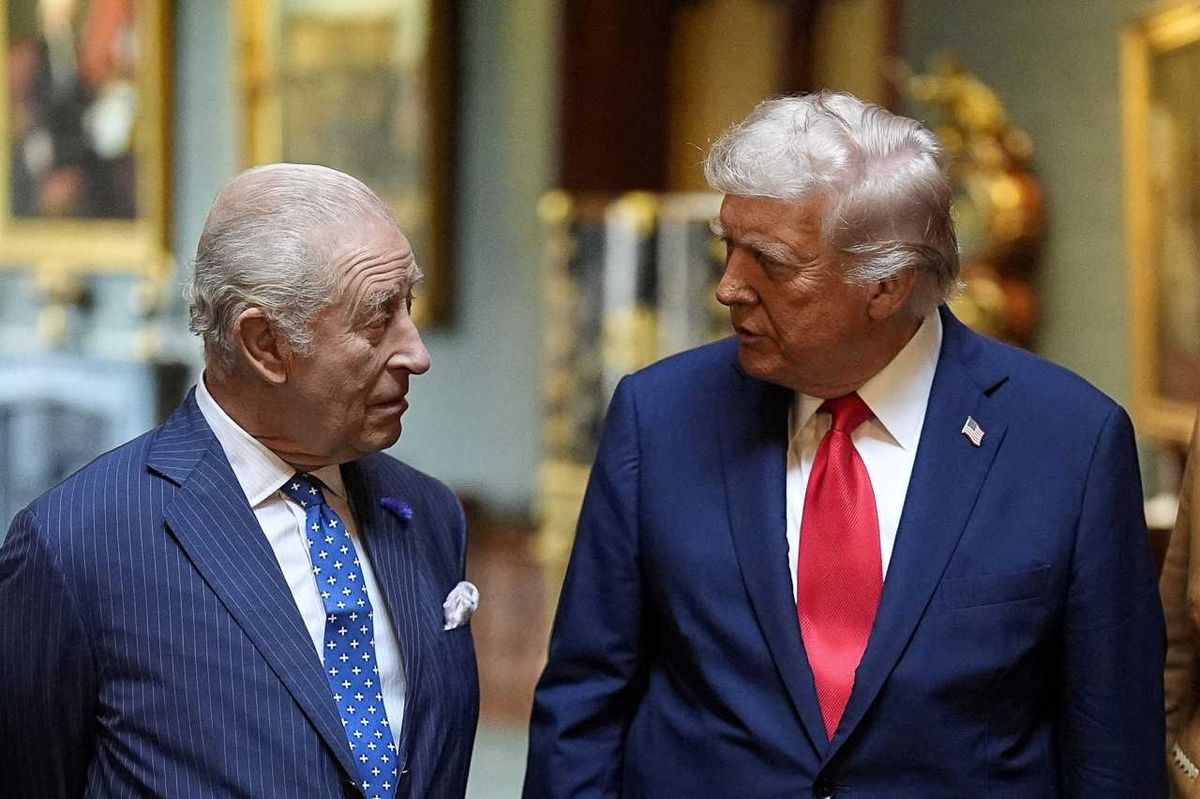
President Donald Trump plans on meeting with King Charles III on Monday — and if early reports are to be believed, the encounter could be quite embarrassing for both men.

“Trump has always been very receptive to the pageantry that comes with hobnobbing with royalty – but the King is also grappling with a family crisis that may cast another awkward shadow over his interactions with the president,” wrote The Independent's Alex Hannaford on Sunday. Citing both Trump’s criticism of Prime Minister Keir Starmer for not helping him in his war against Iran and the longstanding friendship between Trump, Charles’ brother Andrew Mountbatten-Windsor and the late pedophile Jeffrey Epstein, Hannaford pointed out that millions in America and the United Kingdom question why there have not been legal consequences in America as existed in Britain.

“In Washington, there is little of the reflexive deference that surrounds the monarchy at home. American political reporters – and British correspondents in the US – operate at a greater remove,” Hannaford wrote. “Here, an unanswered question could prove a provocation that invites a louder, more public demand for the truth.”

He added, “And this isn’t the only problem on the horizon for Charles. Not only will Charles be arriving as Trump publicly doubts the Special Relationship under Sir Keir’s stewardship, for some, the visit could be seen as a show of political appeasement of a controversial administration that is leaning more towards authoritarian instincts every day.”

Former Republican strategist Steve Schmidt warned King Charles III that if he visits Trump, the result will be a “brutal” humiliation for him.

“Lawmakers are ready to show their teeth, too,” Hannaford wrote. “While Congress lacks the statutory power to compel a foreign citizen to testify, any formal subpoena would be triggered if Mountbatten-Windsor ever sets foot on US soil. And a Mutual Legal Assistance Treaty (MLAT) could petition British courts to force a deposition on UK soil in any criminal investigation. If Democrats regain control of the House of Representatives (and/or Senate) in November, the current polite requests for interviews are likely to be replaced by a barrage of Oversight Committee subpoenas and televised hearings focused on the Epstein files.”

In addition to the controversies involving the Iran war and Epstein, King Charles III’s visit is also controversial because Trump is ripping out granite White House fixtures installed by the anti-monarchical president Thomas Jefferson to prepare for the monarch’s visit. The Washington Post described it as “his latest White House renovation: a new black granite path that the royals are expected to take to the Oval Office.”

He added, “… [T]he president [was] eager to replace decades-old beige Tennessee flagstone with his handpicked dark granite slabs before the royal visit,” with Trump bragging in a plaque that “such attention to detail is rarely seen in the modern era!’”

It is perhaps symbolically appropriate that Trump is preparing for the British royal’s visit by tearing out Jeffersonian institutions, given Trump’s deeper opposition to Jefferson’s political philosophy.

"His 'empire of liberty' offered the potential to dismantle the artificial hierarchies inherited from the past and imbue all aspects of life with the promise of freedom and happiness," Dean Caivano, an assistant professor of political theory at Lehigh University and author of "A Politics of All: Thomas Jefferson and Radical Democracy," told this author for Salon Magazine in 2024. "Although this idealized image of a free and harmonious American society is undeniably marred by the institution and legacy of slavery, overlooking the role of education and science as prerequisites for freedom and equality diminishes our ability to assess the historical and contemporary limits of American democracy critically."

He added that Trump’s attitude toward science "relies on reactionary, draconian, and dogmatic thinking. By launching a direct assault on the scientific community, Project 2025 undermines the foundation of an enlightened citizenry that Jefferson held in high regard. The project advocates for dramatic cuts to research and development, promotes climate denialism, and seeks to hyper-politicize public health and STEM fields."

White House scrambles as Australian flags hung to greet arrival of King Charles

David Edwards
April 24, 2026 
RAW STORY


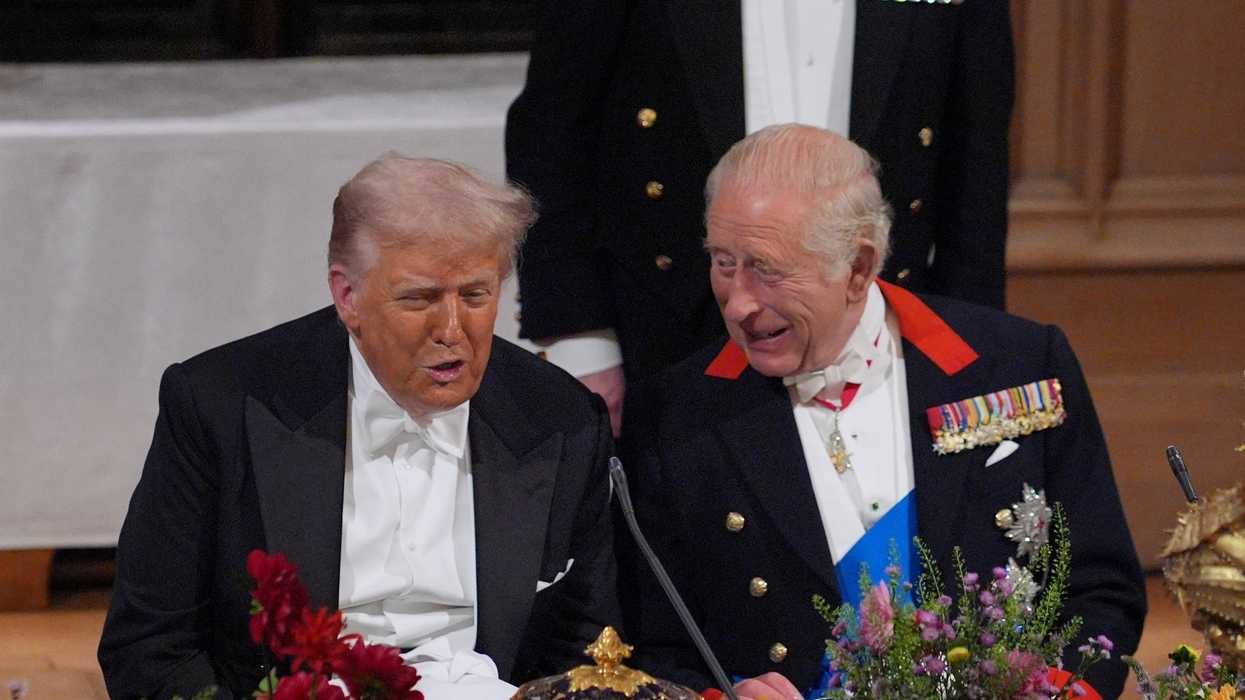
King Charles III (left) with US President Donald Trump at Windsor Castle, Berkshire, before formally bidding farewell to the president on day two of their state visit to the UK, September 18, 2025. Aaron Chown/Pool via REUTERS/File Photo

The White House took swift action after Australian flags were placed on the streets of Washington, D.C., to mark the arrival of King Charles III of Britain.

On Friday, Photos shared on social media showed Australian flags lining 17th Street. Freelance reporter Andrew Leyden shared several of the photos on X.

"After a short lunch break (and geography lesson) DC public work crews have decided to replace the Australian flags with the British flag around the White House," Leyden explained several hours later.