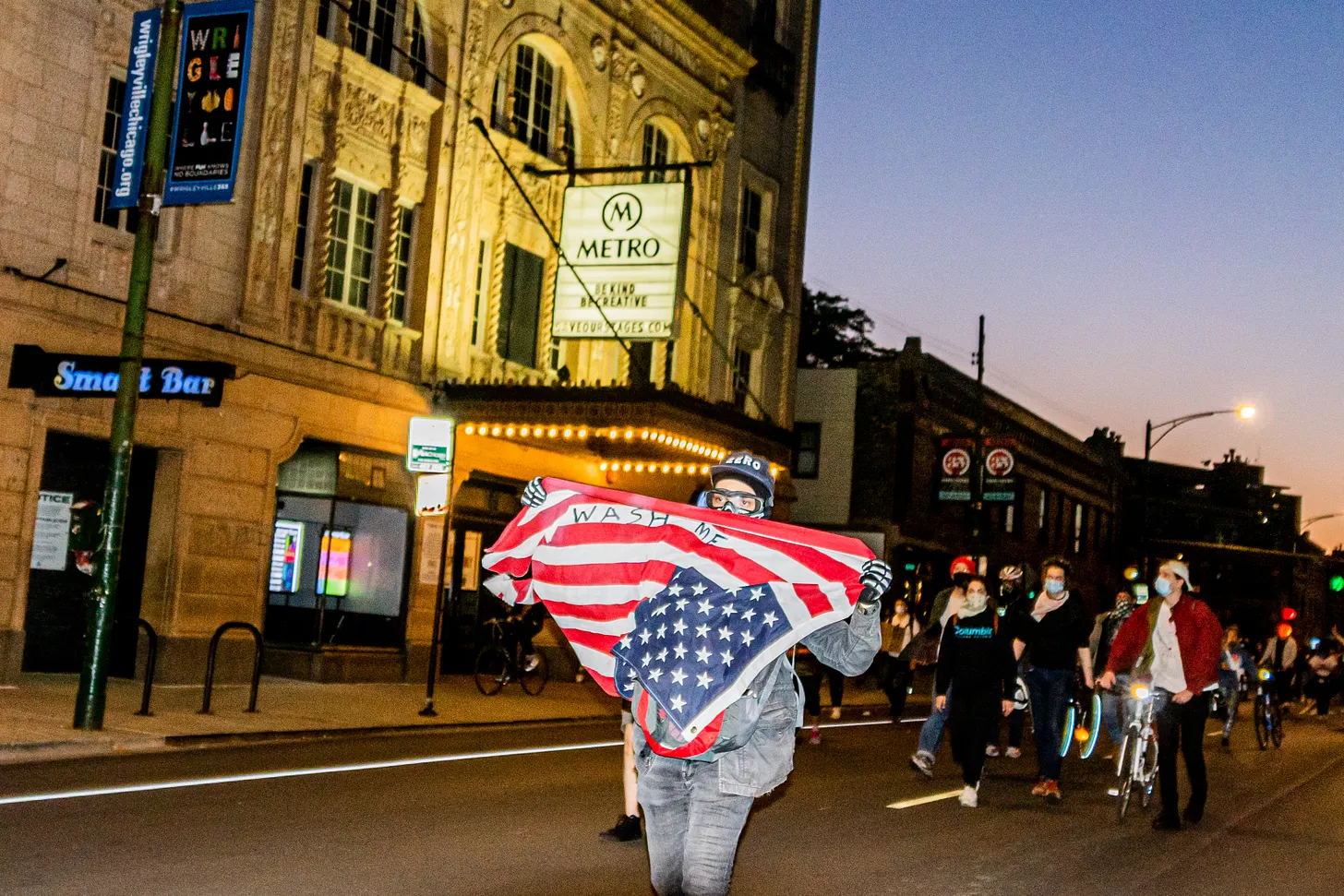
Major anniversaries of the Declaration of Independence have a way of coming at inconvenient times. When the bicentennial took place, the United States had suffered a humiliating defeat in Vietnam, Congressional investigations had revealed massive FBI spying on US citizens, and Richard Nixon had just resigned in disgrace. Public confidence in the government was at a low ebb.
The centennial in 1876 was even worse. The federal government was about to abandon its commitment to Reconstruction, pulling troops out of the South to bribe Florida electors into voting for a Republican presidential candidate who had, in fact, lost at the polls. Nearly a century of Jim Crow laws, poll taxes, lynchings, and Klan terror would follow. In the South, a brief experiment in biracial democracy abruptly ended; in the North, robber baron capitalism was in full swing. Within a year, a largely spontaneous railroad strike prompted pitched battles across the country between federal troops and street protesters enraged by the depredations of the railroad barons.
The 250th anniversary of the Declaration is a few days away. For many, the current occupant of the White House bears a striking resemblance to the sniveling monarch in the hip-hop musical Hamilton. The real King George was supposed to be ruling by Divine Right; Donald Trump seems to think he is as well, turning his ICE brownshirts loose on city streets, using his office to enrich himself and his family, flouting laws, and starting wars on a whim only to become bored with them weeks later. Despised by much of the population, he clings to his diminishing mass base with naked appeals to white racism and male supremacy. He plasters his name on every public venue he can think of and honors the nation’s founding with a cage match on the White House lawn.
So what are we supposed to celebrate? The men who signed the Declaration were hardly heroes. Most were wealthy merchants and/or slaveholders. They had an agenda that reflected their class interests. The revolution they led left slavery intact, accelerated the dispossession and outright murder of Native peoples, and reserved political power for a narrow slice of the population. After 250 years, we are still dealing with these contradictions.
But revolutions, even conservative ones, have a way of taking on a life of their own. The American Revolution could not have succeeded without the support of ordinary people whose interests did not neatly align with those of the Founding Fathers. And once the revolution was over, the Declaration’s afterlife exceeded the intentions of its authors. Its promise that “governments derive their just powers from the consent of the governed” and its assertion that “all men are created equal” would be taken up, again and again, by people the founders would never have imagined as political equals: enslaved Africans, workers, women, and anti-colonial revolutionaries around the world.
Founding Fathers, or Deadbeat Dads?
The contradictions that confronted colonial society on the cusp of the revolution were real enough, but nowhere near as momentous as Thomas Jefferson’s soaring rhetoric in the Declaration of Independence would suggest. “No taxation without representation,” the battle cry of the revolution, hardly seems like the sort of demand that would arouse the masses. Measured against the popular grievances in British colonies like India and Ireland, where the economic stakes were greater and the human cost far higher, the “long train of abuses and usurpations” cited by Jefferson look like small potatoes.
But the leaders of the revolution, Jefferson among them, had class interests to protect that distinguished them from most colonists. They saw British trade and taxation policies as detrimental to their businesses, and many of them feared that Crown-appointed colonial administrators lacked the resources and the wherewithal to protect them should the masses of people show any signs of restiveness.
Jefferson identified with the philosophers of the European Enlightenment, who challenged hereditary rule by royal families and a landed aristocracy. For them, and for much of this country’s revolutionary generation, political power properly flowed not from bloodlines but from property. The Declaration’s famous line about governments “deriv[ing] their just powers from the consent of the governed” is widely seen as a call for democracy, but it was also a defense of private property—including property in slaves. Significantly, there was already a growing debate in England about the morality of the slave trade, and American slaveholders regarded it with deep unease.
Jefferson himself was deeply ambivalent. Born into the Virginia aristocracy, Jefferson disliked the idleness and self-indulgence of the planter class; he believed that slavery not only robbed enslaved people of their natural rights but also corrupted the slaveowners. “I tremble for my country when I reflect that God is just,” he would write in 1782. But he was too burdened with debt to consider freeing his own 600 slaves—even after he fathered several children with one of them. And politically, abolishing slavery outright was a bridge too far. A denunciation of slavery in the original draft of the Declaration was left on the cutting room floor, replaced by a specious claim that King George had “forced” it upon the colonists.
The “chosen people”?
If Jefferson thought the Southern planters were morally compromised, he pinned his hopes on the white yeoman farmers whom he considered “the chosen people of God.” He envisioned a democracy of small producers and hoped that the settlement of the frontier would allow their emergence as the dominant social class in the new nation. They already made up a majority of the population of colonial America.
But wealth in the colonies was concentrated in the hands of a few whose fortunes were tied to transatlantic trade, mainly shipowners and large planters growing crops for export. For anyone else, the largely unsettled west held out the best hope of an independent livelihood.
Lacking access to markets in the coastal cities, farmers in the interior produced mainly for their own use. What business they engaged in was apt to involve barter with their neighbors. If taxes imposed by the Crown affected them, it was because without access to currency they had no way to pay them. Tax collectors on the frontier sometimes came in for rough treatment.
What really rankled, though, were British restrictions on settlement west of the Appalachians. After a long, grinding war, Britain had wrested formal control of the area from the French, but it was still wilderness, and for all practical purposes it remained Indian land. Occupied with expanding and defending its empire in other parts of the world, Britain had no stomach for colonizing the Mississippi Valley, much less policing it. But people still defied the British ban on settlement, and they resented that the government would not protect them from Indian resistance, or even provide them with authorization and resources to protect themselves.
It was an issue that united hardscrabble yeoman farmers of the West and wealthy land speculators from the East. In deference to their interests, Jefferson would include the Second Amendment when he drafted the Bill of Rights 10 years later. The “right to bear arms” enshrined by our current Supreme Court was originally about Indian removal, a process that would continue a century longer as the nation expanded westward.
Black lives mattered
Yet if the Declaration meant property rights and political independence to the founders, and land and local autonomy to frontier settlers, its promise of equality took on a very different meaning in Black hands.
The much-quoted passage in the Declaration that “all men are created equal” seems truly revolutionary even today. With a few exceptions, the Founding Fathers never suggested that the Declaration’s embrace of equality applied to Black people. But that did not stop Black people from acting as though it did. The Declaration actually served as an inspiration for Gabriel’s revolt, an aborted slave rebellion that occurred in Virginia 25 years later. The abolitionist movement repeatedly invoked it. In a famous Fourth of July speech in 1858, Frederick Douglass excoriated white America for betraying its promise. In the Gettysburg address, Abraham Lincoln—his own racism notwithstanding—said the Civil War was being fought to defend it. Every struggle against racism in this country, every effort to extend democracy in the face of capitalist power, has found the idea indispensable.
By the same token, antebellum slaveowners found it increasingly hard to swallow. At the time of the Revolution, they typically defended slavery as a necessary evil and viewed their slaves mainly as a source of cheap labor. But as the abolitionist movement gained steam, drawing strength and moral authority from Frederick Douglass and others who had escaped bondage and fled North, they stopped apologizing and started justifying their ownership of human property as a good thing, indispensable to civilization’s survival. In the South Carolina low country, where Blacks outnumbered whites by as much as eight to one, the perceived threat of rebellious slaves loomed as large in the minds of slaveowners as the fabulous wealth being wrested from their labor.
In 1822 a well-organized conspiracy led by a free Black carpenter named Denmark Vesey probably would have seized control of Charleston had it not been betrayed at the last minute. Nine years later, in tidewater Virginia, Nat Turner led a bloody slave uprising and remained at large for weeks until he was finally caught and executed.
The Southern slaveocracy concluded that any talk of abolition was a menace and had to be stopped, lest it encourage further rebellions. South Carolina’s John C. Calhoun, their leading voice in Congress, took the Senate floor to declare that the Declaration’s assertion of equal rights was “the most false and dangerous of all political error.” Other spokesmen for the planter class insisted that slavery was not simply a labor system, it was “the step-ladder by which civilized countries have passed from barbarism to civilization.”
After slavery was finally abolished, Jim Crow laws were justified with the same language of social control, though the term “separate but equal” paid cynical lip service to the Declaration. In 1896 the Supreme Court offered its blessing to the charade in Plessy vs. Ferguson. Nearly six decades—marked by often bitter struggle—would have to pass before the high court finally acknowledged that segregation and inequality were functionally related.
Consent of the governed?
The Declaration of Independence has another abiding message today: its affirmation of the right of revolution. The mere fact that the American revolution occurred encouraged a succession of anti-monarchical and anti-colonial uprisings in Europe, Latin America, and the Caribbean that were more socially transformative and often far bloodier. In 1946, when the people of Vietnam had defeated Japanese occupation and were preparing to resist recolonization by the French, the Vietnamese communist leader Ho Chi Minh would draft a national constitution taking entire passages word for word from Jefferson’s text.
At a time when too many politicians reflexively talk about the “right to exist,” it’s worth noting a central premise of the Declaration: states derive “their just powers from the consent of the governed.” No government possesses an inherent right to exist, independent of popular will. Governments do not have rights; people do.
Jefferson believed in the rights of the individual and insisted that there are some areas of our lives where the government has no business going. This tradition has yielded important gains. Jim Crow laws that dictated where Black people could live, work, and go to school have fallen. More recently, movements have challenged the state’s ability to dictate whom people can marry, whether women should have children, or how people live their private lives.
But the right of revolution goes beyond rejecting government intrusion in our personal lives. It’s not only about how we are treated as individuals, but about our collective destiny.
The Black liberation struggle—indeed, the struggle of any oppressed people—is all about making that distinction. Martin Luther King Jr. famously observed that the right to sit at a desegregated lunch counter doesn’t mean much if you can’t afford the price of a hamburger; he spent his last years challenging the class contradictions that kept people from affording it. Malcolm X didn’t pontificate about a “color-blind” society; he called for an end to white people’s power over Black people. The Ten Point Program of the Black Panther Party didn’t demand equal treatment and an end to discrimination; it demanded “the power to determine the destiny of our Black community.” A Latino leader of the Third World strike at San Francisco State College in 1968 summed it all up nicely: “We don’t want equality, we want self-determination.”
Implicit in the call for self-determination is Jefferson’s argument that governments that rule without “the consent of the governed” should be overthrown. He spoke of “the tree of liberty being watered with the blood of tyrants” and at one point mused about the need for a revolution every 20 years.
Mao Tse-tung, who pinned his hopes on the rising national liberation struggles in the Third World, believed that their fate was inextricably linked to that of the Black liberation movement in the United States. He pointed out that colonialism and imperialism had their roots in the African slave trade, and the capitalist system grew and flourished on the backs of enslaved African American labor. Viewed in that light, Black people’s confrontation with the ambiguous language in the Declaration of Independence is truly a global one.
For 250 years, Americans and people around the world have been fighting over the meaning of 1776. They still are. The Declaration of Independence has always contained profound contradictions. Simultaneously a defense of slavery and an inspiration for slave revolts, a justification for settler expansion and a touchstone for anti-colonial liberation, the Declaration remains contested terrain.
Revolutions may be defined by the class outlook of those who lead them, but they invariably hold out the promise of something bigger, a vision of human liberation. When they fall short, they inspire us to keep struggling—in ways that no cage match can contain.
Peter Shapiro is a longtime labor activist living in Oakland. Many years ago he studied US history at UC Berkeley. More recently, he wrote Song of the Stubborn One Thousand: The Watsonville Canning Strike 1985-87 (Haymarket Books).

Dissent is one of this nation’s defining characteristics. Every decade since the earliest days of colonization, Americans have protested for just about every cause imaginable, and every time they did, defenders of the status quo denounced the protesters as unpatriotic and in more recent times as un-American. But protest is one of the consummate expressions of “Americanness.” It is patriotic in the deepest sense.
Even before the United States was conceived, there was dissent. During the 17th century religious dissent played a significant role in the planting and development of the English colonies. In the 18th century political dissent led to the open rebellion that resulted in the birth of the United States. In the 19th century dissenters demanded the abolition of slavery, suffrage for women, fair treatment of Native Americans, and the banning of immigrants. And they protested against the War of 1812, the Mexican War, the Civil War (on both sides), and the Spanish-American War. In the 20th century dissenters organized to prohibit alcohol but also demanded workers’ rights, women’s rights, African American rights, Chicano rights, reproductive rights, and LGBTQ+ rights. They also protested against every war (declared and undeclared) fought by the United States. In the 21st century dissenters have protested against abortion, NAFTA, globalization, the Iraq War, the PATRIOT Act, the National Security Agency, bank bailouts, and out-of-control deficits. Most recently dissenters have mobilized to protest against systemic racism, sexual harassment and assault, and Congress’s inability (or refusal) to enact meaningful legislation to address climate change and gun violence. And then there are those who, despite their real grievances, having fallen for the widespread disinformation circulating on untrustworthy internet sites, raise their voices in protest on the basis of conspiracy theories, lies, and a distorted view of American history. Clearly, dissent has many faces.
On the broadest level, dissent is going against the grain. It is speaking out and protesting against what is (whatever that is), most often by a minority group unhappy with majority opinion and rule. However, history has shown that dissent is far more complex, that it comes from all political perspectives and in a variety of categories: mostly religious, political, economic, and cultural/social. Religious dissent is the insistence that everyone be allowed to worship according to the dictates of conscience and not according to the rules of an established religion. Although most religious dissent occurred during the colonial period, when individuals insisted on religious liberty, and during the early national period, when the new nation endorsed the principle of separation of church and state, the demand for religious autonomy persists to this day. Religious dissent was expressed when new sects such as the Shakers, the Mormons, or the Branch Davidians were formed, and it is still being expressed on a different level in the debates over school prayer, intelligent design versus evolution, abortion, capital punishment, and the right to die.
Political dissent is a critique of governance. As the United States grew from a fledgling nation into a world power, political dissenters expressed dissatisfaction about the way those who were in charge governed, and usually (but not always) they provided a plan or recipe for redressing what they perceived as wrong. Most often they used the nation’s founding documents as the authority to legitimize their protest. Antebellum abolitionists demanded the end of slavery, declaring that holding persons in bondage was contrary to the principle that “all men are created equal.” In recent years hundreds of thousands of Americans protested the decision to invade Iraq, proclaiming that doing so transforms the United States into an aggressive imperial power and that by embracing imperialism the United States is renouncing its democratic birthright.
When the economy crashes, economic dissent comes to the fore. People take to the streets protesting economic injustice and inequality. And as distress and suffering expands from the lower classes to the middle class, so too does protest. One thinks of the Richmond bread riots during the Civil War, the violent labor disputes of the 19th century, the Bonus Army’s encampment at the Capitol in 1932, the militant labor activism during Franklin Delano Roosevelt’s liberal presidency, the tax revolts of the 1970s, the occupation of Zuccotti Park in 2011.
Cultural and social dissent is a rejection of the predominant attitudes, beliefs, and behavior of mainstream society. Utopian groups in the 19th century defied the conventional values of their time and established communities where all men and women would be treated equally. “Beatniks” and “hippies” in the mid-20th century rejected the conventional middle-class morality of their time, urged their fellow Americans to “do their own thing,” and influenced millions to reevaluate their views of race, gender, and sexuality.
But this is only part of the story. There is significant and frequent overlapping of religious, political, and cultural/social dissent. For example, many dissenters, such as temperance activists in the early 20th century and the Christian right today, can be labeled as political, religious, and social dissenters. The 1960s counterculture’s challenge to American values was also intricately tied up in the political protests against the Vietnam War and the struggle for racial equality. Furthermore, there are economic and psychological factors that often play roles in dissent movements.
There are some decades that are relatively quiet dissentwise and others when significant problems intensify so rapidly that tens of millions of people get involved in the discussion to find solutions. During these periods we see a sharp rise in dissent, and that dissent can take many forms as different groups propose different solutions. Some dissenters are reformers who wish to fix the problems through a process of reform. Some are reactionaries who seek to address the problems by returning to the policies that existed before the problems arose. Some are radicals or even revolutionaries who propose to solve the problems by smashing the system and starting over. The debate over slavery and the events leading to the Civil War, the Progressive era, and the 1960s, and the present day are periods when dissent, in all its diverse forms, exploded.
There are several levels or stages of dissent. At the beginning individuals might simply disagree with a policy or a law or an issue. Perhaps they are willing to tolerate a wrong or an injustice for a while, but when it becomes less tolerable, the next step is to become active. Individuals might write a letter or an article, give a speech, lead a protest march, or conduct a demonstration. Dissent and protest carried to a higher level entails resistance, civil disobedience, breaking laws, or even participating in a riot or insurrection.
The methods and forms of dissent are wide-ranging. Many protesters express dissent through petitions and protest marches. Some use music or art or theater or comedy to articulate their message. Some engage in acts of civil disobedience, willfully breaking laws to put pressure on the system to force those who have political and economic power to acknowledge and address the issues. They are often marginalized individuals and groups that lack power but have a legitimate grievance against the way things are. Most times these types of dissenters have criticized the United States from the left. They have sought more equality, more moral rectitude, more freedom. They have demanded that America live up to what it had committed itself to on paper at the Constitutional Convention. Many of these dissenters have viewed the Constitution and the Declaration of Independence as binding contracts between the people and the government and protested when they believed the government was not fulfilling its part of the contract.
Dissenters often have a keen sense of history and build on the experiences and methods of earlier dissenters. It is not unusual to see dissenters quote those who have gone before as well as draw on the successful tactics and strategies of earlier dissent movements. The Civil Rights Movement of the 1950s and 1960s employed many of the tactics of the labor movement of the 1930s, while antiwar activists adopted the tactics of the Civil Rights Movement in their protests against the war in Vietnam and later the Iraq War. Dissenters with a vision for the future look to the past for inspiration.
But there are some dissenters who have a sketchy understanding of American history who want to return to an imagined past that never existed. For example, those who protest against immigration in order to keep America white, not realizing that the country has always been a nation of diversity, peopled by immigrants of all ethnic, racial, and religious backgrounds. The Ku Klux Klan in the 1920s opposing anyone who was not “One Hundred Percent American” and the Unite the Right protesters in Charlottesville, Virginia in 2017 chanting “You will not replace us!” are examples of this.
Individuals and groups that protest against the protesters are also expressing dissent. Reactionaries have frequently resisted change and fought to maintain the special privileges and supremacy of their class or race or gender. Some have wanted to maintain the status quo and prevent change, while others have sought to turn back the clock to a “simpler,” more “trouble-free” time. When abolitionists denounced slavery, antiabolitionists argued just as passionately to preserve the institution. When women demanded equality, millions of Americans reacted with hostility and formed antisuffrage associations.
Although most dissent springs from those who lack political power, there are instances when a dissent movement is part of the power structure—the temperance movement and the Know-Nothings of the 19th century; the anti-tax ideologues of the 20th and 21st centuries. There are also notable individuals who fought entrenched interests from a position of political power—Senators Robert M. La Follette and Margaret Chase Smith, for example, spoke out against what they believed was a usurpation or misuse of power on the part of the federal government.
Over the years dissenters achieved varying levels of success. Some got in trouble. Some were arrested. Many were beaten. Some were killed. But they kept hammering away at the powers that be until those powers began to listen. As a result, public opinion was swayed, laws were enacted or repealed, slavery was abolished, unions were organized, women got the right to vote, the Jim Crow laws were invalidated. In fact, many dissenters who were maligned, vilified, and even demonized as unpatriotic and anti-American by their contemporaries are now considered heroes. Some dissenters never achieved the change they were seeking, but though their goals were dismissed, they raised new questions and had an influence on the political discussion.
For the most part dissenters have embraced lofty ideals and have a moral purpose. And most of them believe they are acting to ensure that the United States lives up to its promise to secure Americans’ natural rights. But there are dissenters whose goals are not well-intended or virtuous and who use questionable means to attain their goals—they are not in it to grant equal rights to a downtrodden minority but to restrict rights or to promote their own narrow interests at the expense of others.
During times of heightened passions—the Antebellum period, the Progressive era, the Great Depression, the Vietnam War—dissenters have protested from liberal, conservative, and radical standpoints. In the debates about the war in Vietnam, for example, there were those who believed that America was acting as an imperial power and that the capitalist system should be toppled. There were those who opposed the war primarily on ethical grounds because the United States was acting immorally. And there were those who opposed the war simply because the United States was losing it and thus argued that if the government was not going to go all-out in its effort to destroy communism in Vietnam, then there was no point in being there. In the end, for completely different reasons, radicals, doves, and hawks all came to protest the war in Vietnam.
Obviously not all dissenters are created equal. Nor are the consequences of their efforts necessarily positive or socially useful. There is a difference between dissenters whose goal is to create a more just society by expanding the rights of the disempowered, and those who are self-aggrandizing troublemakers interested only in disrupting society or denying rights to others. Historian Eric Foner, in The Story of American Freedom, points out that “freedom” is a “contested concept.” So too is “dissent.”

No comments:
Post a Comment