Mass “Unchilding” and “Forgetting” of Palestinian Children
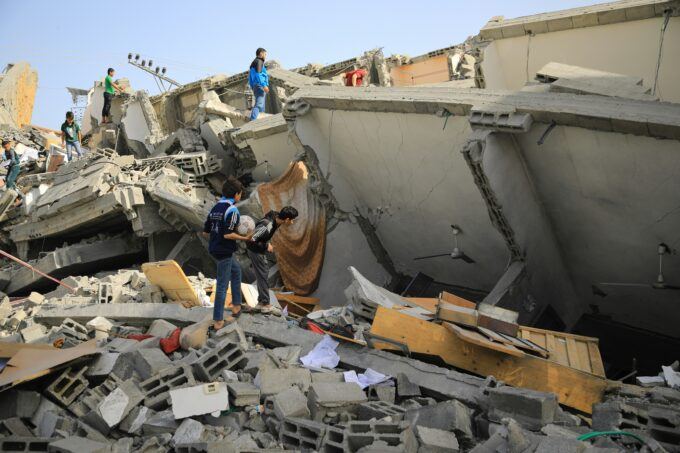
Image by mohammed al bardawil.
There is no shortage of things that should astonish us about the West’s indifference to Israel’s genocide in Gaza, but the treatment of children stands apart. In ordinary life, care for children is the deepest moral reflex we have: parents structure their days around it, laws and institutions exist to enforce it, and even distant or imagined threats to our children are enough to produce panic, outrage, and decisive action. When one of our children is hurt – physically or emotionally – we feel it in our own bodies; a small injury can be agonizing, a night of fear can undo us, and the death of a child is rightly understood as the most shattering loss from which families often never fully recover. And yet, when Palestinian children are killed, maimed, starved, orphaned, displaced, detained, or psychologically traumatized in the tens of thousands, this supposedly deeply-ingrained instinct no longer obtains. What is treated as sacrosanct everywhere else becomes contingent here, revealing a moral collapse that no amount of rhetoric can conceal.
The Unchilding of Palestinian Children
A landmark report released in June 2026 by the UN Independent International Commission of Inquiry concludes that Israeli authorities and security forces have deliberately targeted Palestinian children, finding that these acts constitute evidence of genocide, crimes against humanity, and war crimes. Examining the period from October 2023 through October 2025, the Commission records at least 20,179 children killed and 44,143 injured, while emphasizing that these figures almost certainly underestimate the true toll.
More fundamentally, the report argues that the deliberate targeting of children is not incidental to Israel’s military campaign but a calculated strategy and one of the principal indicators of genocidal intent, observing that “by targeting children, Israel is attacking the very capacity of the Palestinian people to exist and to determine their future.” The report documents repeated cases of children killed by rifle and drone fire or suffering gunshot wounds to the head and torso, alongside the systematic destruction of schools and hospitals and the eradication of the conditions necessary for children’s survival and development. Worse still, documented accounts from medical personnel and witnesses describe the intentional, surgical targeting of children by Israeli soldiers, including reports of systematic sniper fire in which different days were allegedly devoted to shooting children in different parts of the body – “like a game of target practice.” The scale of this assault on Palestinian children is almost impossible to comprehend.
This devastation is reflected in the official numbers. According to the Commission’s findings, children account for roughly 30 percent of all those killed, while UNICEF and other humanitarian agencies estimate that thousands more have been injured, orphaned, displaced, or psychologically traumatized. Yet even these staggering figures conceal the true scale of the devastation. Numerous humanitarian organizations have stressed that the total overall casualty data – across the entire population – almost certainly represents a substantial undercount, perhaps by as much as 35-40 percent. UNICEF has also warned that every child in Gaza now requires intense mental health support, with widespread trauma, sleep disorders, and fear responses across the entire child population. In Gaza City, large-scale surveys have found overwhelming levels of severe psychological distress among children living through repeated bombardment, displacement, and loss.
This psychological fracturing is exacerbated by the collapse of family and societal networks, occurring despite the endurance of Sumud – the deeply ingrained practice of courageous and steadfast resilience rooted in mutual care, collective identity, and familial cohesion. Indeed, the ongoing calculated assault is aimed precisely at the social fabric that makes such collective resistance possible. More than 58,000 children have reportedly lost one or both parents, while thousands more are unaccompanied or separated in destroyed family networks. In hospitals, clinicians have coined the term WCNSF – “Wounded Child, No Surviving Family” – for children pulled from rubble as the sole survivors of their households. Many arrive unnamed – too young, too traumatized, or too injured to identify themselves, with no surviving relatives able to claim them.
The assault on childhood survival is nowhere more painfully visible than in the catastrophic rate of pediatric bodily trauma. UNICEF reporting has documented children undergoing amputations at extraordinary rates, often without anesthesia, with some estimates describing multiple children per day losing limbs under conditions of relentless bombardment and medical collapse. Gaza now has the highest per capita population of child amputees in the world, a statistic that has no parallel in recent history. This physical destruction is compounded by a deliberate Israeli policy of medical denial, which systematically blocks thousands of these amputees from leaving the Strip to receive the urgent reconstructive surgeries and rehabilitative care unavailable within Gaza’s collapsed healthcare system.
UN Special Rapporteur Francesca Albanese, in her reports on the Occupied Palestinian Territories, has described this structural erasure as the “unchilding” of Palestinian children – the systematic destruction of the societal conditions that make childhood possible at all. Her subsequent work, including Anatomy of a Genocide, documents how mass death, starvation, displacement, detention, and psychological trauma function as part of a deliberate and systematic assault on the conditions necessary for children’s survival and development, threatening the very possibility of a Palestinian future and their right to self-determination.
The Bereavement Multiplier
The demographic concept of the bereavement multiplier helps clarify what raw casualty figures conceal. Developed by demographers during the COVID-19 pandemic, the bereavement multiplier refers to the number of close family members and loved ones who experience significant grief and loss following a death. A child killed does not represent a single loss but a cascading network of bereavement – parents, siblings, grandparents, caregivers, classmates, neighbours, and extended kin – often resulting in ten or more deeply affected individuals per death. Applied conservatively to Gaza’s reported child death toll alone, this suggests that several hundred thousand people have already been afflicted by the deep grief associated with the death of children. But in Gaza’s dense familial and social networks, these layers of mourning overlap to compound the impacts: families lose multiple children, survivors mourn entire households, and communities experience repeated exposure to widespread death. The result is not isolated bereavement, but population-wide psychological devastation extending far beyond the official death and injury totals. When the trauma borne by Palestinians in the West Bank and the wider diaspora is added, the number of people living under conditions of sustained traumatic stress likely reaches into the millions.
The Psychology of Unchilding
The psychological consequences of life in Gaza cannot be understood by conventional models of post-traumatic stress, which typically assume that traumatic events have ceased and recovery can begin. For Palestinian children, the threat itself has become relentless. More than fifteen years of blockade, repeated military assaults, and forced displacement have been compounded by the destruction of homes, schools, hospitals, and cultural institutions, the loss of parents and caregivers, and the deprivation of food, clean water, healthcare, and education. The result is an environment in which danger is not episodic but continuous. As psychologist Triantoro Safaria argues, Gazan children are living under conditions of “continuous traumatic stress” – a state characterized by unremitting and inescapable threat rather than exposure to discrete traumatic events.
A comprehensive synthesis of the recent research by Anies Al-Hroub likewise concludes that conventional psychiatric models are fundamentally inadequate for understanding the psychological condition of Palestinian children. Instead, it calls for a framework that integrates continuous traumatic stress with structural violence, recognizing that children’s mental health is inseparable from the political, historical, and material conditions in which they live. The evidence consistently demonstrates extraordinarily high levels of post-traumatic stress disorder, depression, death anxiety, existential distress, and complicated grief, with many studies reporting clinically significant symptoms in 70–90 percent of children assessed. Because bombardment, displacement, and deprivation continue unabated, children rarely experience the safety necessary for healing and recovery. Cumulative exposure to war-induced trauma multiplies the risk for long-term harmful effects, creating what researchers now describe as a “continuum of trauma.”
The Destruction of Childhood Itself
The sustained environment of violence directly lays bare the psychological dimension of Albanese’s “unchilding” framework. Orphanhood, repeated displacement, and the collapse of family and community life compel children to prematurely assume adult responsibilities for daily survival long before they are developmentally capable of doing so.
Play, learning, exploration, and socialization are entirely displaced by hyper-vigilance, scavenging, child labor, family caregiving, and the daily struggle to secure basic necessities. Emerging research suggests that these extreme conditions will permanently affect children’s neurological, emotional, and social development, underlining what Safaria describes as a collective “crisis of childhood itself.”
Intergenerational Trauma and Complicated Grief
The mental health consequences of these devastating conditions extend well beyond children’s direct experiences of the violence. Caregivers themselves are coping with overwhelming trauma, grief, displacement, and deprivation, giving rise to what researchers describe as secondary traumatization, whereby children’s emotional suffering is intensified through the distress of parents and other caregivers. The result is an intergenerational cycle of perpetual trauma in which post-traumatic stress responses are systematically transmitted through entire family systems.
Clinical grief literature uses the term “complicated grief” to describe mourning that becomes prolonged or destabilized following sudden or violent death, the loss of a child, suicide, fractured relationships, or circumstances in which grieving and mourning cannot be safely processed. These are already among the most devastating forms of human bereavement, encompassing both the emotional experience of grieving and the cultural expressions of mourning. In Gaza, however, such circumstances are no longer exceptional – they have become the ordinary conditions under which significant loss and deprivation occur.
Thus, viewed through the lens of grief and trauma studies, Gaza presents not merely a crisis of bereavement but one of complicated grief and complex trauma on a population-wide scale. Death occurs amid displacement, starvation, and destroyed homes, with children witnessing the deaths and disappearances of siblings and parents. In this same wreckage, parents search through rubble for the remains of their children, sometimes recovering only fragments of their bodies. Deprived of even the dignity of a proper burial, families are denied the conditions necessary to process their grief and integrate profound loss into their continuing life narrative. Trauma is sustained because the conditions producing it do not cease, ultimately fracturing the family and community connections that normally shelter and protect children during crises.
Western Complicity and Moral Collapse
The brutal murder of Hind Rajab was never an isolated atrocity. As Lama Khouri recently observed, there are “tens of thousands of Hind Rajabs” in Gaza – children whose names will never be recognized, but whose undocumented suffering is the very foundation of this assault on Palestinian childhood. While we may show fleeting sympathy for the few children whose stories break through to the outside world, countless others disappear without witness, memorial, or public reckoning. It is this exact silence that allows the machinery to keep moving. We look away when the news cycle shifts, but as Khouri notes: “Our forgetting is not innocent. It is the thing the killing needs from us, and it is being counted on.”
None of this is to deny the suffering of children in other war zones – including Sudan, Yemen, Congo – where violence against civilians persists amid profound international indifference. Gaza, however, occupies a distinct place within Western political life. Israel is not an isolated or marginal actor; it is armed, funded, diplomatically protected, and rhetorically defended by the very governments that most loudly proclaim their commitment to human rights, international law, and the protection of children. Yet these high-minded principles collapse with startling ease in the case of Palestinians.
More concerning still, this extraordinary deference to Israel has increasingly been accompanied by efforts at home to curtail civil liberties, suppress protest, and narrow the boundaries of acceptable political dissent. The pain and suffering of these young victims are not simply ignored; they are justified, normalized, and often suppressed from public view to preserve a strategic alliance with a rogue regime. Through this domestic enforcement, citizens in North America and Europe become not merely observers of these crimes against Palestinian children, but accomplices – however unwillingly or unwittingly – in the political structures that sustain them.
To maintain their facade of moral enlightenment, Western societies do not simply fail to respond; with the aid of complicit media, they have learned how to “forget” while the killing continues. Reality is permitted to appear only in fragments – briefly visible before the next wave of headlines. We witness the slaughter, mutilation, and starvation of Palestinian children as if it were no more than an unsettling news story – shocking to look at, but detached from any claim upon our conscience or sense of compassion. The total abandonment of these innocent lives takes place amid a resounding silence that persists even within many progressive humanitarian organizations, suggesting not just hypocrisy, but something more disturbing: a profound erosion of our shared humanity.
Our complicity and failure to act force a disturbing question upon us: how will we explain to our own children that we stood by and watched the “slow erasure of a people“ through the annihilation of its children?
James Baldwin articulated a moral truth that speaks directly to this situation: “The children are always ours, every single one of them, all over the globe; and I am beginning to suspect that whoever is incapable of recognizing this may be incapable of morality.”
Why Do Societies Normalize Harm to Children in War, Poverty and Public Policy?

Trieste Herencia (Sad Inheritance) by Joaquín Sorolla, 1899. Public Domain.
Few ideas command more universal agreement than the belief that children must be protected. Across cultures, religions, and political traditions, they are regarded as uniquely deserving of care, safety, and opportunity. Yet a glaring contradiction emerges when we look closely at the conditions under which millions of children actually live.
Around the world, childhood is routinely fractured by war, hunger, pollution, displacement, and poverty. Even within the United States, children face food insecurity, inadequate healthcare, environmental hazards, failing infrastructure, and unequal educational opportunities. We usually discuss these realities as separate crises—economic, political, or environmental. Rarely do we recognize them as interconnected symptoms of a larger pattern.
To a child, however, these bureaucratic distinctions matter little. The consequences accumulate in bodies, minds, and futures. This reality forces an uncomfortable question: if societies profess such deep concern for children, why does so much preventable harm persist? Why are conditions we would find intolerable in an individual case so easily accepted when they occur at scale?
The answer is not necessarily a lack of empathy. It is something more troubling: many forms of harm to children have become normalized. They persist not because societies openly endorse them, but because they have been quietly absorbed into the ordinary operation of institutions, policies, and social systems.
Consider how many of the gravest threats to children are discussed. War is typically analyzed in terms of territory, security, military strategy, or geopolitical interests. National debt is debated in the context of budgets, interest rates, and fiscal policy. Environmental disasters are measured through property loss, infrastructure damage, and economic costs. Immigration enforcement is discussed in terms of law, borders, and political conflict.
Yet children often experience these events differently. They encounter them not as policy questions but as disruptions to safety, stability, health, education, and belonging. The consequences can persist long after the original crisis has faded from public attention. Different in form, these crises share a common feature: the well-being of children is rarely the measure by which they are judged, even when children bear a disproportionate share of the harm.
Around the world, the pattern is remarkably consistent. Whether the source is armed conflict, environmental disaster, economic instability, forced migration, or political repression, children frequently bear consequences they neither created nor can control. The details vary from one society to another, but the underlying dynamic remains the same: the costs of collective failures are often carried by those with the least power to influence them.
Public expressions of concern for children are nearly universal. News reports on wars, famines, environmental disasters, and epidemics routinely highlight the number of children harmed. Yet these acknowledgments often remain symbolic rather than transformative. Concern is expressed, tragedy is recognized, and attention moves on, while the underlying conditions that produced the harm remain largely unchanged.
The suffering of children is often invoked as evidence of a crisis, yet it rarely becomes the standard by which the success or failure of public responses is judged.
The same pattern appears in the United States. While hunger is often debated through the lens of federal budgets and public spending, millions of children quietly rely on school meal programs as their primary source of daily nutrition. Similarly, environmental contamination is routinely assessed using regulatory thresholds and economic costs, even as emerging research documents developmental harms from pollution across childhood and adolescence. Immigration enforcement, too, is often discussed through the abstract language of borders and legality, while children endure the immediate fear, instability, and trauma of family separation. In each instance, the language of policy can obscure the lived realities of childhood.
The Evidence Is Already There
We do not lack evidence. We lack organized will. Year after year, global organizations such as UNICEF, Save the Children, and Oxfam document the scale of systemic harm inflicted on children. The data is neither hidden nor ambiguous. Yet a profound disconnect persists between public concern and institutional action. Societies routinely pass sweeping laws, sign international declarations, and voice collective outrage, but consistently fail to build the systems needed to turn concern into protection.
A stark, contemporary manifestation of this gap is found in the 2026 Global Out of the Shadows Index. Developed by Economist Impact alongside Together for Girls, the index benchmarked how 60 countries address child sexual abuse and exploitation. Its findings point to a familiar pattern. Many countries have developed legal protections for children, but far fewer have built the institutions, systems, and public commitments needed to make those protections meaningful in everyday life. Across the global index, governance and prevention emerged as the absolute weakest areas.
This points to a difficult truth. The failure to protect children is rarely a failure of knowledge. We know far more about the causes of harm than we did a generation ago. We know how poverty affects development. We know how violence shapes mental health. We know how environmental toxins accumulate in growing bodies. The question is no longer whether the evidence exists. The question is why societies continue to tolerate conditions that produce predictable harm.
The pattern extends across national boundaries and political systems. Wealthy countries and lower-income countries alike often struggle to translate concern into prevention. Some fail because of limited resources. Others fail despite having substantial resources at their disposal. The recurring challenge is not simply capacity, but the willingness to organize institutions around children’s long-term well-being.
Part of the answer lies in the unequal conditions into which children are born. Long before children make choices of their own, geography, family circumstances, health, environment, and social status begin shaping the opportunities available to them.
The Biology of Inequality
To understand how policy impacts a child, we must expand our definition of “biology” beyond mere genetics. A child’s biology is inextricably bound to a social reality: where they are born, to whom they are born, and the specific burdens they inherit and are expected to bear. Poverty, race, disability, environmental pollution, generational trauma, and social exclusion are not abstract social concepts, nor are they inescapable destinies. Instead, they are environmental realities that become physically embodied over time.
Society quite literally writes itself into children’s bodies. What once sounded like a metaphor is now supported by decades of developmental research. We see it in Adverse Childhood Experiences (ACEs) research and toxic stress models, which demonstrate how prolonged hardship alters a child’s neurological development and immune system. We even see it in the physical record preserved in children’s shed primary teeth. Studies of so-called “milk teeth”suggest that the microscopic layers of those teeth can serve as a biological record of prenatal and early childhood environmental exposures, offering a window into the conditions that shape development.
Evidence of this process appears across multiple dimensions of childhood development. Research on respiratory health suggests that lung damage sustained during childhood can persist throughout life. At the same time, studies of environmental exposure continue to reveal how pollution, conflict, and deprivation leave lasting marks on developing bodies. Whether the source is war, poverty, or environmental contamination, the effects of childhood conditions often extend far beyond childhood itself.
When systemic inequality is allowed to persist, it begins to shape a child’s biological trajectory. Chronic stress associated with instability, deprivation, and neglect can alter how children process the world, affecting cognitive development, emotional regulation, and physical health. Over time, these effects influence everything from learning and attention to self-image, trust, and future opportunity. What begins as a social condition can become a biological one, transforming unequal circumstances into unequal outcomes.
The consequences do not end with the individual child. Childhood trauma can shape relationships, communities, and even future conflicts as unresolved harm is carried into adulthood.
The significance of these findings extends beyond health and development. If social conditions can become biologically embedded, then the question is no longer whether harm occurs. The question becomes why societies continue to accept conditions that predictably produce it.
How Harm Becomes Normal
The normalization of harm does not require overt cruelty; it requires only routine. Societies manage to tolerate the suffering of children by systematically dismantling it into manageable, administrative pieces. When a crisis is broken down into separate departments, budgets, jurisdictions, headlines, and eligibility categories, the human reality vanishes. Children are quietly transformed into statistics, cases, costs, risks, or collateral damage. Because bureaucratic fragmentation ensures that no single actor or agency appears fully responsible, the system continues to operate without any single institution fully accountable for its cumulative effects.
This normalization is sustained by psychological distance and economic abstraction. When child poverty is reduced to a budgetary line item or environmental contamination to a cost-benefit calculation, it becomes easier to focus on managing a problem than on the lived experience of the children affected by it. This abstract mindset is further sustained by policy drift and weakened enforcement. Existing protections are rarely abolished overnight; instead, they are steadily weakened through executive or legal actions that erode regulatory oversight and reduce institutions’ capacity to protect vulnerable populations.
When accountability is diffused across a labyrinth of agencies, inaction becomes the default setting. The institutions that shape children’s lives—schools, healthcare systems, child welfare agencies, environmental regulators, and immigration authorities—often operate according to different mandates, funding streams, and measures of success. Each addresses a piece of a child’s experience, while no institution is responsible for the whole child. The greatest danger to children is not a sudden wave of malice, but the quiet efficiency of the everyday. The result is not merely administrative failure. It is a culture in which preventable harm can persist for years, even decades, without provoking the sustained public response it would demand if children remained fully visible.
Children and the Moral Foundation of Civil Rights
The expansion of modern civil rights in the United States has never been a purely abstract legal exercise, and some of the most consequential moments of American democratic progress occurred when the nation was forced to confront the harm being done to children. It was the televised horror of children being attacked by police dogs and fire hoses during desegregation struggles. It was also the recognition in Brown v. Board of Education—supported in part by research on children’s self-image—that segregation harmed not only educational opportunity, but a child’s sense of self and place in society.
Historically, protecting children has not merely shielded the vulnerable—it has expanded democracy itself. When the law recognizes the rights of a child, it compels the state to acknowledge a deeper obligation. The struggle for civil rights has always been about defining who counts as a full human being in the eyes of the law. By centering the child, these movements successfully argued that a society’s legitimacy is measured by how it treats those who cannot vote, lobby, or protect themselves.
The restoration and strengthening of civil rights protections should not be viewed as a secondary political concern. If children become invisible within public institutions, they are more easily reduced to statistics, categories, or symbols in larger political debates. A society that recognizes children as full human beings affirms that dignity, healthy development, and opportunity are not privileges to be distributed selectively, but conditions necessary for democratic life itself.
What Can Be Changed
To confront the systemic neglect of children, we must move from diagnosis to responsibility. The structures that normalize harm were built by human choices, which means those same choices can dismantle them. Transforming how society treats its youth requires shifting from reactive intervention after trauma has occurred to a proactive, sustained architecture of prevention.
In the immediate term, the most important task is restoring the protections that help prevent predictable harm. School nutrition programs, early childhood services, public health initiatives, civil rights enforcement, and international assistance are often treated as discretionary expenditures. Yet, they form part of the social infrastructure that allows children to develop safely. Prevention rarely attracts the attention that accompanies a crisis, but its effects are often more profound. The strongest systems of care are those that reduce the likelihood of harm before intervention becomes necessary. Protecting children also requires the enforcement and strengthening of civil rights protections, helping to shield young people from systemic discrimination and institutional displacement. Finally, breaking down bureaucratic silos to build coordinated systems of care that integrate healthcare, education, and social services into unified networks can prevent harm before it manifests.
In the medium term, overcoming the psychological distance that insulates us from distant suffering becomes a central task. Sister-city programs, cities of refuge, and other forms of civic partnership demonstrate that communities can assume responsibility for one another across geographic and political boundaries. When people develop sustained relationships with places beyond their own, distant suffering becomes harder to ignore and easier to address collectively. This framework transforms abstract global crises into concrete local obligations, fostering cross-border solidarity and direct mutual aid.
Cultural change also depends on public rituals that remind societies of their obligations to future generations. The relative invisibility of Children’s Day is itself revealing. Societies routinely profess concern for children, yet devote comparatively little public attention to reflecting on their well-being. International Children’s Day receives only a fraction of the attention devoted to observances such as Earth Day, Mother’s Day, or Father’s Day. Yet it could serve as a focal point for schools, communities, and civic institutions to reflect on children’s well-being and compare approaches across regions and nations. Just as Earth Day helped elevate environmental awareness, a more visible Children’s Day could reinforce the idea that protecting children is a shared social responsibility rather than a private concern.
Ultimately, the most enduring change is not institutional but cultural. Modern societies measure success through economic growth, productivity, and financial performance. Yet these indicators reveal little about whether children are safe, healthy, or able to flourish. A society committed to children would ask a different question: Are young people developing the capacities they need to live meaningful lives? When children’s well-being becomes a central measure of success, policy priorities begin to change as well.
America Making America Whole
This effort requires a posture of candid self-examination rather than celebratory rhetoric. The United States cannot credibly present itself as a global beacon for human rights or children’s well-being while failing to confront its own domestic record. Within its own borders, millions of children contend with systemic poverty, food insecurity, deep-seated educational inequality, and toxic environmental exposure. This vulnerability is compounded by weakened labor protections that expose young people to exploitation, the ongoing trauma of family separation and detention at the border, and a glaring legal omission: the United States remains the only United Nations member state that has not ratified the Convention on the Rights of the Child.
Yet ratification alone is not a guarantee of success. Many nations that have formally embraced the Convention continue to struggle with poverty, conflict, exploitation, and inadequate protection for children. The challenge is not simply adopting principles, but translating them into culture, institutions, and daily practice.
At the same time, some countries have demonstrated that meaningful progress is possible. The Economist Impact 2026 Global Out of the Shadows Index found examples of lower- and middle-income nations strengthening prevention efforts, improving accountability, and expanding protections for children despite limited resources. Such examples suggest that political commitment and institutional design can matter as much as national wealth.
The argument here is not that America should lecture the rest of the world on moral responsibility. It is that America needs to repair itself. True leadership on the global stage cannot be projected outward while systemic neglect is tolerated at home.
If the United States were to organize its laws, budgets, institutions, and communities around the well-being of children, it could offer the world something more persuasive than rhetoric: evidence that democratic societies are capable of confronting their own failures and repairing them. Such an achievement would not solve every problem, but it would demonstrate that accountability, prevention, and long-term investment in human development remain possible in a complex modern society. By addressing the structural conditions that undermine children’s well-being, the nation would reinforce the principle that democratic institutions are ultimately judged by their capacity to support human flourishing.
The Standard We Choose
Ultimately, we must return to the central question that anchors this series: Does your community care about children?
When we ask this, we must deepen our understanding of what “care” actually means. The true measure of a society’s commitment to its youth is not sentiment. It is not found in political speeches, corporate slogans, or cycles of selective outrage after a tragedy. The genuine measure is structural: whether a society organizes its resources, institutions, and legal protections around a child’s right to live, learn, grow, and belong.
The condition of our children is never incidental; it is diagnostic. It does not exist in a vacuum, separate from our economic successes or political debates. Instead, the well-being of the youngest among us provides one of the clearest indicators of a society’s overall health. It reveals exactly what a society values, what kinds of suffering it is willing to tolerate, and what kind of future it is actually prepared to build.
We can no longer treat the harm inflicted on children as an unfortunate byproduct of a complex world. It is a direct consequence of the standards we choose—and it remains within our power to choose a higher standard. Doing so will require countries, working both together and independently, to revisit their budgets, strengthen protections for children, and establish effective systems of accountability and enforcement. International agreements and declarations matter, but their promise is fulfilled only when they are translated into daily practice.
Yet the responsibility does not rest solely with national governments or international institutions. The well-being of children must also be advanced community by community, school by school, neighborhood by neighborhood. Public policy can establish protections, but communities give those protections life. Every level of society has a role to play, and every adult has a responsibility to help create the conditions in which children can thrive. The question that anchors this series is whether a community cares about children. The answer must be demonstrated not only through words, but through action. Every child counts.
This article was produced bythe Independent Media Institute.

No comments:
Post a Comment