Monday, May 18, 2026

The US Must End Its Illegal Boat Strikes


 May 15, 2026


The U.S. military has been carrying out extrajudicial killings in the Caribbean and Pacific over the past nine months with impunity.

On May 8, the U.S. military struck another boat in the eastern Pacific, killing two people and leaving one survivor. U.S. Southern Command claimed “the vessel was transiting along known narco-trafficking routes” and “was engaged in narco-trafficking operations.”

According to The Intercept, there have now been 58 such boat strikes since September that have killed at least 193 people. As with the May 8 attack, the names and nationalities of most of these victims remain unknown.

The Trump administration has accused civilian boats of transporting narcotics to the U.S. and says its killing “narco-terrorists.” But the Pentagon has provided no evidence for these claims or any indication that the people killed posed an imminent threat.

International and U.S. law do not allow the use of the military to kill civilians suspected of crimes. Boat bombing on the high seas is not a legitimate law enforcement operation. Nor is it curbing the flow of drugs into the United States, as Trump claims, or combating the root causes of drug use.

Even if the boats did carry drugs, the appropriate response would be to lawfully intercept and detain the suspects and afford them due process of law.

In a desperate attempt to provide legal cover for these murders, the Trump administration is asserting that the U.S. is engaged in an “armed conflict” with unspecified drug cartels — the same kind of broad legal authority invoked by the George W. Bush administration in its post-9/11 “war on terror.”

But there is no armed conflict in the Caribbean or the Pacific. The people on those boats are civilians who are not legitimate military targets. “You just can’t call something war to give yourself war powers,” noted University of Pennsylvania professor Claire Finkelstein.

Legal and human rights experts agree.

Last October, UN High Commissioner for Human Rights Volker Türk condemned the boat strikes. “None of the individuals on the targeted boats appeared to pose an imminent threat to the lives of others or otherwise justified the use of lethal armed force against them under international law,” Türk said in his October 31 statement.

Despite the unsubstantiated, fear-mongering claims pushed by the Trump administration, investigations have shown that several of those people killed were fishermen trying to make a living for their families. On January 20, the U.S. attacked the Ecuadorian fishing boat La Fiorella. None of the eight fishermen aboard have been seen since.

Survivors have also endured abuse. In two separate Pacific attacks on Ecuadorian fishing boats in March, 36 survivors said they were “abducted and tortured by American forces and taken by boat all the way to El Salvador before being returned to Ecuador,” according to an investigation by Drop Site News.

“They handcuffed us, put hoods over our heads and pushed us around. We were terrified they were going to kill us,” recalled Jhonny Sebastián Palacios, one of the survivors, in an interview with The Guardian.

The U.S. must immediately end these boat strikes and take accountability for the harms caused to the victims and their families. And Congress must do its job of conducting oversight to ensure transparent and independent investigations of these strikes.

The use of unlawful force will become more normalized at home and abroad unless the Trump administration is held accountable for these illegal killings and its blatant abuse of power.

When federal immigration agents killed American citizens earlier this year, we saw all too clearly the risks of letting the government shoot people and call them “terrorists.” It leaves all of us less secure, undermines the rule of law, and can’t be allowed to become routine.

Farrah Hassen, J.D., is a writer, policy analyst, and adjunct professor in the Department of Political Science at Cal Poly Pomona.

Can We Still Laugh Together? Political Cartoons and Censorship


 May 15, 2026

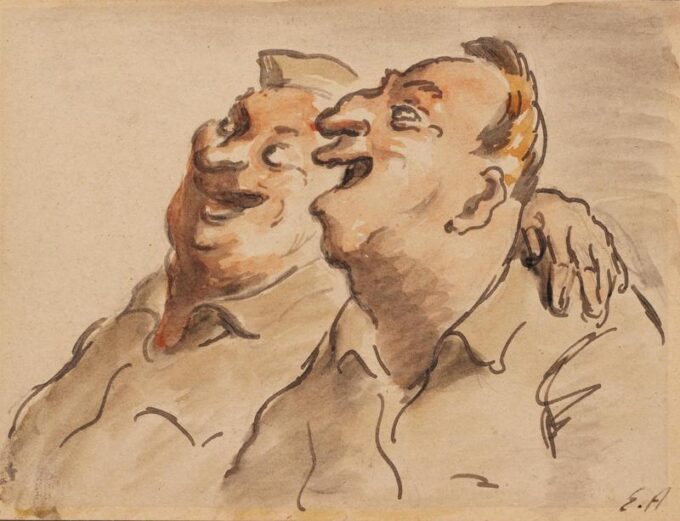
Photograph Source: Edward Ardizzone – Public Domain

“Journalism is an essential pillar of democracy,” observed Irene Khan, the U.N. Special Rapporteur on Freedom of Opinion and Expression on May 3, World Press Freedom Day. According to Reporters Without Borders’ World Press Freedom Index, the United States has fallen to its lowest ranking on record in 2025 after a decade-long decline. What happens to satire when press freedom shrinks? Why has satire increasingly become something institutions fear rather than defend?

Major U.S. media institutions are scaling back or restricting editorial cartoons, from the New York Times terminating its years-long contract with cartoonist Patrick Chappatte in 2019 to The Washington Post facing the 2025 resignation of Pulitzer Prize–winning cartoonist Ann Telnaes after her cartoon was not published.

Now the pressure on satire is moving beyond newsrooms into U.S. government policy. A March 9 Pentagon memo stated that Stars and Stripes, the soldiers’ newspaper, would no longer be permitted to publish “comic strips and editorial cartoons from commercial news media sources.” According to a January Pentagon plan announced by spokesperson Sean Parnell, the newspaper was to eliminate what he called “woke distractions that siphon morale.”

Bill Mauldin, Eisenhower and the Limits of Satire

The tension between satire and authority is not new. In The New York Review of Books, Bill McKibben traces this tension back to the cartoons of the legendary Bill Mauldin, who wrote for Stars and Stripesin World War II while serving active duty.

Mauldin’s cartoons, immensely popular with the troops, portrayed soldiers being simple, regular GI Joes, rather than the spit and polish image General George Patton wanted. Patton considered Mauldin an “unpatriotic anarchist,” and complained about him to his superior, General Dwight D. Eisenhower.

Eisenhower rejected Patton’s objections in a letter to a theater commander: “A great deal of pressure has been brought on me in the past to abolish such things as Mauldin’s cartoons…You will make sure that the responsible officer knows he is not to interfere in matters of this kind.”

McKibben argues that Eisenhower saw Mauldin’s work not as undermining morale, but as strengthening it. As McKibben states, Eisenhower felt that, far from “siphoning morale” or inciting mutiny, “Mauldin’s cartoons…let soldiers see their frustrations expressed. Also, of course, there was the small matter of the fact that the U.S. of that era stood for freedom against the authoritarianism of the Axis.”

McKibben’s example shows that even in wartime a democracy should be strong enough to tolerate irreverence.

Cartooning for Peace and Global Free Expression

Beyond the military, the premise that satire can strengthen rather than weaken a society has become a global challenge. In the wake of the 2005–2006 crisis over the Danish cartoons depicting the Prophet Muhammad, then U.N. Secretary-General Kofi Annan in 2006 convened international cartoonists from a wide variety of backgrounds. This initiative helped lead to the creation of Cartooning for Peace.

Cartooning for Peace was founded on the belief that cartoons are not trivial provocations, but essential tools for expressing disagreement, testing limits, and making it possible to laugh, even if uncomfortably.

Today, Cartooning for Peace is an active international network of almost 400 editorial cartoonists from nearly 80 countries united by a clear mission. “Cartoonists play an essential role in shaping public opinion and subjecting officials to it,” wrote Kenneth Roth, former executive director of Human Rights Watch.  “Cartoonists are no joke. They are an essential part of democracy.”

Every two years, Freedom Cartoonists awards the Kofi Annan Courage in Cartooning Award in Geneva. This year’s winners were Jimmy “Spire” Ssentongo from Uganda and Safaa Odah from Gaza, Palestine. Spire was cited for “denouncing corruption, institutional abuse and abuses of power” in the Ugandan government. He has lived in exile since 2020, a victim of cyber harassment among other threats.

Safaa Odah has documented the devastation faced by Gazans for the past two and a half years. She lives in the Khan Younes camp and continues to draw the everyday lives of Gazans, often only on the walls of her tent. She draws scenes of life continuing among the bombs and destruction, and bears witness to the continuing horrors Palestinians endure.

When Mainstream Newspapers Stop Laughing

Yet even as Cartooning for Peace defends satire as essential to freedom worldwide, some of America’s biggest newspapers have been moving in the opposite direction. At the New York Times, the paper ended political cartoons in 2019 after a syndicated cartoon by António Moreira Antunes was published in its International Edition. It depicted Benjamin Netanyahu as a dog wearing a Star of David collar, leading a blind Donald Trump in a yarmulke. The image drew accusations of antisemitism, and the Times apologized, calling it “an anti-Semitic political cartoon.” The Times subsequently ended daily editorial cartoons in its international edition.

A similar fault line appeared in The Washington Post. In 2025 cartoonist Ann Telnaes resigned after the paper refused to publish a cartoon she submitted depicting tech and media figures—including Jeff Bezos, the Post’s owner, Mark Zuckerberg, and Sam Altman—kneeling before a statue of Donald Trump at Mar-a-Lago.

Telnaes said the decision was not about accuracy or redundancy, but about the perspective the cartoon expressed. “For the first time,” she wrote, “my editor prevented me from publishing a cartoon because of who or what I chose to aim my pen at.”

Democracies Need Satire

Eisenhower’s intervention in the Mauldin case established a clear principle: even under the pressures of war, satire directed at the military should be protected rather than suppressed. By contrast, contemporary restrictions on Stars and Stripes under Secretary of Defense Pete Hegseth point in the opposite direction. Hegseth has frequently said “The real threat we face is the enemy from within,” where humor and criticism are treated not as part of morale, but as potential threats to it.

Eisenhower directed the Allied victory in Europe. If he understood that satire like Bill Mauldin’s cartoons strengthened morale rather than undermining it, then today’s appeals to “discipline” or “respect” as a basis for suppressing cartooning ring hollow.

The distance between Eisenhower’s willingness to tolerate internal satire during a world war and modern calls for tighter control is not a matter of degree, but of philosophy: one understands that morale in a democracy can include dissenting humor; the other risks confusing discomfort with danger.

Cartoonists are not America’s “enemy from within.” Just as Ssentongo and Odah were honored, political cartoonists such as Chappatte, Telnaes and many others are global treasures. The real “enemy from within” is not political cartoonists, but institutions and leaders like Hegseth who do not understand satire’s role in a free society the way Eisenhower did.

A self-confident society can laugh at power. An insecure society can’t laugh at itself and demands obedience instead. When a society can no longer laugh together, it is no longer free.

Daniel Warner is the author of An Ethic of Responsibility in International Relations. (Lynne Rienner). He lives in Geneva.