Thursday, May 28, 2026

From Soviet antihistamine to Alzheimer's breakthrough: a UK biotech bets on a molecule the world forgot

From Soviet antihistamine to Alzheimer's breakthrough: a UK biotech bets on a molecule the world forgot
A Canadian chemist, a rediscovered polymorph and a drug that may outperform everything on the market — if the West is willing to listen / bne IntelliNews
By Leon Aris in Berlin May 28, 2026

A small UK-registered biotech company believes it has found an Alzheimer's treatment that is safer, cheaper and more effective than anything currently on the market — and it has done so by revisiting a molecule that Soviet chemists first synthesised in the 1970s and that Pfizer abandoned as a failure in the early 2000s. The drug candidate, DMB-I, is now entering phase 3 clinical trials after phase 2 results showed it significantly outperforming memantine, the most widely prescribed Alzheimer's treatment in the world. The company behind it, BIGESPAS Ltd, is aiming for a commercial launch by 2028.

A disease without a solution — and a market without one either

The backdrop to this story is a global health crisis that is, by any measure, accelerating. Alzheimer's disease is on course to affect tens of millions more people by 2050, driven by two converging forces: a rapidly ageing population — the disease typically presents at 60 and above — and improved diagnostics that are reclassifying vast numbers of previously miscategorised dementia cases. "Many people who were diagnosed with old age dementia — only recently did specialists start differentiating that clearly from Alzheimer's," said Dr Boris Gorin, the scientist at the centre of the DMB-I project. "Advanced diagnostic techniques show that the number of cases is growing."

The pharmaceutical industry has largely failed to keep pace. The existing standard of care — dominated by drugs such as memantine and donepezil — provides modest symptomatic relief at best. The most high-profile recent attempt at a step change, Biogen's biologic treatment Aduhelm, received conditional FDA approval in 2021 and briefly added $19bn to Biogen's market capitalisation. But it cost $100,000 per patient per year, required intravenous administration in a clinical setting and carried serious safety risks including brain bleeds. It has since been largely withdrawn. The market, in short, is enormous, undersupplied and in desperate need of something that actually works at a price ordinary patients can afford.

BIGESPAS believes DMB-I is that something. The question is whether anyone will trust a drug developed out of post-Soviet science in the current geopolitical climate.

The credibility problem

The name Trofim Lysenko does not appear in any of the company's marketing materials, but it looms over any discussion of Russian science in the West. Lysenko, the Soviet agronomist whose ideologically driven pseudoscience set Soviet biology back decades, has become shorthand in western scientific circles for the dangers of politicised research from that part of the world. More recently, Russia's announcement of a cancer cure that failed to materialise, and the Kremlin's promotion of Sputnik V — a Covid vaccine that never received European Medicines Agency approval despite widespread use elsewhere — have deepened western scepticism about bold claims emerging from the former Soviet space.

The founders of BIGESPAS are acutely aware of this. Their first and most emphatic response is structural: this is a British company. "The fact that it was tested in Russian clinical trials does not mean it is a Russian product," Gorin said flatly. The company is registered in the United Kingdom, and its co-founder Pavel Shmarenkov — an economist and fintech entrepreneur by background — is equally direct in rejecting the Sputnik parallel. "That was an emergency situation with extraordinarily high competition," he said. "Scientific results are multinational. One plus one equals two everywhere, not only in Russia."

The decision to conduct clinical trials in Russia was, they insist, purely financial. Russian trials cost approximately one tenth of equivalent Western studies. For a small, self-funded biotech without the backing of a major pharmaceutical company, that differential is not a minor consideration — it is the difference between running the trials at all and not running them. "We did it on our own, with our initial investors," Shmarenkov said. "We needed to verify the hypothesis that DMB-I is a real, strong product before going further."

The science: a question of shape

To understand why DMB-I might succeed where previous attempts failed, it helps to recall one of the most consequential — and most disturbing — episodes in 20th-century pharmaceutical history. Thalidomide, widely prescribed in Britain and Europe in the late 1950s as a treatment for insomnia and morning sickness, caused severe birth defects in thousands of children. The reason, understood only later, was that the drug existed in two mirror-image molecular forms — what chemists call enantiomers — one of which was therapeutically useful and one of which was catastrophically harmful. The physical shape of a molecule, it turned out, was not a secondary detail. It was everything.

DMB-I's story is a variation on this theme, though with a happier trajectory. The underlying molecule, latrepirdine (also known as Dimebon), has been known since the 1970s, when it was developed in the Soviet Union as an antihistamine. It is chemically identical across all its forms — the same atoms, the same bonds. But like many pharmaceutical substances, it can exist in different crystalline structures, known as polymorphs. Think of graphite and diamond: both are pure carbon, but their physical properties could hardly be more different. One is soft and black; the other is the hardest natural material on earth. The difference is purely structural.

Pfizer identified several polymorphs of latrepirdine when it ran its phase 3 clinical trials in the early 2000s — and the trials failed. What Gorin realised, while working on an unrelated polymorphism study in Canada around 2019, was that Pfizer had not found all of them. "I screened for all possible polymorphs using modern techniques and found one that Pfizer had not reported," he said. "The hypothesis came to life: could it be that Pfizer missed the most active polymorph?" Preclinical testing on animal models confirmed that the newly identified form — named DMB-I — was significantly more active than any of those Pfizer had studied. Gorin is careful not to frame Pfizer's failure as negligence. "I would not call it a mistake. I would call it tough luck." The screening techniques now available were simply not as comprehensive in the early 2000s. Pfizer did not know what it was missing.

What makes DMB-I specifically superior is its solubility. The new polymorph dissolves and penetrates the gastrointestinal wall faster than its predecessors, reaching the bloodstream more rapidly and building up in brain tissue more effectively. This matters enormously for an oral drug — one taken as a pill rather than administered intravenously — because the absorption efficiency of oral medications varies widely, and a compound that passes through the gut too slowly may never reach therapeutic concentrations in the brain at all.

Phase 2 clinical trials, conducted across 135 patients over 26 weeks, established the optimal dosage at 20mg taken three times daily and compared the drug's performance directly against memantine. "The short answer is yes — it is way more effective than memantine," Gorin said. The improvements observed spanned three domains: cognitive alertness, social communication — which Alzheimer's patients frequently lose entirely — and what Gorin calls operational ability, meaning the capacity to perform basic daily tasks independently. Side effects were negligible, limited to a mild aftertaste. "Next to nothing," Gorin said. The drug does not cure Alzheimer's — no drug does — but its symptomatic impact, based on phase 2 data, appears to be meaningfully greater than the current standard of care, with a safety profile backed by decades of use of the base molecule as an antihistamine.

The business case: cheap, oral and ready for a gap in the market

The commercial logic behind DMB-I rests on a set of conditions that are, for a drug developer, unusually favourable. The Alzheimer's treatment market is large and growing. The existing options are either modestly effective legacy drugs or expensive, inaccessible biologics that most patients cannot afford and most healthcare systems struggle to fund. DMB-I is oral — a pill taken at home, requiring no hospital visit, no intravenous line and no clinical supervision. That alone dramatically reduces the cost of treatment and the burden on patients, who are, by definition, elderly and often frail.

"Only a very small segment of the aged population can afford extremely expensive biologics," Shmarenkov noted. "Most rely on affordable drug products." The memory of Aduhelm — a drug whose $100,000 annual price tag provoked a public backlash and a Medicare coverage dispute even as its clinical benefit remained contested — casts a long shadow over the biologics market. A drug that demonstrably works, is safe, can be prescribed by a GP and taken at home, and costs a fraction of the current alternatives, represents a genuinely different proposition.

Phase 3 trials, targeting between 500 and 700 patients across multiple confirmatory studies, are planned to begin this year and run for 52 weeks — one year, compared with the 26 weeks of phase 2. The extended duration will allow the team to observe longer-term effects and to test DMB-I in combination with other medications, which phase 2 protocols did not permit. If results are positive, a regional commercial launch in the Eurasian market — Russia, Kazakhstan, Uzbekistan and neighbouring countries — is targeted for 2028. "You cannot get approval in one country today and start selling everywhere the next day," Shmarenov said. "That is not how the industry works."

The longer-term strategy is standard biotech: prove the asset in markets where regulatory approval is more accessible, build a commercial track record, then sell or partner with a major pharmaceutical company capable of global distribution. "Independently, we will not be able to penetrate the western market," Gorin said with characteristic candour. "It can be a partnership, a sellout, an IPO — but it has to be through interaction with big pharma." The Eurasian region may be retained independently under any such deal, given the team's existing relationships and infrastructure there. Canada — where Gorin has lived and worked for thirty years — is identified as the most likely first Western market entry point, with the European Medicines Agency and the FDA representing the larger but more complex targets beyond that.

Geopolitics and the long road West

The path from promising phase 2 results to a pharmacy shelf in London or Toronto runs directly through a set of obstacles that are as much political as scientific. Western regulators, particularly the FDA, have historically required that trials submitted for approval be conducted under their own protocols and on their own soil — meaning that however compelling the Russian data, an entirely separate set of studies may be required before the drug can be considered for Western markets.

Then there is the broader question of perception. Whatever the structural argument about British incorporation, the scientific roots of DMB-I lie in Soviet-era chemistry, its trials were conducted in Russia, and its initial commercial launch will be in the post-Soviet space. In a geopolitical environment defined by deep mistrust between Russia and the West, that is not a neutral provenance for a drug seeking FDA or EMA approval — however strong the underlying data.

The founders' counter-argument returns, ultimately, to the science. The molecule does not have a nationality. The clinical results are what they are. And the market they are addressing — hundreds of millions of people globally, most of them with no access to effective treatment — is not going away. "If it works, it works," Gorin said. "I don't see why western countries would not be interested in a product that works."

That confidence may prove justified. Or the journey from a Soviet antihistamine to a western pharmacy shelf may turn out to be longer and more complicated than a promising phase 2 trial suggests. Phase 3 will begin to provide the answer. In a year or two, as Gorin put it, the world will start to hear something. The question is whether it will be listening

Blond-haired buffalo 'Donald Trump' draws crowds at Bangladesh zoo

28.05.2026, 

dpa

Photo: Nazrul Islam/dpa

By Nazrul Islam, dpa

Crowds lined up in Bangladesh on Thursday to visit an albino buffalo nicknamed “Donald Trump” that was spared from slaughter during the Islamic festival of Eid al-Adha after becoming a social media sensation.

The more than 700-kilogram buffalo drew widespread attention because of its blond comb-over, which many said resembled the hairstyle of US President Donald Trump.

The animal was transferred to Mirpur National Zoo in Dhaka on Wednesday night after the Bangladeshi government intervened to save it.

Zoo director Rafiqul Islam Talukder said the buffalo was moved to the facility following the government’s decision.

The buffalo had been raised for the past 10 months at Rabeya Agro Farm in Narayanganj, outside Dhaka, where it attracted a steady stream of curious visitors.

Farm owner Zia Uddin Mridha said his brother named the buffalo after Trump because of its unusual hair and facial resemblance to the US president.

An individual had bought the animal and planned to sacrifice it during Eid al-Adha, or the Festival of Sacrifice. Interior Minister Salahuddin Ahmed said the government was reimbursing the buyer now that it is under protection at the Dhaka zoo.

Visitors crowded around the enclosure to catch a glimpse of the now-famous animal.

"Oh, at last, Donald Trump is in the zoo. It is better he was not slaughtered, at least," said one visitor, trying to film the animal's movements through the fence.

"Is it Donald Trump? Look, here is Trump," said another man, pointing the animal out to his child while walking past the enclosure, where the bull stood tied with a rope under a shaded area surrounded by lush greenery.

Authorities placed a sign on the fence identifying the animal as “White Buffalo (Donald Trump) Albino Buffalo.”

Another visitor, Ajmal Haq, said the animal should have been slaughtered as a symbol of eliminating the US president, whom he accused of being responsible for the deaths of thousands of people in the Gaza Strip and Iran.

Still, he said it was good that the government had placed the animal in the zoo.

“Let the people see Trump as a bull in Bangladesh,” Haq said.


'Sleepy Donald'? Trump accused of dozing off at Memorial Day event, reigniting age concerns


Issued on: 27/05/2026 - FRANCE24
05:20 min From the show

A viral video appearing to show Donald Trump falling asleep at a Memorial Day ceremony on Monday has sparked outrage online, reigniting rumours about the state of the US president's health. Social media users claimed Trump was dozing off, and furious that it could take place at a ceremony to honour fallen US military personnel. Though the low-quality video is difficult to verify, it has reignited scrutiny about Trump's health.

Social media users claimed Trump's eyes were closed during Defence Secretary Pete Hegseth's speech at Arlington National Cemetery, and that he was fighting sleep. They shared the video, saying Trump has "no respect" and prompting renewed mockery over Trump's long-running attacks on former US president Joe Biden as "Sleepy Joe", with users pointing to what they claimed was Trump himself appearing drowsy at a national event.

The viral 30-second video, though, is difficult to verify due to its low quality. It's unclear whether pixels or shadows affect the clip, as Trump's eyes cannot be clearly seen. No full streams of the Memorial Day event depicted the ceremony in 4K, with the placement of the camera at a distance.

Trump has been previously accused of sleeping on the job: last December, during an hours-long cabinet meeting, a video of him with his eyes closed for long periods of time also prompted much debate. Trump himself later commented that he was simply "bored", but not asleep. He was also accused in March of falling asleep at a security roundtable in Memphis, Tennessee, and just this month he faced renewed backlash after a video appeared to show his eyes closed in the Oval Office. The White House, though, pushed back on the rumours online, claiming he was "blinking."

The Arlington video came a day before Trump underwent his fourth publicly disclosed health exam since he returned to office, spending three hours at the Walter Reed Medical Centre for what the White House said was a "preventative medical checkup".

Trump said on Truth Social that everything "checked out perfectly", but fresh rumours about his health are swirling before his 80th birthday next month.

An April survey by Ipsos/Washington Post found that just 40 percent of Americans believe Trump has the mental capacity required to carry out his presidential duties.

VIDEO BY:  Vedika BAHL


Artists pull out of Trump-backed concert for America’s 250th birthday

Artists pull out of Trump-backed concert for America’s 250th birthday
Copyright 250 Freedom Instagram - AP Photo - Canva

By David Mouriquand
Published on

While a cage fighting ring is being built on the White House lawn, a new event celebrating the 250 years of the USA is set to take place at the National Mall in Washington, D.C. The line-up has been called “a parody”, and some acts have already pulled out.

You may have heard that this year marks the United States of America’s 250th birthday, and Donald Trump is going all out when it comes to “250 Freedom” events.

Construction has begun on an Octagon-shaped cage on the White House south lawn, which is set to host a controversial UFC (Ultimate Fighting Championship).

The mixed martial arts extravaganza has already rubbed people up the wrong way, with many comparing it to the Hunger Games and highlighting that cage matches may not be the best way to spend money when Americans are struggling with healthcare cuts, soaring inflation, and rising fuel prices.

“Elect a clown, expect a circus,” as one X user put it.

Now, a new event has been announced: The Great American State Fair, which will take place from 25 June – 10 July at the National Mall in Washington, DC.

The musical line-up has been revealed and it’s... charitably, very 90s. Absolutely nothing wrong with that. We missthe decade and its music output. However, when you peruse the headliners, it's a different story. Less charitably, it’s a set of has-beens who rely on nostalgia tours.

The performers include Vanilla Ice, Martina McBride, C+C Music Factory, Young MC, Morris Day, Poison’s Bret Michaels, Flo Rida and Fab Morvan - the surviving member of the lip-syncing duo Milli Vanilli.

Girl, you know it’s true...

Less true is the announcement that Morris Day, best known as the lead singer of The Time (a group associated with Prince), will be performing.

Day took to Instagram, writing: “Contrary to rumor, Morris Day & The Time will not be performing at the ‘Great American State Fair.'” adding, “It’s A No For Me.”

Fair enough. We’re sure that Kid Rock will be very happy to step in as a replacement.

Young MC has also dropped out, after being included on the bill, posting: I HAVE INFORMED MY AGENTS THAT I WILL NOT BE PERFORMING AT THE FREEDOM 250 EVENT,” adding: “The artists were never told about any political involvement with the event.”

The line-up has been blasted online, with many referring to it as “a joke”, “pathetic” and “a parody”. One Instagram commenter stated: "Milli Vanilli?! Like the 80’s band that got caught not singing a single word of their own music? Fitting."

Elsewhere, the celebration will apparently “unite and showcase all 56 U.S. states and territories in a single World’s Fair-scale event”.

According to the website: “This is an opportunity for visitors from across America to experience an unforgettable celebration of the people and traditions that define our nation. Our nation unites diverse states and territories to form the strongest country in the world. This once-in-a-generation celebration will feature live music, carnival rides, and dozens of hands-on partner activations, where visitors can taste, touch, and experience what makes each state and territory unique.”

“Freedom 250” is funded through a public-private partnership with funding from Trump-aligned tech firms Palantir and Oracle and federal contractors Deloitte and Lockheed Martin, among others. It is facing growing scrutiny from watchdog groups and members of Congress over the use of federal dollars for Trump-aligned events.

Consumer advocacy group Public Citizen is calling for congressional investigations after The New York Times reported that donors to Freedom 250 were offered access to the president if they donated $1 million.

The Great American State Fair starts on 25 June.

Aid agency: Every fourth Ebola death in Congo is a child

28.05.2026, DPA


Photo: Kitsa Musayi/dpa


At least one in four confirmed Ebola deaths in the Democratic Republic of the Congo is a child, the aid agency Save the Children said on Wednesday.

Four of the 17 Ebola patients whose deaths have so far been confirmed in the central African country were children, a spokesman said in a statement.

The true number is likely to be significantly higher given there have been over 240 deaths in the current wave which are suspected to be due to Ebola. The lack of laboratory capacity in the particularly hard-hit Ituri region means confirming Ebola infections is proving difficult.

"I have responded to several Ebola outbreaks over the years, but this is the fastest spread I have ever seen," said Babou Rukengeza, head of Save the Children's Ebola emergency response in Congo.

Many countries have cut their aid funding and Rukengeza believes fatal consequences are being felt on the ground.

Rukengeza also said children in the region, which is affected by poverty, armed conflicts and malnutrition, are currently exposed to another risk - deaths from malaria are rising.

The first symptoms of the mosquito-borne disease, such as fever, aching limbs and malaise, resemble those of Ebola. But many people are avoiding health centres out of fear of infection.

Maintaining obstetric care in the midst of the Ebola outbreak is also challenging, experts say.

UN Women, which champions gender equality and female rights, recently pointed out that the share of women and girls among those affected in previous Ebola outbreaks had been disproportionately high.

WHO: Ebola Outbreak In DR Congo Collides With Conflict And Hunger


A health worker at an Ebola treatment centre in Beni, Democratic Republic of Congo (DRC), disinfecting a doctor after he had been contact with Ebola patients during an outbreak in 2019. A new outbreak in the DRC is raising international alarm.
 Copyright: Vincent Tremeau / World Bank (CC BY-NC-ND 2.0)

May 28, 2026 
UN News
By Vibhu Mishra

The UN World Health Organization (WHO) on Wednesday warned that eastern Democratic Republic of the Congo faces a “catastrophic collision of disease and conflict” as a fast-spreading Ebola outbreak outpaces containment efforts in a region already battered by armed violence, mass displacement and acute hunger.

WHO Director-General Tedros Adhanom Ghebreyesus said the Ebola Bundibugyo virus outbreak in Ituri province was spreading in an environment where insecurity, attacks on health facilities and population movements were making it “nearly impossible” to trace contacts and isolate cases.

“We cannot build community trust or isolate the sick while bombs are falling,” he said.

The Bundibugyo strain of Ebola, first identified in Uganda in 2007, has no approved vaccine or treatment.

DRC has reported nearly 1,000 suspected Ebola cases and more than 220 suspected deaths, according to figures from health agencies and partners, although only one death has been laboratory confirmed. In neighbouring Uganda, health authorities have reported seven confirmed cases linked to the outbreak, including two healthcare workers and one confirmed death.

Rapidly evolving outbreak

WHO warned that the outbreak was continuing to spread geographically, with evidence of ongoing cross-border transmission.

The outbreak is centred in Ituri province but has now spread across 11 health zones, with cases also reported in North Kivu – including in Butembo and Goma – and in South Kivu, according to the UN Children’s Fund (UNICEF).

Health officials say the virus is spreading through family clusters and health facilities, with infections linked to caregiving, family gatherings and unsafe funeral practices.

Conflict undermining response

Efforts to contain the outbreak are unfolding in one of the most volatile regions of eastern DRC, where humanitarian access has long been constrained by conflict involving multiple armed groups, including the Allied Democratic Forces (ADF), CODECO militias and the Rwanda-backed M23 armed group.

A December 2025 report by the UN peacekeeping mission MONUSCO documented persistent violence across Ituri and North Kivu, including attacks on villages, health facilities and displaced communities that killed hundreds of civilians and forced widespread displacement.

Active fighting and restrictions imposed by armed groups also hampered humanitarian operations, limited civilian movement and disrupted access to essential services.

Hunger and disease collide


The violence has compounded an already severe humanitarian crisis. According to the latest analysis by IPC – the UN-backed global food security monitor – nearly 10 million people across Ituri, North Kivu, South Kivu and Tanganyika are facing acute hunger between January and June 2026.

At the national level, an estimated 26.5 million people in DRC are experiencing high levels of acute food insecurity.

“Hunger and disease are old companions,” Tedros said. “People weakened by hunger are far more vulnerable to infections.”

Poor roads, damaged infrastructure


WHO said conflict, poor infrastructure and insecurity were limiting the movement of aid and access to health services.

“In many affected areas, health facilities are either non-functional or operating under severe constraints due to insecurity,” Tedros said. “Poor road conditions further restrict the movement of goods and humanitarian assistance.”

Children are also being heavily affected, not only through infection but through the disruption of health, nutrition and education services, UNICEF warned. It added that children affected by Ebola outbreaks often face the loss of parents and caregivers, while stigma and fear can leave them isolated within their communities.

Building trust

WHO is at the centre of a UN systemwide response, deploying emergency personnel, medical supplies and funding to help contain the outbreak.

The agency is also working with community leaders in Bunia to build trust and counter misinformation. It has developed public information messages and awareness materials adapted to local contexts and translated into local languages for wider reach.

“Community trust is the foundation of effective public health response,” said Julienne Ngoundoung Anoko, a WHO Community Engagement Officer deployed in Bunia. “Without community support, outbreak control measures cannot succeed.”
Calls for ceasefire

Tedros appealed for an immediate ceasefire to allow humanitarian and medical teams safe access to affected communities.

“Stopping this Ebola transmission depends entirely on humanitarian access,” he said.


International Rescue Committee warns Ebola outbreak could become 'deadliest on record'

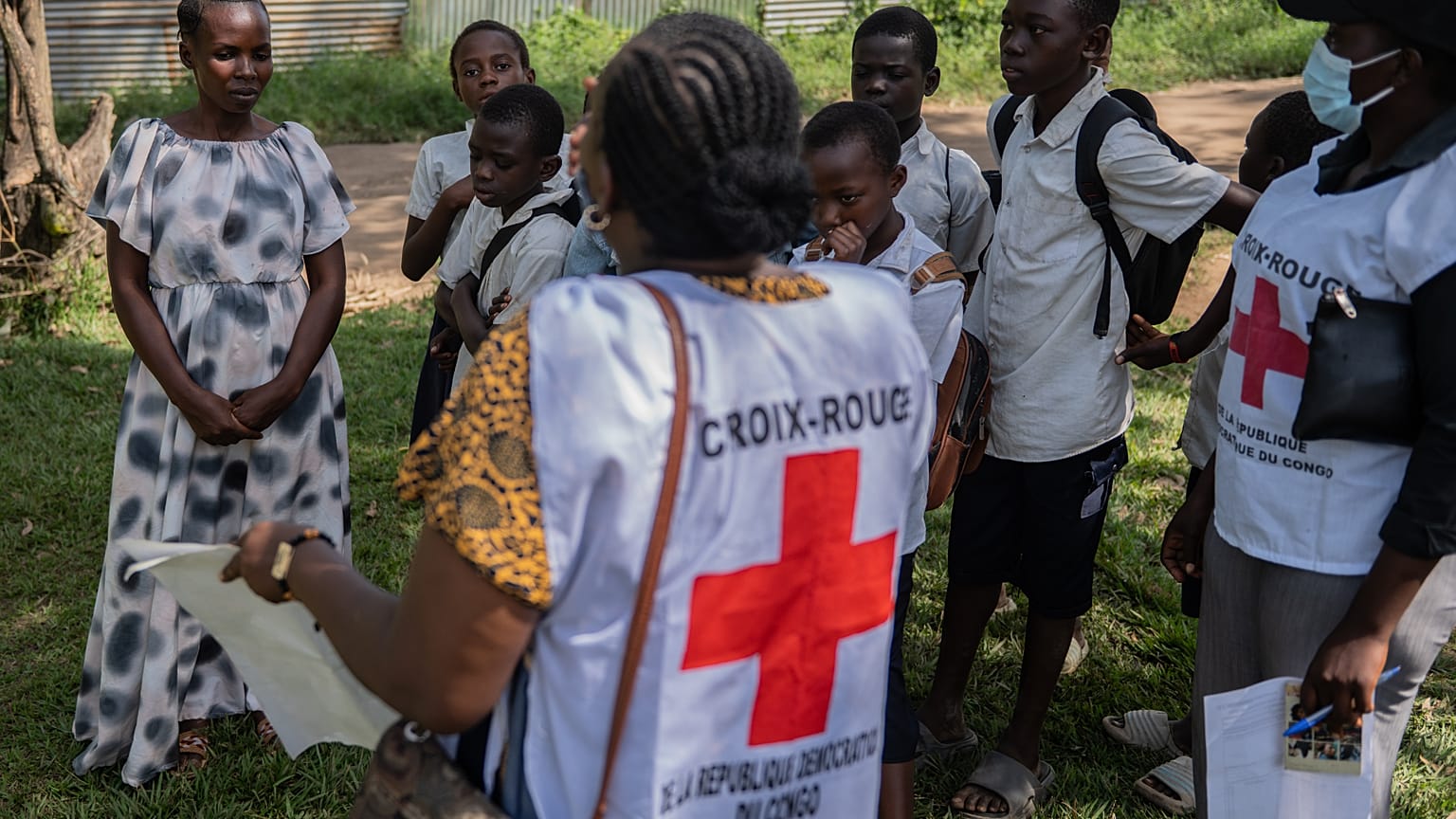
Vanny Birungi, a Red Cross volunteer, speaks to people during a house-to-house sensitisation campaign amid the Ebola outbreak in Bunia, Congo, Monday, May 25, 2026.
Copyright Copyright 2026 The Associated Press. All rights reserved


By Nathan Rennolds
Published on

The International Rescue Committee said the outbreak was spreading faster than response efforts in the Democratic Republic of the Congo.

The International Rescue Committee (IRC) has warned that the Ebola outbreak in the Democratic Republic of the Congo could become the "the deadliest outbreak on record" unless urgent international action is taken.

The World Health Organization said earlier this week that there were now more than 900 suspected cases of Ebola and 220 suspected deaths in the DRC. The outbreak has also spread to neighbouring Uganda, where there are seven confirmed cases, including one confirmed death.

The epidemic is being driven by the rare Bundibugyo virus, which has no proven vaccine, making efforts to contain the spread particularly difficult.

In a press release, the IRC, a New York-based humanitarian aid organisation founded in 1933, called for "urgent international funding and coordination" to tackle the outbreak, warning that regional conflict and aid cuts were impacting attempts to control it.

“The warning signs are flashing red,” Bob Kitchen, the IRC's vice president of Emergencies, said.

“Eastern DRC is confronting this outbreak more fragile and less prepared than during the 2018-2020 outbreak that killed more than 2,000 people- and with fewer resources to fight it," he continued. "Increased conflict and cuts to global aid funding have dismantled defenses at exactly the wrong moment. The lesson from every previous outbreak is clear: delays cost lives."

Last week, three volunteers working for the Red Cross in the DRC died from suspected cases of Ebola in Ituri Province, the epicentre of the Ebola outbreak in the country.

The Red Cross said that volunteers Alikana Udumusi Augustin, Sezabo Katanabo and Ajiko Chandiru Viviane were believed to have contracted the Ebola virus while managing dead bodies.

Ebola is a deadly illness first identified in 1976. Symptoms can include fever, weakness, diarrhoea, vomiting, and sometimes bleeding.


Three monkeys return after group of macaques escapes in Germany

28.05.2026, 

dpa 

Photo: Uwe Anspach/dpa


By Florentine Dame, dpa

Three monkeys have returned after a group of rhesus macaques escaped in the town of Witten in western Germany earlier on Thursday, according to police.

The highly intelligent but shy animals are presumed to have scraped mortar out of brick wall at an animal sanctuary, enabling them to break out, a police spokesman said. 

The broadcaster WDR reported that the group consisted of six so-called temple monkeys.

They had been housed in the sanctuary for animal welfare reasons. They are said to pose no danger to the public, so the local emergency services are not actively searching for them.

Three monkeys had returned on their own by Thursday afternoon, a police spokesman said, citing the sanctuary.

The fate of the other fugitives remains unclear.

"Anyone who sees a monkey in their garden can, however, contact the police or the fire brigade," said the police spokesman. Details will be passed on to the those responsible, who will ensure the animals are caught, he said.

Ousted BP head says he called out ‘excessive’ spending like limousines

28.05.2026, DPA


Photo: Ian West/PA Wire/dpa


The ousted chairman of BP has rejected “lies” about his conduct and said his views on cost-cutting and calling out “excessive expenditure” on things like a limousine or private flight were not shared by others at the firm.

Albert Manifold issued a statement in response to reports about his conduct after BP’s board removed him with immediate effect on Tuesday.

The board had cited “serious concerns” related to this conduct, oversight and governance at the oil giant.

Media reports following the move cited sources close to the company who said Manifold had engaged in bullying and aggressive behaviour towards other staff.

Manifold said he accepts the board’s decision to remove him, but added: “What I do not accept is that lies can be told about me, nor that anyone should be allowed to hide behind anonymity when commenting on my time at BP.”

Responding to the reports, he said: "Is it possible that in my determination to drive change on costs, performance, the balance sheet and shareholder communications, I pushed hard and challenged people directly? Yes, it is.

"But there is a considerable distance between driving an organisation with urgency and the characterisation of my conduct that is now being put about.

"At no point in my tenure as chairman of BP has anyone raised with me any issue about my conduct or my relationship with my colleagues."

Manifold, who had joined BP last October as it sought to drive an improvement in its performance, said he felt his priorities as the company’s chairman, particularly regarding shareholder interests, differed to others within the group.

This involved driving significant cost-cutting across the business, including “laying off thousands of people,” he said.

Manifold said he wanted to “set an example” at a time of cutbacks and that included calling out “unnecessary or excessive expenditure.”

“I had no interest in having a dedicated chauffeur-driven limousine at my beck and call on the occasions that I was in London,” he insisted.

“I had no interest in taking private aviation nor in availing myself of corporate tickets for sports events.

“I made my own coffee, bought my lunch in the local café. I sat in a small office, eschewing the grand corner-office privilege of previous chairmen.”

BP’s board has appointed Ian Tyler as interim chairman and launched a search process for a permanent replacement.

Amanda Blanc, senior independent director at BP, said on Tuesday: “Albert has helped bring a welcome focus and pace to BP’s transformation.

“However, the board has been surprised and disappointed to learn of governance oversight and conduct issues it deems unacceptable and has taken decisive action.”

Manifold’s removal came a month after almost a fifth of BP shareholder votes were cast against his election.

Shareholder advisory group Glass Lewis had called for investors to vote against him because of concerns over governance.