Monday, June 01, 2026

Philippine rooftop solar boom makes country China’s second-largest export market in 2026
Philippine rooftop solar boom makes country China’s second-largest export market in 2026
High prices for power have lead to a bottom-up green energy revolution as households turn to cheap Chinese-made solar panels for affordable electricity. / bne IntelliNews


By bne IntelliNews June 1, 2026

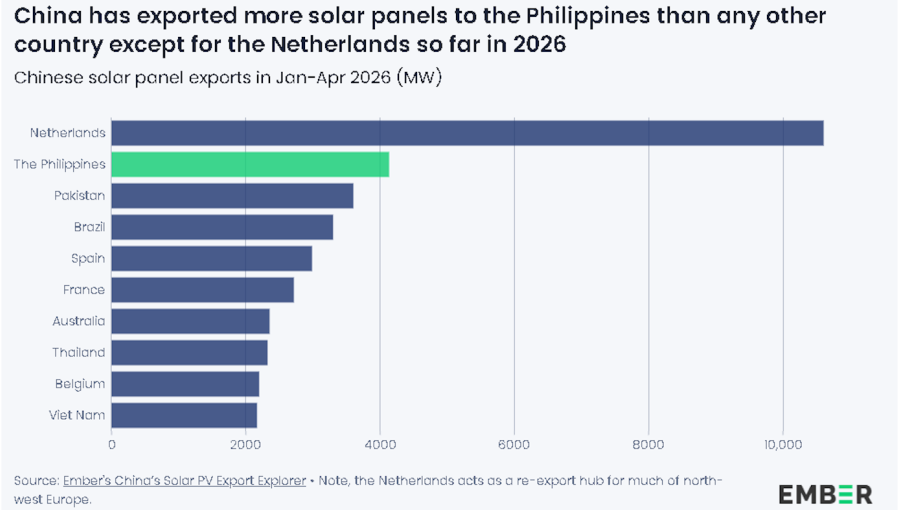
The Philippines has emerged as China’s second-largest export market for solar panels so far in 2026, driven by a rapid expansion of rooftop installations as households and businesses seek relief from some of the highest electricity prices in Southeast Asia.

It’s a bottom-up green energy revolution. The surge is being led largely by consumers rather than government mandates, highlighting how economics is increasingly driving the adoption of renewable energy in emerging markets. Millions of Filipinos are installing Chinese-made solar panels on homes and commercial buildings in response to the soaring price of power.

According to research by energy think-tank Ember, the economics of rooftop solar in the Philippines have become particularly compelling. The organisation said that “a Chinese solar panel — given cost of electricity in the Philippines — now has a payback period of only 3.1 years for households and 2.3 years for businesses”. The Chinese solar panels also have an expected working life of 30 years, making the calculation compelling over the long-term.

That calculation reflects a sharp contrast between the upfront cost of imported solar equipment and the high price consumers pay for grid electricity. The Philippines has long relied heavily on imported fossil fuels, leaving power prices vulnerable to fluctuations in global energy markets.

The affordability of Chinese solar technology has been a key factor. Panels produced by major manufacturers including Longi Green Energy Technology (SHA:601012), JA Solar Technology (SZSE:002459) and Trina Solar (SHA:688599) are now widely available across the country through local distributors and installers.

The trend is also being supported by improvements in panel durability. As noted in the source material, “panels from the big Chinese makers - Longi, JA Solar, Trina - now come with 30-year performance warranties as standard”. Given that “the average lifespan of a solar panel is roughly 30 years”, households that recover their installation costs within a few years can benefit from decades of low-cost electricity generation.

The development challenges traditional assumptions about the energy transition. “We're used to thinking of green energy as something top-down, the government imposing on reluctant citizens, but increasingly - in large parts of the world - it's becoming the exact opposite: a bottom-up movement of ordinary people who simply want cheaper energy.”

The Philippine experience suggests that, where electricity prices are high enough, rooftop solar adoption can accelerate without substantial subsidy programmes, driven primarily by consumer demand for lower energy bills.

Australia’s battery boom enables more than half of new solar output to be shifted beyond daylight hours
Australia’s battery boom enables more than half of new solar output to be shifted beyond daylight hours
New battery capacity has allowed Australia to move half its new solar power to for use after daily light hours. / bne IntelliNewsFacebook
By bne IntelliNews June 1, 2026

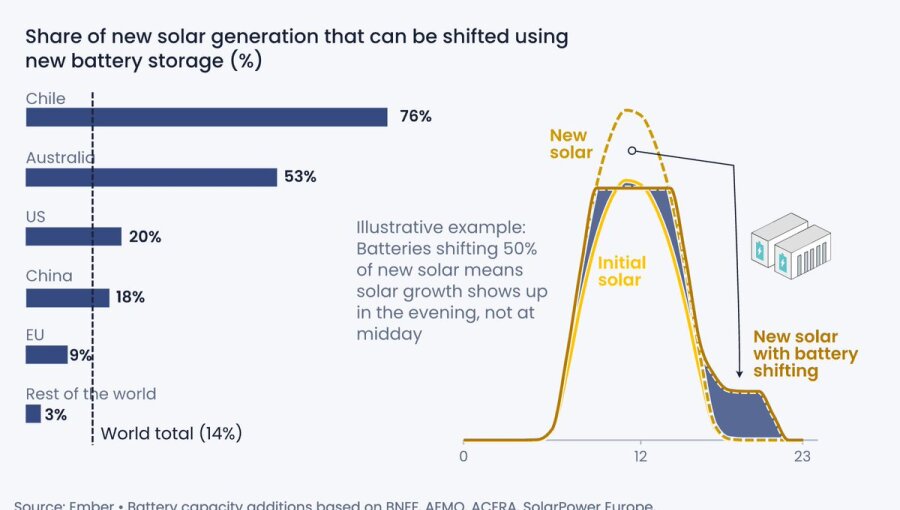
Australia installed enough battery storage capacity in 2025 to shift 53% of newly generated solar electricity beyond daylight hours, as the battery revolution accelerates.

The finding, cited by Australia’s Minister for Climate Change and Energy Chris Bowen, comes from analysis by energy think-tank Ember and highlights how batteries are increasingly being deployed alongside solar generation to store excess power produced during the middle of the day and release it during periods of higher demand.

As IntelliNews reported, Australia has already installed enough grid-level battery capacity to flatten the early evening spike in prices at peak demand.

Australia has one of the world’s highest rates of rooftop solar adoption, with more than four million households equipped with solar panels. The rapid growth of solar generation has created periods of abundant daytime electricity, increasing the importance of battery systems capable of shifting energy into evening peak hours.

Commenting on the latest figures, Bowen said: “Batteries...help reduce bills for everyone, not just those with batteries.”

The expansion of storage capacity has become a central element of Australia’s energy strategy as coal-fired power stations approach retirement and renewable generation accounts for an increasing share of electricity supply. Industry analysts have argued that batteries can help stabilise the grid, reduce price volatility and limit the curtailment of renewable energy during periods of strong solar output.

The market has also benefited from falling battery costs, driven largely by increased global manufacturing capacity and declining prices for lithium-ion technology. Australia has supported deployment through a combination of state-level programmes, utility-scale investment and growing consumer interest in household battery systems.

According to Ember, the ability to shift more than half of new solar generation beyond daylight hours demonstrates the extent to which storage is becoming integrated into renewable energy infrastructure. The development is particularly significant in a country where rooftop solar penetration is among the highest globally and where electricity demand peaks typically occur after sunset.

 

Indonesian employers' association, mining cartels yield to country’s $66bn export monopoly

Indonesian employers' association, mining cartels yield to country’s $66bn export monopoly
/ Chris - UnsplashFacebook
By IntelliNews June 2, 2026

In a political concession to the state’s economic centralisation agenda, Indonesia’s powerful business consortia have announced their support for President Prabowo Subianto's newly launched export monopoly, Jakarta Globe reports.

Following an emergency coordination assembly on June 1, the Indonesian Employers Association (Apindo), alongside the Indonesian Mining Association (IMA), the Indonesian Coal Mining Association (APBI-ICMA), the Indonesian Nickel Industry Forum (FINI), and the Indonesian Palm Oil Association (Gapki), issued a rare, sweeping joint endorsement backing the total centralisation of the country's resource wealth.

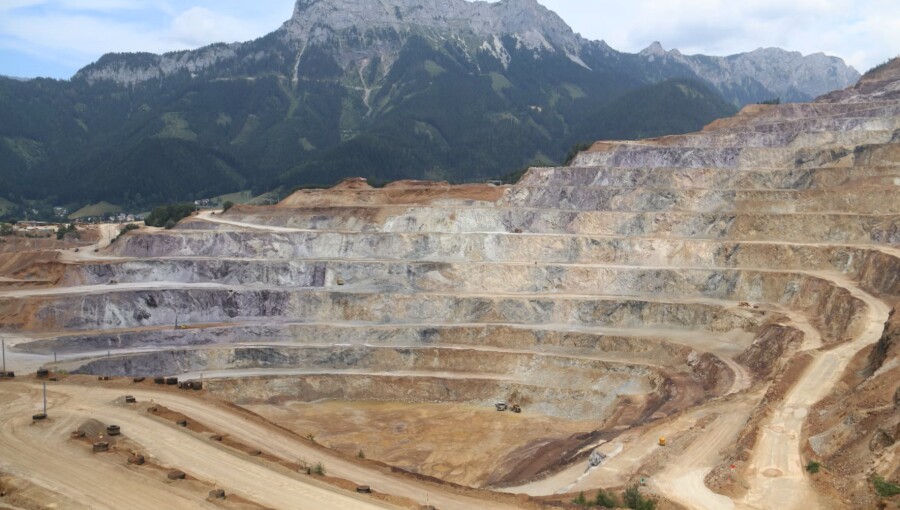
The corporate capitulation lands on the designated first day of the state’s trade shake-up. The policy mandates that PT Danantara Sumberdaya Indonesia (Persero), or DSI, a state-controlled trading monolith owned by the nascent sovereign wealth fund Danantara Investment Management, will serve as the exclusive exporter of the nation's key resource pillars.

The mechanism targets a $66.13bn (approximately IDR1,073 trillion) in annualised resource revenues, comprising roughly 23.4% of Indonesia's entire export economy. The state’s structural takeover is designed to aggressively plug systemic fiscal holes that have plagued the resource sector for over three decades. According to data cited by the Prabowo administration, corporate practices like under-invoicing, transfer pricing, and the offshore retention of export earnings have caused a staggering cumulative tax revenue leakage of $908bn over the last 34 years.

Finance Minister Purbaya Yudhi Sadewa and Coordinating Minister for Economic Affairs Airlangga Hartarto emphasised that routing all trades through DSI will improve transaction credibility. By integrating with the Directorate General of Customs and Excise's CEISA 4.0 digital platform, the state can force the immediate repatriation of all foreign exchange earnings directly back into the domestic banking grid, building strong upward defence lines for the rupiah.

While Apindo and the mining syndicates publicly framed their backing as a patriotic alignment with Article 33 of the 1945 Constitution, their joint statement functions as a calculated effort to prevent a total commercial bottleneck.

Led by Apindo Chairwoman Shinta Kamdani, the industry cartels reminded state planners that the target commodities operate under disparate business models, where the underlying contract frameworks, infrastructure logistics, international buyer profiles, and complex financing covenants governing bulk steam coal diverge completely from those of refined ferronickel, specialised ferroalloys, or volatile liquid crude palm oil (CPO). The associations demanded a hard guarantee that all existing and long-term supply contracts with international steel mills, power utilities, and global refineries will be legally protected and honoured without DSI interference.

To protect sensitive commercial secrets, the consortium proposed the development of a highly secure, closed-loop integrated export platform. This digital firewall would restrict DSI’s access to broad regulatory oversight while preventing state officials from leaking competitive pricing models or customer profiles back into the open market.

To reassure jittery global commodity markets and institutional bondholders, Danantara Chief Operating Officer Dony Oskaria confirmed that DSI will be governed by rigid, western-style corporate standards. In a highly unusual move for a strategic state trading body, the government has appointed veteran Australian commodities executive Luke Thomas Mahony as the inaugural President Director of DSI.

Meteor explodes over United States, triggering sonic boom

Dharvi Vaid 
DW with AFP and AP
05/31/202

A meteor broke apart over the US state of Massachusetts. Several people reported that the buildings they were in shook during the incident.

A meteor hurtling toward Earth's atmosphere exploded over the northeastern United States, causing a loud double boom that shook buildings in Massachusetts and Rhode Island, according to reports on Saturday.

The phenomenon released energy equivalent to about 300 tons of TNT, accounting for the loud noise, the US space agency, NASA, wrote in a statement posted on X.


What do we know?


The meteor, measuring about 3 feet (nearly 1 meter) wide, entered the atmosphere around the New Hampshire border with Massachusetts, north of Boston, the Associated Press cited the American Meteor Society as saying.

The fireball fragmented over northeastern Massachusetts and southeastern New Hampshire at 2:06 pm (6:06 pm UTC), NASA deputy news chief Jennifer Dooren told news agency AFP.

She added that the meteor was traveling at 75,000 miles per hour (more than 120,000 kilometers per hour) when it broke apart at an altitude of 40 miles (64 kilometers) over the area.

"This fireball was not associated with any currently active meteor shower, but it was a natural object and not a re-entry of space debris or a satellite," Dooren said in her statement.


Loud noise alarms people

Residents in the region were left baffled by the echoing boom.

Some people took to social media to report that their houses shook from the noise.

In some videos circulating online, what sounded like two quick booms could be heard, with no sign of fire, smoke or any visible causes for the noise.


Edited by: Srinivas Mazumdaru
DNA had one rule. Bacteria didn't get the memo

DW
01.06.2026

Every cell in every organism on Earth copies DNA the same way. Except one bacterial protein — quietly doing something scientists had never seen before.


Your DNA has never been created from scratch.

Think of it like a recipe — passed down from parent to child over countless generations, all the way back 4 billion years to the earliest life on Earth. With tweaks and changes accumulating along the way, but always copied from something that already existed.

That's the one rule that has held the entire time: to make DNA, you need existing genetic material to copy from.

Scientists just found a protein that breaks this rule.

A mechanism nobody has seen before

"It was quite a surprise!" Alex Gao, a biochemist at Stanford University in California and senior author of the study, told DW.

His team had been investigating how bacteria protect themselves from viruses when they identified something unexpected: a protein called Drt3b that builds DNA without anything to copy from. It uses its own shape as a mold to snap the right building blocks into place.

"We didn't believe it until we saw the cryo-EM structure [...] That was the moment it really clicked for us," he said — referring to cryo-electron microscopy, a technique that images molecules at near-atomic resolution.

The findings were published in the journal Science in April.

Gao and his team used the bacterium E. coli, found in the intestines of humans and other warm‑blooded animals. It is a cornerstone of research because of its fast growth and simple, well‑mapped genetics
Image: NIH/IMAGE POINT FR/picture alliance


So how does it actually work?

DRT3 — the full system studied by Gao's team — works in two steps.

DNA is double-stranded: think of it like a zipper, with two sides that fit together.

One side is built in a familiar way, with a protein called Drt3a using a small piece of genetic material as a template to build one strand.

The other side is where things get strange. A second protein, Drt3b, needs to build the other side of that zipper — but does so without a template. Instead, specific parts of the protein itself act as the guide, locking onto the right DNA building blocks or "nucleotides" one by one until the strand is complete. And that's what we didn't think was possible — at least not like this.

Other proteins have done something similar before — but only in short fragments, like writing a sentence. Drt3b writes a whole paragraph. It's the first known protein to produce a long, sequence-specific strand of DNA using nothing but its own structure as a guide.

Why does it matter?

"The research is groundbreaking," said Philip Kranzusch, a biochemist at Harvard Medical School who was not involved in the study.

That’s because scientists have been studying DNA since the 1950s and bacteria have been quietly doing something they never imagined was possible. Which raises the question: what else are we missing?

There's also a practical angle. If scientists could engineer Drt3b to produce other DNA sequences, it might one day work as a tool for building custom DNA molecules — without needing a template to copy from.

But we're not there yet. "We do not yet know if it can be reprogrammed or engineered in a useful way," Rafael Pinilla-Redondo, an assistant professor at the Section of Microbiology at the University of Copenhagen, told DW.
Francis Crick helped uncover the structure of DNA in 1953, alongside James Watson, building on crucial experimental work by Rosalind Franklin and Maurice Wilkins
Image: UPI Photo/IMAGO


So does this break the rules of biology?

The discovery has sparked debate around what is called the "central dogma of biology" — the idea that genetic information flows from DNA to RNA to protein, but never from protein back into DNA. If a protein can write a DNA sequence, does that break the rule?

"No, I would not say the central dogma has been broken," said Pinilla-Redondo. What the study shows is a protein helping to build a short, repetitive DNA sequence in a very specific context — not proteins generally rewriting genetic code. "The exciting part is not that the rules of biology have collapsed. It is that evolution has found a very unexpected way to build a DNA molecule," he said.

But what does the DNA actually do?

Scientists don't fully know yet.

The leading hypothesis is that the DNA acts as a kind of molecular sponge — soaking up essential components of the attacking virus and neutralizing it. But Alex Gao is careful about how firmly he holds that idea. "That's currently our leading hypothesis, but we're certainly open to alternative models," he said.

Pinilla-Redondo agrees the mechanism is still far from understood. "Is the DNA a decoy, a signal, a scaffold, or a toxic molecule? That is the key mystery," he said.

Jennifer Doudna (left) and Emmanuelle Charpentier were awarded the 2020 Nobel Prize in chemistry for the development of the CRISPR method for genome editing, which allows scientists to rewrite DNA in almost any organism
Image: Alexander Heinl/dpa/picture alliance


Is this the next CRISPR?

CRISPR — the molecular scissors that allow scientists to cut and edit DNA with unprecedented precision — was itself first discovered as a quirky bacterial defense system. It has since transformed medicine, including the first approved gene therapyfor sickle cell disease in 2023.

Sounds familiar, right? But will it be a similar story with DRT3?

Probably not — at least not yet. "CRISPR is a once-in-a-generation breakthrough that revolutionized biotechnology," said Gao. "While it is early to predict applications of DRT3, we are most excited about DRT3 for expanding our understanding of the mechanisms of DNA synthesis."


A glimpse into microbial dark matter

"The field of bacterial immunity is exploding," said Pinilla-Redondo. Experimental research on these bacterial defense systems has only just begun — and the diversity of mechanisms being uncovered is striking, with multiple research groups around the world independently making similar findings.

For Gao's team, this discovery is less an ending than a beginning. Bacteria have spent billions of years fighting viruses, quietly evolving molecular tricks that we're only beginning to discover. How many more are out there?

"It points to a vast reservoir of uncharacterized biology within microbial 'dark matter,' where fundamental mechanisms likely remain undiscovered," said Gao.

Edited by: Frank Lee

Esteban Pardo Science journalist and communicator
Swing Youth: In Nazi Germany, jazz was an act of defiance
DW
05/31/202

The Nazis denounced jazz music as "degenerate art," despite its widespread popularity in Germany. As the Nazis clamped down on expression, groups of jazz-loving teenagers formed the Swing Youth to rebel.


Josephine Baker was a star in Germany before the Nazis seized power
Image: TT/IMAGO


The interwar Weimar Republic period is often referred to as a "Golden Age" of culture and creativity in Germany. It was a time when groundbreaking movements, from Bauhaus architecture and experimental cinema to avant-garde art and theater, flourished against the backdrop of economic catastrophe and extreme political polarization.

In cities such as Berlin, where speakeasies, cabarets and hedonistic nightlife were the norm, a radical new genre of music became immensely popular. Jazz, which emerged from African American communities in the Deep South, was first brought to Germany by pioneering artists from the US, UK and France after World War I.

Josephine Baker, the US-born dancer, actress and jazz artist who found fame in 1920s Paris, became a huge star in Germany after her sensational debut as the "Black Venus" in Berlin in 1926. By the 1930s, records by jazz icons such as Louis Armstrong and Duke Ellington were being played all over Germany.

Baker would become known for her civil rights activism in the USImage: Keystone Archives/HIP/picture-alliance

But after the Nazis seized power in 1933, modern art forms like jazz came under extreme pressure. The white supremacist Nazis, who believed that Germanic peoples belonged to a superior "Aryan master race", sought to align German society through a process known as Gleichschaltung (synchronization).

This was the process of Nazification through which all aspects of society from politics and law, into art, music and everyday life, were submerged into a totalitarian system of control. The Reich Culture Chamber (Reichskulturkammer) placed music, arts, literature, theater, radio, film and the press under state supervision, allowing only artists belonging to Nazi-affiliated bodies to work.

The Nazis produced touring exhibitions denouncing so-called 'degenerate' art and music, pictured here in Düsseldorf in 1938, and sought to link jazz with Jewish identity
Image: TT/IMAGO

In 1937 and 1938, the Nazis introduced the labels "degenerate art" ("entartete Kunst") and "degenerate music" ("entartete Musik") to persecute artists and artworks that did not conform to the Nazi ideal of art and beauty, or to the Nazis' racial worldview.

By 1935, it was forbidden to broadcast jazz, which, with its Black American roots, the Nazis denounced as inferior. Many jazz promoters and musicians were also Jewish, and the Nazis spread antisemitic and racist propaganda about its origins, linking jazz with Jewish people.

A racist caricature of a jazz musician wearing a Star of David appeared on a propaganda poster for the 1938 Nazi exhibition 'Entartete Musik' ('Degenerate Music')
Image: Fine Art Images/Heritage Images/IMAGO

Individual artists were eventually banned, as was listening to foreign radio stations. However, jazz music was never completely outlawed by Nazis. Due to its widespread popularity, there were even attempts to create a more "Germanic" form of jazz music.

Enter the Swing Youth (Swing-Jugend), which emerged as a counterculture movement among affluent teenagers in the northern city of Hamburg in 1939. The movement quickly spread to other cities like Berlin.

ADVERTISEMENT

Youth under Nazi rule: from repression to resistance

German youth had been the target of Nazi propaganda since the 1920s. After 1933, escaping indoctrination became almost impossible as youth organizations had become a key tool of ideological control.

After it restricted freedom of association and dissolved independent youth groups, the National Socialist regime established organizations such as the Hitler Youth (Hitlerjugend) and the League of German Girls (Bund Deutscher Mädel). Their purpose was to mold young Germans into loyal and disciplined members of the "people's community" ("Volksgemeinschaft"), starting from an early age.

The purpose of the Hitler Youth, pictured here in Nuremberg in 1940, was to indoctrinate young people in Nazi ideology
Image: United Archives/kpa Keystone/IMAGO

But not all young people in Nazi Germany supported the regime's ideology, and for the Swing Youth, jazz music became a vehicle for rebellion. Its members tried to distinguish themselves from Nazi youth movements by appropriating American fashion trends and names. They wore their hair long and dressed in plaid jackets to meet in cafes and clubs playing swing, a jazz sub-genre. They were also said to have greeted one another with the phrase: "Swing Heil!"

The term "Swing Youth" likely originated with the authorities who persecuted them as a label for young people who distanced themselves from the Nazi regime primarily through their preference for swing.

"They stood up for a certain form of freedom, resisting the idea of being the same as everyone else," historian Mascha Wilke from the Foundation for Remembrance, Responsibility and Future (EVZ) told DW.

Historian Mascha Wilke emphasized the bravery of the young people who 'dared to be themselves'
Image: Melissa Escarria Parra/DW

While the Swing Youth's resistance to Nazi ideology was more cultural than political, it nevertheless became a target of repression. Its adherents were even monitored by the Nazi Security Services, which according to musicologist Ralph Willett, accused them of "hankering after democratic freedom and American casualness."

Some were arrested and even sent to concentration camps. Wilke also refers to an incident in which detainees reportedly sang and danced to Louis Armstrong's "Jeepers Creepers" inside a camp — an act she describes as "incredibly brave."

\
The memory of the Swing Youth was honored at a 'Liberation Dance' in Berlin on May 8, 2026
Image: Melissa Escarria Parra/DW

Jazz and swing enthusiasts of all generations gathered at Berlin's Besselpark on May 8, 2026, to mark the 81st anniversary of Liberation Day (Tag der Befreiung), commemorating the unconditional surrender of the Wehrmacht, and to honor those persecuted for their love of jazz and swing music.

Organized by the EVZ, participants were invited to dance to swing. Newcomers could also receive guidance from Natalie Reinsch, a historian and professional swing dancer working for the Bremen Alliance for German-Czech Cooperation, who was invited by the EVZ.

"Totalitarian regimes have always suppressed art forms like swing and jazz, because they stand for individuality," Reinsch said.

Edited by: Helen Whittle


Space race: Why Portugal is reaching for the stars

Jochen Faget
05/31/2026
DW

A spaceport is being built on a small Portuguese island in the Atlantic. Is Portugal on the verge of becoming a space nation?

Germany's ATMOS Space Cargo company aims to land its Phoenix transport capsule at Portugal's Santa Maria spaceport
Image: Atmos

Imagine rockets being launched from the Azores, an archipelago out in the Atlantic Ocean, carrying Portuguese-built satellites into space — and then picture reusable space capsules returning to base.

While this may sound like a rather futuristic scenario, elements of it could soon become reality. Portugal, after all, is working hard to become a spacefaring nation, with the help of its many highly skilled engineers and EU cooperation.

"Portugal has modernized considerably over the past 20 years," Portuguese Space Agency President Ricardo Conde tells DW. "Our universities produce outstanding engineers. We have created human capital that we can build on."

Conde, whose agency was founded in 2019, says about 80 different companies now employ some 2,000 highly qualified workers across Portugal's space industry. It generated a turnover of €200 million ($232.5 million) last year, according to Conde, with even greater productivity expected this year.

This is "because we hold another trump card: the Azores," Conde says.

Indeed, Portugal is presently building a spaceport on the sleepy Azores island of Santa Maria.

"This will be a big deal," Ivo Vieira of space industry group AED Cluster Portugal tells DW. "The European Space Rider spaceplane is even slated to land there in 2028."

It will float down on huge parachutes and land right beside the old runway, which was once built by the Americans during World War II and is now barely ever used. Vieira says a rocket launch is planned for 2030, which will send "a South Korean satellite into orbit."

Several satellite communication antennas are already in operation on the island, he adds.


This Santa Maria site could see a growing number of rocket launches
Image: ASC - Atlantic Spaceport Consortium


Will Portugal seek to rival US spaceports?

Is Portugal in the process of establishing its very own Cape Canaveral? Not exactly. Bruno Carvalho of spaceport operator ASC says it will not rival the vast US rocket launch site.

"It is much smaller and more of an addition to the European Kourou spaceport in French Guiana," Carvalho explains. "We will be a cost-effective launch site for smaller rockets with smaller satellites, within the EU, which is strategically important."

The space port's remote location in the Atlantic also means spacecrafts can safely land in the ocean without posing a potential danger to anyone. Thirty-five people will work at the spaceport once everything is set up and ready. This makes for a far smaller and cheaper operation than US launch sites.

Carvalho also wants the site to tap into local resources and hopes it could strengthen the local economy: "Maybe we can bring back young people who have left the island."

The first Azores spacecraft landing could take place later this year.

"Portuguese authorities have approved the first EU splashdown for the Phoenix 2.1 transport space capsule," Marta Oliveira of ATMOS Space Cargo tells DW.

Oliveira, co-founder of the German space logistics firm, aims to deliver satellites to orbit at low cost using reusable capsules. She jokingly describes her venture as "the FedEx of space."

For now, transporters are sent into space using SpaceX, though that could change, says Oliveira, as "we are in talks with European companies." The plan is for spacecraft to land in the Atlantic, near the Azores island of Santa Maria, with "ASC spaceport facilitating logistics and coordinating with the local authorities, which is ideal for us."

Marta Oliveira says the Azores make an ideal base for rocket launches
Image: Atmos Space Cargo


Portugal's compact satellites

What is still missing are satellites.

"Three Portuguese centers are developing them," says Ricardo Conde. "One is the CEiiA consortium in Porto in the north, another is the Open Cosmos multinational at the university of Coimbra in the center of [Portugal] and a third is based in Lisbon, which mainly builds satellites in collaboration with the armed forces."

They are small and used for commercial, military and mixed applications such as communications, Earth and ocean observation and, most recently, fighting wildfires.

CEiiA, which also develops mobility and aircraft technology, is already making big progress.

"We entered the space sector in 2018," Andre Dias, who is responsible for the consortium's downstream division, tells DW. "Our aim is to develop an industry for high-resolution satellites."

To achieve this, a research and development facility will be established in Portugal's north, near the city of Guimaraes, to "partner with the city and local university there, as we want to increase our production capacity by a factor of four or five."


CEiiA has the capacity to build four civilian satellites, weighing up to 500 kilograms (roughly 1,100 pounds), every year, says Dias. He adds that demand is growing steadily and expanding capacity could open the door to more international contracts.

One can see decentralization playing out between "the large European space nations like Germanyand France and smaller countries such as Portugal, so what we are seeing is a kind of democratization of space travel," Dias says. "We are specializing in small satellites that cost between €20 and 30 million, not the big ones that can cost up to €500 million."

While aiming to build compact units, the Portuguese space agency's plans are anything but modest.

"We will have 30 satellites in space by 2030, some of them in collaboration with Spain," Conde tells DW. "We want to bring international players to Portugal to work with them and are building on European initiatives."

This also applies to the military sector, he adds, which is becoming increasingly important.

This article was translated from German.
How China keeps North Korea's economy alive
DW
01.06.2026

Pyongyang relies on China for 95% of its legitimate trade; hacking, arms deals and remittances also help it stay afloat.

China is one of North Korea's few allies and its main legitimate trading partner
Image: Florence Lo/REUTERS
ADVERTISEMENT

North Korea runs one of the most bizarre economies on the planet. Despite being one of only a handful of nations with nuclear weapons, its 2024 gross domestic product (GDP) was a paltry $26.6 billion (€22.9 billion).

This is about 70 times smaller than South Korea's $1.86 trillion economy and about a fifth of the annual revenue of the world's top-traded company, Nvidia.

Thanks to a centrally planned economy that prioritizes domestic production, North Korea is nowhere near as reliant on trade as your average free-market economy, partly due to international sanctions, introduced by the United Nations in 2017 over its nuclear weapons and ballistic missiles program.

The North's total imports and exports account for just a small fraction of GDP, versus the South, where international trade makes up around 80% of the economy, according to the World Bank.

North Korea continues to test missiles in defiance of sanctions and UN resolutionsImage: AFP PHOTO/KCNA VIA KNS


How important is China in North Korea's economy?

You could say that China plays almost an exclusive role in North Korea's minimal reliance on trade.

According to the Washington-based think tank the National Committee on North Korea, Pyongyang depends on China for up to 95% of total trade and 85% of its exports.

Almost all imports also come from China. In 2024, North Korea's legitimate imports totaled just $2.33 billion — tiny by global standards.

With no domestic oil production, these deliveries from China include petroleum and other fuels and are essential in keeping the economy functioning, along with food, textiles, machinery, electronics and vehicles.

This gives Beijing enormous economic clout over North Korean leader Kim Jong Un. A recent report suggested that US President Donald Trump is now trying to leverage that muscle to bring Pyongyang back to the negotiating table over its contentious nuclear weapons program.

South Korea's Yonhap news agency reported recently that Chinese President Xi Jinping is expected to visit Pyongyang in the next few weeks, playing a key mediator role to help bridge the gap between Trump and Kim in the long-running dispute. Beijing is yet to confirm the trip.


What is North Korea allowed to export to the rest of the world?

The rogue state's legitimate exports are even less impressive. According to the Korea Trade-Investment Promotion Agency, North Korea's exports barely reached $360 million in 2024.

Those foreign sales are strikingly modest, with fake hair and wigs the country's only best seller, making up about 40% of exports, primarily to China, which then reexports them to the rest of the world.

North Korea turned to wigs for vital foreign income after sanctions blocked its traditional big exports like coal and minerals, while fake hair was not explicitly banned.

The communist country also has an abundant supply of low-cost and often forced labor — perfect for a highly labor-intensive and low-tech business like wig making.

Other goods like tungsten and other ores, frozen fish, iron and steel and watch components each make up less than 10% of the country's exports.

Since the sanctions were imposed, Pyongyang has lost roughly $2.2 billion annually in export revenue, according to the Korea Economic Institute of America think tank.


Crypto-theft is alleged to be a major earner for the North Korean regime
Image: Kacper Pempel/REUTERS

How else does Pyongyang make money?

Beyond its meager exports, North Korea generates significantly more hard currency through its shadow economy.

The country sends tens of thousands of workers overseas, many to Russia and China, to work in construction, logging, factories and fisheries.

This program is widely seen by human rights groups and the UN as another form of forced labor.

The state then seizes most of their wages, generating around half a billion dollars annually, according to the UN Panel of Experts.

Thousands of North Korean computer professionals also work remotely for US, South Korean and European Union-based companies, pretending to be legitimate freelancers, using false — often stolen — identities.

Often, they earn high salaries, which are then funneled back to the regime. In 2024, these loyalty remittances brought in $800 million for the state, according to the US Treasury Department.

North Korea also operates one of the world's most sophisticated and lucrative hacking programs, prompting one US think tank to label its cybercriminals "the most dangerous state-sponsored threat to the financial services sector."

In 2025, North Korean hackers stole a record $2.02 billion in cryptocurrency, representing over half of all global digital currency theft that year, the blockchain intelligence firm Chainalysis calculated.

Yet, the communist nation's biggest — and most shadowy — money spinner has been fueled by the war in Ukraine and Pyongyang’s long-standing close ties with Moscow.

North Korea has supplied Russia with millions of artillery shells, rockets and ballistic missiles, boosting the Kremlin's war machine and earning Kim's regime an estimated $7 billion to $13.8 billion since 2023, according to South Korea’s Institute for National Security Strategy.

These revenues, according to Seoul-based intelligence officials, are being used to accelerate the North's nuclear and ballistic missile program, as well as source additional oil and food from China.

Edited by: Rob Mudge


London Tube workers go on two-day strike


Jenipher Camino Gonzalez
DW with Reuters
01.06.2026

A strike in London's Tube will see the closure of two train lines and partial closure of two others, as the union demands better worker condition for workers.

Authorities are expecting travel and commute on London's tube to be significantly impacted.
Image: Rasid Necati Aslim/Anadolu/picture alliance


Parts of London's underground, known as the Tube, will be shut for two days this week, after transport union leaders announced a strike on Monday.

The National Union of Rail, Maritime and Transport Workers (RMT) said workers will be encouraged to walk off the job on Tuesday and Thursday for 24 hours each day.

The action comes amid an ongoing labor dispute, after the union called off planned strikes last month to allow talks to continue.

Transport for London (TfL) confirmed that strikes were planned by "some Tube drivers," saying that while some lines will close, others are expected to remain open and operating.

"Despite our best efforts in ACAS talks, TfL have failed to provide assurances on our members deeply held concerns around fatigue, reduced flexibility, shift lengths and the impact these proposals could have in a safety-critical role like tube driving," RMT wrote on its X account.


"We remain available for meaningful talks, but strike action tomorrow will now go ahead," the post added.

How is service affected?


TfL responded to the RMT's announcement by saying it was disappointed that the union had chosen to go ahead with strike action, despite what it said were assurances over the new working pattern.

Authorities are expecting travel and commute on London's tube to be significantly impacted.

According to TfL, there will be no service on the Circle line or the Piccadilly line. No service is also expected on the Metropolitan line between Baker Street and Aldgate, and on the Central line between White City and Liverpool Street.

TfL said that although it plans to offer service on the remaining lines, travelers should expect disruption, as service levels "will vary" across the network.

Passengers can also expect services to start late and finish early, with limited service before 6:30 a.m.

The agency also encouraged customers to "complete their journeys before 21:00" on both strike days.

London Tube is the world's oldest subway 05:45


Edited by: Louis Oelofse
Nicaragua: Indigenous leader Rivera dies in detention
DW with AP, AFP and Reuters
01.06.2026

The Indigenous leader and former lawmaker had been detained by Nicaragua's authoritarian government in 2023 on undisclosed charges.


Rivera’s fight for Nicaragua’s Indigenous people began in the 1960s
Image: Lou Dematteis/REUTERS


Nicaraguan Indigenous leader and activist Brooklyn Rivera died from health complications after nearly three years in detention, the country's health ministry said on Sunday.

Last week, the Nicaraguan government's confirmed that he had been detained since 2023. UN representatives, the US government and Rivera's family have demanded proof that he was still alive.

"We regret to confirm that he has sadly passed away," the health ministry said in a statement on state-run media outlets.

Authorities said the leader's "physical and neurological deterioration" was "a consequence of a bacterial infection caused by the COVID-19 virus," adding doctors had made "enormous" efforts to save Rivera's life.

On Wednesday, the government had released images of Rivera hooked up to a ventilator, acknowledging that his situation was critical.
Rivera was ‌arrested ​while still a sitting lawmaker
Image: Nicaragua's Ministry of Health/AFP

The 73-year-old was a renowned leader of the Miskito People and a former member of Nicaragua's Congress. He was arrested in 2023 by the left-wing authoritarian government of President Daniel Ortega on undisclosed charges.

According to news reports from 2024, the government told the Office of the UN High Commissioner for Human Rights that Rivera's parliamentary immunity had been revoked. The authorities were reportedly preparing to investigate serious crimes, including treason.

Rivera's exiled daughter, Tininiska Rivera, said that she wanted the government to hand over her father's body so that it can be buried under Miskito traditions. She also refuted the government's claims that family members were with Rivera when he died.

Activists decry Rivera's death

Human Rights activists and groups across the world denounced the leader's death.

"They took him alive, and after refusing to tell his family, his lawyer, the world anything about his fate, then they call him brother," said Reed Brody, an American human rights lawyer and member of a group of UN experts on Nicaragua. Brody referred to an earlier statement where the Ortega Government called Rivera a "brother" and said they were praying for him.

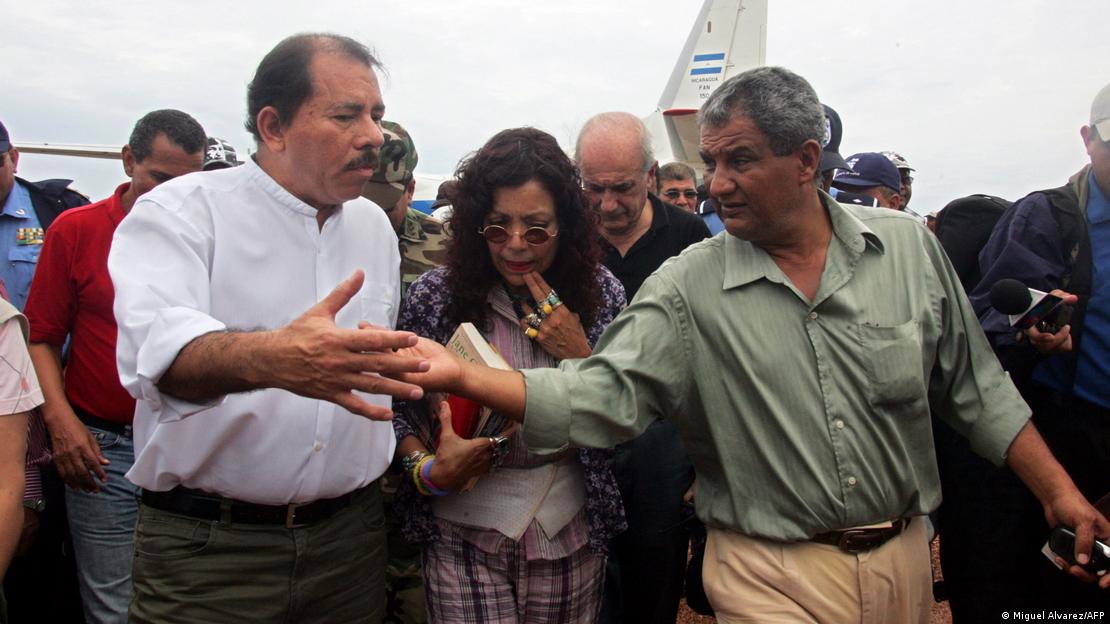
Rivera was a representative of the Miskito people, who live along Nicaragua’s northeast coastImage: Miguel Alvarez/AFP

"Unconscionable cynicism on the part of the government to make it seem like they were trying to help him," Brody said.

Manuel Orozco, a director at the Inter-American Dialogue, said that Rivera's death was a result of "complete neglect." "His death represents the magnitude of repression," he said.

Argentina-based Inter-American Center for Legal Assistance in Human Rights also denounced Rivera's death in a post on X, demanding that those responsible "should be held criminally accountable."

Albert R Ramdin, Secretary General of the Organization of American States, said he was "deeply concerned" about reports of Rivera's death.

"His death demands an immediate, independent, and transparent investigation," Ramdin wrote Sunday on X. "The rights to life, personal integrity, and due process must be guaranteed."

Edited by: Darko Janjevic