Philippine rooftop solar boom makes country China’s second-largest export market in 2026
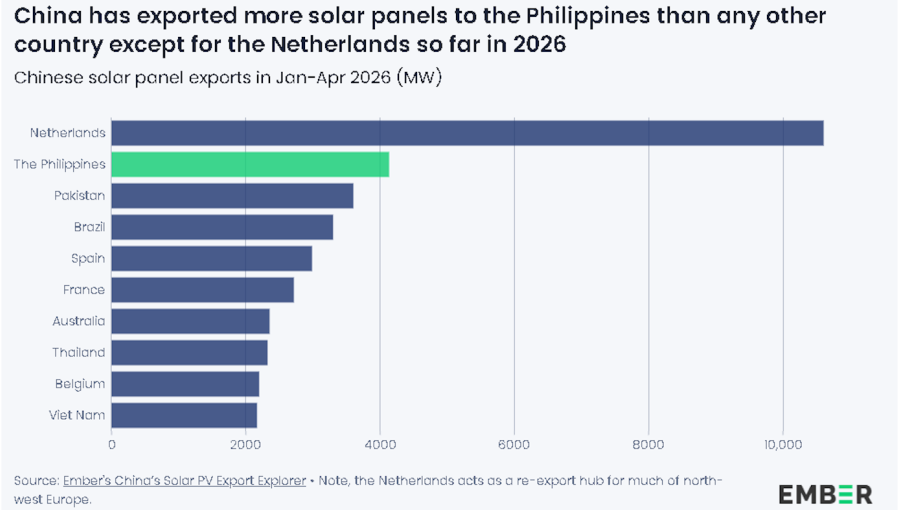
The Philippines has emerged as China’s second-largest export market for solar panels so far in 2026, driven by a rapid expansion of rooftop installations as households and businesses seek relief from some of the highest electricity prices in Southeast Asia.
It’s a bottom-up green energy revolution. The surge is being led largely by consumers rather than government mandates, highlighting how economics is increasingly driving the adoption of renewable energy in emerging markets. Millions of Filipinos are installing Chinese-made solar panels on homes and commercial buildings in response to the soaring price of power.
According to research by energy think-tank Ember, the economics of rooftop solar in the Philippines have become particularly compelling. The organisation said that “a Chinese solar panel — given cost of electricity in the Philippines — now has a payback period of only 3.1 years for households and 2.3 years for businesses”. The Chinese solar panels also have an expected working life of 30 years, making the calculation compelling over the long-term.
That calculation reflects a sharp contrast between the upfront cost of imported solar equipment and the high price consumers pay for grid electricity. The Philippines has long relied heavily on imported fossil fuels, leaving power prices vulnerable to fluctuations in global energy markets.
The affordability of Chinese solar technology has been a key factor. Panels produced by major manufacturers including Longi Green Energy Technology (SHA:601012), JA Solar Technology (SZSE:002459) and Trina Solar (SHA:688599) are now widely available across the country through local distributors and installers.
The trend is also being supported by improvements in panel durability. As noted in the source material, “panels from the big Chinese makers - Longi, JA Solar, Trina - now come with 30-year performance warranties as standard”. Given that “the average lifespan of a solar panel is roughly 30 years”, households that recover their installation costs within a few years can benefit from decades of low-cost electricity generation.
The development challenges traditional assumptions about the energy transition. “We're used to thinking of green energy as something top-down, the government imposing on reluctant citizens, but increasingly - in large parts of the world - it's becoming the exact opposite: a bottom-up movement of ordinary people who simply want cheaper energy.”
The Philippine experience suggests that, where electricity prices are high enough, rooftop solar adoption can accelerate without substantial subsidy programmes, driven primarily by consumer demand for lower energy bills.
Australia’s battery boom enables more than half of new solar output to be shifted beyond daylight hours
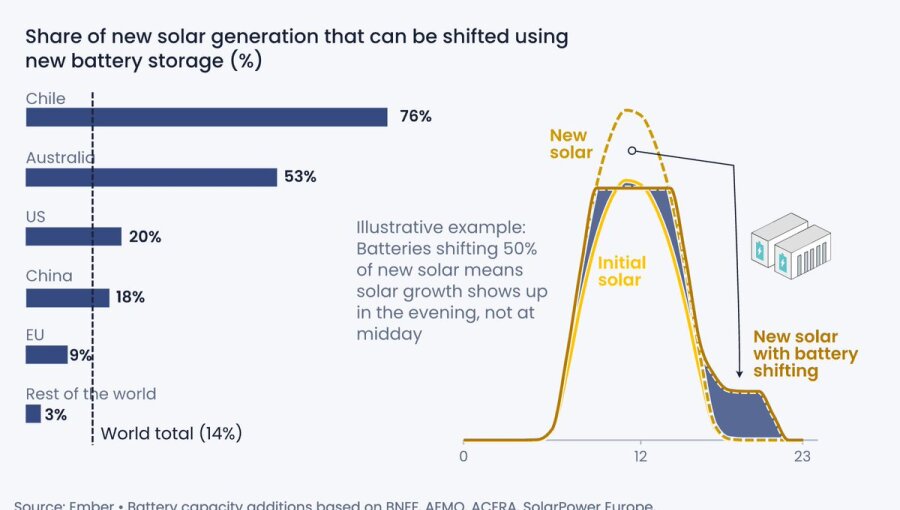
Australia installed enough battery storage capacity in 2025 to shift 53% of newly generated solar electricity beyond daylight hours, as the battery revolution accelerates.
The finding, cited by Australia’s Minister for Climate Change and Energy Chris Bowen, comes from analysis by energy think-tank Ember and highlights how batteries are increasingly being deployed alongside solar generation to store excess power produced during the middle of the day and release it during periods of higher demand.
As IntelliNews reported, Australia has already installed enough grid-level battery capacity to flatten the early evening spike in prices at peak demand.
Australia has one of the world’s highest rates of rooftop solar adoption, with more than four million households equipped with solar panels. The rapid growth of solar generation has created periods of abundant daytime electricity, increasing the importance of battery systems capable of shifting energy into evening peak hours.
Commenting on the latest figures, Bowen said: “Batteries...help reduce bills for everyone, not just those with batteries.”
The expansion of storage capacity has become a central element of Australia’s energy strategy as coal-fired power stations approach retirement and renewable generation accounts for an increasing share of electricity supply. Industry analysts have argued that batteries can help stabilise the grid, reduce price volatility and limit the curtailment of renewable energy during periods of strong solar output.
The market has also benefited from falling battery costs, driven largely by increased global manufacturing capacity and declining prices for lithium-ion technology. Australia has supported deployment through a combination of state-level programmes, utility-scale investment and growing consumer interest in household battery systems.
According to Ember, the ability to shift more than half of new solar generation beyond daylight hours demonstrates the extent to which storage is becoming integrated into renewable energy infrastructure. The development is particularly significant in a country where rooftop solar penetration is among the highest globally and where electricity demand peaks typically occur after sunset.

No comments:
Post a Comment