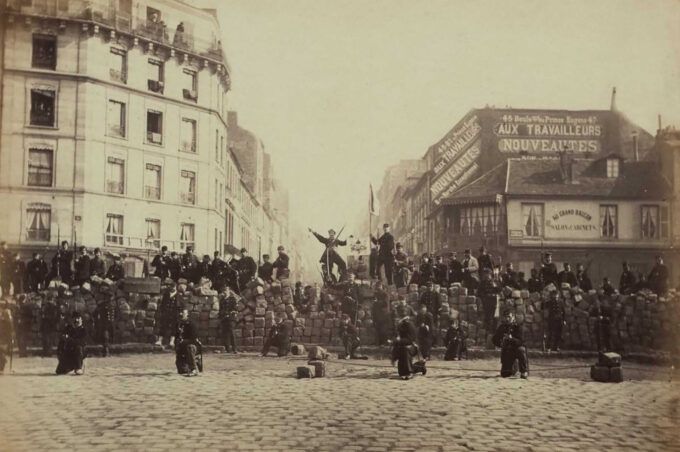
A barricade thrown up by the Communard National Guard on 18 March 1871 – Public Domain
May 28, 2026, marks the 155th anniversary of the Communards’ last stand at Père-Lachaise Cemetery and the end of the Paris Commune. A few days ago, the Tricontinental Institute published an article by our friend and comrade Vijay Prashad who seeks to draw lessons from past socialist experiences. On this occasion, he notes that “All socialist revolutions in the modern world have taken place in the poorer nations, where the peasantry predominates and where wealth has been systematically leached from their territory into distant lands.”
The Paris Commune reminds us of an important fact: here was one revolution that did not take place in a poorer country, but in one of the world’s leading capitalist nations. One need only read Émile Zola, the famous chronicler of nineteenth-century France, to remember how profoundly Second Empire society had already been transformed by capitalism. By 1871, when the Commune broke out, France was already well on the way to transitioning from competitive capitalism to imperialist capitalism, even though the latter would truly take off only after the Commune with the scramble for Africa.
In a sense, Vijay Prashad’s exclusion of the Commune from the revolutionary experiences he analyses is justified. The Commune was exceptionally short-lived (72 days!), and it lacked both a clear revolutionary programme and a revolutionary organisation. Indeed, the Commune can easily be seen as the first socialist revolution, but also as the last of the pre-modern revolutions in which craftsmen and the petty bourgeoisie indisputably played a key role alongside a working class that already represented half of Paris’ population. But this revolution was so brief that the revolutionary moment did not develop into a revolutionary experience capable of transforming society in a deep and lasting way.
Nevertheless, in New Times and Old Mistakes in a New Guise—Lenin’s text that Vijay Prashad quotes, the Russian revolutionary reflects on the construction of socialism and explicitly refers to the government of the Commune as a precursor to the Soviet government.
But is there really nothing to be learnt from the Paris Commune, apart from a legend and a few magnificent revolutionary songs, such as “The Internationale”? Admittedly, it would be a mistake to celebrate the Commune. It lasted only 72 days, and the Commune—besieged, starved, poorly armed, and divided—was ultimately crushed with a brutality that shook the whole of Europe. But it would be an even greater mistake to bury it after ceremonially paying our respects to our heroic fallen comrades. Because the Commune is the only revolutionary experiment at the heart of capitalism, we must ask ourselves, without fetishism or discouragement, what can be learnt from it. The Commune must not become a dusty museum. It must be a laboratory—a place of concrete possibilities, fatal errors, and lessons that never grow old.
I. The State is Not Neutral: A Truth That The Republic Has Written in Blood
One of the most persistent myths of French republicanism that haunts the French left is the idea of an impartial state, acting as an arbiter above the classes. The Commune shattered that myth.
In 1871, the Third Republic—Adolphe Thiers’s Republic, the one that claimed to champion ‘freedom’—reached an explicit agreement with Bismarck, the national enemy, so that Prussian troops would release tens of thousands of French soldiers in order to crush the workers of Paris. The “national defence” government, led first by Jules Favre and then by Adolphe Thiers, was in reality a class alliance against the working class.
French communists, socialists and anarchists are commemorating the Bloody Week this Sunday. What we are commemorating remains a matter of historical assessment. French bourgeois media, from Le Monde to France Culture, eagerly circulate the fanciful figures of the British historian Robert Tombs (aptly named!). In an attempt to downplay the number of casualties, he puts the death toll at between 6,000 and 7,000, hoping to show that the Bloody Week claimed fewer lives than the so-called “Reign of Terror” during France’s 1789 revolution. The message is revolutionaries are more bloodthirsty than the bourgeoisie, who hold back when it is, alas, necessary to restore order to avert an even greater bloodbath.
The Paris City Council itself circulated these figures, reducing them even further. In an article marking the 150th anniversary of the Commune, it evoked the death toll of 3,000 to 5,000 souls – even though, elsewhere, it admits 20,000 deaths — as does the French Senate. To repeat this figure of 3,000 to 4,000 deaths is not a matter of methodological error but of state amnesia. Yet the sources tell a different story. The Prefect of Police at the time estimated that 17,000 bodies had been buried at the city’s expense. Marshal Mac Mahon, the first president of the Third Republic — and thus the butcher of the Bloody Week — put forward the same figure. Camille Pelletan, a radical journalist who was not a Communard but dedicated its life to document the massacres, identified 18,000 of those shot by name.
Today, the most rigorous historical studies agree on a figure of at least 30,000 deaths in a single week. And to this horrifying number, one should add the 3,000 deaths in detention or during deportation in New Caledonia (Kanaky) and French Guiana. Less visible revealing the ferocious repression that the Communards endured, 28,000 workers were arrested, and tens of thousands were forced onto the road of exile. Camille Pelletan using the numbers of registered voters in Paris before and after the Commune, arrives at a reduction in the urban population of 150,000 people, meaning 100,000 Parisians had to flee.
In total, nearly one in four Parisian workers were shot, imprisoned or driven out. In the 11th arrondissement of Paris, a modest plaque recalling that there were so few Parisian workers remained after the Commune that workers had to be brought in from Belgium and elsewhere. Contemporary accounts report that it was impossible to find a carpenter in Paris. That construction workers were in short supply everywhere. Consequently, the years following the Commune marked the beginning of the great migration for workers from rural France to Paris.
This debate over the Bloody week’s death toll is not merely academic: it determines the nature of the bourgeois Republic. The Republic did not defend the masses’ freedoms; it played the role of executioner of its own working class. Figures are a weapon. To deny the mass slaughter is to refuse to learn the lesson: when the bourgeois state feels threatened, it does not engage in debate—it shoots. With 30,000 dead, the Bloody Week was the greatest massacre of civilians in history within such a short period of time, over such a limited area. Marx learned the lesson when he wrote that “after every revolution marking a progressive phase in the class struggle, the purely repressive character of the state power stands out in bolder and bolder relief.”
For us Marxists, the lesson is clear: the bourgeois state—whether monarchical, imperial or republican—is not an instrument to be reformed, but rather one to be dismantled. Social security institutions, public schools, hospitals: all these can be defended under capitalism, but they are not socialist strongholds. The army, the police, the central bank, the courts: this is where real power lies—and the Commune teaches us that they must be smashed. State power must be seized. Without that, the workers’ conquests are, at best, tolerated; at worst, destroyed in bloodshed.
II. The mistakes of 1871: what is killing us is indecision
If the Commune is an educational treasure, it is also because of its weaknesses. Marx never hid them.
The first mistake: failing to march on Versailles on 18 March. Thiers was isolated and defenceless, without an army. A three-hour march would have been enough. But the Communards, concerned about ‘legitimacy’, wanted to organise elections first. It was a mistake: two weeks later, Versailles had rebuilt its army.
The second mistake: failing to seize the Banque de France. This was undoubtedly the mistake with the most serious consequences. The Banque de France, the nation’s treasury, held billions in gold, banknotes and deposits. Seizing it would have deprived Versailles of its ability to pay the army, fund the repression and buy the Prussians’ complicity. But the Commune did nothing of the sort. It borrowed money from the bank — 16.9 million francs, or nearly 40% of its budget — without nationalising it. Why? Because, as Charles Beslay, the Commune’s finance delegate, put it with bewildering naivety: “We cannot be generous with other people’s money.” This sentence, uttered by an old Proudhonian haunted by respect for property, sealed the fate of the insurrection. Capital remained standing, unscathed, and financed its own arsenal against the Communards. The key stronghold of finance capital remained standing. In 1924, France’s first left-wing government was shattered by capital flight. In 2015, Syriza capitulated because it did not dare touch the Bank of Greece. The lesson spans the centuries: one does not negotiate with capital. Either you place it under revolutionary control, or it destroys you.
The third mistake: the absence of a centralised revolutionary party. The Commune was a mix of Proudhonists, Blanquists, Jacobins and anarchists. A magnificent “union of the left” ahead of its time. A superb display of impotence with deadly consequences. Without a single leadership, and lacking both military and political discipline, it allowed infiltrators from Versailles to move about freely.
The conclusion is not ‘authoritarianism for authoritarianism’s sake’, but rather: ‘A revolution without an organised party, without democratic centralism, without the ability to strike quickly and decisively, dooms itself.” The creativity of the masses is indispensable. Constant improvisation is a death sentence. Lenin and the Bolsheviks learnt this lesson by heart. With hindsight, we can (and must!) judge the Bolsheviks’ mistakes. Perhaps they were sometimes too harsh. Perhaps they were heavy-handed. But when the Bolshevik Revolution broke out, the Bloody Week was not even 50 years old. The blood was not yet dry and, for the Russian leaders and Lenin, born in 1870, it was not a distant memory; it was a childhood trauma.
The Commune teaches us not to forgive — not out of vengeance, but out of clear-sightedness. The bourgeois in Versailles did not forgive. They shot the wounded in hospitals, women and the elderly. A revolution that refuses to disarm its enemies always ends up being murdered. Not because violence is beautiful, but because the class enemy never calls a truce.
III. Living the Commune: what remains in our practice
So what should we take away from these 72 days in practical terms?
First, we must reject defeatism and fatalism. The Commune showed that a revolution at the heart of imperialism is possible. In 1871, France was a world power, not a colony. Yet the workers seized power — albeit briefly, and albeit clumsily.
Second, we must understand that the programme is not written in a quiet office, but forged in the heat of battle. The Commune did not have a pre-written ‘socialist programme’. It pioneered: the election of judges, the abolition of the standing army, the separation of church and state (34 years before it was finally voted in France), equal pay for women and men in education — a world first. It asked the trade unions to prepare for the takeover of abandoned workshops in the form of cooperatives.
This is the approach we must adopt: theorising on the basis of practice, daring to take partial measures that are oriented towards socialism, and never waiting for the ‘perfect moment’. We are right to discuss what socialism will be. That is how we will be ready. But we must not spend too much time on it. When Marx, in Critique of the Gotha Programme, defines socialism and communism, he does so in two succinct paragraphs. Socialism, “the first phase of communist society as it is when it has just emerged after prolonged birth pangs from capitalist society”, will have “inevitable defects”, and will in particular be organised around the principle of contribution, which is “therefore, a right of inequality”. Everyone receives in proportion to what they contribute. The primary goal is the abolition of the capitalist class, that is to say, the abolition of the parasitic logic whereby some receive without even contributing to labour.
It is only “in a higher phase of communist society, after the enslaving subordination of the individual to the division of labour, and therewith also the antithesis between mental and physical labour, has vanished; after labour has become not only a means of life but life’s prime want; after the productive forces have also increased with the all-around development of the individual, and all the springs of co-operative wealth flow more abundantly – only then can the narrow horizon of bourgeois right be crossed in its entirety and society inscribe on its banners: From each according to his ability, to each according to his needs!”
The concept of socialism is less important for describing a ready-made system or a set of institutions and reforms (even if this thought experiment is useful as a preparatory exercise); it is important as an inaugural moment. And this is what the Paris Commune reminds us of. What matters is the revolutionary moment of seizing state power, which makes reforms possible. Above all, the capitalist class must be disarmed because it is prepared to do anything to prevent the construction of socialism. To fail to envisage seizing state power and to transform it radically is to leave the enemy the opportunity (which they will not fail to seize) to destroy the workers’ conquests as soon as these go too far and call into question the centrality of the rate of profit. It is the difference between the reforms initiated after the inaugural revolutionary moment and far-reaching reforms under capitalist rule. Capitalists cannot endure a socialist government, even when it limits its reforms for various reasons as the Commune’s did, but they can stomach large reform that does not question their rule, because they know they can simply unravel them over time—as capitalist have resigned themselves to do with the Social security system that annoys them. This, too, is a lesson Marx draws from the Commune in The Civil War in France. We would do well to reread it frequently and make it our own, to avoid the idealist fallacy of thinking that it is by having the best, most tightly knit, most coherent project that we will win. Indeed,
The working class did not expect miracles from the Commune. They have no ready-made utopias to introduce par décret du peuple. They know that in order to work out their own emancipation, and along with it that higher form to which present society is irresistably tending by its own economical agencies, they will have to pass through long struggles, through a series of historic processes, transforming circumstances and men. They have no ideals to realize, but to set free the elements of the new society with which old collapsing bourgeois society itself is pregnant.
In conclusion
155 years after the Bloody Week, what does the Commune tell us?
It tells us:
+ That the bourgeois state kills its own children when it must;
+ That revolutionary timidity costs more than boldness;
+ That victory is impossible without a disciplined party, without taking control of the banks, without military leadership;
+ That the people invent their new forms of government as they go along.
In short, it teaches us that socialism as an inaugural moment—involving tactical thinking to hasten and prepare for the seizure of state power by raising class consciousness and strengthening class organisation—is at least as important as socialism as a project in the battle of ideas.
Le Temps des cerises (The Time of Cherries) by Jean-Baptiste Clément, that revolutionary song disguised as a love song, reminds us of the importance of the revolutionary moment:
But the time for cherries is short,
Coral pendants that you pick while dreaming.
When you are in the season of cherries,
If you are afraid of heartache
Avoid the beautiful ones.
I, who do not fear cruel sorrows,
I shall not live without suffering one day.
When you are in the season of cherries,
You’ll have love pains too.
Just as love always returns when a relationship ends, the Revolution will flare up again, and we, the revolutionaries of the twenty-first century, will make mistakes and suffer the consequences. The Commune teaches us how to avoid some of them, but let us be certain that we will make others. Without its lessons, Lenin might not have been able to dance in the snow on the 73rd day of the Bolshevik Revolution to celebrate the fact that the Soviet government had lasted longer than the Paris Commune, as some say he did.


