Khanna Vows Amendment to Kill ‘Insidious’ Effort to Deepen Military Ties Between US, Israel
One analyst noted that Section 224 of the National Defense Authorization Act would “provide a higher level of military-industrial integration than the US has with any other country in the world.”

Reps. Ro Khanna (D-Calif.) and Thomas Massie (R-Ky.) conduct a news conference on February 9, 2026 in Washington, DC.
(Tom Williams/CQ-Roll Call, Inc via Getty Images)
Jake Johnson
Jun 01, 2026
COMMON DREAMS
US Rep. Ro Khanna on Sunday said he will introduce an amendment to kill a provision tucked inside the sprawling 2027 National Defense Authorization Act that would deepen ties between the American and Israeli militaries.
Khanna (D-Calif.) wrote on social media that he would work to ensure the provision, Section 224 of the NDAA, is removed from the bill in the House Armed Services Committee, which is set to mark up the $1.15 trillion legislation on Thursday. The provision, according to legislative text unveiled last week, would “require the secretary of defense to designate an executive agent responsible for synchronizing cooperative efforts between the United States and Israel, including bilateral defense technology research, development, testing, evaluation, integration, and industrial cooperation.”
Khanna’s pledge to spearhead committee efforts to remove the provision came after Rep. Thomas Massie (R-Ky.)—who has partnered with the California Democrat in pushing for the full release of the Epstein files—condemned Section 224 on social media and vowed to “offer an amendment to strip it from the bill on the floor” if it survives the House Armed Services Committee.
“We are a sovereign country,” Massie wrote.
Ben Freeman, director of the Democratizing Foreign Policy program at the Quincy Institute for Responsible Statecraft, noted last week that while the US and Israel “already work together heavily on missile defense,” Section 224 “would greatly expand coordination to seemingly every area of defense tech, including AI, quantum, autonomous systems, directed energy, cyber, biotech, and many more.”
“It also proposes ‘network integration’ and ‘data fusion.’ In other words, the US military’s data could soon be the Israeli military’s data. If fully enacted, this proposal would provide a higher level of military-industrial integration than the US has with any other country in the world,” Freeman wrote. “The result could well be a US political system even more susceptible to the whims of an Israeli government that seemingly has no qualms about drawing the US into military conflicts in the Middle East.”
The NDAA provision has drawn outrage from anti-war groups that are pushing American lawmakers to cut off military assistance to Israel over its genocidal assault on Gaza, which has been carried out with the help of US weaponry. Last month, the Trump administration fast-tracked the approval of a transfer of American rockets to the Israeli military, which receives around $4 billion per year in aid from the US.
“While Americans oppose more military aid to Israel, Congress is inserting something even deeper and more insidious into the US military budget (NDAA): US integration with the Israeli military!” Medea Benjamin, co-founder of the peace group CodePink, said last week. “Tell Congress: Reject Section 224 of the NDAA. No military integration. No weapons and AI partnerships.”
Section 224 is crammed into legislation that, if passed, would authorize more than $1 trillion in military spending for the coming fiscal year—part of President Donald Trump’s push for an unprecedented $1.5 trillion military budget for 2027.
Experts at the Center for American Progress (CAP) noted in a Monday analysis that “while the recently released chairman’s mark of the NDAA does moderate some aspects of the budget—such as introducing guardrails on the ‘Trump-class’ battleship program—it does not go nearly far enough.”
“Congress should refuse to authorize the president’s unjustifiable increase request,” CAP argued. “Instead, lawmakers should insist on a disciplined defense budget that makes sense, ensuring that funds are spent on programs critical for the well-being of American servicemembers and modern defense needs—not vanity projects with limited military utility.”
‘This Must Stop’: Call Grows for US Lawmakers to Pass Lebanon War Powers Resolution
A coalition of anti-war groups said Rep. Rashida Tlaib’s resolution “is the only legislative tool that can force a vote and thus every member of Congress to take a position about this war on the record.”

US Rep. Rashida Tlaib (D-Mich.) speaks during a press conference outside the US Capitol building on September 16, 2025, in Washington, DC.
(Photo by Celal Gunes/Anadolu via Getty Images)
As Israel’s deepening invasion of Lebanon threatens to derail peace talks between the US and Iran, American lawmakers are facing pressure to pass a war powers resolution to limit US involvement this week.
In recent days, despite a ceasefire agreement in April, Israel has ordered the forced evacuation of hundreds of thousands more Lebanese civilians from their homes in the country’s south, and declared all areas south of the Zahrani River a combat zone.
In what Defense Minister Israel Katz has described as a continuation of its “Gaza model,” the Israel Defense Forces have systematically razed dozens of villages across southern Lebanon.
US Rep. Rashida Tlaib (D-Mich.), who introduced the war powers resolution in April, said, “This must stop.”
“Our country should not be assisting or supporting indiscriminate bombings and forced displacement anywhere, including Lebanon,” Tlaib said on social media Monday, responding to a report that the death toll had climbed above 3,400 since Israel launched its assault on Lebanon in March. “We must pass the Lebanon war powers resolution this week.”
The brief resolution would require the US to end unauthorized military cooperation with Israel within seven days of being passed, which proponents said may also limit the ability of the US military to share intelligence and coordinate targets with Israel.
Tlaib and other progressives like Rep. Ro Khanna (D-Calif.) initially pushed for the resolution to be brought to a House vote during the week of May 18, but it was kicked until after lawmakers returned from recess.
In the meantime, several cosponsors have signed onto the resolution, bringing the total up to 17. They include Congressional Progressive Caucus Chair Greg Casar (D-Texas) and Rep. André Carson (D-Ind.), who serves on the House Permanent Select Committee on Intelligence.
War powers votes can be introduced by any member of Congress and do not need the support of the Republican Speaker of the House, Mike Johnson (La.).
A coalition of anti-war groups led by Just Foreign Policy organized a letter-writing campaign to tell members of Congress to support the resolution. The groups say supporters have sent nearly 24,000 letters to Congress so far.
“Israel’s invasion of Lebanon has killed more than 3,000 people since March 2nd, displaced over 1.2 million—a fifth of the country’s entire population—and caused over $14 billion in destruction. Hospitals bombed. Entire villages erased,” they said. “Rashida Tlaib’s resolution... is the only legislative tool that can force a vote and thus every member of Congress to take a position about this war on the record.”
Spokespeople for the Democrats on the House Foreign Relations Committee did not respond when asked by Common Dreams whether members planned on supporting Tlaib’s resolution.
Israel has been accused of ramping up its attacks on Lebanon as a means of sabotaging peace talks between the US and Iran. Abbas Araghchi, Iran’s foreign minister, wrote on social media Monday that “the ceasefire between Iran and the US is unequivocally a ceasefire on all fronts, including in Lebanon.”
It was reported by Iran’s Tasnim News Agency on Monday that Tehran was backing away from talks with President Donald Trump in response to Israel’s escalation in Lebanon. The country’s foreign ministry said the US “bears direct responsibility both for the violations of the ceasefire against Iran and for the violations committed by the Zionist regime against Lebanon.”
However, after phone calls with a Hezbollah intermediary and Israeli Prime Minister Benjamin Netanyahu, Trump said on Truth Social that “talks were continuing at a rapid pace,” and “there will be no Troops going to Beirut, and any Troops that are on their way have already been turned back.”
Netanyahu responded to the reports by saying that he planned to launch more attacks against Lebanon’s densely populated capital if Hezbollah did not stop attacking Israel, and that Israel would “continue operating in southern Lebanon as planned.”
Democrats Opposed to Tlaib’s Resolution to Stop U.S. Joining War on Lebanon
Israel’s war on Lebanon is “quickly turning southern Lebanon into the ‘next Gaza,’” according to advocacy groups.PublishedJune 3, 2026
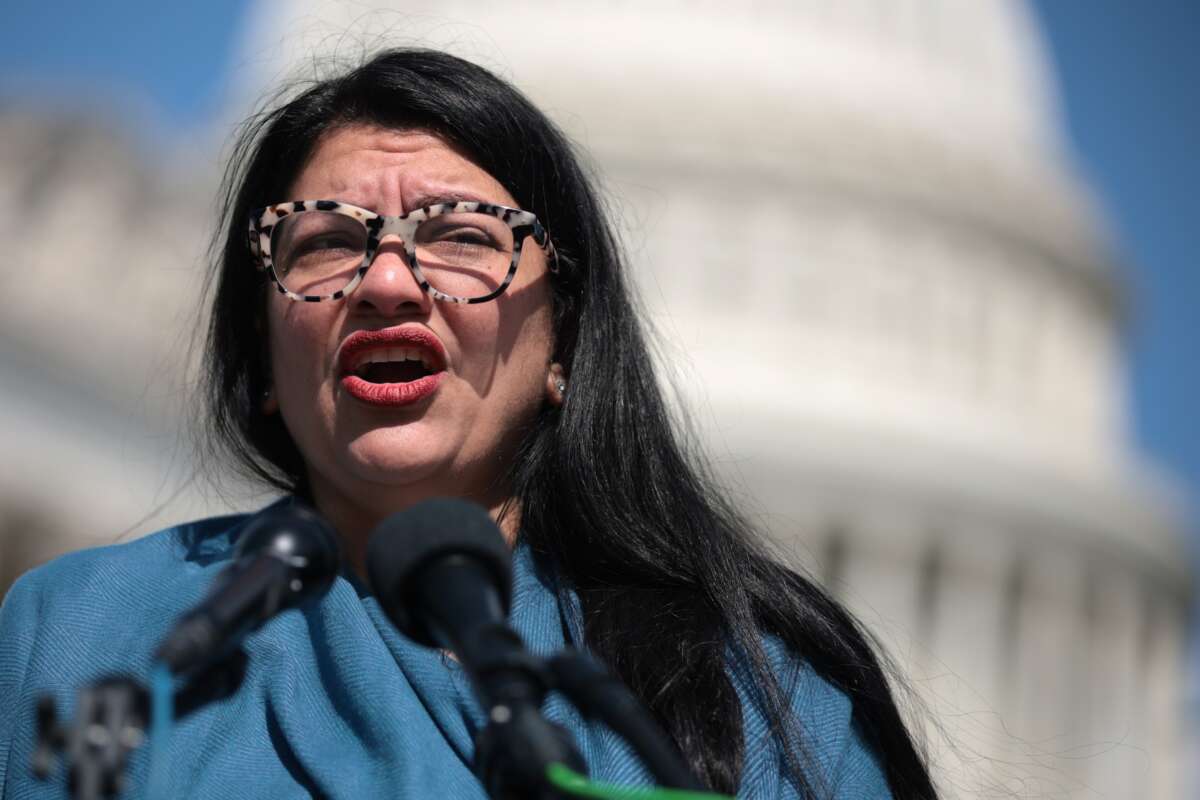
U.S. Rep. Rashida Tlaib (D-MI) speaks during a news conference on congressional oversight of the homeland security in front of the U.S. Capitol on April 8, 2025 in Washington, DC.Alex Wong / Getty Images
Democrats are reportedly “not happy” that Michigan Rep. Rashida Tlaib (D) is pushing for a vote on a war powers resolution to limit U.S. support for Israel’s war on Lebanon, according to an Axios report on Wednesday.
The resolution, which is likely to face a vote on Thursday in the House, calls for President Donald Trump to end all U.S. participation in Israeli military operations in Lebanon, including removing U.S. forces and ending any intelligence sharing with Israel in Lebanon.
But according to lawmakers and aides, this resolution has engendered more opposition within the Democratic Party than Iran war powers resolutions.
“The United States is assisting this destruction [in Lebanon] through the weapons, intelligence, logistics, and diplomatic cover it provides the Israeli government,” Tlaib’s office explained in a press release.
Tlaib wrote on X on Monday that, “Our country should not be assisting or supporting indiscriminate bombings and forced displacement anywhere, including Lebanon.”
According to the Council on American Islamic Relations (CAIR), Israel’s war on Lebanon is “quickly turning southern Lebanon into the ‘next Gaza.’” Israel has killed over 3,400 people and displaced over 1.2 million in Lebanon since its latest war on the country began in March. But Israel has been engaged in a lower-scale but longer-term war on the south of the country since 2024.
On Monday, Iranian state media announced that Iran would be ceasing negotiations with the U.S. due to Israel’s expanded war on Lebanon. Earlier that day, Israel had threatened to bomb the Lebanese capital, Beirut, while expanding its occupation of the south of the country.
Although Trump said later on Monday that he had spoken to both Hezbollah and Israeli Prime Minister Benjamin Netanyahu, and that Beirut would not face strikes, Netanyahu said that Israeli forces “will continue to operate as planned in southern Lebanon.”
The U.S. government, meanwhile, has been working to pressure the Lebanese government to disarm Hezbollah, pushing for the demilitarization of the one group that has the ability to defend the south from Israel’s incursions. In February, the House Foreign Affairs Subcommittee on the Middle East held a hearing entirely focused on dismantling Hezbollah, with Democrats like Brad Sherman saying there is a “historic opportunity” to disarm Hezbollah in the wake of the genocide in Gaza. But this ignores realities in Lebanon. Beyond the fact that Hezbollah is the sole group with the capability of defending the south from Israel’s occupation, disarming Hezbollah would likely lead to civil war in the country.
Still, Democrats’ widespread agreement with disarming Hezbollah might be a factor in their seeming opposition to Tlaib’s resolution.
In a statement to Axios, Tlaib said: “Poll after poll shows that the American people do not support our government sending a blank check and unlimited military assistance to the Israeli government as it massacres thousands of innocent civilians and demolishes entire cities and communities.”
“Members of Congress should listen to them,” particularly as Israel’s campaign in Lebanon “threatens to prolong the disastrous war with Iran,” she said.
But top Democrats in the House Foreign Affairs, Armed Services and Intelligence Committees are likely to vote no, which will likely sway other Democrats to vote no.
‘Huge Win for the Constitution’ as House Finally Passes Iran War Powers Resolution
“Now it’s time for the Senate to act,” said CodePink’s Medea Benjamin. “Let’s keep the pressure on and send this resolution to Trump’s desk. No more illegal wars. No more blank checks for militarism.”

A group of National Guardsmen walk past a Win Without War billboard truck displaying the message “No War With Iran” in front of the US Capitol in Washington, DC on February 24, 2026.
(Photo by Jemal Countess/Getty Images for Win Without War)
Brett Wilkins
Jun 03, 2026
COMMON DREAMS
Raucous applause erupted in the House of Representatives on Wednesday after US lawmakers passed a war powers resolution aimed at ending Donald Trump’s illegal war of choice against Iran—although skeptics cautioned that the measure will likely have little impact on the actions of a president who has habitually shown utter contempt for the rule of law.
House lawmakers voted 215-208, with 7 legislators not voting, in favor of H.Con.Res.86, introduced in April by Rep. Gregory Meeks (D-NY) and cosponsored by Reps. James Himes (D-Conn.), Adam Smith (D-Wash.), Gabe Amo (D-RI), Maggie Goodlander (D-NH), and Thomas Massie (R-Ky.).
Every Democrat present voted for the resolution, while three Republicans—Reps. Tom Barrett (Mich.), Warren Davidson (Ohio), and Brian Fitzpatrick (Pa.)—broke ranks with their GOP colleagues and joined Massie in voting to approve the measure, which directs Trump to “remove United States armed forces from hostilities with Iran.”
“We are trapped in a war that won’t end because an incompetent president launched it thinking of only his own ego while failing to prepare for the consequences,” Meeks, the ranking member on the House Foreign Affairs Committee, said during floor debate ahead of Wednesday’s vote. “Diplomacy is the only exit from this, not more bombing, not more bluster.”
The War Powers Resolution of 1973—also known as the War Powers Act—requires the president to notify Congress within 48 hours of committing troops to military action and limiting such action to 60 days, with a 30-day withdrawal period, unless lawmakers declare war or issue an authorization for the use of military force.
It’s been 95 days since the US and Israel launched their war on Iran, which followed last summer’s separate bombing campaigns by both allies. Since then, more than 3,400 Iranians—many of them civilians—have been killed and over 26,000 others wounded by airstrikes, while Iranian counterattacks have killed 13 US troops, 26 Israelis, and over 20 people in Gulf Arab states aligned with the US.
House lawmakers had tried and failed to pass Iran war powers resolutions on three previous occasions. Last month, after four US Senate Republicans helped Democrats advance one of the resolutions, GOP leadership in the House canceled two subsequent votes on the measure.
“Since President Trump’s illegal war of choice on Iran began, I have been extremely clear over and over again that Congress alone has the power to declare war,” Rep. Pramila Jayapal (D-Wash.)—who did not vote Wednesday because she was in India due to a family health emergency—said in a statement. “This war has had disastrous effects for the American people and for the world in the nearly 100 days since Trump began it without congressional approval.”
Jayapal continued:
“Waged with absolutely no imminent threat and no endgame, this war has already killed 13 US service members and injured many more; killed thousands of civilians in Iran and Lebanon, and displaced millions more; wasted billions in US taxpayer dollars that should have been spent on lowering healthcare and housing costs for Americans; and all while causing gas prices and grocery costs to skyrocket.
“The simple truth is that the American people are paying the price for Trump’s lawlessness,” Jayapal added. “Every day that this war continues is a violation of our Constitution.”
Rep. Yvette Clarke (D-NY) asserted that “our victory—while monumental—does not change the truth that this war never should have began, and never would have began, had the president not disgraced America and our laws to ensure that it did.”
Rep. Mark Pocan (D-Wis.) said on social media: “The American people are tired of presidents abusing their power by spending billions of our taxpayer dollars on unnecessary wars. I urge the Senate to quickly pass this bill to end Trump’s illegal war in Iran.”
Civil society groups opposed to the war applauded Wednesday’s vote, which Medea Benjamin, co-founder of the peace group CodePink, called a “total rebuke of Trump.”
“After 95 days of illegal war, Congress is finally enacting the will of the people, who overwhelmingly oppose President Trump’s disastrous war on Iran,” Eric Eikenberry, government relations director at Win Without War, said in a statement.
“While congressional action is welcome, it is woefully late. Congress should not have taken over three months to pass a resolution that would force Trump to end this war,” he continued. “Their delay has left millions of people struggling amidst unnecessary, unacceptable human and economic consequences.”
“Lawmakers who’ve placed their loyalty to Trump over acting to determine when and whether the United States goes to war have failed both their constituents and their constitutional duty,” Eikenberry added.
Naveed Shah, political director of the veterans’ group Common Defense, said following the vote, “Veterans understand the costs of war better than most Americans, which is why we commend the Republicans who joined Democrats on this vote and showed the kind of courage and independence this moment demands.”
“This was an important step toward ending a dangerous war and ensuring that the American people have a voice through their elected representatives,” Shah added. “It is long past time to put guardrails on this brazen president, who launched us into an illegal war with Iran.”
Alix Fraser, vice president of advocacy at Issue One, a group dedicated to reducing the role of money in politics, said in a statement that “today’s vote is a huge win for the Constitution and for the American people.”
“The House finally had the political willpower to stand up to the president’s unconstitutional war,” Fraser added. “Americans should celebrate this massive victory, but have every right to feel frustrated that it took this long for Congress to work on behalf of the people. That must change. Our democracy will not survive if Congress fails to uphold its responsibility to check executive power at this critical juncture.”
“Every day that this war continues is a violation of our Constitution.”
Some observers noted that Wednesday’s vote is likely to be largely symbolic, pointing to Trump’s veto—and the Senate’s failure to overturn it—of a 2019 bipartisan war powers resolution directing him to end US military support for the Saudi-led war in Yemen.
Still, lawmakers and advocates urged the Senate to pass the Iran resolution to uphold the rule of law and force Trump’s hand.
“Ending this war is a moral imperative,” said Rep. Don Beyer (D-Va.).
Rep. Ayanna Pressley (D-Mass.) implored upper chamber lawmakers to “immediately follow suit and act to end this war.”
Rep. Melanie Stansbury (D-NM) posted on Bluesky: “Now it’s time to pass the Senate. The power to declare war has been with Congress. Now let’s get it done and end this war!”
Benjamin said: “Now it’s time for the Senate to act. Let’s keep the pressure on and send this resolution to Trump’s desk. No more illegal wars. No more blank checks for militarism.”
In ‘Troubling Escalation’ Against Free Press, Pentagon Bans Reporters From Public Affairs Office
“Banning journalists from the press office in the Pentagon, where they worked professionally in previous administrations, is simply a sign that current DOD leadership fears accountability,” said one reporter.

US Secretary of War Pete Hegseth speaks during the 23rd IISS Shangri-La Dialogue at the Shangri-La Hotel on May 30, 2026 in Singapore.
(Photo by Ezra Acayan/Getty Images)
Julia Conley
Jun 02, 2026
COMMON DREAMS
The Trump administration’s “asinine attempts to silence objective journalism just hit a new low,” said one press freedom advocate late Monday after the Pentagon announced that the US Department of Defense would mark its press office as a classified area, banning journalists from the space where they’ve previously talked openly with DOD officials.
Reporters on the military are currently largely banned from the building altogether as litigation is ongoing over the administration’s requirement that journalists have an escort to move about the Pentagon, but the new policy means that should they be able to return, they would be even more limited in their access to public affairs officers whose job it is to keep the press and public informed.
“For multiple administrations, Pentagon reporters have used the press office to meet with public affairs officers and have open conversations about what America’s armed services are doing in order to keep the public informed,” said Ben Grazda, an advocacy manager for Reporters Without Borders North America.
Calling Defense Secretary Pete Hegseth “petulant” and pointing to his unsuccessful demand that journalists sign “loyalty pledges,” Grazda added that “journalists will continue their tenacious reporting and hold the Pentagon accountable for the money, operations, and lives they impact every day.”
The Washington Post reported that Pentagon speechwriters will be moved into the public affairs office, which will be equipped with the Secret Internet Protocol Router Network, or SIPRNet, which is used to transmit classified information.
“This is the most transparent war department in history. No amount of spin from the Fake News media will change that. The Pentagon Press Office has been redesignated as a Sensitive Compartmented Information Facility due to speechwriters from the Office of the Secretary of War sharing the facility,” said Jose Valdez, the acting Defense Department press secretary, on social media on Monday, referring to Hegseth by the title he prefers.
Despite Valdez’s claims, journalists referred to the decision as “Orwellian” and noted that Hegseth is further curtailing press access to the Pentagon as the US is mediating talks to end the war the US and Israel started against Iran in February.
The policy was also announced as The New York Times reported that Hegseth had blocked the promotions of nine Navy officers who had been selected by senior Navy admirals, appearing to “violate the rules governing a promotion system that is supposed to be apolitical and merit-based.”
“Banning journalists from the press office in the Pentagon, where they worked professionally in previous administrations, is simply a sign that current DOD leadership fears accountability,” said Times reporter Trip Gabriel.
The decision to close the press office to members of the press comes eight months after hundreds of journalists walked out of the Pentagon in protest of a new policy barring them from seeking information that the Trump administration had not authorized for release.
That policy was struck down by a federal court earlier this year, but the government has appealed the ruling.
The National Press Club called the Pentagon’s newest policy “a remarkable and troubling escalation in the Defense Department’s ongoing effort to restrict independent reporting.”
“This move does not occur in isolation,” said Mark Schoeff Jr., a reporter at CQ Roll Call and president of the organization. “It follows a troubling pattern of escalating restrictions on Pentagon coverage, including efforts to limit journalists to pre-approved information, revoke credentials for routine reporting practices, and physically remove reporters from long-standing workspaces and access without an escort.”
“Calling a press workspace ‘classified’ does not make the government more transparent,” said Schoeff. “It creates yet another obstacle between journalists and the information Americans have a right to know, especially at a moment when the public needs clear, unfiltered information about the US military.”
“Independent reporting on the US military is not optional,” he added. “When journalists are pushed farther from the institutions they cover, the American people are left with less information, less transparency, and less oversight. Any effort to restrict that access should alarm everyone who values a free and informed society.”
‘Major Warning Sign of What’s to Come’: Number of Young Kids Without Health Insurance Surges
“Many more parents of young children enrolled in Medicaid themselves will be at higher risk of losing coverage as work reporting requirements and added red tape come along in 2027.”
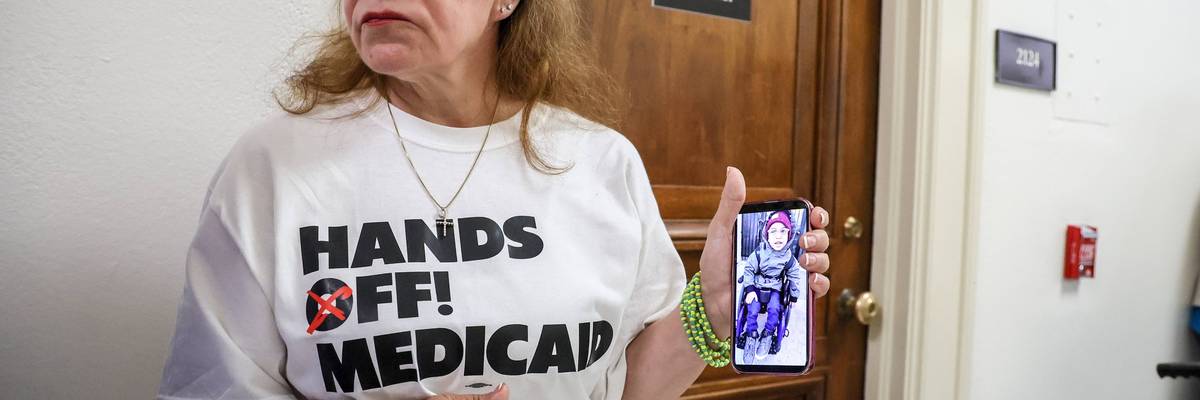
A demonstrator holds up a picture of her grandson, who has Cerebral Palsy, as she questions Republican lawmakers on May 13, 2025 in Washington, DC.
(Photo by Jemal Countess/Getty Images for Protect Our Care)
Jake Johnson
Jun 02, 2026
COMMON DREAMS
The number of young children without health insurance in the US rose sharply between 2022 and 2024 and is set to continue surging as the Trump administration implements work reporting requirements and other changes expected to kick millions—adults and kids—off Medicaid.
A report published Monday by the Center for Children and Families (CCF) at Georgetown University’s McCourt School of Public Policy found that nearly 220,000 additional children under the age of six were uninsured in 2024, a 23% increase from 2022. During that period, the total share of young children without health insurance rose to 5.3%—the highest rate in almost a decade.
The new report argues the rising uninsured rate among young children is “at least in part” attributable to the unwinding of pandemic-era protections that allowed people to remain on Medicaid without undergoing routine eligibility checks. The analysis found that Texas, Florida, and Georgia accounted for more than half of the increase in young children without insurance between 2022 and 2024.
Elisabeth Wright Burak and Aubrianna Osorio, researchers at CCF, wrote that “these data provide a major warning sign for what’s to come, as states grapple with the onslaught of Medicaid cuts from [the 2025 Republican budget law] and new coverage restrictions.”
“One in 4 children in the US have at least one parent who was born abroad,” the researchers wrote. “For these children, the vast majority of whom are citizens, harsh anti-immigration policies and rhetoric are already leading to missed doctor appointments, on top of the ongoing fear, uncertainty, and overall stress that can compromise healthy development of young children. Fears of safety and separation have made more parents afraid to enroll their eligible, citizen children in programs like Medicaid and [Supplemental Nutrition Assistance Program], exposing children and families to additional financial risk and food insecurity.”
“Many more parents of young children enrolled in Medicaid themselves will be at higher risk of losing coverage as work reporting requirements and added red tape come along in 2027,” they added. “We know as parents lose coverage, their children are also at grave risk of losing access to health care through the ‘unwelcome mat’ effect.”
CCF’s report came as the Trump administration rolled out a new rule that will dictate how states implement Medicaid work reporting requirements included in the 2025 Republican budget law, which contains around $900 billion in cuts to Medicaid over the next decade.
Advocates warned the rule will result in millions of people, including many children, losing coverage by creating onerous bureaucratic barriers to obtaining and keeping Medicaid coverage. CCF estimated last week that, as of April 2026, roughly 2 million fewer children were enrolled in Medicaid and the Children’s Health Insurance Program compared to January 2025, the start of President Donald Trump’s second White House term.
“This is terrible news because when child enrollment in Medicaid and CHIP goes down, the child uninsured rate goes up,” wrote Joan Alker, CCF’s executive director. “And the child uninsured rate was already going up when President Trump took office, yet we have heard nothing about this from them. Federal officials should be scrambling to figure out the root cause of this coverage loss for children as income eligibility levels did not change and the unemployment rate has been inching upward since President Trump took office.”
‘Absolutely Crazy’: Horror as Trump Moves to Dismantle Crucial Ocean Monitoring System“Blinding the public to climate change won’t make it go away. It will only accelerate its profound consequences.”

Researchers prepare to deploy a glider instrument into the ocean.
(Photo by Rebecca Travis/Woods Hole Oceanographic Institution)
Julia Conley
Jun 02, 2026
COMMON DREAMS
In what a number of scientists suggested was the Trump administration’s latest effort to stop tracking the changing climate in hopes of convincing the public that the climate emergency isn’t happening, the National Science Foundation announced Monday that it was dismantling a crucial deep-ocean monitoring system that for years has helped researchers understand the impacts of the crisis on the world’s oceans.
The NSF said it plans to send ships this month to remove more than 900 instruments, part of a project called the Ocean Observatories Initiative. The project collects data on temperatures, currents, and the ocean’s absorption of carbon dioxide off the coasts of Oregon, Alaska, Washington, and North Carolina, as well as in the Irminger Sea between Iceland and Greenland.
A spokesperson for NSF told The New York Times that the dismantling of the initiative will help the NSF in “prioritizing support for evolving scientific priorities and emerging technologies as well as a deliberate approach to smart life cycle management within its portfolio of research infrastructure.”
The reasoning given for the shuttering of the project, said Tara Blume, a journalist at Oklahoma City NBC affiliate KFOR, was “a master class in obfuscation and doublespeak.”
Genevieve Guenther of the group End Climate Silence shared her own interpretation of why the $368 million ocean observation system is being discontinued, despite the fact that it had been set to collect data for 25 years.
“We need to track ocean currents to assess how close we are to climate tipping points that will essentially destroy the world as we know it,” said Guenther. “The GOP doesn’t want us to be able to do that. That’s why they’re dismantling ocean monitoring.”
Scientists have used data gathered by moorings, robotic vehicles, and other instruments that transmit the information to research laboratories, to study changes in the Atlantic Meridional Overturning Current (AMOC), a current system that moves warm water northward and cools the Arctic and Northern Atlantic regions while absorbing carbon dioxide deep into the ocean and keeping it out of the atmosphere.
Data gathered at the observation station in the Irminger Sea has been key to understanding AMOC, which scientists fear is gradually weakening due to planetary heating and could ultimately collapse, likely causing major global weather changes.
“This is absolutely crazy,” said David Doniger, a senior strategist and attorney at the Natural Resources Defense Council’s climate and energy department. “Wouldn’t you want to know if the ocean currents are changing? Wouldn’t you want to know ocean temperatures? These things affect everything from fishing to hurricanes.”
Following the announcement that the stations will be dismantled in the coming weeks, said Blume, “science gasps for breath.”
President Donald Trump has attempted several times to shut down or drastically reduce the budget of the Ocean Observatories Initiative, which costs $48 million annually to run. Congress has restored the program’s funding.
The dismantling of the program comes months after the Environmental Protection Agency repealed the “endangerment finding,” which for years had underpinned the department’s environmental regulations; after the administration closed down the National Center for Atmospheric Research, which had gathered data on hurricanes and extreme weather to help improve forecasts; and after the National Aeronautics and Space Administration released a statement on record-breaking temperatures in 2024 and 2025—without any mention of the climate crisis or climate change.
“Blinding the public to climate change won’t make it go away. It will only accelerate its profound consequences,” said clinical researcher Iris Gorfinkel.
According to the Trump administration, said historian Nick Kapur, “apparently climate change doesn’t exist if you prevent scientists from measuring it.”
Markey Demands Trump Cancel Plan to Give Private Companies Enough Plutonium to Build 2,000 Nuclear Bombs
“Only Trump’s get-rich-quick bros would come up with this corrupt and moronic scheme,” wrote Democratic Sen. Ed Markey.

Sen. Ed Markey (D-Mass.) spoke out against Trump’s challenges to judicial law during a press conference held at the John F. Kennedy Federal Building.
(Photo by Jessica Rinaldi/The Boston Globe via Getty Images)
Jake Johnson
Jun 02, 2026
COMMON DREAMS
A prominent US senator on Tuesday implored President Donald Trump to cancel his administration’s plan to give private companies enough plutonium to build around 2,000 nuclear bombs, warning the move raises “serious weapons proliferation concerns” along with potentially massive safety issues and conflicts of interest.
“If implemented, this would be the first time the US government has made weapons-grade plutonium available to private companies,” Sen. Ed Markey (D-Mass.) wrote in a letter to Trump. “I urge you to cancel this misguided scheme.”
The New York Times reported last week that the US Department of Energy currently has “more than 50 tons of surplus plutonium left over from nuclear weapons programs, and the agency had previously been planning to dilute much of that material and bury it.”
But last May, Trump signed an executive order halting the dilution program and instructing his energy secretary to “establish a program to dispose of surplus plutonium by processing and making it available to industry in a form that can be utilized for the fabrication of fuel for advanced nuclear technologies.”
Last Tuesday, the Energy Department said it has entered into “advanced negotiations” with five nuclear energy companies—Oklo, Flibe Energy, Exodys Energy, Shine Technologies, and Standard Nuclear—to potentially distribute the Cold War-era plutonium.
Markey noted in his letter that Energy Secretary Chris Wright previously served on the board of Oklo, a California-based nuclear technology company whose stock price jumped in response to the department’s announcement.
“I am concerned that your administration is moving forward with plans to give plutonium to Oklo not because this makes
sense for the United States, but because Oklo stands to benefit financially and Secretary Wright is acting in his former company’s interest. Secretary Wright’s close ties to the company present an appearance of impropriety.”
The senator also expressed opposition to the plan on its merits, warning that “the transfer of weapons-usable plutonium to private industry would increase the risk of nuclear weapons proliferation, including to rogue states or terrorists.”
“Your plan—which would provide US companies with plutonium from US military stocks and subsidize them both to reprocess plutonium domestically and export reprocessing technology—would reverse our successful nonproliferation policy,” Markey wrote. “The United States cannot effectively discourage other countries from using plutonium for civil purposes if we use it ourselves.”
Nuclear experts have raised similar concerns about the Trump administration’s plan to transfer weapons-grade plutonium into the hands of private, for-profit corporations.
“Plutonium-based fuels and reprocessing have a poor track record when introduced in civilian nuclear energy programs,” Ernest Moniz, a nuclear physicist who headed the Energy Department during the Obama administration, wrote last year, warning that transfer schemes such as the one put forth by Trump would “produce new radioactive waste streams that must be managed” and “elevate the risk of a safety or security incident at a nuclear facility.”
In a social media post last week, Markey condemned the Trump administration’s plan in scathing terms, writing that “using plutonium for nuclear power is stupid and dangerous.”
“This material is used in nukes, and it’s too unsafe for widespread commercial use. Do we want Iran using plutonium in its reactor? No,” Markey wrote. “Only Trump’s get-rich-quick bros would come up with this corrupt and moronic scheme.”

‘Harmful to American Workers’: Warren, Sanders Lead Charge Against Trump Crypto Scheme for 401Ks
“This would strip long-held investor protections from retirement savers and encourage the use of more risky, complex, and expensive investments.”
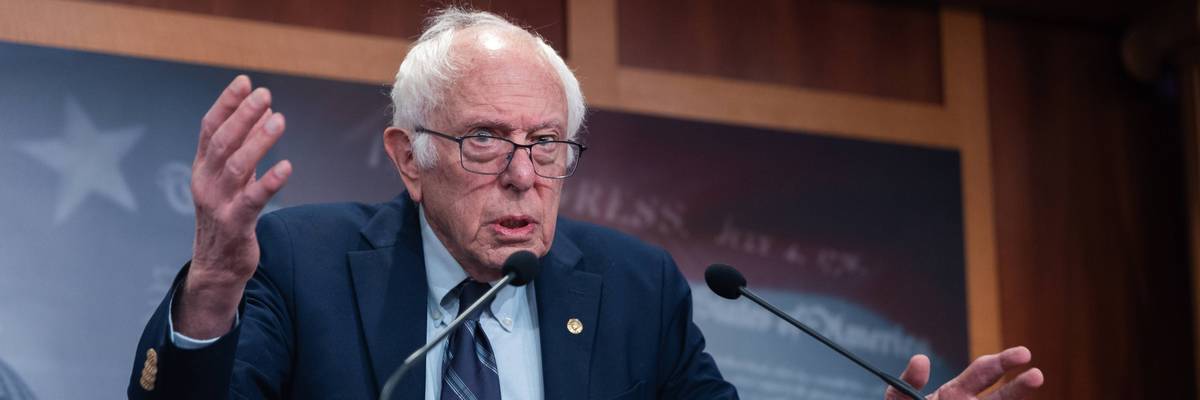
Sen. Bernie Sanders (I-Vt.) speaks at an impromptu press conference on recent election results, in Washington DC, United States on November 5, 2025.
(Photo by Nathan Posner/Anadolu via Getty Images)
Brad Reed
Jun 02, 2026
COMMON DREAMS
Two progressive US senators are leading the charge against a new Trump administration scheme that would allow Americans’ retirement funds to invest in cryptocurrencies.
As reported by The Guardian on Tuesday, Sens. Bernie Sanders (I-Vt.) and Elizabeth Warren (D-Mass.), along with Rep. Bobby Scott (D-Va.), sent a letter to the US Department of Labor (DOL) warning against enacting a proposed rule change that would allow 401(k) investments to include crypto.
Cryptocurrencies have long proven to be volatile assets that have been involved in multiple fraud schemes, which the FBI estimates cost Americans more than $20 billion in 2025 alone.
“This would strip long-held investor protections from retirement savers and encourage the use of more risky, complex, and expensive investments,” states the letter. “The proposed rule is harmful to American workers.”
Offering an example of the dangers of investing in crypto, the letter cites President Donald Trump’s personal meme coin, whose value has cratered since its peak in January 2025.
The push to let 401(k)s invest in crypto has also drawn criticism from Americans for Financial Reform (AFR), which on Monday released a white paper outlining how the plan would put Americans’ retirement savings at risk while also serving as a boon to the private equity industry.
Oscar Valdés Viera, senior policy analyst for private equity and capital markets at AFR, accused the DOL of handing over US retirement savings to “the worst Wall Street predators and crypto scammers.”
“This proposal would use 401(k)s to bail out a struggling industry and advance the administration’s push to embed crypto deeper into the financial system,” Valdés Viera explained. “Driving workers into the arms of private equity firms and crypto insiders would let the president’s Wall Street and crypto cronies pocket billions at the expense of families’ retirement security.”
Democracy Defenders Fund (DDF) last week noted that Trump and his family, who have major ties to the cryptocurrency industry, would stand to personally profit from the DOL’s proposed rule change.
“President Trump stands to benefit if ordinary people can use their employer-sponsored retirement plans to invest in crypto,” said Virginia Canter, chief counsel and director of ethics and anti-corruption at DDF. “The administration claims the proposed rule would ‘relieve regulatory burdens,’ but it looks more like self-dealing.”
In addition to allowing 401(k)s to invest in cryptocurrencies, the proposed DOL rule change would also allow them to invest in private credit assets, which are typically loans negotiated with non-bank lenders.
Benjamin Schiffrin, director of securities policy for Better Markets, said on Tuesday that letting 401(k)s invest in these assets would be a similarly risky bet to letting them invest in crypto.
“This is exactly the wrong approach at the wrong time,” said Schiffrin. “There could hardly be a proposal more dangerous to Americans’ retirement security. Investors already in private credit are currently running for the exits. DOL’s proposal means that one day millions of Americans with 401(k)s may have to do the same.”
Israel Keeps Killing Lebanese Civilians Despite Trump’s De-Escalation Claim“The more Netanyahu prevents the war with Iran from ending, the more obvious it becomes that he convinced Trump to start it.”

An aerial view of buildings and a parking area opposite the Jabal Amel Hospital, the largest hospital in the city of Tyre, Lebanon, on June 2, 2026, shows damage from an Israeli strike.
(Photo by Houssam Shbaro/Anadolu via Getty Images)
Jessica Corbett
Jun 02, 2026COMMON DREAMS
The death toll from Israel’s assault on Lebanon continued to rise on Tuesday despite President Donald Trump’s claims of de-escalation following Monday phone calls with Israeli Prime Minister Benjamin Netanyahu and an intermediary for Hezbollah.
The Lebanese Ministry of Public Health said Tuesday that “the cumulative toll of the aggression from March 2 to June 2 has reached 3,468 dead and 10,577 injured,” even amid a ceasefire agreed to in April. The deal stemmed from Trump and Netanyahu’s illegal war on Iran, and Israel initially claimed it did not include Lebanon.
Ben-Gvir Says Israel ‘Will Not Allow’ Trump to Make a Peace Deal With Iran as IDF Kills Dozens in Lebanon
After Iran on Monday reportedly halted talks with the US over Israel’s attacks on Lebanon, Trump said on his Truth Social platform that due to his phone calls, Israeli troops “have already been turned back” from Beirut, and Hezbollah “agreed that all shooting will stop—That Israel will not attack them, and they will not attack Israel.”
However, Netanyahu said later Monday that “I spoke this evening with President Trump and told him that if Hezbollah does not stop attacking our cities and civilians, Israel will strike terrorist targets in Beirut. This position remains unchanged.”
According to Axios reporting contested by a senior Israeli official, one US source summarized Trump’s remarks to Netanyahu as follows: “You’re fucking crazy. You’d be in prison if it weren’t for me. I’m saving your ass. Everybody hates you now. Everybody hates Israel because of this.”
Another source said that Trump was “pissed” and at one point yelled at the prime minister, “What the fuck are you doing?”
While “the story has understandably been met with considerable skepticism,” wrote Trita Parsi, executive vice president of the Quincy Institute for Responsible Statecraft, there are “a few important counterexamples—particularly from Trump’s second term—that suggest the Axios story is not entirely implausible.”
“What is also plausible, however, is that Trump will once again fail to sustain the pressure and, by that, allow for Netanyahu’s potential retreat to prove temporary,” Parsi predicted.
Republican Congressman Thomas Massie (Ky.), a libertarian who recently lost his reelection primary to a Trump-backed challenger, responded to the reporting on social media: “It’s all talk. Just withhold foreign aid to Israel for a month, and they’ll stop bombing their neighbors—instant peace, the Strait of Hormuz can be opened, and gas drops $2 a gallon. Israel has been, and continues to be, the biggest welfare recipient from American taxpayers.”
Massie also said that “the more Netanyahu prevents the war with Iran from ending, the more obvious it becomes that he convinced Trump to start it.”
Progressive Democratic Congresswoman Ilhan Omar (Minn.) similarly said late Monday: “The lesson Israel has learned, time and again, is that it can commit genocide and other atrocities with near-total impunity. Now it’s exporting the Gaza playbook to Lebanon. Israel’s war in Lebanon is killing thousands and displacing over a million. NO MORE US AID TO ISRAEL.”
Citing Lebanon’s National News Agency (NNA) on Tuesday, Al Jazeera cataloged Israel’s killings since Trump’s de-escalation claims:
Two Syrians were killed in an Israeli attack on a plant nursery where they were working in the town of Jebchit in the Nabatieh governorate, NNA said on Tuesday.
Israeli drone strikes hit a motorcycle on Martyr Sabra Street in Toul and a car in the Dhi’at al-Arab neighborhood of Ansar, killing two people, NNA said.
The third strike hit a car near the village of Harouf, killing one person.
Separately, an Israeli drone strike hit a car on the road linking the southern town of Marjayoun with the city of Nabatieh, killing James Karam, a dentist from the nearby Christian municipality of Qlayaa, along with his daughter and son, NNA reported.
Those deaths followed Israel’s Monday airstrike in the southern village of Marwaniyeh, which killed six members of the Hassan Abdullah family, according to the Lebanese Civil Defense. Palestine Chronicle reported that “rescue teams worked throughout the night and into Tuesday morning to recover victims trapped beneath the rubble of the destroyed building. Three additional people were pulled from the debris during the operation.”
Also on Monday, Israel attacked the Jabal Amel Hospital in Tyre, killing at least four people and injuring dozens more.
Dr. Abdinasir Abubakar, the World Health Organization (WHO) representative in Lebanon, said Tuesday that the hospital is one of the few operating in the country’s south, and the attack “caused significant damage... to the emergency department and intensive care unit.”
“Six hospitals have not yet resumed maternity delivery services and are currently providing only emergency room care,” he noted. “For pregnant women and newborns, delays in care can mean the difference between life and death.”
WHO has verified nearly 200 attacks on healthcare facilities and workers in Lebanon over the past three months. Calling for such attacks “to stop” and “active protection for healthcare,” Abubakar stressed that “these attacks kill and maim, they also deprive people of the health services they need.”
Israel hit Jabal Amel Hospital after a strike near Hiram Hospital the previous day, according to Doctors Without Borders, which supports both facilities. Omar Ebeid, the organization’s project coordinator in southern Lebanon, said Tuesday that “these repeated attacks reflect a grave failure to protect the medical mission and underscore the urgent need to safeguard civilians, medical staff, health facilities, and continuous access to lifesaving care.”
Faced with a rising death toll and Israeli forces’ destruction of civilian infrastructure, The Associated Press reported, “another round of talks between Israel and Lebanon began Tuesday in Washington, where Lebanese negotiators are set to seek a full ceasefire that will prevent future attacks.”


