Friday, June 12, 2026

Trump Administration Moves to Denaturalize 17 Americans in Attack on Legal Immigration

“The government has used this power in the past to target people it views as political opponents,” said a law professor.
June 10, 2026

New US citizens stand for the national anthem before receiving their naturalization certificates during a formal ceremony in Chicago, Illinois, on June 25, 2025.Kamil Krzaczynski / AFP


Did you know that Truthout is a nonprofit and independently funded by readers like you? If you value what we do, please support our work with a donation.

On Monday, the Trump administration announced that it is seeking to strip the citizenship of 17 Americans born outside the U.S. in the largest denaturalization effort in decades.

The administration claims that the individuals committed serious crimes and failed to disclose them during the naturalization process. But this is only the latest maneuver in President Donald Trump’s attempt to ramp up denaturalization and target immigration, including legal immigration.

Of the 17 targeted individuals, 11 are from countries in Latin American and the Caribbean, three are from Asia, two from Africa, and one is European.

Last month, the administration announced that it would begin the process to denaturalize 12 other citizens.

Trump has moved to ramp up denaturalizations since his first term, and even more so in his second.


Trump Administration Sets Goal to Denaturalize Thousands of US Citizens in 2026
Immigration officials have reportedly issued guidance setting a quota of 100 to 200 denaturalization cases a month. By Sharon Zhang , Truthout December 18, 2025


In December, the Trump administration directed U.S. Citizenship and Immigration Services (USCIS) to supply the Department of Justice with 100 to 200 denaturalization cases per month.

In April, the administration identified 384 Americans born outside the U.S. whose citizenship it wants to revoke. The administration also stated that it would use regular prosecutors in regional courts, rather than those within the Department of Justice’s Office of Immigration Litigation, to accelerate the pace of denaturalizations.

Denaturalization cases have been relatively rare since the 1990s. Between 1990 and 2017, the U.S. government filed an average of 11 denaturalization cases per year. The process is known to require a high bar of evidence.

Trump’s efforts appear to include an attempt to lower this bar. In one case during Trump’s first term, the Justice Department stripped the citizenship of a New Jersey man born in India after declaring that he had arrived in the U.S. without travel documents or proof of identity, and that he had used a different name.

In a more recent case, a U.S. citizen born in Mexico was denaturalized for drug dealing, and the case rested on whether or not he had begun selling drugs – largely marijuana – before or after his naturalization. The Department of Justice revoked his citizenship after concluding that he had started selling drugs the year before becoming a citizen, though his attorney insists this is false.

Amanda Frost, a law professor at the University of Virginia, told The New York Times in April that expanded denaturalization sends the message “that naturalized citizens don’t have the same rights and stability as native-born citizens.”

“The government has used this power in the past to target people it views as political opponents,” she warned.

Cassandra Robertson, a law professor at Case Western Reserve University, told NPR this month that the denaturalization efforts “are an attempt to suppress the political speech of naturalized citizens.”

“Although the cases that have been brought first are maybe people who’ve committed some pretty bad crimes, the government’s rhetoric is certainly not limited to that,” she said.

“Once it becomes easy to take somebody’s citizenship away,” she added, “it becomes easy to take anybody’s citizenship away.”

While the U.S. has denaturalized infrequently since the 1990s, the last widespread government effort to denaturalize U.S. citizens was during the McCarthy period. During the Red Scare of the 1940s and ‘50s, the U.S. government denaturalized thousands of foreign-born Americans accused of communist sympathies.

But in 1967, a Supreme Court ruling drastically limited denaturalization. Since then, it has largely been limited to whether or not an individual failed to disclose previous crimes or convictions in their naturalization process. But this, too, can be up to interpretation – as the naturalization application does not define what it considers to be a crime.

But even in the years before Trump, some cases of denaturalization were highly political. In the case of Rasmea Odeh, the Palestinian community activist was deported in 2017 after a years-long case. Odeh was arrested by the Department of Homeland Security in 2013 – under Obama’s administration – and charged with ‘unlawful procurement of naturalization’ for failing to mention her conviction and imprisonment by Israel, where she had been tortured and sexually assaulted.
‘Bureaucratic Temper Tantrum’: Trump White House Pilloried Over Reported Effort to Deport Iran War Critic Trita Parsi

“Irony is if the Trump admin had listened to Parsi, they’d be in much better shape now,” said a fellow anti-war writer.


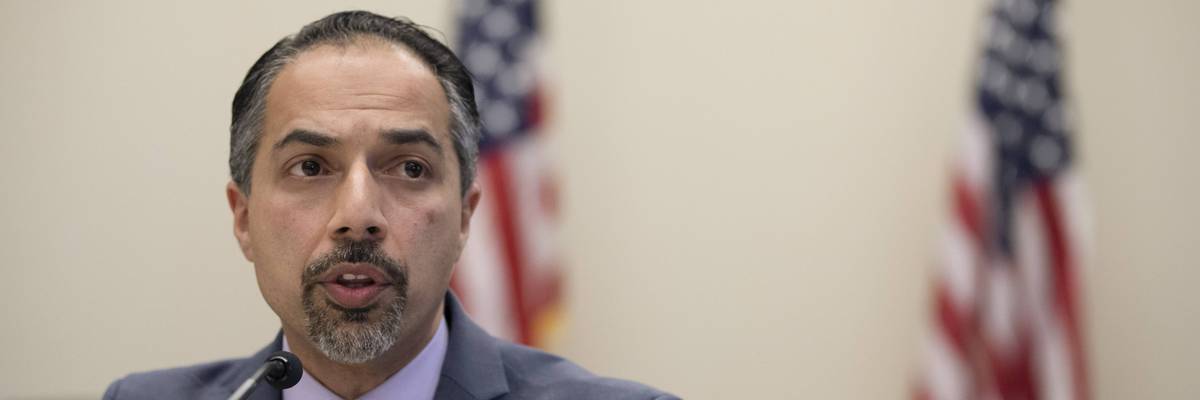
Trita Parsi of the Quincy Institute speaks at the Pathway to Peace Policy panel on February 12, 2020, 
at the US Capitol in Washington, DC.
(Photo by Tasos Katopodis/Getty Images)


Stephen Prager
Jun 11, 2026
COMMON DREAMS

The Trump administration is once again being accused of using immigration enforcement to silence speech after it reportedly launched an investigation into one of the most prominent critics of the president’s war in Iran, Trita Parsi, as part of an effort to deport him.

Parsi, an Iranian-Swedish citizen who holds a green card in the US, is the co-founder and executive vice president of the Quincy Institute for Responsible Statecraft and co-founded the National Iranian American Council (NIAC).

Since February, when the US and Israel launched a war against Iran that has killed more than 1,700 civilians, wracked the global economy, and spiraled out across the Middle East, Parsi has been a highly cited anti-war voice in the media.


But according to an exclusive report from The Free Press published on Thursday, which quotes senior Trump administration officials, the State Department views Parsi, who has lived in the US for 25 years, not as “another Washington pundit eager to share his point of view,” but as someone seeking to nefariously spread “Iranian influence.”

“The secretary has been very clear,” an unnamed Trump administration official said, referring to Secretary of State Marco Rubio. “Anyone who seeks to undermine the US, we’re taking a hard look at.” That includes “people who support adversaries of ours and whose work furthers their agenda and undermines our security.”

Since attacking Iran, the Trump administration has brought the hammer down on other Iranians living legally in the US due to their alleged sympathies with their nation of origin.

In April, the State Department arrested two women alleged to be the niece and grandniece of Iranian Gen. Qasem Soleimani, who was extrajudicially assassinated in an airstrike ordered by President Donald Trump in 2020. Rubio accused the two women of promoting “regime propaganda,” revoking their green cards, though documents later revealed that the women had no connection to the slain general.

The administration also canceled the visa belonging to the daughter of Ali Larijani, secretary of Iran’s Supreme National Security Council, who was assassinated in March.

The administration has similarly wielded its powers against foreign-born critics of Israel, including Columbia University student protest leader Mahmoud Khalil, and Tufts University student Rümeysa Öztürk, who was snatched off the street by immigration agents and detained for weeks over an opinion piece she co-wrote calling on her school to divest from Israel. The White House’s deportation effort against her was thrown out by an immigration judge in February.

Documents unsealed in January showed that five pro-Palestine student activists singled out by the State Department, including Öztürk and Khalil, were targeted for deportation for no other reason than their speech and were not accused of any wrongdoing.

Relying on a previously rarely used provision in the McCarthy era Immigration and Nationality Act, the administration has defended its right to strip legal residents of their status on the grounds of speech alone that was adverse to a “compelling United States foreign policy interest.”

In the case of Khalil, Rubio acknowledged in a memo that his speech was “otherwise lawful,” but claimed that allowing him to remain in the country would undermine the Trump administration’s foreign policy goals of supporting Israel and “combating antisemitism.”

A similar justification appears to be undergirding the administration’s attacks on Parsi. According to The Free Press, the administration has highlighted his and his organization’s public warnings against escalation against Iran, his role as an informal adviser to negotiations for the 2015 Iran nuclear deal, opposition to US sanctions against the country, and correspondence with Iranian officials as evidence that he is working to further Tehran’s influence.


While Parsi has not yet publicly confirmed that an investigation is underway, The Free Press reported that the Quincy Institute has prepared for legal action if the government attempts to have him detained or deported.

The outlet cited a memo from Quincy CEO Lora Lumpe, who noted that Parsi had recently come into the crosshairs of the notorious pro-Trump influencer Laura Loomer, who accused him of being “a mouthpiece for the Iranian regime” and threatened that his “days in our country are numbered.”

The State Department has previously appeared to make decisions directly in response to Loomer’s online outbursts. Loomer was the first to erroneously claim that the two women detained in April were relatives of Soleimani. She also took credit for the department revoking the visa of the British commentator and Israel critic Sami Hamdi, who was abducted by US Immigration and Customs Enforcement (ICE) in the middle of a speaking tour.

The State Department has also appeared to follow her lead after she called for it to block children injured during Israel’s genocide in Gaza from entering the US on medical humanitarian visas to receive desperately needed surgeries and rehabilitative care.

News of the State Department’s pursuit of an investigation against Parsi was described as the latest attempt by the Trump administration to use the threat of deportation to bully critics into silence.

“Trita Parsi is a courageous and outspoken critic of the US-Israeli war on Iran, alongside whom we’re proud to have worked in opposition to war and injustice for many years,” said the civil liberties organization Defending Rights & Dissent. “The Trump administration’s investigation of Parsi is an outrageous attack on free speech. Government officials are explicit that they are exploring deporting Parsi specifically for his advocacy—a blatant affront to the First Amendment.”

Branko Marcetic, another prominent war opponent who writes for Jacobin magazine, called the attack on Parsi “contemptible.”

“Irony is if the Trump admin had listened to Parsi, they’d be in much better shape now,” he added. “Instead, they put their political futures in the hands of people Trump himself called warmonger idiots, and now they’re left throwing this bureaucratic temper tantrum.”

Drop Site News, which has often interviewed Parsi as an expert, also noted the significance of the fact that the “exclusive” report was being published by The Free Press, a hawkish right-wing publication that “has repeatedly published articles that amplify official pressure on critics of Israel, US wars, and aggressive foreign policy, contributing to a chilling effect intended to deter others from speaking out.”

Some of Parsi’s ideological opponents have also warned against the government’s efforts to punish his speech, like Kaveh Shahrooz, a prominent Iranian-Canadian advocate for regime change in Iran.

“You’d be hard-pressed to find anyone who, over the past decade, has been more aggressively outspoken against Trita Parsi and NIAC than I have,” Shahrooz said. “But I’m deeply uncomfortable with what’s being reported.”

“Unless the [US government] can demonstrate that Parsi violated US law... deporting him would amount to targeting someone for their speech and political beliefs,” he continued. “An abuse of government power directed at someone you despise today can very easily be directed at you, or at someone you support, tomorrow.”
Behind JD Vance's bloopers, bungles and bonkers claims is a dead serious plan


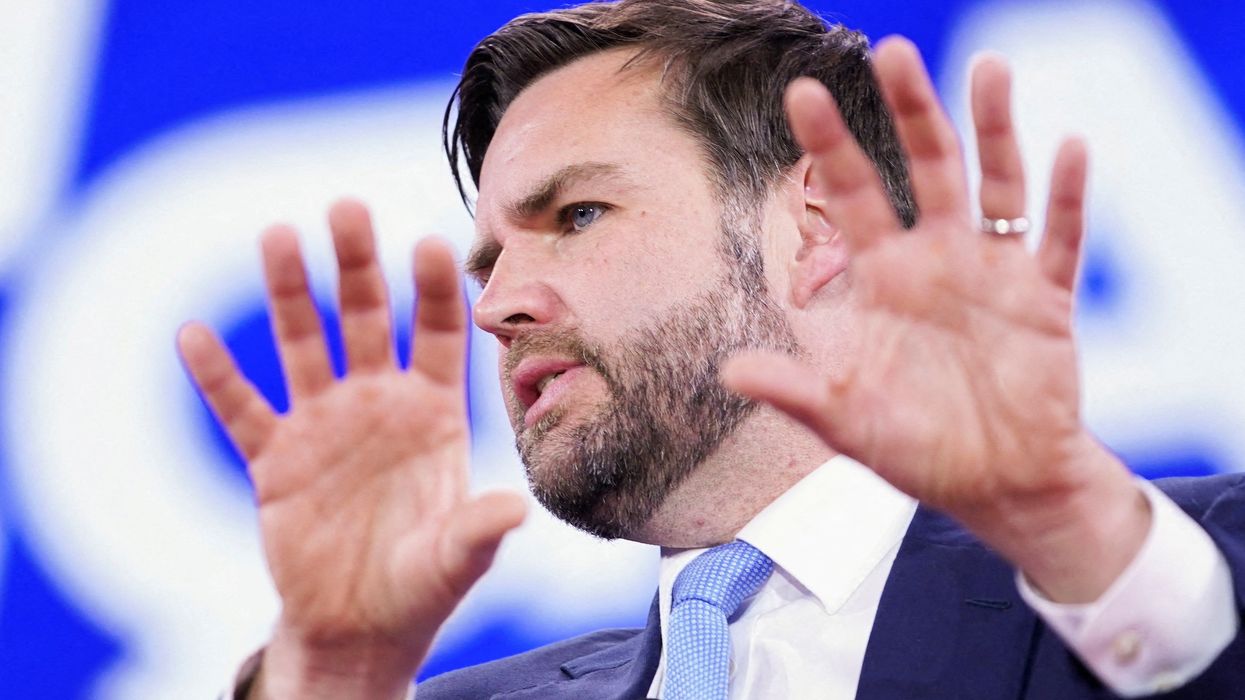
U.S. Vice President JD Vance addresses the Conservative Political Action Conference (CPAC) in National Harbor, Maryland, U.S., February 20, 2025. REUTERS/Nathan Howard

June 11, 2026 
ALTERNET

I’ve been watching JD Vance as carefully as anyone can track a snake in the grass, which is to say, with some difficulty. He has seemed uncomfortable with Trump’s grandiose foreign ambitions, especially Trump’s failed war in Iran, but I’ve seen no evidence that JD has spoken out against any of it even inside Trump’s ego-echo chamber.

JD hasn’t carved out a regressive policy specialty for himself, as have some other of Trump’s despicable underlings such as Stephen Miller, Russell Vought, and Harmeet Dhillon.

Nor has JD become much of a spokesperson for Trump. He rarely appears on television or even on social media. Nor has he been visible on Capitol Hill. He hasn’t cinched any deal in Congress.


JD seems to appear when and where a vice president is supposed to, but then disappears again into the daily effluence of Trump.

But there’s one particular area where JD seems to stand out (I was tempted to write “excel,” but it’s impossible to excel at something as execrable as JD’s specialty.) He is the regime’s strangest bigot.


Among all the bigots in the Trump regime — and there are many — JD’s bigotry stands out for a particular lunacy, combining magic realism with a unique ultra-wackiness.

We saw glimmers of this during the 2024 campaign when JD, then a U.S. senator from Ohio, insisted that the pets of upright Americans residing in Springfield, Ohio, were being “abducted and eaten” by Haitian immigrants “who shouldn’t be in this country.”

Despite being informed by city officials that Haitian immigrants were not in fact eating pets, Vance doubled down. He was sure Haitians were eating people’s pets. The publicity surrounding JD’s bizarre claims led to threats against Springfield’s Haitian community.


Not to let a disgusting lie about a minority group go unexploited, Trump amplified Vance’s pet-eating claim during his presidential debate with Kamala Harris.

Finally confronted by irrefutable evidence that Haitian immigrants were not eating pets in Springfield, Vance admitted publicly that he was speaking, shall we say, metaphorically: “If I have to create stories so that the American media actually pays attention to the suffering of the American people, then that’s what I’m going to do,” he told CNN.

Hello?


Now, JD is back.

“Henry Nowak died the same way a civilization dies: abandoned, handcuffed by authorities who neither trusted nor cared for him, and accused of hate crimes he did not commit,” JD declared on X last week. Nowak would still be alive “if the last few generations of European elites had stood their ground against the politics of self-hatred and the mass invasion of migrants, many of whom despise the West and the people who love it.”

If you’ve followed this sad story, you know that an 18-year-old British student named Henry Nowak was fatally stabbed in the British city of Southampton in December by Vickrum Digwa, who falsely claimed Nowak had racially abused him and that Digwa had acted in self-defense. After the truth came out, Digwa was jailed for life on June 1, with a minimum term of 21 years.

That, in turn, prompted JD’s jeremiad against “mass invasion of migrants.”


But inconveniently for JD, Digwa was born and raised in Britain. Which puts JD’s blaming Nowak’s death on a “mass invasion of migrants” roughly on par with his claims about the eating habits of Haitian-Americans in Springfield.

This hasn’t stopped JD, of course, who’s using the Nowak murder to bolster his narrative of Britain as a “once powerful nation” whose elites are now welcoming “migrants” who “despise the West.”

JD has become a mouthpiece inside the Trump regime for assailing what JD repeatedly terms the “decline of Western civilization,” especially in Europe. It’s part of the Trump regime’s increasingly shrill critique of Europe. Trump’s most recent National Security Strategy promises to push “Europe to remain European, to regain its civilizational self-confidence, and to abandon its failed focus on regulatory suffocation.”

In a sense, then, JD has stepped into the bigoted shoes of Viktor Orbán; Nigel Farage, the leader of the right-wing populist Reform UK party; and other resurgent European white Christian nationalists.


But there’s something more to this. JD wants to be the leader of the world’s anti-democracy movement.

Recall that JD would never have become a senator from Ohio in 2022 were it not for the billionaire tech financier Peter Thiel, who staked $15 million on JD’s election — a major portion of all the funds that went into JD’s Senate race.

Thiel knew what he was buying. Before running for the Senate, JD had worked for Thiel’s California venture capital firm and was part of Thiel’s libertarian community of rich crypto bros, tech executives, back-to-the-landers, and disaffected far-right intellectuals.

Because Thiel had been a major funder of Trump’s 2016 presidential run, he had significant influence with Trump when urging him to pick JD for his vice president.


Thiel was such a strong sponsor of JD because Thiel saw in his protege a future leader of a political movement to turn the U.S. away from democracy. “For Peter,” said one of the people familiar with his thinking, “Vance is a generational bet.”

Thiel is a self-styled libertarian who once wrote: “I no longer believe that freedom and democracy are compatible.”

Hello? Freedom is incompatible with democracy only if you view democracy as a potential constraint on your wealth and power.

That’s the point. Thiel and JD — along with Elon Musk, Steve Bannon, tech entrepreneur David Sacks, Palantir co-founder Joe Lonsdale, Palantir adviser Jacob Helberg, Sequoia Capital’s Doug Leone, blogger Curtis Yarvin, and others in the anti-democracy movement — believe that the only way true libertarians can win in the U.S. is for a Caesar-like figure to wrest power from the U.S. establishment and install a monarchical regime, run like a startup.

Yarvin — who’s something of a thinker behind this movement — has written that real political power in the United States is held by a liberal amalgam of universities and the mainstream press, whose commitment to equality and justice is eroding social order.

In Yarvin’s view, democratic governments should be replaced with sovereign joint-stock corporations whose major “shareholders” select an executive with total power, who serves at their pleasure. Yarvin refers to the city-state of Singapore as an example of a successful authoritarian regime.

How to achieve Yarvin’s vision? The first step, as JD offered in a 2021 podcast, is to replace “every single midlevel bureaucrat, every civil servant in the administrative state … with our people. And when the courts stop you, stand before the country, and say” — as did Andrew Jackson — that “the chief justice has made his ruling. Now let him enforce it.”

The next step, apparently, is to foment so much division and bigotry inside the U.S. and within every other major Western nation that people come to view those on the other side of the political divide as the source of everything that’s wrong with their lives. That way, they won’t look upward to see Peter Thiel, Elon Musk, and the other billionaire robber barons, plutocrats, and oligarchs of this second Gilded Age grabbing most of the wealth and power for themselves.

And average people will trade in democracy for strongman autocracy.

Behind JD’s bloopers about Haitian-Americans and British “migrants” is a deadly serious plan to unite the far-rights of America and Europe and rid much of the world of democracy. If JD ever becomes president, he’s intent on finishing the job.


Robert Reich is a professor of public policy at Berkeley and former secretary of labor. His writings can be found at https://robertreich.substack.com/
Trump biographer says 'demented' president will go down as 'worst in history'

June 11, 2026
ALTERNET


Art of the Deal Co-author Tony Schwartz predicts Trump is destined to make history — just not the side of it he probably wants.

MS NOW anchor Ari Melber asked Schwartz to comment on Trump’s most recent slate of gaffes, particularly his devastating claim that he “loves” the inflation currently racking voters and threatening to destroy his own Republican Party in the November midterms.

“It's demented. I mean, it's so self-destructive,” said Schwartz, who described Trump as an addict who acts as a kind of “black hole.”

“And you pour stuff into it. And he poured it in and maxed out when he was reelected president. And it looked fantastic. But it seeped out incredibly quickly. And then he has to keep upping the ante and chasing the high. And so now where he's at is there's no high to chase. So that's just that's just a piece of self-destructiveness. He's going to go down as the worst president in the history of this country,” said Schwartz, the founder of consulting firm the Energy Project.

The worst of Trump’s crisis will hit when Democrats re-take Congress as a result of Trump’s self-imposed crises with the war in Iran, rampant inflation and other Trump-sources plagues, said MS NOW host Ari Melbar, citing a claim be Sen. John Cornyn (R-Texas) that Trump was hurting his own party with self-serving decisions and his insistence on a kind of slavish loyalty, ultimately setting himself up for a midterm disaster.

Cornyn added that Trump’s following two years of powerlessness will be “the most miserable two years of his life.”

Schwartz said Trump’s “got something going on pretty significant physically, given the number of visits to the hospital,” and his debilitating health problems will likely merge with his post-midterm powerlessness to drive Trump into the permanent doldrums.

“He would not step down or bow out,” said Schwartz, predicting the second half of Trump’s impotent second term to be “a tortuous time” for him. “I think he's going to quit in his own mind. It's like you're playing a basketball game. You're playing a basketball game, you're down by 29 [points] and you say, ‘you know what? I've had it.’ And that's where we go if they lose the midterms. … He is going to quietly quit, even if he just loses the House.”

But Shwartz predicted Trump’s time of torture is unavoidable.

“I think people really — maybe this is my hope — are underestimating how big this [blue] wave is going to be. I think it’s going to be bigger.”

Trump 'wants to sink his party's fortunes': Data guru draws mind-boggling conclusion

Travis Gettys
June 11, 2026
RAW STORY


President Donald Trump's economic polling looks so bad that CNN's Harry Enten wondered whether he was engaged in self-sabotage.

The president blurted out "I love the inflation" when asked about the last month's 4.2 percent spike in costs, and the data analyst said that certainly won't help Trump or his Republican allies on the most pressing issue for American voters.

"I would just say, if I'm an American, based upon the polling I'm seeing, I hear the president, go, 'What the heck did I just hear? What the heck is going on?'" Enten said. "One of the most politically tone-deaf statements I've ever heard, and you can see it in the numbers right here. Americans don't think don't like the inflation, they hate the inflation. They don't love the inflation, they hate the inflation."

Trump is 50 points underwater on the issue of inflation in at least eight polls — a historic first, Enten said.

"Every other president and every other year, the answer is zero," he said. "Trump is not only the first one to reach minus-50 points or worse, net approval rating on inflation. He's done it many times, so when I hear Trump's statement, I just, I feel like [the character] Mrs. White in [the 1985 film] 'Clue' and going, what what is what is happening here?"

The president's approval rating on gas prices, which have exploded since he launched a war on Iran, is even more gruesome.

"How about an 80 percent disapproval on gas prices?" Enten said. "Which of course is fueling this frustration with inflation. Take a look here, the only president with an 80 percent disapproval rating on gas prices of all time is Trump in 2026. You can see Trump there, he's pointing the arrow to it. Yes, he has done it, this Iran war has done it. It has fueled record frustration, inflation and record frustration when it comes to gas prices. The only president ever with at least an 80 percent disapproval rating on gas prices, Donald John Trump in this year, 2026."

Trump's inflation comments quickly spread among Republicans on Capitol Hill, and Enten said the remarks won't be helpful.

"The Republicans on Capitol Hill absolutely hated Donald Trump's statement," he said. "Why? Because just it is absolutely funneling down, okay. Democrats are more, are the party more trusted on inflation, for the first time since the 1970s. It is true. Now today we are actually seeing polling in which the Democrats are the party that is more trust than inflation. I was looking back at all the polls. I can find the last time it really happened in an average of polls was in 1978. Of course, before that, inflation, boom, took Jimmy Carter out, and if history is prologue in this situation, well, it's going to take out the Republican majority in the House, as well."

"So no wonder that Republicans heard that statement and, just like me, are like Mrs. White. What, what what what did I just hear? Well, you just heard a president who wants to sink his party's midterm fortunes. That's what you just heard"

War, What Is It Good For?

Absolutely Nothing

by | Jun 12, 2026


Note from Tom: TomDispatch (at least as run by me) is now done, but if all goes well, Tom himself isn’t. And with that in mind, here’s what I hope will be but the first of a series of pieces that I’ll be writing on this ever-stranger world of ours at this new Substack of mine. Check it out. Tom

Historically speaking, consider it strange beyond compare. There may, in fact, be nothing like it in the imperial history of this planet. The United States, the greatest power on Earth from the moment it defeated Nazi Germany and imperial Japan in World War II, has never again actually won a war of any significance (or even come close). And that’s true despite the fact that it’s distinctly been the numero uno power on this planet for the last century-plus, with by far the most powerful and wildly over-funded military that has fought any number of wars during these decades, always against seemingly far less powerful adversaries.

Of course, in the atomic age, wars between imperial great powers, as in World War I and World War II, are no longer truly conceivable. Still, over more than a century of great-powerdom, my country has certainly fought a remarkable number of wars, some for endless years, without a single victory (not one!), which is no small… well, I can’t use the word “accomplishment” (but feel free to add whatever word you think might be appropriate).

From the Korean War in the early 1950s (at best a draw) to Vietnam (Cambodia and Laos) in the 1960s and 1970s, a distinct loss (despite the slaughter of literally millions of Vietnamese, Cambodians, and Laotians, and 58,000 Americans); from the invasion of Afghanistan in October 2001 in the wake of the 9/11 attacks on New York City and Washington D.C., to the invasion of Iraq in 2003, both of which ended in dismal defeat (Afghanistan after 20 years of combat!), as did the full-scale Global War on Terror launched by President George W. Bush; and, in the era of Donald Trump, from the Caribbean Sea and eastern Pacific Ocean (where more than 60 random boats have been blasted out of the water) to the bombing of Somalia and Nigeria, and now the devastating air and naval war on Iran, the United States, despite its weaponry, has proven incapable of actually impressing its will on lesser powers in what might by now be considered an all-American militaristic tradition.

Phew! I’m already out of breath!

And mind you, all of those anything-but-victories happened while the Pentagon budget rose to nearly the trillion-dollar mark, almost three times the military budget of China, the next great power on this planet of ours. (And keep in mind that Donald Trump has been demanding Congress add another half-trillion dollars to that budget, which, if the senators and representatives were ever to agree, would put the U.S. in another universe of military expenditures from any other country on Earth). And yet, you wouldn’t be wrong if you pointed out that the more this country has spent on its military, the more disastrous its war-making has become. (Go figure!)

So, don’t think there’s anything new or particularly striking about Donald Trump’s visibly failing war against Iran. In fact, the present situation there couldn’t have been more predictable (not that anyone bothered to tell that to the president). Once upon a time, it seemed as if Donald Trump knew something about the dangers of imperial war-making. After all, in his first term in office, other than a brief military fling in Syria against Islamic State fighters, which he quickly pulled out of, declaring ISIS defeated (which, of course, it wasn’t), he stayed remarkably clear of war-making. And within months of returning to office in 2025, he was already claiming that he had ended eight wars. (He didn’t.) And yet today, from the Caribbean (with Cuba now seemingly in his gunsights) to the Middle East, King Trump seems to be a committed war-maker through and through.

And perhaps it’s not just the United States anymore that seems so capable of making but never winning a war. After all, Russia’s more than four-year-long war in Ukraine is by now a first-class disaster for Vladimir Putin with hundreds of thousands of dead Russian soldiers and increasing devastation delivered by Ukrainian drones to Russian oil facilities and the like. (Of course, it’s also a full-scale calamity for the Ukrainians!)

In that context, consider China the smartest imperial power on planet Earth today. Other than a few border clashes with India years ago, it has grown in power in every way without having to make war a significant part of its arsenal (so to speak). Yes, it has indeed built up that military arsenal (including its nuclear one) in a significant fashion, as any great power on this planet would undoubtedly do. But despite its threats against the island of Taiwan and those brief clashes with India, unlike so many imperial powers of the past (and present), it has generally stayed remarkably clear of war-making.

Its leaders, it seems, have learned the necessary lesson about such conflicts (at least in our present version of an imperial age). In an era when lesser powers can nonetheless arm themselves effectively with the most modern drones and missiles, among other things, war-making simply never seems to work out well. And, oddly enough, in his first round as president, Donald Trump indeed seemed to have learned just such a lesson. In those years, the U.S. engaged in no significant war-making, but explain it as you will, he came back to power in January 2024 in a different mood entirely (and moods are the Trumpian reality in a big-time fashion).

As “our” president took on Iran recently, I couldn’t help thinking about that antiwar song of the Vietnam era that began with the phrase “War, what is it good for?Absolutely nothin’.”

Someone should tell “our” president that before… well, who knows what, but nothing good happens, that’s for sure! In the context of his war with Iran, consider him, in fact, the president of decline and, of course, confusion. The only question really is what exactly he’s likely to take down with him.

An Unwarranted War, a Global Economic Drag


The lingering energy shock is morphing from the Asian epicenter to a global economic drag. The US/Israel war imposes a fatal penalty on global growth.

by | Jun 11, 2026 |

When the US-Iran conflict escalated earlier this year, the immediate concern centered on oil prices and the Strait of Hormuz.

But the real danger was never confined to crude oil. The crisis has evolved into a broader energy, logistics, fertilizer, food and financial shock.

What began as a regional conflict has become a structural drag on the global economy.

Prolonged pain

Recent warnings by the International Energy Agency (IEA), the International Monetary Fund (IMF) and the World Bank underscore the same point.

Even if military hostilities continue to ease, energy systems, shipping networks and commodity supply chains will require many months – and in some cases years – to normalize. The result is likely to be a weaker global economy in the second half of 2026 and throughout 2027.

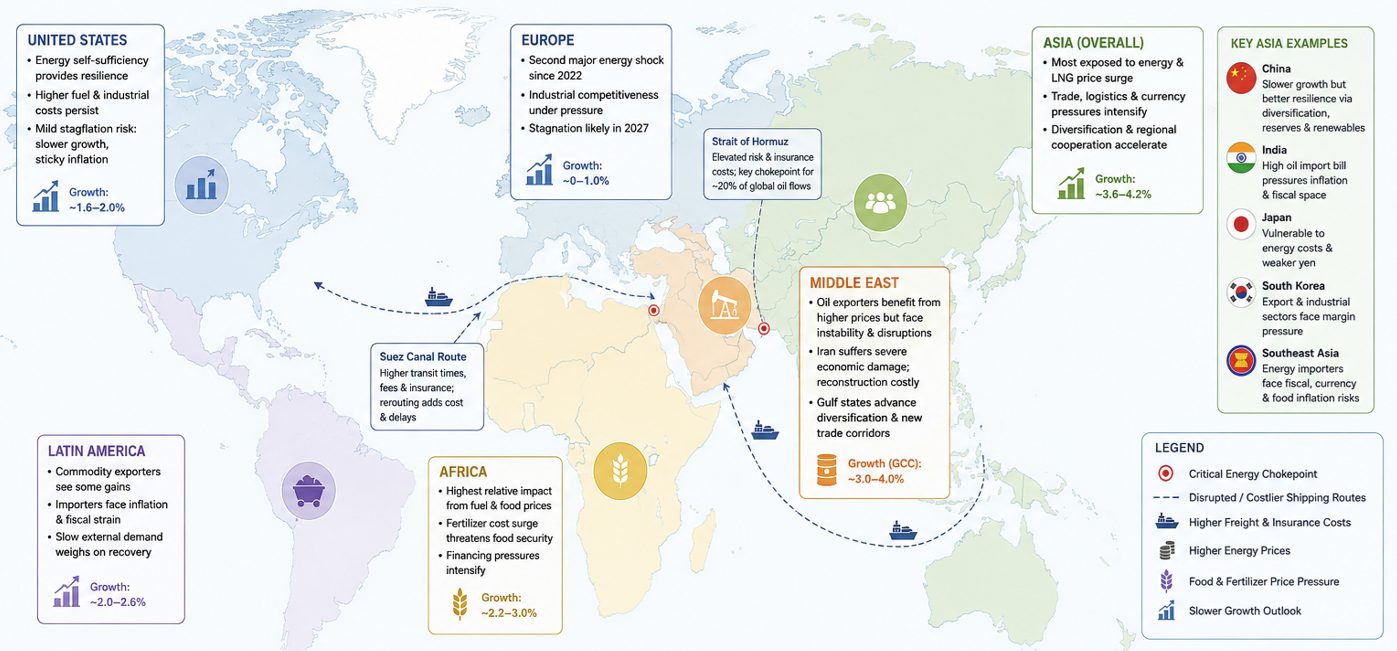
Global Energy Shock Impact Trends 2026 H2 – 2027
Sources: IEA, IMF WEO, World Bank, Reuters, author’s assessment.

The core issue is persistence. The IMF warns that prolonged energy disruptions could push the world toward recessionary conditions. The World Bank expects rising energy prices in 2026, while the IEA reports tightening supplies, falling inventories and continuing refinery disruptions.

The world faces a prolonged period of elevated energy costs, fragmented trade routes, higher insurance premiums, supply-chain restructuring and slower productivity growth.

US: Resilient but increasingly stagflationary

The United States is better positioned than most advanced economies because of domestic energy production and continued AI-led investment. Yet, higher fuel, petrochemical and transport costs are already feeding through the economy.

Gasoline prices remain well above pre-war levels, while energy-intensive industries face sustained cost pressures.

Growth is likely to remain positive through 2027, but below pre-conflict expectations. Inflation may prove more persistent than policymakers anticipated.

The principal risk is not recession but a stagflationary environment characterized by slower growth, elevated prices and tighter financial conditions.

By targeting Iran’s strategic capabilities while expanding military deployments across the region, the US has contributed to a prolonged risk premium in global energy markets.

At the same time, it has left Europe, Japan, South Korea and much of the developing world highly vulnerable to the resulting energy shock.

China: Economic exposure, strategic beneficiary  

As the world’s largest energy importer, Beijing remains vulnerable to disruptions in Gulf oil and LNG supplies. Higher energy prices, weaker external demand and increased transport costs will likely moderate Chinese growth through 2027.

But Beijing has spent more than a decade preparing for precisely such contingencies. Diversified energy imports from Russia, Central Asia and Africa, extensive strategic petroleum reserves, large-scale renewable investments and expanding regional trade networks provide buffers unavailable to most Asian economies.

More importantly, the crisis reinforces China’s long-standing argument that excessive dependence on Western-dominated maritime routes and financial systems constitutes a strategic vulnerability.

As Gulf states, Asian economies and many Global South nations seek greater economic resilience, China is positioned to benefit through expanded infrastructure investment, energy partnerships and trade integration.

The United States remains the predominant military actor in the crisis, but China is emerging as one of its principal geopolitical beneficiaries.

Europe: The most vulnerable advanced region       

Europe remains the weakest link among advanced economies. The continent has not fully recovered from the energy consequences of the Ukraine conflict.

The Iran-related shock has compounded existing vulnerabilities by raising LNG competition, industrial costs and fertilizer prices.

Germany illustrates the challenge. Its manufacturing sector faces a second major energy shock within five years. Industrial competitiveness is likely to deteriorate further, while fiscal constraints limit governments’ ability to cushion households and firms.

Southern Europe may perform somewhat better due to tourism, but energy costs will continue to restrain investment.

For Europe as a whole, 2027 may bring stagnation rather than recession. Yet stagnation itself represents a significant deterioration relative to earlier expectations.

European geopolitics revolves around an imagined Russian attack, yet the region’s economic fundamentals are being undermined by the protracted energy shock.

Asia: Still the epicenter   

Asia remains the region most exposed to the lingering crisis. The transmission mechanisms identified earlier – oil, LNG, trade logistics and financial spillovers – have intensified rather than disappeared.

The most vulnerable major economies are Japan, South Korea, India and many Southeast Asian importers. All depend heavily on imported hydrocarbons. Higher energy bills worsen trade balances, pressure currencies and reduce household purchasing power.

India faces a more difficult balancing act. Strong domestic demand and favorable demographics remain strengths, yet sustained oil prices near or above $90 per barrel would raise inflation and fiscal pressures. The country’s growth rate will likely remain among the world’s highest, but below its potential.

Across Asia, the crisis is reinforcing long-term trends toward energy diversification, regional trade arrangements and reduced dependence on vulnerable maritime chokepoints.

Middle East: Huge structural damage 

In the Middle East, oil-exporting states benefit from higher prices but suffer from geopolitical instability and disrupted export routes.

The Gulf monarchies – particularly Saudi Arabia, the UAE and Qatar – possess financial buffers that allow them to absorb short-term volatility. Yet, infrastructure damage, shipping disruptions and investment uncertainty are imposing significant costs. Full normalization of regional energy logistics could take years.

Iran remains the principal economic casualty. Even if hostilities diminish, sanctions, damaged infrastructure and capital flight will weigh on growth for years. Reconstruction needs will be immense.

The broader regional consequence is the acceleration of economic diversification. Gulf states will intensify efforts to reduce dependence on hydrocarbon exports, while simultaneously investing in alternative trade corridors and logistics networks.

Since fall 2023, a set of unwarranted wars in the Middle East has severely penalized the colossal modernization initiatives in the Gulf.

Latin America: Mixed effects, darkening skies                     

Latin America faces a divided outlook. Commodity exporters such as Brazil benefit from higher agricultural and resource prices. Yet gains are partly offset by weaker global demand and tighter financial conditions.

Mexico faces indirect exposure through slower US growth and manufacturing demand.

Argentina illustrates the vulnerability of heavily indebted economies. Higher energy costs and global financing pressures complicate stabilization efforts.

More broadly, countries with large fuel-import bills will face renewed inflationary pressures.

Overall, Latin America is unlikely to experience a major crisis, but the region’s recovery trajectory will slow amid darkening skies. It is the target of the Trump administration’s lethal imperial dreams – from Panama, Venezuela, Cuba and Nicaragua to Argentina, even Colombia.

Africa: The disproportionate victim     

Africa may suffer the greatest relative damage. The World Bank and IMF have repeatedly warned that poorer economies bear a disproportionate burden from higher fuel and fertilizer costs.

For many African countries, the energy shock rapidly becomes a food-security shock. Rising transport, fertilizer and import costs feed directly into consumer prices and poverty rates. Countries such as Egypt, Kenya and Senegal face growing external financing pressures.

Even resource exporters like Nigeria and Angola confront governance and investment challenges that limit the benefits of higher oil prices.

The most concerning issue is food security. There are deep interconnected vulnerabilities linking natural gas, fertilizer production and agricultural output. The consequences could extend well beyond 2027.

Global outlook through 2027         

The most likely outcome is neither global recession nor rapid recovery. Instead, the world appears headed toward a prolonged adjustment period characterized by Brent crude averaging roughly $85–100 per barrel, plus persistently elevated LNG and shipping costs.

These translate to higher food and fertilizer prices, slower global trade growth, renewed inflationary pressures and lower business investment due to uncertainty.

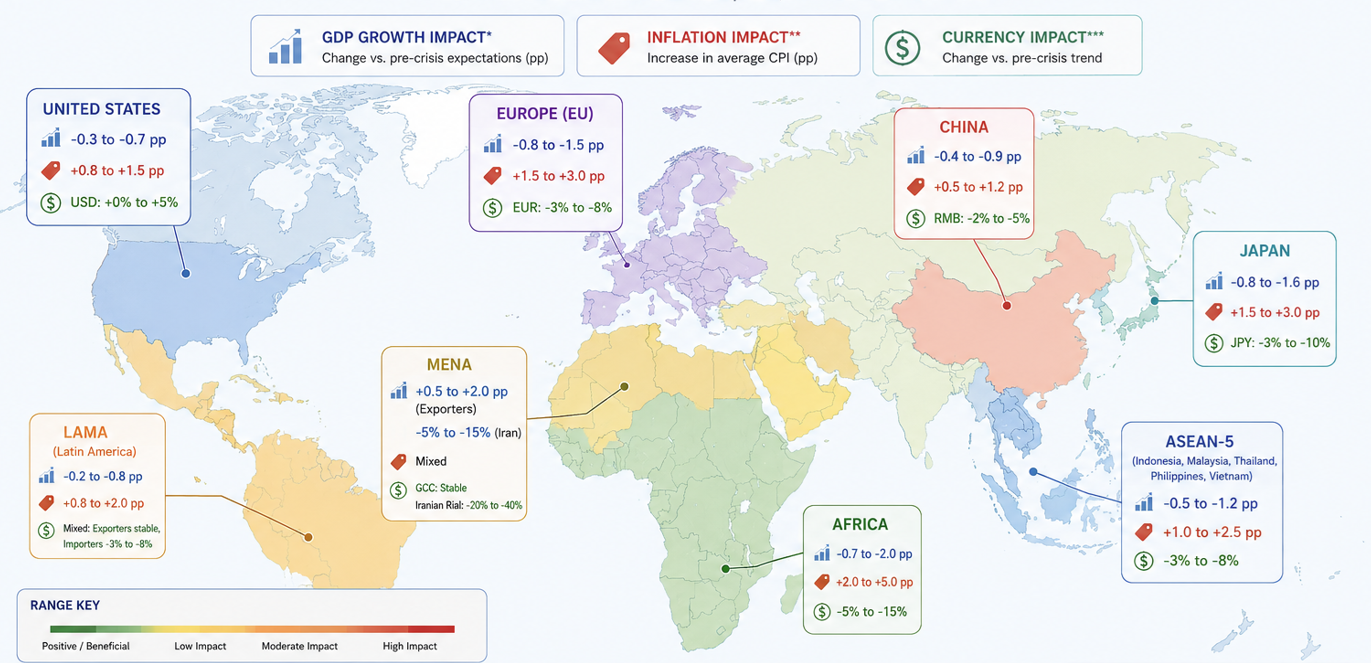
Persistent Disruption Impact.
Sources: IEA, IMF WEO, World Bank, national sources, author’s assessment.

Under this baseline, global growth is likely to remain near or in the proximity of 2.8–3.1% through 2027; below pre-conflict expectations but above outright recession levels.

The principal danger lies in a prolonged energy disruption or renewed military escalation, which could push oil prices toward the $110–125 range envisioned in adverse IMF scenarios and substantially increase recession risks. The era of relatively cheap, secure and politically predictable energy flows is fading.

What is emerging instead is a more regionalized, more expensive and more geopolitically contested energy system – one whose economic consequences will extend well beyond the battlefield and well beyond 2027.

The original version was published by China-US Focus on June 5, 2026.

Dr. Dan Steinbock is an internationally recognized visionary of the multipolar world and the founder of Difference Group. He has served at the India, China and America Institute (US), Shanghai Institutes for International Studies (China) and the EU Center (Singapore). For more, see https://www.differencegroup.net