What the “Flamingo Revolution” reveals
Saturday 20 June 2026, by Albanian Anti-Capitalist Collective (KASh)
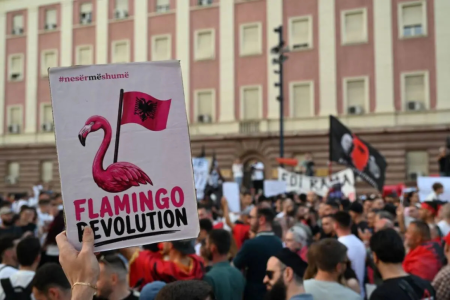
For more than a week, the European media have been regularly relaying images of Albania, usually absent from the Western press: thousands of demonstrators, flags or placards in hand, can be seen in the streets of Tirana or elsewhere. They have been gathering incessantly since 30 May 2026 against planned tourism projects in Zvërnec, near the Narta Lagoon, as well as on the island of Sazan. Beyond the ecological issues, the barbed wire installed on the coast against which activists are pressing has become, for the people, the symbol of a major political issue: that of the progressive dispossession of their territory and future. [1]
We propose to review these recent events and retrace their chronology. More fundamentally, we want to show that the current mobilization goes far beyond the defence of the environment: it reveals the major tensions that still run through contemporary Albania around questions of territorial sovereignty and the broader right of the population to self-determination.
To understand these conflicts and potential breaking points, it is necessary to examine their causes—including the convergence of interests between foreign investors, oligarchs, local landowners, and politicians, which leads to a progressive commodification of territory. In other words, we intend to highlight the capitalist, neoliberal and imperialist nature of the combined mechanisms that lead to the democratic denial against which the Albanian people are currently rising.
Chronology of the opposition movement
It all began on 15 March 2024, when Jared Kushner, Donald Trump’s son-in-law, published computer-generated images on his Instagram account presenting several luxury tourism projects in Albania. On 16 January 2025, Reuters revealed that Edi Rama, Albania’s prime minister, had reached an agreement estimated at $1.4 billion with Atlantic Incubation Partners LLC, an affiliate of Affinity Partners, to develop a vast hotel complex on the island of Sazan.
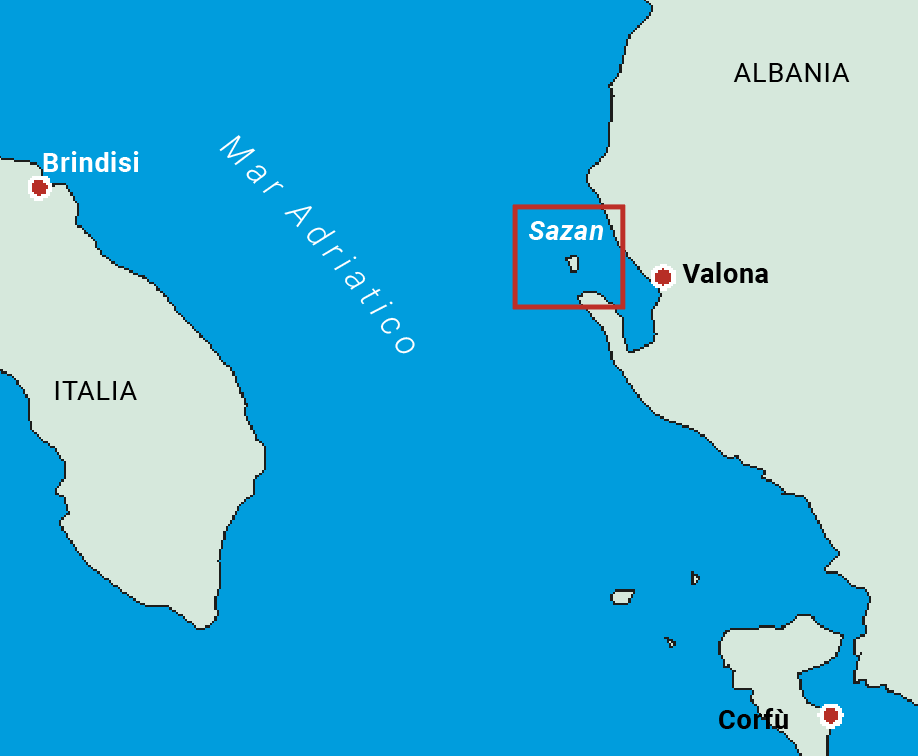
Located at the entrance to Vlorë Bay, Sazan is the largest island in Albania. Long closed to the public, it served as a strategic military base under the regime of Enver Hoxha. After the fall of the latter, Sazan’s prolonged isolation helped preserve its remarkable landscapes and biodiversity, as urbanization transformed much of the Albanian coastline as early as the 1990s.
While the revelations about Sazan have acted as a catalyst, they are not the only ones to fuel widespread opposition. On the coast of Vlorë, in the Zvërnec and Narta region, another large-scale tourism project is taking shape. This includes the construction of thousand villas, apartments and hotels as well as tourist infrastructure on several hundred hectares located near one of the most important ecosystems in Albania. In the area, hundreds of distinct species of birds have been observed, some of which settle there to winter — for example, the pink flamingo. The latter has become both the symbol of the ecological richness of the site and its fragility in the face of tourist projects, so much so that it has been adopted as an emblem of the protest movement. The term "Flamingo Revolution" (Revolucioni i flamingove) has thus gradually taken hold among the demonstrators to designate the mobilization.
At the end of April 2026, the first works began in the area of Pishë Poro and Portonovo. Bulldozers entered the site, which was previously accessible to the public, while fences and barbed wire were installed. On 23 May, residents and environmental activists gathered for the first time near Narta Lagoon to protest against the fences erected around Pishë Poro beach.
A week later, on 30 May, a new demonstration took place near the Portonovo construction site. Clashes then broke out between demonstrators and private security agents in charge of protecting the future construction site. Images of these incidents circulated quickly on social networks, causing a wave of indignation across the country.
In the days that followed, thousands of people took to the streets of Tirana and several major cities in Albania to demand the abandonment of current projects, to demand stronger legal protection of the territory, and to call for the resignation of prime minister Rama.
Barbed wire revives old memories
While opponents of the Zvërnec and Sazan projects denounce the destruction of protected natural areas and the privatisation of the coastline, the anger that has been expressed in recent weeks is not limited to environmental concerns alone. To understand the cause of the protest and its extent, it is necessary to sketch the history of the Albanian people. For more than a century, the question of their self-determination has been at the centre of their concerns: whether as a popular project or as a project of local elites, it has been negotiated or even repeatedly denied, which has profoundly influenced political consciousness and national historiography.
In 1913, at the London Conference, the major European powers recognised Albania’s independence and drew the country’s borders. A significant part of the Albanian population remained outside the new state. Kosovo was assigned to Serbia, while other territories were attached to Montenegro or Greece. Independence was thus born of a political paradox: that of a state finally recognized by influential nations, but deprived of a significant part of the population it was supposed to gather.
In addition, this newly independent Albanian state was then placed under the authority of a foreign prince, Wilhelm of Wied, appointed by the European powers in 1914. This tutelage continued during the twentieth century, with the predominantly Albanian territories continuing to be subject to multiple influences and forms of external domination: military occupations, interventions by the great powers, political or economic tutelage and so on.
Of course, the tourism projects of Zvërnec and Sazan differ significantly from these historical sequences. But the images of barbed wire, private militias and beaches closed to the public revive a collective memory maintained by a deeply rooted historiography. Indeed, in the Albanian national narrative, the motif of a small people resilient in the face of centuries of foreign domination is central; the identity of Albanians has thus survived the Roman, Byzantine, and Ottoman empires, the Balkan wars, the fascist and Nazi occupations of the twentieth century, and, more recently, the policies of ethnic cleansing carried out in Kosovo.
Recent events add to this long-running narrative. For a part of public opinion, the fundamental question of the political destiny of Albanians is once again being asked, in a new form: who decides the future of the territory? Until the fall of the colonial empires and the entry into neo-colonialism, foreign domination was manifested — and partly exercised — by arms.
Today, imperialism is taking the less visible routes of markets, investment, major private infrastructure projects and agreements between governments and big business. The mechanisms have certainly changed, but recent events reveal on the one hand the discernment of a population in the face of this reconfiguration of imperialist domination, and on the other hand its fear of losing its right to self-determination. For many protesters, barbed wire is not just a sign of beach closure; They revive a collective trauma, passed down from generation to generation, which is still painful.
In this regard, it should be added that the current mobilizations in Albania do not follow a single political line. There are very heterogeneous orientations and sensibilities: ecologists, left-wing activists, citizens with no particular political affiliation, but also nationalists from more traditional movements. This diversity can be explained precisely by the historical, symbolic charge that the question of territory has in Albanian consciousness and historiography. Albanian nationalism is not an imperialist nationalism, but a nationalism of resistance, anti-colonial struggle and self-determination. Its origin does not diminish its political contradictions, nor the violence it may have engendered. However, this ideological relationship to the nation makes it possible to understand why the defence of a lagoon, an island or a beach can today mobilise far beyond ecologist circles – an adhesion that may be surprising from the point of view of Western Europe.
A logic of neoliberal dispossession
However, the planned projects for Zvërnec and Sazan are not isolated projects. Since the fall of the Stalinist regime, part of the country’s coastline, agricultural land and natural resources have gradually been ceded to private interests. These decisions were taken without real popular consultation, often for the benefit of a minority of local or foreign investors. The neoliberal dynamic has accelerated under the government of Edi Rama, who has made attracting foreign investment and tourism development one of the pillars of his economic strategy. For its supporters, this policy is a means of modernising the country and promoting its European integration. In practice, it has mainly resulted in an increased concentration of wealth in the hands of a minority, in the strengthening of the political power of Albanian oligarchs, and in the gradual transformation of the territory into a commodity auctioned off for the benefit of the wealthiest investors.
The development policy designed by Rama has gradually become a reality over the past few years. Since the adoption of the Strategic Investment Act in 2015, several million square meters of public or semi-public land have been made available to private investors. According to a survey by Citizens.al, nearly 5.8 million square meters had already been allocated to strategic investors in 2023, a significant portion of which was on the coast. More recently, the Albanian government presented a portfolio of 83 priority projects related to tourism and infrastructure development aimed at attracting foreign capital. This data shows that the tourism industry is not a side project of the government. On the contrary, it represents one of the pillars of the economic model that has been in place for several years. Indeed, tourism would represent about 26% of GDP, including its indirect benefits. For the demonstrators, the Zvërnec barbed wire is not simply a democratic denial, but is the tangible expression of an entire development model, fundamentally based on the privatization of the public domain.
It should also be pointed out that, even when it is not sold off to private capital, Albanian territory is a resource that is willingly abandoned in exchange for any economic reward, even if indirect. In 2023, Edi Rama and Giorgia Meloni, Italy’s far-right prime minister, reached an agreement for the construction of a refugee camp in Gjadër, near the coast in the north of the country. For the Meloni government, it is a question of relocating the processing of refugee applications outside the national territory, at a lower cost; for Rama, the aim is to present the Albanian government as a reliable partner in the management of the migration crisis, with a view to facilitating the process of integration into the EU. He expects such integration to have major economic benefits: boosted exports, foreign investment made more fluid by the legal framework, economic aid and so on.
Like the plans for Zvërnec and Sazan, this project claims to indirectly strengthen the country’s economic development, in defiance of any democratic decision-making process on the management of the territory: the Albanian people have never been able to express their opinion on this dehumanising policy that transforms their land into an open-air prison of Frontex – the European Border and Coast Guard Agency.
This logic is not new. For more than twenty years, Albania has been importing waste sporadically, mainly from Italy, while it is already facing real difficulties in managing its own waste. This is evidenced by the many open-air landfills that dot its territory. Before his first term, Rama had promised to put an end to the public-private agreements responsible for the phenomenon. He then changed his mind; the situation was only regularized in 2022, after an investigation was conducted and several individuals and public entities were indicted for corruption.
More recently, the government has introduced a particularly advantageous tax regime to attract European pensioners, particularly Italians, who are exempt from tax on their pensions when they move to the country. Their number has grown from a few hundred to nearly 3,000 in just a few years. The logic remains the same: Albanian territory is being sold off to foreign states, in this case EU members, whose political favour is to be gained.
Who sells Albania?
Kushner and Affinity Partners did not arrive in a virgin Albania; the ground had already been prepared for them. In fact, it would be too simple to summarize the challenge facing Albania to an opposition between foreign capital and national interests. Today’s major tourism projects are not isolated phenomena, but are the result of an older process during which the territory was gradually monopolized by a nebula of local actors: businessmen, speculators, dubious intermediaries, figures close to the government and the nouveau riche who appeared in the chaos of the privatizations of the 1990s.
The project covers an estimated area of 437 hectares. Of these, 251 hectares are affected by construction, and are mainly owned by two major landowners: Redi Struga, who owns 120 hectares through his companies (South Adriatic Development and Smart Construction Invest), as well as Arthur Shehu, a resident of Florida, who owns 110 hectares. Similarly, several investigations point to the role that Shefqet Kastrati — one of Albania’s most powerful oligarchs, head of the Kastrati group — allegedly played in the conduct of negotiations related to the projects.
This nebula of interests makes it possible both to facilitate the contribution of foreign capital and to conceal the responsibility of the main players in the operation. The question of land ownership is nevertheless quite central. Who owns the territory for the Zvërnec and Sazan tourism projects? A few private owners, international investment funds, or the relevant local authorities? The current controversy therefore goes beyond the question of the direct nuisance caused by the real estate project. It concerns issues of sovereignty, democracy, and the management of the country’s common wealth.
What future for the mobilization and for Albania?
The Zvërnec and Sazan affair reveals the convergence of interests between Albanian economic elites, a neoliberal political power, and international investors in search of new spaces for the valorisation of capital. Local oligarchs provide the land, governments change laws and create favourable conditions for the planned projects, while foreign capital provides the necessary financing for the land development of the territory. In this system, citizens lose all control over part of their land without ever being consulted and the environment becomes a simple resource, an asset whose value is measured by its ability to generate profit.
Lenin wrote that imperialism is the highest stage of capitalism. More than a century later, the barbed wire in Albania offers a particularly concrete illustration of this. It is no longer armies that threaten Albania, but capital that buys sections of its coastline at low prices. Violence has not disappeared; it is now exercised in other forms, more subtle, discreet, diffuse — those of a mode of development imposed by foreign capital at the expense of the Albanian people.
The demonstrations of recent weeks, however, show that this violence is contested and rejected. Despite the speeches exalting the development and the influence of the economic interests at stake, thousands of Albanians have seen the forces at work behind the barbed wire and the issues that the situation raises. They have not only identified an ecocidal tourism project, but also a tangible manifestation of a denial of sovereignty, democracy and control of the territory.
In an international context that keeps repeating that there is no alternative to the demands of capital, markets and investors, the Albanian demonstrators propose another narrative: no development can be considered legitimate when it is built against the will of the populations concerned. Behind the defence of a lagoon, a beach or an island, it is ultimately the right of peoples to decide their own future that is at stake. The challenge now lies in the political materialization of this struggle: in a country without a real radical left front against Rama’s Socialist Party, how can these popular demands be directed towards a real anti-capitalist and anti-imperialist policy? Albanians will tell us.
18 June 2026
Translated by International Viewpoint from Marx21.ch.
Footnotes
[1] Featured image: During a demonstration in Tirana, June 2026. Photo: Erisa Kryeziu.
Albanian Anti-Capitalist Collective (KASh)
Kolektivi antikapitalist shqiptar në Zvicër, Albanian Anti-Capitalist Collective (KASh) in Switzerland.
Understanding Albania’s Flamingo Revolution

First published at Rosa-Luxemburg-Stiftung.
Over the past week, citizens across Albania have taken to the streets in mass protests against the government. Unlike previous waves of mobilization since the collapse of the socialist dictatorship in 1991, these protests target both the governing majority and the mainstream opposition, reflecting a deep crisis of political representation and a widening challenge to the socio-economic model that has shaped Albania over the past three decades.
The immediate trigger for the protests was the approval of luxury tourism developments on Sazan Island, belonging to the Karaburun–Sazan National Marine Park, and in the Narta Lagoon, including the Pishë-Poro beach in Zvërnec, which forms part of the Vjosa–Narta Protected Landscape. The area constitutes a critical ecosystem in the Mediterranean, serving as a crucial stopover site for migratory birds moving between Europe and Africa. It also supports extraordinary biodiversity, providing habitat for more than 200 species, such and emblematic wildlife like the loggerhead turtle, the Mediterranean monk seal, and the Albanian water frog, as well as pelicans and the flamingos that have become the emblem of the movement.
In 2004, the Albanian government granted the Vjosa–Narta region Protected Landscape status, a designation that was further reinforced by the 2017 Law on Protected Areas. The law was subsequently amended in 2024, weakening long-standing restrictions on construction within these zones and raising concerns that conservation objectives were being subordinated to private interests. In the same year, U.S. media reported on plans by Ivanka Trump and her husband, Jared Kushner, to develop a luxury tourism project in the area, which includes a $1.4 billion resort on Sazan Island and a $4.7 billion development in Zvërnec, close to the coastal city of Vlorë.
The project, known as Zvërnec South Adriatic Development, is being advanced by Atlantic Incubation Partners, a company linked to Jared Kushner’s Affinity Partners fund. The Albanian government has granted Atlantic Incubation Partners “Strategic Investor Status”, allowing it to benefit from accelerated approval procedures and other special provisions under Albania’s strategic investment framework. While Atlantic Incubation Partners acts as the strategic investor, the resort is being developed through a separate project company — Zvërnec South Adriatic Development — which is registered offshore through a trust structure in the Netherlands, while its ultimate beneficial owners remain undisclosed.
Moreover, an investigation by the Balkans Investigative Reporting Network (BIRN), found a controversial tangle of local businesses and political interests behind the presidential American family, including individuals linked to organized crime allegations, judicial misconduct, and one of Albania’s most powerful oligarchs, Shefqet Kastrati.
What sparked the protests?
Although Albanian Prime Minister Edi Rama has insisted that the project does not yet exist, preparatory work has already been underway, in violation of legal and regulatory requirements. In recent days, it came to light that the government had officially granted approval for the construction of the project in January 2025, doing so through a non-transparent decision-making process that largely escaped public scrutiny.
Protests initially began in Zvërnec on 23 May. From the beginning they addressed issues that went beyond environmental concerns. Local residents and activists alike condemned the intervention in a protected area, arguing in particular that it amounted to land grabbing that would benefit foreign billionaires, politically connected oligarchs, and the political establishment that had enabled the project.
On 30 May, as citizens once again gathered peacefully in Zvërnec, they were attacked by Kastrati’s private security guards, who also detained one of the demonstrators, while state police refused to intervene. For many, this episode became further evidence of the government’s complicity in a suspicious project and the state’s failure to protect the livelihoods of its citizens. It reinforced a growing sense that the state no longer serves the public, but rather powerful private and political interests. This perception became a catalyst for a broader wave of mobilization, transforming what had begun as a local environmental struggle into a nationwide protest movement. Feeling betrayed and abandoned by public institutions, citizens increasingly turned to one another in solidarity, building new forms of collective organization and resistance.
Within 24 hours, the movement grew enormously under the slogan “Albania is not for sale,”, quickly spreading to other Albanian cities, including Durrës, Vlorë, Elbasan, Korçë, and Shkodër, as well as to Albanian communities abroad. Since then, demonstrations continue to be organized across the diaspora as well, from Europe and North America to other parts of the world where Albanian communities reside.
A second episode of violence that followed on 3 June, this time at the hands of the state, further amplified the movement. Police blocked access routes in the capital Tirana, including the main boulevard leading to the Prime Minister’s Office where daily demonstrations are being held, citing security measures related to a football match between Albania and Israel. Subsequently they deployed water cannons against peaceful demonstrators, including parents with young children. Far from suppressing the movement, the crackdown galvanized public outrage and brought even larger crowds into the streets the following day.
As public pressure mounted and questions surrounding the legality of the development attracted growing national and international attention, state institutions came under increasing pressure to respond. In such a situation, Albania’s Special Structure Against Corruption and Organized Crime (SPAK) announced the launch of an investigation into the Kushner-Trump-backed project, focusing in part on the controversial 2024 amendments to the Law on Protected Areas.
Who is leading the protests?
Despite coming from diverse social, political, and ideological backgrounds, Albanians both at home and abroad have demonstrated a remarkable capacity to set aside their differences and unite around a common cause: the defense of democracy, the public interest, and the country’s natural heritage. The movement has brought together an unusually broad coalition, including left-wing organizations, members of the LGBTQ+ community, environmental activists, representatives of all four religious communities, feminist collectives, and even conservatives, nationalists, and right-leaning individuals.
Apart from three small and recently established political parties, which emerged from earlier civic engagements, including the radical-left Together Movement (Lëvizja Bashkë) the protesters have categorically rejected the involvement of the mainstream opposition. The Democratic Party of Albania (DP), led by Sali Berisha, in particular is seen as responsible for laying the political and economic foundations of the system they are now contesting.
Moreover, the DP has effectively aligned itself with the government on the developments in Sazan Island and the Vjosë–Narta area, actively defending the projects rather than opposing them, largely because of the involvement of members of the Trump family. In recent years, Berisha has sought to preserve his political relevance through the adoption of Trump-style rhetoric and a closer alignment with the European far-right.
For many citizens, the convergence of the government and the opposition on this issue has reinforced the perception that Albania’s two dominant political camps are ultimately united in their support for the same political and economic model. As a result, people have taken to the streets calling for revolution and demanding that both Rama and Berisha be held accountable. Protesters want Rama out of office and are calling for the government to step down.
At the same time, they are demanding the legal framework governing “strategic investors” be repealed; the withdrawal of the government’s so-called “Mountains Package,” which critics argue facilitates the transfer of public land to private investors with limited transparency and inadequate environmental safeguards; the reversal of recent amendments to the Law on Protected Areas; and repealing the amendments to the Law on Cultural Heritage.
This rejection of the established political class has also shaped the organizational character of the protests. The movement remains leaderless. Rather than being organized around a central figure or formal leadership structure, it has developed as a largely horizontal and participatory mobilization, with decisions emerging collectively through daily assemblies on the boulevards. This loose organizational structure has posed a challenge to the regime’s attempts to diminish or co-opt the protests. .
All of this is unfolding within a remarkably creative and peaceful environment. In the aftermath of the violent dispersal of protesters by police on 3 June, protesters returned to the streets carrying white roses, which they offered to police officers while urging them to switch sides.
This commitment to non-violence has further shaped the protest ground with demonstrators transforming Tirana’s main boulevard, as well as streets across the country, into spaces of civic participation and collective solidarity. Within the demonstrations, they have created areas where children can draw and play; young people help elderly participants move through the crowds and offer support to those in need; and each night, after the protest, they clean the streets before leaving.
The movement’s emphasis on solidarity has also resonated beyond the demonstrations themselves. Marathon swimmer Eva Buzo undertook a symbolic 20-kilometre swim from Sazan Island to the Narta Lagoon in support of the campaign to protect the area.
Government response and media narratives
Caught off guard by the rapid expansion of the protests and increasingly unable to control the narrative, particularly as the movement has attracted an unprecedented level of international media coverage, Rama has sought to shift the focus of the debate. After initially attempting to suppress the demonstrations through police intervention, he has increasingly sought to delegitimize them politically, portraying the protests as externally orchestrated, invoking “hybrid warfare,” and referring to unspecified actors allegedly working against Albania.
At the same time, members of the Socialist Party (SP) have sought to bolster these claims through appeals to nationalism and accusations of foreign interference. Taulant Balla, a senior SP figure, posted a picture on his account on Facebook of a car bearing Belgrade license plates during the protest in Zvërnec last weekend, suggesting that Serbian interests were involved in organizing the demonstrations. The vehicle, however, belonged to Reuters journalists who had travelled to Albania to report on the protests. Earlier, government-affiliated voices had similarly sought to link the protests to Greece.
Iran has emerged as the latest alleged foreign actor behind the demonstrations. On Monday, the spokesperson for Iran’s Foreign Ministry dismissed these allegations as unfounded. Rama has also claimed that the protests are damaging tourism, yet tourists in Albania are not only showing support for the demonstrations but are as well joining them in solidarity.
Still, pro-government media outlets in Albania have actively promoted these stories and are also participating in smear campaigns targeting individual activists and protesters, including members of the diaspora. Media outlets aligned with the opposition and members of the DP have also contributed to the spread of disinformation and efforts to discredit the movement. As a result, the protests have become the subject of competing political narratives that often distract from their actual demands.
Among the most persistent claims has been the attempt to associate the developments on Sazan Island and in the Narta Lagoon with Israel. Referencing Jared Kushner’s Jewish background, actors from across Albania’s mainstream political spectrum have sought to portray the movement as motivated by antisemitism, thereby undermining its legitimacy in the eyes of international audiences. Rama himself contributed to this narrative in the early stages of the mobilization by attributing the protests, in part, to what he characterized as “Muslims” who had “strayed from the path of God”. He later rejected claims that Israel was involved in the project, yet he did not publicly retract his earlier remarks regarding members of the Muslim community.
The movement has little to do with Kushner’s ethnicity or religion. Rather, protesters are mobilizing against what they perceive as the privatization of protected public land for the benefit of foreign billionaires and politically connected business interests. This extends far beyond a single tourism project as it reflects a wider process through which public goods and natural resources are increasingly transformed into opportunities for private accumulation, facilitated by a state that appears more responsive to investors than to citizens.
Similar protests have emerged in various parts of Albania, although they have generally remained more localized and have attracted far less public attention. Such is the case in the northern coastal area of Rrjoll where local inhabitants confronted police and called for construction works on a government-designated “strategic investment project” to be halted, arguing that land had been appropriated on the basis of allegedly forged ownership documents. A similar pattern unfolded in Theth, a village in the northern Albanian Alps, where residents who had long been promised legalization measures and assistance for family-run tourism businesses instead faced demolitions carried out under police supervision.
In the capital Tirana residents have witnessed a profound and often irreversible transformation of the urban landscape. Critics argue that the current construction boom has created opportunities for money laundering through the real estate sector, while large-scale development projects have increasingly restricted public access to areas of historical and cultural significance, contributing to a growing sense of exclusion among citizens.
The “Flamingo Revolution”
Following the collapse of state socialism, Albania went through a radical neoliberal transformation under conditions that facilitated the emergence of a new socio-economic elite, whose accumulation of wealth was often connected to corruption and organized crime.
The rapid privatization of the 1990s, through which public assets were transferred into private hands, often under suspicious and highly controversial circumstances, depended heavily political power to access state resources, concessions, licenses, and legal protections. At the same time, the emergence of the first organized crime groups created new centers of economic power that would later evolve into influential business and oligarchic networks. The relationship became mutually reinforcing as political elites facilitated the accumulation of private wealth, while these emerging economic actors supplied the financial resources and informal networks that helped political parties consolidate and reproduce their power, creating a system in which distinguishing between political authority and private interest grew increasingly difficult.
To sustain this model, the ruling elites of the past 35 years have relied on governance mechanisms that limit democratic accountability, strengthening authoritarian practices as a means of managing the social and political contradictions generated by an increasingly unequal system of wealth accumulation. The weakening of environmental protections, the Strategic Investor framework, police violence against protesters, smear campaigns against activists, concentration of media power, and attempts to delegitimize dissent as “foreign interference” are not isolated phenomena. They are mechanisms through which the state protects and reproduces a political-economic order that operates to the detriment of the majority of society.
Albanians have directly experienced the consequences of this model: mass unemployment, economic insecurity, large-scale emigration, and the daily struggle to make ends meet in a system that has stripped them of basic rights and freedoms and, until recently, also robbed them of the capacity to imagine a different reality. Even if the current protests do not achieve the outcomes they seek in the near future, they have already accomplished something extraordinary: citizens have overcome their fear and found the courage not only to identify the roots of the problem, but also to envision a different world. In recent days, the movement’s slogan has changed from “Albania Is Not for Sale” to “New Albania.” Not yet a strategy, but a collective ambition nevertheless.
What comes next?
The chances of Rama resigning remain relatively low at the moment. Beyond the fact that he has repeatedly rejected the idea of stepping down, the protests would likely need to develop into a broader popular uprising for the government to fall. If that were to happen, a technical government could potentially be negotiated to oversee new elections. Yet such a scenario would present its own challenges as the movement remains leaderless, and the few recently established political parties that support it are small, lack significant resources, and hold opposing ideological positions. Their approaches to politics also differ significantly. While the Together Movement tends to adopt a more grassroots and uncompromising stance, center-right parties such as Albania Becomes (Shqipëria Bëhet) and Opportunity (Mundësia) generally favor a more pragmatic approach and have shown a greater willingness to engage and compromise with established political actors. Thus, the prospect of a broad coalition among them is uncertain.
Even in a best-case scenario, in which parliament were dissolved and a coalition emerging from the movement managed to form, the Albanian Constitution would require parliamentary elections to be held within 45 days. This would leave very little time for new political forces to organize, build electoral structures, and prepare for a national campaign. The ruling SP would still retain considerable structural advantages, including control over state institutions, extensive patronage networks, significant financial resources, and substantial influence over much of the media landscape, all of which have historically been deployed to its advantage during electoral campaigns.
Moreover, Rama continues to enjoy considerable international backing, particularly from the EU. Although a spokesperson for the European Commission recently stated that the Albanian government should address protesters’ concerns regarding environmental protection as part of its obligations under the EU acquis, there is little indication that the EU would distance itself from Rama in the near future. This is particularly the case given the absence of a clearly identifiable alternative political force capable of assuming power.
Yet these developments should not be viewed solely through the lens of immediate political change. The significance of the movement may lie less in its ability to bring down the government in the short term than in its potential to reshape Albania’s political landscape over the longer term. The emerging political parties associated with the protests have the chance to be able to capitalize on the momentum generated by the mobilization, expand their social base, and gradually build organizational capacity. Under current conditions, the most realistic outcome may not be the immediate replacement of the government, but the eventual displacement of the existing mainstream opposition and the emergence of a new political alternative that is more closely aligned with the concerns and aspirations of ordinary citizens.
Gresa Hasa is a doctoral researcher at the Faculty of Law and the Center for Southeast European Studies at the University of Graz and a 2026 BiEPAG Fellow. Her academic work and regional expertise focus on the Western Balkans.

.png)