Thursday, July 02, 2026

The War in Ukraine Arrives at a Crucial Juncture

by | Jul 2, 2026

Though relegated to the sidelines thanks to President Donald Trump’s decision to launch an illegal and unjustified war on Iran at the behest of the Israeli warfare state, the war in Ukraine grows more dangerous with each passing day. In fact, recent reports indicate a perilous increase in attacks on energy and civilian infrastructure from both Moscow and Kiev.

On June 17, Kiev launched the largest aerial attack of the war on Moscow with an estimated 550 drones and missiles. One attack resulted in the spectacular explosion at the Kapotnya refinery southeast of Moscow. It was the third time in a month that the refinery had been targeted by Kiev. Whether the explosion was caused by a Russian MANPAD defending Moscow or by a direct hit from a Ukrainian drone remains unclear. Shortly after the attack, a Ukrainian commander sent a message to the Russian people: “This war has now reached your homes as well. We hope that message helps Russia bring this war to an end.”

Only days later, on June 20, another attack struck the Antipinsky oil refinery in Tyumen in Western Siberia, some 1,200 miles from Ukraine. That same evening, Ukraine struck the oil terminal at Kerch in Crimea. A week later, Ukraine hit Russian refineries in the Krasnodar and Yaroslavl regions.

In response, Russian forces have struck both Dnipropetrovsk and Zaporizhzhia, killing numerous civilians. For his part, Russia’s president, Vladimir Putin, noted that “strikes on our infrastructure, wherever they are directed, have absolutely no effect on the situation at the front, on the line of contact.”

For Ukraine’s Volodymyr Zelensky, there would seem to be a number of motives at play — none of which portend an end to the conflict, now in its fifth year. For one thing, Zelensky has seen a dip in the robust support he once had from Washington under Trump II. He seems convinced that such shows of force will shore up what remains of his support among Democratic war hawks, as well as among his European collaborators such as the German Chancellor Frederich Merz and the now-departing British Prime Minister Keir Starmer.

Yet Zelensky’s stepped-up drone war, far from being, as some US analysts suggest, a show of strength, may be the beginning of the end for the budding despot, the desperate last gasp of a wartime leader with an economy in ruins, a shrinking population, and a generation of young men irretrievably lost. Putting Zelensky’s drone war into proper perspective may require recalling how ultimately ineffective the flurry of Nazi Germany’s V2 missile attacks on London and the Japanese Kamikaze attacks on the US Navy were during the final year of the Second World War.

The mood among ‘official’ Moscow has, as might be expected in light of these developments, grown darker than usual. In addition to the unprecedented drone attacks on Moscow, Russia has suffered an estimated 1.2 million war casualties, including approximately 325,000 dead. And while there are growing signs of war weariness and disgust with Putin’s regime among pro-Western elements in Moscow and St. Petersburg, there are voices close to the Kremlin that are, in a manner not terribly dissimilar to our own neoconservatives whenever Israel attacked, baying for blood.

Sergei Karaganov, an academic who heads the Kremlin’s Council for Foreign and Defense Policy, has repeatedly called for Russia to strike Europe with nuclear weapons in order to “restore deterrence.” For his part, Russian Foreign Minister Sergei Lavrov promised that Russia would retaliate for the refinery attack on a “mass scale.” Lavrov also warned that the current “state of affairs poses serious threats to global security. A direct confrontation between NATO and Russia could rapidly escalate into an exchange of nuclear strikes, with catastrophic consequences.” Lavrov’s comments were originally meant for publication in POLITICO Europe, but the outlet, owned by the shamelessly pro-war Axel Springer group, pulled the piece at the last minute. Heaven forbid we hear from the “enemy” directly.

That said, with Donald Trump distracted by more pressing matters of state such as the deteriorating condition of the Reflecting Pool and his duties as host of the Great American State Fair (his promise to end this war now, as with so many other promises, forgotten) few, if any, remaining world leaders outside of Pope Leo XIV have called for a cessation of hostilities in between Russia and Ukraine and her sponsors in Washington and Brussels.

With Moscow married to its narrative, and Kiev married to its, now would seem the time for diplomacy – to assist Moscow and Kiev seek, as Kissinger once put it, a “common interest for different purposes.” Yet the war drags on. And its potential to suck both Europe and the United States into a far more disastrous conflagration grows as both parties to the conflict become increasingly desperate for a breakthrough.

James W. Carden is the author of The Great Betrayal: How the Democrats Became the Party of War. He is the editor of The Realist Review and a contributing editor at The Nation.

James W. Carden is the editor of The Realist Review.  He is a columnist and former adviser to the US-Russia Bilateral Presidential Commission at the U.S. Department of State. His articles and essays have appeared in a wide variety of publications including The Nation, The American Conservative, Responsible Statecraft, The Spectator, UnHerd, The National Interest, Quartz, The Los Angeles Times, and American Affairs.


Strike on Kyiv cathedral highlights rush to preserve Ukrainian artifacts

(RNS) — The Ark for Ukraine project has brought three mobile labs in vans to Ukraine to help preserve Ukrainian cultural heritage by scanning archives of thousands of manuscripts, artifacts and even buildings to digitize them.
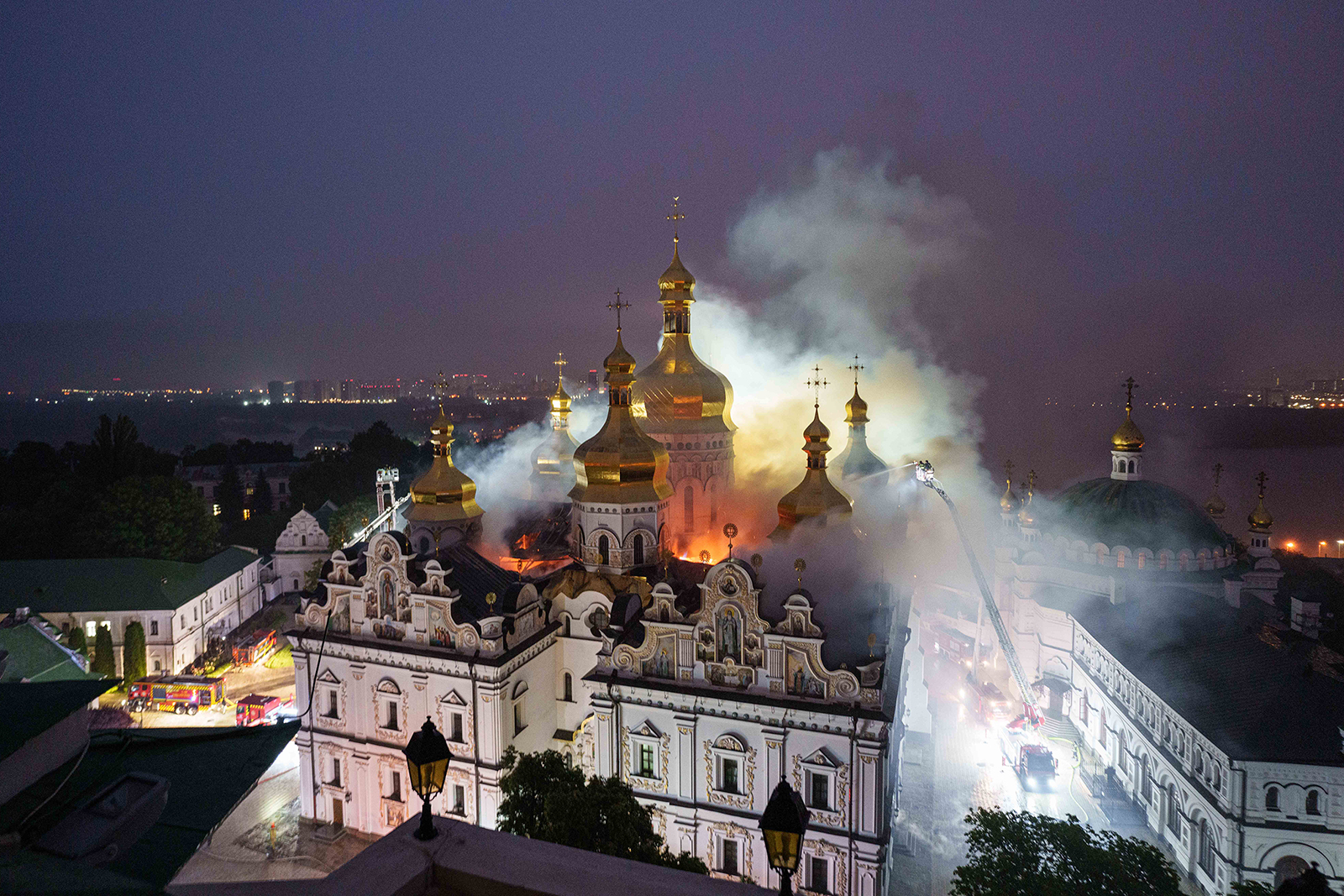

Rescue workers try to put out a fire at the Dormition Cathedral of thousand-year-old Monastery of Caves, also known as Kyiv Pechersk-Lavra, following a Russian strike on Kyiv, Ukraine, Monday, June 15, 2026. (AP Photo/Evgeniy Maloletka)

David I. Klein
July 1, 2026
RNS

(RNS) — For those working to safeguard Ukraine’s religious and cultural heritage, the threats of moisture, sunlight and mishandling have taken a backseat to bullets, bombs and looting.

Up against four years of destruction and counting, a dedicated cadre of scholars, artists and museum workers in Ukraine and around the world is working to preserve and immortalize what they can — if not physically then digitally.

In mid-June, Russian drones struck an 11th-century church, Ukraine’s most important religious site. The church and its associated cave and monastery complex, called the Kyiv Perchesk-Lavra, is revered by Eastern Orthodox Christians globally and contains hundreds of icons and relics, including a crypt of saints from across the centuries.

The June 15 strike started fires in the Dormition Cathedral and damaged several other buildings on the grounds, which will take an estimated 10 million euros to restore, according to Ukrainian officials. The strike was among the most damaging to Ukraine’s cultural and religious heritage since the outbreak of the full-scale war in February 2022.

“Before this attack, we knew that they could target our culture, so we are already trying to preserve everything we can,” said Kateryna Shapovalova, the custodian of collections at the Museum of Kyiv History.



An Ark III 3D scan at Kyiv Pechersk-Lavra in Kyiv, Ukraine. (Photo © 2026 Paul Safko)

The Ark for Ukraine project, which Shapovalova is part of, has, since 2023, brought three mobile labs to Ukraine to help preserve Ukrainian cultural heritage by scanning archives of thousands of manuscripts, artifacts and even buildings to digitize them.

Shapovalova signed up to train with an ark unit after surviving a missile strike on her apartment complex that destroyed her own home.

“I want to save our culture and preserve what I can because I can see how it can stay in mine and everyone’s mentality when something precious can be destroyed,” she said, saying she felt so devastated after losing her apartment that she needed medication.

Arks I and II mobile units, established as a partnership between the national libraries of Ukraine and the Czech Republic, scan in 2D.



The Ark III mobile lab at Kyiv Pechersk-Lavra in Kyiv, Ukraine. (Photo © 2026 Paul Safko)

Ark III, a partnership between the Kyiv Perchesk-Lavra and the National Museum of the Czech Republic, takes on another dimension, equipped with drones to 3D scan everything from the smallest pieces of jewelry to entire cathedrals and monasteries.

“With all the technology we have on hand, we are able to create so-called digital twins to have perfect clones, digital clones, of all the real items,” Paul Safko, one of the architects behind ARK III, told Religion News Service.

The digital clones will never compare to seeing a real piece of history in front of your face, holding it in your hands, or in the case of Orthodox Christian worship, kissing an icon or asking a saint for intercession in the presence of their mummified body. But digital copies can be an essential tool for researchers around the world and for repairing and restoring damage.

The lab, built into the chassis of a Volkswagen Crafter van, was unveiled in front of Perchesk-Lavra in late May, less than a month before the complex was struck.

“We had to develop a unique solution, as, after I did some research, I found nothing like it existed before,” Safko said. “We decided to create a mobile station, a lab on wheels … the main idea was that if it’s in a dangerous zone, in case of an airstrike, alarm or any shooting nearby, the car is able to move, to run.”

The vans themselves have become targets, with their locations needing to be kept closely guarded, according to a spokesman for The Czech-based Karel Komarek Family Foundation, which funds the project.

The June 15 attack also struck Ukraine’s national film studio, destroying its entire historic costume collection, containing more than 100,000 outfits stretching back decades. A day earlier, a drone strike on the Kharkiv Museum of Art damaged over a thousand exhibits. And on June 16, a music hall in Dnipro and Kyiv’s National Chernobyl Museum were also damaged in attacks.

At the Museum of Kyiv History, precious underground space is saved for the most historically significant exhibits, while others are stored in aboveground safes, said Shapovalova.

The recent drone strike shattered glass throughout her museum, but that has become a normal occurrence, she explained, joking that she was thankful the history museum is in an old building rather than a modernist one with glass architecture.

According to UNESCO, some 536 registered cultural heritage sites have been verified as damaged or destroyed as of the beginning of June 2026. Of those, 154 are religious sites, like Perchesk-Lavra. A report by Ukrainian authorities estimated more than 1,700 damaged heritage sites.

In a country where 85% of the population identifies as Christian, and with longstanding Muslim and Jewish communities, those sites are a key part of Ukraine’s national identity, said Cyril Hovorun, a Ukrainian Orthodox theologian and scholar and associate dean at Sankt Ignatius Theological Academy in Sweden and senior lecturer at the Stockholm School of Theology.



Ark III 3D equipment on May 25, 2026, in Kyiv, Ukraine. (Photo © 2026 Paul Safko)

Ukraine has remained on the border of Eastern and Western worlds for much of its history.

“Ukraine never wanted to be isolated; however, it always was on the fringes of different worlds, hence the name — which means borderland,” Hovorun said. “But it wasn’t just the borderland of Moscow, but of everything else in which Ukraine participated, of the Roman world, the Arabic world, the Slavic world, you name it.”

Ukraine’s Orthodox monasteries tell of its ties to the Eastern Roman world, its Catholic cathedrals to the Western one, its mosques to the Ottoman Empire and Islamic caliphates and its synagogues and Jewish cemeteries to the global Ashkenazi Jewish culture that spread from Ukraine to America, Israel and beyond, Hovorun said.

“That continues to this day. It’s reflected in our culture, our artifacts, archeological findings, literature and the mentality of the people,” he continued. “Largely this war of Russia against Ukraine has been a war against our identity. They want to destroy and obliterate our identity, and because those sites are part of our identity, they target them.”

Russia has not acknowledged intentionally targeting Ukrainian heritage sites and denied responsibility for the attack on Perchesk-Lavra, instead blaming American armaments for the damage.

But the denial of a Ukrainian culture and history distinct and separate from Russia’s has been one of Moscow’s justifications for the war since its start.

Russia has also been accused of systematically removing evidence of that culture from the regions of Ukraine it occupies, of “Russifying” Ukrainian children, and a year ago banning the Ukrainian language from being taught in schools in the occupied regions (areas that were largely Russophone before the war.)



Rescue workers carry out temporary repairs of the roof of the Dormition Cathedral of thousand-year-old Monastery of Caves, also known as Kyiv Pechersk-Lavra, damaged after a Russian strike in Kyiv, Ukraine, Thursday, June 18, 2026. (AP Photo/Evgeniy Maloletka)

Lukáš Pfauser, spokesman for the Karel Komárek Family Foundation funding the Ark project with support from prominent Czech philanthropists, said that the organization was drawn to the project due to their country’s own experience as a satellite state in the Soviet bloc. Many accuse Russia’s leaders, who espouse a Russian World ideology, of trying to imitate the Soviet-era attempt at authoritarian unity.

“For 50 years we were under the totalitarian regime, so we have a huge experience from our own culture,” Pfauser said.

“The main quote in our minds was, ‘If a nation’s culture survives, then so too does the nation,’” he added, referencing the words of the famed Czechoslovak economist and art collector Jan Viktor Mládek.

Shapovalova wants everyone learning about Ukraine to know that Ukrainians are their own people, preserving their own culture that is hundreds of years old.

Ultimately, Shapovalova and her colleagues know they won’t be able to save everything.

“You always need to have priorities, and we’re always glad that we know we need to save our people first, and our items after that,” Shapovalova said.





Why Iran Believes Israel Will Attack Again Before October

The recent Israeli-Lebanese agreement and Hezbollah's unreported role in the previous war is leading Tehran to this conclusion


by | Jul 2, 2026

Reprinted with permission from Trita Parsi’s Substack.

Will Israel restart the war with Iran before the October elections? This is the consensus view emerging within Iran’s internal national security debate over the past week.

Several factors are driving Tehran to this conclusion. Beyond its deep – and not entirely unwarranted – suspicion of President Donald Trump’s intentions, heightened by Vice President JD Vance’s recent remark that Trump wants to use the MOU to replenish global oil reserves and then “see where the hand is,” two developments stand out: the recent Israeli-Lebanese agreement and its impact on Hezbollah’s military posture over the coming months.

From Tehran’s perspective, the agreement hands Israel a significant advantage in any renewed war with Iran – one it lacked in February. By allowing Israeli forces to remain in parts of southern Lebanon, the deal appears to contravene the MOU while fundamentally reshaping the military balance. Israel’s continued presence in these strategic positions would make it far more difficult for Hezbollah to mount the kind of offensive operations that proved critical during the previous round of fighting.

That matters because, in February and March, the Iranians say they used only about 40 percent of their offensive capabilities against Israel, because Hezbollah carried much of the remaining burden. At the time, pundits in the West were debating why Tehran hit the UAE harder than it did Israel.

Part of it was because of Israel’s much higher pain tolerance compared to the GCC states. Tehran was aiming to reach the most accessible pain threshold to pressure the US to end the war. But part of it was the critical role Hezbollah played in the war, contrary to much of the press coverage at the time. It played a critical role in stretching Israel’s defenses, complicating its targeting decisions, and forcing it to divide resources across multiple fronts.

That role, however, was poorly understood because Israel imposed near-total military censorship during the war – far stricter than the censorship regime in June 2025 – which sharply limited public visibility into Hezbollah’s operations and their impact. As a result, the degree to which Hezbollah shaped the course of the war has been significantly underestimated.

Unlike the MOU, the current Israeli-Lebanese agreement does not require Israel to withdraw from Lebanese territory until Hezbollah has been disarmed. Since that outcome is highly unlikely in the foreseeable future, Israel is poised to retain its positions inside Lebanon, enabling it to renew the war with Iran without facing the same pressure from its northern front that constrained it during the previous conflict.

Netanyahu’s motivations are clear. Beyond his long-standing desire to use American force to subjugate Iran to Israeli domination and achieve a regional balance favorable to Israel, he now also has stark political and personal reasons to restart the war.

The MOU has come at a steep political cost for Netanyahu. His prospects for reelection in October are weaker than they have been in months. Once seen as the Israeli leader uniquely capable of delivering President Trump, he now confronts the prospect that both the war and the ensuing diplomacy will leave Israel in a strategically weaker position – undermining the very case he has made for his leadership.

And of course, if he loses the elections, he will likely spend the next few years in jail, as he will lose his immunity as Prime Minister and face trial over corruption charges.

Whether the Trump administration is coordinating with Israel on such a strategy remains unclear to Tehran. But suspicions surrounding Secretary of State Marco Rubio run particularly deep, given his role in brokering the Israeli-Lebanese agreement, his support for the war, and his perceived opposition to the MOU.

From Tehran’s perspective, there are three plausible scenarios. The first is that the White House is aware of Israel’s plans and helped broker the Lebanese agreement in part to facilitate them. The second is that Washington is unaware of Netanyahu’s intentions but would nonetheless come to Israel’s defense – and perhaps even join the offensive – once Netanyahu resumes the war. The third is that the administration is caught by surprise, chooses not to restrain Israel, but also refrains from direct military involvement in the conflict.

Tehran does not believe Israel’s advantage in Lebanon will prove decisive. Iranian officials remain confident they can impose severe costs on Israel and deny it its broader strategic objectives. But a renewed war could still achieve Netanyahu’s most immediate aim: killing the MOU. Given his mounting political and legal pressures, Netanyahu may be desperate enough to be willing to challenge Trump directly to ensure precisely that outcome.

The question is, once again, not how Trump will react, but if Trump will prevent Netanyahu from deliberately shaping and limiting Trump’s options. This is the test Trump has repeatedly failed.

Trita Parsi is the Executive VP of the Quincy Institute for Responsible Statecraft and an award-winning author. Washingtonian Magazine has named him one of the 25 most influential voices on foreign policy. Noam Chomsky calls him “one of the most distinguished scholars on Iran”

Visit Trita Paris’s Substack and subscribe.

Want to See Why the GOP Medicaid Work Requirements Are a Disaster? Look to Arkansas

Wishful thinking and wildly unrealistic assumptions will not magically make a horrible policy a good one.


People protest the upcoming Medicaid cuts in Washington, D.C., May 22, 2025. The House passed a bill to support President Trump’s domestic agenda this morning which will force strict work requirements on Medicaid recipients.
(Photo: Astrid Riecken For The Washington Post via Getty Images)

Eileen Appelbaum
Jul 02, 2026
Center for Economic and Policy Research

As I noted in an article earlier this month, the Congressional Budget Office (CBO) estimates that the federal government will save $911 billion over 10 years and that 10 million people will lose health insurance as a result of Medicaid changes in H.R.1, aka the One Big Beautiful Bill Act (OBBBA). This bill requires near-poor, able-bodied Medicaid beneficiaries with incomes currently above the poverty line but under thresholds that depend on family size — $22,025 for an individual or $45,360 for a family of four — to navigate a maze of red tape and reporting requirements twice a year to remain enrolled. Disabled people on Medicaid, including those with cancer or end stage renal disease, will have to prove that they are too disabled to work in order to waive the work requirement.

An analysis by health policy organization KFF found that in 2023, 64 percent of adults 19 to 64 years of age enrolled in Medicaid were working either full or part-time. Nearly 30 percent were not working because of caregiving responsibilities, disability or school attendance — barriers to employment that typically exempt people from work requirements in programs that mandate them. Most of the 8 percent who were not working were retired or unemployed. The result is that only a small share of Medicaid enrollees will lose access to the program because they do not meet work requirements. However, many more will lose coverage because of the difficulty of navigating the reporting requirements and the administrative red tape built into the OBBBA for this purpose.


In June 2026, HHS released interim regulations for the changes to Medicaid that states must implement by January 1, 2027. The regulations are much more severe than the requirements in H.R.1, and have upended work that states had already done to be ready to comply by the January 1 deadline. This has forced states to scramble to be ready in just six months, an extraordinarily short window to prepare for the large changes in reporting requirements. Disenrolling people by mistake may mean the difference between life and death for Medicaid enrollees. The rollout of the new work and massively burdensome reporting requirements is likely to be bumpy.

ASPE Publishes Very Brief Fantastical Briefing Report


In conjunction with the release of the new eligibility and reporting requirements, the Department of Health and Human Services released a brief, prepared by the Office of the Assistant Secretary for Planning and Evaluation (ASPE), with the Orwellian title, “Medicaid Work Requirements Incentivize Employment and Are Estimated to Reduce Poverty.” The brief’s conclusion that pushing people off the Medicaid rolls will increase employment and reduce poverty is contradicted by an earlier assessment by the Congressional Budget Office (CBO). CBO found that mandating work requirements would decrease what the federal government pays for Medicaid, increase the number of people without health insurance, raise costs for states, and wouldn’t increase employment.

The four-and-a half page ASPE brief has few citations for its assertions about how cutting access to health insurance for poor people will magically produce jobs for those disenrolled from Medicaid. While the authors say they have reviewed three decades of literature on work requirements in social programs, and they have an online bibliography with more than 130 references, they cite only 10 papers in the brief. As NOTUS observes, the researchers that produced the 10 papers cited in the brief are crying foul, claiming that their studies are being misused, and in some cases are being used to support conclusions that are the opposite of what the studies show. In other cases, researchers complain that while the findings of their studies may not be distorted, crucial job search supports for job seekers in their studies that are not available to people facing disenrollment from Medicaid in 2027 are ignored in the ASPE brief.

As noted in a technical analysis of the ASPE brief published in Health Affairs, the brief assumes totally unrealistic employment effects. It considers two scenarios. In the first, all 5.8 million people on Medicaid — who the brief assumes will not meet the new work requirements and are not exempt from them — will increase their work effort. The report does not spell out where the 5.8 million figure comes from, but a back-of-the-envelope calculation suggests it includes about 4.2 million people enrolled in Medicaid who are working part-time and 1.6 million who are retired, unemployed or otherwise not working. The brief assumes that these Medicaid recipients will increase their hours of work at their current wage or at the average wage among similarly educated Medicaid-eligible individuals.

Part-time workers are assumed to increase their hours and those who are not working are assumed to find jobs. Unbelievably, the change in employment participation is assumed to be 100 percent in the first scenario. This is more than 23 times higher than the 4.2 percent increase the ASPE brief authors report for welfare-to-work experiments that, unlike Medicaid work requirements, involved cash assistance and provided people leaving welfare programs with substantial help for finding work.The help included employment services such as transportation and job search assistance and case management services to assist people in meeting work requirements. In the second scenario, the brief’s authors assume that 80 percent of the 5.8 million people they believe will not meet the work requirements will succeed in finding employment. This is a 57 percent increase in participation and is 13 times the welfare-to-work effect.

The reductions in poverty cited in the ASPE brief are not calculated independently, but follow from the entirely unrealistic assumptions about the increases in work participation. The earnings increase on average per family is $16,780 — a result of the built-in employment and wage assumptions. Net of the loss of benefits as their incomes rose, families of Medicaid recipients whose work participation rises experience an increase in resources or $12,034. In the first scenario, this reduces poverty by 2.9 million people; in the second, by 1.6 million.

Arkansas’ Experience with Work Requirements

The ASPE brief omits any mention of the one instance where a state — Arkansas — implemented work requirements in 2018. This is a glaring omission in a report on the effects of work requirements in Medicaid, and suggests the brief’s authors may not have wanted to report the disastrous results of this introduction of work requirements.

The application of work requirements to Medicaid is a new development and there are just a few empirical studies of the Arkansas case. A cutting edge 2026 analysis by Harvard Medical School researcher Yuji Mizushima found that total Medicaid participation declined sharply during the months in which the mandated work requirements were in effect. Mizushima examined two groups of people — those on Medicaid who were disenrolled because they didn’t meet the work requirement, and those in the general population who failed to enroll in Medicaid because of the work requirement. The author found that participation in Medicaid fell by about 28,810 adults — 18,164 who were disenrolled and more than 10,500 who did not apply or reapply for Medicaid. There was no discernible change in the number of hours worked and no increase in employment or in participation in the labor force of the Medicaid population in the months leading up to, during, or following the enforcement of the work mandate. This supports similar findings in research on the Arkansas experience in other studies. A year after Arkansas implemented work requirements, the poor results led a federal judge to pause and later to strike down the work requirement.

Conclusion

The introduction of work requirements in Medicaid in Arkansas during the first Trump administration led to a disastrous decline in access to health insurance for people who had relied on Medicaid for health care, but did not increase hours of work or employment. This stands in direct contradiction to the wishful thinking and wildly unrealistic assumptions embodied in the two scenarios in the ASPE brief, and raises unavoidable questions about why the authors failed to examine the Arkansas experience.


Eileen Appelbaum
Eileen Appelbaum is Co-Director of the Center for Economic and Policy Research (CEPR) in Washington, DC, Fellow at Rutgers University Center for Women and Work, and Visiting Professor at the University of Leicester, UK.
Full Bio >


A blue stripe grunt swims in Florida Keys National Marine Sanctuary.
(Photo by Larry Benvenuti/ NOAA)
Common Dreams

As the United States approaches its 250th year as a nation, the festivities are widespread in DC. But even as Americans prepare to celebrate, the Trump administration is quietly working to expose some of our most treasured ocean places to harmful activities like mining, drilling, and industrial fishing.

We should be spending this anniversary lifting up our shared natural and cultural heritage. Instead, the Trump administration is spending this consequential year trashing the very idea of shared heritage by erasing history and selling out nature on land and sea. While there has been extensive coverage about how this erasure is playing out on land, the administration is also aggressively selling out our ocean heritage.

Having worked in the Biden administration and now both leading national conservation coalitions, we hear from communities across the country every day, who are trying to protect the ocean and coasts they love and depend on.

And what we hear is that communities don’t like what they are seeing from the Trump administration. They don’t want to be cut off from their own ocean backyards by corporate pollution. They don’t want dirty and destructive industry off their coasts. And they especially don’t want the Trump administration selling off public lands and waters to the highest bidder.

All of us who love the ocean have a chance now to be a part of the alliance to save its future.

In the Pacific Ocean, expedited permits for deep-sea mining make it easier to sell off the right to mine around the Northern Mariana Islands, Guam, and American Samoa. Thousands of people in these US territories have made it clear that they oppose these mining ventures because these companies use unproven technology that jeopardizes their livelihoods. Our coalitions have engaged tens of thousands of people voicing their opposition, yet the administration has continued the process of selling off the seafloor to mining companies with little benefit to the communities that bear the risks.

The expansion of offshore oil and gas leases, which would open 34 new sales in waters off the coast of Alaska, California, and Florida, would also benefit just a handful of fossil fuel companies. In one fell swoop, they would sell out the climate; introduce the constant possible threat of an oil spill; and further threaten local fishing, recreation, and subsistence.

Reopening protected waters to industrial fishing is the same short-sighted story. Like our national parks on land, marine national monuments are protected as special places we safeguard for our children and grandchildren to enjoy. They are home to spectacular wildlife and important cultural heritage and history. However, Trump’s executive orders will lead to all of these monuments opening to industrial fishing—the largest rollback of protected areas in US history—endangering these special places and the diverse creatures therein.

Meanwhile, the federal workforce focused on public lands and waters has been decimated. If they weren’t fired through budget-slashing with the planning and accuracy of a 14-year-old playing laser tag, they quit to avoid carrying out unconscionable actions. Many of the staff who had relationships with communities are no longer in government service, replaced with corporate insiders.

These actions are as unpopular as they are destructive. Loving the ocean is as unique and universal as the American experience, and we relate to it in countless ways for sustenance, livelihoods, spiritual renewal, recreation, and more: the thrill of catching a fish for dinner, the magic of watching a whale breach, the way that just the smell of salty water can put us in a better mood. From the lush mangrove forests of the Florida Keys, to vibrant coral reefs of the central Pacific, to the rocky coastlines of New England, or the enchanting tidepools of the West Coast, there’s no reason to let the administration run roughshod over these simple, profound pleasures.

Collectively, we can push back on the Trump administration’s attack on the ocean. We’ve seen this administration abandon projects before, including the DOGE program. All of us who love the ocean have a chance now to be a part of the alliance to save its future.

For the last 250 years, past generations fought to protect our coasts and waters.

Now, it’s up to us to keep that tradition alive.


Our work is licensed under Creative Commons (CC BY-NC-ND 3.0). Feel free to republish and share widely.


Miriam Goldstein
Miriam Goldstein is the executive director of the National Ocean Protection Coalition.
Full Bio >

Shantha Ready Alonso
Shantha Ready Alonso is the executive director of the America the Beautiful for All Coalition.
Full Bio >


'Grim picture' for Bari Weiss as CBS News ratings continue to 'crumble': report

Tom Boggioni
July 2, 2026 
RAW ST0RY


CBS News head Bari Weiss at a conference in Idaho in July. (Brendan McDermid/Reuters)

The numbers don't lie—and they're devastating for CBS News and embattled division head Bari Weiss.

According to a report from media watchdog Status, despite CBS News touting a modest 1 percent year-over-year gain for Tony Dokoupil's "CBS Evening News" in the second quarter, a closer examination reveals a "grim picture" under Weiss. The broadcast averaged just 3.9 million viewers in Q2, according to Nielsen—marking its second-worst second quarter on record and remaining stuck below the "critical" 4 million viewer threshold.

And things are getting worse, not better, wrote Natalie Korach of Status, because last month "CBS Evening News" hit its lowest-rated June of the entire 21st century in total viewers.

Meanwhile, "CBS Mornings" cratered even harder, plummeting to its lowest-rated month in the program's entire history with fewer than 1.7 million total viewers.

The morning show's collapse is particularly stark in the key 25-54 age demographic—the metric advertisers care most about. In June, "CBS Mornings" averaged just 269,000 viewers in that demo, marking the sixth consecutive month the program has failed to top 300,000 viewers.

The bad news for Weiss comes as CBS owner Paramount's pending $111 billion acquisition of CNN's parent company Warner Bros. Discovery will be approved, which has CNN employees on edge and looking for a way out over fears she may take over.


Senate GOP majority in jeopardy as poll finds Dems 'pulled within striking distance'

Travis Gettys
July 1, 2026 
RAW STORY


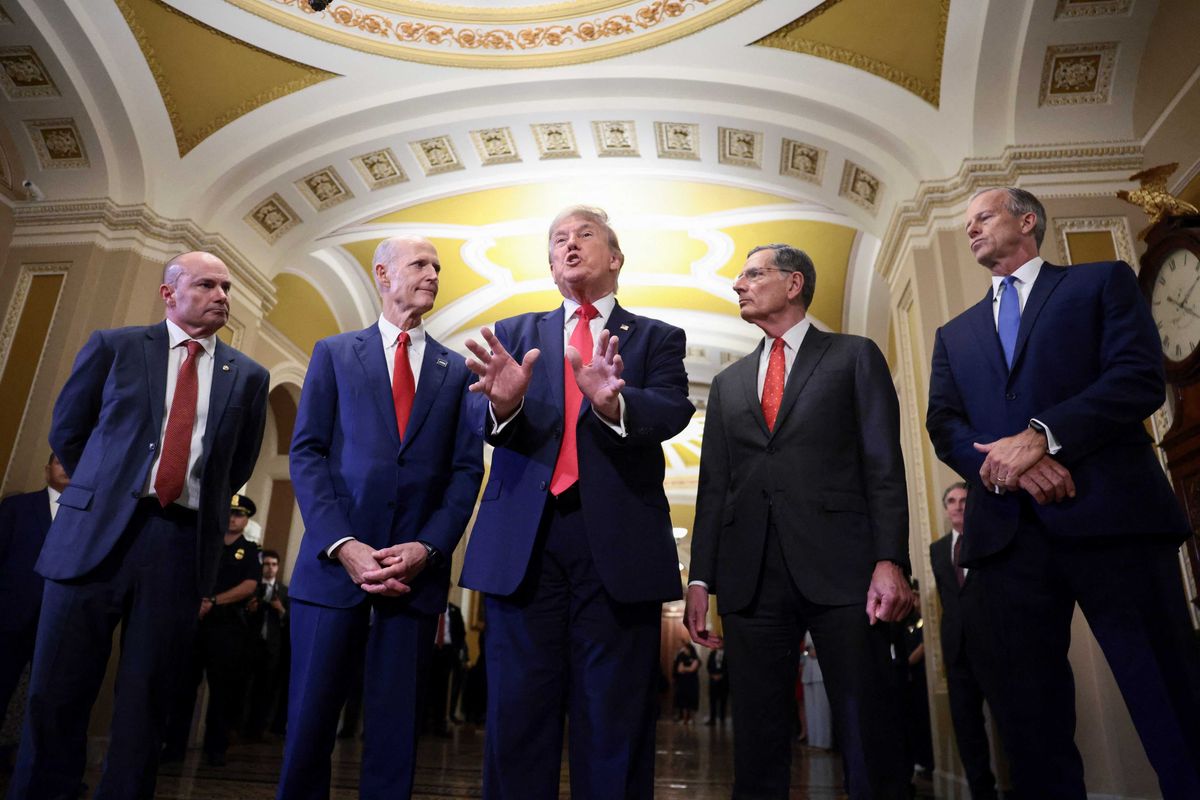
President Donald Trump speaks to reporters next to U.S. Senate Majority Leader John Thune (R-SD), U.S. Senator Rick Scott (R-FL), U.S. Senator Mike Lee (R-UT) and U.S. Senate Majority Whip John Barrasso (R-WY) on the day of a Senate Steering Committee Lunch on Capitol Hill in Washington, D.C., on June 24, 2026. REUTERS/Evelyn Hockstein

President Donald Trump has helped clear a path for Democrats to retake control of the U.S. Senate, according to fresh polling data.

A new New York Times/Siena poll across six Senate battleground states found an opening for Democrats to flip enough seats to regain the Senate majority, and the surveys found the 80-year-old president was largely to blame for his party's shaky foundation.

"Democrats face an uphill battle to win control of the Senate but have pulled within striking distance of enough Republican-held seats to put the majority in play this fall," the Times reported. "Republicans are hampered by the unpopularity of President Trump and his diminished standing on the economy, while most of the Democratic candidates are so far running ahead of their party’s own struggling brand, the polls show."

Republicans currently hold 53 seats, meaning Democrats would need to flip at least four while defending all their own vulnerable seats. The Times/Siena surveys examined the six states seen as Democrats' best pickup opportunities — Alaska, Iowa, Maine, North Carolina, Ohio and Texas — and found that if the election were held today, Republicans would likely hold on to enough of those races to keep the majority.

The numbers mark a significant shift.

Trump carried five of the six states in 2024, winning them by an average of eight points, while the new polling shows the Senate races tied on average, 47 percent to 47 percent.

Democrats hold a slim lead in Maine and a stronger one in North Carolina, where former Gov. Roy Cooper leads Michael Whatley by seven points. Republicans are narrowly ahead in Alaska, Iowa and Ohio, while Texas is tied.

The shift appears driven largely by economic frustration. Just 36 percent of voters approved of Trump's handling of cost-of-living issues, dropping to 24 percent among independents. Voters said jobs, inflation and the economy were by far their top concerns, and by a 14-point margin said Trump's policies have done more harm than good.

Trump's overall approval sits at 43 percent, with 54 percent disapproving. His handling of the war with Iran and gas prices also drew weak marks, though immigration remains his strongest issue.

Democratic candidates are also outperforming their party's brand. In every state surveyed, voters were less likely to call the Democratic Senate candidate "too far left" than to say the same of the Democratic Party overall — a gap that was widest in Iowa.

Democratic candidates also posted higher favorability ratings than their Republican opponents in five of the six states, with Maine's Graham Platner, dogged by controversy, the exception.

Democrats currently hold an enthusiasm edge, with 93 percent of Democratic voters saying they are very likely to vote compared with 87 percent of Republicans — helping Democratic candidates outrun their party's standing even in redder states like Alaska, Iowa, Ohio and Texas.
CANADA VS U$A

Ex-GOP operative appalled as Trump builds 'barrier of corruption' for donor's payout

Bennito L. Kelty
July 1, 2026 
RAW ST0RY


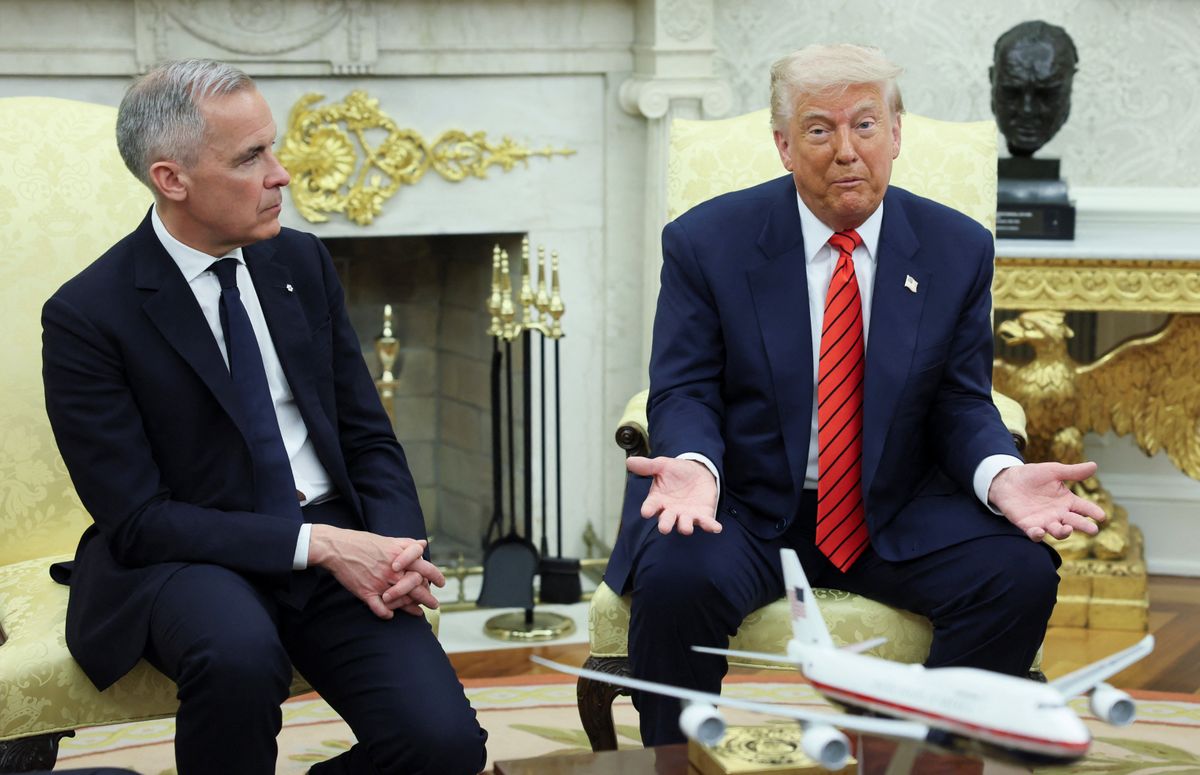
U.S. President Donald Trump and Canadian Prime Minister Mark Carney meet in the Oval Office at the White House in Washington, D.C., U.S., May 6, 2025. REUTERS/Leah Millis TPX IMAGES OF THE DAY

A former Republican operative flagged how badly President Donald Trump damaged a relationship with a close U.S. ally to help a donor.

Steve Schmidt focused on Canada for his Wednesday episode of The Warning to mark July 1, which is Canada Day. He talked in particular about the Gordie Howe International Bridge connecting Windsor, Ontario, with Detroit.

"Look at this bridge. It's brand new, paid for by Canada, though the American side gets to keep half the revenue," Schmidt explained. "It is a vital pipeline, an artery for commerce that flows back and forth, a trillion dollars a year."


The bridge also "sustains jobs" and "creates opportunity across both sides of the border," Schmidt continued. However, Schmidt was only talking about the bridge's potential because Trump "will now not allow the Gordie Howe Bridge to open," he said.

Schmidt noted that Matthew T. Moroun, a Detroit billionaire, owns the nearby Ambassador Bridge. He claimed that Moroun "donated $1 million to Donald Trump," and blamed that connection for the reason the Gordie Howe Bridge has yet to open.

"The Ambassador Bridge is jam-packed. It's a toll bridge," Schmidt explained. "When the new bridge opens, it will diminish the traffic and decrease the profit for the ownership group on the [Ambassador] bridge."

Schmidt blasted the refusal by Trump to open the bridge, and noted the soured relationship between the U.S. and Canada is even "killing the bourbon industry."

He said, "The next president has an absolute moral obligation to repair this relationship." He called on Americans to "look north and think this thought: we're sorry," for Canada Day.

"Donald Trump has erected a barrier of corruption as if he's generalissimo of some banana republic, and it's appalling," Schmidt said. "He has vandalized a relationship that is steeped in friendship that goes back beyond the moment of his birth, and it is appalling."


Jen Psaki blows lid off Trump's shady tariff stock manipulation: 'Tip of the iceberg'

Matthew Chapman
July 1, 2026 


President Donald Trump's stock trades have raised red flags with legal observers numerous times — but there's a new revelation from the president's more than 900-page financial disclosure this week that shows something especially alarming, MS NOW's Jen Psaki said on Wednesday evening.

Specifically, stock purchases timed to some of Trump's most controversial tariff policies, later struck down by the Supreme Court, recontextualize the whole reason he may have enacted and adjusted these tax policies when he did.

"Do you remember last year, when Trump announced his massive across-the-board tariffs ... he called it Liberation Day?" said Psaki, a former White House press secretary. "It actually led to a stock market crash. That Liberation Day announcement was on April 2 last year, and Trump's financial disclosures show that he made 327 stock purchases 6 days later on April 8, while the stock market was down."

Those trades, noted Psaki, "vary in size from the ones of $15,000 range all the way up to the $100,000 to $250,000 range" — representing massive amounts of money in total.

"The next morning, just after the market opened, he told his followers on Truth Social quote, 'THIS IS A GREAT TIME TO BUY!' in all caps, obviously," said Psaki. Then, just "hours" after that post, he announced a "pause" on the tariffs, "and the stock market had a historic rally, so historic in fact, it represented the biggest single day gain in the history of the Bloomberg Billionaires' Index."

Trump was asked about these trades at the time, noted Psaki, and said, "I'm profiting because the stock market is going up, everybody's profiting."

The worst part, said Psaki, is that that is just the "tip of the iceberg," as it still pales in comparison to the sheer magnitude of profit the Trump family is making off of poorly-regulated cryptocurrency ventures.


Nobel winner warns 'extremely destructive' Trump grifts are breaking the economy

Matthew Chapman
July 1, 2026 
RAW STORY


U..S. President Donald Trump speaks at the site of ongoing construction of the planned White House ballroom in Washington, D.C., U.S., May 19, 2026. REUTERS/Kevin Lamarque

President Donald Trump and his family's self-enrichment schemes, which stand to net them $1.4 billion in crypto profits alone, are more than a moral issue, Nobel Prize-winning economist-turned-political pundit Paul Krugman told MS NOW's Ari Melber on Wednesday — they're an active threat to the U.S. economy.

"We talked earlier in the program about what is wrong with Trump's corruption, how it also violates his own claims and past vows," said Melber. "I thought I would start by asking you in plain English, as an economist, what is the cost to the rest of us, the public, if the government is corrupt or captured, separate from the morality?"

Krugman used the analogy of the infamous Philippine autocrat Ferdinand Marcos and his "crony capitalism scheme" that decimated that country's economy

"My parents' generation used to say, 'It's not what you know, it's who you know,'" said Krugman. "In other words, Trump has created a situation in which "success in business depends on having the right connections and having the favor of the leader, supreme leader, whatever."

This state of affairs, he said, is "extremely destructive."

"It does mean that all of the incentives on business are to curry favor, not to actually be good," said Krugman. "Especially that if what it takes to curry favor is just who is best at funneling money to the president's family and his friends." This is a massive departure from what actually makes the U.S. economy work, he said, which is that "we rewarded actual productivity, we rewarded creation of actual value, as opposed to just making the White House happy."


Anderson Cooper throws Trump's past corruption claims back in his face in searing montage

Bennito L. Kelty
July 1, 2026
RAW ST0RY


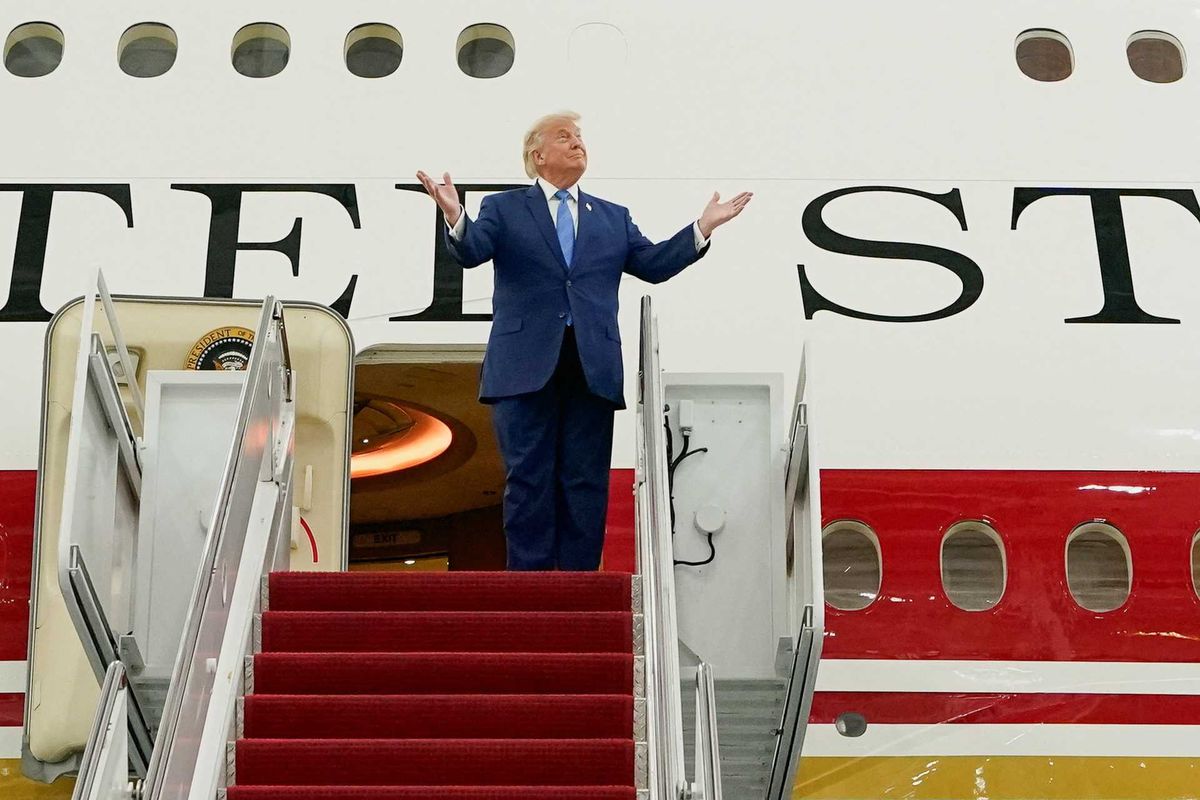
U.S. President Donald Trump gestures as he tours the VC-25B aircraft gifted by Qatar that will be used as Air Force One, at Joint Base Andrews, Maryland, U.S., June 19, 2026. REUTERS/Elizabeth Frantz

CNN anchor Anderson Cooper called out Trump's acceptance of luxurious gifts with a montage showing his past comments.

Cooper was doing a segment about Trump's jet that was gifted to him by Qatar while also bringing up more recent revelations of enrichment by Trump and his family through foreign deals, including in Kazakhstan and through his crypto ventures.

However, Cooper made a point about Trump's hypocrisy by playing a video from his 2016 debate with former Democratic presidential nominee Hillary Clinton.

"I seem to recall him once having very strong feelings about accepting foreign gifts," Cooper said before cutting to a clip where Trump attacks Clinton. Trump talks about "Saudi Arabia giving $25 million, Qatar, all these countries" giving gifts to Clinton.

"You talk about women and women's rights," Trump said in the clip. "These are people that push gays off buildings, these are people that kill women and treat women horribly, and yet you take their money."

Trump then asked Clinton, "Why don't you give back the money that you've taken from certain countries that treat certain groups of people so horribly?"

Cooper noted the irony that Trump was "so offended" by million-dollar donations to Clinton while she was Obama's secretary of state.

"It certainly did not look good, and then-candidate Trump knew it," Cooper said. "He knew that even the appearance of impropriety matters. What's more, he seemed to understand back then that gifts to public servants do not come with no strings attached."

Cooper then played a clip of Trump bragging, "I give to many people," and "I give to everybody. When they call, I give, and you know what? When I need something from them two or three years later, I call them, and they are there for me."


'Mind-boggling': Historian flags striking irony of Trump's first trip in Qatari jet

Robert Davis
July 1, 2026 
RAW ST0RY


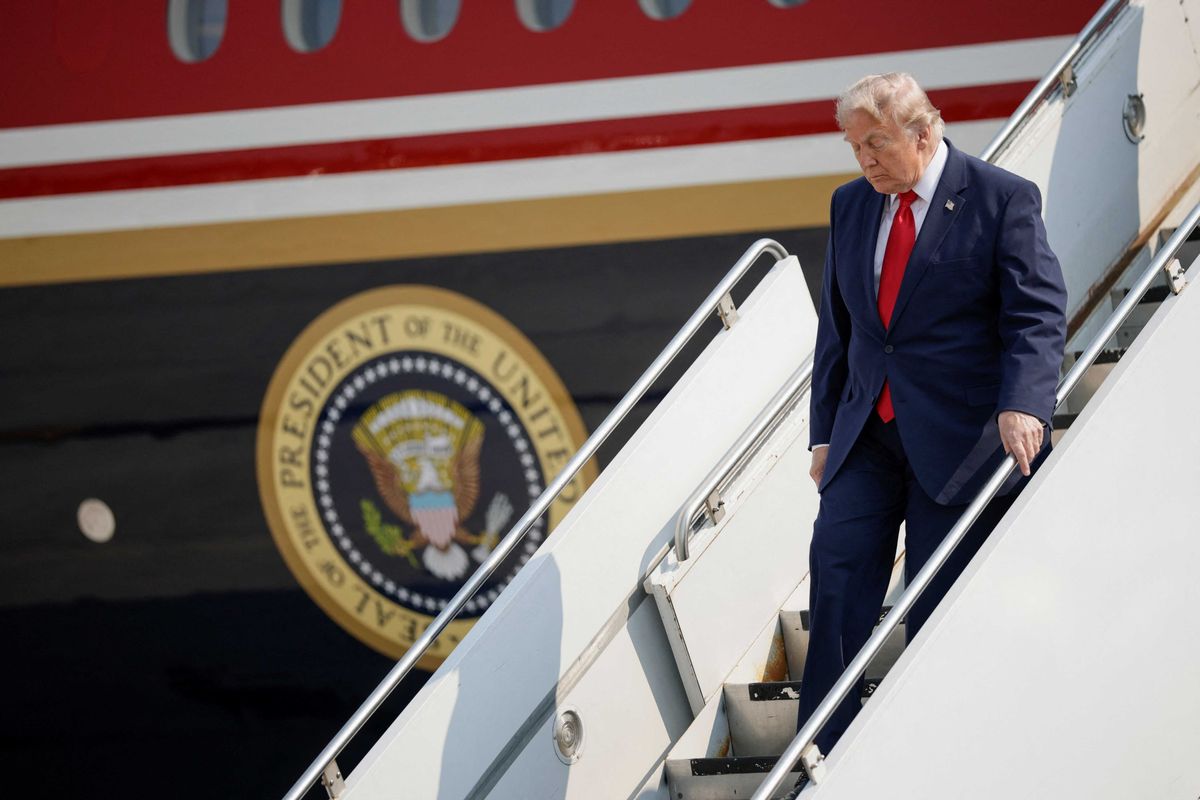
U.S. President Donald Trump disembarks the new Air Force One, a plane gifted by the Qatari government, as he arrives at Bismarck Municipal Airport in Bismarck, North Dakota, U.S., July 1, 2026. REUTERS/Evan Vucci

A prominent presidential historian flagged a striking irony behind President Donald Trump's first trip in his Qatari jet on Wednesday.

Last year, Trump was gifted a jet worth more than $400 million by the Qataris, which was subsequently renovated from tip to tail using American taxpayer money. Trump took the plane out for a spin on Wednesday, flying to North Dakota for the opening of the Theodore Roosevelt Presidential Library, a move that raised several red flags for historian Douglas Brinkley.

"I don't know what American can applaud the idea of [Qatar] gifting a plane like this to Donald Trump, and having it at the presidential library. So it really does feel like the White House has a for-sale sign and that you can, you can influence pedal," he told CNN's Anderson Cooper on "AC360."

Brinkley noted it was ironic for Trump to use the jet for such an occasion, given that Roosevelt was a fierce anti-corruption advocate while he was in office.

Trump, on the other hand, has seemed to embrace corruption as reports indicate he has profited greatly from his position, Brinkley argued.

"We can't just sweep this under the rug," Brinkley said. "The American citizens have to know how he earned that $2 billion and really talk about it because the crypto part of this, to me, is mind-boggling how he can be playing these games with it."


CNN host instantly busts Trump's money claim by pointing out who's right behind him

Travis Gettys
July 1, 2026  
RAW STORY


Eric Trump, Donald Trump Jr., Bettina Trump and President Donald Trump/CNN

CNN's John Berman immediately fact-checked a claim by President Donald Trump about his business dealings.

The 80-year-old president was asked Wednesday morning, as he prepared to board a nearly $400 million luxury jet given to him by Qatar, about recent financial disclosures showing that he had raked in $2.2 billion since returning to office, and Trump insisted he had little to do with his own investments.

"You know, I don't get involved in my personal, we have funds that run my money," Trump told reporters on the tarmac. "Well, I've made a lot of money before I became president, and they invest my money in. I don't talk to them; I never, I do not even speak to them. So I have many people – I don't know what they call it, closed accounts or something. You put your money in, and that said, I don't talk to them. They're big institutions, and they run it."

"But, yeah, I've had a great career in business, I've had a great career," he added. "I don't know if I've had a better career in politics or business, but I had a great career in business and, you know, you saw the cash and you report the different things, and what they do is we gave it, I think it's called a blind account, but they basically they take it, and I purposely, I never speak to any of the people that run the money. But they're big institutions, and they invest in whatever they invest."

The White House has repeatedly emphasized that Trump has placed his businesses in a blind trust managed by his sons, and the "CNN News Central" host pointed out that both of them – Donald Trump Jr. and Eric Trump – were traveling to North Dakota with their father.

"The president was also asked about reports that he's made an enormous amount of money since being in office from new financial disclosures," Berman said. "The president said he doesn't know anything about it; it's all handled by private people. But he said it with his two sons standing right behind him, two people who were actually involved with that money. He said, yeah, I don't ever talk to the people who do anything with this money. The two sons right behind him, they were right there."

Berman later wondered whether the Trump sons would ever be called to testify about their business dealings if Democrats win back a congressional majority.

"The president said he hasn't talked to the people who handle his money," Berman said. "Again, his two sons were standing directly behind him when he said that."