Thursday, July 02, 2026

Baptist Network created to oppose White nationalism, foster Black church collaboration

(RNS) — ‘We're a connector and a catalyzer, and not a denomination,’ its spokesperson said in an interview.


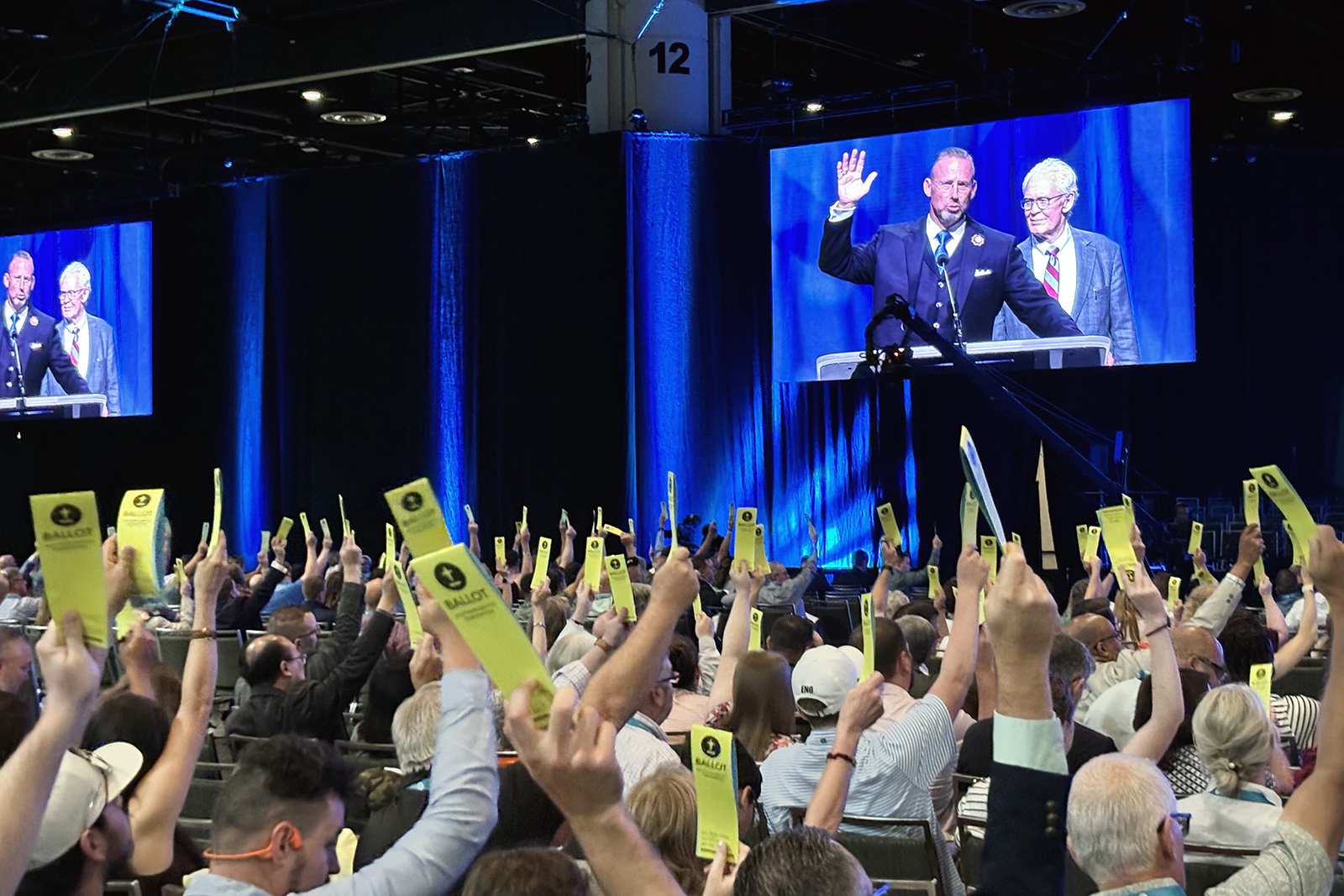
President Clint Pressley, on video screen, calls a vote during the Southern Baptist Convention annual meeting, Wednesday, June 10, 2026, at the Orange County Convention Center in Orlando, Fla. (RNS photo/Bob Smietana)

Adelle M. Banks
June 29, 2026 
RNS


(RNS) — Baptist leaders are creating a new network focused on Black churches and communities in light of what some see as growing nationalism among evangelicals and wider political decisions they feel are detrimental.

“The conflating of faith with this rightward drift and the infringement not only on the autonomy of the church but all issues related to justice, the Voting Rights Act, the deification of (conservative activist) Charlie Kirk and all of these things have given us great concern,” Pastor Gregory Perkins, spokesperson for The Baptist Network, told Religion News Service.

Perkins, who is the immediate past president of the Southern Baptist Convention’s National African American Fellowship, said a meeting was scheduled for Monday (June 29) at the Arlington, Texas, church of Pastor Dwight McKissic, one of the network’s conveners and a leader who successfully encouraged Southern Baptists to adopt resolutions criticizing the Confederate flag and condemning white supremacy in 2016 and 2017.

Leaders expected to attend or join the network are affiliated with groups such as the American Baptist Churches USA, Cooperative Baptist Fellowship, Full Gospel Baptist Church Fellowship, Southern Baptist Convention and historic Black Baptist denominations such as the Progressive National Baptist Convention, National Baptist Convention of America and National Baptist Convention, USA.


Pastor Gregory Perkins. (Courtesy photo)

Their focus is not to become another denomination, but “a connector and a catalyzer,” Perkins said.

The network will comprise representatives of predominantly Black churches or denominations in North America but also aims to be racially inclusive, he added.


The group, which plans to have its official launch in the fall at a meeting of dozens of leaders, said in a news release that they have “grown weary of being criticized or marginalized for addressing issues of race, immigration, poverty, and justice from a biblical perspective.”

Perkins said organizers had been in conversation about developing a network long before the Southern Baptists’ recent vote that could lead to a ban on women pastors but “the current climate within the SBC helped inform our needs, perhaps in a more expedited fashion.”

He said “like-minded Baptists” who are forming the new network also oppose the recent Supreme Court ruling “allowing the administration to take away the protected status of Haitian citizens, while inviting South African citizens to come.”

The new network, which will include mentoring, training and missions partnerships, is one of several recent attempts to address issues of concern by faith leaders of color in a collaborative way.

Perkins inaugurated the Black Collective of the Southern Baptist Convention at an event featuring representatives of various Caribbean and African fellowships just before the June annual meeting of the nation’s largest Protestant denomination.

“I wanted to send a message of unity amongst the diaspora, but also amongst the broader SBC family, because there had been this notion that we somehow were working in cross purposes,” he said.

A broader gathering featuring Black church leaders, The Black People’s Convention, is tentatively planned for February 2027 in Maryland, said Bishop Erika Crawford of the African Methodist Episcopal Church. It would be a revival of an 1830 event in which African Methodist Episcopal Church founder Richard Allen brought together Black leaders of different faiths and organizations at his Philadelphia church.

“Today, we face a different moment — but the same urgency,” reads a description on a website about the upcoming convention. “Across this nation, we are witnessing the erosion of civil rights, widening economic gaps, threats to education, and ongoing challenges to our communities’ health, safety, and stability.”

Perkins said he thinks the various initiatives are sparked by a period where there are “coordinated actions that are intentionally disadvantaging communities of color, specifically Black and brown communities.”

“I do believe that there’s a coming together,” he said.
How women pastors became public enemy No. 1 in the SBC

(RNS) — Southern Baptists have long believed that only men can be pastors. But for decades, the denomination took no action to expel churches where women pastors served. Then, in the middle of an abuse controversy, it became a denominational crisis.


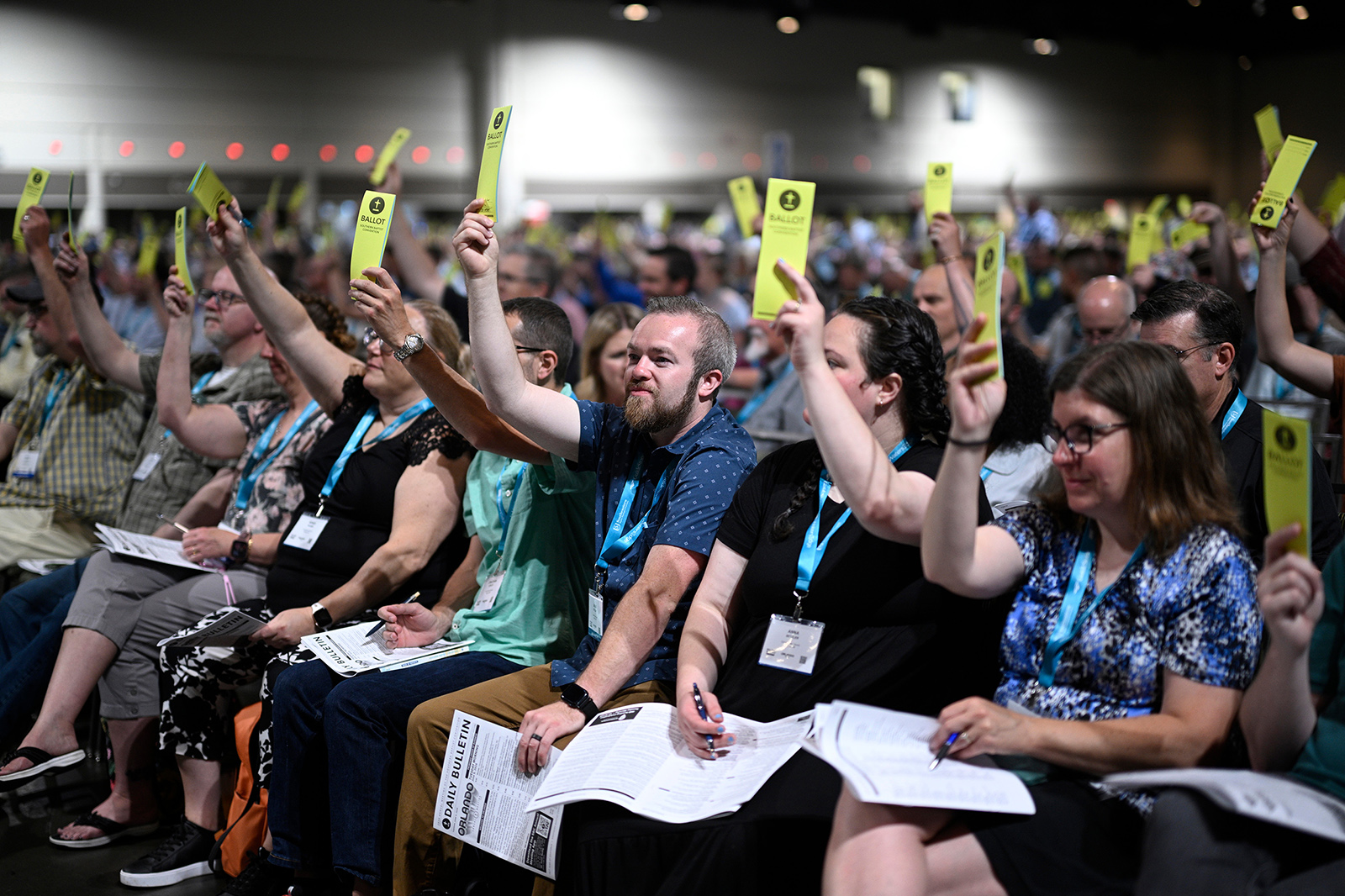
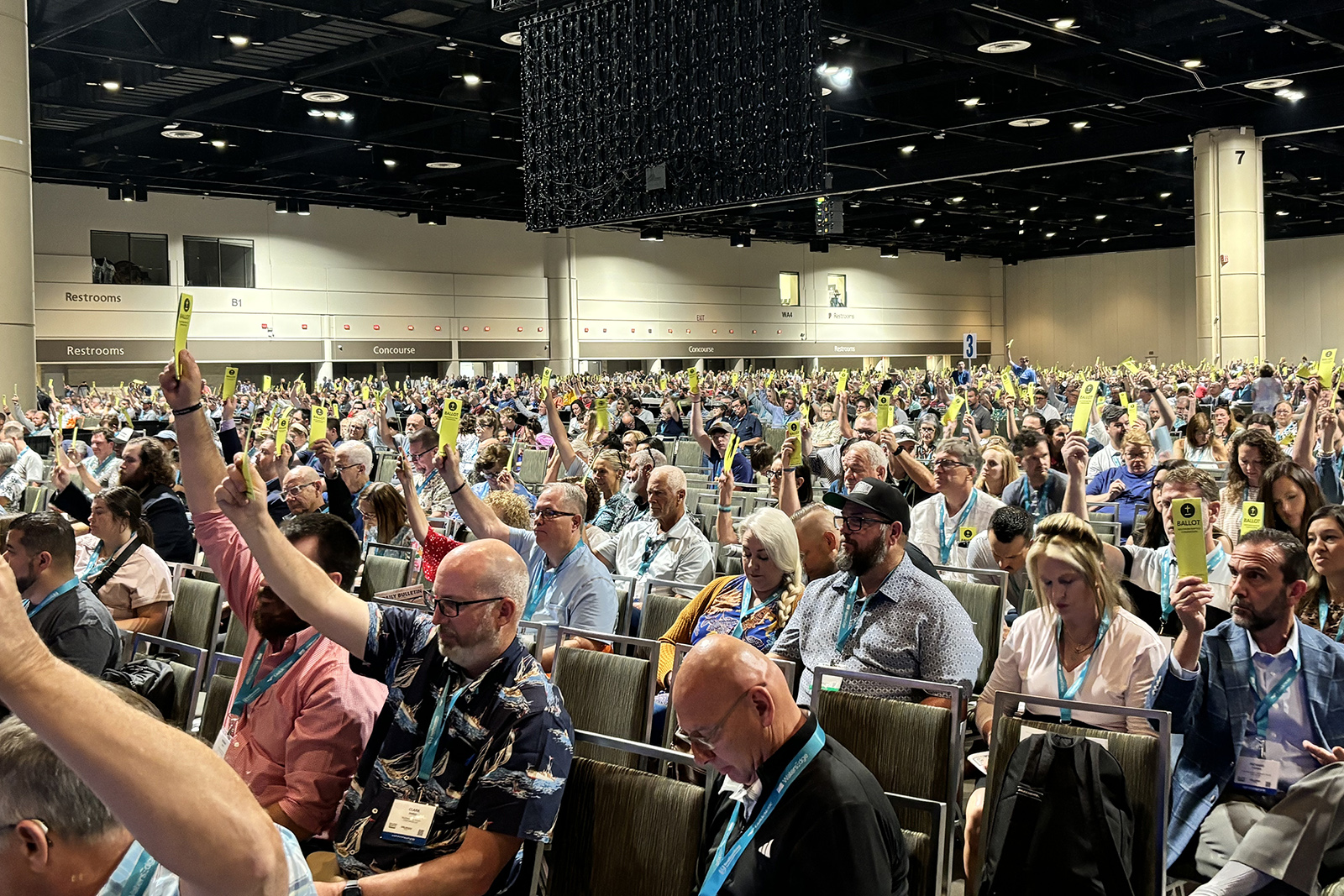
Attendees hold up their ballots while voting on a motion during the annual meeting of the Southern Baptist Convention, June 9, 2026, in Orlando, Fla. (AP Photo/Phelan M. Ebenhack)

Bob Smietana
June 23, 2026 
RNS

ORLANDO, Fla. (RNS) — In the first summer of this century, more than 11,000 Southern Baptists gathered in Florida to update their convention’s statement of faith by limiting the office of pastor to men only.

But that 2000 limit was not binding on local churches. Instead, it applied only to the denomination’s seminaries and mission boards.

“We don’t have the right, the authority or the power to limit anybody,” the Rev. Adrian Rogers, a famed Baptist preacher who chaired the committee that revamped the Baptist Faith and Message, told reporters at the time.

“We would resist that.”

Al Mohler, head of Southern Baptist Theological Seminary, agreed.

“We would never presume to tell another church whom they may call as a pastor or tell another person whether or not they may serve as pastor,” Mohler, who also had served on the committee, told Baptist Press, an official SBC publication, in 2000. “We’re not trying to force our beliefs on someone else.”

Some churches left the SBC and joined groups such as the Cooperative Baptist Fellowship, which allows women to serve as pastors. A few churches were expelled by their local association — including Glendale Baptist Church in Nashville, Tennessee, which was kicked out not because its pastor was a woman, but because she was gay.

But there was no national action to expel churches with women pastors.


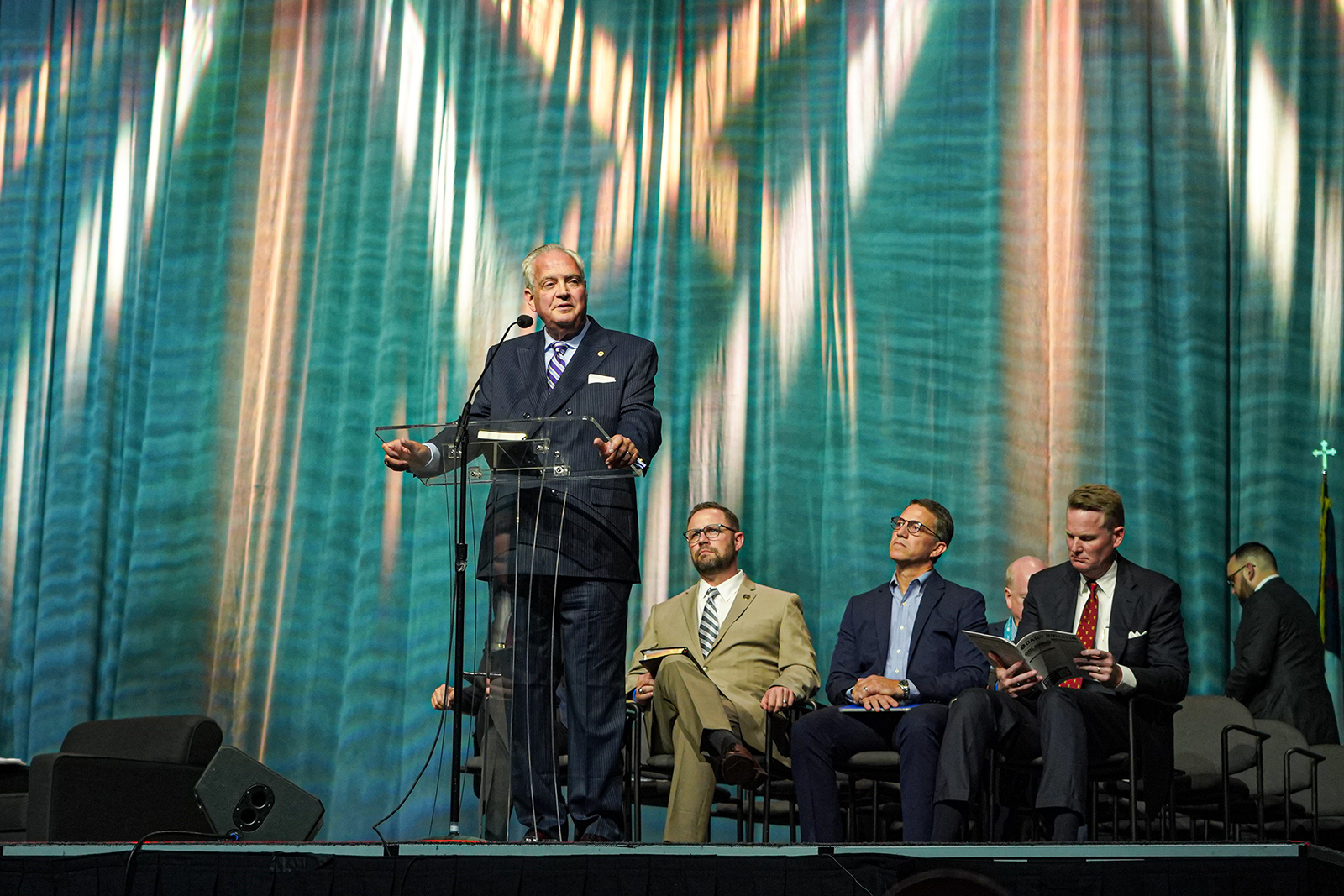
Al Mohler addresses the Southern Baptist Convention annual meeting, June 9, 2026, in Orlando. (RNS photo/Marty Jean-Louis)

For more than two decades, Mohler’s view was the status quo. While his seminary and other Baptist institutions taught that only men should be pastors, some churches believed the rule on male-only clergy applied just to the senior pastor. So they gave women in staff roles the title of pastor.

Then Mohler changed his mind and decided all women pastors had to go.

How and why that happened reveals a larger trend among conservative evangelicals and MAGA advocates, in which women are seen as threats to both the church and the country. It also reflects the way social media has transformed every local debate into a national controversy — and the way well-intentioned reforms can have unintended consequences.
RELATED: Southern Baptists pass a ban on women pastors again. This time, they hope it sticks.

During the recent SBC meeting in Orlando, Mohler claimed the Bible demanded that Southern Baptists make it clear women pastors were no longer welcome.

“There’s a great line that divides liberal and biblical evangelicalism, and you can see it on this very issue,” Mohler told thousands of local church representatives, known as messengers, gathered in a cavernous meeting hall at the Orange County Convention Center.

“The trajectory of liberal denominations is clear.”


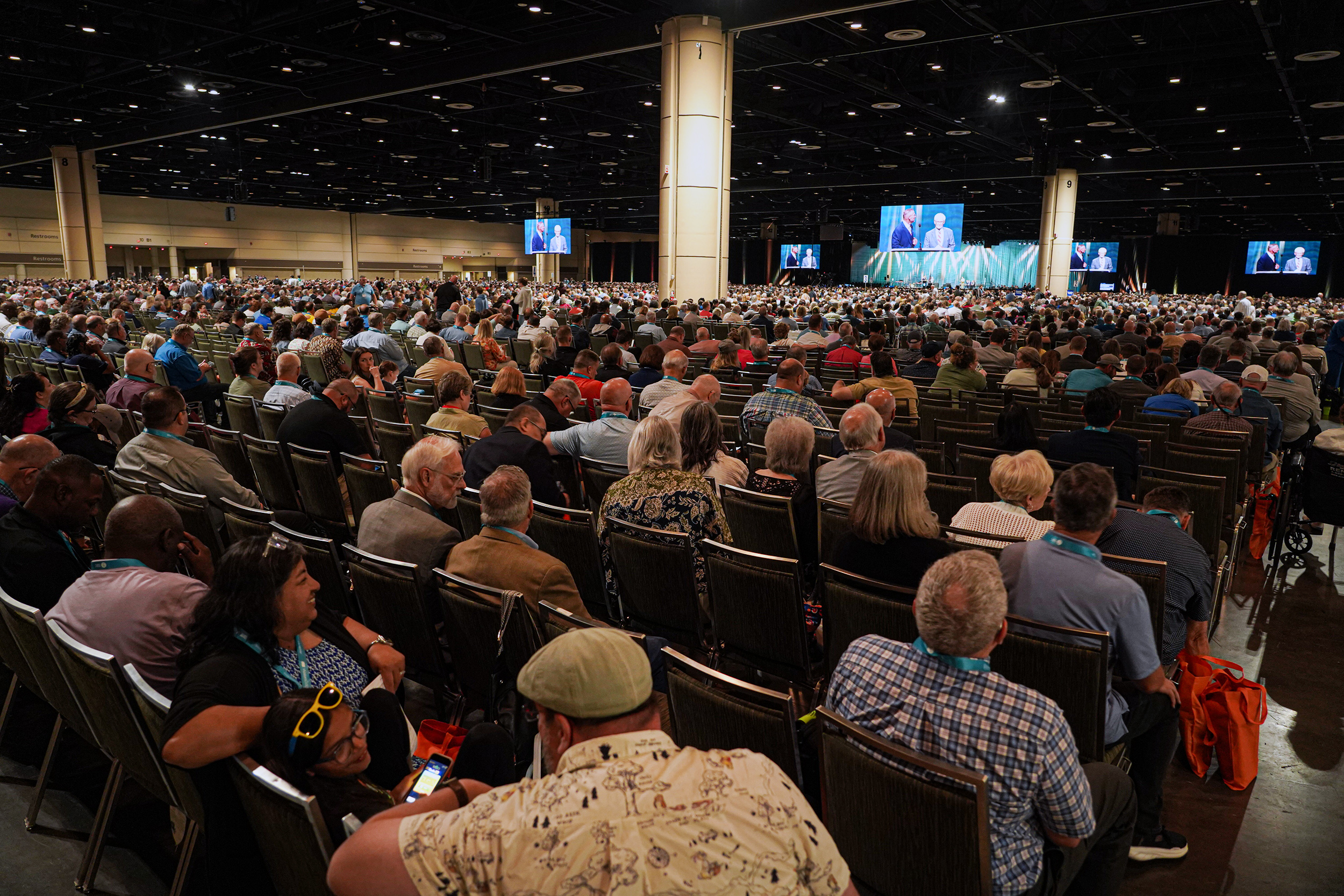
Thousands of messengers attend the Southern Baptist Convention annual meeting, June 9, 2026, in Orlando. (RNS photo/Marty Jean-Louis)

Mohler’s “Truth and Unity Amendment,” which would bar churches with women pastors — or churches that allow women to preach — was approved by three-quarters of the messengers at the SBC’s annual meeting in mid-June. If approved again next year at the SBC’s 2027 meeting in Indianapolis, the amendment would become part of the SBC’s constitution.

In an interview with reporters after the vote on the amendment, Mohler said he was unaware until a few years ago that there were still churches in the SBC that had women pastors. He’d assumed most had left during the SBC’s long-running civil war, known as the conservative resurgence.

Then, a social media post from Saddleback, a prominent megachurch, about ordaining some women staffers as pastors sparked an online controversy over the issue.

Those posts led to repeated attempts to expel churches like Saddleback, which was deemed not in “friendly cooperation” with the SBC in 2023.

“Social media and the digital revolution, where all of a sudden someone in one part of the SBC can find out what’s going on, or be presented with a social media feed, of something on the other side of the country, that’s a game changer,” Mohler told reporters.

Mohler is partly right.

Heidi Campbell, a professor of communication at Texas A&M University, said social media has made the internal workings of churches everybody’s business — not just the members of that church. And more people can weigh in on what should be done about it, said Campbell, who studies how digital media affects religious groups. That explains some of what happened in the SBC.


Messengers, or delegates, vote during the Southern Baptist Convention annual meeting, June 10, 2026, at the Orange County Convention Center in Orlando. (RNS photo/Bob Smietana)

“It makes something that would have been just behind closed doors into a huge media event,” Campbell said.

Still, it’s unclear exactly how many SBC churches have women pastors. In 2000, when the male-only limit was added to the SBC statement of faith, less than “one-tenth of one percent” of the denomination’s then 41,000 churches had a woman serving as senior pastor, according to a report in SBC Life, an official denominational publication.

Even in the Baptist denominations that allow female pastors, relatively few women serve as senior or co-pastors, ranging from about 10% of churches in the Cooperative Baptist Fellowship to about 1% of Texas Baptist congregations and 4% of churches in the Baptist General Conference of Virginia.

Mike Law, a Virginia pastor who has advocated for a ban on churches with women pastors, claimed in 2023 to have found 170 SBC churches where women hold the title of pastor. The SBC has more than 40,000 congregations.

But there’s more to the story.

The debate over whether any woman could hold the title of pastor, no matter what her responsibilities, came at a time when the SBC was trying to gain more control over local congregations.

In 2019, the SBC set up a permanent credentials committee to help determine if churches were in “friendly cooperation” with the denomination. That change made it easier for the SBC to vote out churches for issues like racism or sexual abuse.

But soon, Southern Baptists who disapprove of women pastors began to report churches like Saddleback to the committee. In 2023, Saddleback, whose pastor, Rick Warren, had been an evangelical celebrity for decades, was one of several churches expelled for having women pastors on staff.

The controversy over Saddleback also started during a time when Southern Baptists were reeling over a sex abuse scandal. The scandal threatened the power of male SBC leaders, said Meredith Stone, executive director of Baptist Women in Ministry.

“They became the face of the enemy to many people,” she said. “So, to get that off themselves, they needed to create a new enemy.”

Many of the advocates for reforms to prevent sexual abuse were women. Those women and women pastors became a convenient target, said Stone. And a tool meant to deal with racism and abuse was used to paint women pastors as a threat to the denomination.


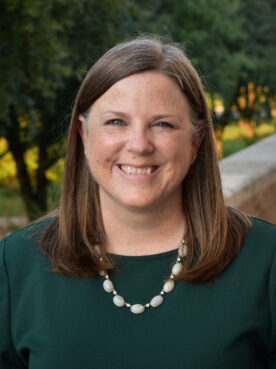
Meredith Stone. (Photo courtesy of Baptist Women in Ministry)

“It is unfathomable to think that women who are simply sharing the love and grace of Jesus Christ are an equal kind of threat to the ministry of the Southern Baptist Convention as racism and the perpetuation of sexual abuse,” said Stone.

Stone also worries that social media is being used to harass women who serve as pastors, rather than just as a tool for debate. Critics of women pastors have posted videos and photos of women preaching, calling for the pastors and their churches to be removed from the SBC, or in some cases contacting the pastor and their churches.

“It’s not just calling attention to things,” she said. “It has enabled harassment, which is harmful.”

The controversy over women pastors is coming at a time when the SBC is rethinking how to engage the outside world post-COVID and during the age of President Donald Trump.

Calvin University professor Kristin Kobes Du Mez, author of “Live, Laugh, Love,” a forthcoming book about Christian women, said that during the Obama era, Southern Baptists had tried showing a friendlier face to the outside world, more concerned about loving their neighbor than winning at politics.

Southern Baptist leaders also championed diversity and lifted up women as important to the church, even if they could not be pastors.

That more winsome approach is now out of style. Churches or leaders who are less than enthusiastic MAGA supporters are now viewed with suspicion. Diversity is seen as a liberal plot. Outspoken women are accused of being more feminist than Christian.


Kristin Du Mez. (Photo © Deborah K. Hoag)

Critics of sex abuse reforms, including Willy Rice, who was recently elected SBC president, began to claim that concerns about abuse in the SBC have been overblown and that feminists and activists had a political agenda to harm the SBC and its Nashville-based Executive Committee.

Rice has ties to a faction of MAGA activists and pastors who believe the SBC has become too “woke” or liberal in recent years and wants the denomination to become more aggressive in fighting the culture wars.

That faction, which also opposes women pastors, is part of a larger conservative Christian movement that views women with suspicion, said Du Mez. Some in the movement say women should have no authority in the church. Others say women should not be allowed to vote.

“What you’ll hear in these circles, not just in the SBC, but in the Christian right generally, and in the right more broadly, is that women are the problem here,” she said. “There’s a sense that if women had less power, then our country and our church would be more on track and more faithful.”

Ironically, the push to expel churches with women pastors comes at a time when women, who have long served as the backbone of congregations of all kinds, are losing faith in religion. That’s especially true of young women, according to national polling.

Baylor historian Beth Allison Barr, author of “The Making of Biblical Womanhood,” said she suspects that leaders in the SBC like Mohler fear their hold on power is slipping away, and so are doubling down on their theology to preserve their legacy.

“The whole Southern Baptist world has staked its entire identity on this issue of male-only leadership with the conservative resurgence,” she said. “For that to be questioned would undo everything that the conservative resurgence has been trying to accomplish.”
One Eye Squinted

Texas should ask not whether to require Bible reading in schools — but why

(RNS) — If the purpose is to teach students to read rich literary texts to better equip them to understand and appreciate literary and cultural traditions, then teaching key passages from the Bible is an excellent idea.

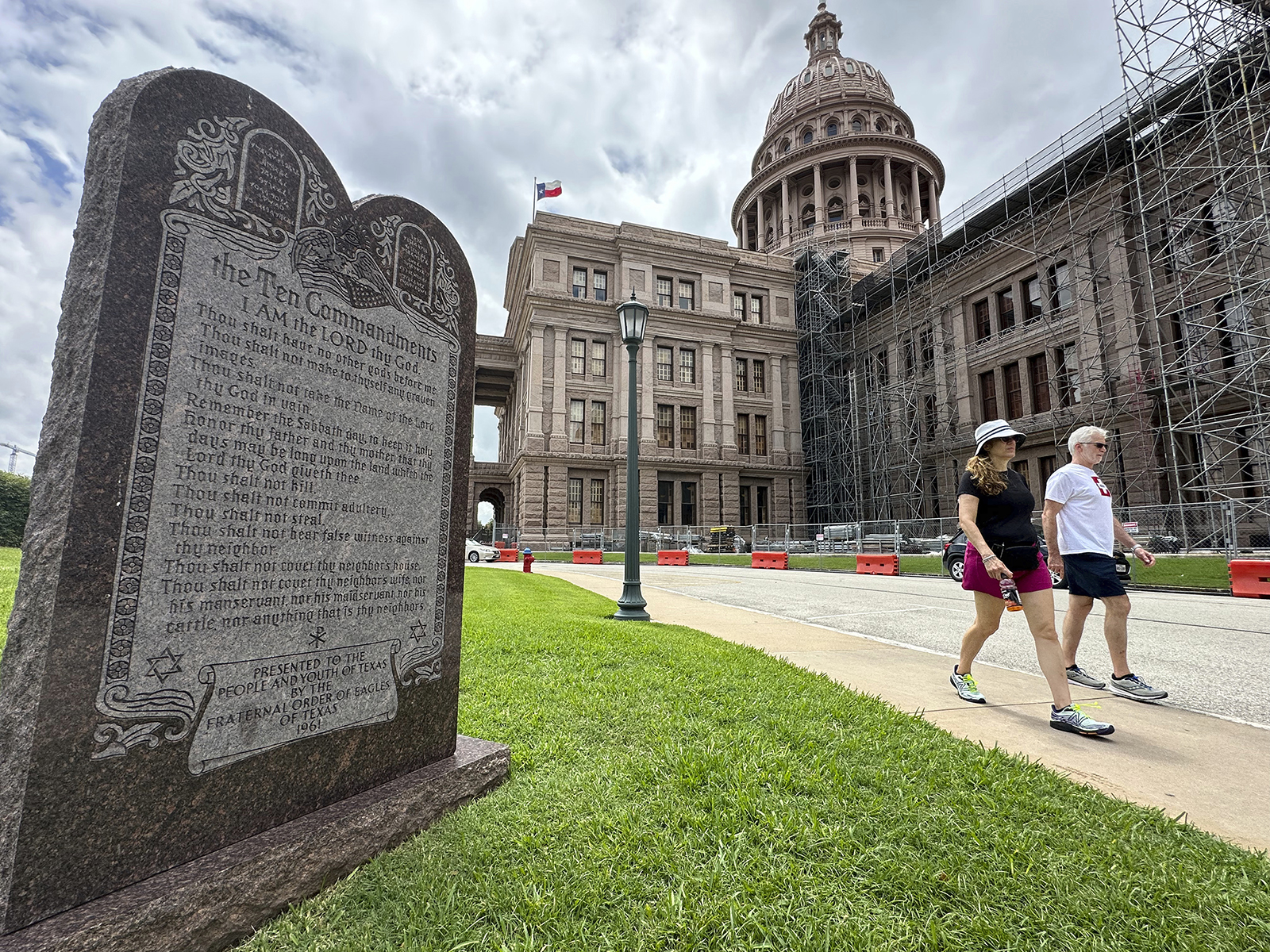
Visitors walk past a granite monument of the Ten Commandments outside the state Capitol, June 20, 2024, in Austin, Texas. (AP Photo/Paul Weber)

Karen Swallow Prior
July 1, 2026 

(RNS) — Last week, the Texas State Board of Education approved a mandatory reading list for its public schools. The change making the most headlines is the new curriculum requirement for Language Arts that includes Bible stories and passages from the Bible. Countless Christians (and others) are now weighing in on whether or not the Bible should be required reading in public schools given the pluralistic character of our nation.

Whether or not the Bible should be required reading in public schools isn’t the right question, however. Nor is it the most pressing one for Christians.

What texts are taught (and what ones are excluded) is an important matter, of course. So, too, is the separate matter of the qualifications of the teachers who teach the material. But a teacher who is qualified to teach Dr. Suess or Shakespeare is just as qualified (or not) to teach the Bible as literature.

Reading lists — whether such lists pertain to required, recommended or removed texts — are perennially controversial. Any core curriculum by its very nature creates a tension between two competing goods: cultivating a communal body of knowledge and giving freedom to teachers, classrooms and schools to teach most effectively in their own contexts. This tension exists in public schools, private schools and college classrooms. These questions are part of the bigger picture but still don’t point us to the more important questions.

The right question isn’t whether the Bible should be required, but why it is.

If the purpose is to teach students to read rich literary texts to better equip them to understand and appreciate literary and cultural traditions, then teaching key passages from the Bible is an excellent idea.

As many have rightly argued over the years, one can hardly understand world history and literature without a passing knowledge of it. Perhaps no one has expressed this truth more eloquently than novelist Marilynne Robinson did in her 2011 essay in The New York Times titled, “The Book of Books: What Literature Owes the Bible.” Robinson writes, “The Bible is the model for and subject of more art and thought than those of us who live within its influence, consciously or unconsciously, will ever know. Literatures are self-referential by nature, and even when references to Scripture in contemporary fiction and poetry are no more than ornamental or rhetorical — indeed, even when they are unintentional — they are still a natural consequence of the persistence of a powerful literary tradition.”

If this is the reason, then let the schools teach the Bible.

Also let them teach the Tao Te Ching. Let them teach Shakespeare and Dickens. Let them teach Frederick Douglass and Anne Bradstreet. Let them teach Judy Blume, S.E. Hinton, Alex Haley, Mark Twain and Toni Morrison. Let them teach Paulo Coelho, Ray Bradbury, Langston Hughes and Emily Dickinson. Let them teach as many great, good and fun literary texts as the school days allow. (On that point, I do wish the Texas Board of Education had left Margaret Thatcher and the Federalist Papers for the history and government curricula to leave more space in the language arts requirements.)

RELATED: Teaching Bible in public schools is not a good idea


If, however, the motivation for requiring the Bible in public school classrooms is something other than offering a sound education in literature, language and culture — if the motivation is something that is rooted in an attempt to elevate one religion over another or if it is merely a ham-fisted attempt to advance a Christian nationalist agenda — then Christians seeking to follow the way of Jesus ought to be wary.

The Bible is sacred. It is powerful, and its power is to be used in our own lives as Christians against our own sin and that of the church, not wielded against other citizens in wars of our own making.

From my vantage point, which is far from Texas and Texas politics, I don’t know what the motivation for the new requirement is. Ultimately, the fruit the new requirements bear will be telling.

This leads to the other matter that raises more important questions than whether or not readings from the Bible should be required in school. This is the matter of whether or not people can read at all.

Illiteracy in America is, according to some analysis, at a crisis point. Widely cited data shows that America is facing the highest rates of adult illiteracy in over 150 years. The National Literacy Institute reports the following:On average, 79% of U.S. adults nationwide are literate in 2024.
21% of adults in the U.S. are illiterate in 2024.
54% of adults have a literacy below a sixth-grade level (20% are below fifth-grade level).
Low levels of literacy cost the U.S. up to 2.2 trillion per year.

It’s important to note that the vast majority of illiterate adults in America (about two-thirds) were born here.

Why is illiteracy a Christian concern?

As Tony Kriz and Jeff Martin argue compellingly in their book, “Read: How God’s People Can Bring Justice through Literacy,” doing all we can to teach basic literacy is a way of loving our neighbors. The documentary film “Sentenced,” produced by the Children’s Literacy Project and a companion film to this book, conveys powerfully the profound and lasting effects of illiteracy not only on individual lives but on the rest of society. Illiteracy is linked to generational poverty, disproportionate rates of imprisonment, higher rates of teen pregnancy, under-education and under-employment. Human flourishing in the modern world requires literacy, and doing all we can to cultivate literacy is a powerful and far-reaching way to love our neighbors as ourselves.

For a longer view of what it means to live in a post-literate world, one need only read Neil Postman’s classic text, “Amusing Ourselves to Death: Public Discourse in the Age of Show Business.” Published nearly four decades ago, the book predicted what kind of culture we would have today because we were then and are still becoming a people who have ceased to read.

Because Christians are people of the Word, no one more than Christians should understand how crucial reading is to learn more about a God whose very name is “the Word” (John 1:1) and who reveals himself through his written and inspired word in part to help us understand his purpose for our lives.

Not only this, but Christians are by definition a people of hope. We can hope because we have read the end of the story.

This hope confirms one approach to illiteracy described in “America Is Sliding Toward Illiteracy,” published last year in the Atlantic. The article explains that decreased learning and increased illiteracy over the past 10 years or more are owed, in part, to lowered expectations: “In short, schools have demanded less and less from students — who have responded, predictably, by giving less and less.”

Requiring Bible readings alone isn’t an increase in expectations. But teaching students to read many rich literary texts well — in and of itself — just might be.


The Bible verses dividing Washington: How Matthew 25 became a political litmus test

(RNS) — 'He told me that Matthew 25 was about individuals, and not nations,' Sen. Raphael Warnock said, referring to Speaker Mike Johnson. 'The text actually says nations.' Warnock added: “It's a very narrow individualistic faith, and I think it has consequences for the kind of policy you end up with.”


FILE - Migrants seeking asylum line up while waiting to be processed after crossing the border Wednesday, June 5, 2024, near San Diego, Calif. (AP Photo/Eugene Garcia)

Jack Jenkins
July 1, 2026 
RNS

WASHINGTON (RNS) — When Sen. Raphael Warnock of Georgia walked into Speaker Mike Johnson’s office last month, the two men already held starkly different political views. By the time the meeting ended 30 minutes later, it was clear they also sit on different ends of the Christian spectrum.

Warnock, a Democrat and pastor of a prominent Black church, had raised questions in an interview with The New York Times a few days prior about whether the speaker’s Republican politics reflected his professed faith. The senator described himself as a “Matthew 25 Christian,” referring to a biblical passage that features Jesus telling his followers a parable in which “all the nations” are judged by how they care for the “least of these” — described as the hungry, the stranger and the imprisoned, among others. How, Warnock had told the Times, do you “say a long prayer, hold hands with your fellow legislators and then cut a trillion dollars out of Medicaid?”

In response, Johnson, a Southern Baptist from Louisiana, called for the confab and offered a diametrically opposing interpretation of Matthew 25.

“He told me that Matthew 25 was about individuals, and not nations,” Warnock told Religion News Service, referring to Johnson. “The text actually says nations.”

Warnock, a member of the Progressive National Baptist Convention who holds a Ph.D. in systematic theology and recently published a faith-themed book, added: “It’s a very narrow individualistic faith, and I think it has consequences for the kind of policy you end up with.”

The Johnson-Warnock meeting, which the Democrat has otherwise described as “respectful,” added to the brewing debate over Matthew 25 that has been building over the last year, pitting mainline pastors, Black protestants and the pope against evangelical politicians put on the defensive amid outspoken religious criticisms of President Donald Trump’s policies.


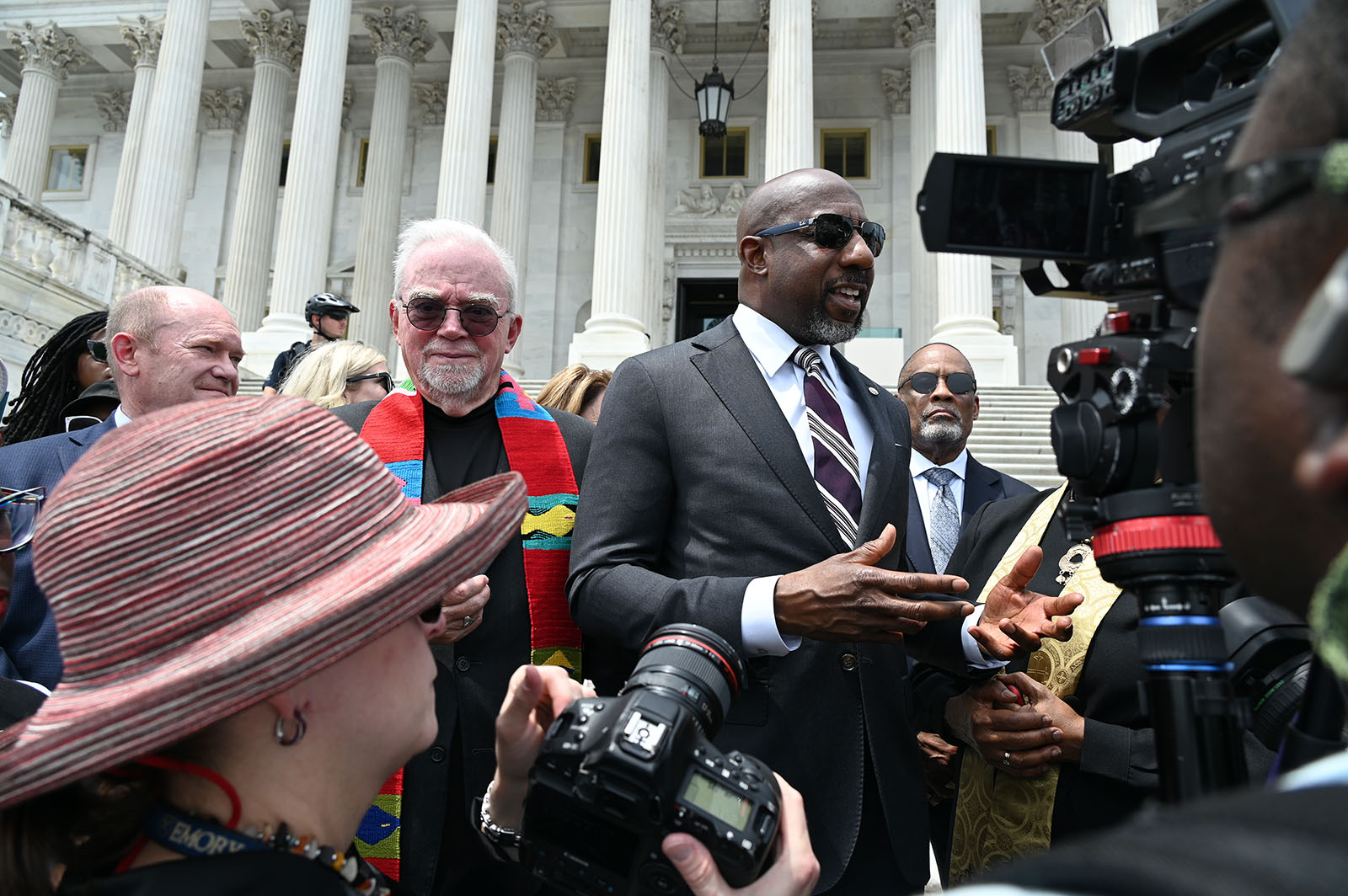
Sen. Raphael Warnock, center, speaks from the steps of the U.S. Capitol during a rally against the “One Big Beautiful Bill Act,” June 10, 2025. (RNS photo/Jack Jenkins)
RELATED: Warnock, declaring ‘spiritual crisis,’ urges public, private sectors to help meet needs

Matthew 25 itself is hardly unheard of among Democrats. Former Vice President Al Gore, former Transportation Secretary Pete Buttigieg and Rep. Alexandria Ocasio-Cortez have all publicly cited it in the past. But the passage received a moment of global recognition in November, when Pope Leo invoked Matthew 25 after he was asked by reporters about the president’s immigration policies.

The Bible, Leo quipped, “says very clearly: at the end of the world, we’re going to be asked, ‘how did you receive the foreigner?’”

When a reporter for Migrant Insider asked Johnson in February if he had any response to Leo, Johnson insisted Matthew 25 was directed at individuals, “not to the civil authorities,” and later published a lengthy post on X expanding on his reasoning.

The post proved divisive. It was celebrated by evangelical conservatives such as author Allie Beth Stuckey and Tony Perkins, head of the Family Research Council, while more than 40 Catholic Democrats in the House signed a letter that amounted to a theological rebuke of Johnson. The Rev. William Barber II, a prominent anti-poverty activist and Protestant, called for Johnson to participate in a public theological debate about immigration.

How Johnson, who has not attended seminary or pursued degrees in theology or biblical studies, arrived at his interpretation is not clear. Representatives for the speaker declined multiple requests for an interview on the topic, and his precise take on Matthew 25 does not appear to be universally held within the SBC, Johnson’s denomination. The SBC’s congregation-focused structure generally precludes uniformly conscripting specific Bible interpretations in a formalized way, and a spokesperson for the denomination deferred to the Ethics and Religious Liberty Commission, the group’s political arm. Asked about the passage, an ERLC spokesperson told RNS the group does not “have a position” on the interpretation of Matthew 25.


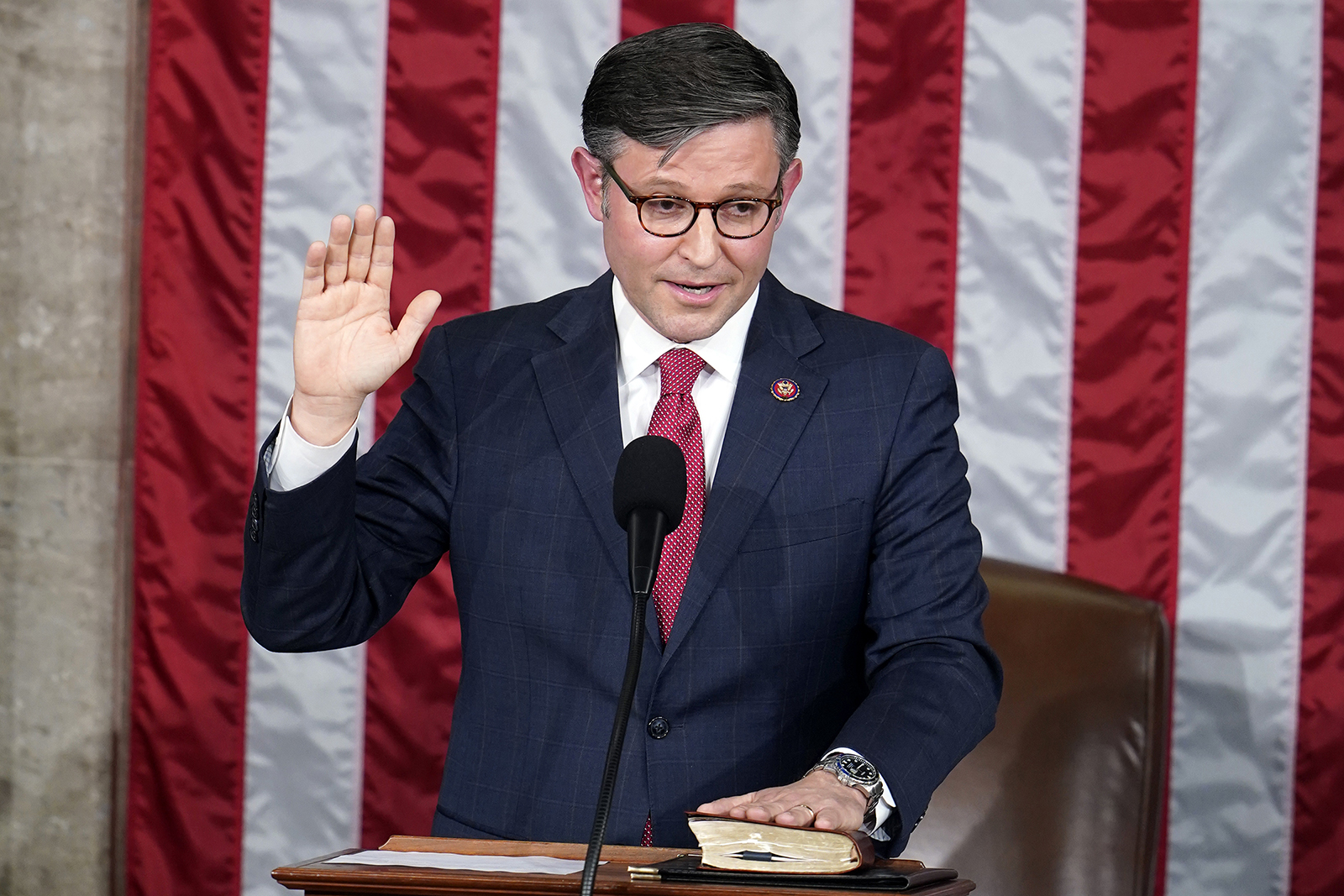
Rep. Mike Johnson, R-La., takes the oath to be the Speaker of the House at the Capitol in Washington, Wednesday, Oct. 25, 2023. (AP Photo/Alex Brandon)

But there have been many interpretations over time, and other evangelical thinkers have offered takes similar to Johnson’s, albeit with different twists. In an email to RNS, Pastor Robert Jeffress, a longtime Trump supporter and prominent Southern Baptist pastor in Texas, argued that, while there are “many passages in the Bible that encourage care for those who are unable to help themselves,” Matthew 25 “is not one of them.” Instead, he insisted the “least of these” is a reference to “a specific group of Jewish evangelists” mentioned in the Book of Revelation.

Judith Gundry, an evangelical scholar and New Testament professor at Yale Divinity School, told RNS in an email that there are Bible verses that urge followers of Jesus to aid the vulnerable. But mention of the “least of these, my brothers and sisters” in Matthew 25, she argued, is a reference to disciples who are “fleeing persecution.”

Gundry insisted her interpretation is “not peculiarly Evangelical,” and noted a biblical passage can have political implications regardless of how different scholars determine its context. But Heath Carter, a professor of American Christianity at Princeton Theological Seminary, said the broader debate over Matthew 25 may reflect “deeper, longer-standing divides” among U.S. Christians that date back at least a century.

On one side of the theological chasm, he said, are those who believe Christianity is “oriented around the salvation of individual souls” and that “the way that you change society is by changing every soul within it.” Their de facto opponents, however, hold that “inequality and social problems spring from structural or systemic roots” and argue that “part of what it means to be a faithful Christian in the modern world is to fight against inequality and its structural forms.”

Carter said Christian concern about broader structural issues surged in the aftermath of the Civil War and eventually culminated in a movement known as the social gospel, which became popular in the early 20th century. The social gospel, which stressed the threat of societal sin and the need to care for the poor, is credited with playing a role in the passage of the New Deal. Decades later, Civil Rights icon the Rev. Martin Luther King Jr. — whose pulpit at Ebenezer Baptist Church in Atlanta is now filled by Warnock — said he was a “profound advocator of the social gospel.”

However, even the social gospel movement did not fall neatly along religious lines.

“Back in that day, evangelicals were social gospelers in many cases,” said Carter, who authored the book “Union Made: Working People and the Rise of Social Christianity in Chicago.”


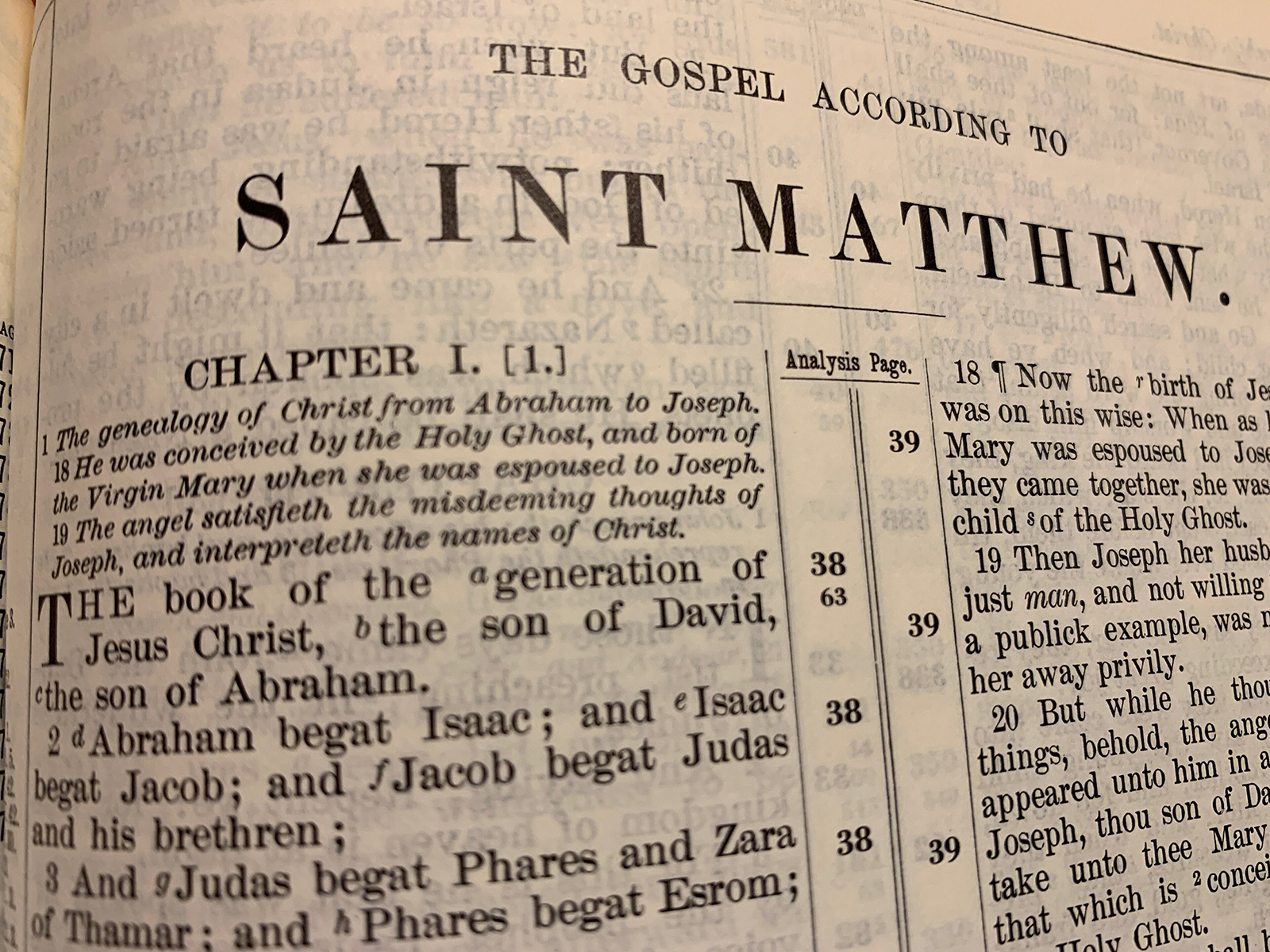
The Gospel of Matthew. (Photo by John Snyder/Wikimedia/Creative Commons)

Others see Johnson’s interpretation of Matthew 25 as evidence of Trump’s influence. “It’s just striking to see these interpretations that now completely exempt the actions of government from religious or even ethical obligation towards (the) less fortunate,” said John Compton, a Chapman University professor and author of the book “The End of Empathy: Why White Protestants Stopped Loving Their Neighbors.” “This idea that the individual should never act through government, or that the government should never be the vehicle for compassionate action toward others — I don’t think you really find that very much prior to the Trump years.”

Another example of Republican politicians challenging faith leaders on their interpretations of Matthew 25 came up in March. At a congressional hearing on the Department of Homeland Security’s Minnesota deportation efforts, the Rev. Mariah Tollgaard, a United Methodist minister in St. Paul, read a statement criticizing the president’s immigration policies and mentioned Matthew 25. In response, GOP Rep. Michael Cloud, a former communications director at an evangelical megachurch, brandished a Bible and argued that “Christ didn’t say” to “lobby your government,” that taxes are coercive and Christian “charity” is ultimately voluntary.

Cloud’s office didn’t respond to questions about his remarks, but Tollgaard, denied time to respond in the hearing, told RNS by email that the congressman’s framing “flattens” Scripture.

“In the Bible, God’s people are instructed to build structures of shared responsibility — laws about gleaning, Jubilee debt release, and care for the stranger — that are not optional but are understood as expressions of covenant love, what we might today call the common good,” she wrote. “And even if one wanted to argue that caring for those in need should be the work of individuals, in a representative democracy our government is precisely the means by which people, acting together, shoulder that responsibility.”

Tollgaard added: “Matthew 25 is not a bootstraps story about self‑optimization; it is Jesus’ stark reminder that God’s judgment is revealed in how a community treats those who are hungry, sick, strangers, or imprisoned.”

It is unclear whether Cloud, Johnson and other conservatives who read Scripture like they do will popularize their interpretations of Matthew 25. Warnock said he is not looking to get into a “back and forth Bible study” about Scripture because he is “not interested in living in a theocracy.”

But as a pastor, he felt an obligation to push back. Warnock still questions the faith of fellow lawmakers like Johnson who pray before passing legislation such as last year’s sweeping, GOP-led domestic policy megabill, which Warnock and others have argued will ultimately cost millions access to healthcare. It was an act, the Senator suggested, that ignores the Bible’s call to care for the poor.

“Religion just ends up being one tool in their political project,” Warnock said. “I don’t think it’s about the religion.”
Four key takeaways from Trump's Religious Liberty Commission Report


(RNS) — The advisory commission’s 224-page draft report includes some controversial recommendations.


The Religious Liberty Commission holds a hearing at the Museum of the Bible, April 13, 2026, in Washington, D.C. (Video screen grab)

David Katibah
June 30, 2026  
RNS


(RNS) — Almost immediately after the Trump administration’s Religious Liberty Commission released its draft 224-page report Friday (June 26), several faith and civic leaders responded with criticism.

“The report and the commission behind it fail to represent and uplift the importance of religious diversity and tolerance for all faiths in our country — not just a special, chosen few,” the Rev. Paul Brandeis Raushenbush, president and CEO of Interfaith Alliance, said in a statement.

The report is “not a blueprint for protecting religious freedom. It is a roadmap for expanding religious privilege,” said Secular Coalition for America Executive Director Steven Emmert in a statement.

The 12-member advisory commission, established by executive order in May 2025, is made up of 11 Christians, many of them allies of President Donald Trump, and one Orthodox Jew. Tasked with publishing a report on the history and state of religious liberty, the commission has held hearings in which witnesses and members spoke about religious intolerance and intimidation, primarily faced by Christians. Critics have long attacked the commission for being partisan and ignoring issues such as Islamophobia, and a lawsuit filed by groups representing interfaith, Muslim, Sikh and Hindu organizations that challenges the commission’s composition is pending.


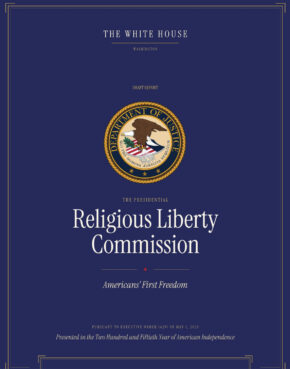
The Religious Liberty Commission’s draft report cover. (Courtesy image)

The report set forward dozens of legal and policy recommendations, including establishing a religious liberty violation hotline, forming a Department of Justice religious liberty task force, expanding funding for school choice and appointing judges with a proven commitment to religious liberty.


What follows below are some takeaways:

The commission argues there is a misunderstanding of separation of church and state. The report said that the “wall of separation of church and state” metaphor has been misapplied and weaponized to restrict religion’s place in public life. Noting that a wall of separation of church and state never appears in the Constitution, the report contends that religious liberty is the “bridge” between church and state. It recommends that the Department of Justice issue guidance clarifying that.

The Freedom From Religion Foundation was among organizations to raise an alarm, noting the First Amendment’s establishment clause bars passing any laws that favor one religion over another. “The Establishment Clause exists precisely because the government must remain neutral on matters of religion,” says FFRF Co-President Dan Barker in a statement.

The commission recommends repealing the Johnson Amendment, which forbids nonprofits, including houses of worship, from endorsing political candidates. The commission also recommended that the IRS issue guidance against enforcing the restrictions on “religious speech by houses of worship and faith-based non-profits” until it is repealed.

The report focuses mostly on perceived anti-Christian bias. Islamophobia is scarcely covered, despite the fact that a recent PRRI poll details a rise in Islamophobia. Buddhist, Zoroastrian, Baháʼí and Native American faiths also are not mentioned in the report. While the report acknowledges antisemitism, it defines it partially in terms of Zionism: Antisemitism, it says, is an “ideology that seeks to erase Jewish history and deny the Jewish people’s ancestral connection to the land of Israel.” The report also fails to discuss the rights or experiences of the religiously unaffiliated, who make up roughly a third of all Americans today.

The report does not discuss the pending religious freedom lawsuits filed by religious groups and leaders. More than 50 denominations, regional religious bodies and individual houses of worship have signed on to four separate lawsuits claiming the Trump administration violated their religious freedom by rescinding an internal government policy that discouraged immigration raids on houses of worship.

The draft report is open for public comment until July 12, after which the commission will hold a virtual public meeting to finalize the report. Information about the meeting will be posted on the commission’s website at least seven days prior to the meeting. Public comments can be emailed to RLC@usdoj.gov using the subject line, PUBLIC COMMENT – [TOPIC OR CHAPTER NUMBER] – [NAME]. The commission encourages respondents to refrain from using personally identifiable information in their comments.
Opinion

Ms. Rachel, Lady Zaynab and the power of empathy to fight injustice

(RNS) — While Ms. Rachel teaches through her songs that 'big feelings are OK,' she also demonstrates — like Lady Zaynab did — that women are the strongest leaders when they mobilize their grief and outrage, and love and compassion — toward meaningful action.


Ms. Rachel discusses being mad in an episode about emotions and feelings.
 (Video screen grab)


Zehra Kamani
June 29, 2026 
RNS

(RNS) — Lately, I’ve been watching a lot of Ms. Rachel and resonating with the messages she has been sharing with my 2-year-old son. “It’s OK to be mad … You can say it, ‘I’m so mad!'” she shares in her children’s YouTube series, “Songs for Littles.”

Mad is an understatement for many who are downright outraged at the state of injustice in the world and mass inaction by its leaders. While anger has provoked many to speak out in the wake of the genocide in Gaza, the unprovoked war on Iran and the flattening of Lebanon, Ms. Rachel has channeled her anger and raised her voice through an incredibly powerful skill: empathy.

Rachel Accurso is an American educator, entertainer and YouTube sensation who teaches young kids language skills and emotional development through musical videos. She has attributed her activism and ethical beliefs to her Christian faith. With an audience of over 20 million subscribers, she is also a staunch advocate for children’s rights and has been unapologetically vocal on social media, whether in speaking out against Israel’s violence and the starvation of the children of Gaza or condemning violence perpetrated by immigration enforcement agents against immigrant families and children.


While I watch her with pride as a fellow woman and mother, I can’t help but remember another powerful woman in history: Lady Zaynab, the granddaughter of Islam’s Prophet Muhammad (peace be upon him), and how she used both empathy and her voice to spark a revolution remembered to this day.

The tragedy of Karbala in 680 CE Iraq saw the brutal murder of Zaynab bint Ali’s brother, Husayn, and 72 other friends and family of the Prophet Muhammad (pbuh) — the youngest of whom was Husayn’s son, a 6-month-old baby, in their stand against the oppressive Umayyad leader, Yazid. The atrocities sanctioned by Yazid in Karbala included depriving children of water, murdering children and youth, mutilating bodies and imprisoning the surviving women and children under harsh conditions.


Zaynab oversaw the well-being of the survivors, taking on a role that required both strong leadership and empathy. She cared for the orphan children, provided emotional support to the widows and ensured everyone’s needs were taken care of as they moved forward without their loved ones — all while bearing the trauma of losing her own children.


Palestinian children receive donated food at a community kitchen in Nuseirat, in central Gaza Strip, Saturday, Jan. 24, 2026. (AP Photo/Abdel Kareem Hana)

Ms. Rachel’s consistent support for global humanitarian rights and the rights of children worldwide, particularly in Palestine — the world’s most dangerous place to be a child, according to aid groups — has drawn immense support from her fans. Her posts show her lovingly singing songs of comfort to children like Rahaf, a double-amputee as a result of violence in Gaza, and others detail the tragic stories of babies and young children being detained in U.S. immigration detention centers.


But despite receiving international praise, Ms. Rachel has also drawn her share of negative attention, and her intentions have been questioned, to the extent that she has been accused, without evidence, of being funded for spreading “Hamas-aligned propaganda” or acting as a foreign agent. She has faced these accusations despite also speaking out in support of Israeli children and the hostages taken during the Oct. 7, 2023, Hamas attack on Israel.

Accusations like these are an age-old tactic attempting to malign and discredit women’s efforts toward social justice. Take Viola Desmond, whom some referred to as a Canadian Rosa Parks, a Black woman who was convicted of a tax violation for sitting in the “whites only” section of a movie theater in 1940s Canada. After losing her legal case, she also lost her hair salon business and her marriage. She was pardoned only after her death, but is now celebrated as a visionary with her image on the Canadian $10 bill.

While feminist movements have helped create a path for women to take up space and use their voice and talents across the global stage, there has been much discussion on the ways that the feminism millennials grew up with has failed us. Millennial women particularly saw an era of “girlbossing (their) way out of oppression,” in the words of Buzzfeed News writer Shannon Keating, as if they needed to prove themselves in a patriarchal society.

Women were still left battling the dichotomy of soft versus strong within male-oriented systems. Often unappreciated for strengths like collaboration, flexibility and emotional intelligence, some have tried to push the scales in their favor by adopting the leadership skills found in their successful male counterparts. But those women were criticized for being overbearing and unlikeable.

But soft skills are now making a comeback with the changing dynamics of post-pandemic work-life balance, the upsurge in remote work opportunities and the rise in artificial intelligence shedding light on the need for real-world human interaction. These changing dynamics call on us to re-conceptualize what a successful human, regardless of gender, looks like.

Jacinda Ardern, former New Zealand prime minister, is another prime example of someone who has skillfully combined decisive action with empathic leadership. In the wake of the Christchurch mosque shooting in 2019, she demonstrated what it looks like to be a “soft and strong” leader. She passed strict gun control laws while appropriately comforting the nation’s — and the world’s — Muslim communities.

The attention and praise that women like Ms. Rachel and Ardern garner have little to do with their financial success — although they’ve achieved that as well — and a lot to do with their reserves of compassion and humanity. Last year, in a viral social media post, Ms. Rachel condemned the world’s leaders for their silence and for putting their greed for money and career success ahead of human life.

Lady Zaynab hailed from a milieu of feminism when Arabian women were, just years prior, granted the right to vote under Islam. She was the granddaughter of Lady Khadijah, an immensely wealthy and independent businesswoman who used her resources to feed and protect the Muslim community during Islam’s early years of political and social strife.

Zaynab was famously known for speaking out publicly against Yazid and addressing him directly within his court. Despite her vulnerability, she felt neither ashamed nor intimidated when challenging the tyrant in an audience of his supporters, among whom the propaganda against herself and her family prevailed.

Like Ms. Rachel, Viola Desmond and so many other strong female leaders, Zaynab was criticized. Her reputation and that of her family was questioned. She was dismissed as a mere grief-stricken, emotional woman who was no longer afforded the same rights and dignity that her grandfather Muhammad (pbuh) previously established. And yet her words struck a chord, stirring the empathy of others as they listened to the horrific narrations of injustices perpetrated by Yazid, planting the seeds of a revolution that ultimately saw Yazid’s demise.

Ms. Rachel is a modern reminder of the example that Zaynab presented to us centuries ago — the power of a woman’s empathy together with her voice.

As a former music teacher who began creating music and making videos to help teach her son with speech delays, the origins of Ms. Rachel’s fame stem from compassion and love for children. Her mission from the outset has been to help children thrive, no matter their geographical, cultural or social background. While she teaches through her songs that “it’s OK to be mad” and “big feelings are OK,” she also demonstrates, like Zaynab did, that women are the strongest leaders when they mobilize their big feelings — their grief and outrage, and love and compassion — toward meaningful action.

Ms. Rachel’s voice singing songs of joy and hope, complete with her iconic pink hairband and overalls, are perhaps the modern-day image of an empowered woman— one that Lady Zaynab embodied in her own era — one who is proud to draw upon her empathy while utilizing the platform, resources and influence she has worked hard to acquire to address what truly matters.

(Zehra Kamani is a Toronto-based freelance writer with a background in research. Her website is zehrakamani.com. The views expressed in this commentary do not necessarily reflect those of Religion News Service.)

Walking the tightrope under siege: Cuba’s reforms and the defence of socialist sovereignty

CDR graphic

First published at Canadian Dimension.

The announcement of Cuba’s new package of economic transformations has generated intense debate both within Cuba and among supporters of the Revolution internationally. Some have expressed concern that aspects of the reforms represent a retreat toward capitalism, a weakening of socialist principles, or even a concession to the relentless pressure of US imperialism. Such concerns should not be dismissed. They arise from a genuine commitment to the principles that have defined the Cuban Revolution and an understandable apprehension about the dangers that accompany any expansion of market mechanisms.

Yet the starting point for any serious analysis must be reality. Cuba confronts one of the most severe economic crises in its contemporary history. This crisis is not the product of abstract policy failures alone, nor can it be understood apart from the unprecedented escalation of the US economic war against the island. Washington’s objective remains unchanged: to create such hardship, deprivation, and social dislocation that the Cuban people abandon their revolutionary project and surrender their sovereignty.

For more than six decades, successive US administrations have sought to achieve through economic warfare what they could not accomplish through invasion, sabotage, terrorism, diplomatic isolation, or political subversion: the destruction of the Cuban Revolution. The current phase of that assault has reached extraordinary levels. Cuba faces financial persecution, restrictions on fuel imports, obstacles to international banking transactions, sanctions against foreign investors, and a campaign explicitly designed to suffocate the country’s economy.

Under such circumstances, the Cuban revolutionary leadership could not simply stand still. To do nothing would itself have been a decision—a decision carrying potentially devastating consequences for the Cuban people and for the survival of the Revolution. As Cuban economists and policymakers have repeatedly noted, many of the measures now being implemented have been debated for decades. Indeed, part of the current crisis stems from reforms that were delayed, only partially implemented, or obstructed by institutional inertia. The cost of inaction has been enormous.

The question therefore is not whether changes were necessary. They were. The real question is what kind of changes are being implemented, under whose authority, and for what purpose.

Some critics view measures such as expanded foreign investment, modifications to foreign trade arrangements, greater flexibility for state enterprises, and new forms of financing as evidence of capitalist restoration. Such conclusions are premature and often misunderstand the central issue confronting socialist societies.

Socialism has never been built under ideal conditions. Neither Marx nor Engels imagined that socialist construction would occur in a small developing country subjected to permanent siege by the world’s most powerful imperial state. Every socialist revolution has been forced to navigate contradictions, shortages, external threats, and difficult compromises. The history of revolutionary movements is not the history of advancing under perfect conditions; it is the history of defending emancipatory projects under hostile conditions.

Lenin confronted precisely this reality in 1921. After years of civil war, foreign intervention, economic collapse, and devastation, Soviet Russia introduced the New Economic Policy (NEP). The NEP permitted limited private enterprise, market exchange, and concessions to foreign capital. It was fiercely debated within the revolutionary movement. Yet Lenin insisted that the decisive issue was not the existence of market mechanisms in isolation, but which class held political power and whether the socialist state retained command over the strategic direction of society.

The NEP was not viewed as a surrender. It was understood as a strategic retreat designed to preserve revolutionary power, rebuild productive capacity, and gain time under extremely unfavourable conditions.

History never repeats itself mechanically, and Cuba is not Soviet Russia. Nevertheless, the comparison is instructive. Revolutionary governments occasionally face circumstances in which tactical flexibility becomes necessary to preserve strategic objectives.

The decisive question remains: who controls the state? The Cuban Revolution has not relinquished political power to domestic capitalists, foreign corporations, or international financial institutions. Cuba remains a sovereign state governed by institutions created through the revolutionary process. The Communist Party remains in leadership. The state retains control over the commanding heights of the economy. National independence remains non-negotiable.

This distinction is crucial. The issue is not whether market mechanisms exist. Markets exist in varying forms in virtually every society. The decisive question is for whom the social product is generated and how the social surplus is utilized.

Is wealth produced for private accumulation by a narrow elite? Or is it directed toward national development, social welfare, public health, education, scientific advancement, food security, and collective wellbeing?

That is the central dividing line between socialist-oriented development and capitalist restoration. Those worried about the weakening of the state monopoly on foreign trade raise legitimate concerns. History demonstrates that openings to market forces can generate inequalities and social pressures. Similarly, proposals involving greater participation of foreign investment and changes in enterprise structures deserve careful scrutiny.

There are real dangers. No serious revolutionary should deny them. There is the danger of growing inequalities. There is the danger of bureaucratic distortions. There is the danger of the emergence of privileged sectors. There is the danger that market incentives, if left unchecked, could gradually reshape social relations in ways inconsistent with socialist objectives.

But dangers alone cannot determine policy. The alternative to confronting these risks is not some idealized preservation of a previous status quo. The alternative may well be deepening economic collapse, worsening shortages, increased emigration, deterioration of public services, and the weakening of the material foundations upon which the Revolution rests. The challenge is therefore not to avoid all risk — a practical impossibility — but to manage those risks while preserving revolutionary power.

In this regard, an important aspect of the current debate concerns alternatives that deepen worker participation, cooperative development, community control, and democratic forms of economic management. These discussions deserve serious attention. Cuba’s future need not be reduced to a choice between bureaucratic centralization and private capital accumulation. Expanding the role of workers, cooperatives, municipalities, and communities in economic decision-making remains an essential component of socialist renewal.

Indeed, the debate itself demonstrates an often-overlooked reality: Cuba continues to grapple openly with fundamental questions about the direction of its development. The Revolution has never claimed infallibility. Cuban leaders have repeatedly acknowledged errors, shortcomings, delays, and bureaucratic obstacles. The current reforms emerge not from ideological conversion to capitalism but from a recognition that existing mechanisms have proven insufficient under present conditions.

Ultimately, however, the principal contradiction remains external. The greatest threat to Cuban socialism is not the ongoing debate among revolutionaries about economic policy. The greatest threat remains the unrelenting campaign by Washington — including the real possibility of military aggression — to force Cuba into submission. This is why international solidarity remains indispensable.

Those outside Cuba have every right — and indeed a responsibility — to discuss, debate, and critically evaluate developments on the island. But such discussions must begin from an unequivocal defence of Cuba’s right to determine its own future free from imperial coercion.

The Cuban people alone have the right to decide how their society evolves. Not Washington. Not Wall Street. Not the architects of blockade and economic warfare.

The irony is that many of those demanding a return to capitalism for Cuba preside over capitalist societies increasingly incapable of delivering security, equality, or hope for future generations. Across the capitalist world, growing numbers of people face declining living standards, mounting insecurity, precarious employment, and diminishing prospects for their children. The promise and illusion that capitalism would provide prosperity for all has become increasingly difficult to sustain even in its historic centres.

Against this backdrop, Cuba’s struggle remains what it has always been: the effort to preserve national sovereignty and social justice under extraordinarily hostile conditions. The current measures should therefore be understood neither as a capitulation nor as an abandonment of socialist aspirations. They are better understood as an attempt — whether ultimately successful or not — to navigate a perilous moment in defence of a revolutionary project that continues to face the concentrated hostility of the most powerful empire in history.

The debate over the reforms will continue. It should. But the first question must never be forgotten: what would happen if Cuba did nothing? The Revolution was never confronted with a choice between an ideal socialism and imperfect reforms. It was confronted with the challenge of defending socialist sovereignty amid economic siege.

That reality imposes urgent and necessary changes. The task now is to ensure that those changes strengthen rather than weaken the Revolution’s foundational commitment: a sovereign nation in which the wealth produced by society serves the many rather than the few, national development rather than foreign domination, and human needs rather than private profit.

Isaac Saney is a professor in the Department of History at Dalhousie University and a specialist in Cuba and Black Studies. He is also a member of the executive of the Canadian Network on Cuba.

Cuba: History and inventory

FB graphic

First published in Spanish at La Cosa. Translation by LINKS International Journal of Socialist Renewal.

History is one thing; an inventory is another. If 1959 was history, 2026 seems like an inventory. The package of 176 measures across 23 areas presented to the National Assembly on June 18 represents the most significant market-oriented reform since 1959. More than 148 legal provisions are affected, leaving almost no sector of the economy untouched.

Many of these measures have been demanded by a broad spectrum of people for a long time, including: decentralisation, ending the dual currency system, small-scale land ownership, markets, and municipal autonomy. What follows is not an argument against them, but an examination of their impacts.

First, a simple textual analysis of the document, presented as a “sovereign exercise to preserve the Revolution’s achievements without renouncing socialism.”

The word “worker” does not appear in the document’s 23 key sections. “Trade union” appears once, solely to cap wages at a company’s “economic and financial capacity.” “Socialism” is relegated to rhetoric; in the technical measures, it survives as a label, “Socialist State Enterprise”, which the document orders be “transformed … into a joint-stock company.” The signifier remains, but the significate changes.

The significate taking its place has a name, though it is not used in the document: structural adjustment, albeit a heterodox one. Its key measures — price liberalisation, private banking, VAT [Value Added Tax], successive devaluations accompanied by liquidating companies that “cannot withstand” the adjustment, eliminating universal subsidies and unrestricted openness to foreign investment — are normally recommended by global financial institutions’ stabilisation programs.

The stated difference lies in the pace and nominal retention of state ownership over “fundamental” sectors, a category the document does not define. It does, however, define the mechanism for their transfer: separating ownership (which remains “social”) from management (which becomes “non-state”). In practice, this is similar to how China and Vietnam enabled private accumulation within formal public structures.

“Market” appears about 20 times. Beyond the finer detail, the social safeguards accompanying it — a fund started with “a portion” of the savings from scrapping subsidies, social responsibility delegated to the private sector, and three-to-six months’ wages severance pay — present, once again, a sequencing problem: scrapping energy and transport subsidies will trigger immediate inflation, eroding the Fund before it even becomes operational.

There are three hypothetical paths from here.

The first is a “renewal” of socialism, ideally with workers’ control, as demanded by Marxist left sectors. In the 1970s and ’80s, Cuba achieved health and education indicators far above its income level. It sent troops to Angola and Cuito Cuanavale, helping militarily defeat Apartheid. [South African anti-Apartheid leader] Nelson Mandela said “the decisive defeat of the aggressive apartheid forces [in Angola] destroyed the myth of the invincibility of the white oppressor”, travelling to the island in 1991 to express his gratitude in person. This is part of Cuban socialism’s legacy; workers’ control in Cuba, however, is a fantasy.

The left had a real working-class base before 1959: anarcho-syndicalism dominated the labour movement until the 1920s; Communists, Trotskyists and the PSP [Popular Socialist Party] later supported trade unions and strikes. After the 1960s, state socialism triumphed — with top-down planning, centralised power, and limited self-organisation. When the party hierarchy reorganises rather than collapses, workers’ control is not the outcome; instead, administrative power is converted into ownership.

The second possible path is a negotiated transition from above: regime elites negotiating with economic groups that have emerged under their wing, with a gradual opening rather than a rupture. Other post-Communist transitions show that the model’s limits is that without political reform, the opening inevitably stalls or is reversed.

Cuba also has a specific flaw that often accompanies these processes: corruption. Former Deputy Prime Minister and Minister of the Economy Alejandro Gil Fernández was dismissed in February 2024 for “serious errors”. He was investigated for espionage, embezzlement, bribery, money laundering and influence peddling. With leaks of this magnitude, the question is not whether the pact will hold, but on which side loyalties lie.

The third hypothetical scenario is transitioning towards subordination to Washington. Cuba is not Venezuela — it does not as much oil nor comparable armed forces — but the blockade, the cutting off of fuel imports since January, the US charges against Raúl Castro and sanctions on Gaesa [a Cuban conglomerate owned by the Cuban Revolutionary Armed Forces] means the US is pushing Cuba towards subordination.

Venezuela provided the blueprint: regime change did not improve wages or resolve the electricity crisis; instead, the immediate changes were to laws, with hydrocarbon and mining reforms opening them up to foreign capital — formalising an “economy of plunder and dispossession,” according to sociologist Emiliano Terán Mantovani. Gaesa, Cuba’s ports and nickel are the Cuban hub of this hemispheric operation.

The three paths share a common foundation: the document creates the conditions for private economic actors with their own interests, whose representation the one-party system cannot accommodate without transforming itself. The implicit pact is a developmental authoritarianism — economic freedom in exchange for political obedience.

Cuba President Miguel Díaz-Canel said as much, perhaps unintentionally: “Without wealth, there is nothing to distribute … If there is no wealth, there is no social justice, and everything else is a fairy tale.” Subordinating social justice to wealth production has been a liberal capitalist tenet for two centuries. That this is presented as the foundation of Cuban socialism in 2026 is not a contradiction in discourse; it runs right through the document.

Behind these scenarios lies an older problem: a democratic political economy demands two things Cuba has failed to combine: political inclusion and the state’s real capacity to accumulate wealth in order to distribute social rights. Cuba has tried three different ways of failing on both counts in its past three constitutions.

The 1940 Constitution promised social democracy without a state capable of delivering it: of the 70 complementary laws enacted, only 10 were passed in a decade. It fostered political inclusion but not the promised effective redistribution (the 1952 coup also stifled that possibility).

The 1976 Constitution built up distributive capacities — health, education, social security — but on the basis of the single party as the “supreme leading force”: it generated redistribution but institutionalised political exclusion. Although it was announced in 2018 that PCC [Cuban Communist Party] membership would no longer be a prerequisite for holding political office, the party and its youth wing account for 14% of the electoral roll but 95% of MPs.

The 2019 Constitution recognised private property and the market without the political rights to make decisions on these, without effective tax mechanisms to tie them to redistribution, and without an accumulation model — involving state-owned and private enterprises as well as foreign investment — capable of converting them into a source of social rights. More than five years after it came into effect, Cuban courts still do not recognise its direct legal force — “exactly as happened with its predecessor,” according to José Walter Mondelo García and Julio César Guanche Zaldívar — with only two of more than 140 applications filed for constitutional protection being accepted for consideration.

Today’s expanding market does not redistribute: it concentrates. In the first quarter of 2021, more than half of all state investment went into tourism and property, but barely 1% to innovation. The reform document makes no mention of poverty or inequality: it calls them “multidimensional vulnerability” and delegates their resolution to economic actors — both state and private — “as part of their social responsibility at the community level.”

This exclusion is compounded by others. Unpaid care work continues to fall disproportionately on women: almost one in two Cuban women of working age are outside the formal labour force, and although there are more women with university degrees, they have less economic autonomy and are under-represented in better-paid sectors. The 23 pillars say nothing about this; they delegate it, like other social safeguards, as a voluntary responsibility of businesses and communities.

Racial stratification persists in wealth, symbolic recognition and institutional power. Given Cuba’s migration history, the diaspora of remittances and capital for new private businesses is disproportionately white. An open market that fails to address these exclusions does not redistribute wealth: it simply adds layers to existing inequality.

None of this is occurring in isolation. The world in which Cuba is negotiating its opening is one where neo-fascism is becoming institutionalised through elected governments, racism is again state policy and extreme inequality is celebrated as a merit. Cuba is part of this landscape, not its centre. Neither is its socialism the redeeming exception it is sometimes portrayed as, nor could its eventual recolonisation be considered separately to what is occurring to much of Latin America.

The reforms are long overdue. The window of opportunity that Cuban socialism enjoyed after 1959 was squandered through procrastination, stagnation and persecution of all independent organisations. [The crackdown on protests on] July 11, 2021, confirmed that many Cubans see the revolution’s social contract as broken. Society reached this point disempowered, without its own political organisation and unable to endure more hardship.

The suffocating situation is reflected in other figures: infant mortality rose from 4.0 to 9.9 per thousand live births between 2018–25; childhood cancer survival rates fell from 85% to 65% due to a lack of cytostatic drugs; more than 12,000 children are awaiting surgery without supplies; and more than half of essential medicines are in short supply. This suffering, with its own history and exacerbated by Washington’s “maximum pressure”, is the raw material with which more than one scenario is being negotiated — pain turned into a geopolitical bargaining chip.

These scenarios may be hypothetical. But the crisis’ tragedy, its exploitation for self-interest and the Cuban people’s inability to influence its outcome are not.